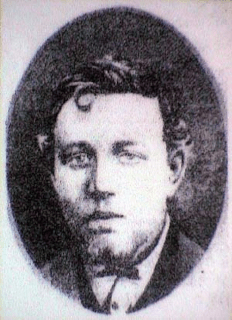
Casey is born to a teacher during the height of the Great Famine of 1846. Eight years later he moves to Gurteen, near Ballymahon in County Longford, when his father is given the post of headmaster at the local school. His work would come to be closely associated with Ballymahon.
As a teenager Casey works as an assistant to his father and is expected to follow him into teaching. However, he is disillusioned by the insufficiently nationalistic nature of the curriculum and spends a great deal of time writing poetry. It is at this time, reputedly at the age of fifteen, that he writes his best-known song, “The Rising of the Moon,” which commemorates the Irish Rebellion of 1798.
Following the increasing popularity of his songs and ballads at nationalist gatherings, Casey moves to Dublin in the 1860s and becomes active in the Fenian movement. He is a major contributor to The Nation newspaper, for which he assumes his pen name of ‘Leo.’
In 1866, at the age of 20, Casey publishes a collection of poems, entitled A Wreath of Shamrocks. Most of the poems therein had already been published elsewhere, primarily in The Nation. The further fame engendered by the success of the book leads him to be sought after as a speaker. He addresses mass rallies in Dublin, Liverpool and London that year, in the lead up to the Fenian Rising in 1867.
When the uprising fails, Casey is imprisoned without trial for eight months in Mountjoy Prison. He is released on the understanding that he would leave for Australia and not return to Ireland. However, he chooses to stay on in Summerhill, Dublin in disguise, living as a Quaker and continuing to write and publish in secret.
Casey marries Mary Josephine Briscoe in January 1868 and they have a son Michael, who dies shortly after birth in October 1869. Casey’s health had been broken by the treatment he had received in prison. He falls from a cab on or near O’Connell Bridge in the centre of Dublin in 1870. He dies from his injuries on St. Patrick’s Day, March 17, 1870.
Following his death, Casey is buried in Glasnevin Cemetery. The newspapers report that between fifty and one hundred thousand mourners walk in his funeral procession.
Byrne joins the Society of the United Irishmen in the spring of 1797 and later that same year is appointed by the Leinster committee to organise the half barony of Rathdown. As a delegate for Rathdown barony, he is a well respected and competent figure. With the assistance of his Protestant friend Thomas Miller of Powerscourt, he undertakes the organisation of military and civil branches of the United Irishmen in Rathdown, recruiting 2,000 men by late 1797. In October 1797 he is forced to resign from the yeomen after refusing to swear the oath of loyalty and his activities begin to come to the attention of Dublin Castle.
According to the informant A.B. (Thomas Murray), Byrne attends the inaugural meeting of the United Irishmen’s Wicklow county committee in December. It is held in the Annacurra home of William’s first cousin, John Loftus. Murray’s information tells that Byrne established networks of contacts between the Leinster committee and the Cork United Irishmen along with other contacts in Munster.
Byrne’s career comes to an end when he, along with fourteen other Leinster delegates, are arrested on March 12, 1798 at the house of Oliver Bond. They had been betrayed by Thomas Reynolds, treasurer of Kildare United Irishmen and member of the provincial committee. Reynolds had been informed that plans for an insurrection were about to be finalised by the committee. Byrne is arrested in possession of incriminating documents which are described by Attorney-General for IrelandArthur Wolfe as being ‘very treasonable printed papers.’
On July 4, 1798 Byrne with four others is brought before a commission of oyer and terminer on charges of high treason. The case mounted by the state against him is based principally on the evidence of Reynolds and also that given by his former comrade William Miller of Powerscourt. The weight of the evidence is overwhelming, rendering an effective defence impossible.
Byrne’s lawyer, John Philpot Curran KC, the leading defence counsel of the period, attempts to cast Reynold’s character and motives in a foul light but it is futile. In his last days, efforts are made to spare his life if he would only express regret for his actions and accuse Lord Edward FitzGerald for having led him to this point. He refuses, meeting his end with great dignity and stoicism.
Byrne is convicted of high treason and executed on July 25, 1798 outside Green Street Courthouse, Dublin.
The Dublin Magazine notes that Byrne “met his fate with a degree of courage perhaps unequalled.” For his service to the state, Reynolds is honoured by Dublin Corporation with the freedom of the city on October 19, 1798, spending much of his life thereafter in fear of assassination.
McCracken’s father is Captain John McCracken, a Presbyterian of Scottish descent and a prominent shipowner. Her mother, Ann Joy, comes from a French ProtestantHuguenot family, which made its money in the linen trade and founded the Belfast News Letter. Her liberal and far-sighted parents send her to David Manson‘s progressive co-educational school, where ‘young ladies’ received the same education as the boys. She excels at mathematics.
As an adult, McCracken manages a successful muslin business in Belfast, which pioneers the production of patterned and checked muslin. She runs the business together with her sister and has at least one agent in Dublin.
McCracken is the sister of Henry Joy McCracken, one of the founding members of the Society of United Irishmen. In the aftermath of her brother’s defeat at the Battle of Antrim on June 7, 1798, she helps Henry Joy and some colleagues hide in the hills of south Antrim, bringing them clothes and money. She is arranging for a ship to take him to the United States when he is recognised by three Carrickfergus soldiers and arrested there on July 7, 1798.
McCracken shares her brother’s interest in reviving the oral-music tradition of Ireland and is a founding member of the Belfast Harp Society (1808–1813). She supports Edward Bunting in his collecting of traditional music, introducing him to people who can help, acting as his unofficial secretary and contributes anonymously to the second volume of his work The Ancient Music of Ireland in 1809. Bunting lives with the McCrackens for thirty-five years, before moving to Dublin 1819 and thereafter corresponds regularly with McCracken.
McCracken, like her brother, holds radical beliefs and these extend not just to the politics of the time, but to many social issues, such as poverty and slavery. She is dedicated to the poor of Belfast and from her earliest childhood she works to raise funds and provide clothes for the children of the Belfast Poorhouse, now known as Clifton House, Belfast. Following a visit from Elizabeth Fry she forms the Ladies Committee of the Belfast Charitable Society and is chair from 1832–1855. Thanks to the efforts of the committee a school, and later a nursery, is set up to educate the orphans of Belfast. She takes particular pains to find a suitable teacher, displaying a high level of dedication and compassion for her cause. The committee also inspects the homes where children of the poorhouse are apprenticed out.
McCracken leads the Women’s Abolitionary Ccmmittee in Belfast during the height of the anti-slavery movement and continues to promote the cause long after the spirit of radicalism had died in Belfast. By the 1850s, the liberality of the 1790s had largely evaporated in the aftermath of the failure of the Irish Rebellion of 1798, and the subsequent executions or exile of the leading protagonists.
At the age of 88, McCracken is to be seen at the Belfast docks, handing out anti-slavery leaflets to those boarding ships bound for the United States, where slavery is still practised. Her continued campaign long after the deaths of her counterparts serves to demonstrate the strength of radicalism that exists in certain circles of Belfast society at the close of the eighteenth century.
After her brother’s execution in Belfast, McCracken takes over the care of his illegitimate daughter, Maria, which is not universally accepted in her wider family. She lives with Maria and her family until her death at the age of 96 on July 26, 1866. She is buried in grave number 35 at Clifton Street Cemetery.
A blue plaque has been placed by the Ulster History Circle on the house at 62 Donegall Pass, Belfast, where McCracken lived for much of her later life.
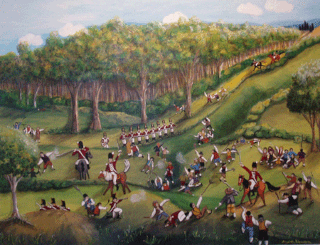
The Battle of Vinegar Hill, an engagement during the Irish Rebellion of 1798, takes place on June 21, 1798 when over 13,000 British soldiers launch an attack on Vinegar Hill outside Enniscorthy, County Wexford, the largest camp and headquarters of the Wexford United Irishmen. It marks a turning point in the rebellion, as it is the last attempt by the United Irishmen to hold and defend ground against the British military. The battle is actually fought in two locations: on Vinegar Hill itself and in the streets of nearby Enniscorthy.
By June 18, the British have surrounded County Wexford with between 13,000 and 18,000 troops and are ready to pour into Wexford to crush the insurgency. The United Irishmen leadership issues a call to all its fighters to gather at Vinegar Hill to meet the army in one great, decisive battle. The number assembled is estimated at between 16,000 and 20,000, but the majority lack firearms and have to rely on pikes as their main weapon. The camp also includes many thousands of women and children who are staying there for protection against the rampaging military.
The British plan, as formulated by General Gerard Lake, envisages the complete annihilation of the United Irishmen, women and children by encircling the hill and seizing the only escape route to the west, the bridge over the River Slaney. Lake divides his force into four columns to accomplish this. Three columns, under Generals David Dundas, James Duff and Francis Needham are to assault Vinegar Hill, while the fourth column, under General Johnson, is to storm Enniscorthy and its bridge.
The battle begins shortly before dawn with an artillery bombardment of Irish positions on the hill. Advance units quickly move against the United Irishmen outposts under cover of the bombardment and move artillery closer as forward positions are secured. The tightening ring forces the United Irishmen into an ever-shrinking area and increases exposure to the constant bombardment, including new experimental delayed-fuse shells resulting in hundreds of dead and injured. At least two mass charges are launched by the United Irishmen which fail to break the lines of the military and the situation on Vinegar Hill soon becomes desperate for the United Irishmen.
Meanwhile, a detachment of light infantry under the command of General Johnson attacks the town of Enniscorthy but meets with fierce resistance. Buildings in the town have been fortified and the initial attack is driven back with the loss of munitions and men. A second attack commences with reinforcements including cavalry, which retake the lost cannon and ammunition while also incurring considerable casualties. The United Irishmen are slowly driven out of the town but manage to hold the Slaney bridge and prevent the British from crossing.
When British troops crest the eastern summit of Vinegar Hill, the rebels begin to slowly withdraw through a gap in the British lines later known as “Needham’s Gap”, so-named because the late arrival of General Needham’s troops prevented a total encirclement of the hill. Although the bulk of the United Irishmen army escape, many are left behind and killed in the routing phase of the battle from both cavalry and infantry attack, but also from the advanced field guns which are switched to grapeshot to maximize casualties.
In addition to conventional casualties, there are also instances of British troops raping the women accompanying the United Irishmen and in Enniscorthy, United Irishmen wounded are burned to death when soldiers set fire to a building used as a casualty station. These atrocities may have been perpetrated in revenge for the execution by the United Irishmen of numbers of mostly Protestantloyalist prisoners of war in the preceding weeks. The United Irishmen abandon much of the supplies they had taken from surrounding areas, and thirteen cannons are captured by the British, a number of which had been taken from the British forces previously.
Meanwhile, the bulk of the United Irishmen force streams uninterrupted towards the Three Rocks camp outside Wexford and, following the decision to abandon the town, split into two separate columns in a new campaign to spread the rebellion beyond Wexford. One immediately sets out to the west, the other northwards towards the Wicklow Mountains to link up with General Joseph Holt‘s forces.
The defeat is therefore not the immediate crushing blow to the Wexford United Irishmen that it has falsely been depicted as, but it does alter the course of the fighting as continued resistance now takes the form of mobile warfare, raids, and large scale, guerilla-type operations.
Casualties for the United Irishmen have been variously reported, with estimates ranging from 400 to around 1,200. Kevin Whelan estimates a figure of between 500 and 1,000 including camp followers, while Archibald McLaren, a British soldier eyewitness, writes that the United Irishmen casualties total about 1,200 men. British casualties are around one hundred.
A British advance force of 400 is defeated at Tuberneering on June 4. This rebel victory punches a hole in the dragnet the military has attempted to throw around County Wexford and also yields them three artillery pieces. The town of Arklow has been evacuated in the ensuing panic but the rebels content themselves with taking the town of Gorey and staying within the Wexford border. On June 5 the rebels attempt to break out of County Wexford across the River Barrow and to spread the rebellion but are halted by a major British victory at the Battle of New Ross. When the rebels finally move against Arklow, the town has been reoccupied by a force of 1,700 men sent from Dublin under Francis Needham, 1st Earl of Kilmorey, who quickly fortifies the town with barricades and has artillery positioned on all the approaches to the town.
The rebel army that forms for attack on the afternoon of June 9 is a combined force of Wexford and Wicklow rebels led by Billy Byrne, Anthony Perry, Conor McEvoy, Edward Fitzgerald, and Fr. Michael Murphy. The British in Arklow consist of approximately 1,000 militia from counties Antrim and Cavan and 150 regular cavalry supported by 250 Yeomanry. They are joined by 315 Durham Fencibles (Princess of Wales’s Fencible Dragoons) arriving an hour before the rebels.
The area surrounding the town and the approaches is covered by scrub and the rebel strategy adopted is to advance under cover attacking the town simultaneously from several points. Before the action begins, the rebels under Esmonde Kyan open fire upon the town with some of the artillery captured at Tuberneering and have some success by scoring a direct hit on a British artillery position, destroying the cannon and killing the attendant crew. The main assault is quickly launched but at all entry points the Irish are thrown back by the musket fire of the well-trained and disciplined militia and volunteers, and canister shot from the 3 pounder battalion gun brought by the fencibles. An attempt by the British to turn the Irish failure into a rout is defeated when pikemen and sharpshooters drive a cavalry charge back across the River Avoca, but an attempt to force a way into the town through the outlying fishing port is bloodily repulsed.
As Irish casualties mount, the lack of ammunition and proper leadership begin to work against them, and after Fr. Murphy is killed leading a charge, their attacks start to fade. As nightfall comes, the rebels begin to withdraw under cover of darkness and collect their wounded. They are not pursued or molested by the garrison who are, unknown to the rebels, down to their last three or four rounds per man and are themselves at the brink of defeat.
While rebel casualties are estimated at about 1,000 no full casualty list seems to exist on the British side, but are probably in the region of 100 dead and wounded. The defeat at Arklow marks the third failure to extend the fight for Irish independence beyond the borders of County Wexford following the other bloody repulses at New Ross and Bunclody. The Irish strategy now changes to a policy of static defence against the encroaching British armies.
At age four, Banim’s parents send him to a local school where he learns the basics of reading and grammar. At age five, he is sent to the English Academy at Kilkenny where his older brother Michael (1796–1874) is a student. After five years at the English Academy, he is sent to a seminary run by a Reverent Magrath, considered to be the finest Roman Catholic school in Ireland. After a year at the seminary, he transfers to another academy run by a teacher named Terence Doyle. Throughout his school years, he reads avidly and writes his own stories and poems. When he is ten, he visits the poet Thomas Moore, bringing along some of his own poetry in manuscript. Moore encourages him to continue writing and gives him a season ticket to his private theatre in Kilkenny.
At the age of 13, Banim enters Kilkenny College and devotes himself specially to drawing and miniature painting. He pursues his artistic education for two years in the schools of the Royal Dublin Society, and afterwards teaches drawing in Kilkenny, where he falls in love with one of his pupils, a 17-year-old girl named Anne. His affection is returned, but her parents disapprove of their relationship and send her out of town. Anne dies two months later of tuberculosis. Her death makes a deep impression on him and his health suffers severely and permanently.
In 1820 Banim goes to Dublin and settles finally to the work of literature. He publishes a poem, The Celt’s Paradise, and his play Damon and Pythias is performed at Covent Garden in 1821. During a short visit to Kilkenny he marries, and in 1822, in conjunction with Michael, plans a series of tales illustrative of Irish life, which should be for Ireland what the Waverley Novels are for Scotland. The influence of his model is distinctly traceable in his writings.
Banim then sets out for London, and supports himself by writing for magazines and for the stage. A volume of miscellaneous essays is published anonymously in 1824, called Revelations of the Dead Alive. The first series of Tales of the O’Hara Family appears in April 1825, which achieves immediate and decided success. One of the most powerful of them, Crohoore of the Bill Hook, is by Michael Banim.
In 1826, a second series is published, containing the Irish novel, The Nowlans. Banim’s health has given way, and the next effort of the “O’Hara family” is almost entirely the production of his brother Michael. The Croppy, a Tale of 1798 (1828), a novel of the Irish Rebellion of 1798, is hardly equal to the earlier tales, though it contains some wonderfully vigorous passages.
The Mayor of Windgap, and The Ghost Hunter (both by Michael Banim), The Denounced (1830) and The Smuggler (1831) follow in quick succession, and are received with considerable favour. Most of these deal with the darker and more painful phases of life, but the feeling shown in his last, Father Connell, is brighter and tenderer. Banim, meanwhile, suffers from illness and consequent poverty. In 1829, he goes to France, and while he is abroad a movement to relieve his wants is set on foot by the English press, headed by John Sterling in The Times. A sufficient sum is obtained to remove him from any danger of actual want.
Banim returns to Ireland in 1835, taking up residence in Dublin. On meeting him again in August, Michael Banim finds his brother’s condition to be that of a complete invalid. He is often in pain and has to use opiates to sleep, but during the short intervals between the attacks of his illness, he is able to enjoy conversation and the company of his brother and friends. In September he returns to Kilkenny and is received with an address from the citizens of Kilkenny showing their appreciation of him, and a subscription from them of £85. After a short stay in his childhood home, he settles in Windgap Cottage, then a short distance from Kilkenny. He passes the remainder of his life there, dying on August 13, 1842.
Michael Banim acquires a considerable fortune which he loses in 1840 through the bankruptcy of a firm with which he had business relations. After this disaster he writes Father Connell (1842), Clough Fionn (1852), and The Town of the Cascades (1862). He dies at Booterstown.
“The true place of the Banims in literature is to be estimated from the merits of the O’Hara Tales; their later works, though of considerable ability, are sometimes prolix and are marked by too evident an imitation of the Waverley Novels. The Tales, however, are masterpieces of faithful delineation. The strong passions, the lights and shadows of Irish peasant character, have rarely been so ably and truly depicted. The incidents are striking, sometimes even horrible, and the authors have been accused of straining after melodramatic effect. The lighter, more joyous side of Irish character, which appears so strongly in Samuel Lover, receives little attention from the Banims.”
Mahon, the eldest of four children, is the son of Patrick Mahon of New Park, who took part in the Irish Rebellion of 1798, and Barbara, a considerable heiress and the only daughter of James O’Gorman of Ennis. He studies at Clongowes Wood College, where he is one of the earliest pupils, and at Trinity College Dublin, where he takes his BA in 1822 and his MA in law in 1832. Following his father’s death in 1821, he inherits half the family property and becomes a magistrate for Clare.
In 1830, Mahon marries Christina, the daughter of John O’Brien of Dublin. She is an heiress and has property valued at £60,000 in her own right, which gives him the resources to seek election to parliament. The couple spends little time together, and she dies apart from him in Paris in 1877. They have one son who dies in 1883.
As a result, when Mahon is elected for Clare at the 1830 United Kingdom general election, he is entitled to take his seat. However, during the election campaign he quarrels with O’Connell, and after his election he is unseated for bribery. He is subsequently acquitted and stands again at the 1831 United Kingdom general election, but is defeated by two O’Connell-backed candidates, one of whom is his old schoolfriend Maurice O’Connell, Daniel O’Connell’s son. He gives up on politics, becomes deputy lieutenant of Clare, and captain of the local militia.
Following his defeat in the 1852 election, Mahon returns to Paris, then travels on to Saint Petersburg, where he serves in the Imperial Bodyguard. During this period, he journeys through lands from Finland to Siberia. He then travels across China, India and Arabia. His finances largely exhausted, he serves as a mercenary in the Ottoman and Austrian armies before returning to England in 1858. Late that year, he leaves for South America, where he attempts to finance the construction of a canal through Central America.
Mahon is a close associate of Charles Stewart Parnell, who he successfully nominates for the leadership of the League in 1880 but is dropped in 1885 as a party candidate because of his age and his tendency to vote with the Liberal Party in Parliament. He is also embroiled in a court case disputing the will of his son.
Mahon had served alongside William O’Shea as an MP, and the two were close friends. He introduced him and Katharine O’Shea, his wife, to Parnell. After Parnell is named in the O’Sheas’ divorce case in 1890, Mahon splits with Parnell, siding with the Irish National Federation. However, Parnell attends Mahon’s funeral in Glasnevin Cemetery a few months later.
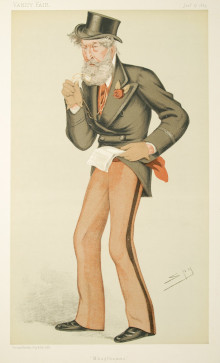
(Pictured: Caricature of James Patrick Mahon by Sir Leslie Matthew Ward under the pseudonym “Spy” published in Vanity Fair in 1885)
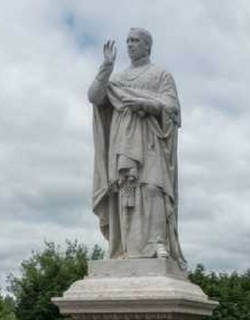
MacHale’s parents are Patrick and Mary Mulkieran MacHale. He is so feeble at birth that he is baptised at home by Father Andrew Conroy. By the time he is five years of age, he begins attending a hedge school. Three important events happen during his childhood: the Irish Rebellion of 1798, the landing at Killala of French troops, whom the boy, hidden in a stacked sheaf of flax, watches marching through a mountain pass to Castlebar, and a few months later the brutal hanging of Father Conroy on a false charge of high treason.
With his friend and ally, Daniel O’Connell, MacHale takes a prominent part in the important question of Catholic emancipation, impeaching in unmeasured terms the severities of the former penal code, which had branded Catholics with the stamp of inferiority. During 1826 his zeal is omnipresent. He calls on the Government to remember how the Act of Union in 1800 was carried by William Pitt the Younger on the distinct assurance and implied promise that Catholic emancipation, which had been denied by the Irish Parliament, should be granted by the Parliament of the Empire.
Oliver Kelly, Archbishop of Tuam, dies in 1834, and the clergy selects MacHale as one of three candidates, to the annoyance of the Government who despatches agents to induce Pope Gregory XVI not to nominate him to the vacant see. Disregarding their request, the pope appoints MacHale Archbishop of Tuam. He is the first prelate since the Reformation who has received his entire education in Ireland. The corrupt practices of general parliamentary elections and the Tithe War cause frequent rioting and bloodshed and are the subjects of denunciation by the new archbishop, until the passing of a Tithes bill in 1838. He also leads the opposition to the ProtestantSecond Reformation, which is being pursued by evangelical clergy in the Church of Ireland, including the Bishop of Tuam, Killala and Achonry, Thomas Plunket.
The repeal of the Acts of Union 1800, advocated by O’Connell, enlists MacHale’s ardent sympathy and he assists the Liberator in many ways, and remits subscriptions from his priests for this purpose. In his zeal for the cause of the Catholic religion and of Ireland, so long downtrodden, but not in the 1830s, he frequently incurs from his opponents the charge of intemperate language, something not altogether undeserved. In his anxiety to reform abuses and to secure the welfare of Ireland, by an uncompromising and impetuous zeal, he makes many bitter and unrelenting enemies, particularly British ministers and their supporters.
The Great Famine of 1846–47 affects his diocese more than any. In the first year he announces in a sermon that the famine is a divine punishment on his flock for their sins. Then by 1846 he warns the Government as to the state of Ireland, reproaches them for their dilatoriness, and holds up the uselessness of relief works. From England as well as other parts of the world, cargoes of food are sent to the starving Irish. Bread and soup are distributed from the archbishop’s kitchen. Donations sent to him are acknowledged, accounted for, and disbursed by his clergy among the victims.
The death of O’Connell in 1847 is a setback to MacHale as are the subsequent disagreements within the Repeal Association. He strongly advises against the violence of Young Ireland. Over the next 30 years he becomes involved in political matters, particularly those involving the church. Toward the end of his life he becomes less active in politics.
MacHale attends the First Vatican Council in 1869. He believes that the favourable moment has not arrived for an immediate definition of the dogma of papal infallibility. Better to leave it a matter of faith, not written down, and consequently he speaks and votes in the council against its promulgation. Once the dogma had been defined, he declares the dogma of infallibility “to be true Catholic doctrine, which he believed as he believed the Apostles’ Creed“. In 1877, to the disappointment of the archbishop who desires that his nephew should be his co-adjutor, Dr. John McEvilly, Bishop of Galway, is elected by the clergy of the archdiocese, and is commanded by Pope Leo XIII after some delay, to assume his post. He had opposed this election as far as possible but submits to the papal order.
Every Sunday MacHale preaches a sermon in Irish at the cathedral, and during his diocesan visitations he always addresses the people in their native tongue, which is still largely used in his diocese. On journeys he usually converses in Irish with his attendant chaplain and has to use it to address people of Tuam or the beggars who greet him whenever he goes out. He preaches his last Irish sermon after his Sunday Mass, April 1881. He dies in Tuam seven months later, on November 7, 1881.
By this time access to institutional power in Ireland was restricted to a small minority, the Anglo-Irish of the Protestant Ascendancy, and frustration at the lack of reform among the Catholic majority eventually led, along with other reasons, to the Irish Rebellion in 1798, involving a French invasion of Ireland and the seeking of complete independence from Great Britain. This rebellion was crushed with much bloodshed, and the subsequent drive for union between Great Britain and Ireland that passes in 1800 is motivated at least in part by the belief that the rebellion was caused as much by reactionary loyalist brutality as by the Society of United Irishmen.
Furthermore, Catholic emancipation is being discussed in Great Britain, and fears that a newly enfranchised Catholic majority will drastically change the character of the Irish government and parliament also contributes to a desire from London to merge the Parliaments.
Complementary acts have to be passed in the Parliament of Great Britain and in the Parliament of Ireland. The Parliament of Ireland had recently gained a large measure of legislative independence under the Constitution of 1782. Many members of the Irish Parliament jealously guard this autonomy and a motion for union is legally rejected in 1799.
Only Anglicans are permitted to become members of the Parliament of Ireland, though the great majority of the Irish population are Roman Catholic, with many Presbyterians in Ulster. In 1793 Roman Catholics regain the right to vote if they own or rent property worth £2 per acre. The Catholic hierarchy is strongly in favour of union, hoping for rapid emancipation and the right to sit as MPs, which is delayed after the passage of the acts until the passage of the Roman Catholic Relief Act 1829.
From the perspective of Great Britain, the union is desirable because of the uncertainty that followed the Irish Rebellion of 1798 and the French Revolution of 1789. If Ireland adopted Catholic Emancipation, willingly or not, a Roman Catholic Parliament could break away from Britain and ally with the French. Also the Irish and British Parliaments, when creating a regency during King George III‘s “madness”, gave the Prince Regent different powers. These considerations lead Great Britain to decide to attempt merger of the two kingdoms and their Parliaments.
The final passage of the Act in the Irish Parliament is achieved with substantial majorities, in part according to contemporary documents through bribery, namely the awarding of peerages and honours to critics to get their votes. Whereas the first attempt had been defeated in the Irish House of Commons by 109 votes against to 104 for, the second vote in 1800 produces a result of 158 to 115.
In the first Parliament of the United Kingdom of Great Britain and Ireland, the members of the House of Commons are not elected afresh. By royal proclamation authorised by the Act, all the members of the last House of Commons from Great Britain take seats in the new House, and from Ireland 100 members are chosen from the last Irish House of Commons: two members from each of the 32 counties and from the two largest boroughs, and one from each of the next 31 boroughs (chosen by lot) and from the University of Dublin. The other 84 Irish parliamentary boroughs are disfranchised, all being pocket boroughs, whose patrons receive £15,000 compensation for the loss of what is considered their property.
(Pictured: Coat of Arms of the United Kingdom from 1837 to 1952 used by Queen Victoria, King Edward VII, George V, Edward VIII and George VI)
When the Irish Rebellion of 1798 breaks out in Ireland, Wolfe Tone urges the French Directory to send effective assistance to the Irish rebels. All that can be promised is a number of raids to descend simultaneously around the Irish coast. One of these raids under General Jean Joseph Amable Humbert succeeds in landing a force near Killala, County Mayo, and gains some success in Connacht (particularly at Castlebar) before it is subdued by General Gerard Lake and Charles Cornwallis. Wolfe Tone’s brother Matthew is captured, tried by court-martial and hanged. A second raid, accompanied by James Napper Tandy, comes to a disastrous end on the coast of County Donegal.
Wolfe Tone takes part in a third raid, under Admiral Jean-Baptiste-François Bompart, with General Jean Hardy in command of a force of 2,800 men. He certainly knows before departing that the odds against them are incredibly long. Most of the United Irish organization has already spent itself in Wexford, Ulster, and other places. There is one slim reed of hope for success – the news from Hubert, who is sweeping the British before him in Mayo with his 1,000 Frenchmen and Irish rebel allies. Wolfe Tone once said he would accompany any French force to Ireland even if it were only a corporal’s guard, so he sails off with Hardy’s Frenchmen aboard the Hoche.
They are intercepted by a large British fleet at Buncrana on Lough Swilly on October 12, 1798. Escape aboard one of the small, fast ships is Wolfe Tone’s only hope to avoid a hangman’s noose but he refuses to transfer from the large, slow Hoche, which has little choice but certain sinking or capture. He refuses offers by Napoleon Bonaparte and other French officers of escape in a frigate before the Battle of Tory Island. “Shall it be said,” he asks them, “that I fled while the French were fighting the battle of my country?”
The Hoche withstands an attack by five British ships for several hours, with Wolfe Tone commanding one of her batteries. Inevitably the masts and rigging of the Hoche are shot away and she strikes her colors. Wolfe Tone is dressed in a French adjutant general‘s uniform, but there is little chance of him avoiding detection with so many former acquaintances among the British. He is thrown into chains taken prisoner when the Hoche surrenders.
When the prisoners are landed at Letterkenny Port a fortnight later, Sir George Hill recognises Wolfe Tone in the French adjutant general’s uniform in Lord Cavan’s privy-quarters at Letterkenny. At his trial by court-martial in Dublin on November 8, 1798, Wolfe Tone makes a speech avowing his determined hostility to England and his intention “by frank and open war to procure the separation of the countries.” Recognising that the court is certain to convict him, he asks that “the court should adjudge me to die the death of a soldier, and that I may be shot.” His request to be shot is denied.
On November 10, 1798, Wolfe Tone is found guilty and sentenced to be hanged on November 12. Before this sentence is carried out, either he attempts suicide by slitting his throat or British soldiers torture and mortally wound him. Military surgeon Benjamin Lentaigne treats him just hours before he is due to be hanged. The story goes that he is initially saved when the wound is sealed with a bandage, and he is told if he tries to talk the wound will open and he will bleed to death.
A pamphlet published in Latin by Dr. Lentaigne some years after Wolfe Tone’s official “suicide” refers to an unusual neck wound suffered by an unnamed patient which indicates that “a bullet passed through his throat.” This leads to speculation that Wolfe Tone may have been shot.
Theobald Wolfe Tone dies on November 19, 1798, at the age of 35 in Provost’s Prison, Dublin, not far from where he was born. He is buried in Bodenstown Graveyard in County Kildare, near his birthplace at Sallins, and his grave is in the care of the National Graves Association.
(Pictured: “Capture Of Wolfe Tone Date 1798,” a drawing by Mary Evans Picture Library, the UK’s leading source for historical images)