seamus dubhghaill

Promoting Irish Culture and History from Little Rock, Arkansas, USA


Leave a comment

Death of Sybil le Brocquy, Playwright & Conservationist

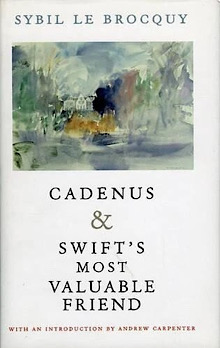
Sybil le Brocquy, Irish playwright, patron of the arts and conservationist, dies in Dublin on September 4, 1973. Two of her three children are involved with the arts: a son is the painter Louis le Brocquy and her daughter is the sculptor Melanie le Brocquy.

She is born Helen Mary Sybil Staunton on December 21, 1892, in Herbert Street, Dublin, to Dorothy Eleanor Redington and Peter Maurice Staunton. Her father is a barrister who later becomes a solicitor. Though he moves to Aram Lodge, CastlereaCounty Roscommon where he practises law, she grows up in Dublin and Howth, going to secondary school in Loreto AbbeyRathfarnham, and later at Loreto Convent, St. Stephen’s Green. She goes on to study German and singing in Koblenz. She marries Albert le Brocquy on December 30, 1915, and settles in Dublin. They have three children, Louis, Noel and Melanie.

Le Brocquy becomes involved in various women’s movements, helping to organise the Women’s International League for Peace and Freedom in July 1926. She is involved with the League of Nations Association as well as helps to establish Irish Civil Rights, PEN International, and Amnesty International in Ireland. She is an active member of Old Dublin Society and for a time president of the Irish Women Writers’ Society. She acts with the Drama League appearing as Helen Staunton. She writes plays and dramatic pieces which are staged by the Drama League at the Abbey Theatre and broadcast by Radio Éireann.

Her writings and work are often historically investigative, finding W. B. Yeats’s birthplace and arguing that Jonathan Swift had a child by Vanessa. She is involved in the Swift Tercentenary celebrations with Cearbhall Ó Dálaigh. As a result of her work, including with Trinity College Dublin Library and representing the Library on the Royal Irish Academy’s National Committee for Anglo-Irish Literature, she is co-opted to the Cultural Committee of the Department of External Affairs and appointed a Trustee of the National Library of Ireland. She is an excellent organiser and fundraiser and is heavily responsible for securing money for the Gate Theatre, Dublin, in 1970. She also initiates the literary prize, the Book of the Year award.

Le Brocquy becomes ill with an undiagnosed illness and dies on September 4, 1973, at the Meath Hospital, Dublin.


Leave a comment

Death of Esther Vanhomrigh, Lover & Correspondent of Jonathan Swift

Esther Vanhomrigh, Irish woman of Dutch descent and a longtime lover and correspondent of Jonathan Swift, dies in Celbridge, County Kildare, on June 2, 1723. Swift’s letters to her are published after her death. Her fictional name “Vanessa” is created by Swift by taking Van from her surname, Vanhomrigh, and adding Esse, a pet form of her first name, Esther.

Vanhomrigh is born in Dublin on February 14, 1688, the eldest of four children of Bartholomew Van Homrigh, a merchant of Amsterdam and afterwards of Dublin, who is appointed commissary of the stores by King William III upon his expedition into Ireland. He serves as Lord Mayor of Dublin from 1697–98. Her mother, also named Esther, is the daughter of John Stone, an Irish commissioner of revenue. She grows up at Celbridge Abbey in County Kildare.

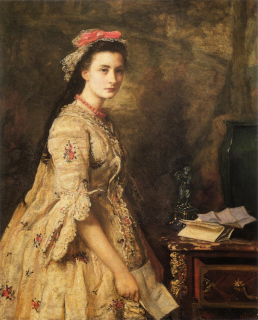
Vanhomrigh’s father dies in 1703, and his widow moves her family to London in 1707. She becomes acquainted with Swift in December of that year while the family is en route for London, at Dunstable, and it is here that their intense 17-year relationship begins. She is 22 years younger than Swift, and it is obvious from the beginning that he admires her for her rugged qualities, as he does not admire very delicate women. She is said “not to be a beauty,” although it is difficult to be sure about this since no contemporary portrait of her exists (the famous 1868 Millais portrait is a work of artistic imagination). Swift later serves as her tutor. After her mother dies in 1714, she follows Swift to Ireland, and returns to Celbridge Abbey, but she is desperately miserable there.

Their relationship is fraught. It is broken up after 17 years by Swift’s relationship with another woman, Esther Johnson, whom he calls “Stella,” in 1723. Swift has known Stella since about 1690, when she is a little girl in the household of his employer Sir William Temple; their relationship is intense and it is possible that they secretly married in 1716. Vanhomrigh is thought to have asked Swift not to see Stella again, and he apparently refuses, thus putting an end to their relationship.

Vanhomrigh never recovers from his rejection and dies on June 2, 1723, likely from tuberculosis contracted from nursing her sister Mary, who had died of the same disease in 1720, as had their mother before her. Some accuse Swift of inadvertently causing her death.

Vanhomrigh’s father had left her well provided for, but she is burdened by debts accumulated by her mother and her spendthrift brother Bartholomew. In her will, she names the barrister Robert Marshall and George Berkeley, the celebrated philosopher and future Bishop of Cloyneexecutors and joint residuary legatees of her estate, although she knew neither man well. Due to the debts, a protracted lawsuit ensues and a large part of the estate is lost in legal costs. It is widely reported that she had made it a condition of the inheritance that her executors publish all her correspondence with Swift, but in fact, no such stipulation seems to have been made.

Swift, whose letters to her are published after her death, is not mentioned in her will, perhaps a final retaliation against a man whose neglect made her “live a life like a languishing death.”


Leave a comment

Death of Charles Jervas, Painter, Translator & Art Collector

Charles Jervas, Irish portrait painter, translator, and art collector of the early 18th century, dies at his home at Cleveland Court, London, on November 2, 1739.

Born in Shinrone, County Offaly, around 1675, Jervas is one of seven children (five sons and two daughters) of John Jervas of Clonlisk, Shinrone, and his wife Elizabeth, daughter of Captain John Baldwin, High Sheriff of County Offaly, of Shinrone. He studies in London as an assistant under Sir Godfrey Kneller between 1694 and 1695.

After selling a series of small copies of the Raphael Cartoons around 1698 to Dr. George Clarke of All Souls College, Oxford, the following year, he travels to Paris and Rome (while financially supported by Clarke and others) remaining there for most of the decade before returning to London in 1709 where he finds success as a portrait painter.

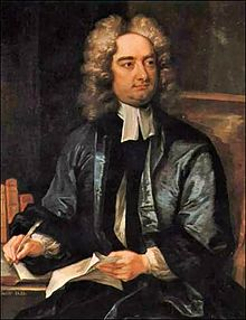
Painting portraits of the city’s intellectuals, among them such personal friends as Jonathan Swift and the poet Alexander Pope, both of which are now in the National Portrait Gallery, London, Jervas becomes a popular artist often referred to in the works of literary figures of the period.

Jervas gives painting lessons to Pope at his house in Cleveland Court, St. James’s, which Pope mentions in his poem, To Belinda on the Rape of the Lock, written in 1713 and published in 1717 in Poems on Several Occasions.

Pope’s verse Epistle to Mr. Jervas, written around 1715, is published in the 1716 edition of John Dryden‘s 1695 translation of Fresnoy’s Art of Painting (Charles Alphonse du Fresnoy‘s De arte graphica, 1668). In it, Pope refers to Jervas’s skill as an artist:

O, lasting as those colours may they shine,
Free as they stroke, yet faultless as thy line;
New graces yearly like thy works display,
Soft without weakness, without glaring gay!

With his growing reputation, Jervas succeeds Kneller as Principal Painter in Ordinary to King George I in 1723, and subsequently King George II. In 1727 he marries Penelope Hume, a wealthy widow with a supposed fortune of £20,000, and moves to Hampton, London. He continues to live in London until his death on November 2, 1739.

Jervas’s translation of Miguel de Cervantes‘s novel Don Quixote, published posthumously in 1742 as being made by Charles “Jarvis” due to a printer’s error, has since come to be known as “the Jarvis translation.” He is first to provide an introduction to the novel including a critical analysis of previous translations of Don Quixote. It has been highly praised as the most accurate translation of the novel up to that time, but also strongly criticised for being stiff and humourless, although it goes through many printings during the 19th century.

As principal portraitist to the King of England, Jervas is known for his vanity and luck, as mentioned in the Imperial Biographical Dictionary, “He married a widow with $20,000; and his natural self-conceit was greatly encouraged by his intimate friend [Alexander] Pope, who has written an epistle full of silly flattery.”

According to one account, after comparing a painting he had copied from Titian, Jervas is said to have stated, “Poor little Tit, how he would starve!”

Upon being told that Jervas had set up a carriage with four horses, Godfrey Kneller replies, “Ach, mein Gott, if his horses do not draw better than he does, he will never get to his journey’s end.”


Leave a comment

Death of Esther Johnson, Close Friend of Jonathan Swift

Esther Johnson, an Englishwoman known as “Stella” and known to be a close friend of Jonathan Swift, dies on January 28, 1728. Whether or not she and Swift are secretly married, and if so, why the marriage is never made public, is a subject of debate.

Johnson is born in Richmond, Surrey, England, on March 13, 1681, and spends her early years at Moor Park, Farnham, home of Sir William Temple, 1st Baronet. Here, when she is about eight, she meets Swift, who is Temple’s secretary. He takes a friendly interest in her from the beginning and apparently supervises her education.

Johnson’s parentage has been the subject of much speculation. The weight of evidence is that her mother acts as companion to Temple’s widowed sister, Martha, Lady Giffard, and that Johnson, her mother and her sister Anne are regarded as part of the family. Her father is said to have been a merchant who died young. Gossip that she is Temple’s illegitimate daughter seems to rest on nothing more solid than the friendly interest he shows in her. There are similar rumours about his supposed relationship with Swift.

When Swift sees Johnson again in 1696, he considers that she has grown into the “most beautiful, graceful and agreeable young woman in London.” Temple, at his death in 1699, leaves her some property in Ireland, and it is at Swift’s suggestion that she move to Ireland in 1702 to protect her interests, but her long residence there is probably due to a desire to be close to Swift. She generally lives in Swift’s house, though always with female companions like Rebecca Dingley, a cousin of Temple whom she has known since childhood. She becomes extremely popular in Dublin and an intellectual circle grows up around her, although it was said that she finds the company of other women tedious and only enjoys the conversation of men.

In 1704, their mutual friend, the Reverend William Tisdall, tells Swift that he wishes to marry Johnson, much to Swift’s private disgust, although his letter to Tisdall, which outlines his objections to the marriage, is courteous enough, making the practical point that Tisdall is not in a position to support a wife financially. Little is known about this episode, other than Swift’s letter to Tisdall. It is unclear if Tisdall actually proposes to her. If he does, he seems to have been met with a firm rejection, and he marries Eleanor Morgan two years later. He and Swift, after a long estrangement, become friends once more after Johnson’s death.

Johnson’s friendship with Swift becomes fraught after 1707 when he meets Esther Vanhomrigh, daughter of the Dutch-born Lord Mayor of Dublin, Bartholomew Van Homrigh. Swift becomes deeply attached to her and invents for her the name “Vanessa.” She in turn becomes infatuated with him and after his return to Ireland follows him there. The uneasy relationship between the three of them continues until 1723 when Vanessa, who is by now seriously ill from tuberculosis, apparently asks Swift not to see Johnson again. This leads to a violent quarrel between them, and Vanessa, before her death in June 1723, destroys the will she had made in Swift’s favour, leaving her property to two men, George Berkeley and Robert Marshall, who though eminent in their respective callings are almost strangers to her.

Whether Swift and Johnson are married has always been a subject of intense debate. The marriage ceremony is allegedly performed in 1716 by St. George Ashe, Bishop of Clogher, with no witnesses present, and it is said that the parties agree to keep it secret and live apart. Johnson always describes herself as a “spinster” and Swift always refers to himself as unmarried. Rebecca Dingley, who lives with Johnson throughout her years in Ireland, says that Johnson and Swift were never alone together. Those who know the couple best are divided on whether a marriage ever took place. Some, like Mrs. Dingley and Swift’s housekeeper Mrs. Brent laugh at the idea as “absurd.” On the other hand, Thomas Sheridan, one of Swift’s oldest friends, believes that the story of the marriage is true. He reportedly gives Johnson herself as his source. Historians have been unable to reach a definite conclusion on the truth of the matter. Bishop Ashe dies before the story first becomes public, and there are no other witnesses to the supposed marriage.

A collection of Johnson’s witticisms is published by Swift under the titles of “Bon Mots de Stella” as an appendix to some editions of Gulliver’s Travels. A Journal to Stella, a collection of 65 letters from Swift to Johnson, is published posthumously.

In 1722, Martha, Lady Giffard, dies and leaves money to Johnson and Swift’s sister, Mrs. Fenton, who had been her companion in 1711.

Johnson’s health begins to fail in her mid-forties. In 1726, she is thought to be dying and Swift rushes back from London to be with her but finds her better. The following year it becomes clear that she is gravely ill. After sinking slowly for months, she dies on January 28, 1728, and is buried in St. Patrick’s Cathedral, Dublin. Swift is inconsolable at her death and writes The Death of Mrs. Johnson in tribute to her. When Swift dies in October 1745, he is buried beside her at his own request. A ward in St. Patrick’s University Hospital is named “Stella” in her memory.

In the 1994 film Words Upon the Window Pane, based on the play by William Butler Yeats, Johnson is played by Bríd Brennan. The plot turns on a séance in Dublin in the 1920s, where the ghosts of Swift, Johnson and Vanessa appear to resume their ancient quarrel.

In the 1982 Soviet film The House That Swift Built, Johnson is played by Aleksandra Zakharova.

Leave a comment

Death of Irish Writer Denis Johnston

Irish writer (William) Denis Johnston dies on August 8, 1984, at Ballybrack, County Dublin. He writes mostly plays, but also works of literary criticism, a book-length biographical essay of Jonathan Swift, a memoir and an eccentric work on cosmology and philosophy. He also works as a war correspondent and as both a radio and television producer for the BBC.

Johnston is born in Dublin on June 18, 1901, the only child of William John Johnston from Magherafelt, a barrister and later an Irish Supreme Court judge, and his wife Kathleen (née King), a teacher and singer from Belfast. They are Presbyterians and liberal home rulers. He sees the family home in Dublin occupied by rebels during the 1916 Easter Rising.

Johnston is educated at St. Andrew’s College, Dublin (1908–15, 1917–19), and Merchiston Castle School, Edinburgh (1915–16). In 1918, he attempts to join Sinn Féin, offering to supply the party with weapons taken from his Officers’ Training Corps. In 1922, while reading history and law at Christ’s College, Cambridge (1919–23) he tries to enlist in the civil war Free State army. He goes on to study at the Harvard Law School (1923–24) and enters King’s Inns in Dublin and the Inner Temple in London.

In London, developing his interest in the theatre, Johnston abandons plans for a legal and political career.

Johnston is a protégé of W. B. Yeats and George Bernard Shaw, and has a stormy friendship with Seán O’Casey. He is a pioneer of television and war reporting. He works as a lawyer in the 1920s and 1930s before joining the BBC as a writer and producer, first in radio and then in the fledgling television service. His broadcast dramatic work includes both original plays and adaptation of the work of many different writers.

Johnston’s first play, The Old Lady Says “No!”, helps establish the worldwide reputation of Dublin’s Gate Theatre. His second play, The Moon in the Yellow River, has been performed around the globe in numerous productions featuring such storied names as James Mason, Jack Hawkins, Claude Rains, Barry Fitzgerald, James Coco and Errol Flynn. Later plays deal with the life of Jonathan Swift, the 1916 Rebellion, the pursuit of justice, and the fear of death. He writes two opera libretti and a pageant.

“Passionate in his radical skepticism and loathing of what he saw as the pernicious influence of the Roman Catholic Church,” at the end of 1933, Johnston joins the trade unionist John Swift, the Dublin novelist Mary Manning, and fellow northerner, the libertarian socialist Jack White, in forming The Secular Society of Ireland. “Convinced that clerical domination in the community is harmful to advance,” the society seeks “to establish in this country complete freedom of thought, speech and publication, liberty for mind, in the widest toleration compatible with orderly progress and rational conduct.” Among other things it aims to terminate the clerically-dictated ban on divorce, the Censorship of Publications Act and the system of clerical management, and consequent sectarian teaching, in schools.

This is at a time of heightened clerical militancy and as soon the meeting place of the Society (from which it distributed the British journal The Freethinker) is exposed, it has to shift to private houses outside of Dublin. In 1936, Johnston and the other members disband the society and donate the proceeds to the government of the beleaguered Spanish Republic. He has become a recognised man of the left. In 1930 he joins the Irish Friends of Soviet Russia, and though never a party member, until as late as the 1950s he professes faith in a communist future.

During World War II he serves as a BBC war correspondent, reporting from El Alamein, through the Italian campaign, to Buchenwald and Adolf Hitler‘s Berghof. For this he is awarded an OBE, a mention in dispatches, and the Yugoslav Partisans Medal. He then becomes Director of Programmes for the television service.

Johnston later moves to the United States and teaches at Mount Holyoke College, Smith College and other universities. He keeps extensive diaries throughout his life, now deposited in the Library of Trinity College, Dublin, and these together with his many articles and essays give a distinctive picture of his times and the people he knew. Another archive of his work is held at the library of Ulster University at Coleraine. He receives honorary degrees from Ulster University and Mount Holyoke College and is a member of Aosdána.

Johnston and actress Shelah Richards are the parents of Jennifer Johnston, a respected novelist and playwright, and a son, Micheal. His second wife is the actress Betty Chancellor, with whom he has two sons, Jeremy and Rory.

Johnston dies on August 8, 1984, at Ballybrack, County Dublin, and is buried in St. Patrick’s Cathedral close. His epitaph is a quotation from The Old Lady Says “No!” – Emmet’s lines praising Dublin “the strumpet city.”

Johnston’s war memoir, Nine Rivers from Jordan, reaches The New York Times‘ Best Seller list and is cited in the World Book Encyclopedia‘s 1950s article on World War II under “Books to Read,” along with Winston Churchill, Dwight D. Eisenhower, et al. Joseph Ronsley cites an unnamed former CBS Vietnam War correspondent who called the book the “Bible,” carrying it with him constantly, “reading it over and over in the field during his tour of duty.” In a profile in The New Yorker in 1938, Clifford Odets is quoted as saying that the only playwrights he admires are John Howard Lawson, Sean O’Casey, and Denis Johnston.

The Denis Johnston Playwriting Prize is awarded annually by Smith College Department of Theatre for the best play, screenplay or musical written by an undergraduate at Smith College, Mount Holyoke College, Amherst College, Hampshire College and the University of Massachusetts Amherst. The prize is endowed by his former student at Smith, Carol Sobieski.


Leave a comment

Birth of Sir Richard Levinge, 1st Baronet

Sir Richard Levinge, 1st Baronet, Irish politician and judge who plays a leading part in Irish public life for more than 30 years, is born at Leek, Staffordshire, England, on May 2, 1656.

Levinge is the second son of Richard Levinge of Parwich Hall, Derbyshire, Recorder of Chester, and Anne Parker, daughter of George Parker of Staffordshire and his wife Grace Bateman. The Levinges (sometimes spelled “Levin”) are a long-established Derbyshire family with a tradition of public service. Through his mother he is a first cousin of Thomas Parker, 1st Earl of Macclesfield, Lord High Chancellor of Great Britain.

Levinge is educated at Audlem School, Derbyshire, and St. John’s College, Cambridge. He enters the Inner Temple in 1671 and is called to the Bar in 1678. He is a Member of Parliament (MP) of the House of Commons of England for City of Chester from 1690 to 1695. He is also, like his father, Recorder of Chester in 1686-87, but is summarily removed from this office by King James II of England.

Levinge is one of the first to declare for William III of England at the Glorious Revolution and is sent by the new Government to Ireland as Solicitor-General in 1689. In 1692 he is elected as a member of the Irish House of Commons for Belfast and for Blessington, but chooses to sit for Blessington, a seat he holds until 1695. During this time, he serves as Speaker of the Irish House of Commons. In politics he is a moderate Tory, noted throughout his career for his desire to conciliate. In an age of bitter political faction this earns him the uncharitable nickname “Tom Double.” Although he supports the Penal Laws, as no Irish officeholder then could do otherwise, he is very tolerant in religious matters and has several Roman Catholic friends, including his predecessor as Solicitor-General, Sir Theobald Butler.

Levinge later represents Longford Borough from 1698 to September 1713 and Kilkenny City from 1713 to November 1715 in the Irish Parliament. In 1713 he is also returned for Gowran but chooses to sit for Kilkenny. He is created a Baronet of High Park in the County of Westmeath, in the Baronetage of Ireland on October 26, 1704.

Levinge also serves as Solicitor-General for Ireland from 1689, from which office he is dismissed in 1695 following a quarrel with Henry Capell, 1st Baron Capell of Tewkesbury, the Lord Lieutenant of Ireland. He returns to office as Solicitor-General in 1705 through the good offices of James Butler, 2nd Duke of Ormonde, who has acted as his patron for some years past. History repeats itself when the Lord Lieutenant, Thomas Wharton, 1st Earl of Wharton, dismisses him from office in 1709 with what is regarded by many, including Jonathan Swift, as brutal suddenness. He once again becomes a member of the Parliament of Great Britain representing Derby from 1710 to 1711. He becomes Attorney-General for Ireland in 1711, after Ormonde replaces Wharton as Lord Lieutenant.

Levinge had expressed his interest in being appointed to the English Bench but meets with no success in his efforts to achieve office in England. Under George I of Great Britain, despite being of the “wrong” political persuasion, and his growing age, his famous moderation, and his 30 years’ experience of Irish public life make him acceptable as an Irish judge to the Government, in which he has a powerful supporter in his cousin Lord Macclesfield. In 1721 he becomes Chief Justice of the Irish Common Pleas for Ireland and a member of the Privy Council of Ireland. He complains bitterly of the poor quality of his junior judges, and asks for suitable replacements, although he complains equally about some of those whose names are put forward as possible replacements. Despite being in great pain from gout in his last years, he remains on the Bench until his death on July 13, 1724.

Levinge divides his time between his ancestral home, Parwich Hall, which he purchases from his childless elder brother, and his newly acquired property Knockdrin Castle, County Westmeath. Most of his estates passes to his eldest son, who extensively rebuilds Parwich.

(Pictured: Knockdrin Castle, County Westmeath, the main Levinge residence in Ireland)


Leave a comment

Birth of George Berkeley, Anglican Bishop of Cloyne

George Berkeley, Bishop of Cloyne of the Anglican Church of Ireland known as Bishop Berkeley, is born at his family home, Dysart Castle, near Thomastown, County Kilkenny, on March 12, 1685. He is an Anglo-Irish philosopher whose primary achievement is the advancement of a theory he calls “immaterialism” (later referred to as “subjective idealism” by others). This theory denies the existence of material substance and instead contends that familiar objects like tables and chairs are ideas perceived by the mind and, as a result, cannot exist without being perceived. He is also known for his critique of abstraction, an important premise in his argument for immaterialism.

Berkeley is the eldest son of William Berkeley, a cadet of the noble family of Berkeley whose ancestry can be traced back to the Anglo-Saxon period and who had served as feudal lords and landowners in Gloucester, England. Little is known of his mother. He is educated at Kilkenny College and attends Trinity College Dublin, where he is elected a Scholar in 1702, being awarded BA in 1704 and MA and a Fellowship in 1707. He remains at Trinity College after completion of his degree as a tutor and Greek lecturer.

Berkeley’s earliest publication is on mathematics, but the first that brings him notice is his An Essay Towards a New Theory of Vision, first published in 1709. In the essay, he examines visual distance, magnitude, position and problems of sight and touch. While this work raises much controversy at the time, its conclusions are now accepted as an established part of the theory of optics.

The next publication to appear is A Treatise Concerning the Principles of Human Knowledge in 1710, which has great success and gives him a lasting reputation, though few accept his theory that nothing exists outside the mind. This is followed in 1713 by Three Dialogues between Hylas and Philonous, in which he propounds his system of philosophy, the leading principle of which is that the world, as represented by our senses, depends for its existence on being perceived.

For this theory, the Principles gives the exposition and the Dialogues the defence. One of his main objectives is to combat the prevailing materialism of his time. The theory is largely received with ridicule, while even those such as Samuel Clarke and William Whiston, who do acknowledge his “extraordinary genius,” are nevertheless convinced that his first principles are false.

Shortly afterwards, Berkeley visits England and is received into the circle of Joseph Addison, Alexander Pope and Richard Steele. In the period between 1714 and 1720, he intersperses his academic endeavours with periods of extensive travel in Europe, including one of the most extensive Grand Tours of the length and breadth of Italy ever undertaken. In 1721, he takes holy orders in the Church of Ireland, earning his doctorate in divinity, and once again chooses to remain at Trinity College Dublin, lecturing this time in Divinity and in Hebrew. In 1721-22 he is made Dean of Dromore and, in 1724, Dean of Derry.

In 1723, following her violent quarrel with Jonathan Swift, who had been her intimate friend for many years, Esther Vanhomrigh names Berkeley her co-heir along with the barrister Robert Marshall. Her choice of legatees causes a good deal of surprise since she does not know either of them well, although Berkeley as a very young man had known her father. Swift says generously that he does not grudge Berkeley his inheritance, much of which vanishes in a lawsuit in any event. A story that Berkeley and Marshall disregarded a condition of the inheritance that they must publish the correspondence between Swift and Vanhomrigh is probably untrue.

In 1725, Berkeley begins the project of founding a college in Bermuda for training ministers and missionaries in the colony, in pursuit of which he gives up his deanery with its income of £1100.

In 1728, Berkeley marries Anne Forster, daughter of John Forster, Chief Justice of the Irish Common Pleas, and his first wife Rebecca Monck. He then goes to America on a salary of £100 per annum. He lands near Newport, Rhode Island, where he buys a plantation at Middletown – the famous “Whitehall.” He purchases several enslaved Africans to work on the plantation. He also brings John Smibert to New England, the Scottish artist he “discovered” in Italy, who is generally regarded as the founding father of American portrait painting. Meanwhile, he draws up plans for the ideal city he plans to build on Bermuda. He lives at the plantation while he waits for funds for his college to arrive. The funds, however, are not forthcoming and he leaves America and returns to London in 1732.

Berkeley and his wife have four children who survive infancy: Henry, George, William and Julia, and at least two other children who die in infancy. William’s death in 1751 is a great cause of grief to his father.

Berkeley is nominated to be the Bishop of Cloyne in the Church of Ireland on January 18, 1734. He is consecrated as such on May 19, 1734. He is the Bishop of Cloyne until his death on January 14, 1753, although he dies at Oxford.

While living in London’s Saville Street, Berkeley takes part in efforts to create a home for the city’s abandoned children. The Foundling Hospital is founded by royal charter in 1739, and Berkeley is listed as one of its original governors.

Berkeley’s last two publications are Siris: A Chain of Philosophical Reflexions and Inquiries Concerning the Virtues of Tarwater, And divers other Subjects connected together and arising one from another (1744) and Further Thoughts on Tar-water (1752). Pine tar is an effective antiseptic and disinfectant when applied to cuts on the skin, but he argues for the use of pine tar as a broad panacea for diseases. His 1744 work on tar-water sells more copies than any of his other books during Berkeley’s lifetime.

Berkeley remains at Cloyne until 1752, when he retires. With his wife and daughter Julia, he goes to Oxford to live with his son George and supervise his education. He dies soon afterwards and is buried in Christ Church Cathedral, Oxford. His affectionate disposition and genial manners make him much loved and held in warm regard by many of his contemporaries. Anne outlives her husband by many years, dying in 1786.

(Pictured: “Bishop George Berkeley,” oil on canvas portrait by John Smibert, c. 1727)


Leave a comment

Birth of Jonathan Swift, Essayist, Pamphleteer, Poet & Cleric

Jonathan Swift, satirist, essayist, political pamphleteer, poet and cleric who becomes Dean of St. Patrick’s Cathedral, Dublin, is born in Dublin on November 30, 1667.

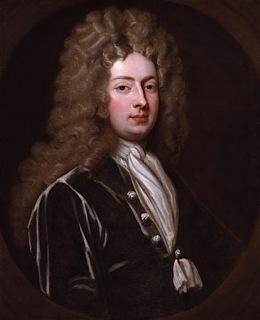
Swift’s father, an attorney, also named Jonathan Swift, dies just two months before he is born. Without steady income, his mother struggles to provide for her newborn. Moreover, he is a sickly child. It is later discovered that he suffers from Ménière’s disease, a condition of the inner ear that leaves the afflicted nauseous and hard of hearing. In an effort to give her son the best upbringing possible, Swift’s mother gives him over to Godwin Swift, her late husband’s brother and a member of the respected professional attorney and judges group Gray’s Inn. Godwin Swift enrolls his nephew with one of his cousins in Kilkenny College, which is perhaps the best school in Ireland at the time. He arrives there at the age of six, where he is expected to have already learned the basic declensions in Latin. He has not and thus begins his schooling in a lower form. He graduates in 1682, when he is 15. His transition from a life of poverty to a rigorous private school setting proves challenging. He does, however, make a fast friend in William Congreve, the future poet and playwright.

In 1682, Swift commences his undergraduate studies at Trinity College, Dublin. In 1686, he receives a Bachelor of Arts degree and goes on to pursue a master’s degree. Not long into his research, huge unrest breaks out in Ireland. The king of Ireland, England and Scotland is soon to be overthrown. What becomes known as the Glorious Revolution of 1688 spurs him to move to England and start anew. For 10 years, Swift works in Surrey‘s Moor Park and acts as an assistant to Sir William Temple, 1st Baronet.

During his Moor Park years, Swift meets the daughter of Temple’s housekeeper, an 8-year-old named Esther Johnson, known as “Stella.” They become lovers for the rest of their lives until Johnson’s death in 1728. It is rumored that they marry in 1716, and that Swift keeps of lock of Johnson’s hair in his possession at all times.

During his decade of work for Temple, Swift returns to Ireland twice. On a trip in 1695, he takes all necessary requirements to become an ordained priest in the Anglican tradition. Under Temple’s influence, he also begins to write, first short essays and then a manuscript for a later book. Temple dies in 1699. Swift completes the task of editing and publishing Temple’s memoirs. He then leans on his priestly qualifications and finds work ministering to a pea-sized congregation just 20 miles outside of Dublin. For the next ten years, he gardens, preaches and works on the house provided to him by the church. He also returns to writing. His first political pamphlet is titled A Discourse on the Contests and Dissentions in Athens and Rome.

In 1704, Swift anonymously releases A Tale of a Tub and The Battle of the Books. Tub, although widely popular with the masses, is harshly disapproved of by the Church of England. Ostensibly, it criticizes religion, but Swift means it as a parody of pride. Nonetheless, his writings earn him a reputation in London and when the Tories come into power in 1710, they ask him to become editor of The Examiner, their official paper. After a time, he becomes fully immersed in the political landscape and begins writing some of the most cutting and well-known political pamphlets of the day, including The Conduct of the Allies, an attack on the Whigs. Privy to the inner circle of Tory government, he lays out his private thoughts and feelings in a stream of letters to his beloved Stella. They are later published as The Journal to Stella.

When he sees that the Tories will soon fall from power, Swift returns to Ireland. In 1713, he takes the post of Dean at St. Patrick’s Cathedral, Dublin. While leading his congregation at St. Patrick’s, he begins to write what would become his best-known work. In 1726, at last finished with the manuscript, he travels to London and benefits from the help of several friends, who anonymously publish it as Travels into Several Remote Nations of the World, in Four Parts. By Lemuel Gulliver, First a Surgeon, and then a Captain of Several Ships, more simply known as Gulliver’s Travels. The book is an immediate success and has not been out of print since its first run.

Not long after the celebration of this work, Esther Johnson, falls ill. She dies in January 1728. Her death moves Swift to write The Death of Mrs. Johnson.

In 1742, Swift suffers a stroke and loses the ability to speak. He dies on October 19, 1745. He is laid to rest next to Esther Johnson inside Dublin’s St. Patrick’s Cathedral.


Leave a comment

Birth of Charles Maturin, Clergyman, Playwright & Novelist

Charles Robert Maturin, also known as C. R. Maturin, an Irish Protestant clergyman ordained in the Church of Ireland and a writer of Gothic plays and novels, is born in Dublin on September 25, 1780. His best-known work is the novel Melmoth the Wanderer.

Maturin is descended from Huguenots who found shelter in Ireland, one of whom is Gabriel Jacques Maturin who becomes Dean of St. Patrick’s Cathedral, Dublin, after Jonathan Swift in 1745. He attends Trinity College Dublin. Shortly after being ordained as curate of Loughrea, County Galway, in 1803, he moves back to Dublin as curate of St. Peter’s Church. He lives in York Street with his father William, a Post Office official, and his mother, Fedelia Watson. He marries the acclaimed singer Henrietta Kingsbury on October 7, 1804.

Maturin’s first three works are Gothic novels published under the pseudonym Dennis Jasper Murphy and are critical and commercial failures. They do, however, catch the attention of Sir Walter Scott, who recommends Maturin’s work to Lord Byron. With their help, his play Bertram is staged in 1816 at the Theatre Royal, Drury Lane for 22 nights, with Edmund Kean starring in the lead role as Bertram. Financial success, however, eludes Maturin, as the play’s run coincides with his father’s unemployment and another relative’s bankruptcy, both of them assisted by the fledgling writer. To make matters worse, Samuel Taylor Coleridge publicly denounces the play as dull and loathsome, and “melancholy proof of the depravation of the public mind,” going nearly so far as to decry it as atheistic.

The Church of Ireland takes note of these and earlier criticisms and, having discovered the identity of Bertram‘s author after Maturin had shed his nom de plume to collect the profits from the play, subsequently bar his further clerical advancement. Forced to support his wife and four children by writing on his curate salary of £80-90 per annum, compared to the £1000 he made for Bertram, he switches back from playwright to novelist after a string of his plays meet with failure. He produces several novels in addition to Melmoth the Wanderer, including some on Irish subjects and The Albigenses, a historical novel which features werewolves. Various poems have also been ascribed to Maturin on dubious grounds and appear to be the work of others. The prize-winning “Lines on the Battle of Waterloo” is published in 1816 under the name of the university graduate John Shee. “The Universe” appears with Maturin’s name on the title page in 1821 but is now thought to be almost completely the work of James Wills.

The exaggerated effectiveness of Maturin’s preaching can be gauged from the two series of sermons that he publishes. On the occasion of the death of Princess Charlotte, he declares, “Life is full of death; the steps of the living cannot press the earth without disturbing the ashes of the dead – we walk upon our ancestors – the globe itself is one vast churchyard.” A contemporary account records that there had seldom been seen such crowds at St Peter’s. “Despite the severe weather, people of all persuasions flocked to the church and listened spellbound to this prince of preachers. In his obituary it is said that ‘did he leave no other monument whereon to rest his fame, these sermons alone would be sufficient.'”

Maturin dies in Dublin on October 30, 1824. A writer in the University Magazine later sums up his character as “eccentric almost to insanity and compounded of opposites – an insatiable reader of novels; an elegant preacher; an incessant dancer; a coxcomb in dress and manners.”

A sister of Maturin’s wife marries Charles Elgee, whose daughter, Jane Francesca, becomes the mother of Oscar Wilde. Thus, Charles Maturin is Oscar Wilde’s great-uncle by marriage. Wilde discards his own name and adopts the name of Maturin’s novel, Melmoth, during his exile in France.

Maturin’s eldest son, William Basil Kingsbury Maturin, follows him into the ministry, as do several of his grandsons. One of these, Basil W. Maturin, dies in the sinking of RMS Lusitania on May 7, 1915. The second son is Edward Maturin, who emigrates to the United States and becomes a novelist and poet there.


Leave a comment

St. Patrick’s Hospital for the Insane Opens in Dublin

Having been funded by a bequest from author Jonathan Swift following his death in 1745, St. Patrick’s Hospital for the Insane, Dublin, opens on September 19, 1757. The hospital is a psychiatric facility located near Kilmainham and the Phoenix Park.

Today, St. Patrick’s University Hospital, known for the innovative care of its patients, provides “Ireland’s largest, independent, not-for-profit mental health services.” When founded in 1745 it is the first psychiatric hospital to be built in Ireland mandated for the care of “Idiots and Lunaticks.”

Although new theories of madness and more therapeutic approaches to treatment are being proposed in the late 1700’s, during most of the eighteenth-century society views the lunatic as one who has literally lost his reason, “the essence of his humanity,” and therefore “his claim to be treated as a human being.” Treatments designed “to weaken the animal spirits that were believed to be producing madness,” still include restraints with chains, bloodletting, emetics, purging, and beating.

Confinement rather than cure is the focus of the earliest institutions in Great Britain. They resemble prisons with cells and keepers to control the inmates. Bethlem Hospital in London is the first to include lunatics in 1377. By the eighteenth century it has become infamous as “Bedlam” and has a reputation for cruelty, neglect, and poor living conditions, with an inadequate diet, rough clothing, and inactivity. Even worse, the mad in Bedlam are displayed as entertainment — a “freak show,” a “spectacle,” a “menagerie” from which “both provincial bumpkins and urban sophisticates could derive almost endless amusement” for a fee.

The earliest biographers of Jonathan Swift report that he had chosen to found St. Patrick’s Hospital because he had become insane himself at the end of his life. One writer even claims that he is the first patient to die there. Neither of these conclusions is accurate. It is his philosophical views and personal experiences that influence Swift’s decision to leave his estate for the establishment of St. Patrick’s.

Throughout the eighteenth century, medicine, politics, and literature all debate the relation between reason and madness, a subject that greatly interests Swift. In his most powerful satires, including Gulliver’s Travels (1726) and A Modest Proposal (1729), he sometimes explores the Lockean theory that “any person could fall into madness by the erroneous association of ideas.”

But the stronger motivation for Swift’s legacy grows from his involvement with the day-to-day problems of the Irish people, not only as an individual but also as Dean of St. Patrick’s Cathedral, a position he holds from 1713 until his death. At mid-century there are no provisions specifically for lunatics. If not being cared for by their families or found wandering the countryside, lunatics would sometimes be confined with criminals in prisons, with the poor in a workhouse, or with the sick in a hospital. Swift has firsthand knowledge of these conditions since he served as a governor of the workhouse and as a trustee of several hospitals. In 1710, after a visit to Bedlam, he gets himself elected a governor there in 1714. By 1731 he has decided on his legacy, intending his hospital to be charitable and more humane than Bedlam.

Another strong motivation may have been Swift’s ability to empathize with the sufferers of madness. Not mental illness but recurring attacks of Ménière’s disease (MD) afflict him for over fifty years, beginning at age twenty-three. The debilitating bouts of vertigo, nausea, tinnitus, and deafness worsen by the late 1730’s, and he complains of memory loss and difficulty in reading and writing. When he finalizes his will in 1740, he refers to himself as sound in mind but weak in body. In 1742, following a sudden decline in his health, his friends have him judged incompetent and appoint a guardian. Probable dementia increases his helplessness until his death on October 19, 1745.

Swift leaves an estate of about 12,000 pounds. In his will he lists details as to where St. Patrick’s should be built and how it should be run by his board of governors. Although they first meet in 1746, the asylum does not open until 1757. The governors need to acquire the site, oversee the plan and construction of the building, and ensure available money for operating expenses. Insufficient funds are the main obstacle, even after adding money from rents, donations, subscriptions and Parliament. Finally, St. Patrick’s has to accept paying patients to offset the costs of its charity cases.

Richard Leeper, who is appointed Resident Medical Superintendent in 1899, introduces a series of important initiatives including providing work and leisure activities for the patients. Norman Moore, who is appointed Resident Medical Superintendent in 1946, introduces occupational therapy, including crafts and farm work to the patients.

After the introduction of deinstitutionalisation in the late 1980s the hospital goes into a period of decline. In 2008 the hospital announces the expansion of its outpatient services to a series of regional centres across Ireland. A mental health facility for teenagers, known as the Willow Grove Adolescent Inpatient Unit, opens at the hospital in October 2010.

The hospital is affiliated with Trinity College Dublin and has 241 inpatient beds.