seamus dubhghaill

Promoting Irish Culture and History from Little Rock, Arkansas, USA


Leave a comment

Éamon de Valera Visits Butte, Montana During His American Tour

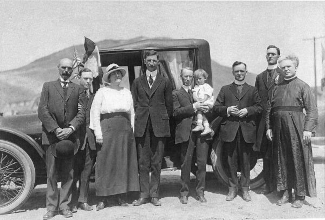
President Éamon de Valera visits Butte, Montana, on July 25, 1919, during his American Tour of 1919-20. Montana Lieutenant Governor W. W. McDowell meets his train and rides with de Valera through the streets to where de Valera then addresses over 10,000 people who have come out to hear him. The next day, de Valera addresses a joint session of the Montana State Legislature.

De Valera’s eventful 1919 begins in Lincoln Jail and ends in New York City’s Waldorf Astoria, the largest and most luxurious hotel in the world. Smuggled aboard the SS Lapland in Liverpool in June, he sails for the United States during the closing stages of the Paris Peace Conference. As London’s Sunday Express complains in August 1919, “there is more Irish blood in America than in Ireland,” making the United States the obvious destination for a sustained propaganda and fundraising mission.

After his highly-publicised American debut at New York’s Waldorf Astoria, the self-styled “President of the Irish Republic” embarks on the first leg of what is to be an eighteen-month tour of the United States. The purpose of his mission is twofold: to gain formal recognition of the Irish Republic and to raise funds via a bond issue to support the independence movement and the newly established Dáil Éireann.

Between July and August 1919, de Valera and his entourage travel over 6,000 miles from New York to San Francisco, addressing enormous crowds at dozens of venues. He fills Madison Square Garden to capacity and receives a thirty-minute standing ovation from 25,000 people in Chicago’s Wrigley Field. Twice as many people fill Boston’s Fenway Park on June 29, cheering the arrival of the “Irish Lincoln.” The Sinn Féin envoys also visit less obvious Irish communities of the period, such as Scranton, Savannah, New Orleans and Kansas City. For de Valera’s personal secretary, Seán Nunan, the public meeting in Butte, Montana is like “an election meeting at home – there were so many first-generation Irishmen working on the mines – mainly from around Allihies in West Cork.” In San Francisco de Valera dedicates a statue of Robert Emmet by Irish-born sculptor Jerome Connor in Golden Gate Park, a replica of which stands sentinel in St. Stephen’s Green in Dublin. This is one of many symbolic gestures linking the American and Irish struggles for independence played out before the flashing bulbs of the ubiquitous press photographers. On August 15, The Cork Examiner notes that the enthusiastic American exchanges “indicate that few public missionaries from other lands – possibly only Mr. Parnell – have ever had such receptions as were accorded to the Sinn Féin leader.”

De Valera’s team deserves credit for the incredible logistical triumph that is the U.S. tour. As chief organiser, Liam Mellows travels ahead to each city, ensuring a suitable reception is prepared and a venue secured for a mass meeting. Seán Nunan is de Valera’s fastidious personal secretary and Harry Boland, Sinn Féin TD for South Roscommon and Irish Republican Brotherhood (IRB) envoy, is at his side troubleshooting, speechmaking and shaking hands. As the tour progresses, de Valera’s supporting cast expands to include Kerry-born Kathleen O’Connell who becomes de Valera’s full-time personal secretary from 1919.

The next stage of de Valera’s American odyssey begins on October 1, 1919, in Philadelphia, a city with a rich Irish heritage and rife with symbolism of America’s struggle for independence. Over the next three weeks, de Valera and his team travel from the Atlantic to the Pacific seaboard and back again, delivering seventeen major public speeches and a host of smaller ones to aggregate crowds of over half a million.

The pace is relentless as the Irish team makes its way through middle America. De Valera is received as a visiting dignitary at multiple state legislatures and presented with honorary degrees from six American universities. In line with his secondary objective to foster the interest of “wealthy men of the race in the industrial development of Ireland,” he addresses the Chambers of Commerce in a number of cities and arranges a personal meeting with Henry Ford, the son of an Irish emigrant, during his visit to Detroit in October. In the same month in Wisconsin, he is made a Chief of the Chippewa Nation, an honour he later says meant more to him than all the freedoms of all the cites he was ever given. It is not surprising that by the time they reach Denver on October 30, The Irish World reports that “the President looked tired.” Still, he musters the energy to make high profile visits to Portland, Los Angeles and San Diego before beginning the return journey to New York at the end of November.

After a short break for Christmas, the Irish team prepares for the launch of the Bond Certificate Drive. A week-long frenzy of publicity kicks off on January 17 at New York City Hall where Mayor John F. Hylan presents de Valera with the Freedom of the City. During the spring of 1920, de Valera addresses the Maryland General Assembly at Annapolis before making the swing through the southern states of America.

It is not all plain sailing for the Sinn Féin representatives in America. The tour of the west coast in late 1919 sees increasing tensions with American patriotic bodies who are critical of de Valera’s perceived pro-German stance during World War I. He is heckled during a speech in Seattle and a tricolour is ripped from his car in Portland by members of the American Legion. The trip through the southern states in the spring of 1920 coincides with rising American anti-immigration and anti-Catholic nativism. A small number of counter demonstrations are organised by right-wing Americans. Most notably, members of the Ku Klux Klan make unwelcome appearances at several rallies in the American south, making clear their opposition to de Valera’s presence.

The Irish envoys also contend with antagonism from the leaders of Friends of Irish Freedom (FOIF), the broad-based popular front of Clan na Gael headed by veteran Fenian John Devoy and Judge Daniel Cohalan. The FOIF uses its significant resources to finance de Valera’s tour and facilitate the Bond Certificate Drive, but behind the scenes there are significant personality clashes and tensions over tactics.

The increasingly public dispute comes to a head in a row over strategies at the Republican National Convention in Chicago in June 1920. Drawing on his influential political contacts, Cohalan persuades the Republican Party to include Irish self-determination in their election platform. However, much to Cohalan’s fury, de Valera leads a separate delegation to the Convention and insists on a resolution calling for recognition of the Irish Republic. The result is that two resolutions are submitted to the Platform Committee, which indicates dissension in the Irish ranks and gives the Committee the excuse to include neither in the final platform. After de Valera also fails to secure the endorsement of the Democratic convention in San Francisco in June, it is clear that the Irish question will not be a significant factor in the ensuing presidential election. Relations between the FOIF and de Valera reach a new low. In November 1920, de Valera makes the final break with the FOIF and sets up a new organisation, the American Association for the Recognition of the Irish Republic.

De Valera is in Washington, D.C. on October 25 when Terence MacSwiney dies after 74 days on hunger strike. Six days later, at the last great meeting of the American tour, 40,000 people fill New York’s Polo Grounds to commemorate MacSwiney’s death. By late November, de Valera knows that it is time to return to Ireland. Smuggled aboard SS Celtic in New York harbour on December 10, he prepares for the nine-day journey home. He had failed to obtain the recognition of the United States Government for the Republic, but his cross-continental tour and associated press coverage raised international awareness and over $5 million for the Irish cause.

(From: An article by Helene O’Keeffe that was first published in the Irish Examiner on March 24, 2020 | Photo: Eamon de Valera, center, president of the Provisional Government of the Irish Republic, in Butte, Montana, in 1919 to encourage support for Ireland’s fight for independence. Courtesy of Butte-Silver Bow Public Archives)


Leave a comment

Birth of Irish American Novelist Thomas Mayne Reid

Thomas Mayne Reid, Irish American novelist, who fought in the Mexican-American War (1846–1848), is born on April 4, 1818, in Ballyroney, a hamlet near Katesbridge, County Down, in present day Northern Ireland.

Reid is the son of the Rev. Thomas Mayne Reid, a Presbyterian minister and later a senior clerk of the General Assembly of the Presbyterian Church in Ireland, and his wife, a daughter of the Rev. Samuel Rutherford. Educated at the Royal Belfast Academical Institution, he rebels against his father’s plans for him and decides not to pursue a career in the church. He briefly runs a school at Ballyroney before emigrating to the United States in 1839. Arriving in New Orleans, Louisiana, he finds a job as a corn factor’s clerk in the corn market. After six months he leaves because he refuses to whip slaves. Travelling across America, he works as a teacher, a clerk and an Indian-fighter, and anonymously publishes his first poem in August 1843. Later that year he meets Edgar Allan Poe in Philadelphia and the two become close friends. Poe later admits that Reid was ‘a colossal but most picturesque liar,’ but was impressed by his brilliant story-telling abilities.

With the outbreak of the Mexican-American War in 1846 Reid enlists in the 1st New York Infantry Regiment and is commissioned second lieutenant. Contributing a series of reports from the front under the pseudonym ‘Ecolier,’ he performs with great bravery in the Battle of Chapultepac on September 13, 1847. Wounded during the battle, he is promoted to first lieutenant three days later. Following his discharge from the army in 1848 he claims to have reached the rank of captain, but this is another of his inventions.

Reid’s first play, Love’s Martyr, is staged at the Walnut Street Theatre, Philadelphia, for five nights in October 1848, and the following year he publishes an embellished account of his experiences in Mexico entitled War Life. All of his works are published under the name ‘Captain Mayne Reid.’ In July 1849 he sails to England with a group of Hungarian radicals but decides against accompanying them to the Continent. Returning briefly to Ireland, he settles in London in 1850 and writes a novel, The Rifle Rangers. It is an immediate success and is followed quickly by The Scalp Hunters (1851), The Desert Home (1852), and The Boy Hunters (1853). While in England in 1851 he meets and falls in love with a 13-year-old girl, Elizabeth Hyde, daughter of his publisher, G. W. Hyde, an English aristocrat. When he discovers her age, he tells her that she is ‘getting old enough to have a lover, and you must have me.’ Two years later he continues with his suit, and this time is successful as they marry in 1853. He is immensely proud of his young bride, and later writes a semi-autobiographical novel The Child Wife (1868), based on their relationship.

Establishing a reputation as one of the most popular novelists of his generation, Reid does much to enhance the romantic image of the American West. His internationally successful books include The White Chief (1855), Bush Boys (1856), Oceola (1859), and The Headless Horseman (1865), and his novel about miscegenation, The Quadroon (1856), is later plagiarised by Dion Boucicault for The Octoroon (1859). A champion croquet player, he writes a treatise on the subject in 1863.

Disaster strikes in November 1866 when Reid is declared bankrupt. He had squandered all his money on the construction of ‘The Ranche,’ a Mexican-style hacienda in England. To raise money, he returns to the United States and embarks on a successful lecturing tour. Settling at Newport, Rhode Island, he writes another novel, The Helpless Hand (1868), which is a huge success and alleviates some of his difficulties. His wife hates America, however, and after he is briefly hospitalised in 1870, they decide to return to England.

Ill health, artistic doubts, and financial insecurity plagued Reid’s final years. Diagnosed with acute depression, he is unable to recapture his earlier audience and, despite a pension from the U.S. government, he struggles for money. He dies at Ross in Herefordshire on October 22, 1883, and is buried at Kensal Green Cemetery in London.

Although not regarded as an important novelist, Reid none the less has a significant influence on subsequent writers. The young Vladimir Nabokov is deeply impressed by his adventure stories, and one of his own first works is a poetic recreation of The Headless Horseman in French alexandrine. Both Robert Louis Stevenson and Arthur Conan Doyle are admirers, and politicians as diverse as Theodore Roosevelt and Leon Trotsky also make reference to his varied output. In total, Reid publishes over sixty novels, which are printed in ten languages.


Leave a comment

The Second Battle of Fredericksburg

The 6th Louisiana Infantry, a largely Irish Confederate regiment, fights at the Second Battle of Fredericksburg, also known as the Second Battle of Marye’s Heights, on May 3, 1863, in Fredericksburg, Virginia, as part of the Chancellorsville Campaign of the American Civil War. With its ranks filled with Irishmen from New Orleans and roundabouts, the 6th fights in nearly every major battle of the Eastern Theater, from First Battle of Bull Run to the Battle of Appomattox Court House.

Confederate General Robert E. Lee leaves Major General Jubal Anderson Early to hold Fredericksburg on May 1, while he marches west with the rest of the Army of Northern Virginia to deal with Union Army Major General Joseph Hooker‘s main thrust at Chancellorsville with four corps of the Army of the Potomac. Early has his own division, along with William Barksdale‘s brigade from McLaws’ division and cannons from the artillery reserve. Early is assisted by Brigadier General William Pendleton of the artillery reserve. Cadmus Wilcox‘s brigade arrives on May 3, increasing Early’s strength to 12,000 men and 45 cannons. Most of the Confederate force is deployed south of Fredericksburg.

Early is ordered by Lee to watch the remaining Union force near Fredericksburg. If he is attacked and defeated, he is to retreat southward to protect the Confederate supply lines. If the Union force moves to reinforce Hooker, then Early is to leave a covering force and rejoin Lee with the remainder of his troops. On May 2, misunderstanding his orders, Early leaves one brigade at Fredericksburg and starts the rest of his force towards Chancellorsville. Lee corrects the misunderstanding and Early then returns to his positions that night before Major General John Sedgwick of the Union Army discovers the Confederate retreat.

Sedgwick is left near Fredericksburg with the VI Corps, the I Corps, and the II Corps division of Brigadier General John Gibbon. Hooker’s plan calls for Sedgwick to demonstrate near the city in order to deceive Lee about the Union plan. The VI and II Corps seize control of several crossings on April 29, laying down pontoon bridges in the early morning hours, and the divisions of William T. H. Brooks and James S. Wadsworth cross the river. The I Corps is ordered to reinforce the main army at Chancellorsville during the night of May 1. During the evening of May 2, Sedgwick receives orders to attack Early with his remaining forces.

Sedgwick moves his forces into Fredericksburg during dawn on May 3, uniting with Gibbon’s division which had crossed the river just before dawn. Sedgwick originally plans to attack the ends of Marye’s Heights, but a canal and a stream block the Union forces. He then decides to launch an attack on the Confederate center on the heights, which is manned by Barksdale’s brigade, with John Newton’s division. This attack is defeated. Colonel Thomas M. Griffin of the 18th Mississippi Infantry grants the Union forces a truce in order to gather in their wounded. During this truce, the Union commanders notice that the flank of Barksdale’s left regiment is unprotected.

Sedgwick launches another attack against this flank and Barksdale’s front using elements from all three VI Corps divisions, which pushes the Confederate forces off the ridge, capturing some artillery. The first men to mount the stone wall are from the 5th Wisconsin and the 6th Maine Infantry regiments. Barksdale retreats to Lee’s Hill, where he attempts to make another stand but is again forced to retreat southward.

Confederate casualties total 700 men and four cannons. Early withdraws with his division two miles to the south, while Wilcox withdraws westward, slowing Sedgwick’s advance. When he learns of the Confederate defeat, Lee starts moving two divisions east to stop Sedgwick. Following the campaign, Early becomes embroiled in an argument with Barksdale over what Barksdale considered a slight to his brigade in a newspaper letter that Early had written. The exchange continues until Lee orders the two generals to cease.

Sedgwick loses 1,100 men during the engagement. At first, he starts to pursue Early’s division but then follows the orders he received the previous day and starts west along the Plank Road towards Hooker’s army at Chancellorsville. Gibbon’s division is left in Fredericksburg to guard the city.

(Pictured: Three men in a tree on Stafford Heights watching distant fighting on Marye’s Heights during the Second Battle of Fredericksburg, 1863. Smoke from the battle is possibly visible in the distance which would make it one of the earliest combat photographs of a land battle. The destroyed railroad bridge over the Rappahannock River is in the middle ground of the photo. Source: National Park Service via the Western Reserve Historical Society)


Leave a comment

Death of Fr. Abram Joseph Ryan, Poet & Priest

Abram Joseph Ryan, Irish American poet, active proponent of the Confederate States of America, and a Catholic priest, dies in Louisville, Kentucky on April 22, 1886. He has been called the “Poet-Priest of the South” and, less frequently, the “Poet Laureate of the Confederacy.”

Ryan is born Matthew Abraham Ryan in Hagerstown, Maryland on February 5, 1838, the fourth child of Irish immigrants Matthew Ryan and his wife, Mary Coughlin, both of Clogheen, County Tipperary, and their first to be born in the United States.

In 1840 the family relocates to Ralls County, Missouri, and then, in 1846, to St. Louis, where the father opens a general store. Ryan is educated at St. Joseph’s Academy, run by the De La Salle Brothers. Showing a strong inclination to piety, he is encouraged by his mother and teachers to consider becoming a priest. He decides to test a calling to the priesthood and on September 16, 1851, at the age of 13, enters the College of St. Mary’s of the Barrens, near Perryville, Missouri, a minor seminary for young candidates for the priesthood. By the time of his graduation in 1855, he has decided to pursue Holy Orders.

Ryan then enters the Vincentians, taking the oath of obedience to the Congregation. He does three more years of study at the college during the course of which, on June 19, 1857, he receives minor orders. In 1858, shortly after the death of his father, he is sent to the Seminary of Our Lady of the Angels near Niagara Falls, New York.

As a Southerner, Ryan feels out of place at the seminary, and soon begins to express his opposition to the abolitionist movement then gaining popularity in the Northeastern United States. He then joins in the sentiment expressed by the Catholic bishops and editors of the nation in that period, who feel threatened by the anti-Catholic opinions expressed by the leadership of the Abolitionists. His writings in that period begin to express suspicion of Northern goals. Possibly for that reason, he is sent back to St. Mary of the Barrens.

During the winter of 1860, Ryan gives a lecture series through which he starts to gain notice as a speaker. His abilities as a preacher gain wide approval, and his superiors decide to have him ordained a priest earlier than is the normal age under church law. On September 12, 1860, he is ordained a priest at his home parish in St. Louis, with the ordination being performed by the Bishop of St. Louis, Peter Richard Kenrick.

In the Fall of 1861, soon after the start of the American Civil War, Ryan is transferred back to the Seminary of Our Lady of the Angels in New York. After a couple of bouts of illness, he declares himself fit to teach again in April 1862, but his superiors instead transfer him to parish duties in LaSalle, Illinois. After arriving there, he realizes that he will not be able to express his strong views in support of the Confederacy. Frustrated, and feeling ignored by his immediate superior, he requests his release from his oath of obedience. Upon his release he returns home, where he and his brother David intend to enlist in the Confederate States Army.

Ryan makes sporadic early appearances as a freelance chaplain among Confederate troops from Louisiana and begins making appearances in Tennessee in 1862. He begins full-time pastoral duties in Tennessee in late 1863 or early 1864. Though he never formally joins the Confederate Army, he clearly is serving as a freelance chaplain by the last two years of the conflict, with possible appearances at the Battle of Lookout Mountain and the Battle of Missionary Ridge near Chattanooga, and well-authenticated service at the Battle of Franklin and the subsequent Battle of Nashville. Some of his most moving poems —”In Memoriam” and “In Memory of My Brother”— come in response to his brother’s death, who died while serving in uniform for the Confederacy in April 1863, likely from injuries suffered during fighting near Mount Sterling, Kentucky.

On June 24, 1865, Ryan’s most famous poem, “The Conquered Banner,” appears in the pages of the New York Freeman’s Journal over his early penname “Moina.” Starting in 1865, he moves from parish to parish throughout the South. Beginning in November 1881 he spends a year in semi-retirement at Biloxi, Mississippi while completing his second book, A Crown for Our Queen. In Augusta, Georgia, he founds The Banner of the South, a religious and political weekly in which he republishes much of his early poetry, along with poetry by fellow-southerners James Ryder Randall, Paul Hamilton Hayne, and Sidney Lanier, as well as an early story by Mark Twain.

In 1879, Ryan’s work is gathered into a collected volume of verse, first titled Father Ryan’s Poems and subsequently republished in 1880 as Poems: Patriotic, Religious, Miscellaneous. His collection sells remarkably well for the next half-century. His work also finds a popular following in his family’s ancestral home of Ireland. An article about his work appears in Irish Monthly during his life, and a decade after his death, yet another collection of his poetry is published in Dublin by The Talbot Press under the title Selected Poems of Father Abram Ryan.

In 1880 Ryan’s old restlessness returns, and he heads north for the twofold object of publishing his poems and lecturing. He dies April 22, 1886, at a Franciscan friary in Louisville, Kentucky, but his body is returned to St. Mary’s in Mobile, Alabama for burial. He is interred in Mobile’s Catholic Cemetery. In recognition of his loyal service to the Confederacy, a stained-glass window is placed in the Confederate Memorial Hall in New Orleans in his memory. In 1912 a local newspaper launches a drive to erect a statue to him. Dedicated in July 1913, it includes a stanza from “The Conquered Banner” below an inscription that reads: “Poet, Patriot, and Priest.”


Leave a comment

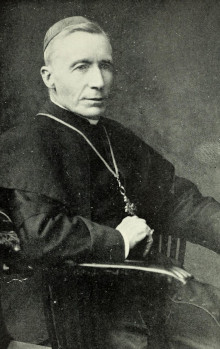
Birth of James Cardinal Gibbons, Archbishop of Baltimore

james-cardinal-gibbons

James Cardinal Gibbons, American prelate of the Catholic Church, is born in Baltimore, Maryland on July 23, 1834 to parents Thomas and Bridget (née Walsh) Gibbons who had emigrated from Toormakeady, County Mayo. In his role as Archbishop of Baltimore from 1877 to 1921, he serves as a bridge between Roman Catholicism and American Catholic values.

Gibbons is taken by his parents from Baltimore to Ireland in 1837. Following his father’s death in 1847, at the height of The Great Hunger, his mother moves the family back to the United States. He spends the next eight years as a grocer in New Orleans. In 1855 he enters a seminary in Baltimore, becoming a priest in 1861. He rises through the ranks of the Roman Catholic Church quickly, and by 1868 he is the youngest bishop in the United States. During a short stay in North Carolina, he writes The Faith of Our Fathers (1876), a defense of Catholicism that proves exceptionally popular, selling more than two million copies. He is elevated to Archbishop of Baltimore in 1877. He assumes a leadership role as the presiding prelate at the Third Plenary Council of Baltimore in 1884, and in 1886 he is made a cardinal by Pope Leo XIII.

As a leader of the Catholic Church hierarchy in the United States, Gibbons is outspoken in his praise for American democratic institutions and he advocates Americanization — the rapid assimilation of Catholic immigrants into American culture and institutions — both as a means to counter Protestant Americans’ suspicions toward Catholics and to avoid the fragmentation of the Catholic Church in the United States along ethnic lines. He is also sympathetic to the cause of organized labour and works to overcome suspicions within the Catholic Church toward the Knights of Labor, which has been considered a secret society by many clergymen.

On education, as on other social issues, Gibbons seeks ways of harmonizing the tenets of the Catholic faith with the principles of American democracy. He enters the controversy over control of parochial and public schools in 1891 when he defends Archbishop John Ireland’s experimental plan for cooperation between Catholic and public schools in the Minnesota towns of Faribault and Stillwater. To the dismay of conservative bishops, he refuses to condemn public education and encourages efforts to find common ground between the two systems. The Faribault-Stillwater plan remains controversial despite Gibbons’s support, and acrimony between the plan’s supporters and conservative opponents lingers until 1893.

During World War I, Gibbons is instrumental in the establishment of the National Catholic War Council, and afterwards supports the League of Nations. Although initially opposed to women’s suffrage, when the Nineteenth Amendment passes Gibbons urges women to exercise their right to vote “…not only as a right but as a strict social duty.”

James Cardinal Gibbons dies at the age of 86 in Baltimore on March 24, 1921. Throughout his career he is a respected and influential public figure. Although nonpartisan, he takes positions on a variety of foreign and domestic policy issues and is personally acquainted with every U.S. president from Andrew Johnson to Woodrow Wilson.


Leave a comment

Birth of William Vincent Wallace, Composer & Musician

william-vincent-wallace

William Vincent Wallace, Irish composer and musician, is born at Colbeck Street, Waterford, County Waterford on March 11, 1812. In his day, he is famous on three continents as a double virtuoso on violin and piano. Nowadays, he is mainly remembered as an opera composer of note, with key works such as Maritana (1845) and Lurline (1847/60), but he also writes a large amount of piano music that is much in vogue in the 19th century.

Wallace’s father, Spencer Wallace of County Mayo, becomes a regimental bandmaster with the North Mayo Militia based in Ballina. William is born while the regiment is stationed for one year in Waterford. The family returns to Ballina in 1816 and he spends his formative years there, taking an active part in his father’s band and already composing pieces by the age of nine for the band recitals.

Under the tuition of his father and uncle, Wallace writes pieces for the bands and orchestras of his native area. He becomes accomplished in playing various band instruments before the family leaves the Army in 1826, moving from Waterford to Dublin, and becoming active in music in the capital. He learns to play several instruments as a boy, including the violin, clarinet, organ, and piano. In 1830, at the age of 18, he becomes organist of the Roman Catholic Cathedral at Thurles, County Tipperary, and teaches music at the Ursuline Convent there. He falls in love with a pupil, Isabella Kelly, whose father consents to their marriage in 1832 on condition that Wallace become a Roman Catholic. The couple soon moves to Dublin where he is employed as a violinist at the Theatre Royal.

Economic conditions in Dublin deteriorate after the Acts of Union 1800 and the whole Wallace family decides to emigrate to Australia in 1835. Wallace’s party first lands at Hobart, Tasmania in late October, where they stay several months before moving on to Sydney in January 1836. The Wallaces open the first Australian music academy in April. Wallace has already given many celebrity concerts in Sydney, and being the first virtuoso to visit the Colony, becomes known as the “Australian Paganini.” He is also active in the business of importing pianos from London, but his main activity involves many recitals in and around Sydney under the patronage of the Governor, General Sir Richard Bourke. The most significant musical events of this period are two large oratorio concerts on behalf of the organ fund at St. Mary’s Cathedral in Sydney in 1836 and 1838, which he directs, and which utilize all the available musical talent of the Colony, including the recently formed Philharmonic [Choral] Society.

In 1838, Wallace separates from his wife and begins a roving career that takes him around the globe. In 1841, he conducts a season of Italian opera in Mexico City. Moving on to the United States, he stays in New Orleans for some years, where he is feted as a virtuoso on violin and piano, before reaching New York City, where he is equally celebrated, and publishes his first compositions (1843–44).

Wallace arrives in London in 1845 and makes various appearances as a pianist. In November of that year, his opera Maritana is performed at the Theatre Royal, Drury Lane with great success, and is later presented internationally. Maritana is followed by Matilda of Hungary (1847), Lurline (1847/60), The Amber Witch (1861), Love’s Triumph (1862) and The Desert Flower (1863). He also publishes numerous compositions for the piano.

In New York in 1843–1844, Wallace is associated with the early concert seasons of the New York Philharmonic Society, and in 1853 is elected an Honorary (Life) Member of the Society. In 1854, he becomes an American citizen after a marriage in New York to German-born pianist Hélène Stoepel, sister of composer Robert Stoepel. In later years, having returned to Europe for the premieres of his later operas, he develops a heart condition for which he receives treatment in Paris in 1864. He dies in poor circumstances at the Château de Bagen, Sauveterre-de-Comminges, in the Haute Garonne on October 12, 1865. He is buried in Kensal Green Cemetery, London.

(Pictured: William Vincent Wallace. Undated portrait by Mathew Brady, New York City, Library of Congress)


Leave a comment

Death of Colonel James Hagan

james-hagan

James Hagan, Irish American captain in the United States Army during the Mexican–American War and a Confederate States Army colonel during the American Civil War, dies in Mobile, Alabama on November 6, 1901.

Hagan is born in County Tyrone on June 17, 1822. His family moves to a farm near Philadelphia, Pennsylvania when he is still at an early age, and he is educated at Clermont Academy. He moves to Alabama in 1837. His prosperous uncle, John Hagen of New Orleans, Louisiana, takes him into the family business and sets him up in Mobile to manage the Hagan business there.

Hagan serves in John Coffee Hays‘s Texas Rangers, a cavalry unit in Major General Zachary Taylor‘s army during the Mexican–American War. He is recognized for his gallantry at the Battle of Monterrey. He is commissioned a captain in the 3rd U.S. Dragoons in 1848 and is discharged on July 31, 1848. After the war, he returns to Mobile where he purchases and subsequently manages a plantation rather than remaining in the family mercantile business. In 1854, he marries Bettie Oliver, daughter of Alabama’s attorney general.

At the beginning of the American Civil War, Hagan organizes and is elected captain of a cavalry company for the Alabama Militia, the “Mobile Dragoons,” which serves on guard duty along the Gulf Coast. At the rank of major he transfers to the 1st Mississippi Cavalry Regiment on October 26, 1861. The regiment fights at the Battle of Shiloh on April 6–7, 1862. He leads his men in a mounted charge at the Battle of Perryville, which is highly commended by his brigade commander, Brigadier General Joseph Wheeler.

Hagan is promoted to colonel of a new regiment, the 3rd Alabama Cavalry Regiment, on July 1, 1862. The regiment fights in all of the campaigns of the Army of Tennessee. In July 1863, He is assigned to command Brigade 1 of Brigadier General William T. Martin‘s Division of the Cavalry Corps of the Army of Tennessee, which is Major General Joseph Wheeler’s old brigade. During the spring and summer of 1863, the brigade screens the left front of General Braxton Bragg‘s army. Wheeler recommends that Hagan be promoted to brigadier general, but Bragg blocks the promotion because he says Hagan is in a state of “dissipation”, a reference to drunkenness or alcoholism. Hagan is wounded near Franklin, Tennessee in the winter of 1862 and again near Kingston, Tennessee in November 1863. In November 1863, he resigns and returns to Mobile to recover from his wounds and his disappointment from not being promoted.

After he recuperates, Hagan asks that his resignation be revoked. The resignation is revoked, and he returns to his regiment for the Atlanta campaign, where the regiment fights as infantry in the trenches. When Brigadier General William Wirt Adams is promoted to command of the Division, Hagan is assigned to permanent command of the brigade, consisting of five regiments and one battalion of Alabama cavalry. His brigade is part of Wheeler’s force which opposes Major General William Tecumseh Sherman‘s March to the Sea and Campaign of the Carolinas. He is wounded again at the Battle of Monroe’s Crossroads, near Kinston, North Carolina on March 10, 1865, and again at Fayetteville, North Carolina the next day.

Although Hagan is assigned as acting brigadier general in early 1865, he never receives an official appointment from Jefferson Davis or confirmation by the Confederate States Senate of an appointment as a general officer. Major General Wheeler later writes that he had been told unofficially by Confederate States War Department officials that brigadier general commissions had been issued for Hagan, Henry Marshall Ashby and Moses Wright Hannon near the end of the war, but no such commissions ever were delivered.

Hagan returns to Mobile after the war but is penniless since his fortune had been converted to Confederate money. He works as manager of a plantation on the Alabama River in the 1870s and early 1880s. President Grover Cleveland appoints him crier of the United States District Court in Alabama in 1885.

James Hagan dies on November 6, 1901, at Mobile, Alabama. He is buried in Magnolia Cemetery in Mobile.


Leave a comment

Death of Dick Dowling, Confederate Commander

Southern Methodist University, Central University Libraries, DeGolyer Library

Richard William “Dick” Dowling, the victorious confederate commander at the Second Battle of Sabine Pass in the American Civil War, dies of yellow fever in Houston, Texas on September 23, 1867.

Dowling is born in the townland of Knockballyvishteal, Milltown, County Galway on January 14, 1837, the second of eight children, born to tenant farmer Patrick and Bridget Dowling (née Qualter). Following the eviction of his family from their home in 1845, the first year of the Great Famine, nine-year-old Dowling leaves Ireland in 1846 with his older sister Honora, bound for New Orleans in the United States.

As a teenager, Dowling displays his entrepreneurial skills by successfully running the Continental Coffeehouse, a saloon in the fashionable French Quarter. His parents and siblings follow from Ireland in 1851, but the joy of reunion is short-lived. In 1853, a yellow fever outbreak in New Orleans takes the lives of his parents and one of his younger brothers. With rising anti-Irish feeling growing in New Orleans, following local elections which see a landslide victory for the “Know Nothing” party, Dowling moves to Houston in 1857.

In 1857 Dowling marries Elizabeth Ann Odlum, daughter of Benjamin Digby Odlum, a Kildare-born Irishman, who had fought in the Texas Revolution, being captured at the Battle of Refugio in 1836.

By 1860, Dowling owns a number of saloons. His most successful is named the Bank of Bacchus, located on Courthouse Square in downtown Houston. “The Bank” as it is known locally becomes Houston’s most popular social gathering place in the 1860s and is renowned for its hospitality. He is also involved in setting up Houston’s first gaslight company and is first to have it installed in his home and “The Bank.” He is a founding member of Houston’s Hook and Ladder Company Number One fire department and is also involved in running the city’s first streetcar company.

Prior to the outbreak of the American Civil War, Dowling makes a name for himself as an able and successful entrepreneur. Among other things, he is involved with a predominantly Irish militia company which serves a more social than military role in Houston society. Upon Secession, this militia company is mustered straight into the Confederate States Army, with Dowling being elected First Lieutenant. The unit names themselves the “Jefferson Davis Guards” in honor of Confederate President Jefferson Davis. The Davis Guards are initially part of a Texas State Troops/Confederate expedition sent to take over Union Army forts and arsenals along the border with Mexico. The expedition is successfully completed without a shot being fired. They participate in the Battle of Galveston on New Year’s Day 1863, following which they are assigned to a newly constructed artillery post near the mouth of the Sabine River called Fort Sabine.

Sabine Pass was important as a point of arrival and departure for blockade runners. It is suspected that the Union Army will attempt an invasion of Texas via Sabine Pass because of its value as a harbor for blockade runners and its proximity 18 miles southeast of Beaumont, which lies on the railroad between Houston and the eastern part of the Confederacy.

To negotiate Sabine Pass all vessels except small boats take one of the two river channels. No seagoing ship can traverse the Pass without great risk of running aground should it stray from one of the channels. The inevitable course of any steam-powered warship, including shallow-draft gunboats then common to the U.S. Navy, would use one of the channels, both of which are within fair range of the fort’s six smoothbores.

Dowling spends the summer of 1863 at the earthen fort instructing his men in gunnery. On September 8, 1863, a Union Navy flotilla of some 22 gunboats and transports with 5,000 men accompanied by cavalry and artillery arrive off the mouth of Sabine Pass. The plan of invasion is sound, but monumentally mismanaged. Four of the flanking gunboats are to steam up the pass at speed and draw the fire of the fort, two in each channel, a tactic which had been used successfully in subduing the defensive fortifications of Mobile and New Orleans prior to this. This time, however, Dowling’s artillery drills pay off as the Confederates pour a rapid and withering fire onto the incoming gunboats, disabling and capturing two, while the others retreat in disarray. The rest of the flotilla retreats from the mouth of the pass and returns ignominiously to New Orleans, leaving the disabled ships with no option but to surrender to Dowling. With a command of just 47 men, Dowling had thwarted an attempted invasion of Texas, in the process capturing two gunboats, some 350 prisoners and a large quantity of supplies and munitions.

The Confederate government offers its gratitude and admiration to Dowling, now promoted to Major, and his unit, as a result of their battlefield prowess. In gratitude, the ladies of Houston present the unit with specially struck medals, which are actually Mexican eight reale coins with both faces sanded down and inscribed “Sabine Pass, 1864” on one side and a Maltese cross with the letters D and G on the other. Because of the official recognition given to the action, it is now accepted that these Davis Guard Medals are the only medals of honor issued by the Confederate government, and consequently are collector’s items today.

After the battle of Sabine Pass Dowling is elevated to hero status in his hometown of Houston. He subsequently serves as a recruiter for the Confederacy and is personally commended for his action at the battle by Jefferson Davis. After the war he returns to his saloon business and quickly becomes one of the city’s leading businessmen.

Dowling’s promising future is cut short by another yellow fever epidemic which devastates Houston in the late summer of 1867, and he dies on September 23, 1867. He is buried at St. Vincent’s Catholic Cemetery, the oldest Catholic cemetery in Houston.


Leave a comment

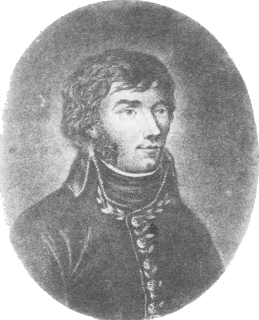
Death of General Jean Joseph Amable Humbert

jean-joseph-amable-humbert

General Jean Joseph Amable Humbert, French soldier and French Revolution participant who leads a failed invasion of Ireland to assist Irish rebels in the Irish Rebellion of 1798, dies on January 3, 1823, in New Orleans, Louisiana.

Born in the townland of La Coâre Saint-Nabord, outside Remiremont Vosges, Humbert is a sergeant in the National Guard of Lyon. He rapidly advances through the ranks to become brigadier general on April 9, 1794, and fights in the Western campaigns before being allocated to the Army of the Rhine.

In 1794, after serving in the Army of the Coasts of Brest, Humbert serves under Louis Lazare Hoche in the Army of the Rhin-et-Moselle. Charged to prepare for an expedition against Ireland, he takes command of the Légion des Francs under Hoche, sailing in the ill-fated Expédition d’Irlande against Bantry Bay in 1796, and is engaged in actions at sea against the Royal Navy. Contrary weather and enemy action force this expedition to withdraw. The trip home ends in a naval battle, the Action of 13 January 1797, during which Humbert, on the French ship Droits de l’Homme (1794), narrowly escapes death. As the ship is destroyed and sinks, hundreds of men perish, but Humbert is among the last to escape.

On his return to France, Humbert serves in the Army of the Sambre-et-Meuse, before being appointed to command the troops in another attempt to support a rising in Ireland in 1798. His command chiefly consists of infantry of the 70th demi-brigade with a few artillerymen and some cavalry of the 3rd Hussars, however by the time he arrives off the Irish coast the United Irish rising has already suffered defeat. The expedition is able to land in Ireland at Killala on Thursday August 23, 1798, meeting with initial success in the Battle of Castlebar where he routs the Irish Militia. Humbert subsequently declares a Republic of Connacht, with hopes of taking Dublin. However, Humbert’s small force is defeated at the Battle of Ballinamuck by the Irish Royal Army, and he is taken as a prisoner of war by the authorities. The British send the French officers home in two frigates and then massacre their Irish supporters. Humbert makes no attempt to save the Irish who bravely supported him.

Humbert is shortly repatriated in a prisoner exchange and appointed in succession to the Armies of Mayence, Danube and Helvetia, with which he serves at the Second Battle of Zurich. He then embarks for Santo Domingo and participates in several Caribbean campaigns for Napoleon Bonaparte before being accused of plundering by General Brunet. It is also rumored that he engages in an affair with Pauline Bonaparte, the wife of his commanding officer Charles Leclerc. He is returned to France by order of General Leclerc in October 1802, for “prevarications, and liaison relationships with organisers of the inhabitants and with leaders of brigands.” A committed Republican, his displeasure at Napoleon’s Imperial pretensions lead to him being dismissed in 1803 and he retires to Morbihan in Brittany.

In 1810, after brief service in the Army of the North, Humbert emigrates to New Orleans, where he makes his acquaintance with French pirate Jean Lafitte. In 1813, Humbert joins the revolutionary Juan Bautista Mariano Picornell y Gomila in an unsuccessful attempt to foment rebellion in Spanish Mexico, but the effort fails. In 1814, Humbert again leaves New Orleans and joins the rebelling forces of Buenos Aires, briefly commanding a corps, before returning home. Humbert last fights the British at the Battle of New Orleans, as a volunteer private soldier in U.S. ranks, in the War of 1812, wearing his Napoleonic uniform. General Andrew Jackson thanks him for his assistance there after the American victory in January 1815. Thereafter Humbert lives peacefully as a schoolteacher until his death on January 3, 1823.

A monument to General Humbert depicting Mother Ireland stands on Humbert Street, Ballina, County Mayo. In 1989, sculptor Carmel Gallagher unveils a bust of General Humbert in Killala, Ireland, to mark the upcoming bicentennial of the Irish Rebellion of 1798.


Leave a comment

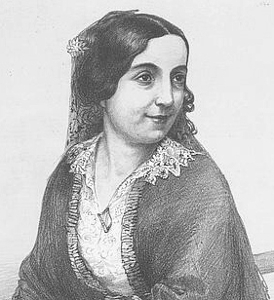
Birth of Soprano Catherine Hayes

Catherine Hayes, world-famous Irish soprano of the Victorian era, is born in Limerick, County Limerick, on October 25, 1818. According to London‘s Daily Express, “Hayes was the ‘Madonna‘ of her day; she was the 19th-century operatic equivalent of the world’s most famous pop star.”

Hayes is born into abject poverty. After five years of vocal study in Paris and Milan she makes her debut at the Italian Opera in Marseilles, in Vincenzo Bellini‘s I Puritani in May 1845, followed by performances of Gaetano Donizetti‘s Lucia di Lammermoor and Gioachino Rossini‘s Mosé in Egitto.

Her debut at La Scala in Milan quickly followed in 1845 with phenomenal success. Shortly thereafter the young Giuseppe Verdi becomes interested in her for one of his new operas. Her great success continues in Vienna, as well as in Venice, Florence, Genoa, Rome and other cities in Italy, where she becomes the most sought after Lucia di Lammermoor.

Early in 1849, Hayes accepts a contract to sing at the Royal Opera House, Covent Garden, London where she makes her debut in Linda di Chamounix in April. In June 1849, she receives an invitation to sing at Buckingham Palace for Queen Victoria and 500 guests. After an evening of Italian music, when the Queen requests an encore, Hayes with a smile sings the beautiful Irish rebel songKathleen Mavourneen.”

During Ireland’s Great Famine in November 1849, her emotional return to her native country results in rave notices for her performance in Lucia di Lammermoor and other operas and concerts in Dublin, Limerick and Cork. Her success is now almost complete.

In 1851 Hayes goes to the United States, where Jenny Lind is creating such a wave of success. Hayes gives concerts in New York City, Boston, Toronto, Philadelphia, Washington, D.C., Charleston, Savannah and New Orleans and forty-five other places including the river towns along the Mississippi River, with equal success. She meets presidents, statesmen and business leaders along the way. She is also destined to meet her future lover and husband in America, Jenny Lind’s former manager. Her travels take her to the “gold rush” in the San Francisco area in the 1850s, where her presence creates a furor, singing for the miners and the elite of San Francisco. The great showman P.T. Barnum sponsors her tour.

She sings in opera and concerts in Peru and Chile, then travels to Hawaii where she gives a concert before continuing on to Australia. Hayes is the first great European opera star to visit Australia. She is mentioned in most Australian history books about early culture in the young colony.  She also travels to Calcutta, India where she performs for the British Military and then on to Singapore and Batavia (Java) before returning to Australia for more opera and concerts.

Hayes returns to England in August 1856, after an absence of five years.  On October 8, 1857, at St. George’s, Hanover Square, she marries William Avery Bushnell. He soon falls into ill-health and dies at Biarritz, France, on July 2, 1858. After her husband’s death she takes part in concerts in London and the country towns.

Catherine Hayes dies in the house of a friend, Henry Lee, at Roccles, Upper Sydenham, Kent, on August 11, 1861, and is buried in Kensal Green Cemetery.