Joe Heaney, traditional Irish singer also known as Joe Éinniú or Seosamh Ó hÉanaí, dies in Seattle, Washington on May 1, 1984. He spends most of his adult life abroad, living in England, Scotland and New York City, in the course of which he records hundreds of songs.
Heaney is born Carna, a remote village in the Irish-speaking district of Connemara, County Galway, along the west coast of Ireland on October 15, 1919. He starts singing at the age of five, but his shyness keeps him from singing in public until he is 20. He learns English at school in Carna. When he is 16 years old, he wins a scholarship to attend school in Dublin. While there he wins first and second prizes at a national singing competition. Most of his repertoire, estimated to exceed 500 songs, is learned while growing up in Carna.
In 1949, Heaney goes to London where he works on building sites and becomes involved in the folk-music scene. He records for the Topic Records and Gael Linn Records labels. He is married for six years until his wife dies of tuberculosis.
Heaney is recorded by Pádraic Ó Raghallaigh for Raidió Teilifís Éireann, and by Peter Kennedy for the BBC in 1959. The BBC recordings are assembled on a BBC LP, not commercially issued, as BBC LP 22570.
Joe Heaney dies of emphysema in Seattle on May 1, 1984. The Joe Heaney Collection of the University of Washington Ethnomusicology Archives is established after his death. The Féile Chomórtha Joe Éinniú (Joe Heaney Commemorative Festival) is held every year in Carna. An Irish-language biography of him has been written by Liam Mac Con Iomaire, and a biography that discusses his work in the larger context of Ireland and the United States was published in 2011 by Sean Williams and Lillis Ó Laoire.
The British become aware of Conyngham’s plans and manage to maneuver him out of his ship with the help of the Dutch. After the loss of his ship, he heads back to France, hoping to connect with an ally to the United States. It is there he meets Benjamin Franklin, who helps him in his adventures many times in the future. They form a lasting relationship, and Conyngham eventually awards Franklin the nickname “the Philosopher” for his intellectual fortitude and resourcefulness. Franklin is entrusted with several commissions of the Continental Navy, and on March 1, 1777, Conyngham is appointed Captain of the luggerSurprise.
Conyngham scores a first victory that would warm the heart of any Irishmen, capturing the British merchant shipPrince of Orange on May 3, 1777. Later that year he is commissioned a captain in the Continental Navy and given command of the USS Revenge. He begins a series of highly successful raids into British waters from the port of Dunkirk, thus earning his sobriquet “The Dunkirk Pirate.”
In 1778 Conyngham sets sail for the West Indies and terrorizes British vessels there before finally returning to Philadelphia on February 21, 1779. He and his men had claimed 60 prize vessels in just 18 months. When he sets sail again his luck runs out and his ship is captured by the British vessel HMS Galatea on April 27, 1779. Conyngham was taken to prison in England and treated harshly by his British captors.
After two failed escape attempts, Conyngham tunnels his way out of Mill Prison in Plymouth and manages to make his way to the continent. He joins John Paul Jones on a cruise on the Alliance before returning to the United States. He is captured by the British again in March 1780 and spends another year in Mill Prison.
After the war Conyngham fails in his efforts to continue his naval career or to gain recognition from the United States Congress for his service during the war. He had lost the commission papers given to him by colonial representatives in Paris in 1777. It is said that he assists in the defense of Philadelphia against his old British foes during the War of 1812.
Gustavus Conyngham dies in Philadelphia seven years later on November 27, 1819. Nearly a century later, John Sanford Barnes, a retired navy captain and naval historian, acquires a cache of autographs and documents from a sale by Charavay of Paris. In the collection is Conyngham’s commission from Benjamin Franklin. Barnes publishes his discovery in September 1902, proving that the “Dunkirk Pirate” had never been a pirate at all, but one of the first heroes of the United States Navy.
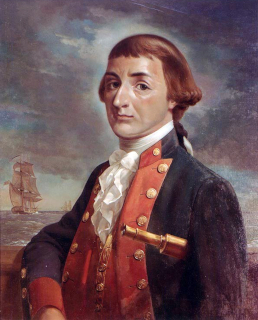
(Pictured: Captain Gustavus Conyngham, Continental Navy. Painting by V. Zveg, 1976, based on a miniature by Louis Marie Sicardi. Courtesy of the U.S. Navy Art Collection, Washington, D.C. U.S. Naval Historical Center Photograph.)
Devlin and his family return to live in Dublin in 1918. He studies at Belvedere College and, from 1926, as a seminarian for the Roman Catholicpriesthood at Clonliffe College. As part of his studies he attends a degree course in modern languages at University College Dublin (UCD), where he meets and befriends Brian Coffey. Together they publish a joint collection, Poems, in 1930.
In 1927, Devlin abandons the priesthood and leaves Clonliffe. He graduates with his BA from UCD in 1930 and spends that summer on the Blasket Islands to improve his spoken Irish. Between 1930 and 1933, he studies literature at the University of Munich and the Sorbonne in Paris, meeting, amongst others, Beckett and Thomas MacGreevy. He then returns to UCD to complete his MAthesis on Michel de Montaigne.
Devlin joins the Irish Diplomatic Service in 1935 and spends a number of years in Rome, New York and Washington, D.C.. During this time he meets the French poet Saint-John Perse, and the Americans Allen Tate and Robert Penn Warren. He goes on to publish a translation of Exile and Other Poems by Saint-John Perse, and Tate and Warren edit his posthumous Selected Poems.
Since his death on August 21, 1959, there have been two Collected Poems published; the first in 1964 is edited by Coffey and the second in 1989 by J.C.C. Mays.
Just before midnight on April 14, 1912 in the North Atlantic, the RMS Titanic, the world’s largest ship, fails to divert its course from an iceberg, ruptures five compartments along its starboard side, and begins to sink. The liner, four days into her maiden voyage from Southampton to New York City, sinks at 2:20 AM on the morning of April 15, 1912.
RMS Titanic‘s maiden voyage, commanded by 62-year-old Captain Edward John Smith, begins shortly after noon on April 10, 1912 when she leaves Southampton on the first leg of her journey to New York City. A few hours later she reaches Cherbourg, France, where she takes on passengers. Her next port of call is Queenstown (now Cobh) in Ireland, which she reaches around midday on April 11. After taking on more passengers and stores, RMS Titanic departs in the afternoon with an estimated 2,224 people on board.
RMS Titanic receives six warnings of sea ice on April 14 but is traveling near her maximum speed when her lookouts sight the iceberg. Unable to turn quickly enough, the ship suffers a glancing blow that buckles her starboard side and opens five of her sixteen compartments to the sea. RMS Titanic has been designed to stay afloat with four of her forward compartments flooded but not more, and the crew soon realises that the ship is going to sink. They use distress flares and wireless radio messages to attract help as the passengers are put into lifeboats. However, in accordance with existing practice, RMS Titanic‘s lifeboat system is designed to ferry passengers to nearby rescue vessels, not to hold everyone on board simultaneously. With the ship sinking quickly and help still hours away, there is no safe refuge for many of the passengers and crew. Compounding this, poor management of the evacuation means many boats are launched before they are totally full.
At about 2:15 AM, RMS Titanic‘s angle in the water begins to increase rapidly as water pours into previously unflooded parts of the ship through deck hatches. Her suddenly increasing angle causes a giant wave to wash along the ship from the forward end of the boat deck, sweeping many people into the sea. RMS Titanic‘s stern lifts high into the air as the ship tilts down in the water, reaching an angle of 30–45 degrees. After another minute, the ship’s lights flicker once and then permanently go out, plunging RMS Titanic into darkness. Shortly after the lights go out, the ship splits apart at one of the weakest points in the structure, the area of the engine room hatch. The submerged bow likely remains attached to the stern by the keel for a short time, pulling the stern to a high angle before separating and leaving the stern to float for a few minutes longer. The forward part of the stern floods very rapidly, causing it to tilt and then settle briefly before sinking.
RMS Titanic sinks with over a thousand passengers and crew still on board. Almost all those who jump or fall into the water die from hypothermia within minutes. RMS Carpathia arrives on the scene about 90 minutes after the sinking and has rescued the last of the survivors by 9:15 AM on April 15, some nine and a half hours after the collision with the iceberg.
The death toll has been put at 1,513, including many Irish, although the number of casualties remains somewhat unclear due to a number of factors, including confusion over the passenger list, which includes some names of people who cancelled their trip at the last minute, and the fact that several passengers traveled under aliases for various reasons and were double-counted on the casualty lists.
The disaster causes widespread outrage over the lack of lifeboats, lax regulations, and the unequal treatment of the three passenger classes during the evacuation. Subsequent inquiries recommend sweeping changes to maritime regulations, leading to the establishment in 1914 of the International Convention for the Safety of Life at Sea (SOLAS), which still governs maritime safety today.
Ford is born to Edward Ford (1805-1880) and Ann Ford (1815-1893), emigrating with his parents to Boston, Massachusetts in 1845, never returning to Ireland. He writes in the Irish World in 1886 that “I might as well have been born in Boston. I know nothing of England. I brought nothing with me from Ireland — nothing tangible to make me what I am. I had consciously at least, only what I found and grew up with in here.”
Ford leaves school at the age of thirteen and two years later is working as a printer’s devil for William Lloyd Garrison‘s The Liberator. He credits Garrison for his advocacy for social reform. He begins writing in 1855 and by 1861 is editor and publisher of the Boston Tribune, also known as the Boston Sunday Tribune or Boston Sunday Times. He is an abolitionist and pro-union.
Ford spends four years after the war in Charleston, South Carolina, editing the Southern Carolina Leader, printed to support newly freed slaves. He settles in New York City in 1870 and founds the Irish World, which becomes the principal newspaper of Irish America. It promises “more reading material than any other paper in America” and outsells John Boyle O’Reilly‘s The Pilot.
In 1878, Ford re-titles his newspaper, the Irish World and American Industrial Liberator. During the early 1880s, he promotes the writings of land reformer, Henry George in his paper.
In 1880, Ford begins to solicit donations through the Irish World to support Irish National Land League activities in Ireland. Funds received are tabulated weekly under the heading “Land League Fund.” Between January and September 1881 alone, more than $100,000 is collected in donations. British Prime MinisterWilliam Ewart Gladstone later states that without the funds from the Irish World, there would have been no agitation in Ireland.”
Peck’s parents divorce when he is five years old. An only child, he is sent to live with his grandmother. He never feels as though he has a stable childhood. His fondest memories are of his grandmother taking him to the movies every week and of his dog, which follows him everywhere.
At the age of ten Peck is sent to a Catholic military school, St. John’s Military Academy in Los Angeles. While he is a student there, his grandmother dies. At 14, he moves back to San Diego to live with his father and attends San Diego High School. After graduating he enrolls for one year at San Diego State Teacher’s College (now known as San Diego State University).
With a string of hits to his credit, Peck makes the decision to only work in films that interest him. He continues to appear as the heroic, larger-than-life figures in such films as Captain Horatio Hornblower R.N. (1951) and Moby Dick (1956). He works with Audrey Hepburn in her debut film, Roman Holiday (1953).
Peck finally wins the Oscar, after four nominations, for his performance as lawyer Atticus Finch in To Kill a Mockingbird (1962). In the early 1960s, he appears in two darker films than he usually makes, Cape Fear (1962) and Captain Newman, M.D. (1963), which deal with the way people live. He also gives a powerful performance as Captain Keith Mallory in The Guns of Navarone (1961), one of the biggest box-office hits of that year.
In the early 1970s, Peck produces two films, The Trial of the Catonsville Nine (1972) and The Dove (1974), when his film career stalled. He makes a comeback playing, somewhat woodenly, Robert Thorn in the horror film The Omen (1976). After that, he returns to the bigger-than-life roles he is best known for, such as MacArthur (1977) and the monstrous Nazi Dr. Josef Mengele in the huge hit The Boys from Brazil (1978). In the 1980s, he moves into television with the miniseriesThe Blue and the Gray (1982) and The Scarlet and the Black (1983). In 1991, he appears in the remake of his 1962 film, playing a different role, in Martin Scorsese‘s Cape Fear (1991). He is also cast as the progressive-thinking owner of a wire and cable business in Other People’s Money (1991).
In 1967, Peck receives the Academy’s Jean Hersholt Humanitarian Award. He has also been awarded the Presidential Medal of Freedom. Always politically progressive, he is active in such causes as anti-war protests, workers’ rights and civil rights. In 2003, Peck’s portrayal of Atticus Finch is named the greatest film hero of the past 100 years by the American Film Institute.
Gregory Peck dies in his sleep at his home in Los Angeles, California from bronchopneumonia at the age of 87 on June 12, 2003. He is entombed in the Cathedral of Our Lady of the Angels mausoleum in Los Angeles. His eulogy is read by Brock Peters, whose character, Tom Robinson, was defended by Peck’s Atticus Finch in To Kill a Mockingbird.
John Millington Synge, a leading figure in the Irish Literary Revival, dies in Dublin, on March 24, 1909. He is a poetic dramatist of great power who portrays the harsh rural conditions of the Aran Islands and the western Irish seaboard with sophisticated craftsmanship.
After studying at Trinity College and at the Royal Irish Academy of Music in Dublin, Synge pursues further studies from 1893 to 1897 in Germany, Italy, and France. In 1894 he abandons his plan to become a musician and instead concentrates on languages and literature. He meets William Butler Yeats while studying at the Sorbonne in Paris in 1896. Yeats inspires him with enthusiasm for the Irish renaissance and advises him to stop writing critical essays and instead to go to the Aran Islands and draw material from life. Already struggling against the progression of Hodgkin’s lymphoma which is untreatable at the time and eventually leads to his death, Synge lives in the islands during part of each year between 1898 and 1902, observing the people and learning their language, recording his impressions in The Aran Islands (1907) and basing his one-act plays In the Shadow of the Glen and Riders to the Sea (1904) on islanders’ stories. In 1905 his first three-act play, The Well of the Saints, is produced.
Synge’s travels on the Irish west coast inspire his most famous play, The Playboy of the Western World (1907). This morbid comedy deals with the moment of glory of a peasant boy who becomes a hero in a strange village when he boasts of having just killed his father but who loses the villagers’ respect when his father turns up alive. In protest against the play’s unsentimental treatment of the Irishmen’s love for boasting and their tendency to glamorize ruffians, the audience riots at its opening at Dublin’s Abbey Theatre. Riots of Irish Americans accompany its opening in New York City in 1911, and there are further riots in Boston and Philadelphia. Synge remains associated with the Abbey Theatre, where his plays gradually win acceptance, until his death. His unfinished Deirdre of the Sorrows, a vigorous poetic dramatization of one of the great love stories of Celtic mythology, is performed there in 1910.
In the seven plays he writes during his comparatively short career as a dramatist, Synge records the colourful and outrageous sayings, flights of fancy, eloquent invective, bawdy witticisms, and earthy phrases of the peasantry from County Kerry to County Donegal. In the process he creates a new, musical dramatic idiom, spoken in English but vitalized by Irish syntax, ways of thought, and imagery.
The Irish Emigrant Society is founded in New York City on March 22, 1841.
The Irish and other emigrants face numerous abuses such as “illusive advertisements,” “crooked contractors,” “dishonest prospectuses” and “remittent sharpers” when they arrive in the United States. The Irish Emigrant Society is founded in 1841 by a group of New York Irish to combat issues such as these.
In December 1848 the Emigrant Society advises emigrants that as soon as their ship comes into harbour she will be boarded by an agent of the Society who will offer them sound and honest advice. In addition they warn that the ship will also be boarded by a large number of “runners” – conmen who will make it their business to attract them to the boarding houses that employ them. Emigrants are instructed be careful not to accept help from them as their ploy is to promise good quality board at low prices, but when they come to leave the house an exorbitant fee will be demanded. They will threaten not to hand over luggage unless this fee is paid and violent scenes might often ensue.
The Society warns that many persons, some of Irish birth, have set up offices in the city where they claim to be agents for railroad and steamboat enterprises. These crooks sell tickets which appear to entitle the holder to travel to specific destinations but which are worthless. To protect emigrants from such frauds, various measures are introduced in New York in 1848 including the construction of reception centres and the licensing of steam boats to take emigrants from the quarantine to the landing piers. Boarding houses are also required to display their prices in English, Dutch, German, Welsh and French.
Emigrants who survive the ordeal of the crossing are faced with the decision of where to settle in America. Newspapers carry advertisements singing the praises of the land and climate of Illinois, Iowa, Minnesota and Michigan but never mention the backbreaking work of clearing the land for farming. California also proves to be a very popular destination when news of the California Gold Rush breaks in 1849. It also provides opportunities on the lands that the Native Americans have deserted in search of gold.
(From: “1841 – The Irish Emigrant Society Is Founded In New York,” Stair na hÉireann, https://stairnaheireann.net)
Grace is born on May 10, 1832, in Ireland in Riverstown near the Cove of Cork to James Grace and Eleanor May Russell (née Ellen) while the family is away from home. He is raised on Grace property at Ballylinan in Queens County, now County Laois, near the town of Athy. He is a member of a prominent and well-to-do family. In 1846, he sails for New York against the wishes of his father and works as a printer’s devil and a shoemaker’s helper before returning to Ireland in 1848.
His nephew, Cecil Grace, attempts a crossing of the English Channel in December 1910 in an airplane, flying from Dover to Calais. However, in coming back he becomes disoriented and over Dover flies northeast over the Goodwin Sands toward the North Sea and is lost.
Grace and his father travel to Callao, Peru, in 1851, seeking to establish an Irish agricultural community. While his father returns home, William remains and begins work with the firm of John Bryce and Co., as a ship chandler. In 1854, the company is renamed Bryce, Grace & Company, in 1865, to Grace Brothers & Co., and ultimately to W. R. Grace and Company.
On September 11, 1859, Grace is married to Lillius Gilchrist, the daughter of George W. Gilchrist, a prominent ship builder of Thomaston, Maine, and Mary Jane (née Smalley) Gilchrest. Together, they have eleven children.
Opposing the famous Tammany Hall, Grace is elected as the first Irish American Catholic mayor of New York City in 1880. He conducts a reform administration attacking police scandals, patronage and organized vice, reduces the tax rate, and breaks up the Louisiana State Lottery Company. Defeated in the following election, he is re-elected in 1884 on an Independent ticket but loses again at the following election. During his second term, he receives the Statue of Liberty as a gift from France.
William R. Grace dies on March 21, 1904, at his residence, 31 East 79th Street, in New York City. His funeral is held at St. Francis Xavier Church on West 16th Street, and he is buried at the Holy Cross Cemetery in Brooklyn. At the time of his death his estate is valued at $25,000,000.
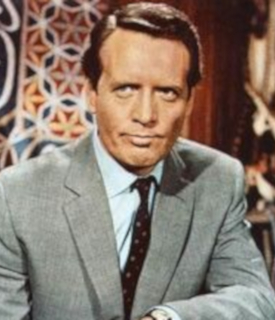
McGoohan is the son of Rose (Fitzpatrick) and Thomas McGoohan, who are living in the United States after emigrating from Ireland to seek work. He is brought up as a Catholic. Shortly after he is born, his parents move back to Mullaghmore, County Leitrim. Seven years later they emigrate to Sheffield, England.
McGoohan attends St. Vincent’s School and De La Salle College in Sheffield. During World War II, he is evacuated to Loughborough, Leicestershire. There he attends Ratcliffe College, where he excels in mathematics and boxing. He leaves school at the age of 16 and returns to Sheffield, where he works as a chicken farmer, a bank clerk, and a lorry driver before getting a job as a stage manager at Sheffield Repertory Theatre. When one of the actors becomes ill, McGoohan is substituted for him, launching his acting career.
McGoohan is most closely identified with two 1960s British television series, Danger Man and The Prisoner. The espionage drama Danger Man, which runs in the United States as Secret Agent, runs for 86 episodes during 1960–1961 and 1964–1967. The cult hit The Prisoner runs for 17 episodes in 1967–1968.
In Danger Man McGoohan puts a new spin on the secret agent formula by refusing to allow his character, John Drake, to carry a gun or indulge in sexual dalliances. The show’s success makes him Britain’s highest-paid TV actor.
McGoohan is one of several actors considered for the role of James Bond in Dr. No. While McGoohan turns down the role on moral grounds, the success of the Bond films is generally cited as the reason for Danger Man being revived in 1964. He is later considered for the Bond role in Live and Let Die but again turns it down.
The success of Danger Man provides McGoohan the leverage he needs to produce The Prisoner, an allegorical Kafkaesque series in which he portrays Number Six, an unnamed agent, thought by many to represent Drake, who angrily resigns and is then held captive in a superficially banal place called The Village, where the mysterious unseen Number One, the ever-changing Number Two, and others try to overcome the fiercely individualistic Number Six’s escape attempts and pry information from him.
McGoohan’s later works include the short-lived medical mystery series Rafferty (1977), such films as Ice Station Zebra (1968), Escape from Alcatraz (1979), and Braveheart (1995), the Broadway spy drama Pack of Lies (1985), and a record four guest-villain appearances on the American detective series Columbo, two of which earned him Emmy Awards. He also directs and writes several episodes of The Prisoner and Columbo. One of his last roles is as Number Six in a 2000 episode of the animated TV comedy The Simpsons.




 The Irish Emigrant Society is founded in