seamus dubhghaill

Promoting Irish Culture and History from Little Rock, Arkansas, USA


1 Comment

Birth of Michael James O’Hehir, Commentator & Journalist

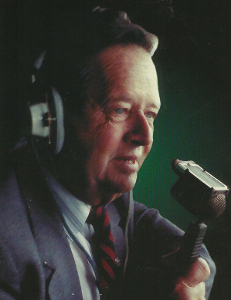
michael-james-ohehirMichael James O’Hehir, hurling, Gaelic football and horse racing commentator and journalist, is born on June 2, 1920, in Glasnevin, County Dublin. Between 1938 and 1985 his enthusiasm and a memorable turn of phrase endears him to many. He is credited with being the “Voice of the Gaelic Athletic Association.”

His father, Jim O’Hehir, is active in Gaelic games, having trained his native county to win the 1914 All-Ireland Senior Hurling Championship title in hurling. He subsequently trains the Leitrim football team that secures the Connacht Senior Football Championship title in 1927 and he also serves as an official with the Dublin Junior Board.

O’Hehir is educated at St. Patrick’s National School in Drumcondra before later attending the O’Connell School. He later studies electrical engineering at University College Dublin, however, he abandons his studies after just one year to pursue a full-time career in broadcasting.

At the age of eighteen O’Hehir writes to Radio Éireann asking to do a test commentary. He is accepted and is asked to do a five-minute microphone test for a National Football League game between Wexford and Louth. His microphone test impresses the director of broadcasting so much that he is invited to commentate on the entire second half of the match.

Two months later, in August 1938, O’Hehir makes his first broadcast – the All-Ireland football semi-final between Monaghan and Galway. The following year he covers his first hurling final – the famous “thunder and lightning final” between Cork and Kilkenny.

By the mid-1940s O’Hehir is recognised as one of Ireland’s leading sports broadcasters. In 1947 he faces his most challenging broadcast to date when he has to commentate on the All-Ireland Football Final from the Polo Grounds in New York City with over 1,000,000 people listening to the broadcast back in Ireland.

In 1944 O’Hehir joins the staff of Independent Newspapers as a sports sub-editor, before beginning a seventeen-year career as racing correspondent in 1947.

In 1961 Ireland’s first national television station, Telefís Éireann, is founded and O’Hehir is appointed head of sports programmes. In addition to his new role O’Hehir continues to keep up a hectic schedule of commentaries.

O’Hehir’s skills do not just confine him to sports broadcasting and, in November 1963, he faces his toughest broadcast. By coincidence he is on holidays with his wife Molly in New York City when U.S. President John F. Kennedy is assassinated. O’Hehir is asked by Telefís Éireann to provide the commentary for the funeral. The live five-hour broadcast proves a huge challenge for him, as he has had no association with political or current affairs broadcasting up to that point and lacks the resources available to more established television stations. O’Hehir’s commentary, however, wins widespread acclaim in Ireland and shows a different side of his nature.

In August 1985 O’Hehir is preparing to commentate on the All-Ireland hurling final between Offaly and Galway. It would be a special occasion as it would mark his 100th commentary on an All-Ireland final. Two weeks before the game he suffers a stroke which leaves him in a wheelchair and with some speaking difficulties. This denies him the chance to reach the century milestone. He hopes to return to broadcasting one day to complete his 100th final, however, this never happens.

In 1987, the centenary All-Ireland football final takes place Croke Park. The biggest cheer of the day is reserved for O’Hehir when he is pushed onto the field in a wheelchair by his son Peter. Nobody expects the standing ovation and the huge outpouring of emotion from the thousands of fans present and from O’Hehir himself.

Over the next few years O’Hehir withdraws from public life. He returns briefly in 1996 when his autobiography, My Life and Times, is published. Michael O’Hehir dies in Dublin on November 24, 1996.

5 Comments

Death of Irish American Mobster Mickey Spillane

Michael J. Spillane, Irish American mobster much better known as Mickey Spillane from Hell’s KitchenNew York City, is killed outside his apartment in Queens on May 13, 1977. Spillane, who is called the “last of the gentleman gangsters,” is a marked contrast to the violent Westies mob members who succeed him in Hell’s Kitchen.

As a young boy in Hell’s Kitchen, Spillane starts as a numbers runner for various organized crime figures in his neighborhood. In 1960, he takes over the rackets left to him by his predecessor Hughie Mulligan. He marries Maureen McManus, the daughter of the Democratic district leader Eugene McManus.

Though Italian mobsters dominate organized crime in the city, the Italian mob stays out of Hell’s Kitchen while Spillane is the boss. Often, Spillane kidnaps members of the Italian Mafia and holds them for ransom to raise money for his operations. Although he runs the rackets such as gambling and loansharking, he never allows the sale of drugs.

It is Spillane’s refusal to allow the Italian mobsters to participate in the Hell’s Kitchen rackets that leads to his downfall. The Jacob K. Javits Convention Center is being built on Spillane’s westside at the time. The amount of money the new convention center, Madison Square Garden, the waterfront and the unions are generating for Spillane is enormous, and the Italians are desperate for a piece of the action. Spillane refuses to allow the Italian mob to participate, and the New York Irish-Italian Mob War begins.

In the 1970s the Irish mob sees an increased threat from the Italian Mafia as the Genovese crime family seeks control over the soon to be built Jacob K. Javits Convention Center. Since the convention center is located in Spillane’s Hell’s Kitchen neighborhood, Spillane refuses to allow any involvement by the Italians. Although the Italian gangsters greatly outnumber the members of the Irish mob, Spillane is successful in keeping control of the convention center and Hell’s Kitchen. The Italians, frustrated and embarrassed by their defeat to Spillane and the Irish gangsters, respond by hiring a rogue Irish American hitman named Joseph “Mad Dog” Sullivan to assassinate Tom DevaneyEddie “the Butcher” Cummiskey, and Tom “the Greek” Kapatos, three of Spillane’s chief lieutenants. By the mid-1970s, Spillane has moved his family out of Hell’s Kitchen to Woodside, Queens, because of threats of violence against his children.

In 1966, a young upstart named Jimmy Coonan attempts to take the neighborhood from Spillane, muscling in on his territory and murdering a Spillane underling. Ultimately, Coonan is sent to prison in 1967. When he is released from prison, Coonan seeks to align himself with the Gambino crime family through an up-and-coming mobster from Brooklyn, named Roy DeMeo. This marks the beginning of the end for the Irish mob, as Coonan eventually goes to work for the Gambinos.

On May 13, 1977, Spillane is killed outside his apartment in Queens. It has long been rumored that DeMeo murdered Spillane as a favor to Coonan, who subsequently takes over as the boss of the Hell’s Kitchen Irish Mob. Spillane is buried in Calvary Cemetery in Queens, New York.


Leave a comment

Founding of the Ancient Order of Hibernians in America

The Ancient Order of Hibernians (AOH) is founded in the United States on May 4, 1836, at St. James’ Roman Catholic Church in New York City, near the old Five Points neighbourhood. A branch is formed the same year at Pottsville, Pennsylvania. The existence and activities of the Order are concealed for some years.

During the late 1860s and early 1870s many of the lodges of the order in Pennsylvania are infiltrated by the Molly Maguires. However, the Molly Maguires and their criminal activities are condemned at the 1876 national convention of the AOH, and the Order is reorganised in the Pennsylvania coal areas.

In 1884 there is a split in the organisation. The Order has previously been governed by the Board of Erin, which has governed the order in Ireland, Great Britain and the United States, but is composed of officers selected exclusively by the organisations in Ireland and Great Britain. The majority leave in 1884 and become the Ancient Order of Hibernians of America, while the small group calls itself Ancient Order of Hibernians, Board of Erin. In 1897 the Ancient Order of Hibernians, Board of Erin, has approximately 40,000 members concentrated in New YorkNew JerseyOhioIllinois, and Michigan, while the Ancient Order of Hibernians of America has nearly 125,000 members scattered throughout nearly every state in the union. The two groups reunite in 1898.

female auxiliary, the Daughters of Erin, is formed in 1894, and has 20,000 members in 1897. It is attached to the larger, “American” version of the order. The AOH has 181,000 members in 1965 and 171,000 in 736 local units of “Divisions” in 1979. John F. Kennedy joins the AOH in 1947.

The Ladies Ancient Order of Hibernians (LAOH) raises $50,000 to build the Nuns of the Battlefield sculpture in Washington, D.C., which the United States Congress authorises in 1918. The Irish American sculptor, Jerome Connor, ends up suing the Order for non-payment.

In 1982, in a revival of Hibernianism, the Thomas Francis Meagher Division No. 1 forms in Helena, Montana, dedicated to the principles of the Order and to restoring a historically accurate record of Brigadier General Meagher’s contributions to Montana. Soon after, six additional divisions form in Montana.

The Order organises the New York City St. Patrick’s Day Parade for 150 years, emphasising a conservative Catholic interpretation of the Irish holiday. In 1993 control is transferred to an independent committee amid controversy over the exclusion of Irish American gay and lesbian groups.

The Brothers of St. Patrick Division of the Ancient Order of Hibernians in America is established at Brother’s of St. Patrick in Midway City, California, in 1995.

In 2013, The Ancient Order of Hibernians raises and distributes over $200,000 to aid victims of Hurricane Sandy.

In 2014, the AOH calls for a boycott of Spencer’s Gifts, for selling products the AOH says promote anti-Irish stereotypes and irresponsible drinking.

On May 10, 2014, a memorial to Commodore John Barry, an immigrant from Wexford who is a naval hero of the American Revolution and who holds commission number one in the subsequent United States Navy, is dedicated on the grounds of the United States Naval Academy. The memorial and associated “Barry Gate” are presented to the Academy by the members of the Ancient Order of Hibernians.

Several buildings of the Ancient Order of Hibernians are listed on the U.S. National Register of Historic Places or are otherwise notable.


Leave a comment

King James I Grants License for Old Bushmills Distillery

King James I grants a license to Sir Thomas Phillips, landowner and Governor of County Antrim, for the Old Bushmills distillery on April 20, 1608. The distillery is thought to date from at least 1276 making it the oldest distillery in the world.

The Bushmills Old Distillery Company itself is not established until 1784 by Hugh Anderson. Bushmills suffers many lean years with numerous periods of closure with no record of the distillery being in operation in the official records both in 1802 and in 1822. In 1860 a Belfast spirit merchant named Jame McColgan and Patrick Corrigan purchase the distillery and in 1880 they form a limited company. In 1885, the original Bushmills buildings are destroyed by fire but the distillery is quickly rebuilt. In 1890, the steamship SS Bushmills, owned and operated by the distillery, makes its maiden voyage across the Atlantic to deliver Bushmills whiskey to America. It calls at Philadelphia and New York City before heading on to SingaporeHong KongShanghai and Yokohama.

In the early 20th century, the United States is a very important market for Bushmills, as well as for other Irish Whiskeyproducers. American Prohibition in 1920 comes as a large blow to the Irish Whiskey industry, but Bushmills manages to survive. Wilson Boyd, Bushmills’ director at the time, predicts the end of prohibition and has large stores of whiskey ready to export. After the World War II, the distillery is purchased by Isaac Wolfson and, in 1972, it is taken over by Irish Distillers, meaning that Irish Distillers controls the production of all Irish whiskey at the time. In June 1988, Irish Distillers is bought by French liquor group Pernod Ricard.

In June 2005, the distillery is bought by Diageo for £200 million. Diageo announces a large advertising campaign in order to regain market share for Bushmills.

In May 2008, the Bank of Ireland issues a new series of sterling banknotes in Northern Ireland which all feature an illustration of the Old Bushmills Distillery on the obverse side, replacing the previous notes series which depicts Queen’s University Belfast.

In November 2014 it is announced that Diageo is to trade the Bushmills brand with Jose Cuervo in exchange for the 50% of the Don Julio brand of tequila that Diageo does not already own.

Some Bushmills offerings have performed well at international Spirits ratings competitions. In particular, its Black Bush Finest Blended Whiskey receives double gold medals at the 2007 and 2010 San Francisco World Spirits Competitions. It also receives a well-above-average score of 93 from the Beverage Testing Institute in 2008 and 2011.


Leave a comment

Birth of John Millington Synge, Poetic Dramatist

John Millington Synge, a leading figure in the Irish Literary Revival, is born at Rathfarnham, near Dublin, on April 16, 1871. He is a poetic dramatist of great power who portrays the harsh rural conditions of the Aran Islands and the western Irish seaboard with sophisticated craftsmanship.

After studying at Trinity College and at the Royal Irish Academy of Music in Dublin, Synge pursues further studies from 1893 to 1897 in GermanyItaly, and France. In 1894 he abandons his plan to become a musician and instead concentrates on languages and literature. He meets William Butler Yeats while studying at the Sorbonne in Paris in 1896. Yeats inspires him with enthusiasm for the Irish renaissance and advises him to stop writing critical essays and instead to go to the Aran Islands and draw material from life. Already struggling against the progression of Hodgkin’s lymphoma which is untreatable at the time and eventually causes his death, Synge lives in the islands during part of each year between 1898 and 1902, observing the people and learning their language, recording his impressions in The Aran Islands (1907) and basing his one-act plays In the Shadow of the Glen and Riders to the Sea (1904) on islanders’ stories. In 1905 his first three-act play, The Well of the Saints, is produced.

Synge’s travels on the Irish west coast inspire his most famous play, The Playboy of the Western World (1907). This morbid comedy deals with the moment of glory of a peasant boy who becomes a hero in a strange village when he boasts of having just killed his father but who loses the villagers’ respect when his father turns up alive. In protest against the play’s unsentimental treatment of the Irishmen’s love for boasting and their tendency to glamorize ruffians, the audience riots at its opening at Dublin’s Abbey Theatre. Riots of Irish Americans accompany its opening in New York City in 1911, and there are further riots in Boston and Philadelphia. Synge remains associated with the Abbey Theatre, where his plays gradually win acceptance, until his death. His unfinished Deirdre of the Sorrows, a vigorous poetic dramatization of one of the great love stories of Celtic mythology, is performed there in 1910.

John Millington Synge dies at the Elpis Nursing Home in Dublin on March 24, 1909, at the age of 37, and is buried in Mount Jerome Cemetery and CrematoriumHarold’s Cross, Dublin.

In the seven plays he writes during his comparatively short career as a dramatist, Synge records the colourful and outrageous sayings, flights of fancy, eloquent invective, bawdy witticisms, and earthy phrases of the peasantry from Kerry to Donegal. In the process he creates a new, musical dramatic idiom, spoken in English but vitalized by Irish syntax, ways of thought, and imagery.


Leave a comment

The American Civil War Begins

The American Civil War begins on April 12, 1861. There is perhaps no other ethnic group so closely identified with the Civil War years and the immediate aftermath of the war as Irish Americans.

Of those Irish who come over much later than the founding generations, fully 150,000 of them join the Union army. Unfortunately, statistics for the Confederacy are sketchy at best. Still, one has but to listen to the Southern accent and listen to the sorts of tunes Southern soldiers love to sing to realize that a great deal of the South is settled by Irish immigrants. But because the white population of the Confederate states is more native-born than immigrant during the Civil War years, there does not seem as much of a drive in the Southern army to recognize heritage in the names and uniforms of regiments as there is in the Union forces.

In the Union army there is the fabled Irish Brigade, likely the best known of any brigade organization, organized in 1861 and led by the flamboyant General Thomas Francis Meagher. They go into battle with an emerald green flag with a large golden harp in its center, celebrating their heritage even in the midst of death. The Irish Brigade makes an unusual reputation for dash and gallantry. It belongs to the First Division of the Second Corps and is numbered as the Second Brigade. The Irish Brigade loses over 4,000 men in killed and wounded during the war; more men than ever belong to the brigade at any given time. The Irish Brigade is commanded, in turn, by General Thomas Francis Meagher, Colonel Patrick Kelly (killed), General Thomas A. Smyth (killed), Colonel Richard Byrnes (killed), and General Robert Nugent.

In the North, centers of Irish settlement are Boston and New York, both of which have sizeable Irish neighborhoods. There are major immigration periods in the 1830s, 1840s, and 1850s. The numbers steadily increase until, according to the 1860 census, well over one and a half million Americans claimed to have been born in Ireland. The majority of these live in the North. There are periods of severe economic difficulties both before and after the war when the immigrant Irish are singled out for the distrust and hatred of their fellow Americans. “No Irish Need Apply” is a frequently seen placard sign above the doors of factories, shops, warehouses, and farms.

The Irish are chiefly distrusted because they are Catholic, and there is much opposition in the United States to the Church of Rome. The frustration this prejudice causes leads indirectly to the boil-over of tempers in July 1863, when the first official draft is held. A mob of mostly immigrant laborers gather at the site of the draft lottery, and as names are called and those not wealthy enough to purchase a substitute are required to join up, the mob’s temper flares.

The situation escalates into full-scale rioting. For three days, cities like New York and Boston are caught up in a rampage of looting, burning, and destruction. Many of the rioters are frustrated Irish laborers who cannot get jobs, and their targets are draft officials, as well as free blacks living in the North, who seem able to get jobs that the Irish are denied. It takes the return of armed troops from the fighting at the Battle of Gettysburg to bring the cities back to peace and quiet.

Such events do little to help the image of the Irish in America, until many years after the war. Despite their wartime heroics, many Irish veterans come home to find the same ugly bias they faced before going off to fight for the Union. Many of them choose to go into the post war army.

Still others follow Thomas Meagher into Canada, where they join up in an attempt to free Canada from British domination. Many simply choose to remain in the Eastern cities, hoping matters will improve as time goes by. Eventually things do get better for the Irish, but it is many long years before ugly anti-Irish prejudice fades.


Leave a comment

Birth of Myles Walter Keogh, Last Man Killed at the Battle of Little Big Horn

Myles Walter Keogh, soldier in the United States Army, is born in Orchard House in LeighlinbridgeCounty Carlow, on March 25, 1840. It is said by the Sioux that he is the last man killed at the Battle of Little Big Horn, where his horse is the only U.S. survivor.

Keogh attends the National School in Leighlinbridge and is long thought to have attended St. Patrick’s College in Carlow but that college has no record of his attendance. It is possible that he attends St. Mary’s Knockbeg College.

By 1860, a twenty-year-old Keogh volunteers, along with over one thousand of his countrymen, to rally to the defence of Pope Pius IX following a call to arms by the Catholic clergy in Ireland. By August 1860, Keogh is appointed second lieutenant of his unit in the Battalion of St. Patrick, Papal Army under the command of General Christophe Léon Louis Juchault de Lamoricière. Once the fighting is over and duties of the Pontifical Swiss Guard become more mundane, Keogh sees little purpose in remaining in Rome. In March 1862, with civil war raging in America, he resigns his commission in the Company of St. Patrick and sets out for New York City, arriving on April 2.

Keogh actively participates in several prominent American Civil War battles including the Shenandoah Valley, the Battle of Antietam, the Battle of Fredericksburg, and the Battle of Gettysburg.

Perhaps the strongest testimony to Keogh’s bravery and leadership ability comes at the Battle of the Little Bighorn, also known as Custer’s Last Stand, on June 25, 1876. The senior captain among the five companies wiped out with General George Armstrong Custer that day, and commanding one of two squadrons within the Custer detachment, Keogh dies in a “last stand” of his own, surrounded by the men of Company I. When the sun-blackened and dismembered dead are buried three days later, Keogh’s body is found at the center of a group of troopers. The slain officer is stripped but not mutilated, perhaps because of the “medicine” the Indians see in the Agnus Dei (“Lamb of God”) he wears on a chain about his neck or because many of Sitting Bull‘s warriors are believed to be Catholic. Keogh’s left knee has been shattered by a bullet that corresponds to a wound through the chest and flank of his horse, indicating that horse and rider may have fallen together prior to the last rally.

The badly injured animal is found on the fatal battlefield, and nursed back to health as the 7th Cavalry’s regimental mascot, which he remains until his death in 1890. This horse, Comanche, is considered the only U.S. military survivor of the battle, though several other badly wounded horses are found and destroyed at the scene. Keogh’s bloody gauntlet and the guidon of his Company I are recovered by the army three months after Little Bighorn at the Battle of Slim Buttes.

Originally buried on the battlefield, Keogh’s remains are disinterred and taken to Auburn, as he had requested in his will. He is buried at Fort Hill Cemetery on October 26, 1877, an occasion marked by citywide official mourning and an impressive military procession to the cemetery.

Tongue River Cantonment in southeastern Montana is renamed after him to be Fort Keogh. The fort is first commanded by Nelson A. Miles. The 55,000-acre fort is today an agricultural experiment station. Miles City, Montana is located two miles from the old fort.


Leave a comment

Birth of Artist Sarah Henrietta Purser

Sarah Henrietta Purser, Irish artist mainly noted for her work with stained-glass, is born on March 22, 1848, in Kingstown (now Dún Laoghaire) in County Dublin, and raised in DungarvanCounty Waterford. She is educated in Switzerland and afterwards studies at the Metropolitan School of Art in Dublin and in Paris at the Académie Julian.

Purser works mostly as a portraitist. She is also associated with the stained-glass movement, founding a stained-glass workshop, An Túr Gloine, in 1903. Some of her stained-glass work is commissioned from as far as New York City, including a window at Christ Church, Pelham dedicated to the memory of Katharine Temple Emmet and Richard Stockton Emmet, grandson of the Irish patriot, Thomas Addis Emmet. Through her talent and energy and owing to her friendship with the Gore-Booths, she is very successful in obtaining commissions, famously commenting, “I went through the British aristocracy like the measles.”

In 1977 Bruce Arnold noted, “some of her finest and most sensitive work was not strictly portraiture, for example, An Irish Idyll in the Ulster Museum, and Le Petit Déjeuner (in the National Gallery of Ireland).”

Sarah Purser becomes wealthy through astute investments, particularly in Guinness. She is very active in the art world in Dublin and is involved in the setting up of the Hugh Lane Municipal Gallery, persuading the Irish government to provide Charlemont House to house the gallery. In 1923 she becomes the first female member of the Royal Hibernian Academy.

Until her death she lives for years in Mespil House, a Georgian mansion with beautiful plaster ceilings on Mespil Road, on the banks of the Grand Canal. After her death in Dublin on August 7, 1943, it is demolished and is developed into apartments. She is buried in Mount Jerome Cemetery in Dublin.


Leave a comment

Birth of Physician & Writer William James MacNeven

William James MacNeven, Irish American physician and writer, is born on March 21, 1763, at Ballynahowna, near Aughrim, County Galway. One of the oldest obelisks in New York City is dedicated to him at St. Paul’s Chapel on Broadway while a second obelisk is dedicated to Thomas Emmet, a fellow United Irishman and Attorney General of New York. MacNeven’s monument features a lengthy inscription in Irish, one of the oldest existent dedications of this kind in the Americas.

The eldest of four sons, at the age of 12 MacNeven is sent by his uncle Baron MacNeven to receive his education abroad, for the penal laws render education impossible for Catholics in Ireland. This Baron MacNeven is William O’Kelly MacNeven, an Irish exile physician, who for his medical skill in her service has been created an Austrian noble by the Empress Maria Theresa. Young MacNeven makes his collegiate studies at Prague. His medical studies are made at Vienna where he is a pupil of Pestel and takes his degree in 1784. The same year he returns to Dublin to practise.

MacNeven becomes involved in the United Irishmen of the time, with such men as Lord Edward FitzGeraldThomas Addis Emmet, and his brother Robert Emmet. He is arrested in March 1798, and confined in Kilmainham Gaol, and afterwards in Fort George, Scotland, until 1802, when he is liberated and exiled. In 1803, he is in Paris seeking an interview with Napoleon Bonaparte in order to obtain French troops for Ireland. Disappointed in his mission, MacNeven comes to America, landing at New York on July 4, 1805.

In 1807, MacNeven delivers a course of lectures on clinical medicine in the recently established College of Physicians and Surgeons. Here in 1808, he receives the appointment of professor of midwifery. In 1810, at the reorganization of the school, he becomes the professor of chemistry, and in 1816 is appointed in addition to the chair of materia medica. In 1826 with six of his colleagues, he resigns his professorship because of a misunderstanding with the New York Board of Regents and accepts the chair of materia medica in Rutgers Medical College, a branch of the New Jersey institution of that name, established in New York as a rival to the College of Physicians and Surgeons. The school at once becomes popular because of its faculty, but after four years is closed by legislative enactment on account of interstate difficulties. The attempt to create a school independent of the regents results in a reorganization of the University of the State of New York.

MacNeven’s best known contribution to science is his “Exposition of the Atomic Theory” (New York, 1820), which is reprinted in the French Annales de Chimie. In 1821 he publishes with emendations an edition of Brande’s “Chemistry” (New York, 1829). Some of his purely literary works, his “Rambles through Switzerland” (Dublin, 1803), his “Pieces of Irish History” (New York, 1807), and his numerous political tracts attract wide attention. He is co-editor for many years of the “New York Medical and Philosophical Journal.”

William James MacNeven dies on July 13, 1841, at the age of 78 in New York City.


Leave a comment

Birth of U2 Bassist Adam Clayton

adam-clayton

Adam Charles Clayton, Irish musician best known as the bass guitarist of the rock band U2, is born in Chinnor, Oxfordshire, England, on March 13, 1960.

Clayton is the oldest child of Brian and Jo Clayton. His father is a pilot with the Royal Air Force, who moves into civil aviation, and his mother is a former airline flight attendant. When he is 4 years old his father works in Kenya as a pilot with East African Airways. Clayton regards this as the happiest period of his childhood. In 1965 the family moves to Malahide, County Dublin, where Clayton’s brother Sebastian is born. The Clayton family becomes friends with the Evans family, including their son, David, who later becomes a fellow U2 band-member with Clayton.

When he is eight years old Clayton is sent to the private junior boarding Castle Park School in Dalkey, Dublin, which he did not enjoy because he is not particularly sports orientated. At age 13 he enters the private St. Columba’s College secondary school in Rathfarnham, Dublin. Here he makes friends with other pupils who are enthusiastic about pop/rock music. It is here in the school band where Clayton plays the bass guitar for the first time.

Clayton later changes school to Mount Temple Comprehensive School in Dublin, where he meets future bandmates, Paul Hewson (aka “Bono“) and Larry Mullen Jr., and is reunited with his childhood friend David Evans (aka “The Edge”). In September 1976, Mullen puts an advert onto the school’s bulletin board seeking other musicians to form a band. The original band is a five-piece band known as “Feedback,” consisting of Bono, The Edge, Mullen, Dik Evans, and Clayton. The name is subsequently changed to “The Hype,” but changes to “U2” soon after Dik Evans leaves the band. Clayton stands in as the nearest thing that the band has to a manager in its early life, handing over the duties to Paul McGuinness in May 1978.

In 1981, around the time of U2’s second, spiritually charged October album, a rift is created in the band between Clayton and McGuinness, and the three other band members. Bono, The Edge, and Mullen have joined a Christian group, and are questioning the compatibility of rock music with their spirituality. However, Clayton, with his more ambiguous religious views, is less concerned, and so is more of an outsider, until Bono’s wedding to Alison Hewson (née Stewart), in which Clayton is the best man.

Clayton makes international headlines in August 1989 when he is arrested in Dublin for carrying a small amount of marijuana. He avoids conviction by making a large donation to charity. Clayton also has alcohol problems, which come to a head on November 26, 1993, when he is so hung over that he is unable to play that night’s show in Sydney, the dress rehearsal for their Zoo TV concert film. Bass duties are fulfilled by Clayton’s technician Stuart Morgan. After that incident, however, Clayton gives up alcohol.

In 1995, after the Zoo TV Tour and Zooropa album, Clayton heads to New York City with bandmate Mullen to receive formal training in the bass as until then Clayton has been entirely self-taught. Bono says of Clayton’s early bass playing, “Adam used to pretend he could play bass. He came round and started using words like ‘action’ and ‘fret’ and he had us baffled. He had the only amplifier, so we never argued with him. We thought this guy must be a musician; he knows what he’s talking about. And then one day, we discovered he wasn’t playing the right notes. That’s what’s wrong, y’know?”

In 2011 Clayton becomes an ambassador for the Dublin-based St. Patrick’s Hospital‘s Mental Health Service “Walk in My Shoes” facility.

Clayton and U2 have won numerous awards in their career, including 22 Grammy Awards, including seven times for Best Rock Duo or Group, and twice each for Album of the Year, Record of the Year, Song of the Year, and Best Rock Album.