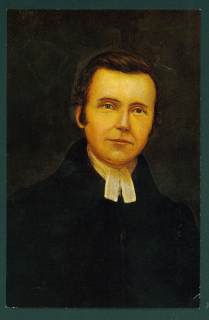
Embury’s parents are members of the colony of Germans that emigrate from the Palatinate to Ireland early in the eighteenth century, and in which Methodism co-founder John Wesley labors with great success. The colony forms from refugees from the War of the Spanish Succession. Embury is educated at a school near Ballingrane and learns the carpentry trade. He is converted on Christmas day 1752, becomes a local preacher at Court-Matrix in 1758 and marries Margaret Switzer that fall.
In 1760, due to rising rents and scarce land, he goes to New York City and works as a schoolteacher. In common with his fellow emigrants, he begins to lose interest in religious matters and does not preach in New York until 1766 when, moved by the reproaches of his cousin Barbara Heck, sometimes called the “mother of American Methodism,” he begins to hold services first in his own house on Barrack Street, now Park Place, and then in a rigging loft on what is now William Street. The congregation thus forms what is probably the first Methodist congregation in the United States, though it is a disputed question whether precedence should not be given to Robert Strawbridge, who begins laboring in Maryland about this time. Before this, he and Barbara Heck worship along with other Irish Palatines at Trinity Church in Manhattan, where three of his children are baptized.
The first Methodist church is built under Embury’s charge in 1768, in association with Thomas Webb and others, on the site of the present John Street United Methodist Church. He himself works on the building as a carpenter and afterward preaches there gratuitously. In 1769, preachers sent out by John Wesley arrive in New York City, and Embury goes to work in the vicinity of Albany at Camden Valley, New York, where he continues to work at his trade during the week and preaches every Sunday. He and several others receive a grant of 8,000 acres to develop for the manufacture of linen. He organizes among Irish emigrants at Ashgrove, near Camden Valley, the first Methodist society within the bounds of what becomes the flourishing and influential Troy Conference.
Philip Embury dies suddenly in Camden, New York in August 1775, in consequence of an accident in mowing. He is buried on a neighboring farm but in 1832 his remains are removed to Ashgrove churchyard and in 1866 to Woodland cemetery, Cambridge, New York, where a monument to him is unveiled in 1873, with an address by BishopMatthew Simpson.
(Pictured: Portrait of Philip Embury by John Barnes, Salem, 1773)
Denis Devlin, one of the major figures and influences of modern and modernist Irish poetry, dies in Dublin on August 21, 1959. Along with Samuel Beckett and Brian Coffey, he is one of the generation of Irish modernist poets to emerge at the end of the 1920s. He is also a career diplomat.
Devlin is born in Greenock, Scotland of Irish parents on April 15, 1908. His family returns to live in Dublin in 1918. He studies at Belvedere College and, from 1926, as a seminarian for the Roman Catholicpriesthood at Clonliffe College. As part of his studies, he attends a degree course in modern languages at University College Dublin (UCD), where he meets and befriends Brian Coffey. Together they publish a joint collection, Poems, in 1930.
Devlin joins the Irish Diplomatic Service in 1935 and spends a number of years in Rome, New York and Washington, D.C. During this time, he meets the French poet Saint-John Perse, and the Americans Allen Tate and Robert Penn Warren. He goes on to publish a translation of Exile and Other Poems by Saint-John Perse, and Tate and Warren edit his posthumous Selected Poems.
Denis Devlin dies suddenly at the age of 51 in Dublin on August 21, 1959. Since his death, there have been two Collected Poems published; the first in 1964 is edited by Coffey and the second in 1989 by J.C.C. Mays.
The Irish Lights vessel Granuaile begins laying the cable a few hundred metres offshore. Divers pull the cable ashore while the ship continues laying to a point about 4 km offshore. From there another vessel, the Reliance, takes over the task, relay-race like, and begins laying further out towards the United States.
The fiber optic cable is owned and operated by Irish company Aqua Comms and will run directly from Ross Strand in Killala to Long Island, New York. It has the capacity to handle up to one third of the world’s telephone calls and can cover the entire Internet traffic of Europe and the United States. The system will enable 53.8 millisecond transfer speeds across the Atlantic Ocean when it goes live in early 2016.
Silicon Republic describes Mayo as “Europe’s entry point to a vastly superior service when construction is completed by next year.” These connections are expected to create “thousands of jobs” in data centre operations. It will have a 53.8 millisecond latency and be capable of handling a third of the world’s phone calls, with over 1.6 million simultaneous Ultra HD video channels, or over 32 million LTE wireless callers.
CEO Martin Roche says, “It will also be the most secure transatlantic cable system, due to the carefully mapped route and the design built into the construction of this project.”
TaoiseachEnda Kenny says, “This new digital infrastructure is essential to help create jobs and new business opportunities across Ireland.” He also added, “This is the most important landing since [French general] Humbert in 1798.”
Local councillor Jarlath Munnelly says the project could “transform” Killala and the north Mayo region. “This is an exciting project, which I am enthusiastically supportive of. It has the potential to transform North Mayo, not just Killala, by enhancing the telecommunications infrastructure in the area, and putting Ireland and Mayo into the centre of a global network,” said the councillor.
Michael Joseph McGivney, American Catholic priest, is born to Irish immigrants Patrick and Mary (Lynch) McGivney on August 12, 1852, in Waterbury, Connecticut. He founds the Knights of Columbus at a local parish to serve as a mutual aid and fraternal insurance organization, particularly for immigrants and their families. It develops through the 20th century as the world’s largest Catholic fraternal organization.
From his own experience, McGivney recognizes the devastating effect on immigrant families of the untimely death of the father and wage earner. Many Catholics are still struggling to assimilate into the American economy. On March 29, 1882, while an assistant pastor at Saint Mary’s Church in New Haven, Connecticut, he founds the Knights of Columbus, with a small group of parishioners, as a mutual aid society to provide financial assistance in the event of the men’s death to their widows and orphans. The organization develops as a fraternal society. He is also known for his tireless work among his parishioners.
The Knights of Columbus is among the first groups to recruit blood donors, with formal efforts dating to 1937 during the Great Depression. As of 2013, the order has more than 1.8-million-member families and 15,000 councils. During the 2012 fraternal year, $167 million and 70 million man-hours are donated to charity by the order.
In 1996, the Roman Catholic Archdiocese of Hartford opens the cause for canonization, an investigation into McGivney’s life with a view towards formal recognition by the Church of his sainthood. Father Gabriel O’Donnell, OP, is the postulator of McGivney’s cause. He is also the director of the Fr. McGivney Guild, which now has 150,000 members supporting his cause.
The diocesan investigation is closed in 2000, and the case is passed to the Congregation for the Causes of Saints in Vatican City. On March 15, 2008, Pope Benedict XVI approves a decree recognizing McGivney’s heroic virtue, thus declaring him “Venerable.” As of August 6, 2013, a miracle attributed to McGivney’s intercession is under investigation at the Vatican.
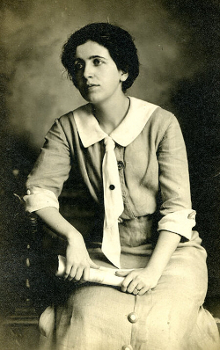
Flynn’s family moves to New York in 1900, where she is educated in the local public schools. She grows up being regaled by tales of Irish revolutionaries. According to their oral tradition all four of her great-grandfathers, Flynn, Gurley, Conneran, and Ryan, are members of the Society of United Irishmen, with grandfather Flynn being one of the leaders in County Mayo when the French fleet lands there during the Irish Rebellion of 1798. Her parents introduce her to socialism. When she is only fifteen, she gives her first public speech, “What Socialism Will Do for Women,” at the Harlem Socialist Club.
In 1907, Flynn becomes a full-time organizer for the Industrial Workers of the World. Over the next few years, she organizes campaigns among garment workers in Pennsylvania, silk weavers in New Jersey, restaurant workers in New York, miners in Minnesota, Missoula, Montana, and Spokane, Washington and textile workers in Massachusetts. She is arrested ten times during this period but is never convicted of any criminal activity. It is a plea bargain, on the other hand, that results in her expulsion from the IWW in 1916, along with fellow organizer Joe Ettor.
A founding member of the American Civil Liberties Union (ACLU) in 1920, Flynn plays a leading role in the campaign against the conviction of Nicola Sacco and Bartolomeo Vanzetti. She is particularly concerned with women’s rights, supporting birth control and women’s suffrage. She also criticizes the leadership of trade unions for being male-dominated and not reflecting the needs of women.
Between 1926 and 1936, Flynn lives in southwest Portland, Oregon with birth control activist, suffragette, and WobblyMarie Equi where she is an active and vocal supporter of the 1934 West Coast Longshoremen’s Strike. In 1936, she joins the Communist Party and writes a feminist column for its journal, the Daily Worker. Two years later, she is elected to the national committee. Her membership in the Party leads to her ouster from the board of the ACLU in 1940.
During World War II, Flynn plays an important role in the campaign for equal economic opportunity and pay for women and the establishment of day care centers for working mothers. In 1942, she runs for the United States Congress at-large in New York and receives 50,000 votes. In July 1948, a dozen leaders of the Communist Party are arrested and accused of violating the Smith Act by advocating the overthrow of the U.S. government by force and violence. After they are convicted in the Foley Square trial they appeal to the Supreme Court, which upholds their conviction in Dennis v. United States.
Flynn launches a campaign for their release but, in June 1951, is herself arrested in the second wave of arrests and prosecuted under the Smith Act. After a nine-month trial, she is found guilty and serves two years in Federal Prison Camp, Alderson near Alderson, West Virginia. She later writes a prison memoir, The Alderson Story: My Life as a Political Prisoner.
After her release from prison, Flynn resumes her activities for leftist and Communist causes. She runs for the New York City Council as a Communist in 1957, garnering a total of 710 votes. She becomes national chairwoman of the Communist Party of the United States in 1961 and makes several visits to the Soviet Union.
Warren is born on March 10, 1703, in Warrenstown, County Meath, the youngest son of Michael Warren and Catherine Plunkett, née Aylmer, who was the first wife of Sir Nicholas Plunkett.
In 1716, when he is 13 years old, Warren signs on as an ordinary seaman in Dublin and he and his brother initially serve together. He rapidly rises in the ranks, becoming a Captain in 1727. His ship patrols American colonial waters to provide protection from French forces. He becomes involved in colonial politics and land speculation.
In 1744, Warren is made commodore and commands a 16-ship squadron off the Leeward Islands, capturing 24 ships in four months. In 1745, he commands a group of ships that support the Massachusetts forces in the capture of the Fortress of Louisbourg. The prize system of the time allows naval officers to profit from the capture of enemy ships, and this expedition earns Warren a fortune, a promotion to the rank of Rear Admiral of the Blue, and a knighthood.
Warren’s lands include several thousand acres on the south side of the Mohawk River west of Schenectady, New York, now known as Florida, Montgomery County, New York, roughly across from present day Amsterdam. He brings two nephews, William Johnson, eventually Sir William Johnson, and Michael Tyrrell to clear and manage the land. Tyrrell soon leaves, asking his uncle for support with a naval appointment. Tyrrell has a very distinguished naval career, rising to Admiral. He becomes sick while headed to London from the West Indies and is buried at sea. In 1741, Warren builds Warren House, a mansion overlooking the Hudson River on his 300-acre estate in Greenwich Village. He also owns property on Long Island, the van Cortland Estate in Westchester County, New York and South Carolina.
While on a visit to Ireland in 1752, Peter Warren dies suddenly in Dublin on July 29, 1752 “of a most violent fever.” The towns of Warren, Rhode Island and Warren, New Hampshire are named after him, as well as Warren Street in Lower Manhattan.
In the early years of his career Olcott sings in minstrel shows, before studying singing in London during the 1880s. Lillian Russell plays a major role in helping make him a Broadway star. When the producer Augustus Pitou approaches him in 1893 to succeed William J. Scanlan as the leading tenor in sentimental operettas on Irish themes, Olcott accepts and performs pseudo-Irish roles for the remainder of his career.
Olcott combines the roles of tenor, actor, lyricist and composer in many productions. He writes the complete scores to Irish musicals such as Sweet Inniscara (1897), A Romance of Athlone (1899), Garrett O’Magh (1901), and Old Limerick Town (1902). For other productions he collaborates with Ernest Ball and George Graff, Jr. in works such as The Irish Artist (1894), Barry of Ballymore (1910), Macushla (1912), and The Isle o’ Dreams (1913). There are some twenty such works between 1894 and 1920.
Olcott is a good songwriter who captures the mood of his Irish American audience by combining melodic and rhythmic phrases from traditional Irish music with melancholy sentiment. Some numbers from his musicals become very popular, such as “My Wild Irish Rose” from A Romance of Athlone, “Mother Machree” from Barry of Ballymore, and “When Irish Eyes Are Smiling” from The Isle o’ Dreams. Sometimes he uses tunes from others, such as that of the title song from Macushla from Irish composer Dermot Macmurrough (pseudonym of Harold R. White) or Too Ra Loo Ra Loo Ral (Irish Lullaby) by James Royce Shannon for his production Shameen Dhu (1914).
Hughes is the third of seven children of Patrick and Margaret (née McKenna) Hughes. He and his family suffer religious persecution in their native land. He is sent with his elder brothers to a day school in the nearby village of Augher, and afterwards attends a grammar school in Aughnacloy. The family emigrates to the United States in 1816 and settles in Chambersburg, Pennsylvania. Hughes joins them there the following year.
After several unsuccessful applications to Mount St. Mary’s College in Emmitsburg, Maryland, he is eventually hired as a gardener at the college. During this time, he befriends Mother Elizabeth Ann Seton, who is impressed by Hughes and persuades the Rector to reconsider his admission. Hughes is subsequently admitted as a regular student of Mount St. Mary’s in September 1820.
Hughes campaigns actively on behalf of Irish immigrants and attempts to secure state support for parochial schools. Although this attempt fails, he founds an independent Catholic school system which becomes an integral part of the Catholic Church’s structure at the Third Plenary Council of Baltimore (1884), which mandates that all parishes have a school and that all Catholic children be sent to those schools. In 1841, Hughes founds St. John’s College in New York City which is now Fordham University.
Hughes is appointed Apostolic Administrator of the diocese due to Bishop Dubois’ failing health. As coadjutor, he automatically succeeds Dubois upon the bishop’s death on December 20, 1842, taking over a diocese which covers the entire state of New York and northern New Jersey. He is a staunch opponent of Abolitionism and the Free-Soil movement, whose proponents often express anti-Catholic attitudes. Hughes also founds the Ultramontane newspaper New York Freeman to express his ideas.
Hughes becomes an archbishop on July 19, 1850, when the diocese is elevated to the status of archdiocese by Pope Pius IX. As archbishop, he becomes the metropolitan for the Catholic bishops serving all the dioceses established in the entire Northeastern United States. To the dismay of many in New York’s Protestant upper-class, Hughes foresees the uptown expansion of the city and begins construction of the current St. Patrick’s Cathedral on Fifth Avenue between 50th and 51st Street, laying its cornerstone on August 15, 1858. At the request of President Abraham Lincoln, Hughes serves as semiofficial envoy to the Vatican and to France in late 1861 and early 1862. Lincoln also seeks Hughes’ advice on the appointment of hospital chaplains.
Hughes serves as archbishop until his death. He is originally buried in St. Patrick’s Old Cathedral, but his remains are exhumed in 1882 and re-interred in the crypt under the altar of the new cathedral he had begun.
O’Sullivan is born in Boyle, County Roscommon on May 17, 1911, the daughter of Evangeline “Mary Eva” Lovatt and Charles Joseph O’Sullivan, an officer in the Connaught Rangers who serves in World War I. She attends a convent school in Dublin, then the Convent of the Sacred Heart at Roehampton, England. One of her classmates there is Vivian Mary Hartley, future Academy Award-winning actress Vivien Leigh. After attending finishing school in France, O’Sullivan returns to Dublin to work with the poor.
O’Sullivan’s film career begins when she meets motion picture director Frank Borzage, who is doing location filming on Song o’ My Heart for 20th Century Fox. He suggests she take a screen test, which she does, and wins a part in the movie, which stars Irish tenor John McCormack. She travels to the United States to complete the movie in Hollywood. O’Sullivan appears in six movies at Fox, then makes three more at other movie studios.
In 1932, she signs a contract with Metro-Goldwyn-Mayer. After several roles there and at other movie studios, she is chosen by Irving Thalberg to appear as Jane Parker in Tarzan the Ape Man, opposite co-star Johnny Weissmuller. She is one of the more popular ingenues at MGM throughout the 1930s and appears in a number of other productions with various stars. In all, O’Sullivan plays Jane in six features between 1932 and 1942.
She plays another Jane in Pride and Prejudice (1940) with Laurence Olivier and Greer Garson and supports Ann Sothern in Maisie Was a Lady (1941). After appearing in Tarzan’s New York Adventure (1942), O’Sullivan asks MGM to release her from her contract so she can care for her husband who has just left the Navy with typhoid. She retreats from show business, devoting her time to her family. In 1948, she re-appears on the screen in The Big Clock, directed by her husband for Paramount Pictures. She continues to appear occasionally in her husband’s movies and on television. However, by 1960 she believes she has permanently retired. In 1958, Farrow’s and O’Sullivan’s eldest son, Michael, dies in a plane crash in California.
Actor Pat O’Brien encourages her to take a part in summer stock, and the play A Roomful of Roses opens in 1961. That leads to another play, Never Too Late, in which she co-stars with Paul Ford in what is her Broadway debut. Shortly after it opens on Broadway, John Farrow dies of a heart attack. O’Sullivan sticks with acting after Farrow’s death. She is also an executive director of a bridal consulting service, Wediquette International. In June and July 1972, O’Sullivan is in Denver, Colorado, to star in the Elitch Theatre production of Butterflies are Free with Karen Grassle and Brandon deWilde. The show ends on July 1, 1972. Five days later, while still in Denver, deWilde is killed in a motor vehicle accident.
When her daughter, actress Mia Farrow, becomes involved with Woody Allen both professionally and romantically, she appears in Hannah and Her Sisters, playing Farrow’s mother. She has roles in Peggy Sue Got Married (1986) and the science fiction oddity Stranded (1987). Mia Farrow names one of her own sons Ronan O’Sullivan Farrow for her mother. In 1994, she appears with Robert Wagner and Stefanie Powers in Hart to Hart: Home Is Where the Hart Is, a feature-length made-for-TV movie with the wealthy husband-and-wife team from the popular weekly detective series Hart to Hart.
Maureen O’Sullivan dies in Scottsdale, Arizona, of complications from heart surgery on June 23, 1998, at the age of 87. O’Sullivan is buried at Most Holy Redeemer Cemetery, Niskayuna, New York. She is survived by six of her children, 32 grandchildren, and 13 great-grandchildren. Michael, her oldest son, is killed at age 19 in a plane crash in 1958.
The Fenian insurgents, led by Brigadier GeneralJohn O’Neill, a former Union cavalry commander who had specialized in anti-guerrilla warfare in Ohio, secures boats and transfers some 800 men across the Niagara River, landing above Fort Erie, before dawn on June 1, 1866. An additional 200–400 Fenians and supplies cross later in the morning and early afternoon until the U.S. Navygunboat, the USS Michigan, begins intercepting Fenian barges at 2:20 PM.
O’Neill spends the first day trying to rally the local citizenry to the Fenian cause and to commandeer supplies for his mission, but his force is plagued by desertions almost from the outset. An additional column of 200 Fenians join his group, bringing his total strength at Ridgeway to at least 650 men.
Meanwhile, the British are mobilizing both local Canadian militia and British garrison troops to defend against the impending invasion of Canada. The Fenians night-march north across Black Creek through a cedar swamp, then turn inland on Ridge Road on the morning of June 2, taking up a defensive position on Limestone Ridge near the present Canadian town of Ridgeway. There, they clash with 850 advancing Canadian militia commanded by Lieutenant-Colonel Alfred Booker of the 13th Battalion.
In the first hour of the battle, the Canadians appear to prevail, driving Fenian skirmishers back across Bertie Road. Then the tide turns, and to this day, it is not clear what causes the impending chaos. O’Neill, observing the chaos breaking out in the Canadian ranks, quickly orders a bayonet charge that completely routs the inexperienced Canadians. The Fenians take and briefly hold the town of Ridgeway. Then, expecting to be overwhelmed by British reinforcements, they quickly turn back to Fort Erie where they fight a second battle, the Battle of Fort Erie, against a small but determined detachment of Canadians holding the town.
The Canadian loss is nine killed on the field, four dying of wounds in the immediate days following the battle, 22 dying of wounds or disease later and 37 are wounded, some severely enough to require amputation of their limbs. O’Neill says that four or five of his men are killed, but Canadians claim to have found six Fenian bodies on the field. The relatively low casualty figures make this an interesting battle for proponents of theories about soldiers’ reluctance to shoot to kill but might also be accounted for by the fact that the Fenians had deployed only their skirmishers in an attempt to lure the Canadians towards their main force which did not advance until the last minutes of the battle when they launched a bayonet attack that broke Canadian lines.





 seamus dubhghaill