With a report due on Monday, January 31, and widely expected to state that the IRA is not ready to disarm, the Northern Ireland peace process appears headed for a fresh crisis. The report by Canadian Gen. John de Chastelain, head of the province’s independent commission overseeing the handing in of weapons, is expected to confirm that no arms have been turned in.
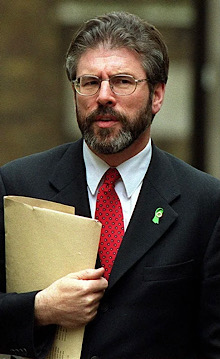
The Ireland on Sunday newspaper says de Chastelain will tell the British and Irish governments that the IRA has put most of its weapons into secret, sealed dumps in the Republic of Ireland. Such disclosures put enormous pressure on Adams, the leader of the Irish republican political party, Sinn Féin.
The UUP, the province’s main Protestant political group, has already threatened to pull out of Northern Ireland‘s fledgling power-sharing government if the IRA does not start disarming.
The UUP calls a top-level party meeting for February 12. A negative report from the decommissioning body will heighten fears that UUP leader David Trimble will make good on his threat to resign as leader of the new government, effectively allowing his party to shut down the province’s first government in 25 years.
Of Adams’s role in the disarmament process, Trimble says, “He asked us to create the circumstances to help him … we did that … we took the risk and created the situation he asked us to create. “Now we hope he now is able to demonstrate his good faith by responding.”
Adams says, “I am concerned at what appears to be an attempt by unionists to hijack the entire process, put up unilateral demands, perhaps in the course of that, tear down the institutions that are only two months in being. I understand why unionists want decommissioning. It is just not within my grasp to deliver it on their terms, and neither is it my responsibility.”
Adams says he can give no assurances that the IRA will hand over its weapons by May 22, the date set by the 1998 Good Friday Agreement for the completion of disarmament, although he stresses he is committed to decommissioning. “No, I can’t and it isn’t up to me,” Adams tells BBC Television when asked if he can guarantee disarmament by May.
Political insiders hint that the report will not be published until Monday (January 31) afternoon, suggesting the highly sensitive document is still being worked on by de Chastelain.
Any unionist pullout from the home-rule government on February 12 will create a political vacuum. Britain may intervene before that to suspend the fledgling executive, in the hope that it can be resurrected quickly if progress eventually is made on disarmament. Sinn Féin warns that either course of action could lead to the IRA breaking off contact with de Chastelain and the ending of disarmament prospects.
Meanwhile, on the eve of the report, thousands of Roman Catholics mark an event and day that symbolizes the province’s past troubles — Bloody Sunday.
Waving Irish flags, some 5,000 protesters retrace the steps of a civil rights march in Londonderry in 1972 that ended in bloodshed when British troops fired on unarmed protesters and killed thirteen people, mostly teenagers. A fourteenth man died later from his wounds. Victims’ relatives and local children carry fourteen white crosses, photos of the dead and a banner that reads, “Bloody Sunday, the day innocence died.” The march passes the scene of the killings and ends in front of Londonderry’s city hall — a spot where the 1972 march was supposed to have finished.
Organizers issue a message to British Prime MinisterTony Blair that they want a forthcoming inquiry not to end in the same way as a probe held within months of the killings, which exonerated the British soldiers by suggesting that some of the victims had handled weapons that day. “Twenty-eight years on from Bloody Sunday, there is still no recognition of the role the British government played in the premeditated attack on unarmed demonstrators,” Barbara de Brun, a top IRA official, tells the crowd.
Relatives of those killed are upset that soldiers who took part in the shootings would be allowed to remain anonymous during the new probe. They are also concerned about a newspaper report that the army recently destroyed thirteen of the rifles used by the soldiers, complicating any ballistics tests at the inquiry.
“Once again, the political and military establishment are up to their old tricks. We won’t accept a public relations exercise,” Alana Burke, who was injured by an armored car during the Bloody Sunday march, tells the crowd.
(From: “Hopes dim for IRA disarmament, peace accord” by Nic Robertson and Reuters, CNN, cnn.com, January 30, 2000)
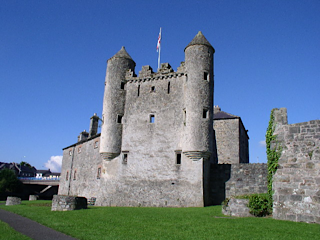
The first siege of Enniskillen takes place at Enniskillen in Fermanagh, present day Northern Ireland, beginning on January 25, 1594, during the Nine Years’ War. In February 1594, the English have captured Enniskillen Castle from the Irish after a waterborne assault and massacre the defenders after they surrender. From May 1594, an Irish army under Hugh Maguire and Cormac MacBaron O’Neill besiege the English garrison in the castle, and in August they defeat an English relief force. A second relief force is allowed to resupply the garrison, but the castle remains cut off. Eventually, in May 1595, the English garrison surrenders to the Irish and are then massacred.
In 1593, Hugh Maguire, Chief of the Name and Lord of Fermanagh, objects to the behaviour of the newly-appointed English Crown sheriff Humphrey Willis. As he had done before being expelled by Hugh Roe O’Donnell from Tyrconnell in 1592, Willis is cattle raiding and plundering throughout Clan Maguire territory. Maguire is not strong enough to resist the sheriff, but after receiving reinforcements from Hugh O’Neill, Earl of Tyrone, Maguire expelled Willis. In May and June 1593, Maguire and Brian Oge O’Rourke of West Breifne raids lands held by the English Lord President of Connaught, Richard Bingham. They destroy the town around Ballymote Castle. This is part of a proxy war waged to distract the Crown while Hugh O’Neill strengthens his position in Ulster. As hoped for, the Crown responds by sending an army under Sir Henry Bagenal and Gaelic leader Hugh O’Neill, Earl of Tyrone (outwardly still loyal to the Crown), who defeats Maguire’s force at the Battle of Belleek in October 1593. However, Maguire’s main force remains unscathed.
Enniskillen Castle sits on the River Erne and commands the strategic bottleneck between Upper and Lower Lough Erne. On January 25, 1594, English Captain John Dowdall arrives at Enniskillen by boat with three infantry companies. They dig trenches in which they place light cannons and musketeers, but the cannons are too small to make much of an impact on the castle walls. On January 30, Captain George Bingham arrives with 300 men.
They launch a waterborne assault on the castle. While musketeers in boats and artillery on land fire at the castle, a large boat holding 67 men anchors at a vulnerable part of the walls. They make a breach in the wall with pickaxes, forcing the Irish to take shelter in the keep. Dowdall threatens to destroy the castle with gunpowder if the garrison does not surrender. An Irish witness claims there are 36 fighting men and 40 women and children in the castle, while Dowdall claims there are 200. After they surrender, Dowdall has them put to the sword and claims to have killed 150. Captain Thomas Lee, who is present, describes this as a great dishonor to the Queen as the defenders had surrendered “uppon composicion, And your majesties worde being past to the poore beggars that kept it, they were all notwithstandinge dishonourably putt to the sworde in a most miserable state.”
Dowdall writes on February 2 to the Lord Deputy of Ireland that he has captured the castle from the “rebel” Hugh Maguire. An English garrison is left in place. A detailed coloured illustration of the siege was made shortly after.
A second siege begins on May 17, 1594. Now acting with the covert support of Hugh O’Neill, Hugh Maguire and Cormac MacBaron O’Neill lay siege to Enniskillen which is now isolated in hostile country. This siege ends on August 30 when Lord Deputy William Russell’s beleaguered garrison withdraws. Following this, there is a truce, but “subterfuge and deception were the hallmarks of this stage of the war.”
A third siege begins when Maguire raises the clan and attacks the castle again in January 1595. In May 1595 the garrison agrees to surrender Enniskillen to the Irish in exchange for their lives. However, the entire garrison is then massacred.
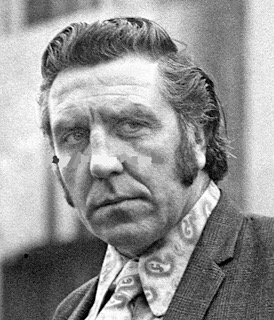
Charles Harding Smith, a Northern Irish loyalist and the first effective leader of the Ulster Defence Association (UDA), is born in Belfast, Northern Ireland, on January 24, 1931. An important figure in the Belfast-based “defence associations” that form the basis of the UDA on its formation in 1971, he later becomes embroiled in feuds with other UDA leaders and is eventually driven out of Northern Ireland by his opponents.
A former soldier in the British Army, Smith, at the time residing in Rosebank Street on the Shankill Road, calls a meeting of other locals at the Leopold Street Pigeon Fanciers Club to develop a response to attacks by republicans from the neighboring Ardoyne area. The location is chosen because Smith is himself a pigeon fancier and a member of the club. At the meeting, it is agreed to establish a vigilante group, the Woodvale Defence Association (WDA), with Smith in command and assisted by Davy Fogel, who organises military drilling for the forty or so recruits, and Ernie Elliott.
The WDA gains widespread notoriety and is blamed for a series of bomb attacks and shootings, most of which have been carried out by the Ulster Volunteer Force (UVF). Nevertheless, Smith’s reputation as a hardline loyalist is boosted as a result and when his group merges with other similar vigilante movements to form the Ulster Defence Association (UDA) in late 1971, he is chosen as chairman of the new group’s thirteen-member Security Council ahead of the other leading candidates, Tommy Herron and Jim Anderson. According to journalist Martin Dillon, Smith is heavily influenced by William Craig and William McGrath, both of whom see a need for a group to replace the Ulster Special Constabulary (USC) and feel that they can easily influence Smith to their way of thinking.
Smith soon takes charge of procuring arms for the UDA. In early 1972, working in tandem with Belfast businessman John Campbell who agrees to bankroll the purchases, he is put in contact with a Scottish arms dealer from whom he is to purchase £50,000 worth of weapons. He sends three WDA associates, John White, Bobby Dalzell, and Robert Lusty (who is also a serving officer in the Royal Ulster Constabulary (RUC)), to meet the arms dealer in a London hotel, following them without attending the actual meeting. The “arms dealer” is actually an RUC Special Branch agent and, after recording the conversation with the WDA men, arrests all three. Smith goes to Scotland Yard the same day to inquire about his friends only to be arrested himself.
Smith remains in custody in England until December 1972 when his case comes to trial. Campbell claims that the deal had been organised for the RUC to entrap the arms dealer, whom they believe to be a Provisional Irish Republican Army member and a series of mistakes by the prosecution helps to ensure that the case collapses with Smith acquitted. The trial is used as part of early arguments regarding collusion between the RUC and loyalists as a list of RUC Special Branch suspects is uncovered in Smith’s house while he attempts to call Chief ConstableGraham Shillington as a character witness.
By the time Smith returns to Belfast in December 1972 there has been changes in the UDA with Tommy Herron in effective control of the organisation and Davy Fogel the dominant figure amongst the WDA. He immediately takes back control of his west Belfast stronghold, threatening Fogel with death if he does not fall into line. Fogel, a close ally of Ernie Elliott, who was killed in circumstances that Smith had been rumoured to be involved in, although it is later determined that Elliott was shot dead after a drunken brawl on Sandy Row had descended into a gunfight, decides it is best not to go up against Smith and stands down.
However, Smith is not satisfied and, after putting out intelligence that Fogel has been taking UDA funds for himself, arrests Fogel and holds him captive for three hours in a Shankill social club where he is told to leave the area. Fogel briefly leaves for east Belfast but when the UDA there makes it clear he is not welcome either he leaves to live in England, from where he controversially gives an interview about his time in the UDA to The Sunday Times. Among claims made by Fogel in this interview is one that Smith was attempting to take control of the UDA with the help of the UVF. Smith is a strong admirer of the UVF’s military structure and hopes to replicate it in the UDA but he has a deep dislike of UVF leader Gusty Spence. As part of his remit to instill military discipline, Smith moves against a culture of racketeering that has become endemic in the west Belfast UDA during his absence. It is this initiative that leads to the rumours concerning his involvement in the death of Elliott, who had been named by some of his rivals in the UDA as a gangster.
Despite Smith’s show of strength following his return to Belfast his public persona remains low-key, with Herron fast emerging as the public face of the UDA. Much of this is down to the fact that Smith is inarticulate and unable to project a good image, unlike Herron who is a good talker and fairly charismatic. The emergence of these two leaders at the same time however is to bring the fledgling movement into near civil war.
Following a period of marginalisation Jim Anderson, who is serving as caretaker leader of the UDA, resigns as chairman of the UDA and as a result a meeting is called of the group’s leaders in March 1973 to determine who will succeed him. By this time Smith and Herron are recognised as the undisputed leaders of the Belfast UDA. There is a fear that whichever of the two is chosen as chairman, the other one will automatically feel obliged to challenge his leadership. As a result, it is determined that someone else should be appointed chairman as a compromise candidate and as Highfield-based activist Andy Tyrie, a man noted for his skill as an organiser, is chairing the conference it is decided that he will be acceptable to both men as chairman of the UDA. Tyrie soon proves to be a powerful rival to the two leaders. In September 1973, Herron is kidnapped and shot dead. His murder remains unsolved.
Tyrie had not proven to be the puppet Smith had hoped and had consolidated his power through his close involvement with Glenn Barr and the Ulster Workers’ Council during the strike of May 1974, an event that had helped to give real credence to Tyrie’s leadership abilities. Fearing the growing power of Tyrie, Smith criticises the UDA leader for sending a delegation to Libya to meet Muammar Gaddafi, who is a hated figure for many loyalists due to his providing arms to the Provisional Irish Republican Army. Smith, who had known about the trip in advance but had raised no objections, verbally attacks Tyrie over the Libya debacle in a meeting of the Inner Council in December 1974 before declaring the following January that he intends to split his West Belfast Brigade from the rest of the UDA.
Two weeks after announcing the schism, Smith is attending a meeting at the West Belfast UDA’s headquarters with Tommy Lyttle when he notices a sniper on a nearby roof. Smith, who is wearing a bulletproof vest, opens his coat as if to challenge the sniper to fire but is seriously wounded when the sniper shoots twice, hitting him both times with armour-piercing bullets. With Smith in hospital, Tyrie calls a meeting of the leading figures in the Shankill UDA and manages to convince Lyttle and other leading figures that Smith is too divisive a figure to remain in charge.
Smith is out of the hospital after only two weeks and declares himself back in charge, but before long he has fallen foul of a number of important people. Two Shankill UDA members are interned on the basis of evidence that rumours suggest had come from Smith, while he also clashed with the local UVF after suggesting that they merge but only on the basis that he will be in control. He begins to make threats against Barr and Chicken, two popular members who are leading figures on the UDA’s political side. Smith calls a meeting of his commanders, but, on February 6, 1975, in an attack arranged in advance by his opponents within the UDA, a gunman bursts in and shoots him twice in the chest. The gunman walks up to the injured Smith and prepares to shoot him in the head but the gun jams and he again survives an attempt on his life.
Smith spends another week in hospital after which he again returns to his Belfast home. Loyalist Davy Payne is sent to his house with another hitman and the two order Smith to leave Northern Ireland. He is taken to the airport the following day and leaves for England, leaving Tyrie as sole leader of the UDA. He settles in Southowram, West Yorkshire, where he works as a lorry driver before his death in 1997. During Dáil Éireann debates in 2005 he is named as a “self-confessed British intelligence agent.”
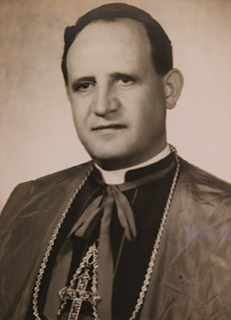
This is a challenging time for the Catholic Church in Ireland, then led by Cardinal William Conway, as it adjusts to both the internal changes generated by the Second Vatican Council and the wider social changes. He is ill-suited to coping with these changes and in particular the violence in Northern Ireland. It is widely assumed that he sees to it that the more overtly nationalistTomás Ó Fiaich is appointed to Armagh in 1977 after the death of Cardinal Conway. The journalist and authorEd Moloney in his book on the Irish Republican Army (IRA) asserts that Alibrandi’s “sympathy for the IRA was a constant source of friction with the government in London.”
Alibrani plays a major role in the 1971 decision by the Vatican to accept the resignation of John Charles McQuaid as Archbishop of Dublin. This comes as a shock to McQuaid, who expected that he would be allowed to remain for some time after the normal retirement age of 75.
In many of the episcopal appointments made while Alibrandi is nuncio, he favours doctrinally “sound,” right-of-centre priests and in the case of the Archdiocese of Dublin picks two priests, Kevin McNamara and Desmond Connell, who are notably ill-suited. In a profile of the Archbishop at the time of his retirement, T. P. O’Mahony observes in The Tablet, “although he rarely gave interviews, and never overtly intervened in policy-making or in public controversies, it is beyond dispute that Archbishop Alibrandi wielded considerable influence behind the scenes.”
The respected academic and church historian Dermot Keogh assessing this period argues that “there was a general view that the best candidates had not been appointed…that a number were not up to the job, that most of the appointees shared a defensive attitude to matters of church and state.”
Alibrandi has “a very testy relationship with three Taoisigh – Jack Lynch, Liam Cosgrave and Garret FitzGerald.” After reaching the retirement age of 75, he returns to his home town in Sicily where he dies on July 3, 2003. His funeral Mass was celebrated on Saturday in Castiglione di Sicilia by Archbishop Paolo Romeo, Apostolic Nuncio to Italy. A memorial Mass for Archbishop Alibrandi will be celebrated by Archbishop Giuseppe Lazzarotto, Apostolic Nuncio to Ireland, on Friday, 11 July at 19.30 in the Church of Our Lady Help of Christians, Navan Road, Dublin.
It is reported in September 2012 during the second Dr. Garret FitzGerald Memorial Lecture at University College Cork (UCC) by Seán Donlon, former secretary general at the Department of Foreign Affairs, that “It came to our [Department of Foreign Affairs] attention that a substantial amount in three bank accounts in Dublin [held by the archbishop] were way in excess of what was needed to run the nunciature. The source [of the money] appeared to be South America.” Donlon goes on to say, “Because of its size, we thought it appropriate to ask if the funds belonged to the Holy See.” When contacted for an answer, Alibrandi “quickly answered ‘no’ and that they belonged to ‘family’. When it was pointed out to him that the money was then liable under Irish taxation law to DIRT, he said he would retire shortly and the accounts would be closed.”
The official statement at the end of the four-hour meeting states that progress has been made in “areas of consultation and co-operation.” The Taoiseach says they discussed industry, tourism, electricity supply, and trade, as well as tariff concessions, and “measures taken by both governments to prevent the spread of foot-and-mouth disease from Britain.”
Afterward, O’Neill returns to Northern Ireland by a different route in order to avoid any possible demonstration. Paisley has been developing a high profile for himself with his attacks on O’Neill in recent months. But he misses the opportunity to protest on this occasion. The next day he issues a statement regretting O’Neill’s return home. “I would advise Mr. Lynch to keep him,” Paisley announces.
Five years earlier, in 1963, O’Neill becomes Prime Minister of Northern Ireland. From very early on, he tries to break down sectarian barriers between the two Northern communities. He also seeks to improve relations with the Republic of Ireland by eradicating the impasse in relations that has existed since the 1920s. He invites then-Taoiseach Seán Lemass to meet him at Stormont on January 14, 1965. Lemass courageously accepts the invitation. At their initial meeting, when they are briefly alone, Lemass says to O’Neill, ”I shall get into terrible trouble for this!” The Northern premier replies, ”No, Mr. Lemass, it is I who will get into terrible trouble.”
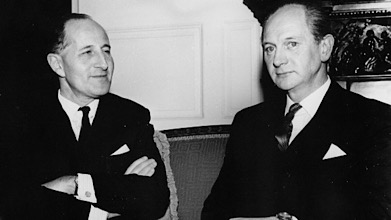
O’Neill makes his return visit to Dublin on February 9, 1965, and the two leaders agree to co-operate on tourism and electricity. It is Lemass who makes the most significant concessions, because the Constitution of Ireland does not recognise the existence of the North. Article 2 of the Constitution actually claims sovereignty over the whole island. Thus, by formally meeting the Prime Minister of Northern Ireland, O’Neill claims that Lemass accorded him “a de facto recognition.”
The Taoiseach then bolsters this at their follow-up meeting in Iveagh House, Dublin, three weeks later. ”The place card in front of me at Iveagh House bore the inscription, Prime Minister of Northern Ireland,” O’Neill proudly explains. Surely this is tantamount to formal recognition. But many Unionists still have grave reservations about dealing with the Republic of Ireland.
In 1966, Ian Paisley establishes the Protestant Unionist Party (PUP) to oppose O’Neill. He rouses sectarian tension by holding mass demonstrations at which he brands O’Neill as the “Ally of Popery.” Nevertheless, public opinion polls indicate support for O’Neill’s leadership from both communities in the North.
After Jack Lynch replaced Lemass as Taoiseach in late 1966, O’Neill continues with his efforts to improve relations with the Dublin government by inviting Lynch to Stormont Castle. The Taoiseach travels to Belfast by car on December 11, 1967. There is no formal announcement of his visit, but word is leaked to Paisley after the Taoiseach’s car crosses the border.
Paisley arrives at Stormont with his wife and a handful of supporters, just minutes before the Taoiseach. With snow on the ground, two of Paisley’s church ministers, Rev. Ivan Foster and Rev. William McCrea, begin throwing snowballs at Lynch’s car. The Royal Ulster Constabulary (RUC) promptly grabs the two ministers. While they are being bundled into a police car, Paisley is bellowing, “No Pope here!” Lynch asks his traveling companion, T. K. Whitaker, “Which one of us does he think is the Pope?”
Paisley demands to be arrested by the RUC, and actually tries to get into the police car with his two colleagues, but he is pulled away. The two clergymen are taken to an RUC station and quickly released. Lynch ridicules the protest. “It was a seasonal touch,” he says. “It reminds me of what happens when I go through a village at home and the boys come and throw snowballs.”
Paisley says he had come to protest against “the smuggling” of Lynch into Stormont. If he had known about the visit earlier, he says that he would have brought along 10,000 people to protest. Denouncing O’Neill, as a “snake in the grass,” he goes on to accuse Lynch of being “a murderer of our kith and kin.” In an editorial, the Unionist Newsletter proclaims that ”there is no doubt that Capt. O’Neill has the full support of his colleagues and of the country.”
O’Neill’s four formal meetings with Lynch and his predecessor contribute to a thaw in relations at the summit between Belfast and Dublin, but the whole process is exploited by others to fan the flames of Northern sectarianism.
People do not realise it in early 1968, but Northern Ireland is about to explode. On October 5, 1968, people gather in Derry for a civil rights march that has been banned by Stormont. When the march begins, it is viciously attacked by the RUC. This ignites a series of further protests, which ultimately leads to Bloody Sunday, and the eruption of the Troubles for the next quarter of a century.
(From: “Meetings helped thaw relations before the North exploded,” Irish Examiner, http://www.irishexaminer.com, January 8, 2018)
The Kingsmill massacre, also referred to as the Whitecross massacre, is a mass shooting that takes place on January 5, 1976, near the village of Whitecross in south County Armagh, Northern Ireland. Gunmen stop a minibus carrying eleven Protestant workmen, line them up alongside it and shoot them. Only one victim survives, despite having been shot 18 times. A Catholic man on the minibus is allowed to go free. A group calling itself the South Armagh Republican Action Force claims responsibility. It says the shooting is retaliation for a string of attacks on Catholic civilians in the area by Loyalists, particularly the killing of six Catholics the night before. The Kingsmill massacre is the climax of a string of tit for tat killings in the area during the mid-1970s, and is one of the deadliest mass shootings of the Troubles.
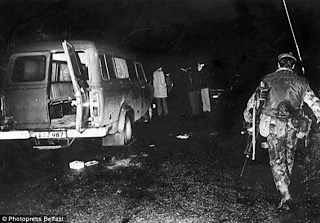
On January 5, 1976, just after 5:30 p.m., a red Ford Transit minibus is carrying sixteen textile workers home from their workplace in Glenanne. Five are Catholics and eleven are Protestants. Four of the Catholics get out at Whitecross and the bus continues along the rural road to Bessbrook. As the bus clears the rise of a hill, it is stopped by a man in combat uniform standing on the road and flashing a torch. The workers assume they are being stopped and searched by the British Army. As the bus stops, eleven gunmen in combat uniform and with blackened faces emerge from the hedges. A man “with a pronounced English accent” begins talking. He orders the workers to get out of the bus and to line up facing it with their hands on the roof. He then asks, “Who is the Catholic?” The only Catholic is Richard Hughes. His workmates, now fearing that the gunmen are loyalists who have come to kill him, try to stop him from identifying himself. However, when Hughes steps forward the gunman tell him to “get down the road and don’t look back.”
The lead gunman then says, “Right,” and the others immediately open fire on the workers. The eleven men are shot at very close range with automatic rifles, which includes Armalites, an M1 carbine and an M1 Garand. A total of 136 rounds are fired in less than a minute. The men are shot at waist height and fall to the ground, some falling on top of each other, either dead or wounded. When the initial burst of gunfire stops, the gunmen reload their weapons. The order is given to “Finish them off,” and another burst of gunfire is fired into the heaped bodies of the workmen. One of the gunmen also walks among the dying men and shoots them each in the head with a pistol as they lay on the ground. Ten of them die at the scene: John Bryans (46), Robert Chambers (19), Reginald Chapman (25), Walter Chapman (23), Robert Freeburn (50), Joseph Lemmon (46), John McConville (20), James McWhirter (58), Robert Walker (46) and Kenneth Worton (24). Alan Black (32) is the only one who survives. He had been shot eighteen times and one of the bullets had grazed his head. He says, “I didn’t even flinch because I knew if I moved there would be another one.”
After carrying out the shooting, the gunmen calmly walk away. Shortly after, a married couple comes upon the scene of the killings and begin praying beside the victims. They find the badly wounded Alan Black lying in a ditch. When an ambulance arrives, Black is taken to a hospital in Newry, where he is operated on and survives. The Catholic worker, Richard Hughes, manages to stop a car and is driven to Bessbrook Royal Ulster Constabulary (RUC) station, where he raises the alarm. One of the first police officers on the scene is Billy McCaughey, who had taken part in the Reavey killings. He says, “When we arrived it was utter carnage. Men were lying two or three together. Blood was flowing, mixed with water from the rain.” Some of the Reavey family also come upon the scene of the Kingsmill massacre while driving to hospital to collect the bodies of their relatives. Johnston Chapman, the uncle of victims Reginald and Walter Chapman, says the dead workmen were “just lying there like dogs, blood everywhere”. At least two of the victims are so badly mutilated by gunfire that immediate relatives are prevented from identifying them. One relative says the hospital mortuary “was like a butcher’s shop with bodies lying on the floor like slabs of meat.”
Nine of the dead are from the village of Bessbrook, while the bus driver, Robert Walker, is from Mountnorris. Four of the men are members of the Orange Order and two are former members of the security forces: Kenneth Worton is a former Ulster Defence Regiment (UDR) soldier while Joseph Lemmon is a former Ulster Special Constabulary (USC) officer. Alan Black is appointed a Member of the Order of the British Empire (MBE) in the 2021 New Year Honours, for his cross-community work since the massacre.
The next day, a telephone caller claims responsibility for the attack on behalf of the “South Armagh Republican Action Force” or “South Armagh Reaction Force.” He says that it was retaliation for the Reavey–O’Dowd killings the night before, and that there will be “no further action on our part” if loyalists stop their attacks. He adds that the group has no connection with the Irish Republican Army (IRA). The IRA denies responsibility for the killings as it is on a ceasefire at the time.
However, a 2011 report by the Historical Enquiries Team (HET) concludes that Provisional IRA members were responsible and that the event was planned before the Reavey and O’Dowd killings which had taken place the previous day, and that “South Armagh Republican Action Force” was a cover name. Responding to the report, Sinn Féin spokesman Mitchel McLaughlin says that he does “not dispute the sectarian nature of the killings” but continues to believe “the denials by the IRA that they were involved”. Social Democratic and Labour Party (SDLP) Assemblyman Dominic Bradley calls on Sinn Féin to “publicly accept that the HET’s forensic evidence on the firearms used puts Provisional responsibility beyond question” and to stop “deny[ing] that the Provisional IRA was in the business of organising sectarian killings on a large scale.”
The massacre is condemned by the British and Irish governments, the main political parties and Catholic and Protestant church leaders. Merlyn Rees, the British Secretary of State for Northern Ireland, condemns the massacre and forecasts that the violence will escalate, saying “This is the way it will go on unless someone in their right senses stops it, it will go on.”
The British government immediately declares County Armagh a “Special Emergency Area” and deploys hundreds of extra troops and police in the area. A battalion of the Ulster Defence Regiment (UDR) is called out and the Spearhead Battalion is sent into the area. Two days after the massacre, the British Prime MinisterHarold Wilson announces that the Special Air Service (SAS) is being sent into South Armagh. This is the first time that SAS operations in Northern Ireland are officially acknowledged. It is believed that some SAS personnel had already been in Northern Ireland for a few years. Units and personnel under SAS control are alleged to be involved in loyalist attacks.
The Kingsmill massacre is the last in the series of sectarian killings in South Armagh during the mid-1970s. According to Willie Frazer of Families Acting for Innocent Relatives (FAIR), this is a result of a deal between the local UVF and IRA groups.
(Pictured: The minibus carrying the textile factory workers is left peppered with bullet holes and blood stains the ground after the massacre, as detectives patrol the scene of the murders)
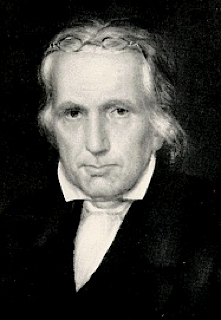
Campbell is born on February 1, 1763, in County Down, Ireland (now Northern Ireland), and is raised as an Anglican. He is ordained a minister in the Scottish Seceder Presbyterian Church sometime after graduating from the University of Glasgow in 1786. He leaves Ireland for the United States in April 1807. This move is prompted by the advice of his physician. Once in America, disagreement arises between him and other Presbyterians over certain points related to Calvinist doctrine and the administration of the Eucharist.
When their study of the New Testament leads the reformers to begin to practice baptism by immersion, the nearby Redstone Baptist Association invites Brush Run Church to join with them for the purpose of fellowship. The reformers agree, provided that they will be “allowed to preach and to teach whatever they learned from the Scriptures.”
Thomas and his son, Alexander, work within the Redstone Baptist Association during the period 1815 through 1824. While both the Campbells and the Baptists share practices of baptism by immersion and congregational polity, it is soon clear that the Campbells and their associates are not traditional Baptists. Within the Redstone Baptist Association, some of the Baptist leaders consider the differences intolerable when Alexander Campbell begins publishing a journal, Christian Baptist, which promotes reform. The Campbells anticipated the conflict and move their membership to a congregation of the Mahoning Baptist Association in 1824.
Campbell is a student of the Enlightenment philosopher John Locke. While he does not explicitly use the term “essentials,” in the Declaration and Address, Campbell proposes the same solution to religious division as had been advanced earlier by Herbert and Locke: “[R]educe religion to a set of essentials upon which all reasonable persons might agree.” The essentials he identifies are those practices for which the Bible provides “a ‘Thus saith the Lord,’ either in express terms or by approved precedent.” Unlike Locke, who sees the earlier efforts by Puritans as inherently divisive, he argues for “a complete restoration of apostolic Christianity.” He believes that creeds serve to divide Christians. He also believes that the Bible is clear enough that anyone can understand it and, thus, creeds are unnecessary.
Campbell combines the Enlightenment approach to unity with the Reformed and Puritan traditions of restoration. The Enlightenment affects the Campbell movement in two ways. First, it provides the idea that Christian unity can be achieved by finding a set of essentials that all reasonable people can agree on. The second is the concept of a rational faith that is formulated and defended on the basis of a set of facts derived from the Bible.
Thomas dies on January 4, 1854, in Bethany, West Virginia, and is buried next to his wife in the Campbell family cemetery.
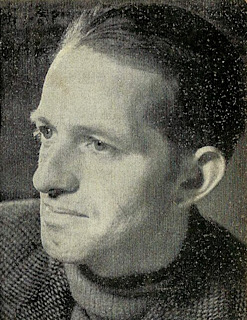
Ó Cuinneagáin Is the third child of Sean Cunningham and his wife Caitlín. He is educated in Belfast, at St. Brigid’s school, Malone Road, and the St. Patrick’s Christian Brothers school on Donegall Street. His political views are permanently influenced by memories of the sectarian violence of 1920–22. In 1927, he enters the Irish civil service as a tax clerk, stationed first at Athlone and then at Castlebar. He is promoted to junior executive officer in the Department of Defence, but resigns in July 1932 after his superiors refuse to allow him six months unpaid leave to study the Irish language in the Donegal Gaeltacht. He turns down a promotion to the Department of Finance, a decision partly motivated by disillusion with Fianna Fáil. He subsequently works as an accountant and lives in the south Dublin suburbs. In 1934, he establishes his own publishing company, Nuachtáin Teoranta, which he boasts is the first company to be registered in the Irish language, and he also contributes to an Irish language socialist paper, An t-Éireannach, under the pen name “Bruinneal gan Smal.”
In 1940–41, Ó Cuinneagáin is active in the Friends of Germany, a pro-Nazi organisation which disintegrates after some of its leading members are interned. On September 26, 1940, he founds Craobh na h-Aiséirighe, a branch of the Gaelic League aimed at attracting dynamic young enthusiasts frustrated by the older activists who dominate established branches. It makes a point of using modern publicity methods to get its message across, a trait which is carried over into Ailtirí na hAiséirghe (Architects of Resurrection), a political movement made up of branch members, which Ó Cuinneagáin founds in 1942. This move leads to the expulsion of Craobh na h-Aiséirighe from the Gaelic League and the establishment of Glún na Buaidhe by branch members who disapprove of his political ambitions and wish to concentrate on the promotion of the Irish language.
Members of Ailtirí wear an informal uniform of a green shirt, tweed suit, and báinín jacket. In private Ó Cuinneagáin reveals that the organisation is modeled on the Hitler Youth. His own title of “ceannaire” (leader) equates with “Führer” and “duce.” Features of the movement copied from Nazism include an emphasis on propaganda based on a few simple concepts and phrases. The claim that party politics allow statesmen to evade individual responsibility, whereas a single leader is necessarily more responsive to public opinion; and the belief that all difficulties can be overcome through willpower.
Ó Cuinneagáin takes to extremes contemporary Catholic advocacy of a corporate state based on vocational principles as the solution to the problems of modernity. While venerating António de Oliveira Salazar‘s Portugal as a role model, he believes that Ireland can surpass it and create a Catholic social model that will redeem the whole world. He takes a quasi-racial view of Irishness and comes close to saying that the only true Irish Catholics are of Gaelic race. When Seán Ó’Faoláin comments acidly in The Bell on the paradox of “Celtophiles” who bear such Celtic names as Blackham and Cunningham, Ó Cuinneagáin protests that he can prove his pure Gaelic descent. The Ailtirí state forces all male citizens to undertake a year’s compulsory military service, which is also used as a means of Gaelicisation, and the resulting citizen army of 250,000 would mount a lightning invasion of Northern Ireland, modeled on the blitzkrieg, with a favourite slogan being “Six Counties, Six Divisions, Sixty Minutes.” In 1943, the Stormont government excludes Ó Cuinneagáin from Northern Ireland.
Ailtirí attracts considerable attention. Its leaders address numerous meetings around the country, attracting large crowds to demonstrations at Dublin and Cork. Ó Cuinneagáin, who is by no means unintelligent, is capable of shrewd observations on the restrictions imposed on most Irish-language bodies by government subsidies, and the impact of the snobbery shown toward the poor by their middle class co-religionists. Several of his lieutenants are academics or engineers. In the 1970s he praises modernist architecture as breaking with the hated Georgian past, and denounces conservationists who oppose plans to build an oil refinery in Dublin Bay. Bilingual pamphlets produced by the group sell thousands of copies. Ó Cuinneagáin is the author of several, including Ireland’s twentieth century destiny (1942), Aiséirí says . . .(1943), Partition: a positive policy (1945), and Aiséirí for the worker (1947). Hus attempts to launch a party paper are stifled until the end of the war. Some of the interest attracted by the group is derived from curiosity or amusement. It also functions to some extent as a front organisation for the banned Irish Republican Army (IRA), with Ó Cuinneagáin declaring that Jews and freemasons should be locked up instead of IRA men. Aiséirí members are involved in the bombing of the Gough memorial in Phoenix Park in July 1957, with the stolen head concealed for a time in the party’s offices.
The party runs four candidates, including Ó Cuinneagáin in Dublin North-West, in the 1943 Irish general election and seven in 1944, but all lose their deposits. Ó Cuinneagáin does not actually vote for himself. Throughout his life he demands Irish language ballot papers. When given English language ones he tears them up, claiming that they disenfranchise him and that this invalidates the election. In 1946, Ailtirí na h-Aiséirí elects eight members to local bodies in counties Louth and Cork. This helps to bring about the decline of the party, as the Cork activists rebell against the rigid Führerprinzip upheld by the electorally unsuccessful ceannaire and his Dublin acolytes. Most of the party’s local support is absorbed by Clann na Poblachta. Ó Cuinneagáin retains a small group of followers centred on his newspaper Aiséirighe.
Ó Cuinneagáin keeps himself in the public gaze by driving around the country in a van painted with slogans, and by regularly appearing in court for refusing to respond to official documents (rates demands, car insurance, court summonses) unless they are supplied in Irish. He enjoys some success in securing the provision of Irish language versions of such documents, and he contrasts the state’s niggardliness on this point with its professed commitment to the revival of Irish. In 1954, he founds an Irish language women’s artistic and social paper, Deirdre, which operates successfully for over a decade without government subsidy.
Ó Cuinneagáin continues to write sympathetically about IRA activities, at one point offering a £1,000 reward for the capture of the Prime Minister of Northern Ireland, Basil Brooke. He maintains surprisingly extensive international neo-fascist contacts. He regularly reprints in Aiséirighe material by the American antisemite and racial segregationistGerald L. K. Smith. He cites praise for Aiséirighe from Der Stahlhelm, a far-right German veterans’ paper, and notes Oswald Mosley‘s support for Irish reunification. He denounces Hugh Trevor-Roper‘s Last days of Hitler as typical British slander of a fallen enemy. He compares the sacrificial ideology of the Hungarian Nazi collaborator Ferenc Szálasi to that of Patrick Pearse. He praises Juan Perón as a model whom Ireland should imitate and he follows the electoral fortunes of Italian neo-fascism with interest. He also maintains contacts with the radical right-wing fringes of Breton, Scottish, and Welsh nationalism. He declares that Ireland’s grievance is against England alone and bemoans the Dublin government’s failure to encourage the break-up of the United Kingdom.
Ó Cuinneagáin denounces the Soviet Union and United States alike as controlled by Zionists and freemasons. He points to illegitimacy and divorce rates in the United States as proof of the folly of those who regard “progressive” American education as superior to the sound Irish teaching methods embodied by the Christian Brothers, and bemoans the increasing flow of “immoral” American comics and paperback books into Ireland. While noting with pride that he has been described as “Ireland’s foremost Jew-baiter,” He claims that his frequent diatribes against Robert Briscoe and the state of Israel are merely anti-Zionist, and that he has nothing against Jews, whom he defines as ultra-Orthodox anti-Zionists. He hopes that a Europe united on national–Christian principles might fend off the influence of the super powers. He echoes Mosleyite calls for European unity and is an early and determined advocate of Irish membership of the European Community. However, he dissents from the Mosleyite view that such a union should be based on African empire. He is generally anti-imperialist, though somewhat more lenient toward Portuguese than British imperialism, and from 1956 the President of Egypt, Gamal Abdel Nasser, becomes one of his heroes. While supporting European unity as a defensive strategy, he also warns that unless Ireland adopts mass conscription the country might be conquered by a regiment of Russian paratroopers landing on Dollymount Strand. Throughout the 1950s and 1960s he regularly calls for the Irish Army to mount a military coup, hinting that it should install him as leader in the same way that the Portuguese army had installed Salazar.
Ó Cuinneagáin gives up contesting elections but regularly cites those who do not vote in elections as indicating the extent of political support for Ailtirí na hAiséirghe. He regularly laments that the safety valve of emigration had taken the steam out of radical politics. In his later years he notes the growth of anti-clericalism and the beginnings of a permissive society in Dublin. He attributes this to the church’s failure to implement its own social teaching and its encouragement of West British snobbery at the expense of the truly Catholic traditions of the Gael.
On April 4, 1945, Ó Cuinneagáin marries Sile Ní Chochláin. They have four sons and two daughters, some of whom become active in left-wing politics. He dies on June 13, 1991. He tends to be remembered as a figure of fun, but this view demands some qualification. He possesses genuine abilities and dedication. His fantasies are an extreme development of the official ideology of the state, and part of his appeal stems from his ability to point out the hypocrisy involved in paying it lip service while failing to push it to its logical conclusion. The blindness and cruelty involved in imposing his world view at a personal level has their counterparts in the institutions of official Ireland. Ailtirí na hAiséirghe may have been a marginal millennial cult, but in Europe during the 1940s such groups were often raised to power by circumstances. Had the World War II taken a different direction after 1940, he might be remembered not as a parody of Pearse but as an Irish Szálasi.
(From: “ÓCuinneagáin, Gearóid Seán Caoimhín” by Patrick Maume, Dictionary of Irish Biography, http://www.dib.e, October 2009)
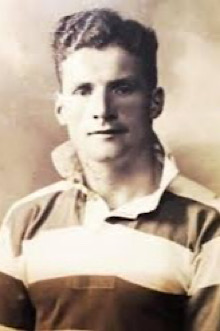
In 1934, aged 16, McAlinden is playing for Glentoran Reserves, when after a game against their reserves, he is offered a professional contract by Belfast Celtic. Together with Jackie Vernon, Tommy Breen, Billy McMillan and Charlie Tully, he subsequently becomes a prominent member of the Celtic team managed by Elisha Scott. This team dominates the Irish League in the era before and during World War II. Among his most notable contributions is scoring in the 2–1 win against Bangor in the 1938 Irish Cup final.
In December 1938, McAlinden signs for Portsmouth for a fee of £7.500. He makes his debut for the club against Chelsea and goes on to become a regular in the side. Within six months of his arrival at the club, he helps them win the 1939 FA Cup final, beating Wolverhampton Wanderers 4–1. After the outbreak of World War II, he plays three times for Portsmouth in wartime regional leagues, but his first spell with the club ends when he then returns to Belfast Celtic in 1939. He returns to Portsmouth for a second stint in 1946. In September 1947, he leaves Portsmouth once again and joins Stoke City for a fee of £7,000.
Following the end of his second stint with Belfast Celtic and before he rejoins Portsmouth, McAlinden signs for Shamrock Rovers in September 1945. He makes his debut against Shelbourne at Glenmalure Park on September 16. While playing for Rovers his teammates include Paddy Coad, Peter Farrell and Tommy Eglington. During his one season with Rovers, he helps the club reach the 1946 FAI Cup final. However Rovers lose 3–1 to Drumcondra.
McAlinden joins Stoke City in September 1947 for a then club record fee of £7,000. He becomes regular inside forward under manager Bob McGrory in 1947–48, playing in 33 matches scoring just twice against Aston Villa and Huddersfield Town. His lack of goals sees him fall out of favour at the Victoria Ground and he is sold to Third Division South side Southend United in October 1948.
In 1948, Southend United signs McAlinden from Stoke City for a fee of £8,000. He continues to play for United until 1954 and during his time with the club he serves as club captain. He also becomes something of a cult hero among the club’s fans and is remembered as being possibly the best player ever to play for the club. In 1950, he is caught up in controversy after it is alleged that he received illegal payments during his second spell with Portsmouth. As a result, he is suspended for the first two months of the 1950–51 season. In April 1954, he makes his last home appearance for United in a 4–1 win over Queens Park Rangers.
When McAlinden begins his international career in 1937 there are in effect, two Ireland teams, chosen by two rival associations. Both associations, the Northern Ireland–based Irish Football Association (IFA) and the Irish Free State–based Football Association of Ireland (FAI), claim jurisdiction over the whole of Ireland and select players from the whole island. As a result, several notable Irish players from this era, including McAlinden play for both teams.
Between 1937 and 1948, McAlinden makes five appearances for the IFA XI, making his international debut in a 1–1 draw with Scotland at Pittodrie Stadium on November 10, 1937. His IFA XI appearances also include the 8–4 defeat against a Combined Services XI at Windsor Park on September 9, 1944. This team is basically a Great Britain XI and features, among others, Matt Busby, Stanley Matthews, Tommy Lawton and Stan Mortensen. He also plays against England in 7–2 defeat at Windsor Park on September 9, 1946. He makes his last appearance for the IFA XI on October 10, 1948, in a 6–2 defeat to England at Windsor Park. He makes his first three appearances for the IFA XI while with Belfast Celtic, his fourth while at Portsmouth and his fifth while at Southend United.
In 1946, while with Portsmouth, McAlinden also makes two appearances for the FAI XI. He is one of several players born in Northern Ireland who benefits from the FAI’s attempts to establish their all-Ireland influence. In June 1946, when the FAI organises an Iberian tour, he, together with Jackie Vernon, Billy McMillan and Paddy Sloan, is one of four Northern Irish players called up. He subsequently plays in both the 3–1 defeat to Portugal on June 16 and then helps Ireland gain a surprise 1–0 victory against Spain on June 23, 1946.
In 1955, McAlinden becomes player/manager of Glenavon. He continues playing for an additional year before finally retiring as a player to concentrate on management. During a thirteen-year stint with Glenavon, he guides them two Irish League titles, three Irish Cup victories and one Gold Cup. After leaving Glenavon, works as a full-time scout for Coventry City before taking charge at Lisburn Distillery in 1969. He subsequently guides a Distillery team that includes a young Martin O’Neill to a win in the 1971 Irish Cup. Later in his first season with Drogheda United, he guides them to the 1976 FAI Cup final, only to lose 1–0 to Bohemian.
McAlinden dies at the age of 75 on November 15, 1993.
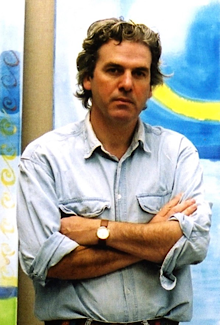
Henderson is born to James Douglas Alexander Henderson, who manages the family business of Henderson & Eadie, and Doris Josephine (née Watson). He attends Portora Royal School in Enniskillen, where the art master, Angus Bryson, spots him as an exceptional student.
From 1972 to 1973 Henderson studies an Arts Foundation course at Ulster University. From 1973 to 1976 he studies Fine Art at Kingston University, London, achieving a Bachelor of Artsfirst class honours degree under the tutelage of Terry Jones, returning in 1977 as Artist-in-Residence. In the same year he becomes the first recipient of the Stanley Picker Fellowship Award in Painting. Between 1978 and 1979 he completes a MA postgraduate in Fine Art at Chelsea School of Art under the tutelage of the artist John Hoyland.
In 1980, Henderson starts his professional artistic journey, developing abstract techniques, creating large canvases with complex layers of overlaid and inter-worked paint. He lives and paints in London for twenty years before relocating back to Ireland. In the mid-1980s he works in a studio adjacent to the house he shares with his partner, Jenni Stone, with whom he has a daughter named Emerald.
During the mid-1980s Henderson’s work becomes recognised by private and public collectors, including Bono, leader of the Irish rock band U2. During this period he sells his first work to the National Art Collection (1986). Cuilcagh Under A Renaissance Sky is purchased for Fermanagh County Museum with a grant from the Arts Council of Northern Ireland during his first solo exhibition “Around a Border” in Ireland. This is followed by three more acquisitions via the Arts Council during the 1980s, who continue to support his work into the new millennium acquiring If Hobbema had Seen Ireland (1989) in 2004 via Art Fund with support from the Esmée Fairbairn Foundation. His work is exhibited by Arts Council England.
In 1990 Henderson moves to the Cooperage Studio, Brick Lane, London, sharing the top floor with sculptor David Fusco and artist Bryan Benge, a friend from Kingston University. Benge says “Every summer the studios in the East End became part of the open studios programme. . . . . He was an intelligent and incredibly accomplished Painter.” It is here, separated from his partner and virtually penniless, he devotes himself entirely to his work, living in a tent, donated by Benge’s parents, inside the studio.
Henderson begins Palinurus in Soho in 1991, a series of twelve paintings depicting night time rooftop scenes across London, painted from an attic in Kingly Street. Exhibited at the Anna Bornholt Gallery in 1992, ten of the series are acquired by a single private collector.
Around 2000, Henderson becomes more influenced by Greek and Irish symbolism, in particular White Island, the Book of Kells and Sheela na gig, reflected in much of the art produced from this time onward. In 2001, he creates a set of enamel manuscripts for The Clinton Centre in Enniskillen, inaugurated by U.S. PresidentBill Clinton in 2002, in commemoration of the Remembrance Day bombing of 1987. He is interested in enameling because of the possibilities that it offers to him as a colourist and in the behaviour of gestural mark-making. The process is made possible when he is introduced to Andrew Morley, the authority on enamel sign making.
Henderson’s artistic influences include Hans Hofmann, Barnett Newman, Mark Rothko, and John Hoyland. Frequently associated with Samuel Beckett and Jack Butler Yeats, he is influenced by his homeland; his early environment, growing up around weaving, yarns and dyeing, the regions political turmoil, symbolism, and in later life his chronic illness, expressed in his more sombre paintings.
John Hutchinson, critic and director of the Douglas Hyde Gallery writes in the Sunday Independent that Henderson’s paintings “demonstrate the fruitfulness of the no man’s land between abstraction and representation,” and “His images deliberately evoke the picturesque and romantic landscape conventions that originated in the late 18th century…..as well as the expressionist subjectivity of painters such as Jack B. Yeats.” Due to Henderson’s disinterest in the commercialisation of his work, he is sometimes referred to as Ireland’s Invisible Genius.
Henderson describes the evolution of his work, after returning to Ireland in 1993, saying, “Since returning to Ireland my work has become less concerned with resting landscape painting in a cultural context more appropriate to our times, but has come full circle towards an internalised organic abstraction which characterised my more intuitive approach until the early eighties.”
Henderson is married once, in 1995 to the actress Patricia Martinelli with whom he subsequently has a daughter in 1997, Bella-Lucia. He remains married, living in the remote village of Boho, County Fermanagh, Northern Ireland, until his death, brought on by a brain tumour, on April 28, 2009. He remains a prolific artist throughout his life.