seamus dubhghaill

Promoting Irish Culture and History from Little Rock, Arkansas, USA


Leave a comment

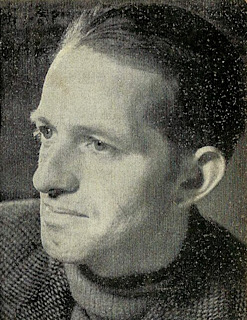
Birth of Gearóid Ó Cuinneagáin, Political Activist & Publisher

Gearóid Seán Caoimhín Ó Cuinneagáin, political activist and publisher, is born John Gerald Cunningham in Belfast on January 2, 1910.

Ó Cuinneagáin Is the third child of Sean Cunningham and his wife Caitlín. He is educated in Belfast, at St. Brigid’s school, Malone Road, and the St. Patrick’s Christian Brothers school on Donegall Street. His political views are permanently influenced by memories of the sectarian violence of 1920–22. In 1927, he enters the Irish civil service as a tax clerk, stationed first at Athlone and then at Castlebar. He is promoted to junior executive officer in the Department of Defence, but resigns in July 1932 after his superiors refuse to allow him six months unpaid leave to study the Irish language in the Donegal Gaeltacht. He turns down a promotion to the Department of Finance, a decision partly motivated by disillusion with Fianna Fáil. He subsequently works as an accountant and lives in the south Dublin suburbs. In 1934, he establishes his own publishing company, Nuachtáin Teoranta, which he boasts is the first company to be registered in the Irish language, and he also contributes to an Irish language socialist paper, An t-Éireannach, under the pen name “Bruinneal gan Smal.”

In 1940–41, Ó Cuinneagáin is active in the Friends of Germany, a pro-Nazi organisation which disintegrates after some of its leading members are interned. On September 26, 1940, he founds Craobh na h-Aiséirighe, a branch of the Gaelic League aimed at attracting dynamic young enthusiasts frustrated by the older activists who dominate established branches. It makes a point of using modern publicity methods to get its message across, a trait which is carried over into Ailtirí na hAiséirghe (Architects of Resurrection), a political movement made up of branch members, which Ó Cuinneagáin founds in 1942. This move leads to the expulsion of Craobh na h-Aiséirighe from the Gaelic League and the establishment of Glún na Buaidhe by branch members who disapprove of his political ambitions and wish to concentrate on the promotion of the Irish language.

Members of Ailtirí wear an informal uniform of a green shirt, tweed suit, and báinín jacket. In private Ó Cuinneagáin reveals that the organisation is modeled on the Hitler Youth. His own title of “ceannaire” (leader) equates with “Führer” and “duce.” Features of the movement copied from Nazism include an emphasis on propaganda based on a few simple concepts and phrases. The claim that party politics allow statesmen to evade individual responsibility, whereas a single leader is necessarily more responsive to public opinion; and the belief that all difficulties can be overcome through willpower.

Ó Cuinneagáin takes to extremes contemporary Catholic advocacy of a corporate state based on vocational principles as the solution to the problems of modernity. While venerating António de Oliveira Salazar‘s Portugal as a role model, he believes that Ireland can surpass it and create a Catholic social model that will redeem the whole world. He takes a quasi-racial view of Irishness and comes close to saying that the only true Irish Catholics are of Gaelic race. When Seán Ó’Faoláin comments acidly in The Bell on the paradox of “Celtophiles” who bear such Celtic names as Blackham and Cunningham, Ó Cuinneagáin protests that he can prove his pure Gaelic descent. The Ailtirí state forces all male citizens to undertake a year’s compulsory military service, which is also used as a means of Gaelicisation, and the resulting citizen army of 250,000 would mount a lightning invasion of Northern Ireland, modeled on the blitzkrieg, with a favourite slogan being “Six Counties, Six Divisions, Sixty Minutes.” In 1943, the Stormont government excludes Ó Cuinneagáin from Northern Ireland.

Ailtirí attracts considerable attention. Its leaders address numerous meetings around the country, attracting large crowds to demonstrations at Dublin and Cork. Ó Cuinneagáin, who is by no means unintelligent, is capable of shrewd observations on the restrictions imposed on most Irish-language bodies by government subsidies, and the impact of the snobbery shown toward the poor by their middle class co-religionists. Several of his lieutenants are academics or engineers. In the 1970s he praises modernist architecture as breaking with the hated Georgian past, and denounces conservationists who oppose plans to build an oil refinery in Dublin Bay. Bilingual pamphlets produced by the group sell thousands of copies. Ó Cuinneagáin is the author of several, including Ireland’s twentieth century destiny (1942), Aiséirí says . . .(1943), Partition: a positive policy (1945), and Aiséirí for the worker (1947). Hus attempts to launch a party paper are stifled until the end of the war. Some of the interest attracted by the group is derived from curiosity or amusement. It also functions to some extent as a front organisation for the banned Irish Republican Army (IRA), with Ó Cuinneagáin declaring that Jews and freemasons should be locked up instead of IRA men. Aiséirí members are involved in the bombing of the Gough memorial in Phoenix Park in July 1957, with the stolen head concealed for a time in the party’s offices.

The party runs four candidates, including Ó Cuinneagáin in Dublin North-West, in the 1943 Irish general election and seven in 1944, but all lose their deposits. Ó Cuinneagáin does not actually vote for himself. Throughout his life he demands Irish language ballot papers. When given English language ones he tears them up, claiming that they disenfranchise him and that this invalidates the election. In 1946, Ailtirí na h-Aiséirí elects eight members to local bodies in counties Louth and Cork. This helps to bring about the decline of the party, as the Cork activists rebell against the rigid Führerprinzip upheld by the electorally unsuccessful ceannaire and his Dublin acolytes. Most of the party’s local support is absorbed by Clann na Poblachta. Ó Cuinneagáin retains a small group of followers centred on his newspaper Aiséirighe.

Ó Cuinneagáin keeps himself in the public gaze by driving around the country in a van painted with slogans, and by regularly appearing in court for refusing to respond to official documents (rates demands, car insurance, court summonses) unless they are supplied in Irish. He enjoys some success in securing the provision of Irish language versions of such documents, and he contrasts the state’s niggardliness on this point with its professed commitment to the revival of Irish. In 1954, he founds an Irish language women’s artistic and social paper, Deirdre, which operates successfully for over a decade without government subsidy.

Ó Cuinneagáin continues to write sympathetically about IRA activities, at one point offering a £1,000 reward for the capture of the Prime Minister of Northern IrelandBasil Brooke. He maintains surprisingly extensive international neo-fascist contacts. He regularly reprints in Aiséirighe material by the American antisemite and racial segregationist Gerald L. K. Smith. He cites praise for Aiséirighe from Der Stahlhelm, a far-right German veterans’ paper, and notes Oswald Mosley‘s support for Irish reunification. He denounces Hugh Trevor-Roper‘s Last days of Hitler as typical British slander of a fallen enemy. He compares the sacrificial ideology of the Hungarian Nazi collaborator Ferenc Szálasi to that of Patrick Pearse. He praises Juan Perón as a model whom Ireland should imitate and he follows the electoral fortunes of Italian neo-fascism with interest. He also maintains contacts with the radical right-wing fringes of Breton, Scottish, and Welsh nationalism. He declares that Ireland’s grievance is against England alone and bemoans the Dublin government’s failure to encourage the break-up of the United Kingdom.

Ó Cuinneagáin denounces the Soviet Union and United States alike as controlled by Zionists and freemasons. He points to illegitimacy and divorce rates in the United States as proof of the folly of those who regard “progressive” American education as superior to the sound Irish teaching methods embodied by the Christian Brothers, and bemoans the increasing flow of “immoral” American comics and paperback books into Ireland. While noting with pride that he has been described as “Ireland’s foremost Jew-baiter,” He claims that his frequent diatribes against Robert Briscoe and the state of Israel are merely anti-Zionist, and that he has nothing against Jews, whom he defines as ultra-Orthodox anti-Zionists. He hopes that a Europe united on national–Christian principles might fend off the influence of the super powers. He echoes Mosleyite calls for European unity and is an early and determined advocate of Irish membership of the European Community. However, he dissents from the Mosleyite view that such a union should be based on African empire. He is generally anti-imperialist, though somewhat more lenient toward Portuguese than British imperialism, and from 1956 the President of Egypt, Gamal Abdel Nasser, becomes one of his heroes. While supporting European unity as a defensive strategy, he also warns that unless Ireland adopts mass conscription the country might be conquered by a regiment of Russian paratroopers landing on Dollymount Strand. Throughout the 1950s and 1960s he regularly calls for the Irish Army to mount a military coup, hinting that it should install him as leader in the same way that the Portuguese army had installed Salazar.

Ó Cuinneagáin gives up contesting elections but regularly cites those who do not vote in elections as indicating the extent of political support for Ailtirí na hAiséirghe. He regularly laments that the safety valve of emigration had taken the steam out of radical politics. In his later years he notes the growth of anti-clericalism and the beginnings of a permissive society in Dublin. He attributes this to the church’s failure to implement its own social teaching and its encouragement of West British snobbery at the expense of the truly Catholic traditions of the Gael.

On April 4, 1945, Ó Cuinneagáin marries Sile Ní Chochláin. They have four sons and two daughters, some of whom become active in left-wing politics. He dies on June 13, 1991. He tends to be remembered as a figure of fun, but this view demands some qualification. He possesses genuine abilities and dedication. His fantasies are an extreme development of the official ideology of the state, and part of his appeal stems from his ability to point out the hypocrisy involved in paying it lip service while failing to push it to its logical conclusion. The blindness and cruelty involved in imposing his world view at a personal level has their counterparts in the institutions of official Ireland. Ailtirí na hAiséirghe may have been a marginal millennial cult, but in Europe during the 1940s such groups were often raised to power by circumstances. Had the World War II taken a different direction after 1940, he might be remembered not as a parody of Pearse but as an Irish Szálasi.

(From: “Ó Cuinneagáin, Gearóid Seán Caoimhín” by Patrick Maume, Dictionary of Irish Biography, http://www.dib.e, October 2009)

Leave a comment

Attempted Assassination of Sir John French

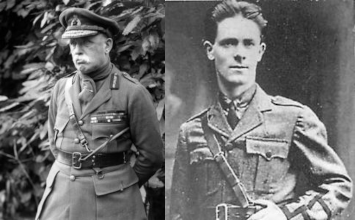
The Irish Republican Army (IRA) attempts to assassinate British General John French, Lord Lieutenant of Ireland, in his car at Phoenix Park, Dublin, on December 19, 1919. French is unhurt, but one IRA Volunteer, Martin Savage, is killed. IRA volunteer Dan Breen and two Dublin Metropolitan Police (DMP) men and a driver are wounded. A Royal Irish Constabulary (RIC) sergeant is knocked unconscious.

On a cold December day in 1919, a group of young IRA volunteers wait at a public house near the Ashtown gate of Dublin’s Phoenix Park. Some are from Dublin, members of Michael Collins’ recently created assassination unit, the Squad. Others are from farther afield, like Dan Breen and Seán Treacy from County Tipperary and Martin Savage from County Sligo.

They are waiting for Sir John French, Lord Lieutenant of Ireland, the most senior British official in the land. He is returning from a visit to the west of Ireland and has alighted at Ashtown train station before returning by car to his official residence, the Viceregal Lodge, in the Phoenix Park.

The IRA men have a signaler in a tree and when French’s car approaches, they attempt to block the road with a farm cart. However, they are too late to block the Lord Lieutenant’s car which sweeps through the impromptu barricade. Shots are fired and one policeman is wounded but French himself emerges unscathed.

A second car, which the IRA believes to contain French, bears the brunt of the volunteers’ revolver fire and grenades. Though the car is badly damaged, there are no casualties.

The third car in the convoy contains French’s military escort and the soldiers inside the vehicle return fire, killing one of the attackers, Martin Savage. Some of the volunteers attempt to recover his body but the Crown forces’ fire is too heavy. Savage’s body is left on the scene as the IRA party flees on bicycles back to the city.

The Irish Times, for one, expresses outrage at the attack, “the attempted assassination of the greatest of Irishmen” which it says will “shock Ireland” and force Sinn Féin, victorious in the election of the previous year, to reflect on whether it wants to be associated with “outrage and assassination.” “There will now be many throughout the world ready to attribute the character of a murder society to the whole new Irish movement.”

But some, even British Prime Minister David Lloyd George, are surprisingly unsympathetic. “They are bad shots” is his only remark on hearing of the attack.

Many in Ireland are even less sympathetic to hear of the escape of the Lord Lieutenant. The Irish Catholic bishops issue a statement the next day condemning not the attack but British rule in Ireland, which they characterise as “rule of the sword, utterly unsuited to a civilised nation.”

The attack is, in hindsight, a turning point, moving the standoff over Irish independence toward all out guerrilla warfare, but also, in a way, symbolising the eclipse of French and of his vision for what the country should be.

Sir John French’s health declines in 1920 and though he holds the position of Lord Lieutenant until April 1921, his central role in Irish affairs is eclipsed by new Chief Secretary for Ireland Sir Hamar Greenwood. He wants to retire to his estates in Ireland in 1922 but is told it is simply too dangerous for him. During the Irish Civil War (1922-23), his country house at Drumdoe, County Roscommon, is raided by armed men who carry off much of the furniture.

French dies from cancer of the bladder at Deal Castle in Deal, Kent, England, on May 22, 1925.

(From: “Today in Irish History: 19 December 1919, The Attempted Assassination of Sir John French” by John Dorney, The Irish Story, http://www.theirishstory.com, December 18,2019 | Pictured: L to R, Sir John French and Martin Savage)


Leave a comment

Death of Sir Thomas Farrell, Irish Sculptor

Sir Thomas Farrell, Irish sculptor, dies at his home, Redesdale House, Stillorgan, County Dublin, on July 2, 1900.

Farrell is born in 1827 in Mecklenburgh Street (later called Railway Street) in Summerhill, Dublin, one of six sons of Terence Farrell, sculptor, and Maria Farrell (née Ruxton). He trains as a sculptor in his father’s workshops. In 1842 he enters the modelling school of the Royal Dublin Society, where he is awarded the prize for “Original design in clay” the following year. He is awarded premiums by the Royal Irish Art Union in 1844 and 1846. As a student he becomes acquainted with the neoclassical sculpture of John Flaxman and John Hogan. His first commission is a monument to Archbishop Daniel Murray in St. Mary’s Pro-Cathedral in Dublin.

One of the first works that make Farrell prominent is the bas-relief representing the last charge at Waterloo, designed for the Wellington Monument in the Phoenix Park. His work is accepted after public competition. Another of his early works is his memorial to Captain John McNeil Boyd in St. Patrick’s Cathedral, Dublin. He enters the competition for the monument to Daniel O’Connell in 1864, but the commission is awarded to John Henry Foley.

His statue of William Smith O’Brien, the Young Ireland leader, formerly at the head of D’Olier Street, is now in O’Connell Street, as is another statue by him, that of Sir John Gray, the surgeon and politician who is instrumental in giving Dublin its water supply.

Throughout his career, Farrell remains actively involved in the Royal Hibernian Academy (RHA). He is elected directly as a full member in 1860 rather than undergoing an initial phase of associate membership. He exhibits almost annually with the academy until his death. He holds a number of posts, including professor of sculpture and treasurer, before being elected president in 1893, being the first sculptor to be so honoured. His achievements are recognised with a knighthood in May 1894.

Farrell dies at his residence, Redesdale House, in Stillorgan, County Dublin, on July 2, 1900. He is a shy, retiring man, and his death is not announced to the public for three days, in keeping with his wishes to avoid any sort of elaborate display on his behalf. Intensely private, he never marries and lives a life immersed in his work. Contemporary accounts describe him as constantly dissatisfied with his work despite consistent public approval for it.


Leave a comment

Death of Australian Explorer Robert O’Hara Burke

Robert O’Hara Burke, Irish soldier and police officer who achieves fame as an Australian explorer, dies of starvation on June 28, 1861, in Cooper Creek, Queensland, Australia, while exploring the continent. He is the leader of the ill-fated Burke and Wills expedition which is the first expedition to cross Australia from south to north.

Burke is born in St. Clerens, County Galway on May 6, 1821, the second of three sons of James Hardiman Burke, an officer in the British Army 7th Royal Fusiliers, and Anne Louisa Burke (nee O’Hara).

Burke enters the Royal Military Academy, Woolwich in May 1835. In December 1836 he fails his probationary exam and goes to Belgium to further his education. In 1841, he enters the Imperial Austrian Army and spends most of his time posted to northern Italy. Towards the end of 1847 he suffers health problems and ultimately resigns from the Austrian army in June 1848.

After returning to Ireland in 1848, he joins the Irish Constabulary (later the Royal Irish Constabulary). He does his cadet training at Phoenix Park Depot in Dublin between November 1849 and January 1850. At the end of 1850 he transfers to the Mounted Police in Dublin.

Burke emigrates to Australia, arriving in Hobart, Tasmania on February 12, 1853, and promptly sails for Melbourne. On April 1, 1853, he joins the recently established Victoria Police force.

After the South Australian explorer John McDouall Stuart reaches the centre of Australia, the South Australian parliament offers a reward of £2,000 for the promotion of an expedition to cross the continent from south to north, generally following Stuart’s route. In June 1860, Burke is appointed to lead the Victorian Exploring Expedition with William John Wills, his third-in-command, as surveyor and astronomical observer.

The expedition leaves Melbourne on August 20, 1860, with a total of 19 men, 27 camels and 23 horses. They reach Menindee on September 23, 1860, where several people resign.

Cooper Creek, 400 miles further on, is reached on November 11, 1860, by the advance group, the remainder being intended to catch up. After a break, Burke decides to make a dash to the Gulf of Carpentaria, leaving on December 16, 1860. William Brahe is left in charge of the remaining party. The small team of Burke, William Wills, John King and Charley Gray reach the mangroves on the estuary of the Flinders River, near where the town of Normanton now stands, on February 9, 1861. They never see open ocean due to flooding rains and swamps.

Already weakened by starvation and exposure, progress on the return journey is slow and hampered by the tropical monsoon downpours of the wet season. Gray dies four days before they reach the rendezvous at Cooper Creek. The other three rest for a day when they bury him. They eventually reach the rendezvous point on April 21, 1861, nine hours after the rest of the party had given up waiting and left, leaving a note and some food, as they had not been relieved by the party supposed to be returning from Menindee.

Burke’s party attempts to reach Mount Hopeless, the furthest outpost of pastoral settlement in South Australia, which is closer than Menindee, but fail and return to Cooper Creek. While waiting for rescue Wills dies of exhaustion and starvation. Soon after, Burke also dies, at a place now called Burke’s Waterhole on Cooper Creek in South Australia. The exact date of Burke’s death is uncertain but has generally been accepted to be June 28, 1861.

King survives with the help of Aborigines until he is rescued in September by Alfred William Howitt. Howitt buries Burke and Wills before returning to Melbourne. In 1862, Howitt returns to Cooper Creek and disinters Burke and Wills, taking them first to Adelaide and then by steamer to Melbourne where they are laid in state for two weeks. On January 23, 1863, Burke and Wills receive a State Funeral and are buried in Melbourne General Cemetery. Ironically, on that same day John McDouall Stuart and his companions, having successfully completed the south-north crossing, are received back at a large ceremony in Adelaide.


Leave a comment

Death of Andrew O’Connor, American Irish Sculptor

Andrew O’Connor, American Irish sculptor whose work is represented in museums in the United States, Ireland, Britain and France, dies in Dublin on June 9, 1941.

O’Connor is born on June 7, 1874, at Worcester, Massachusetts, the eldest of three sons and two daughters of Andrew O’Connor, a stonecutter from Lanarkshire, Scotland, who becomes a professional sculptor, and Marie Anne O’Connor (née McFadden), of County Antrim. Educated in Worcester public schools, at the age of 14 he becomes apprenticed to his father, helping him to design monuments for cemeteries. He is employed in the early 1890s on sculptural work for the World’s Columbian Exposition (Chicago World’s Fair), being active in the studio of William Ordway Partridge, and assisting Daniel Chester French on his colossal Statue of the Republic, a landmark of the 1893 Columbian exposition.

Moving to London (1894–98), O’Connor works on bas-reliefs in the studio of the painter John Singer Sargent, who uses him as a model for his mural Frieze of Prophets for the Boston Public Library. His first independent work, Sea Dreams, a relief of a head, is exhibited at the Royal Academy of Arts in 1896. Returning to the United States (1898–1903), he becomes a studio assistant of French, through whom he receives his first public commission, for the Vanderbilt Memorial Doors for St. Bartholomew’s Episcopal Church, Manhattan, New York, a project completed in 1902 to wide critical acclaim. He also executes the tympanum and lateral friezes.

Around 1900, O’Connor marries an artist’s model named Nora, by whom he has a daughter. In 1902, he hires as studio model Jessie Phoebe Brown from New Jersey and of County Down parentage. The following year he elopes with her to Paris, where they marry and have four sons, the youngest of whom, Patrick O’Connor, becomes an artist and gallery curator. Jessie continues for many years as his primary model, sitting for the heads of both female and male figures, O’Connor coarsening the features for the latter.

During his years in Paris (1903–14), O’Connor is influenced by the work of Auguste Rodin, whom he befriends. Among his pupils in Paris is the American sculptor and heiress Gloria Vanderbilt Whitney. He continues to fulfil numerous commissions for funerary and public monuments in the United States, an example of the former being the Recuillement in Sleepy Hollow Cemetery, near Tarrytown, New York. From 1906 he exhibits annually at the Salon in Paris, where he is the first foreigner to win a second-class medal, for his bronze statue of Gen. Henry Lawton. Included in his only exhibition at the Royal Hibernian Academy (1907) is a bronze relief of the prophet Nehemiah adapted from a panel of the Vanderbilt doors. The relief is subsequently included in his one-man show at the Galerie Hébrard, Paris in 1909.

In 1909, O’Connor wins a competition open to sculptors of Irish descent to execute a monument to Commodore John Barry, the County Wexford-born “father of the American navy,” for Washington, D.C. His design includes a frieze depicting events in Irish history, flanked by a group of three nude Irish emigrants entitled Exile from Ireland, and another group representing the Genius of Ireland, which includes a female figure of the “Motherland.” Probably owing to opposition from the Barry family to the depiction of their ancestor as a rough-and-ready sailor, the commission is not completed. His marble statue of Gen. Lew Wallace (author of Ben-Hur: A Tale of the Christ), a plaster of which is exhibited at the Salon in Paris in 1909, is placed by the state of Indiana in the National Statuary Hall in the United States Capitol, Washington, D.C. Another marble, Peace by Justice, is commissioned as a gift from the United States to the Peace Palace in The Hague in 1913.

O’Connor returns with his family to the United States on the outbreak of World War I, and sets up a studio in Paxton, Massachusetts. In 1918, his standing statue of the youthful Abraham Lincoln is placed outside the Illinois State Capitol at Springfield, Illinois. He later presents a marble head of Lincoln to the American ambassador’s residence, Phoenix Park, Dublin. His memorial in Chicago to President Theodore Roosevelt (1919) is commissioned as a tribute to Roosevelt’s associations with the Boy Scouts of America. The design of four standing scouts, modelled on O’Connor’s sons, is exhibited at the Philadelphia Art Alliance in 1920. He becomes an associate of the National Academy of Design, New York in 1919. In the early 1920s he executes an equestrian statue of the Marquis de Lafayette for South Park, at Mount Vernon, Baltimore, Maryland.

Returning to Paris in the mid-1920s, O’Connor becomes the first foreigner to win a gold medal at the Salon des Artistes in 1928, for the marble sculpture Tristan and Iseult, now held in the Brooklyn Museum, New York. The French government makes him a Chevalier of the National Order of the Legion of Honour in 1929. In 1926 he had exhibited a plaster group, Monument aux morts de la Grande Guerre, at the Salon in Paris. The sculpture is requested in 1932 by the people of Dún Laoghaire, County Dublin, as a memorial to Christ the King, O’Connor obligingly altering the interpretation of his iconography. Imposed on a “Tree of life” are three figures of Christ, representing in turn “Desolation,” “Consolation” and “Triumph.” Cast in bronze, throughout World War II the statue remains hidden in Paris to avoid its being melted down for the valuable metal. Transported to Dún Laoghaire in 1949, due to clerical opposition to its unconventional iconography, it is not at first erected, but for years lay on its side in a garden in Rochestown Avenue until its eventual unveiling in 1978 as Triple Cross in Haigh Terrace, where it stands in Moran Park. His other chief work in Ireland is a bronze statue of Daniel O’Connell in the Bank of Ireland, College Green, Dublin. Inspired by Rodin’s famous Monument to Balzac, the work is executed at his studio in a converted stable at Leixlip Castle, County Kildare in 1931–32.

During the 1930s, O’Connor lives and works in London and Ireland, where he has residences at Glencullen House, County Wicklow, and 77 Merrion Square, Dublin. He dies at the latter address on June 9, 1941, and is buried in Glasnevin Cemetery. His own bronze relief, Le feu sacré, marks the grave. A portrait painting, executed by his son Patrick in 1940, is in Dublin City Gallery The Hugh Lane, which also holds twenty-six sculptures presented by O’Connor late in his life, and posthumously by his family. The collection includes a marble self-portrait bust of 1940, a bronze of the Lafayette cast by the gallery in 1984 from a reduced plaster model presented by the artist, and a bronze group entitled The Victim, on view in Merrion Square Park, from an uncommissioned and uncompleted war memorial conceived by O’Connor under the general title Le Débarquement. The National Gallery of Ireland has the Desolation maquette for the Triple Cross. A centenary exhibition of his work is held at Trinity College Dublin in 1974. His widow dies in Dublin in 1974.

(From: “O’Connor, Andrew” by Lawrence William White and Carmel Doyle, Dictionary of Irish Biography, http://www.dib.ie, October 2009)


Leave a comment

Ahern and Paisley Publicly Shake Hands for the First Time

History is made on April 4, 2007, as Taoiseach Bertie Ahern and Democratic Unionist Party (DUP) leader Ian Paisley shake hands for the first time in public prior to their milestone meeting at Farmleigh, the official Irish state guest house in Dublin.

Ahern is urged by Paisley to ensure that criminals who flee across the Irish border are arrested. The Democratic Unionist leader makes the proposal during a cordial one-and-a-half-hour meeting at Farmleigh in Phoenix Park, where the two leaders exchange their first public handshake.

Afterwards Paisley, who receives an invitation from the taoiseach to visit the Battle of the Boyne site later in the year, says that they had also discussed the need for the new administrations in Northern Ireland and in the Republic of Ireland to work for each other’s best interests. “We can confidently state that we are making progress to ensure our two countries can develop and grow side by side in the spirit of generous cooperation,” he declares. “I trust that old barriers and threats will be removed in my day. Business opportunities are flourishing. Genuine respect for the understanding of each other’s differences and, for that matter, similarities is now developing.”

Earlier the DUP leader, who becomes the First Minister of the new power-sharing government on May 8 alongside Sinn Féin‘s Martin McGuinness as deputy First Minister, firmly shakes the hand of Ahern in public for the first time. As he arrives at Farmleigh, he quips, “I better shake the hands of this man. I’ll give him a firm handshake.”

Paisley, who is accompanied by his son, Ian Paisley, Jr., affectionately grabs the taoiseach by the shoulder. There is another handshake after the meeting at Farmleigh is finished.

Paisley says, “Mr. Ahern has come to understand me as an Ulsterman of plain speech. He didn’t ever need a dictionary to find out what I was saying. We engaged in clear and plain speech about our hopes and our aspirations for the people we both serve. The prime minister kindly congratulated me on my election victory.”

Paisley says that he had raised a number of issues crucial to unionists. “I have taken the opportunity to raise with the prime minister a number of key matters including ensuring that fugitives from justice who seek to use the border to their advantage are quickly apprehended and returned without protracted legal wrangle.” He adds, “I raised other legal issues of interests to unionists, and we discussed cooperation of an economic nature that will be to our mutual benefit.” He also says he had raised the issue of bringing Northern Ireland’s corporation tax into line with that of Ireland.

Regarding the invitation to visit the site of the Battle of the Boyne, Paisley says, “We both look forward to the visit to the battle site at the Boyne… Not to refight it, because that would be unfair, for he would have the home advantage. No Ulsterman ever gives his opponents an advantage. He adds, “Such a visit would help to demonstrate how far we have come when we can celebrate and learn from the past, so the next generation more clearly understands.”

Ahern pays tribute to the leadership shown by Paisley in helping to deliver a better future for the people of Northern Ireland. As Northern Ireland’s politicians continue at great pace to prepare for the return of power sharing, the taoiseach says that the progress has been very encouraging. “At this important time in our history, we must do our best to put behind us the terrible wounds of our past and work together to build a new relationship between our two traditions,” he says. “That new relationship can only be built on a basis of open dialogue and mutual respect. I fervently believe that we move on from here in a new spirit of friendship. The future for this island has never been brighter. I believe that this is a future of peace, reconciliation and rising prosperity for all. We stand ready to work with the new executive. We promise sincere friendship and assured cooperation. I believe that we can and will work together in the interests of everyone on this island.”

Ahern says he believes that the Battle of the Boyne site can be a symbol of the new beginning in the relationship between governments in Belfast and Dublin. “I believe that this site can become a valuable and welcome expression of our shared history and a new point of departure for an island, north and south, which is at ease with itself and respectful of its past and all its traditions,” he declared.

The Battle of the Boyne was fought in 1690 between the followers of England‘s King William of Orange, a Protestant, and the deposed King James, a Catholic, in Drogheda, eastern Ireland. Ireland was at that point under English rule. The battle is commemorated by many Northern Irish loyalists on July 12 each year.

Ministerial posts within the new devolved Stormont government have yet to be finalised. Already Sinn Féin has announced that MPs Michelle Gildernew and Conor Murphy and assembly members Gerry Kelly and Caitríona Ruane will be members of the government. However, the party has not yet indicated which of the four will take the three senior cabinet posts in education, agriculture and regional development and which one will be the junior minister in the Office of First and Deputy First Minister.

The DUP has also yet to name its ministers, but it has chosen finance, economy, environment and culture arts and leisure as the government departments it will head. The DUP’s deputy leader, Peter Robinson, and Nigel Dodds, the Belfast North MP, who both served in the last devolved government, are tipped to be the finance and economy ministers.

The Social Democratic and Labour Party (SDLP) announces the previous day that Margaret Ritchie, the assembly member for South Down, will be its only minister in the executive, taking charge of the Department of Social Development.

The Ulster Unionist Party (UUP) has yet to declare who their two ministers will be at the Departments of Health and Employment and Learning.

(From: “Upbeat Paisley shares first handshake with Irish PM” by Hélène Mulholland and agencies, The Guardian, http://www.theguardian.com, April 4, 2007)


Leave a comment

Death of Paddy Daly, IRA Volunteer & National Army Officer

Paddy Daly, sometimes referred to as Paddy O’Daly, dies at his home in County Dublin on January 16, 1957. He serves in the Irish Republican Army (IRA) during the Irish War of Independence (1919–1921) and subsequently holds the rank of major general in the Irish National Army from 1922 to 1924.

Daly is born in Dublin in 1888. He fights in the 1916 Easter Rising under the command of his namesake Edward Daly, leading the unsuccessful attempt to destroy the Magazine Fort in the Phoenix Park. He is later wounded in the particularly vicious fighting near the Linenhall. He is subsequently interned in Frongoch internment camp for his part in the rebellion until 1918, when he is released as part of a general amnesty for Irish prisoners.

During the Irish War of Independence, Daly serves as leader of the “Squad,” Michael Collins‘ assassination unit.

On December 19, 1919, Daly along with Dan Breen lead an abortive ambush, at Ashtown railway station near the Phoenix Park, on the British Viceroy, Lord Lieutenant of Ireland and Supreme Commander of the British Army in Ireland, Lord French, as he returns from a private party which he had hosted the previous evening at his country residence in Frenchpark, County Roscommon. Lord French escapes the ambush, but Martin Savage is shot dead.

Daly and the men under his command are responsible for the killing of many British intelligence officers, in particular District Inspector Redmond, who had been putting increasing pressure on the Squad. Daly himself personally kills several people, including Frank Brooke, director of Great Southern and Eastern Railway, who serves on an advisory council to the British military, in June 1920. He does not directly lead any of the attacks on Bloody Sunday but is on standby in one of the Squad’s safe houses. In the aftermath, November 23, 1920, he is arrested and interned in Abercorn Barracks in Ballykinler, County Down.

Daly is released on parole from Ballykinler in March 1921, the British apparently being unaware of his senior position within the Dublin Brigade of the IRA. After his release, he, along with Emmet Dalton, is also involved in the attempt to free Seán Mac Eoin from Mountjoy Prison on May 14, 1921. He and his men hijack a British Army Peerless armoured car in Clontarf at the corporation abattoir, while it is escorting a consignment of meat to a barracks and shoot dead two soldiers in the process. The plan involves Dalton and Joe Leonard impersonating two British army officers and using forged documents to “transfer” MacEoin to Dublin Castle. They gain entry to Mountjoy but are discovered before they can free MacEoin and have to shoot their way out. They later abandon the armoured car after removing the Hotchkiss machine guns and setting fire to what they can. Toward the end of the war, in May 1921, the two principal fighting units of the IRA’s Dublin Brigade, the “Squad” and the “Active Service Unit” are amalgamated after losses suffered in the burning of the Custom House. Daly is named Officer Commanding (OC) of this new unit, which is named the Dublin Guard.

Daly’s own account of his activities during the Irish War of Independence is held at the Bureau of Military History in Cathal Brugha Barracks.

After the Anglo-Irish Treaty splits the IRA, Daly and most of his men side with the pro-treaty party, who go on to found the Irish Free State. He is appointed to the rank of brigadier in the newly created Irish National Army, which is inaugurated in January 1922. When the Irish Civil War breaks out in June 1922, he commands the Free State’s troops who secure Dublin, after a week of fighting.

In August 1922, during the Irish Free State offensive that re-takes most of the major towns in Ireland, Daly commands a landing of 450 troops of the Dublin Guard at Fenit, County Kerry, which goes on to capture Tralee from the anti-treaty forces. Acting with severe brutality in Kerry, he comments that, “nobody had asked me to take kid-gloves to Kerry, so I didn’t.” As the Civil War develops into a vicious guerrilla conflict, he and his men are implicated in a series of atrocities against anti-treaty prisoners, culminating in a series of killings with land mines in March 1923. Daly, and others under his command, claim that those killed were accidentally blown up by their own mines. Statements by the Garda Síochána, two Free State lieutenants on duty, W. McCarthy and Niall Harrington, and one survivor, Stephen Fuller, maintain the claims are fabricated.

Daly resigns from the Free State army in 1924 after an incident in Kenmare, County Kerry, concerning the daughters of a doctor. A court martial is held but collapses as no one is prepared to give evidence. He volunteers his services for the Irish Army again in 1940 and is appointed as a Captain to the non-combatant Construction Corps.

Daly is a carpenter by trade. He marries Daisy Gillies in 1910. His brother James (Seamus) marries Daisy’s sister Nora, a Cumann na mBan activist, in a joint wedding ceremony. After Daisy’s death in 1919, Daly marries Bridget Murtagh, also a Cumann na mBan activist, in 1921. Murtagh and Nora O’Daly carry out intelligence gathering for the planned attack on the Magazine Fort in 1916. She is a sister of Elizabeth Murtagh, the first wife of Commandant Michael Love who serves with Daly in the Collins Squad of the IRA, in the Irish Free State Army of the 1920s and during the Emergency period. Murtagh dies in childbirth in 1930. Daly subsequently marries Norah Gillies, his first wife’s niece.

On his death on January 16, 1957, Daly is buried with full military honours in Mount Jerome Cemetery. He is survived by his brothers, Comdt Seamus O’Daly and Capt Frank O’Daly, his sons Patrick and Colbert, and his daughters Brede and Philomena.


2 Comments

Phoenix Park Rail Tunnel Reopens to Passenger Traffic

The Phoenix Park Rail Tunnel, a railway tunnel in Dublin funded by the National Transport Authority, reopens to regular passenger traffic on November 21, 2016, improving services for rail commuters in Kildare and Dublin.

The tunnel is built in 1877 and begins at the Liffey Railway Bridge near Heuston Station, running underneath the Phoenix Park for 690 metres before re-emerging close to the junction of the Infirmary Road and North Circular Road. It joins with the Dublin-Sligo railway line near Glasnevin, before continuing to Dublin Connolly station.

The tunnel is originally built by the Great Southern and Western Railway company to connect Kingsbridge station (now Heuston Station) to the Dublin Docklands and is primarily used for freight. Historically the line has not been used for regular passenger trains, with most traffic through the tunnel being freight or carriages and engines shunted between Connolly and Heuston for maintenance. It has occasionally been used for special passenger services, including traffic for major Gaelic Athletic Association fixtures.

The tunnel reopens to regular passenger traffic on November 21, 2016. As of late 2018, this traffic is predominantly weekday services.

(Pictured: Southern end of the Phoenix Park Tunnel, Dublin, Ireland)


Leave a comment

Birth of Michael O’Riordan, Founder of the Communist Party of Ireland

Michael O’Riordan, the founder of the Communist Party of Ireland who also fights with the Connolly Column in the International Brigades during the Spanish Civil War, is born at 37 Pope’s Quay, Cork, County Cork, on November 12, 1917.

O’Riordan is the youngest of five children. His parents come from the West Cork Gaeltacht of BallingearyGougane Barra. Despite his parents being native speakers of the Irish language, it is not until he is interned in the Curragh Camp during World War II that he learns Irish, being taught by fellow internee Máirtín Ó Cadhain, who goes on to lecture at Trinity College, Dublin.

As a teenager, O’Riordan joins the Irish nationalist youth movement, Fianna Éireann, and then the Irish Republican Army (IRA). The IRA at the time is inclined toward left-wing politics and socialism. Much of its activity concerns street fighting with the quasi-fascist Blueshirt movement and he fights Blueshirt fascism on the streets of Cork in 1933–34. He is friends with left-wing inclined republicans such as Peadar O’Donnell and Frank Ryan, and in 1934, he follows them into the Republican Congress, a short-lived socialist republican party.

O’Riordan joins the Communist Party of Ireland in 1935 while still in the IRA and works on the communist newspaper The Irish Workers’ Voice. In 1937, following the urgings of Peadar O’Donnell, several hundred Irishmen, mostly IRA or ex-IRA men, go to fight for the Spanish Republic in the Spanish Civil War with the XVth International Brigade. They are motivated in part by enmity towards the 800 or so Blueshirts, led by Eoin O’Duffy who go to Spain to fight on the “nationalist” side in the Irish Brigade. He accompanies a party led by Frank Ryan. In the Republic’s final offensive of July 25, 1938, he carries the flag of Catalonia across the River Ebro. On August 1, he is severely injured by shrapnel on the Ebro front. He is repatriated to Ireland the following month, after the International Brigades are disbanded.

In 1938 O’Riordan is offered an Irish Army commission by the Irish Free State but chooses instead to train IRA units in Cork. As a result of his IRA activities during World War II, or the Emergency as it is known in neutral Ireland, he is interned in the Curragh internment camp from 1939 until 1943 where he is Officer Commanding of the Cork Hut and partakes in Máirtín Ó Cadhain’s Gaelic League classes as well as publishing Splannc (Irish for “Spark,” named after Vladimir Lenin‘s newspaper).

In 1944 O’Riordan is founding secretary of the Liam Mellows Branch of the Labour Party and in 1945 is a founding secretary of the Cork Socialist Party, whose other notable members include Derry Kelleher, Kevin Neville and Máire Keohane-Sheehan.

O’Riordan subsequently works as a bus conductor in Cork and is active in the Irish Transport and General Workers Union (ITGWU). In 1946 he stands as a Cork Socialist Party candidate in the Cork Borough by-election and afterwards moves to Dublin where he lives in Victoria Street with his wife Kay Keohane of Clonakilty, continues to work as a bus conductor and remains active in the ITGWU.

In 1947, O’Riordan is a founding secretary of the Irish Workers’ League and general secretary thereafter, and of its successor organisation the Irish Workers’ Party from 1962–70.

In the 1960s, O’Riordan is a pivotal figure in the Dublin Housing Action Committee which agitates for clearances of Dublin’s slums and for the building of social housing. There, he befriends Fr. Austin Flannery, leading Minister for Finance and future Taoiseach Charles Haughey to dismiss Flannery as “a gullible cleric” while the Minister for Local Government, Kevin Boland, describes him as a “so-called cleric” for sharing a platform with O’Riordan.

In all O’Riordan runs for election five times, campaigning throughout for the establishment of a socialist republic in Ireland but given Ireland’s Catholic conservatism and fear of communism, he does so without success. He does, however, receive playwright Sean O’Casey‘s endorsement in 1951.

O’Riordan’s participation in the Spanish Civil War is always an important part of his political identity. In 1966 he attends the International Brigades’ Reunion in Berlin and is instrumental in having Frank Ryan’s remains repatriated from Germany to Ireland in 1979.

O’Riordan is a member of the Irish Chile Solidarity Committee and attends the 1st Party Congress of the Communist Party of Cuba in 1984. He also campaigns on behalf of the Birmingham Six and attends their Appeal trial in 1990. He serves as General Secretary of the Communist Party of Ireland (1970–83) and as National Chairman of the party (1983–88). He publishes many articles under the auspices of the CPI.

O’Riordan’s last major public outing comes in 2005 at the re-dedication of the memorial outside Dublin’s Liberty Hall to the Irish veterans of the Spanish Civil War. He and other veterans are received by President of Ireland Mary McAleese. He is also presented with Cuba’s Medal of Friendship by the Cuban Consul Teresita Trujillo to Ireland on behalf of Cuban President Fidel Castro.

In 1969, according to Soviet dissident Vasili Mitrokhin, O’Riordan is approached by IRA leaders Cathal Goulding and Seamus Costello with a view to obtaining guns from the Soviet KGB to defend Irish republican areas of Belfast during the communal violence that marks the outbreak of the Troubles. Mitrokhin alleges that O’Riordan then contacts the Kremlin, but the consignment of arms does not reach Ireland until 1972. The operation is known as Operation Splash. The IRA splits in the meantime between the Provisional IRA and the Official IRA and it is the latter faction who receives the Soviet arms. Mitrokhin’s allegations are repeated in Boris Yeltsin‘s autobiography.

O’Riordan’s book, Connolly Column – The Story of the Irishmen who fought for the Spanish Republic 1936–1939, is published in 1979 and deals with the Irish volunteers of the International Brigade who fought in support of the Spanish Republic against Francisco Franco in the Spanish Civil War (1936–1939). An updated version of the book is reprinted in 2005 and is launched by the Lord Mayor of Dublin, Cllr. Michael Conaghan at a book launch at SIPTU headquarters, Liberty Hall. The book is the inspiration for Irish singer-songwriter Christy Moore‘s famous song “Viva la Quinta Brigada.”

In 1991, O’Riordan’s wife dies at the age of 81 at their home. He continues to live in their family home before moving to Glasnevin in 2000 to be close to his son Manus who lives nearby. He lives there until falling ill in November 2005 and is taken to the Mater Hospital. His health rapidly deteriorates, and he quickly develops Alzheimer’s disease. Soon afterwards he is moved to St. Mary’s Hospital in the Phoenix Park where he spends the final few months of his life, before his death at the age of 88 on May 18, 2006.

O’Riordan’s funeral at Glasnevin Crematorium is attended by over a thousand mourners. Following a wake the previous night at Finglas Road, hundreds turn up outside the house of his son Manus and traffic grounds to a halt as family, friends and comrades – many of whom are waving the red flag of the Communist Party of Ireland – escort O’Riordan to Glasnevin Cemetery. A secular ceremony takes place led by Manus O’Riordan, Head of Research at SIPTU, with contributions from O’Riordan’s family, Communist Party general secretary Eugene McCartan and IBMT representative Pauline Frasier.

The funeral congregation includes politicians such as Labour Party leader Pat Rabbitte, his predecessor Ruairi Quinn, party front-bencher Joan Burton, Sinn Féin TD Seán Crowe and councillor Larry O’Toole, ex-Workers’ Party leader Tomás Mac Giolla and former Fianna Fáil MEP Niall Andrews. Also in attendance are union leaders Jack O’Connor (SIPTU), Mick O’Reilly (ITGWU) and David Begg (ICTU). Actors Patrick Bergin, Jer O’Leary, singer Ronnie Drew, artist Robert Ballagh, and newsreader Anne Doyle are also among the mourners. Tributes are paid by President of Ireland Mary McAleese, Taoiseach Bertie Ahern, Sinn Féin leader Gerry Adams and Labour Party TDs Ruairi Quinn and Michael D. Higgins.


Leave a comment

St. Patrick’s Hospital for the Insane Opens in Dublin

Having been funded by a bequest from author Jonathan Swift following his death in 1745, St. Patrick’s Hospital for the Insane, Dublin, opens on September 19, 1757. The hospital is a psychiatric facility located near Kilmainham and the Phoenix Park.

Today, St. Patrick’s University Hospital, known for the innovative care of its patients, provides “Ireland’s largest, independent, not-for-profit mental health services.” When founded in 1745 it is the first psychiatric hospital to be built in Ireland mandated for the care of “Idiots and Lunaticks.”

Although new theories of madness and more therapeutic approaches to treatment are being proposed in the late 1700’s, during most of the eighteenth-century society views the lunatic as one who has literally lost his reason, “the essence of his humanity,” and therefore “his claim to be treated as a human being.” Treatments designed “to weaken the animal spirits that were believed to be producing madness,” still include restraints with chains, bloodletting, emetics, purging, and beating.

Confinement rather than cure is the focus of the earliest institutions in Great Britain. They resemble prisons with cells and keepers to control the inmates. Bethlem Hospital in London is the first to include lunatics in 1377. By the eighteenth century it has become infamous as “Bedlam” and has a reputation for cruelty, neglect, and poor living conditions, with an inadequate diet, rough clothing, and inactivity. Even worse, the mad in Bedlam are displayed as entertainment — a “freak show,” a “spectacle,” a “menagerie” from which “both provincial bumpkins and urban sophisticates could derive almost endless amusement” for a fee.

The earliest biographers of Jonathan Swift report that he had chosen to found St. Patrick’s Hospital because he had become insane himself at the end of his life. One writer even claims that he is the first patient to die there. Neither of these conclusions is accurate. It is his philosophical views and personal experiences that influence Swift’s decision to leave his estate for the establishment of St. Patrick’s.

Throughout the eighteenth century, medicine, politics, and literature all debate the relation between reason and madness, a subject that greatly interests Swift. In his most powerful satires, including Gulliver’s Travels (1726) and A Modest Proposal (1729), he sometimes explores the Lockean theory that “any person could fall into madness by the erroneous association of ideas.”

But the stronger motivation for Swift’s legacy grows from his involvement with the day-to-day problems of the Irish people, not only as an individual but also as Dean of St. Patrick’s Cathedral, a position he holds from 1713 until his death. At mid-century there are no provisions specifically for lunatics. If not being cared for by their families or found wandering the countryside, lunatics would sometimes be confined with criminals in prisons, with the poor in a workhouse, or with the sick in a hospital. Swift has firsthand knowledge of these conditions since he served as a governor of the workhouse and as a trustee of several hospitals. In 1710, after a visit to Bedlam, he gets himself elected a governor there in 1714. By 1731 he has decided on his legacy, intending his hospital to be charitable and more humane than Bedlam.

Another strong motivation may have been Swift’s ability to empathize with the sufferers of madness. Not mental illness but recurring attacks of Ménière’s disease (MD) afflict him for over fifty years, beginning at age twenty-three. The debilitating bouts of vertigo, nausea, tinnitus, and deafness worsen by the late 1730’s, and he complains of memory loss and difficulty in reading and writing. When he finalizes his will in 1740, he refers to himself as sound in mind but weak in body. In 1742, following a sudden decline in his health, his friends have him judged incompetent and appoint a guardian. Probable dementia increases his helplessness until his death on October 19, 1745.

Swift leaves an estate of about 12,000 pounds. In his will he lists details as to where St. Patrick’s should be built and how it should be run by his board of governors. Although they first meet in 1746, the asylum does not open until 1757. The governors need to acquire the site, oversee the plan and construction of the building, and ensure available money for operating expenses. Insufficient funds are the main obstacle, even after adding money from rents, donations, subscriptions and Parliament. Finally, St. Patrick’s has to accept paying patients to offset the costs of its charity cases.

Richard Leeper, who is appointed Resident Medical Superintendent in 1899, introduces a series of important initiatives including providing work and leisure activities for the patients. Norman Moore, who is appointed Resident Medical Superintendent in 1946, introduces occupational therapy, including crafts and farm work to the patients.

After the introduction of deinstitutionalisation in the late 1980s the hospital goes into a period of decline. In 2008 the hospital announces the expansion of its outpatient services to a series of regional centres across Ireland. A mental health facility for teenagers, known as the Willow Grove Adolescent Inpatient Unit, opens at the hospital in October 2010.

The hospital is affiliated with Trinity College Dublin and has 241 inpatient beds.