seamus dubhghaill

Promoting Irish Culture and History from Little Rock, Arkansas, USA


Leave a comment

Birth of Valentine Browne Lawless, 2nd Baron Cloncurry

Valentine Browne Lawless, 2nd Baron Cloncurry, Irish peer, politician and landowner, is born in Merrion Square in Dublin on August 19, 1773.

Lawless is the only surviving son of Nicholas Lawless, wool merchant, brewer, and banker, who becomes 1st Baron Cloncurry in 1789, and Margaret Lawless (née Browne), only daughter and heiress of Valentine Browne of Mount Browne, County Limerick. He is educated privately at Portarlington, Queen’s County (now County Laois), and at Blackrock, County Dublin. He enters Trinity College Dublin (TCD) in 1789, graduating BA in 1792. After completing a tour of Europe (1792–95) he returns to Ireland, where he joins the Society of United Irishmen and the loyalist yeomanry. Pressurized by his father, he decides to study law, and is at Middle Temple from 1795 to 1798. He later claims that at a dinner party in the spring of 1797 he hears the prime minister, William Pitt, discuss his plans for a legislative union with Ireland, prompting him to write an anti-union pamphlet in response. Like many of the claims in his published recollections, the story is unreliable.

During 1797 Lawless helps Arthur O’Connor form his United Irishman newspaper The Press, and Leonard McNally informs Dublin Castle that Lawless is its principal shareholder. In October 1797 Lawless attends a meeting of the executive directory of the United Irishmen, of which he is elected a member. Throughout this period and after his return to London he is carefully watched by the British secret service. His friendship with O’Connor, and the fact that he provides funds for Fr. James Coigly, arouse deep suspicion. After the outbreak of open rebellion in Ireland he is arrested at his lodgings in Pall Mall on May 31, 1798, on suspicion of high treason, and imprisoned for six weeks in the Tower of London. Arabella Jefferyes, sister of the Earl of Clare, apparently tries to extort money from Lawless in return for pleading his case to the Duke of Portland. He refuses the offer. On his release he tours England on horseback but is rearrested on April 14, 1799, and held until March 1801. His father votes for the Act of Union, hoping to secure his son’s release, and dies on August 28, 1799. Lawless succeeds him as 2nd Baron Cloncurry. His grandfather and his fiancée, Mary Ryal, also die while he is imprisoned.

Embittered by his experience, Lawless tours the Continent from 1801 to 1805 before returning to his family estate at Lyons Hill, Ardclough, County Kildare. Throwing himself into improving his estates and into local concerns, he founds the County Kildare Farming Society in 1814. He is also involved in canal developments and agricultural improvements in the country. Opposed to the rural constabulary bill of 1822, he supports Catholic emancipation and the attempts of Daniel O’Connell to repeal the Act of Union. He breaks with O’Connell in the 1830s when his friend, Henry Paget, 1st Marquess of Anglesey, is viceroy, because he believes repeal can now be achieved through official means. The rift is never healed.

In 1831, Lawless is admitted to the Privy Council of Ireland (PC) and an English peer but rarely attends the House of Lords. Involved in anti-tithe campaigns, he retires from politics in 1840. Travelling on the Continent in 1841 and 1842, he returns to defend O’Connell’s planned Clontarf meeting in the privy council but refuses to attend any further meetings after his advice on dealing with the Great Famine is ignored in 1846. In 1849 he publishes his personal reminiscences, which appear to have been ghost-written.

Lawless’s health begins to fail in 1851. He dies at the older family home, Maretimo House, Blackrock, on October 28, 1853, and is buried in the family vault at Lyons Hill.

Lawless first marries Elizabeth Georgiana, youngest daughter of Lieutenant-General Charles Morgan, at Rome on April 16, 1803. They have one son and one daughter. The marriage ends in divorce in 1811 after her adultery with Sir John Piers. In 1811, he then marries Emily, daughter of Archibald Douglas of England, and widow of Joseph Leeson. They have two sons and a daughter. The elder son, Edward, succeeds as 3rd Baron Cloncurry. He commits suicide in 1869 by throwing himself out of a third-floor window at Lyons Hill. The younger, Cecil-John, is an MP, but catches a chill at his father’s funeral and dies on November 5, 1853.

(From: “Lawless, Valentine Browne” by Patrick M. Geoghegan, Dictionary of Irish Biography, http://www.dib.ie, October 2009 | Pictured: Lyons House, Lyons Hill, Ardclough, County Kildare)


Leave a comment

Birth of James Whiteside, Politician & Judge

James Whiteside, Irish politician and judge, is born at Delgany, County Wicklow, on August 12, 1804.

Whiteside is the son of William Whiteside, a clergyman of the Church of Ireland. His father is transferred to the parish of Rathmines but dies when his son is only two years old, leaving his widow in straitened circumstances. She schools her son personally in his early years. He is educated at Trinity College Dublin, enters the Middle Temple, and is called to the Irish bar in 1830.

Whiteside very rapidly acquires a large practice, and after taking silk in 1842 he gains a reputation for forensic oratory surpassing that of all his contemporaries and rivalling that of his most famous predecessors of the 18th century. He defends Daniel O’Connell in the state trial of 1843, and William Smith O’Brien in 1848. His greatest triumph is in the Yelverton case in 1861. He is elected Member of Parliament (MP) for Enniskillen in 1851, and in 1859 becomes an MP for Dublin University. In Parliament, he is no less successful as a speaker than at the bar, and in 1852 is appointed Solicitor-General for Ireland in the first administration of Prime Minister Edward Smith-Stanley, becoming Attorney-General for Ireland in 1858, and again in 1866. In the same year he is appointed Lord Chief Justice of the Queen’s Bench, having previously turned down offers of a junior judgeship. His reputation as a judge does not equal his reputation as an advocate, although he retains his great popularity. In 1848, after a visit to Italy, he publishes Italy in the Nineteenth Century. In 1870 he collects and republishes some papers contributed many years before to periodicals, under the title Early Sketches of Eminent Persons.

In July 1833, Whiteside marries Rosetta, daughter of William and Rosetta Napier, and sister of Sir Joseph Napier, Lord Chancellor of Ireland. Like his brother-in-law, Joseph, he is devoted to the Church of Ireland and strongly opposes its disestablishment.

Whiteside is universally well-liked, being noted for charm, erudition and a sense of humour. Barristers who practise before him say that his charm, courtesy and constant flow of jokes make appearing in his Court a delightful experience.

Whiteside’s last years on the bench ware affected by ill health. He dies on November 25, 1876, at Brighton, Sussex, England. His brother-in-law, from whom he is estranged in later years, is overcome with grief at his death and collapses at the funeral. He is buried at Mount Jerome Cemetery in Dublin.

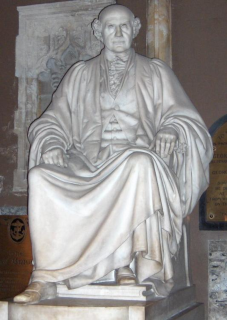
(Pictured: Statue of James Whiteside by Albert Bruce-Joy on display in St. Patrick’s Cathedral)


Leave a comment

The Ballymurphy Massacre

The Ballymurphy massacre is a series of incidents between August 9 and 11, 1971, in which the 1st Battalion, Parachute Regiment of the British Army kills ten civilians in Ballymurphy, Belfast, Northern Ireland, as part of Operation Demetrius. They are indirectly responsible for the death of an eleventh victim. The shootings are later referred to as Belfast’s Bloody Sunday, a reference to the killing of civilians by the same battalion in Derry a few months later. The 1972 inquests return an open verdict on all of the killings, but a 2021 coroner’s report finds that all those killed had been innocent and that the killings were “without justification.”

Belfast is particularly affected by political and sectarian violence during the early part of the Troubles. The British Army is deployed in Northern Ireland in 1969, as events become beyond the control of the Royal Ulster Constabulary (RUC).

On the morning of Monday, August 9, 1971, the security forces launch Operation Demetrius, the main focus of which is to arrest and intern suspected members of the Provisional Irish Republican Army (IRA). The Parachute Regiment is selected to carry out the operation. The operation is chaotic and informed by poor intelligence, resulting in a number of innocent people being interned. By focusing solely on republicans, it excludes violence carried out by loyalist paramilitaries. Some nationalist neighbourhoods attempt to disrupt the army with barricades, petrol bombs and gunfire. In the Catholic district of Ballymurphy, ten civilians are shot and killed between the evening of August 9 and the morning of August 11, while another dies of heart failure.

Members of the Parachute Regiment state that they were shot at by republicans as they entered the Ballymurphy area and returned fire. The press officer for the British Army stationed in Belfast, Mike Jackson, later to become head of the British Army, includes a disputed account of the shootings in his autobiography, stating that those killed in the shootings were republican gunmen. This claim is strongly denied by the families of those killed in the shootings, including in interviews conducted during the documentary film The Ballymurphy Precedent. The claim is found to be without basis by a later coroner’s inquest, which establishes that those killed were “entirely innocent.”

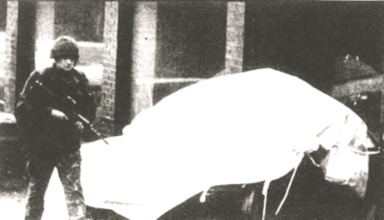
The six civilians killed on August 9 are Francis Quinn (19), shot while going to the aid of a wounded man, Father Hugh Mullan (38), a Catholic priest, shot while going to the aid of a wounded man, reputedly while waving a white cloth to indicate his intentions, Joan Connolly (44), shot by three soldiers as she stands opposite the army base, Daniel Teggart (44), shot fourteen times mostly in the back as he lay injured on the ground, Noel Phillips (20) and Joseph Murphy (41), shot as they stand opposite the army base. Murphy is subsequently taken into army custody and after his release, as he is dying in hospital, he claims that he had been beaten and shot again while in custody. When his body is exhumed in October 2015, a second bullet is discovered in his body, which activists say corroborates his claim.

Edward Doherty (28), is shot and killed on August 10 while walking along Whiterock Road.

Another three civilians are shot on 11 August: John Laverty (20) and Joseph Corr (43) are shot at separate points at the top of the Whiterock Road. Laverty is shot twice, once in the back and once in the back of the leg. Corr is shot several times and dies of his injuries on August 27. John McKerr (49), is shot in the head by an unknown sniper while standing outside a Catholic church and dies of his injuries on August 20. While a number of eyewitnesses state that soldiers were seen shooting toward the area, the 2021 inquest cannot establish who had killed him. The coroner notes that a more specific finding is not possible, in large part, due to an “abject failing by the authorities to properly inquire into the death of [McKerr at the time].”

Paddy McCarthy (44), an eleventh civilian, dies on August 11 following an altercation with a group of soldiers. His family allege that an empty gun is put in his mouth and the trigger pulled, he suffers a heart attack and dies shortly after the alleged confrontation.

In February 2015, the conviction of Terry Laverty, younger brother of John Laverty, one of those killed, is quashed by the Criminal Cases Review Commission. He had been convicted of riotous behaviour and sentenced to six months on the eyewitness evidence of a private in the Parachute Regiment. The case is referred to court because the sole witness retracts his evidence.

In 2016, Sir Declan Morgan, the Lord Chief Justice of Northern Ireland, recommends an inquest into the killings as one of a series of “legacy inquests” covering 56 cases related to the Troubles. These inquests are delayed, as funding has not been approved by the Northern Ireland Executive. The Stormont first minister, Arlene Foster of the Democratic Unionist Party (DUP), defers a bid for extra funding for inquests into historic killings in Northern Ireland, a decision condemned by the human rights group Amnesty International. Foster confirms she has used her influence in the devolved power-sharing executive to hold back finance for a backlog of inquests connected to the conflict. The High Court says her decision to refuse to put a funding paper on the Executive basis is “unlawful and procedurally flawed.”

In January 2018, the coroner’s office announces that the inquest will begin in September 2018. On May 11, 2021, this coroner’s inquest finds that the ten civilians killed were innocent and that the use of lethal force by the British Army was “not justified.” The circumstances of the 11th death are not part of the inquest since Paddy McCarthy died from a heart attack, allegedly after being threatened by a soldier. Following the inquest verdict, Boris Johnson, the British prime minister, apologises for the deaths at Ballymurphy in a phone call to Foster and deputy First Minister Michelle O’Neill. The lack of public apology is criticised by some relatives of the victims and Northern Irish politicians.

In May 2021, families of those shot dead by British soldiers in Ballymurphy urge the Irish government to oppose any attempt to prevent the prosecution of British soldiers alleged to have committed crimes during the Troubles.

The killings are the subject of the August 2018 documentary The Ballymurphy Precedent, directed by Callum Macrae and made in association with Channel 4.


Leave a comment

Birth of Terry Wogan, Irish-British Radio & Television Broadcaster

Sir Michael Terence Wogan KBE DL, Irish-British radio and television broadcaster who works for the BBC in the United Kingdom (UK) for most of his career, is born at Cleary’s Nursing Home, Elm Park, Limerick, County Limerick, on August 3, 1938. Between 1993 and his semi-retirement in December 2009, his BBC Radio 2 weekday breakfast programme Wake Up to Wogan regularly draws an estimated eight million listeners. He is believed at the time to be the most listened-to radio broadcaster in Europe.

Wogan is the elder of two children. He is the son of the manager of Leverett & Frye, a high-class grocery store in Limerick, and is educated at Crescent College, a Jesuit school, from the age of eight. He experiences a strongly religious upbringing, later commenting that he had been brainwashed into believing by the threat of going to hell. Despite this, he often expresses his fondness for the city of his birth, commenting on one occasion that “Limerick never left me, whatever it is, my identity is Limerick.”

At the age of 15, after his father is promoted to general manager, Wogan moves to Dublin with his family. While living there he attends Crescent College’s sister school, Belvedere College. He participates in amateur dramatics and discovers a love of rock and roll. After leaving Belvedere in 1956, he has a brief career in the banking profession, joining the Royal Bank of Ireland. Still in his twenties, he joins the national broadcaster of Ireland, Raidió Teilifís Éireann (RTÉ), as a newsreader and announcer, after seeing a newspaper advertisement inviting applicants.

Wogan conducts interviews and presents documentary features during his first two years at RTÉ, before moving to the light entertainment department as a disc jockey and host of TV quiz and variety shows such as Jackpot, a top-rated quiz show on RTÉ in the 1960s.

Wogan is a leading media personality in Ireland and Britain from the late 1960s, and is often referred to as a “national treasure.” In addition to his weekday radio show, he is known for his work on television, including the BBC One chat show Wogan, presenting Children in Need, the game show Blankety Blank and Come Dancing. He is the BBC’s commentator for the Eurovision Song Contest from 1971 to 2008 (radio in 1971, 1974–1977; television in 1973, 1978, 1980–2008) and the Contest’s host in 1998. From 2010 to 2015 he presents Weekend Wogan, a two-hour Sunday morning show on BBC Radio 2.

In 2005, Wogan acquires British citizenship in addition to his Irish nationality and is awarded a knighthood in the same year and is therefore entitled to use the title “Sir” in front of his name.

Wogan’s health declines after Christmas 2015. He does not present Children in Need in November 2015, citing back pain as the reason for his absence from the long-running annual show. One of his friends, Father Brian D’Arcy, visits him during January and notices he is seriously ill. He dies of cancer at the age of 77 on January 31, 2016 at his home.

British Prime Minister David Cameron says, “Britain has lost a huge talent.” President of Ireland Michael D. Higgins praises Wogan’s career and his frequent visits to his homeland. Taoiseach Enda Kenny and Tánaiste Joan Burton remember Wogan for his role in helping Anglo-Irish relations during the Troubles. D’Arcy speculates that a public funeral would be logistically difficult, as there would be too many people wanting to pay their respects.

After Wogan’s death and his private funeral a few weeks later, a public memorial service is held on September 27 the same year. This is held at Westminster Abbey and is opened by a recording of Wogan himself, and features a number of his celebrity friends making speeches, such as Chris Evans and Joanna Lumley. The service is broadcast live on BBC Radio 2.

On November 16, 2016, the BBC renames BBC Western House, home of BBC Radio 2, in his memory, to BBC Wogan House.


Leave a comment

Birth of E. R. Dodds, Irish Classical Scholar

Eric Robertson Dodds, Irish classical scholar, is born in Banbridge, County Down, on July 26, 1893. He is Regius Professor of Greek at the University of Oxford from 1936 to 1960.

Dodds is the son of schoolteachers. His father Robert is from a Presbyterian family and dies of alcoholism when Dodds is seven years old. His mother Anne is of Anglo-Irish ancestry. When he is ten, he moves with his mother to Dublin, and he is educated at St. Andrew’s College, where his mother teaches, and at Campbell College in Belfast. He is expelled from the latter for “gross, studied, and sustained insolence.”

In 1912, Dodds wins a scholarship at University College, Oxford, to read classics, or Literae Humaniores, a two-part, four-year degree program consisting of five terms of study of Latin and Greek texts followed by seven terms of study of ancient history and ancient philosophy. His friends at Oxford include Aldous Huxley and T. S. Eliot. In 1916, he is asked to leave Oxford due to his support for the Easter Rising, but he returns the following year to take his final examinations in Literae Humaniores, and is awarded a first-class degree to match the first-class awarded him in 1914 in Honour Moderations, the preliminary stage of his degree. His first tutor at Oxford is Arthur Blackburne Poynton.

After graduation, Dodds returns to Dublin and meets W. B. Yeats and George William Russell. He teaches briefly at Kilkenny College and in 1919 is appointed as a lecturer in classics at the University of Reading, where in 1923 he marries a lecturer in English, Annie Edwards Powell. They have no children.

In 1924, Dodds is appointed Professor of Greek at the University of Birmingham, and comes to know W. H. Auden, whose father George, Professor of Public Medicine and an amateur classicist, is a colleague. He is also responsible for Louis MacNeice‘s appointment as a lecturer at Birmingham in 1930. He assists MacNeice with his translation of Aeschylus, Agamemnon (1936), and later becomes the poet’s literary executor. He publishes one volume of his own poems, Thirty-Two Poems, with a Note on Unprofessional Poetry (1929).

In 1936, Dodds becomes Regius Professor of Greek at the University of Oxford, succeeding Gilbert Murray. Murray decisively recommends him to British Prime Minister Stanley Baldwin and it is not a popular appointment. He is chosen over two prominent Oxford dons, Maurice Bowra of Wadham College and John Dewar Denniston of Hertford College. His lack of service in World War I and his support for Irish republicanism and socialism in addition to his scholarship on the non-standard field of Neoplatonism, also does not make him initially popular with colleagues. He is treated particularly harshly by Denys Page at whose college, Christ Church, the Regius Chair of Greek is based.

Dodds has a lifelong interest in mysticism and psychic research, being a member of the council of the Society for Psychical Research from 1927 and its president from 1961 to 1963.

On his retirement in 1960, Dodds is made an Honorary Fellow of University College, Oxford, until his death on April 8, 1979. He dies in the village of Old Marston, northeast of Oxford.

Among Dodds’s works are The Greeks and the Irrational (1951), which charts the influence of irrational forces in Greek culture up to the time of Plato, and Pagan and Christian in an Age of Anxiety, a study of religious life in the period between Marcus Aurelius and Constantine I. He is also editor of three major classical texts for the Clarendon Press, Proclus: Elements of Theology, EuripidesThe Bacchae and Plato’s Gorgias, all published with extensive commentaries, and a translation in the case of the first. His autobiography, Missing Persons, is published in 1977. He edits Louis MacNeice’s unfinished autobiography The Strings are False (1965) and MacNeice’s Collected Poems (1966).


Leave a comment

Birth of Robert Stewart, 2nd Marquess of Londonderry

Robert Stewart, 2nd Marquess of Londonderry, KG, GCH, PC, PC (Ire), Anglo-Irish politician and statesman usually known as Lord Castlereagh, derived from the courtesy title Viscount Castlereagh by which he is styled from 1796 to 1821, is born in Dublin on June 18, 1769. As secretary to the Viceroy of Ireland, he works to suppress the Irish Rebellion of 1798 and to secure passage in 1800 of the Irish Act of Union. As the Foreign Secretary of the United Kingdom from 1812, he is central to the management of the coalition that defeats Napoleon and is British plenipotentiary at the Congress of Vienna. In the post-war government of Lord Liverpool, he is seen to support harsh measures against agitation for reform.

Stewart is born in 28 Henry Street, in Dublin’s Northside. He is the second and only surviving child of Robert Stewart (the elder) and his wife Sarah Frances Seymour-Conway. His parents marry in 1766. He has recurring health problems throughout his childhood, and is sent to The Royal School, Armagh, rather than to England for his secondary education. At the encouragement of Charles Pratt, 1st Earl Camden, who takes a great interest in him and treats him as if he is a grandson by blood, he later attends St. John’s College, Cambridge (1786–87), where he applies himself with greater diligence than expected from an aristocrat and excels in his first-year examinations. But he then withdraws, pleading an illness that he admits to Camden is something “which cannot be directly acknowledged before women,” i.e. something sexually transmitted.

Early in his career in Ireland, and following a visit to revolutionary France, Stewart recoils from the democratic politics of his Presbyterian constituents in Ulster. Crossing the floor of the Irish House of Commons in support of the government, he takes a leading role in detaining members of the republican conspiracy, the United Irishmen, his former political associates among them. After the 1798 Rebellion, as Chief Secretary for Ireland, he pushes the Act of Union through the Irish Parliament. But it is without the Catholic Emancipation that both he and British Prime Minister William Pitt believe should have accompanied the creation of a United Kingdom.

From 1805 Stewart serves under Pitt and then the Duke of Portland as Secretary of State for War. In 1809 he is obliged to resign after fighting a duel with the Foreign Secretary, George Canning, in a dispute over the Walcheren Campaign. In 1812 he returns to government serving Lord Liverpool as Foreign Secretary and as Leader of the House of Commons.

Stewart organises and finances the alliance that defeats Napoleon, bringing the powers together at the Treaty of Chaumont in 1814. After Napoleon’s second abdication in 1815, he works with the European courts represented at the Congress of Vienna to frame the territorial, and broadly conservative, continental order that holds until mid-century. He blocks harsh terms against France believing that a treaty based on vengeance and retaliation will upset a necessary balance of powers. France is restored to the frontiers of 1791, and her British-occupied colonies are returned. In 1820 Stewart enunciates a policy of non-intervention, proposing that Britain hold herself aloof from continental affairs.

After 1815, at home, Stewart supports repressive measures that link him in public opinion to the Peterloo Massacre of 1819. Widely reviled in both Ireland and Great Britain, overworked, and personally distressed, he commits suicide on August 12, 1822. He is found in a dressing room seconds after he has cut his own throat using a small knife. He collapses and dies almost instantly.

(Pictured: “Robert Stewart, 2nd Marquess of Londonderry,” oil on canvas by Thomas Lawrence, National Portrait Gallery)


Leave a comment

The Execution of Fenian Michael Barrett

Michael Barrett, Irish activist and a member of the Fenians, is executed on May 26, 1868, for his part in the Clerkenwell Gaol explosion in December 1867. From all the evidence, it is likely he is not guilty. He is the last man to be publicly hanged in England.

Barrett is born in 1841 in Drumnagreshial in the Ederney area of County Fermanagh. As a young man and in search of work, he moves to Glasgow where, at the age of 27, he joins the Irish Republican Brotherhood (IRB), often referred to as Fenians. In the 1860s, the IRB is a political movement that dominates Irish Republican politics and defies the Catholic Church, middle-class nationalists who advocate milder approaches and Irish Unionists. Tens of thousands of Irishmen in both Ireland and Great Britain are recruited into its ranks.

The Clerkenwell bombing is the most infamous action carried out by the Fenians in mainland Britain. It results in a long-lived backlash that foments much hostility against the Irish community in Britain.

The events that lead up to the bombing start with the arrest in November 1867 of Ricard O’Sullivan Burke, a senior Fenian arms agent who planned the “prison-van escape” in Manchester a few months earlier. O’Sullivan-Burke is subsequently imprisoned on remand in the Middlesex House of Detention, Clerkenwell. On December 13, an attempt to rescue him is made by blowing a hole in the prison wall. The explosion is seriously misjudged. It demolishes not only a large section of the wall, but also a number of tenement houses opposite in Corporation Lane (now Corporation Row), killing 12 people and wounding up to 120 more.

The bombing has a traumatic effect on British working-class opinion. The radical, Charles Bradlaugh, condemns the incident in his newspaper, the National Reformer, as an act “calculated to destroy all sympathy, and to evoke the opposition of all classes.”

The day before the explosion, Prime Minister Benjamin Disraeli bans all political demonstrations in London in an attempt to put a stop to the weekly meetings and marches that are being held in support of the Fenians. He fears that the ban might be challenged, but the explosion has the effect of turning public opinion in his favour.

Months earlier, Barrett had been arrested in Glasgow for illegally discharging a firearm and allegedly false evidence is used to implicate him in the Clerkenwell Prison explosion. In court, he produces witnesses who testify that he had been in Scotland on the date of the incident. The main case against him rests on the evidence of Patrick Mullany, a Dubliner known to have given false testimony before and whose price is a free passage to Australia, who tells the court that Barrett had informed him that he had carried out the explosion with an accomplice by the name of Murphy. After two hours of deliberation the jury pronounces Barrett guilty. On being asked if he has anything to say before sentence is passed, he delivers an emotional speech from the dock.

Many people, including a number of radical MPs, press for clemency. In Fermanagh, Barrett’s aged mother walks several miles in the snow to appeal to the local Irish Conservative Party MP, Captain Mervyn Edward Archdale, a staunch Orangeman, who rejects her.

Barrett is executed outside the walls of Newgate Prison on May 26, 1868, before a crowd of two thousand who boo, jeer and sing “Rule, Britannia!” and “Champagne Charlie” as his body drops. His execution is the last public hanging to take place in England. The hangman is William Calcraft.

Until their transfer to the City of London Cemetery, Barrett’s remains lay for 35 years in a lime grave inside the walls of Newgate Prison. When the prison is demolished in 1903 his remains are taken to their present resting place. Today the grave is a place of Fenian pilgrimage and is marked by a small plaque.

After the explosion, the Prime Minister Disraeli advocates the suspension of the Habeas Corpus Act 1862 in Great Britain, as is already the case in Ireland. Greater security measures are quickly introduced. Thousands of special constables are enrolled to aid the police and at Scotland Yard a special secret service department is established to meet the Fenian threat. Although a number of people are arrested and brought to trial, Barrett is the only one to receive the death sentence.

Within days of the explosion, the Liberal Party leader, William Ewart Gladstone, then in opposition, announces his concern about Irish Nationalist grievances and says that it is the duty of the British people to remove them. Later, he says that it is the Fenian action at Clerkenwell that turned his mind towards Home Rule. When Gladstone discovers at Hawarden later that year that Queen Victoria had invited him to form a government, he famously states, “my mission is to pacify Ireland.”


2 Comments

The 32 County Sovereignty Movement Launches Major Recruitment Campaign

The 32 County Sovereignty Movement, often abbreviated to 32CSM or 32csm, an Irish republican group that is founded by Bernadette Sands McKevitt, launches a major recruitment campaign in west Belfast on April 17, 1999.

The objectives of the 32CSM are:

  • The restoration of Irish national sovereignty.
  • To seek to achieve unity among the Irish people on the issue of restoring national sovereignty and to promote the revolutionary ideals of republicanism and to this end involve itself in resisting all forms of colonialism and imperialism.
  • To seek the immediate and unconditional release of all Irish republican prisoners throughout the world.

The 32CSM does not contest elections but acts as a pressure group, with branches, or cumainn, organised throughout the traditional counties of Ireland. It has been described as the “political wing” of the now defunct Real Irish Republican Army (Real IRA or RIRA), but this is denied by both organisations. The group originates in a split from Sinn Féin over the Mitchell Principles.

The organisation is founded on December 7, 1997, at a meeting of like-minded Irish republicans in the Dublin suburb of Finglas. Those present are opposed to the direction taken by Sinn Féin and other mainstream republican groups in the Northern Ireland peace process, which eventually leads to the Good Friday Agreement, also known as the Belfast Agreement, the following year. The same division in the republican movement leads to the paramilitary group now known as the Real IRA breaking away from the Provisional Irish Republican Army at around the same time.

Most of the 32CSM’s founders had been members of Sinn Féin, with some having been expelled from the party for challenging the leadership’s direction, while others felt they had not been properly able to air their concerns within Sinn Féin at the direction its leadership had taken. Bernadette Sands McKevitt, wife of Michael McKevitt and a sister of hunger striker Bobby Sands, is a prominent member of the group until a split in the organisation.

The name refers to the 32 counties of Ireland which were created during the Lordship of Ireland and Kingdom of Ireland. With the partition of Ireland in 1920–22, twenty-six of these counties form the Irish Free State which is abolished in 1937 and is now known as Ireland since 1949. The remaining six counties of Northern Ireland remain part of the United Kingdom. Founder Bernadette Sands McKevitt says in a 1998 interview with The Mirror that people did not fight for “peace” – “they fought for independence” – and that the organisation reaffirms to the republican position in the 1919 Irish Declaration of Independence.

Before the referendums on the 1998 Good Friday Agreement, the 32CSM lodges a legal submission with the United Nations challenging British sovereignty in Ireland. The referendums are opposed by the 32CSM but are supported by 71% of voters in Northern Ireland and by 94% in the Republic of Ireland. It is reported in February 2000 that the group had established a “branch” in Kilburn, London.

In November 2005, the 32CSM launches a political initiative titled Irish Democracy, A Framework for Unity.

On May 24, 2014, Gary Donnelly, a member of the 32CSM, is elected to the Derry and Strabane super council. In July 2014, a delegation from the 32CSM travels to Canada to take part in a six-day speaking tour. On arrival the delegation is detained and refused entry into Canada.

The 32CSM has protested against what it calls “internment by remand” in both jurisdictions in Ireland. Other protests include ones against former Democratic Unionist Party (DUP) leader Ian Paisley in Cobh, County Cork, against former British Prime Minister John Major being given the Keys to Cork city, against a visit to the Republic of Ireland by Police Service of Northern Ireland (PSNI) head Sir Hugh Orde, and against the Israeli occupation of Palestine and Anglo-American occupation of Iraq.

In 2015, the 32CSM organises a demonstration in Dundee, Scotland, in solidarity with the men convicted of shooting Constable Stephen Carroll, the first police officer to be killed in Northern Ireland since the formation of the PSNI. The organisation says the “Craigavon Two” are innocent and are victims of a miscarriage of justice.

The 32CSM also operates outside of the island of Ireland to some extent. The Gaughan/Stagg Cumann covers England, Scotland and Wales, and has an active relationship of mutual promotion with a minority of British left-wing groups and anti-fascist organisations. The James Larkin Republican Flute Band in Liverpool and the West of Scotland Band Alliance, the largest section of which is the Glasgow-based Parkhead Republican Flute Band, are also supporters of the 32CSM. As of 2014, the 32CSM’s alleged paramilitary wing, the Real IRA, is reported to still be involved in attempts to perpetrate bombings in Britain as part of the dissident Irish republican campaign, which has been ongoing since 1998.

The 32CSM is currently considered a foreign terrorist organization (FTO) in the United States, because it is considered to be inseparable from the Real IRA, which is designated as an FTO. At a briefing in 2001, a spokesman for the U.S. Department of State states that “evidence provided by both the British and Irish governments and open-source materials demonstrate clearly that the individuals who created the Real IRA also established these two entities to serve as the public face of the Real IRA. These alias organizations engage in propaganda and fundraising on behalf of and in collaboration with the Real IRA.” The U.S. Department of State’s designation makes it illegal for Americans to provide material support to the Real IRA, requires U.S. financial institutions to block the group’s assets and denies alleged Real IRA members travel visas into the United States.


Leave a comment

Birth of Liam Cosgrave, Sixth Taoiseach of Ireland

Liam Cosgrave, politician who serves as Taoiseach from February 1973 to July 1977, is born in Castleknock, Dublin, on April 13, 1920.

Cosgrave is the son of William Thomas Cosgrave, the first President of the Executive Council and head of the government of the Irish Free State during the first 10 years of its existence (1922–32). He is educated at Castleknock College, Dublin, studies law at King’s Inns and is called to the Irish bar in 1943. In that same year he enters Dáil Éireann (the lower house of the Oireachtas, the Irish parliament), and he retains his seat until his retirement from politics in 1981.

In 1948, when the first inter-party government replaces Éamon de Valera’s Fianna Fáil regime, which had been in power for the previous 16 years, Cosgrave becomes Parliamentary Secretary to the Taoiseach and to the Minister for Industry and Commerce. It is a short-lived administration, going out of power in 1951 after three years of rule. But in a second inter-party government (1954–57), he becomes Minister for External Affairs and leads the first Irish delegation to the United Nations General Assembly in 1956.

Cosgrave succeeds James Dillon as leader of the Fine Gael party in 1965. Eight years later, as leader of a coalition government in which Fine Gael combines forces with the Labour Party, he becomes Taoiseach. He and British Prime Minister Edward Heath are the main participants in the intergovernmental conference at Sunningdale in December 1973 that gives birth to Northern Ireland’s first, though short-lived, power-sharing executive (1973–74). A devout Roman Catholic, he is intensely conservative on social issues and shocks his cabinet colleagues by voting against his own government’s bill on liberalizing the sale of contraceptives in 1974. The National Coalition is defeated in the 1977 Irish general election, largely on the economic issues of inflation and unemployment.

Cosgrave retires at the 1981 Irish general election. In 1981, he retires as Dáil Deputy for Dún Laoghaire to be replaced by his son, Liam T. Cosgrave. He reduces his involvement in public life but makes occasional appearances and speeches.

Liam Cosgrave dies at the age of 97 on October 4, 2017, of natural causes. He had been at Tallaght Hospital for several months prior to his death there. His funeral is held on October 7, 2017, after which he is interred alongside his father at Inchicore‘s Goldenbridge Cemetery. He is the longest-lived Taoiseach, dying at the age of 97 years, 174 days.


1 Comment

Birth of Patrick Ford, Irish American Journalist & Land Reformer

Patrick Ford, Irish American journalist, Georgist land reformer and fund-raiser for Irish causes, is born in Galway, County Galway, on April 12, 1837.

Ford is the son of Edward Ford (1805-1880) and Anne Ford (1815-1893). He emigrates with his parents to Boston, Massachusetts, in 1845, never returning to Ireland. Although he devotes his life to Irish causes, he writes in The Irish World in 1886 that “I might as well have been born in Boston. I know nothing of England. I brought nothing with me from Ireland—nothing tangible to make me what I am. I had consciously at least, only what I found and grew up with in here.”

Ford is educated in Boston’s public schools and the Latin school of the parish of St. Mary in the North End. He leaves school at the age of thirteen and two years later is working as a printer’s devil for William Lloyd Garrison‘s abolitionist newspaper The Liberator. He begins writing for Boston newspapers in 1855 and by 1861 is editor and publisher of the Boston Tribune, also known as the Boston Sunday Tribune or Boston Sunday Times. He is an abolitionist and pro-union.

During the American Civil War, Ford serves in the Union Army with his father and brother. He serves in the 9th Massachusetts Infantry Regiment and sees action in the Northern Virginia campaign, including the Battle of Fredericksburg on December 13, 1862.

After the Civil War, Ford spends four years in Charleston, South Carolina, editing the South Carolina Leader which promotes the welfare of newly freed slaves. He later edits the Irish American Charleston Gazette. He settles in New York City in 1870 and founds the populist The Irish World, which promotes Irish and Catholic interests and becomes the principal newspaper of Irish America. It promises “more reading material than any other paper in America” and outsells John Boyle O’Reilly‘s Boston Pilot. In 1878, he re-titles his newspaper The Irish World and American Industrial Liberator. During the early 1880s, he promotes the writings of land reformer Henry George in his paper.

The American economic depression of 1873 convinces Ford that the Irish rural poor and the American urban poor share the same plight. He believes that the Homestead Act of 1862 is exploited by big business, especially the railroads, and by speculators who leave the poor without access to the western land meant for settlement. He calls for land reform with the belief that land monopoly is the cause of poverty and that a single tax based on land valuation is the solution. In the mid–1870s he leaves the Democratic Party. Critical of Tammany corruption and attracted to the fiscal policies of the Greenback Party, he is a member of the party’s New York State central committee as early as 1876 and backs the Greenback presidential candidates Peter Cooper and James B. Weaver in 1876 and 1880. Even the Greenbacks fail to offer the land reforms envisaged by Ford, so he forms the short-lived National Cooperative Democracy Party in 1879.

In 1880, Ford begins to solicit donations through The Irish World to support Land League activities in Ireland. Funds received are tabulated weekly under the heading “Land League Fund.” Between January and September 1881 alone, more than $100,000 is collected in donations. British Prime Minister William Ewart Gladstone later states that without the funds from The Irish World, “there would have been no agitation in Ireland.”

In the 1884 and 1888 elections, Ford turns to the Republican Party, encouraging Irish American voters to abandon their traditional loyalty to the Democrats for the Republican candidate James G. Blaine, whom he promotes in The Irish World as supportive of labour and of Ireland. The Republican patronage of the financially troubled The Irish World is a factor in the endorsement, but he believes Blaine’s promise to introduce high trade tariffs will protect American labour interests.

After the Irish Parliamentary Party split in 1891, Ford supports the Parnellite faction of John Redmond and endorses the terms of the Third Home Rule Bill of 1912.

Ford dies on September 23, 1913, at his home at 350 Clermont Street, Brooklyn. After an impressive funeral, he is buried in Brooklyn’s Holy Cross Cemetery.

In 1863, Ford marries Odele McDonald, who predeceases him. They have eleven children, three daughters and eight sons. At the time of his death, his son Patrick is managing editor of The Irish World, and his brother Augustine is business manager and publisher. He appears to have destroyed his personal papers. The files of The Irish World are the best record of his life and work.