seamus dubhghaill

Promoting Irish Culture and History from Little Rock, Arkansas, USA


2 Comments

Founding of “The Freeman’s Journal”

the-freemans-journal

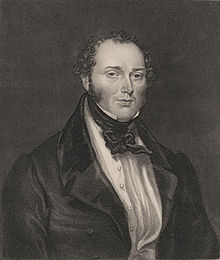
The Freeman’s Journal, the oldest nationalist newspaper in Dublin, is founded by Charles Lucas on September 10, 1763. It is identified with radical 18th-century Protestant patriot politicians Henry Grattan and Henry Flood. This changes from 1784 when it passes to Francis Higgins and takes a more pro-British and pro-administration view. In fact, Higgins is mentioned in the Secret Service Money Book as having betrayed Lord Edward FitzGerald. Higgins is paid £1,000 for information on FitzGerald’s capture.

In the 19th century The Freeman’s Journal becomes more nationalist in tone, particularly under the control and inspiration of Sir John Gray (1815–75).

The Journal, as it is widely known, is the leading newspaper in Ireland throughout the 19th century. Contemporary sources record it being read to the largely illiterate population by priests and local teachers gathering in homes. It is mentioned in contemporary literature as when James Joyce immortalises The Freeman’s Journal as the place of employment of Leopold Bloom in Ulysses. It is seen as symbolising Irish newspapers for most of its time. By the 1880s it becomes the primary media supporter of Charles Stewart Parnell and the Irish Parliamentary Party (IPP).

The Journal is challenged on all sides by rivals. On the nationalist side some prefer The Nation founded by Thomas Davis while others, including radical supporters of Parnell, read the United Irishman. The Anglo-Irish establishment in contrast reads the historically Irish unionist The Irish Times. With the split in the IPP over Parnell’s relationship with Katharine O’Shea, its readership splits too. While The Journal goes with the majority in 1893 in opposing Parnell, a minority moves to read the Daily Irish Independent. It is also challenged from the turn of the century by William O’Brien‘s The Irish People and the Cork Free Press. With Thomas Sexton becoming Chairman of the Board of Directors (1893–1911), The Journal languishes under his spartanic management.

The collapse of the IPP in 1918, and the electoral success of Sinn Féin, see a more radical nationalism appear that is out of step with the moderation of The Journal. It finds itself overshadowed by the more aggressively marketed Irish Independent, the successor to the Daily Irish Independent. Just prior to the outbreak of the Irish Civil War in March 1922, The Freeman’s Journal printing machinery is destroyed by Anti-Treaty IRA men under Rory O’Connor for its support of the Anglo-Irish Treaty. It does not resume publication until after the outbreak of civil war, when the Irish Free State re-asserts its authority over the country.

The Freeman’s Journal ceases publication in 1924, when it is merged with the Irish Independent. Until the 1990s, the Irish Independent includes the words ‘Incorporating the Freeman’s Journal’ in the masthead over its editorials.


Leave a comment

Death of Sir Richard Steele, Writer, Playwright & Politician

richard-steele

Sir Richard Steele, writer, playwright, and politician, remembered as co-founder, with his friend Joseph Addison, of the magazine Tatler, dies in Carmarthen, Wales on September 1, 1729.

Steele is born in Dublin on March 12, 1672, to Richard Steele, an attorney, and Elinor Symes (née Sheyles). He is largely raised by his uncle and aunt, Henry Gascoigne and Lady Katherine Mildmay. A member of the Protestant gentry, he is educated at Charterhouse School, where he first meets Addison. After starting at Christ Church, Oxford, he goes on to Merton College, Oxford, then joins the Life Guards of the Household Cavalry in order to support King William‘s wars against France. He is commissioned in 1697 and rises to the rank of captain within two years. He leaves the army in 1705, perhaps due to the death of the 34th Foot’s commanding officer, Robert Lucas, 3rd Baron Lucas, which limits his opportunities of promotion.

Steele is a member of the Kit-Kat Club. Both Steele and Addison become closely associated with Child’s Coffee-house in St. Paul’s Churchyard.

Steele’s first published work, The Christian Hero (1701), attempts to point out the differences between perceived and actual masculinity. Written while he is serving in the army, it expresses his idea of a pamphlet of moral instruction.

Steele writes a comedy that same year titled The Funeral. This play meets with wide success and is performed at Theatre Royal, Drury Lane, bringing him to the attention of the King and the Whig party. Next, he writes The Lying Lover, one of the first sentimental comedies, but a failure on stage. In 1705, he writes The Tender Husband with contributions from Addison, and later that year writes the prologue to The Mistake, by John Vanbrugh, also an important member of the Whig Kit-Kat Club with Addison and Steele.

In 1706 Steele is appointed to a position in the household of Prince George of Denmark, consort of Anne, Queen of Great Britain. He also gains the favour of Robert Harley, 1st Earl of Oxford and Earl Mortimer.

The Tatler, Steele’s first journal, first appears on April 12, 1709, and appears three times a week. He writes this periodical under the pseudonym Isaac Bickerstaff and gives Bickerstaff an entire, fully developed personality. The Tatler is closed down to avoid the complications of running a Whig publication that had come under Tory attack.

Steele becomes a Whig Member of Parliament in 1713, for Stockbridge. He is soon expelled for issuing a pamphlet in favor of the Hanoverian succession. When George I of Great Britain comes to the throne in the following year, Steele is knighted and given responsibility for the Theatre Royal, Drury Lane in London. He returns to parliament in 1715, for Boroughbridge.

While at Drury Lane, Steele writes and directs the sentimental comedy The Conscious Lovers, which is an immediate hit. However, he falls out with Addison and with the administration over the Peerage Bill (1719), and in 1724 he retires to his second wife’s homeland of Wales. He remains in Carmarthen after his wife’s death, dying there on September 1, 1729. He is buried there at St. Peter’s Church. During restoration of the church in 2000, his skull is discovered in a lead casket, having previously been accidentally disinterred during the 1870s.

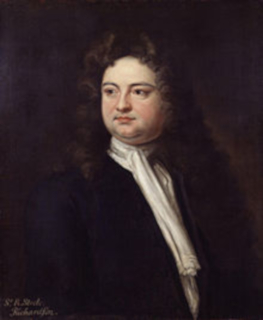
(Pictured: Portrait of Sir Richard Steele by Jonathan Richardson)


Leave a comment

Birth of James Molyneaux, Northern Irish Politician

james-molyneaux

James Henry Molyneaux, Baron Molyneaux of Killead, Northern Irish unionist politician and leader of the Ulster Unionist Party (UUP) from 1979 to 1995, is born in Killead, County Antrim on August 27, 1920. He is a leading member and sometime Vice-President of the Conservative Monday Club. An Orangeman, he is also Sovereign Grand Master of the Royal Black Institution from 1971 to 1995. He is an unrelenting though peaceful supporter of the Protestant cause during the factional conflict that divides Northern Ireland from the 1960s until the early 21st century.

Molyneaux is educated at nearby Aldergrove School. Although he is raised an Anglican, as a child he briefly attends a local Catholic primary school. He leaves school at age 15 and works on his father’s poultry farm. When a Catholic church near his home is burned down by Ulster loyalist arsonists in the late 1990s, he helps to raise funds for its rebuilding.

In World War II Molyneaux serves in the Royal Air Force between 1941 and 1946. He participates in the D-Day landings in FranceFrance and in the liberation of the Belsen-Belsen concentration camp, and occasionally gives interviews about what he sees there. On April 1, 1947, he is promoted to flying officer.

After demobilization Molyneaux establishes a printing business with his uncle, and in 1946 he joins the UUP. He is first elected to local government in 1964 and enters Parliament six years later. He staunchly opposes all power-sharing deals, notably the Anglo-Irish Agreement (1985) between British Prime Minister Margaret Thatcher and Irish Taoiseach Garret FitzGerald, which gives Dublin an official consultative role in the affairs of Northern Ireland and paves the way for devolution.

Molyneaux lacks the firebrand public image of his longtime rival Ian Paisley, who in 1971 breaks with the UUP to form the Democratic Unionist Party (DUP). He never acquiesces to the Good Friday Agreement, which calls for the devolution of Northern Ireland’s government from London to Belfast, however, unlike Paisley and David Trimble, who in 1997 succeeds Molyneaux as the UUP leader and in April 1998 signs the devolution accord.

On retiring as UUP leader, Molyneaux is knighted as a Knight Commander of the Order of the British Empire (KBE) in 1996. The following year, after standing down as an MP at the 1997 general election, he is created a life peer on June 10, 1997, as Baron Molyneaux of Killead, of Killead in the County of Antrim.

James Molyneaux dies at the age of 94 in Antrim, County Antrim, Northern Ireland on March 9, 2015, Commonwealth Day.


Leave a comment

Birth of The Reverend Edward Hincks

edward-hincks

The Reverend Edward Hincks, Anglo-Irish clergyman best remembered as an Assyriologist and one of the decipherers of Mesopotamian cuneiform, is born in Cork, County Cork on August 19, 1792. He is one of the three men known as the “holy trinity of cuneiform,” with Sir Henry Creswicke Rawlinson and Jules Oppert.

Hincks is the eldest son of the Rev. Thomas Dix Hincks, a distinguished Protestant minister, orientalist and naturalist. He is an elder brother of Sir Francis Hincks, a prominent Canadian politician who is also sometime Governor of Barbados, and William Hincks, the first Professor of Natural History at Queen’s College, Cork and afterwards University College, Toronto.

Hincks is educated at home by his father and at Midleton College before entering Trinity College Dublin. He is elected a Scholar of the College in 1810, and in 1812 wins the Gold Medal and Bishop Law‘s Prize for Mathematics. He is elected a Fellow of the College in 1813 and four years later takes his M.A. In 1819, following the death of Thomas Meredith, he is presented to the Rectory of Ardtrea in County Tyrone. Though Ardtrea is a valuable and highly prized Rectory, it is also isolated for a young bachelor, and he resigns the position in 1826, taking up the Rectory in nearby Killyleagh, County Down, an office he holds for the remainder of his life.

The undemanding nature of his clerical duties leave him with more than enough time to pursue his interest in ancient languages. His first love is for the hieroglyphic writing of ancient Egypt. His greatest achievement is the decipherment of the ancient language and writing of Babylon and Assyria: Akkadian cuneiform.

Hincks deduces correctly that cuneiform writing had been invented by one of the earliest civilisations of Mesopotamia, who then bequeathed it to later states such as Babylon, Assyria and Elam. In 1848 he is awarded the Cunningham Medal of the Royal Irish Academy for his achievements.

By 1850 Hincks comes to a number of important conclusions regarding the nature of Assyro-Babylonian cuneiform. He also discovers that cuneiform characters are “polyphonic,” by which he means that a single sign can have several different readings depending on the context in which it occurs. However, not everyone is convinced by the claims being made by the Irishman and his distinguished colleagues. Some philologists even suggest that they are simply inventing multiple readings of the signs to suit their own translations.

In 1857 the versatile English Orientalist William Henry Fox Talbot suggests that an undeciphered cuneiform text be given to several different Assyriologists to translate. If, working independently of one another, they come up with reasonably similar translations, it will surely dispel the doubts surrounding their claims.

As it happens, Talbot, Hincks, Rawlinson and Oppert, are in London in 1857. Edwin Norris, secretary of the Royal Asiatic Society, gives each of them a copy of a recently discovered inscription from the reign of the Assyrian emperor Tiglath-Pileser I. A jury of experts is impaneled to examine the resulting translations and assess their accuracy.

In all essential points the translations produced by the four scholars are found to be in close agreement with one another. There are of course some slight discrepancies. The inexperienced Talbot makes a number of mistakes, and Oppert’s translation contains a few doubtful passages due to his unfamiliarity with the English language. But Hincks’ and Rawlinson’s versions are virtually identical. The jury declares itself satisfied, and the decipherment of cuneiform is adjudged a fait accompli.

Hincks devotes the remaining years of his life to the study of cuneiform and makes further significant contributions to its decipherment. He dies at his rectory in Killyleagh on December 3, 1866, at the age of 74. He is survived by a wife and four daughters.


5 Comments

Birth of Fenian John O’Leary

john-o-leary

John O’Leary, Irish republican and a leading Fenian, is born on July 23, 1830, in Tipperary, County Tipperary. He is imprisoned in England during the nineteenth century for his involvement in the Irish Republican Brotherhood.

O’Leary, born a Catholic, is educated at the local Protestant grammar school, The Abbey School, and later the Catholic Carlow College. He identifies with the views advocated by Thomas Davis and meets James Stephens in 1846.

He begins his studies in law at Trinity College, Dublin, in 1847, where, through the Grattan Club, he associates with Charles Gavan Duffy, James Fintan Lalor and Thomas Francis Meagher.

After the failure of the Young Ireland Rebellion of 1848, O’Leary attempts to rescue the Young Ireland leaders from Clonmel Gaol, and is himself imprisoned for a week from September 8, 1849. He takes part in a further attempted uprising in Cashel on September 16, 1849, but this proves abortive.

O’Leary abandons his study of law at Trinity College because he is unwilling to take the oath of allegiance required of a barrister. He enrolls at Queen’s College, Cork in 1850, to study medicine, later moving to Queen’s College, Galway, then on to further studies at Meath Hospital in Dublin, in Paris and in London. In 1855, he visits Paris, where he becomes acquainted with Kevin Izod O’Doherty, John Martin and the American painter, James Abbott McNeill Whistler. He subsequently becomes financial manager of the newly formed Irish Republican Brotherhood (IRB) and is joint editor of the IRB paper The Irish People.

On September 16, 1865, O’Leary is arrested and later tried on charges of high treason, eventually reduced to “treason felony.” He is sentenced to twenty years of penal servitude, of which five years are spent in English prisons, prior to his release and exile in January 1871. During his exile, he lives mainly in Paris, also visiting the United States, remains active in the IRB and its associated organisations, and writes many letters to newspapers and journals.

On the expiration of his 20-year prison term and therefore of the conditions associated with his release in 1885, O’Leary returns to Ireland. He and his sister, the poet Ellen O’Leary, both become important figures within Dublin cultural and nationalist circles, which include William Butler Yeats, Maud Gonne, Rose Kavanagh, Rosa Mulholland, George Sigerson, and Katharine Tynan. He also functions as an elder statesman of the separatist movement, being active in the Young Ireland Society, and acts as president of the Irish Transvaal Committee, which supports the Boer side in the Second Boer War.

John O’Leary dies at his residence in Dublin on the evening of March 16, 1907. He is referred to famously by W.B. Yeats in his poem September 1913: “Romantic Ireland’s dead and gone/It’s with O’Leary in the grave.”

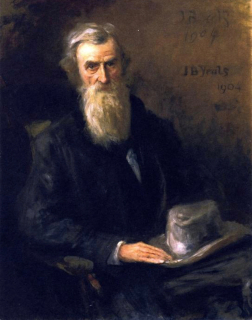
(Pictured: Painting of John O’Leary, a favorite subject of John Butler Yeats (1904). The National Gallery of Ireland owns three oil portraits of O’Leary.)


Leave a comment

Birth of Chartist Leader Feargus O’Connor

feargus-edward-o-connor

Feargus Edward O’Connor, advocate of the Land Plan and prominent Chartist leader who succeeds in making Chartism the first specifically working-class national movement in Great Britain, is born near Castletown-Kinneigh, County Cork on July 18, 1796.

O’Connor is born into a prominent Irish Protestant family who claims to be the descendants of the 12th-century king Ruaidrí Ua Conchobair. He is educated mainly at Portarlington Grammar School and has some elementary schooling in England.

O’Connor practices law but exchanges law for politics when he enters the British Parliament in 1832 as a member for County Cork. Unseated in 1835, he turns to radical agitation in England, although he continues to press Irish grievances and to seek Irish support. As a result of his humour, invective, and energy, he becomes the best-known Chartist leader and the movement’s most popular speaker. His journal, the Northern Star (founded in 1837), gains a wide circulation.

O’Connor’s methods and views alienate other Chartist leaders, particularly William Lovett, but in 1841, after spending a year in prison for seditious libel, he acquires undisputed leadership of the Chartists. Failing to lead the movement to victory and vacillating in his attitude toward the middle class and toward the People’s Charter, a six-point bill drafted and published in May 1838, he begins to lose power, although he is elected to Parliament for Nottingham in 1847. The failure of the People’s Charter in 1848 marks the beginning of the end for O’Connor, whose egocentricity is already bordering on madness.

The circulation of the Northern Star falls steadily, and it loses money. O’Connor’s health is failing, and reports of his mental breakdown regularly appear in the newspapers. In the spring of 1852, he visits the United States, where his behaviour leaves no doubt that he is not a well man.

In 1852 in the House of Commons O’Connor strikes three fellow MPs, one of them Sir Benjamin Hall, a vocal critic of the Land Plan. Arrested by the Deputy Sergeant-at-Arms, he is sent by his sister to Dr. Thomas Harrington Tuke‘s private Manor House Asylum in Chiswick, where he remains until 1854, when he is moved to his sister’s house. He dies on August 30, 1855, at 18 Albert Terrace, Notting Hill Gate and is buried on September 10 in Kensal Green Cemetery. No fewer than 40,000 people witness the funeral procession. Most Chartists preferred to remember O’Connor’s strengths rather than his shortcomings.


Leave a comment

Birth of Hugh O’Brien, 31st Mayor of Boston

hugh-obrien

Hugh O’Brien, the mayor of Boston from 1884-1888, is born in Ireland on July 13, 1827. He is notable as Boston’s first Irish-born mayor, immigrating to the United States in the early 1830s. He is the editor of the Shipping and Commercial List and serves as a Boston alderman from 1875-1883.

O’Brien moves with his family to Boston when he is five years old, well before the potato famine sends waves of impoverished Irish men and women to Boston. He spends seven years in the Boston public schools and is apprenticed to a printer at the age of 12.

Working first for the newspaper Boston Courier and then for a Boston printer, O’Brien excels at the printing business, making foreman when he is only fifteen. He starts his own publication, Shipping and Commercial List, and is soon successful enough to become a respected member of the Boston business elite.

O’Brien’s business success draws the attention of Patrick Maguire, publisher of The Republic newspaper and the unofficial head of Irish politics in Boston. He orchestrates O’Brien’s election to the city’s Board of Alderman.

Boston has long been controlled by native-born Protestants, generally called “Yankees,” most of whom have a stereotypical view of Irish immigrants as poor, ignorant, undisciplined, and under the thumb of the Catholic Church. But the Irish-born population of Boston is exploding, making up over 40% of the city’s population by 1885.

By 1883, Maguire decides that the time has come for Boston to elect an Irish-born mayor. He devises a two-part strategy. O’Brien will be the public face of the campaign, an able public official who criticizes the previous administration for increasing taxes. O’Brien’s pledge to reduce the tax rate without cutting city services appeals to the Yankee tradition of frugality. Meanwhile, behind the scenes, Maguire develops a system of Irish ward bosses who visit each household in the neighborhood and make sure that every eligible Irishman votes for O’Brien. O’Brien sweeps 15 of Boston’s 25 wards and, on December 10, 1884, becomes the first Irish Catholic to be elected Mayor of Boston. He is sworn in on January 5, 1885.

O’Brien surprises the opposition by governing the city in a conservative and honest way during his four terms in office. He cuts tax rates as promised. He also widens streets, establishes the commission that hires Frederick Law Olmsted to design the Emerald Necklace park system, and builds the new Boston Public Library in Copley Square. He disarms his critics by enlisting Yankee and Republican businessmen to serve on the committees overseeing these projects.

Hugh O’Brien dies on August 1, 1895, and is buried at Holyhood Cemetery in Brookline, Massachusetts.


Leave a comment

Birth of Forrest Reid, Novelist & Critic

forrest-reid

Forrest Reid, novelist, literary critic and translator, is born in Belfast on June 24, 1875. He is, along with Hugh Walpole and J. M. Barrie, a leading pre-war novelist of boyhood. He is still acclaimed as the greatest of Ulster novelists and is recognised with the award of the 1944 James Tait Black Memorial Prize for his novel Young Tom.

Reid is the youngest son of a Protestant family of twelve, six of whom survive. His mother, his father’s second wife, comes from an aristocratic Shropshire family. Although proud of this ancestry, he finds the strict Protestant ethics of his immediate family constricting. He is educated at the Royal Belfast Academical Institution, after which he is initially apprenticed into the Belfast tea-trade before going to Christ’s College, Cambridge, where he reads medieval and modern languages, and is influenced by the novelist E. M. Forster. His first book, The Kingdom of Twilight, is published in 1904. Following graduation in 1908, he returns to Belfast to pursue a writing career.

As well as his fiction, Reid also translates poems from the Greek Anthology. His study of the work of W. B. Yeats, W. B. Yeats: A Critical Study, has been acclaimed as one of the best critical studies of that poet. He also writes the definitive work on the English woodcut artists of the 1860s, Illustrators of the Sixties (1928). His collection of original illustrations from that time is housed in the Ashmolean Museum, Oxford.

Reid is a close friend of Walter de la Mare, whom he first meets in 1913, and about whose fiction he publishes a perceptive book in 1929. He is also an influence on novelist Stephen Gilbert and has good connections to the Bloomsbury Group of writers. He is a founding member of the Imperial Art League (later the Artists League of Great Britain) and is also a close friend of Arthur Greeves, the artist known to be C. S. Lewis‘s best friend. Greeves paints several portraits of Reid, now all in the possession of the Royal Belfast Academical Institution.

Reid publishes articles in many magazines, including Uladh, The Westminster Review and the Ulster Review, and he reviews books for The Manchester Guardian. Apostate, an autobiography, is published in 1926, and its sequel, Private Road, is published in 1940. He is a founder member of the Irish Academy of Letters.

Forrest Reid dies on January 4, 1947, in Warrenpoint, County Down, Northern Ireland.

Though Reid’s books are not necessarily well known today, he has been labelled “the first Ulster novelist of European stature,” and comparisons have been drawn between his own coming of age novel of Protestant Belfast, Following Darkness (1912), and James Joyce‘s seminal novel of growing up in Catholic Dublin, A Portrait of the Artist as a Young Man (1914). Reid’s fiction, which often uses submerged narratives to explore male beauty and love, can be placed within the historical context of the emergence of a more explicit expression of homosexuality in English literature in the 20th century.

A ‘Forrest Reid Collection’ is held at the University of Exeter, consisting of first editions of all Reid’s works and books about him. Many of his original manuscripts are in the archives of the Belfast Central Library. In 2008, Queen’s University Belfast catalogues a large collection of Forrest Reid documentary material including many letters from E. M. Forster.

In 1952 Forster travels to Belfast to unveil a plaque commemorating Forrest Reid’s life at 13 Ormiston Crescent.


Leave a comment

Birth of Author Violet Florence Martin

violet-florence-martin

Violet Florence Martin, Irish author, is born at Ross House in Connemara, County Galway on June 11, 1862. She is the co-author of a series of novels with her cousin Edith Somerville under the pen name of Martin Ross in the late nineteenth and early twentieth centuries.

Martin is the youngest of sixteen children of James Martin of Ross (1804–1872). The Martin family, a branch of the Martyn family – one of the Tribes of Galway – had settled at Ross by the early seventeenth century, having previously inhabited the town of Galway for some three hundred years. Her father is a Protestant, his grandfather having converted from the Catholic faith in order to retain the family estates under the Penal Laws. Nevertheless, each child of the family is secretly ‘baptised’ by the family servants.

Martin is a kinswoman of Richard Martin and her contemporary, Edward Martyn, two other notable members of the tribe. Her older brother, Robert Jasper Martin, is a noted songwriter and a well-regarded member of the Tory party in London. She shares a great-grandmother with the writer Maria Edgeworth, whose use of Irish vernacular speech she follows in her work.

Martin’s father manages to save both his estate and his tenants during the Great Famine boasting that not one of his people died during the disaster, but at the cost of bankruptcy. Following his death in 1872, the family moves to Dublin and only returns to Ross in 1888 following revelations of financial fraud of the estate by their agent.

Martin and Edith Somerville are second cousins. They originally meet on January 17, 1886, at Castletownshend, after which they become lifelong companions and literary partners. They come to share a home in Drishane, County Cork. In 1889, Violet adopts the pseudonym Martin Ross, which comprises her surname and the name of her ancestral home. Thus, the authors are called Somerville and Ross. Their works include The Real Charlotte (1889), Some Reminiscences of an Irish R.M. and In the Vine Country.

Martin is a convinced Irish Unionist, in opposition to Somerville’s open nationalism. Both she and her brother Robert are well-regarded members of the literary circle in Irish unionism. However, unlike her brother, Martin is a convinced suffragette, becoming vice-president of the Munster Women’s Franchise League. While on friendly terms with the leading members of the Gaelic literary revival such as W.B. Yeats and Lady Gregory, she objects to their romantic version of Irish peasantry. She is on good terms with Edward Martyn, partner of Gregory and Yeats – and her kinsman – and shares his love of the Irish language and culture.

Martin is seriously injured in a riding accident in November 1898, from which she never fully recovers. This is a contributing factor to her death in Drishane, County Cork, on December 21, 1915. Edith Somerville continues to write under their joint literary names, claiming that they are still in contact. The two women leave thousands of letters and 116 volumes of diaries, detailing their lives, much of them yet unpublished. Edith dies at Castletownshend in October 1949, aged 91, and is buried alongside Violet Florence Martin at Saint Barrahane’s Church, Castletownsend, County Cork.


Leave a comment

The Battle of Carlow

battle-of-carlow-monument

The Battle of Carlow takes place in Carlow, County Carlow on May 25, 1798, when Carlow rebels rise in support of the Irish Rebellion of 1798 which had begun the day before in County Kildare.

The Society of United Irishmen organisation in Carlow, led by a young brogue-maker named Mick Heydon who had taken over the leadership following the arrest of the previous leader, Peter Ivers, who was arrested with several other leading United Irishmen at Oliver Bond‘s house in March of that year, assemble on the night of May 24 and set off at dawn to attack the county town. Picking up more volunteers along the way, their numbers swell to around 1,200 and they march completely unopposed.

The attack on the town is planned to take place simultaneously from four different directions, through the four main streets. All are to converge on Potato Market.

As the various contingents advance, they are unaware that Colonel Mahon of the Ninth Dragoons has the military in the barracks and the town on the highest alert. Their every move is known to him. A strong party of military is stationed in the courthouse, which is now known as the Deighton Hall, situated immediately to the north of the bridge across the River Burren. Another party with two small cannon is stationed on the bridge. On Graigue bridge, there is an officer’s guard of yeomen. In Dublin Street and to the north, well-armed loyalists fill some large strong houses, but without military support, as the attack is known to be weak from that quarter. Tullow Street is left open and to all appearances undefended against what is expected to be the strongest attack of all. The trap is laid.

When the Rebels enter the town of Carlow, they are joined not only by the Catholic inhabitants but also by people who have secretly arrived there during the previous day and night. A crowd of approximately two hundred people break away and march through Tullow Street but when they reach Potato Market their fortunes change.

The forewarned garrison had prepared a deadly ambush, posting men at every window and rooftop. As the rebels relax after their apparently easy victory, the concealed soldiers pour volley after volley of gunfire into the masses of exposed rebels. Taken completely by surprise, the shocked and poorly armed rebels break and flee only to run into another army ambush. The survivors try to escape by breaking through adjoining houses and cabins which are set afire by the pursuing soldiers causing the deaths of 200 of the inhabitants.

In the meantime, the County Laois Rebels, on their way to aid the Carlow rebels having heard mixed reports of the battle and hearing the fate of their comrades, decide it is too late to help and change their plans. They are led by men called Redmond and Brennan. They proceed to Ballickmoyler instead, some miles outside Carlow in County Laois and there they set fire to many loyalist houses and attack the home of John Whitty, a Protestant clergyman. Twenty-one of the Rebels are killed in the fray but despite this they eventually overcome the loyalist inhabitants.

An estimated 500 rebels and civilians are killed in the streets of the town with no reported losses to the military. Another 150 are executed in the repression over the following ten days. A local man who becomes known as “Paddy the Pointer” is reported to have helped to identify escaped rebels to the military by riding around the town and pointing them out.

A memorial, pictured above, is located at Carlow-Graigue, or Graigue-Cullen as it is now known, where remains of many of those who perished that day were flung into a mass grave.