McKee joins Fianna Éireann in 1936. He is arrested following a raid on a Gaelic Athletic Association (GAA) club in 1938, being imprisoned in Crumlin Road Gaol for several months. Following his release from prison, he joins the Irish Republican Army (IRA) in 1939. During World War II, the IRA carries out a number of armed actions in Northern Ireland known as the Northern Campaign. He is arrested and imprisoned in Crumlin Road Gaol until 1946 for his role in this campaign. In 1956, the IRA embarks on another armed campaign against partition, known as the Border Campaign. He is again arrested and interned for the duration of the campaign. He is released in 1962.
As the 1960s proceed, McKee drifts away from the IRA. He grows very disillusioned with the organisation’s increasing emphasis on socialism and reformist politics over “armed struggle.” He is a devout Roman Catholic, who attends Mass daily. As a result, he is very uncomfortable with what he feels are “communist” ideas coming into the republican movement.
During the 1969 Northern Ireland riots, severe rioting breaks out in Belfast between Irish Catholicnationalists, Protestantloyalists, and the RUC. McKee is highly critical of the IRA’s failure to defend Catholic areas during these disturbances. On August 14, 1969, McKee, Joe Cahill and a number of other Irish Republican activists occupy houses at Kashmir Street, however, being poorly armed they fail to prevent Irish Catholics in Bombay Street and parts of Cupar Street and Kashmir Street being driven from their homes in the sectarian rioting that engulfs parts of the city. In the aftermath of the riots, he accuses Billy McMillen, the IRA’s Belfast commander, and the Dublin-based IRA leadership, of having failed to direct a clear course of action for the organization in civil disturbances. On September 22, 1969, he and a number of other IRA men arrive with weapons at a meeting called by McMillen and try to oust him as head of the Belfast IRA. They are unsuccessful but announce that they will no longer be taking orders from the IRA leadership in Dublin. In December 1969, the IRA splits into the Provisional IRA which is composed of traditional militarists like McKee, and the Official IRA which is composed of the remnants of the pre-split Marxist leadership and their followers. He sides with the Provisionals and joins the IRA Army Council in September 1970.
McKee becomes the first OC of the Provisional IRA Belfast Brigade. From the start, there is intermittent feuding between McKee’s men and his former comrades in the Official IRA, as they vie for control of nationalist areas. However, the Provisionals rapidly gain the upper hand, due to their projection of themselves as the most reliable defenders of the Catholic community.
McKee himself contributes greatly to this image by an action he undertakes on June 27, 1970, the Battle of St Matthew’s. Rioting breaks out in the Ardoyne area of north Belfast after an Orange Order parade, and three Protestants are killed in gun battles between the Provisional IRA and loyalists. In response, loyalists prepare to attack the vulnerable Catholic enclave of Short Strand in east Belfast. When McKee hears about this, he drives to Short Strand with some men and weapons and takes up position at St Matthew’s Church. In the ensuing five-hour gun battle, he is wounded and one of his men is killed, along with at least four Protestants.
On April 15, 1971, McKee, along with Proinsias Mac Airt, is arrested by the British Army when found in possession of a handgun. He is charged and convicted for possession of the weapon and imprisoned in Crumlin Road Gaol, and Joe Cahill takes over as OC of the Belfast Brigade.
In 1972, McKee leads a hunger strike protest in an effort to win recognition of IRA prisoners as political prisoners. Republicans who are interned already have special status, but those convicted of crimes do not. On June 19, the 35th day of hunger strike, he is close to death, William Whitelaw concedes Special Category Status (SCS) which, although not officially awarding political status, is tacit recognition of the political nature of the incarceration. Prisoners wear their own clothes, have no prison work, can receive one visit and food parcel per week and unlimited letters.
McKee is released on September 4, 1974, and resumes his position as OC of the Belfast Brigade. At this time the Provisional IRA calls a ceasefire, and he is involved, with Ruairí Ó Brádaigh, in secret peace talks in Derry with the Northern Ireland Office. He is also involved in talks with Protestant clergy in Feakle, County Clare, in December 1974, where he voices his desire to end the violence.
However, in the same period, McKee authorises a number of sectarian attacks on Protestants as well as renewed attacks on rival republicans in the Official IRA. For this he is heavily criticised by a group of Provisional IRA activists grouped around Gerry Adams.
A faction led by Adams manages to get McKee voted off the IRA Army Council in 1977, effectively forcing him out of the leadership of the organisation. His health suffers in this period, and he does not resume his IRA activities. He joins Republican Sinn Féin after a split in Sinn Féin in 1986. At age 89, reflecting on his involvement in the Republican cause he says, “From the time I was 15 until 65 I was in some way involved. I have had plenty of time since to think if I was right or I was wrong. I regret nothing.”
In later years McKee, Brendan Hughes and Tommy McKearney are critical of the Belfast Agreement and of the reformist politics of Sinn Féin. In 2016 he sends a message of support to the launch of the hardline new Republican party Saoradh, reportedly the political wing of the New IRA.
McKee dies in Belfast at the age of 97 on June 11, 2019. His funeral takes place on June 15, 2019, in west Belfast. His coffin is carried on a gun carriage. He is buried in Milltown Cemetery.
Father Des Wilson, Irish Catholic priest and church dissident who in the course of the Northern IrelandTroubles embraces ideas and practice associated, internationally, with liberation theology, dies in his native Belfast on November 5, 2019. He believes the Word of God can never be silent in the face of oppression, injustice and suffering. He seeks to apply the ideas of liberation theology to the North, supporting and empowering marginalised communities, and acting as a voice for the voiceless.
Wilson is born in Belfast on July 8, 1925, the youngest of five sons to William Wilson, a publican and native of County Cavan, and his wife Emma (née McAvoy), a native of south County Down. He spends his earliest years above his father’s pub in Belfast, before the family moves to a house in the suburbs.
Wilson attends primary school locally, then receives secondary education at St. Malachy’s College. During his time there Belfast is blitzed in April and May 1941. Almost 1,000 are killed. The carnage he sees is a factor in his deciding on the priesthood.
After ordination Wilson serves as chaplain in Belfast’s Mater Infirmorum Hospital, then spends 15 years in St. Malachy’s as spiritual director. Former pupils remember him as fair, and able to play jazz excellently on the organ.
Wilson lives out his beliefs, spending half a century in Belfast’s Ballymurphy estate, among the North’s most deprived, and one of the areas which suffers worst from the Troubles. There he plays a role in community development, establishing projects to provide employment in the area. He suffers, finding himself for years outside the official Catholic Church.
Wilson plays a significant role in providing adult education. He wants an education that does not just provide qualifications and open career paths but is psychologically liberating.
Life changes in 1966 when Wilson is moved to St. John’s Parish in West Belfast as a curate. Having come from a comfortable background in Ballymurphy, he is shocked by the poverty, the poor housing and the treatment of women. Unusual for a priest at the time, he moves into a terraced house in the estate. He finds the Catholic Church unable to respond to the multiple problems people are facing. That inability worsens as the Troubles erupt.
Wilson’s personal probity is so recognised that he is accepted as a mediator in feuds between the Provisional Irish Republican Army and Official Irish Republican Army in the 1970s and is able to broker permanent peace. He also helps bring about the ceasefires in the 1990s.
Wilson does not shirk unpopular stances. In the 1970s he refuses to condemn the Irish Republican Army (IRA). Later he says the conviction of former Real Irish Republican Army leader Michael McKevitt for directing terrorism is unsafe. He also publicly visits and supports a Ballymurphy couple which has a very bitter falling out with Sinn Féin, leading to a picket on their home.
By 1975 relations with his bishop has broken down and Wilson resigns but continues ministering in Ballymurphy. Forbidden to say Mass in a church, his pay cut off, he says Mass in his house. He suffers hardship, living from savings, some earnings from writing, broadcasting and lecturing, and help from Quaker and Presbyterian friends. By the early 1980s his Ballymurphy home becomes too small for the many classes he organises. His classes are rehoused and expanded as the Conway Education Centre in a vacant mill. He is able to offer a range of vocational and non-vocational courses with almost 1,000 students. In the mid-1980s his relationship with the Dioceses of Down and Connor is re-established, and he is allowed to continue his ministry.
Personally, Wilson has great gifts of head and heart and is incapable of rancour. A strong belief is that it is important to share food to talk, as happened in Biblical times. Thus, a lunch would last an afternoon.
Wilson dies on November 5, 2019, in Belfast. Instead of wreaths, he asks mourners to donate to the Ballymurphy Massacre Memorial Garden. The garden is dedicated to the victims of the Ballymurphy massacre of August 1971, which saw the killing in the district of eleven civilians by soldiers of the 1st Battalion, Parachute Regiment. The victims include Fr. Hugh Mullan, who had been a student of Wilson’s at St. Malachy’s. He was shot while going to the aid of a wounded man.
McCaughey, from Aughnagar, Galbally, County Tyrone, Northern Ireland, is born on February 24, 1967, the oldest son of Owen and Bridget McCaughey. He is a boyhood friend of several of the “Loughgall Martyrs” including Declan Arthurs, Seamus Donnelly, Tony Gormley and Eugene Kelly, with whom he travels to local discos and football matches when they are growing up.
McCaughey is elected as a Sinn Féin councillor for Dungannon and South Tyrone Borough Council and at the time is the youngest elected representative on the island of Ireland.
Two months prior to his shooting, McCaughey is disqualified from holding his office on the council as he had failed to appear for a monthly council meeting. After his death, the Royal Ulster Constabulary (RUC) reveals the explanation behind his disappearance. He had been shot and wounded in a shoot-out with undercover British Army security forces near Cappagh, County Tyrone. He is then taken south across the Irish border into the Republic of Ireland where he is given hospital treatment and therefore unable to attend the meetings.
Ulster UnionistMP and fellow Dungannon councillor Ken Maginnis alleges that McCaughey had conspired to kill him while both sat as councillors.
McCaughey is shot dead on October 9, 1990, along with Dessie Grew, in an operation by undercover British soldiers. A secret undercover intelligence unit named 14 Intelligence Company, also known as the DET, are monitoring three AK-47s at a farm building in a rural part of County Armagh and are aware that the pair are due to remove the guns.
As McCaughey and Grew are approaching an agricultural shed which is being used to grow mushrooms and also thought to be an IRA arms dump, as many as 200 shots are fired at the two men. British Army reports of the shooting state that the two men left the shed holding two rifles. Republican sources state the men were unarmed.
McCaughey is buried at Galbally Cemetery in October 1990.
The family of McCaughey claims that he and Grew were ambushed after a stakeout by the Special Air Service (SAS). In January 2002, Justice Weatherup, a Northern Ireland High Court judge, orders that official military documents relating to the shooting should be disclosed. However, Police Service of Northern Ireland (PSNI) Chief ConstableHugh Orde has the ruling overturned on appeal in January 2005.
Fellow Sinn Féin representative, Francie Molloy, replaces McCaughey on Dungannon Council after a by-election is held following McCaughey’s death.
In January 2007, the lawyers representing McCaughey and another volunteer, Pearse Jordan, apply to the House of Lords to challenge the details of how the inquests into their deaths are to proceed.
McCaughey’s father, Owen, seeks to compel Chief Constable Hugh Orde to produce key documents including intelligence reports relevant to the shooting and the report of the RUC’s investigating officer.
In 2010, a commemorative portrait of McCaughey is unveiled in the mayor’s parlour at Dungannon council.
McNamee is arrested on August 16, 1986, at his home in Crossmaglen by the British Army and Royal Ulster Constabulary (RUC), then flown to London and charged with conspiracy to cause explosions. At his trial at the Old Bailey, he denies even having sympathy for the IRA, and no evidence is ever presented that he has any paramilitary links. Additionally, the IRA itself states that he is not a member, and never claimed him as a “prisoner of war.” However, his fingerprint is found on electronic circuits in an arms cache that is linked to the Hyde Park bombing. At his trial, he explains that he may have handled the circuits when working for a previous employer, whom he did not know had IRA connections. After five hours of deliberation by the jury, he is found guilty on all charges and sentenced to 25 years in prison.
In September 1994, McNamee and Paul Magee are among six prisoners who escape from Whitemoor Prison, shooting and wounding a prison officer as they do so, before being captured two hours later.
In 1997, McNamee’s case is examined by Channel 4‘s Trial and Error programme. He is later to be the first case referred to the Court of Appeal by the Criminal Cases Review Commission (CCRC), and his conviction is overturned on December 17, 1998, because of other, much more prominent, fingerprints on the same circuits, belonging to known IRA bomb-maker Dessie Ellis, which were not disclosed at McNamee’s original trial. Despite quashing McNamee’s conviction, the appeal judges state, “The Crown makes a strong case that the appellant [McNamee] was guilty of a conspiracy to cause explosions.” Supporters of the campaign to clear his name include the comedianJeremy Hardy.
In February 1999, McNamee reads the IRA Roll of Honour at the Burns and Moley commemoration and the following month he sits with the Caraher family during the trial of Michael Caraher and other members of the Provisional IRA South Armagh Brigadesniper team.
Spence, the sixth of seven children, is born and raised in the Shankill Road area of West Belfast in Northern Ireland, the son of William Edward Spence, a member of the Ulster Volunteers who fought in World War I, and Isabella “Bella” Hayes. The family home is 66 Joseph Street in an area of the lower Shankill known colloquially as “the Hammer.” He is educated at the Riddel School on Malvern Street and the Hemsworth Square school, finishing his education at the age of fourteen. He is also a member of the Church Lads’ Brigade, a Church of Ireland group, and the Junior Orange Order. His family has a long tradition of Orange Order membership.
Spence takes various manual jobs in the area until joining the British Army in 1957 as a member of the Royal Ulster Rifles. He rises to the rank of Provost Sergeant (battalion police). He is stationed in Cyprus and sees action fighting against the forces of Colonel Georgios Grivas. He serves until 1961 when ill-health forces him to leave. He then finds employment at the Harland & Wolff shipyard in Belfast, where he works as a stager (builder of the scaffolding in which the ships are constructed), a skilled job that commands respect among working class Protestants and ensures for him a higher status within the Shankill.
From an early age Spence is a member of the Prince Albert Temperance Loyal Orange Lodge, where fellow members include John McQuade. He is also a member of the Royal Black Institution and the Apprentice Boys of Derry. Due to his later involvement in a murder, he is expelled from the Orange Order and the Royal Black Institution. The Reverend Martin Smyth is influential in his being thrown out of the Orange Order.
Spence’s older brother Billy is a founding member of Ulster Protestant Action (UPA) in 1956, and he is also a member of the group. He is frequently involved in street fights with republicans and garners a reputation as a “hard man.” He is also associated loosely with prominent loyalists such as Ian Paisley and Desmond Boal and is advised by both men in 1959 when he launches a protest against Gerry Fitt at Belfast City Hall after Fitt had described Spence’s regiment as “murderers” over allegations that they had killed civilians in Cyprus. He, along with other Shankill Road loyalists, break from Paisley in 1965 when they side with James Kilfedder in a row that follows the latter’s campaigns in Belfast West. Paisley intimates that Kilfedder, a rival for the leadership of dissident unionism, is close to Fine Gael after learning that he had attended party meetings while a student at Trinity College Dublin (TCD). The Shankill loyalists support Kilfedder and following his election as MP send a letter to Paisley accusing him of treachery during the entire affair.
Spence claims that he is approached in 1965 by two men, one of whom was an Ulster Unionist Party MP, who tells him that the Ulster Volunteer Force is to be re-established and that he is to have responsibility for the Shankill. He is sworn in soon afterward in a ceremony held in secret near Pomeroy, County Tyrone. Because of his military experience, he is chosen as the military commander and public face of the UVF when the group is established. However, RUC Special Branch believes that his brother Billy, who keeps a much lower public profile, is the real leader of the group. Whatever the truth of this intelligence, Spence’s Shankill UVF team is made up of only around 12 men on its formation. Their base of operations is the Standard Bar, a pub on the Shankill Road frequented by Spence and his allies.
On May 7, 1966, a group of UVF men led by Spence petrol bomb a Catholic-owned pub on the Shankill Road. Fire also engulfs the house next door, killing the elderly Protestant widow, Matilda Gould (77), who lives there. On May 27, he orders four UVF men to kill an Irish Republican Army (IRA) member, Leo Martin, who lives on the Falls Road. Unable to find their target, the men drive around in search of any Catholic instead. They shoot dead John Scullion (28), a Catholic civilian, as he walks home. Spence later writes “at the time, the attitude was that if you couldn’t get an IRA man you should shoot a Taig, he’s your last resort.” On June 26, the same gang shoots dead Catholic civilian Peter Ward (18) and wounds two others as they leave a pub on Malvern Street in the lower Shankill. Two days later, the government of Northern Ireland uses the Special Powers Act to declare the UVF illegal. Shortly after, Spence and three others are arrested.
In October 1966, Spence is sentenced to life imprisonment for the murder of Ward, although he has always claimed his innocence. He is sent to Crumlin Road Prison. During its July 12, 1967, march, the Orange lodge to which he belongs stops outside the prison in tribute to him. This occurs despite him having been officially expelled from the Orange Order following his conviction. His involvement in the killings gives him legendary status among many young loyalists and he is claimed as an inspiration by the likes of Michael Stone. Tim Pat Coogan describes Spence as a “loyalist folk hero.” The murder of Ward is, however, repudiated by Paisley and condemned in his Protestant Telegraph, sealing the split between the two.
Spence appeals against his conviction and is the subject of a release petition organised by the Ulster Constitution Defence Committee, although nothing comes of either initiative. Despite the fact that control of the UVF lay with his closest ally, Samuel “Bo” McClelland, from prison he is often at odds with the group’s leadership, in particular with regards to the 1971 McGurk’s Bar bombing. Spence now argues that UVF members are soldiers and soldiers should not kill civilians, as had been the case at McGurk’s Bar. He respects some Irish republican paramilitaries, who he feels also live as soldiers, and to this end he writes a sympathetic letter to the widow of Official IRA leader Joe McCann after he is killed in 1972.
Spence is granted two days leave in early July 1972 to attend the wedding of his daughter Elizabeth to Winston Churchill “Winkie” Rea. The latter had formally asked Spence for his daughter’s hand in marriage during a prison visit. Met by two members of the Red Hand Commando upon his release, Spence is informed of the need for a restructuring within the UVF and told not to return to prison. He initially refuses and goes on to attend his daughter’s wedding. Afterward a plot is concocted where Jim Curry, a Red Hand Commando member, will drive Spence back to prison but the car is to be stopped and Spence “kidnapped.” As arranged, the car in which he is a passenger is stopped in Springmartin and he is taken away by UVF members. He remains at large for four months and during that time gives an interview to ITV‘s World in Action in which he calls for the UVF to take an increased role in the Northern Ireland conflict against the Provisional IRA. At the same time, he distances himself from any policy of random murders of Catholics. He also takes on responsibility for the restructuring, returning the UVF to the same command structure and organisational base that Edward Carson had utilised for the original UVF, with brigades, battalions, companies, platoons and sections. He also directs a significant restocking of the group’s arsenal, with guns mostly taken from the security forces. He gives his permission for UVF brigadier Billy Hanna to establish the UVF’s Mid-Ulster Brigade in Lurgan. His fugitive status earns him the short-lived nickname the “Orange Pimpernel.” He is arrested along with around thirty other men at a UVF drinking club in Brennan Street, but after giving a false name, he is released.
Spence’s time on the outside comes to an end on November 4 when he is captured by Colonel Derek Wilford of the Parachute Regiment, who identifies him by tattoos on his hands. He is sent directly to Long Kesh Detention Centre soon afterward, where he shares a cell with William “Plum” Smith, one of the Red Hand Commandos whom he had met upon his initial release and who had since been jailed for attempted murder.
Spence soon becomes the UVF commander within the Long Kesh Detention Centre. He runs his part of Long Kesh along military lines, drilling inmates and training them in weapons use while also expecting a maintenance of discipline. As the loyalist Long Kesh commander, he initially also has jurisdiction over the imprisoned members of the Ulster Defence Association (UDA), although this comes to an end in 1973 when, following a deterioration in relations between the two groups outside the prison walls, James Craig becomes the UDA’s Maze commander. By this time Spence polarises opinion within the UVF, with some members fiercely loyal to a man they see as a folk hero and others resenting his draconian leadership and increasing emphasis on politics, with one anonymous member even labelling him “a cunt in a cravat.”
Spence begins to move toward a position of using political means to advance one’s aims, and he persuades the UVF leadership to declare a temporary ceasefire in 1973. Following Merlyn Rees‘ decision to legalise the UVF in 1974, Spence encourages them to enter politics and support the establishment of the Volunteer Political Party (VPP). However, his ideas are abandoned as the UVF ceasefire falls apart that same year following the Ulster Workers’ Council strike and the Dublin and Monaghan bombings. The carnage of the latter shocks and horrifies Spence. Furthermore, the VPP suffers a heavy defeat in West Belfast in the October 1974 United Kingdom general election, when the DUP candidate, John McQuade, captures six times as many votes as the VPP’s Ken Gibson.
Spence is increasingly disillusioned with the UVF, and he imparts these views to fellow inmates at Long Kesh. According to Billy Mitchell, Spence quizzes him and others sent to Long Kesh about why they are there, seeking an ideological answer to his question. When the prisoner is unable to provide one, Spence then seeks to convince them of the wisdom of his more politicised path, something that he accomplishes with Mitchell. David Ervine and Billy Hutchinson are among the other UVF men imprisoned in the mid-1970s to become disciples of Spence. In 1977, he publicly condemns the use of violence for political gain, on the grounds that it is counterproductive. In 1978, he leaves the UVF altogether. His brother Bobby, also a UVF member, dies in October 1980 inside the Maze, a few months after the death of their brother Billy.
Released from prison in 1984, Spence soon becomes a leading member of the UVF-linked Progressive Unionist Party (PUP) and a central figure in the Northern Ireland peace process. He initially works solely for the PUP but eventually also sets up the Shankill Activity Centre, a government-supported scheme to provide training and leisure opportunities for unemployed youths.
Spence is entrusted by the Combined Loyalist Military Command (CLMC) to read out their October 13, 1994, statement that announces the loyalist ceasefire. Flanked by his PUP colleagues Jim McDonald and William Plum Smith, as well as Ulster Democratic Party (UDP) members Gary McMichael, John White and David Adams, he reads the statement from Fernhill, a former Cunningham family home on their former Glencairn estate in Belfast’s Glencairn area. This building had been an important training centre for members of Edward Carson’s original UVF. A few days after the announcement, he makes a trip to the United States along with the PUP’s David Ervine and Billy Hutchinson and the UDP’s McMichael, Adams and Joe English. Among their engagements is one as guests of honour of the National Committee on American Foreign Policy. He goes on to become a leading advocate for the Good Friday Agreement.
In August 2000, Spence is caught up in moves by Johnny Adair‘s “C” Company of the UDA to take control of the Shankill by forcing out the UVF and other opponents. Due to his involvement in the peace process and the eventual Good Friday Agreement, the authorities insist against his wishes to install additional security measures to the doors and windows. As a result, when Adair’s men try to force their way into Spence’s Shankill home, they only manage to push a long stick through a partially open window of the bungalow and dislodge a few of his military frames off the opposite wall. There is no other damage and other than that small disruption no one is able to gain any physical entry into the property. When Spence’s wife dies three years later, he says that C Company is responsible for her death, as the events had taken on her health.
On May 3, 2007, Spence reads out the statement by the UVF announcing that it will keep its weapons but put them beyond the reach of ordinary members. The statement also includes a warning that activities could “provoke another generation of loyalists toward armed resistance.” He does not specify what activities or what is being resisted.
Spence marries Louie Donaldson, a native of the city’s Grosvenor Road, on June 20, 1953, at Wellwood Street Mission, Sandy Row. The couple has three daughters, Elizabeth (born 1954), Sandra (1956) and Catherine (1960). Louie dies in 2003. Spence, a talented footballer in his youth with Old Lodge F.C., is a lifelong supporter of Linfield F.C.
Spence dies in a Belfast hospital at the age of 78 on September 25, 2011. He had been suffering from a long-term illness and was admitted to hospital 12 days prior to his death. He is praised by, among others, PUP leader Brian Ervine, who states that “his contribution to the peace is incalculable.” Sinn Féin‘s Gerry Kelly claims that while Spence had been central to the development of loyalist paramilitarism, “he will also be remembered as a major influence in drawing loyalism away from sectarian strife.”
However, a granddaughter of Matilda Gould, a 74-year-old Protestant widow who had died from burns sustained in the UVF’s attempted bombing of a Catholic bar next door to her home, objects to Spence being called a “peacemaker” and describes him as a “bad evil man.” The unnamed woman states, “When you go out and throw a petrol bomb through a widow’s window, you’re no peacemaker.”
Spence’s funeral service is held in St. Michael’s Church of Ireland on the Shankill Road. Notable mourners include Unionist politicians Dawn Purvis, Mike Nesbitt, Michael McGimpsey, Hugh Smyth and Brian Ervine, UVF chief John “Bunter” Graham and UDA South Belfast brigadier Jackie McDonald. In accordance with his wishes, there are no paramilitary trappings at the funeral or reference to his time in the UVF. Instead, his coffin is adorned with the beret and regimental flag of the Royal Ulster Rifles, his former regiment. He is buried in Bangor, County Down.
Living in the nationalist Beechmount neighbourhood of the Falls, he stands for the Falls as a candidate for the Dock Labour Party in a city council by-election in 1956, but loses to Paddy Devlin of the Irish Labour Party, who later becomes his close ally. In 1958, he is elected to Belfast City Council as a member of the Irish Labour Party.
Many sympathetic British Members of Parliament (MPs) are present at a civil rights march in Derry on October 5, 1968, when Fitt and others are beaten by the Royal Ulster Constabulary. Fitt also supports the 1969 candidacy of Bernadette Devlin in the Mid Ulster by-election who runs as an anti-abstentionist ‘Unity‘ candidate. Devlin’s success greatly increases the authority of Fitt in the eyes of many British commentators, particularly as it produces a second voice on the floor of the British House of Commons who challenge the Unionist viewpoint at a time when Harold Wilson and other British ministers are beginning to take notice.
In August 1970, Fitt becomes the first leader of a coalition of civil rights and nationalist leaders who create the Social Democratic and Labour Party (SDLP). By this time Northern Ireland is charging headlong towards near-civil war and the majority of unionists remain hostile.
After the collapse of Stormont in 1972 and the establishment of the Northern Ireland Assembly in 1973 Fitt becomes deputy chief executive of the short-lived Power-Sharing Executive created by the Sunningdale Agreement.
Fitt becomes increasingly detached from both his own party and also becomes more outspoken in his condemnation of the Provisional Irish Republican Army. He becomes a target for republican sympathisers in 1976 when they attack his home. He becomes disillusioned with the handling of Northern Ireland by the British government. In 1979, he abstains from a crucial vote in the House of Commons which brings down the Labour government, citing the way that the government had failed to help the nationalist population and tried to form a deal with the Ulster Unionist Party.
In 1979, Fitt is replaced by John Hume as leader of the SDLP and he leaves the party altogether after he agrees to constitutional talks with British Secretary of StateHumphrey Atkins without any provision for an ‘Irish dimension’ and then sees his decision overturned by the SDLP party conference. Like Paddy Devlin before him, he claims the SDLP has ceased to be a socialist force.
In 1981, he opposes the hunger strikes in the Maze prison in Belfast. His seat in Westminster is targeted by Sinn Féin as well as by the SDLP. In June 1983, he loses his seat in Belfast West to Gerry Adams, in part due to competition from an SDLP candidate. The following month, on October 14, 1983, he is created a UK life peer as Baron Fitt, of Bell’s Hill in County Down. His Belfast home is firebombed a month later and he moves to London.
Gerry Fitt dies in London on August 26, 2005, at the age of 79, after a long history of heart disease.
Dunphy grows up in Drumcondra, Dublin, in what he describes as “a one-room tenement flat [with] no electricity, no hot water.” He attends Saint Patrick’s National School, Drumcondra. In 1958, he gets a one-year government scholarship to Sandymount High School but has to work as a messenger at the tweed clothing shop Kevin and Howlin.
A promising footballer, Dunphy leaves Dublin while still a teenager to join Manchester United as an apprentice. He does not break into the first team at United, and subsequently leaves to play for York City, Millwall, Charlton Athletic, Reading and Shamrock Rovers. It is at Millwall that he makes the most impact. He is considered an intelligent and skillful player in the side’s midfield. He is a member of “The Class of ’71,” the Millwall side that fails by just one point to gain promotion to the Football League First Division.
Dunphy accompanies Johnny Giles back to Ireland to join Shamrock Rovers in 1977. Giles wants to make the club Ireland’s first full-time professional club and hopes to make Rovers into a force in European football by developing talented young players at home who would otherwise go to clubs in England. Dunphy is originally intended to be in charge of youth development. However, despite an FAI Cup winners medal in 1978, his only medal in senior football, and two appearances in the UEFA Cup Winners’ Cup, he becomes disillusioned with the Irish game and drops out of football altogether to concentrate on a career in journalism.
Since the 1980s, Dunphy has written a number of books. His first and most widely praised book is Only a Game? The Diary of a Professional Footballer, which is an autobiographical account of his days playing for Millwall. Written in diary form, it records events from the dressing room of his 1973–74 season, which begins well for him at Millwall but subsequently ends in disillusionment: after being substituted in an October 27, 1973, home loss to eventual league winners Middlesbrough, he does not play another game all season, the club finishing mid-table.
In 1985, rock band U2 and manager Paul McGuinness commission Dunphy to write the story of their origins, formation, early years and the time leading up to their highly successful album The Joshua Tree. His book Unforgettable Fire – Past, Present, and Future – The Definitive Biography of U2 is published in 1988. It receives some favourable reviews, but critics close to the band speak of many inaccuracies. A verbal war erupts in the press during which he calls lead singer Bono a “pompous git.”
Dunphy also writes a biography of long-serving Manchester United manager Matt Busby and in 2002 ghost writes the autobiography of Republic of Ireland and Manchester United player Roy Keane.
Since the mid-1980s, Dunphy has regularly appeared as an analyst during football coverage on Raidió Teilifís Éireann (RTÉ). Since RTÉ acquired the rights to show English football, he has been a regular contributor to Premier Soccer Saturday. He also contributes to analysis of UEFA Champions League games and, in international football, RTÉ’s coverage of FIFA World Cups, UEFA European Football Championships and qualifying matches involving the Republic of Ireland national football team.
In 2001, Dunphy becomes the first male host of the quiz show The Weakest Link, which airs on TV3, for just one series. In 2003, he is hired again by TV3 to host their new Friday night chat show, entitled The Dunphy Show. Pitted head-to-head with RTÉ’s long-running flagship programme, The Late Late Show, Dunphy’s show loses what is a highly publicised “ratings war,” and is cancelled before its original run concludes.
Dunphy is the first presenter of a made-for-mobile television show on the 3 mobile network in Ireland. His rants and “Spoofer of the Week” are watched by thousands of 3 Mobile customers. The shows are awarded “Best Entertainment Show” at Ireland’s Digital Media Awards. He admits he never uses a mobile himself but enjoys filming for a mobile audience from his living room in Ranelagh.
In July 2018, Dunphy announces that he is leaving RTÉ after 40 years with the broadcaster, and that he intends to focus on his podcastThe Stand with Eamon Dunphy.
Dunphy has also has a prominent radio career with several stations, including Today FM, Newstalk and RTÉ Radio 1. He is the original host in 1997 of the popular current affairs show The Last Word on Today FM. In September 2004, he takes over The Breakfast Show slot on the Dublin radio station Newstalk 106 from David McWilliams. The show tries to court controversy and listeners in equal measure. He fails to attract the large listenership predicted, with only a few additional thousand tuning in. He announces in June 2006 his intention to leave Newstalk 106, citing an inability to sustain the demands of an early morning schedule. After his departure from Newstalk 106, he confirms he is suffering from a viral illness from which he later recovers.
In July 2006, RTÉ announces that Dunphy will present a new weekly programme as part of the new RTÉ Radio 1 autumn schedule.
Dunphy rejoins Newstalk but leaves again in 2011 “due to interference from management and a push to put a more positive spin on the news.” On his last show he accuses his boss, Denis O’Brien, of “hating journalism.” He quits after Sam Smyth is sacked from Today FM (also owned by O’Brien) and says management at Newstalk is trying to remove “dissenting voices” like Constantin Gurdgiev from the airwaves.
Dunphy is a daily Mass-goer until he is preparing for marriage to his first wife, Sandra from Salford, when he is 21. He is Catholic and she is Protestant. The priest instructing them for marriage disapproves strongly of the mixed couple, saying that he should not marry her because she is “not a proper person.” Dunphy’s observance is already weakening but he quits his daily Mass-going at this point. He and Sandra have two children, a boy and a girl, and he is now a grandfather. His first marriage ends, and he moves to Castletownshend in County Cork for two years in the early 1990s. He lives with another partner, Inge, before meeting his second wife, RTÉ commissioning editor Jane Gogan, in the Horseshoe Bar in Dublin in 1992. They marry at the Unitarian Church on St. Stephen’s Green on September 24, 2009.
In an interview with An Phoblacht, Dunphy, who had previously written highly critical articles on the Provisional IRA and Sinn Féin, states that he is now a Sinn Féin supporter and declares he had voted for them in the 2011 Irish general election. He describes their representatives as “incredibly hard-working and incredibly intelligent.”
Dunphy publishes his autobiography entitled The Rocky Road in October 2013.
Today, Dunphy generally resides at his home near Ranelagh in Dublin. He also owns a holiday home in Deauville, France.
(Pictured: Éamon Dunphy at the Sinn Féin Summer School, 2013)
Thornley is the youngest child of Welshman Frederick Edward Thornley and Dublin-born Maud Helen Thornley (née Browne). His parents, both civil servants, meet while working in Inland Revenue in Dublin in the 1910s.
Thornley receives a BA and PhD at Trinity College Dublin. His PhD is entitled “Isaac Butt and the creation of an Irish Parliamentary Party (1868–1879)” and is written under the supervision of Theodore William Moody. Working as a presenter on 7 Days since 1963, he is appointed Associate professor of Trinity in 1968. In 1964, he publishes the book Isaac Butt and Home Rule.
In December 1972, Thornley calls for the immediate release of Seán Mac Stíofáin, then leader of the Provisional Irish Republican Army. He is re-elected at the 1973 Irish general election. In April 1976, he loses the Labour Party whip after appearing on a Sinn Féin platform during Easter Rising commemorations. In September 1976, he votes for the Criminal Justice (Jurisdiction) Bill despite misgivings. He tells The Irish Times, “When I get very depressed, I drink too much. When I voted for the Criminal Justice (Jurisdiction Bill) I went on the batter for a forthnight [sic].” In February 1977, he is re-admitted to the Labour Parliamentary Party. He loses his seat at the 1977 Irish general election.
In 1978, Thornley joins the newly formed Socialist Labour Party (SLP) stating that he has done so because “There is no man in politics that I respect more than Noël Browne, despite our occasional differences. If the SLP is good for him, it’s good enough for me.”
Overweight, afflicted with undiagnosed diabetes, his judgement increasingly erratic, from the early 1970s Thornley suffers a steady deterioration of health, compounded by his heavy drinking, on which he relies to cope with stress and emotional depression. On one occasion he collapses in the Dáil and is attended by party colleague Dr. John O’Connell. He dies at the age of 42 on June 18, 1978, one week after admission into Jervis Street private nursing home. After a sung Latin Requiem Mass in St. Andrew’s Church, Westland Row, Dublin, he is buried in Bohernabreena Cemetery, County Dublin.
The Trinity College Labour Branch is formerly named the David Thornley Branch in his honour.
Rice joins the Irish Volunteers in 1913 but does not take part in the 1916 Easter Rising. For a time, he shares lodgings in Rock Street, Tralee, with Austin Stack, and like Stack he is a Gaelic Athletic Association (GAA) member, playing hurling with Kenmare. At the outbreak of the Irish War of Independence (1919-1921), he becomes Officer Commanding of the 5th Battalion of the Kerry No. 2 Brigade. He also holds the post of second in command of that brigade, under Humphrey Murphy. On April 26, 1921, he attends the meeting in Kippagh, County Tipperary, that sees the establishment of the First Southern Division. After the truce, Murphy is transferred to command Kerry No. 1 Brigade, and Rice becomes commanding officer of Kerry No. 2.
Rice opposes the Anglo-Irish Treaty and leads the brigade throughout the Irish Civil War (1922-1923). When Michael Collins comes to Killarney on April 22, 1922, to speak in favour of the agreement, he is met at the train station by a group of fifty men, led by Rice, who attempt to prevent him from speaking. The meeting goes ahead despite several attempts by the group to stop it. During the civil war he leads his men into Limerick, briefly seizing Rathkeale, but for the most part they are on the defensive. In September he commands a force of seventy republicans to take Kenmare. This is a rare and morale-boosting success. When the First Southern Division council meets on February 26-28, 1923, he is one of only two senior officers, among a group of eighteen, who feel that it is worth fighting on.
Shortly after the civil war, Rice marries Nora Aherne, a Cumann na mBan member; they have one son, George. After the war he continues to be active in the Irish Republican Army (IRA) and Sinn Féin. He attends IRA executive meetings in 1923 and is involved in attempts to reorganise the IRA in 1924. He is a delegate to the Sinn Féin ardfheis in 1926, opposing the proposal of Éamon de Valera that abstention be a matter of policy rather than principle. He is elected as a Sinn Féin TD for the Kerry South constituency at the 1957 Irish general election. He does not take his seat in the Dáil due to the Sinn Féin policy of abstentionism. He is one of four Sinn Féin TDs elected at the 1957 Irish general election, the others being Ruairí Ó Brádaigh, John Joe McGirl and Eighneachán Ó hAnnluain. During his time as a TD, he campaigns against the Special Powers Act, which grants the Irish state extra abilities to deal with and punish suspected members of the IRA. He is defeated at the 1961 Irish general election.
In 1966, Rice and fellow Kerry Republican John Joe Sheehy are expelled from Sinn Féin, as are many others, by the new Marxist-Leninist party leadership that had recently come into power. This move both foreshadows and fuels the split in 1969/1970 of both the IRA and Sinn Féin, which leads to the creation of the Marxist-Leninist Official IRA and the more traditional but still left-wing Provisional IRA, and in parallel Sinn Féin – The Workers’ Party and “Provisional” Sinn Féin. Rice gives his support to the Provisionals.
Rice drives an oil lorry for a time and then becomes manager of the Tralee branch of Messrs Nash, mineral-water manufacturers and bottlers. He remains in this position until his retirement in 1965. He dies on July 24, 1970, at his son’s residence in Oakview, Tralee.
Rice’s sister, Rosalie, is a member of Cumann na mBan during the 1916 Easter Rising and is arrested for sending a telegram alerting the Irish Republican Brotherhood (IRB) in the United States to the rising. His cousins Eugene and Timothy Ring are members of the IRB and are also involved with the telegram. His grandfather, Timothy Ring, was a Fenian who fought in the uprising. Two of his cousins are members of the Royal Irish Constabulary (RIC) who both help the republican side during the Irish revolutionary period.
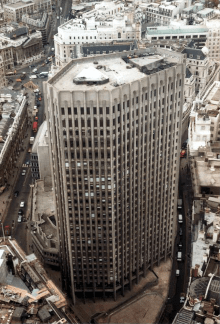
The London Stock Exchange bombing occurs at 8:49 a.m. on the morning of July 20, 1990, with the explosion of a 5 to 10 lb. (2.3 to 4.5 kg) bomb of high explosives inside the London Stock Exchange building on Threadneedle Street in the City of London, England, planted by the Provisional Irish Republican Army (IRA). The building and surrounding area are evacuated after the IRA gives a telephone warning 40 minutes prior to the explosion, and thus nobody is wounded. As many as 300 people are evacuated from the building alone. The bomb’s strength blows a 10-foot hole inside the Stock Exchange Tower and causes massive damage to the visitors’ gallery on the first floor, which is frequently used by foreign tourists and schoolchildren and had been scheduled to open ten minutes after the explosion. The bomb is placed in the men’s toilets behind the gallery. The gallery and public viewing area is forced to close in 1992.
The bombing comes on the eighth anniversary of the July 20, 1982, Hyde Park and Regent’s Park bombings which killed eleven soldiers and wounded 53 people. The IRA launches a renewed campaign in London in 1990. During May, a soldier at an army recruiting centre is killed by a bomb in Wembley, while five are injured in a similar explosion in Eltham. In June 1990, bombs at the Honourable Artillery Company (HAC) and the Carlton Club injure 19 and 20 people respectively.
Scotland Yard‘s anti-terrorist chief George Churchill-Coleman says eight phone calls from the same man with an Irish accent are made between 8:02 a.m. and 8:20 a.m. to the City of London Police, the London Fire Brigade, Reuters, the Financial Times, The Salvation Army and the Stock Exchange itself. The caller telephones Reuters just after 8:00 a.m. and says, “This is the IRA. The bomb is due to go off in half an hour at the stock exchange.” The caller then gives a code word that the police say is known to them and used by the IRA to show that its threats are serious, and says, “Clear the building.”
The Stock Exchange’s chairman, however, says after the attack, “If the purpose of this callous act was to bring the City to a halt, they have failed singularly.” The explosion has little impact on stock trading since that is being carried out by computers elsewhere.
A spokesman for Prime MinisterMargaret Thatcher says she is “appalled when people leave explosive devices in this manner in public areas.” On October 12, 1984, a bomb planted by the IRA at the Grand Brighton Hotel in Brighton, where the Conservative Party is holding its annual conference, kills five people and comes close to killing Thatcher.
In 1992, the IRA bombs the Baltic Exchange building in the city.
(Pictured: The Stock Exchange Tower in 1983, taken from the top of the National Westminster Tower (now Tower 42), clearly showing the symbolic coffin shape of the building)






 seamus dubhghaill