The Army Mutiny is an Irish Army crisis that begins on March 7, 1924, provoked by a proposed reduction in army numbers in the immediate post-Civil War period. A second grievance concerns the handling of the Northern Boundary problem. As the prelude to a coup d’état, the decisions made by influential politicians and soldiers at the time have continuing significance for the Government of Ireland.
In December 1922, following Collins’s death, Liam Tobin forms the Irish Republican Army Organisation (IRAO), taking in Dublin Guard and other Irish Army officers who share his view that “higher command…was not sufficiently patriotic.” President of the Executive Council of the Irish Free StateW. T. Cosgrave, head of the government, attempts to appease the IRAO. He meets with them several times before the 1923 Irish general election and persuades the opposing IRB faction of generals under Richard Mulcahy to keep quiet.
With the election over, Mulcahy now ignores the IRAO as he starts the process of demobilising 37,000 men. In November, sixty IRA officers mutiny and are dismissed without pay. The IRAO now pressures the Government into establishing a committee to supervise future demobilisation. The committee, consisting of Eoin MacNeill, Ernest Blythe, and IRAO sympathiser Joseph McGrath, effectively undermines the authority of the Army Council.
On March 7, 1924, a representative of the IRAO hands a demand to end demobilisation to W. T. Cosgrave. The ultimatum is signed by senior Army officers, Major-General Liam Tobin and Colonel Charles Dalton. Tobin knows his own position is to be scrapped in the demobilisation. Frank Thornton and Tom Cullen are also involved. That morning 35 men of the 36th Infantry Battalion refuse to parade, and the preceding week officers had absconded with arms from the McCan Barracks in Templemore, Gormanston Camp in County Meath, Baldonnel Aerodrome in Baldonnel, Dublin, and Roscommon. The immediate response is an order for the arrest of the two men on a charge of mutiny. This causes alarm throughout Dublin when announced.
On March 8, General Mulcahy makes an announcement to the Army:
“Two Army officers have attempted to involve the Army in a challenge to the authority of the Government. This is an outrageous departure from the spirit of the Army. It will not be tolerated…officers and men…will stand over their posts and do their duty today in this new threat of danger in the same wonderful, determined spirit that has always been the spirit of the Army.”
Leader of the Opposition, Thomas Johnson, issues a statement of support for the Government. In contrast, Minister for Industry and Commerce, Joseph McGrath, whose home Mulcahy orders to be searched, resigns because of dissatisfaction with the government’s attitude to the IRAO officers and support for their perception that the Irish Army treats former British officers better than former IRA officers. Fearing an incendiary speech by McGrath, Cosgrave first offers the IRAO an inquiry and an amnesty before then taking sick leave thus making Minister for Justice, Kevin O’Higgins, de facto head of the Government.
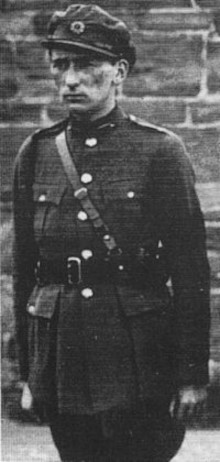
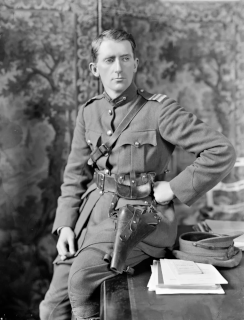
(Pictured: Major General Liam Tobin, a leading figure in the Army Mutiny)
Fuller is born on January 1, 1900, in Kilflynn, County Kerry. He is the son of Daniel Fuller and Ellie Quinlan. His family is from Fahavane, in the parish of Kilflynn.
Fuller serves in the Kilflynn Irish Republican Army (IRA) flying column during the Irish War of Independence. He is First Lieutenant in the Kerry No.1 Brigade, 2nd Battalion. He opposes the Anglo-Irish Treaty and continues to fight with the anti-Treaty IRA during the Irish Civil War. Military records from the 1930s show, in his own hand, that he is in communication with Dublin regarding confirmation of membership in July 1922 and therefore eligible for war pensions. He becomes the most senior Kilflynn member upon the death of Captain George O’Shea.
In 1923, Fuller is captured by Free State troops and imprisoned in Ballymullen Barracks in Tralee by the Dublin Guard who had landed in County Kerry shortly before. On March 6, 1923, five Free State soldiers are blown up by a booby-trapped bomb at Baranarigh Wood, Knocknagoshel, north Kerry, including long-standing colleagues of Major General Paddy Daly, GOC Kerry Command. Prisoners receive beatings after the killings and Daly orders that republican prisoners be used to remove mines.
On March 7, nine prisoners from Ballymullen Barracks, six from the jail and three from the workhouse, are chosen with a broad geographical provenance and no well-known connections. They are taken lying down in a lorry to Ballyseedy Cross. There they are secured by the hands and legs and to each other in a circle around a land mine. Fuller is among them. His Kilflynn parish comrade Tim Tuomey is initially stopped from praying until all prisoners are tied up. As he and other prisoners then say their prayers and goodbyes, Fuller continues to watch the retreating Dublin Guard soldiers, an act which he later says saved him. The mine is detonated, and he lands in a ditch, suffering burns and scars. He crosses the River Lee and hides in Ballyseedy woods. He is missed amongst the carnage as disabled survivors are bombed and shot dead with automatic fire. Most collected body parts are distributed between nine coffins that had been prepared. The explosions and gunfire are witnessed by Rita O’Donnell who lives nearby and who sees human remains spread about the next day. Similar reprisal killings by the Dublin Guard follow soon after Ballyseedy.
Fuller crawls away to the friendly home of the Currans nearby. They take him to the home of Charlie Daly the following day. His injuries are treated by a local doctor, Edmond Shanahan, who finds him in a dugout. He moves often in the coming months, including to the Burke and Boyle families, and stays in a dugout that had been prepared at the Herlihys for seven months.
A cover-up begins almost immediately. Paddy Daly’s communication to Dublin about returning the bodies to relatives differs significantly from Cumann na mBan statements, which Daly complains about as simple propaganda, and later that of Bill Bailey, a local who had joined the Dublin Guard, who tells Ernie O’Malley that the bodies were handed over in condemned coffins as a band played jolly music. Fuller is named amongst the dead in newspaper reports before it is realised that he had escaped. Daly then sends a communication to GHQ that Fuller is reported as having become “insane.” The Dublin Guard scours the countryside for Fuller. The official investigation into the killings is presided over by Daly himself, with Major General Eamon Price of GHQ and Colonel J. McGuinness of Kerry Command. It blames Irregulars for planting the explosives and exonerates the Irish Army soldiers, and this is read out in the Dáil by the Minister for Defence, Richard Mulcahy.
Contrary statements to the Irish Army’s submissions are effectively ignored. Lieutenant Niall Harrington of the Dublin Guard, describes the evidence to the court and the findings as “totally untrue,” explaining that the actions were devised and executed by officers of the Dublin Guard. He contacts Kevin O’Higgins, Minister for Justice and Vice-President, a family friend, to deplore the findings. O’Higgins speaks to Richard Mulcahy, who does nothing. In a separate incident, Free State Lieutenant W.McCarthy, who had been in charge of about twenty prisoners, says that five of them had been removed in the night. They were reportedly shot in the legs then blown up by, in his words, “…a Free State mine, laid by themselves.” He resigns in protest. A Garda Síochána report into the events is also dismissed and is not made public for over 80 years.
Fuller leaves the IRA after the Civil War and follows a career as a farmer in Kerry. He joins Fianna Fáil, the political party founded by Republican leader Éamon de Valera in 1926 after a split from Sinn Féin. He is elected to the 9th Dáil on his first attempt, representing Fianna Fáil at the 1937 Irish general election, as the last of three Fianna Fáil TDs to be elected to the four seat Kerry North constituency. He is re-elected to the 10th Dáil at the 1938 Irish general election, when Fianna Fáil again wins three out of four seats, but loses his seat at the 1943 Irish general election to the independent candidate Patrick Finucane. He returns to farming thereafter.
Fuller never once mentions the Ballyseedy incident from a political platform and states later that he bore no ill-will towards his captors or those who were involved in his attempted extrajudicial killing. He does not want the ill feeling passed on to the next generation. He speaks publicly about the events in 1980, a few years before his death, on Robert Kee‘s groundbreaking BBC series Ireland: A Television History.
Fuller dies in Edenburn Nursing Home, Tralee, on February 23, 1984. He is buried near the Republican plot in Kilflynn where colleagues O’Shea, Tuomey and Timothy ‘Aero’ Lyons are buried.
Fuller’s son Paudie establishes the Stephen Fuller Memorial Cup for dogs of all ages, contested annually on the family farm.
Fuller’s fame largely rests on one night at Ballyseedy. To trace him through the rural society from which he and his fellow Volunteers originated and in which his life was spent, however, gives a fuller understanding of the devastating effects of the conflicts of 1916–23 on a tightly knit rural and small-town society, dominated by extended families of farmers and their service-industry relatives, and of how that society remembered and forgot those traumas.
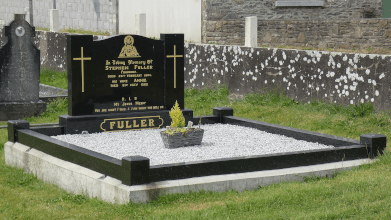
(Pictured: Stephen Fuller’s grave in Kilflynn, by St. Columba’s Heritage Centre)
Tobin is the eldest son of Mary Agnes (nee Butler) and David Tobin, a hardware clerk. He has two younger siblings, Katherine and Nicholas Augustine Tobin, also born in Cork. His family moves to John Street in Kilkenny and then to Dublin. He goes to school in Kilkenny and is an apprentice in a hardware shop at the time of the 1916 Easter Rising. As a participant in the Rising, he fights in the Four Courts garrison under Edward Daly. He is arrested, court martialed, and sentenced to death but his sentence is commuted to life imprisonment. He is a prisoner in Kilmainham, Mountjoy, Lewes, Dartmoor, Broadmoor and Pentonville prisons. He is released in June 1917.
In October 1921, Tobin travels with the Irish Treaty Delegation as part of Collins’ personal staff.
Tim Pat Coogan and James Mackay have examined Tobin’s involvement in the assassination of British Field MarshalSir Henry Wilson. Wilson’s public tirades about Collins is evidence of mutual personal dislike between the two men. In May 1922 Collins tells Tobin “We’ll kill a member of that bunch” to the news of “bloody pogroms” in Belfast. Wilson is intimately involved with the Ulster loyalist cause, including the Curragh Mutiny and the establishment of the Ulster Special Constabulary. Just before the shooting, Coogan places Tobin in London. He meets courier Peig Ni Braonain at Euston Station collecting a document that has been sent from Dublin. Returning to Dublin before the incident, he is jubilant when he tells defence ministerRichard Mulcahy about Wilson’s death. Mulcahy is appalled and threatens to resign.
In October 1922, Tobin’s brother Nicholas, a Free State captain, is accidentally shot dead by his own troops during the raid and capture of a bomb making factory at number 8 Gardiner’s Place, Dublin.
Tobin believes in the steppingstone doctrine which sees the Treaty as a stage towards full independence. With the outbreak of the Irish Civil War he remains loyal to Collins and takes the Pro-Treaty side. He leads in the fight against the Anti-Treaty IRA in the south. Disillusioned with the continuing hostilities and in the aftermath of the death of Collins, he forms an association called the IRA Organisation (IRAO) or “Old Irish Republican Army” to distinguish themselves from the anti-treaty insurgents.
Richard Mulcahy, the new Irish defence minister, proposes to reduce the army from 55,000 to 18,000 men in the immediate post- Civil-War period. Tobin knows his own position is to be affected and shares the perception that the Irish Army treats former British officers better than former IRA officers. On March 7, 1924, Tobin, together with Colonel Charlie Dalton, sends an ultimatum to President of the Executive Council of the Irish Free StateW. T. Cosgrave demanding an end to the army demobilisation. The immediate response is an order for the arrest of the two men on a charge of mutiny. The cabinet, already wary of the Irish Army, orders an inquiry and appoints Garda CommissionerEoin O’Duffy to the army command.
On March 18, the mutineers assemble with hostile intent at a Dublin pub. An order is made to arrest the mutineers and the cabinet demands the resignation of the army council. The generals resign, affirming the subservience of the military to the civilian government of the new state.
In later years, Tobin rebuilds relations with his Civil War foes and joins Éamon de Valera‘s Anti-Treaty Fianna Fáil party. He joins up with Joseph McGrath to form the Irish Hospitals’ Sweepstake in the 1930s. Many other former army comrades find work in this lottery. He leaves the Sweep in 1938. After World War II, he becomes Superintendent of the Oireachtas for the Irish Dáil.
On October 14, 1929, Tobin marries Monica “Mona” Higgins at the Church of the Holy Family, Aughrim Street, Dublin. They have two daughters, Máire and Anne Tobin. Following the death of his father, David, in 1956, Tobin’s health declines, resulting in his death in Dublin on April 30, 1963.
Costello is the younger son of John Costello senior, a civil servant, and Rose Callaghan. He is educated at St. Joseph’s, Fairview, and then moves to O’Connell School, for senior classes, and later attends University College Dublin (UCD), where he graduates with a degree in modern languages and law. He studies at King’s Inns to become a barrister, winning the Victoria Prize there in 1913 and 1914. He is called to the Irish Bar in 1914, and practises as a barrister until 1922.
In 1922, Costello joins the staff at the office of the Attorney General in the newly established Irish Free State. Three years later he is called to the inner bar, and the following year, 1926, he becomes Attorney General of Ireland, upon the formation of the Cumann na nGaedheal government, led by W. T. Cosgrave. While serving in this position he represents the Free State at Imperial Conferences and League of Nations meetings.
Costello is also elected a Bencher of the Honourable Society of King’s Inns. He loses his position as Attorney General of Ireland when Fianna Fáil comes to power in 1932. The following year, however, he is elected to Dáil Éireann as a Cumann na nGaedheal TD. Cumann na nGaedheal soon merges with other parties to form Fine Gael.
During the Dáil debate on the Emergency Powers Act 1939, Costello is highly critical of the Act’s arrogation of powers, stating that “We are asked not merely to give a blank cheque, but to give an uncrossed cheque to the Government.” He loses his seat at the 1943 Irish general election but regains it when Éamon de Valera calls a snap election in 1944. From 1944 to 1948, he is the Fine Gael front-bench Spokesman on External Affairs.
In 1948, Fianna Fáil has been in power for sixteen consecutive years and has been blamed for a downturn in the economy following World War II. The 1948 Irish general election results show Fianna Fáil short of a majority, but still by far the largest party, with twice as many seats as the nearest rival, Fine Gael. It appears that Fianna Fáil is headed for a seventh term in government. However, the other parties in the Dáil realise that between them, they have only one seat fewer than Fianna Fáil, and if they band together, they would be able to form a government with the support of seven Independent deputies. Fine Gael, the Labour Party, the National Labour Party, Clann na Poblachta and Clann na Talmhan join to form the first inter-partygovernment in the history of the Irish state.
While it looks as if cooperation between these parties will not be feasible, a shared opposition to Fianna Fáil and Éamon de Valera overcomes all other difficulties, and the coalition government is formed.
Since Fine Gael is the largest party in the government, it has the task of providing a suitable candidate for Taoiseach. Naturally, it is assumed that its leader, Richard Mulcahy, will be offered the post. However, he is an unacceptable choice to Clann na Poblachta and its deeply republican leader, Seán MacBride. This is due to Mulcahy’s record during the Irish Civil War. Instead, Fine Gael and Clann na Poblachta agree on Costello as a compromise candidate. Costello had never held a ministerial position nor was he involved in the Civil War. When told by Mulcahy of his nomination, Costello is appalled, content with his life as a barrister and as a part-time politician. He is persuaded to accept the nomination as Taoiseach by close non-political friends.
During the campaign, Clann na Poblachta had promised to repeal the Executive Authority (External Relations) Act 1936 but does not make an issue of this when the government is being formed. However, Costello and his Tánaiste, William Norton of the Labour Party, also dislike the act. During the summer of 1948, the cabinet discusses repealing the act, however, no firm decision is made.
In September 1948, Costello is on an official visit to Canada when a reporter asks him about the possibility of Ireland leaving the British Commonwealth. For the first time, he declares publicly that the Irish government is indeed going to repeal the External Relations Act and declare Ireland a republic. It has been suggested that this is a reaction to offence caused by the Governor General of Canada at the time, Harold Alexander, 1st Earl Alexander of Tunis, who is of Northern Irish descent and who allegedly arranges to have placed symbols of Northern Ireland in front of Costello at an official dinner. Costello makes no mention of these aspects on the second reading of the Republic of Ireland Bill on November 24 and, in his memoirs, claims that Alexander’s behaviour had in fact been perfectly civil and could have had no bearing on a decision which had already been made.
The news takes the Government of the United Kingdom and even some of Costello’s ministers by surprise. The former had not been consulted and following the declaration of the Republic in 1949, the UK passes the Ireland Act that year. This recognises the Republic of Ireland and guarantees the position of Northern Ireland within the United Kingdom for so long as a majority there want to remain in the United Kingdom. It also grants full rights to any citizens of the Republic living in the United Kingdom. Ireland leaves the Commonwealth on April 18, 1949, when The Republic of Ireland Act 1948 comes into force. Frederick Henry Boland, Secretary of the Department of External Affairs, says caustically that the affair demonstrates that “the Taoiseach has as much notion of diplomacy as I have of astrology.” The British envoy, John Maffey, 1st Baron Rugby, is equally critical of what he calls a “slipshod and amateur” move.
Many nationalists now see partition as the last obstacle on the road to total national independence. Costello tables a motion of protest against partition on May 10, 1949, without result.
In 1950, the independent-minded Minister for Health, Noël Browne, introduces the Mother and Child Scheme. The scheme would provide mothers with free maternity treatment and their children with free medical care up to the age of sixteen, which is the normal provision in other parts of Europe at that time. The bill is opposed by doctors, who fear a loss of income, and Roman Catholic bishops, who oppose the lack of means testing envisaged and fear the scheme could lead to birth control and abortion. The cabinet is divided over the issue, many feeling that the state cannot afford such a scheme priced at IR£2,000,000 annually. Costello and others in the cabinet make it clear that in the face of such opposition they will not support the Minister. Browne resigns from the government on April 11, 1951, and the scheme is dropped. He immediately publishes his correspondence with Costello and the bishops, something which had hitherto not been done. Derivatives of the Mother and Child Scheme are introduced in Public Health Acts of 1954, 1957 and 1970.
The Costello government has a number of noteworthy achievements. A new record is set in housebuilding, the Industrial Development Authority and Córas Tráchtála are established, and the Minister for Health, Noel Browne, with the then new Streptomycin, bring about an advance in the treatment of tuberculosis. Ireland also joins a number of organisations such as the Organization for European Economic Co-operation and the Council of Europe. However, the government refuses to join NATO, allegedly because the British remain in Northern Ireland. The scheme to supply electricity to even the remotest parts of Ireland is also accelerated.
While the “Mother and Child” incident does destabilise the government to some extent, it does not lead to its collapse as is generally thought. The government continues; however, prices are rising, a balance of payments crisis is looming, and two TDs withdraw their support for the government. These incidents add to the pressure on Costello and so he decides to call a general election for June 1951. The result is inconclusive but Fianna Fáil returns to power. Costello resigns as Taoiseach. It is at this election that his son Declan is elected to the Dáil.
Over the next three years while Fianna Fáil is in power a dual-leadership role of Fine Gael is taking place. While Richard Mulcahy is the leader of the party, Costello, who has proved his skill as Taoiseach, remains as parliamentary leader of the party. He resumes his practice at the Bar. In what is arguably his most celebrated case, the successful defence of The Leader against a libel action brought by the poet Patrick Kavanagh, dates from this period. Kavanagh generously praises Costello’s forensic skill, and the two men become friends.
At the 1954 Irish general election Fianna Fáil loses power. A campaign dominated by economic issues results in a Fine Gael-Labour Party-Clann na Talmhan government coming to power. Costello is elected Taoiseach for the second time.
The government can do little to change the ailing nature of Ireland’s economy, with emigration and unemployment remaining high, and external problems such as the Suez Crisis compounding the difficulty. Measures to expand the Irish economy such as export profits tax relief introduced in 1956 would take years have sizable impact. Costello’s government does have some success with Ireland becoming a member of the United Nations in 1955, and a highly successful visit to the United States in 1956, which begins the custom by which the Taoiseach visits the White House each St. Patrick’s Day to present the U.S. President with a bowl of shamrock. Although the government has a comfortable majority and seems set for a full term in office, a resumption of Irish Republican Army (IRA) activity in Northern Ireland and Great Britain causes internal strains. The government takes strong action against the republicans.
In spite of supporting the government from the backbenches, Seán MacBride, the leader of Clann na Poblachta, tables a motion of no confidence, based on the weakening state of the economy and in opposition to the government’s stance on the IRA. Fianna Fáil also tables its own motion of no confidence, and rather than face almost certain defeat, Costello again asks PresidentSeán T. O’Kelly to dissolve the Oireachtas. The general election which follows in 1957 gives Fianna Fáil an overall majority and starts another sixteen years of unbroken rule for the party. Some of his colleagues questioned the wisdom of his decision to call an election. The view is expressed that he was tired of politics and depressed by his wife’s sudden death the previous year.
Following the defeat of his government, Costello returns to the bar. In 1959, when Richard Mulcahy resigns the leadership of Fine Gael to James Dillon, he retires to the backbenches. He could have become party leader had he been willing to act in a full-time capacity. He remains as a TD until 1969, when he retires from politics, being succeeded as Fine Gael TD for Dublin South-East by Garret FitzGerald, who himself goes onto to become Taoiseach in a Fine Gael-led government.
During his career, Costello is presented with a number of awards from many universities in the United States. He is also a member of the Royal Irish Academy from 1948. In March 1975, he is made a freeman of the city of Dublin, along with his old political opponent Éamon de Valera. He practises at the bar until a short time before his death at the age of 84, in Ranelagh, Dublin, on January 5, 1976. He is buried at Dean’s Grange Cemetery in Dublin.
James Stephens formally establishes the Irish Republican Brotherhood (IRB) in Peter Lanigan’s timber yard, Lombard Street, Dublin, on Saint Patrick’s Day, March 17, 1858. It is originally named the Irish Revolutionary Brotherhood, but soon comes to be known as the Irish Republican Brotherhood. At the same time, John O’Mahoney is founding the American branch of the revolutionary group. O’Mahoney gives the organization the better-known name Fenians, in honor of the Fianna, the soldiers led by Fionn mac Cumhaill, the heroic warrior of Irish legend.
The IRB is a small, secret, revolutionary body whose sole object is to “establish and maintain a free and independent Republican Government in Ireland.” Stephens is a Young Irelander and is a lieutenant to William Smith O’Brien at the Battle of Widow McCormack’s Cabbage Patch in Ballingary, County Tipperary, in August 1848. He is wounded three times and is smuggled onto a ship to England and then to France, where he spends the next eight years. Upon his return to Dublin in 1856, he determines to organise a revolutionary movement and that leads to the founding of the IRB.
The IRB becomes known as the Fenian movement in the 1850s and 1860s and is committed to the use of force to establish an independent Irish republic. After organising an abortive rising in March 1867, it suffers deep internal divisions over its leadership and strategy in both the United States and Ireland—whether it is best to strike at England, in Ireland or in Canada. The issue is resolved after a series of failed interventions in Canada in 1866, 1867 and 1871, and after bombings in England that do not lead Ireland closer to independence. The IRB is unable to exploit the weaknesses and divisions in the constitutional movement following Charles Stewart Parnell’s divorce scandal (1890–91).
The IRB is eventually rejuvenated in Ireland about 1907, led by Bulmer Hobson and Tom Clarke, thus preparing the way for all that follows.The governing body is the Supreme Council. Before 1916 this consists of eleven members, and after the 1917 reorganisation it contains fifteen members. When not in session, all powers of the Supreme Council, except for declaring war, devolve onto an executive of three: the president, secretary and treasurer.
The constitution provides for the establishment of a military council, subordinate to the Supreme Council. The seven signatories of the 1916 Proclamation of the Irish Republic constitute the entire military council at the time. The constitution is dedicated to the use of force against England at any favourable opportunity, but this is to be a democratic decision: “The IRB shall await the decision of the Irish Nation as expressed by a majority of the Irish people as to the fit hour of inaugurating a war against England and shall, pending such an emergency, lend its support to every movement calculated to advance the cause of Irish independence, consistent with the preservation of its own integrity,” a clause adopted in 1873 in response to the controversies arising from the 1867 Fenian Rising.
The IRB plans the 1916 Easter Rising but the Irish Volunteers and the Irish Citizen Army make it possible. The establishment of the Irish Volunteers gives the IRB the great opportunity to train and equip its members as a military body for the purpose of securing independence for Ireland by force of arms and securing the cooperation of all Irish military bodies in the accomplishment of its objectives. Numerically the IRB probably never exceeds 2,000 members, but they are all extremely loyal and well trained, and there is very tight security. The executions of 1916 just about wipe out the Supreme Council, and after the prisoners are released, the IRB has to reconstitute itself.
Following the Easter Rising some republicans—notably Éamon de Valera and Cathal Brugha—leave the organization, which they view as no longer necessary, since the Irish Volunteers now perform its function. The IRB, during the Irish War of Independence (1919-21), is under the control of Michael Collins, who is secretary, and subsequently president, of the Supreme Council. Volunteers such as Séumas Robinson say afterwards that the IRB by then is “moribund where not already dead,” but there is evidence that it is an important force during the war.
When the Anglo-Irish Treaty is signed on December 6, 1921, it is debated by the Supreme Council, which votes to accept it by eleven votes to four. Those on the Supreme Council who oppose the Treaty include former leader Harry Boland, Austin Stack and Liam Lynch. Anti-Treaty republicans like Ernie O’Malley, who fought during the Irish Civil War against the Treaty, sees the IRB as being used to undermine the Irish Republic. The IRB becomes quiescent during the Irish Civil War, which ends in May 1923, but it emerges again later that year as a faction within the National Army that supports Minister for Defence Richard Mulcahy against the “Old IRA,” which fought against the recruitment of ex-British Army personnel and the demobilization of old IRA men. This comes to a head with the Irish Army Mutiny of 1924, in the wake of which Mulcahy resigns and other IRB members of the army are dismissed by acting President of the Executive CouncilKevin O’Higgins. The IRB subsequently dissolves itself, although it is not known whether a formal decision is taken, or it simply ceases to function.
Mulcahy is born in Manor Street, Waterford, County Waterford, on May 10, 1886, the son of post office clerk Patrick Mulcahy and Elizabeth Slattery. He is educated at Mount Sion Christian Brothers School and later in Thurles, County Tipperary, where his father is the postmaster.
Mulcahy is second-in-command to Thomas Ashe in an encounter with the armed Royal Irish Constabulary (RIC) at Ashbourne, County Meath, during the 1916 Easter Rising, one of the few stand-out victories won by republicans in that week and generally credited to Mulcahy’s grasp of tactics. In his book on the Rising, Charles Townshend principally credits Mulcahy with the defeat of the RIC at Ashbourne, for conceiving and leading a flanking movement on the RIC column that had engaged with the Irish Volunteers. Arrested after the Rising, he is interned at Knutsford and at the Frongoch internment camp in Wales until his release on December 24, 1916.
Mulcahy and Michael Collins are largely responsible for directing the military campaign against the British during the Irish War of Independence. During this period of upheaval in 1919, he marries Mary Josephine (Min) Ryan, sister of Kate and Phyllis Ryan, the successive wives of Seán T. O’Kelly. Her brother is James Ryan. O’Kelly and Ryan both later serve in Fianna Fáil governments.
Mulcahy supports the Anglo-Irish Treaty of December 1921. Archive film shows that Mulcahy, as Minister of Defence, is the Irish officer who raises the Irish tricolour at the first hand-over of a British barracks to the National Army in January 1922. He is defence minister in the Provisional Government on its creation and succeeds Collins, after the latter’s assassination, as Commander-in-Chief of the Provisional Government’s forces during the subsequent Irish Civil War.
Mulcahy earns notoriety through his order that anti-Treaty activists captured carrying arms are liable for execution. A total of 77 anti-Treaty prisoners are executed by the Provisional Government. He serves as Minister for Defence in the new Free State government from January 1924 until March 1924, but resigns in protest because of the sacking of the Army Council after criticism by the Executive Council over the handling of the “Army Mutiny,” when some National Army War of Independence officers almost revolt after he demobilises many of them at the end of the Irish Civil War. He re-enters the cabinet as Minister for Local Government and Public Health in 1927.
After the resignation of W. T. Cosgrave as Leader of Fine Gael in 1944, Mulcahy becomes party leader while still a member of the Seanad. Thomas F. O’Higgins is parliamentary leader of the party in the Dáil at the time and Leader of the Opposition. Facing his first general election as party leader, Mulcahy draws up a list of 13 young candidates to contest seats for Fine Gael. Of the eight who run, four are elected. He is returned again to the 12th Dáil as a TD for Tipperary at the 1944 Irish general election. While Fine Gael’s decline had been slowed, its future is still in doubt.
Following the 1948 Irish general election Mulcahy is elected for Tipperary South, but the dominant Fianna Fáil party finishes six seats short of a majority. However, it is 37 seats ahead of Fine Gael, and conventional wisdom suggests that Fianna Fáil is the only party that can possibly form a government. Just as negotiations get underway, however, Mulcahy realises that if Fine Gael, the Labour Party, the National Labour Party, Clann na Poblachta and Clann na Talmhan band together, they would have only one seat fewer than Fianna Fáil and, if they can get support from seven independents, they will be able to form a government. He plays a leading role in persuading the other parties to put aside their differences and join forces to consign the then Taoiseach and Fianna Fáil leader Éamon de Valera, to the opposition benches.
Mulcahy initially seems set to become Taoiseach in a coalition government. However, he is not acceptable to Clann na Poblachta’s leader, Seán MacBride. Many Irish republicans had never forgiven him for his role in the Irish Civil War executions carried out under the Cosgrave government in the 1920s. Consequently, MacBride lets it be known that he and his party will not serve under Mulcahy. Without Clann na Poblachta, the other parties would have 57 seats between them — 17 seats short of a majority in the 147-seat Dáil. According to Mulcahy, the suggestion that another person serve as Taoiseach comes from Labour leader William Norton. He steps aside and encourages his party colleague John A. Costello, a former Attorney General of Ireland, to become the parliamentary leader of Fine Gael and the coalition’s candidate for Taoiseach. For the next decade, Costello serves as the party’s parliamentary leader while Mulcahy remained the nominal leader of the party.
Mulcahy goes on to serve as Minister for Education under Costello from 1948 until 1951. Another coalition government comes to power at the 1954 Irish general election, with Mulcahy once again stepping aside to become Minister for Education in the Second Inter-Party Government. The government falls in 1957, but he remains as Fine Gael leader until October 1959. In October the following year, he tells his Tipperary constituents that he does not intend to contest the next election.
Mulcahy dies from natural causes at the age of 85 in Dublin on December 16, 1971. He is buried in Littleton, County Tipperary.
O’Connor is educated in St. Mary’s College, Dublin, and then in Clongowes Wood College, County Kildare, a public school run by the Jesuit order. It is also attended by the man who later condemns O’Connor to death, his close friend Kevin O’Higgins. He studies experimental physics, logic, and metaphysics. He also attends the College of Science, Merrion Street. He takes a BA (1906) and receives a B.Eng (1911). In 1910, he takes his Bachelor of Engineering and Bachelor of Arts degrees at University College Dublin (UCD), then known as the National University. Prominent in the university’s Literary and Historical Society, he advocates militant constitutional nationalism as one of the many society members active in the Young Ireland branch of the United Irish League.
During the subsequent Irish War of Independence (1919-21) O’Connor is Director of Engineering of the Irish Republican Army (IRA), a military organisation descended from the Irish Volunteers. The specialist skills of engineering and signaling are essential to the development of the 5th Battalion, Dublin Brigade. Its men are forbidden frontline duty as their contribution is regarded as vital, their number too small. But units only expand on an incremental local basis, disappointing General Richard Mulcahy.
O’Connor is also involved in the Republican breakout from Strangeways Prison in Manchester, England, on October 25, 1919. Michael Collins takes a particular interest in the escape and actually visits Austin Stack in the prison under a false name to finalise the arrangements. IRA men hold up traffic while a ladder is propped up against the outside of a prison wall. In all six prisoners escape, among them Piaras Beaslaí.
O’Connor refuses to accept the Anglo-Irish Treaty of 1921, which establishes the Irish Free State. It is ratified by a narrow vote in Dáil Éireann, the Irish parliament. He and many like him feel that the Treaty copper-fastens the partition of the six counties of Northern Ireland and undermines the Irish Republic declared in 1916.
On January 10, a meeting is held at O’Connor’s home in Monkstown, Dublin. In attendance are all senior anti-Treaty IRA officers except Liam Mellows. O’Connor is appointed to chair this grouping, known as the Republican Military Council. It is agreed that an IRA convention should be called without delay; failing this, a separate GHQ will be formed. At a further meeting in O’Connor’s office on March 20, a temporary IRA GHQ staff is elected under Liam Lynch as chief of staff. O’Connor remains in charge of engineering.
On March 26, 1922, the anti-Treaty officers of the IRA hold a convention in Dublin, in which they reject the Treaty and repudiate the authority of the Dáil. However, they are prepared to discuss a way forward. The convention meets again on April 9. It creates a new army constitution and places the army under a newly elected executive of 16 men, including O’Connor, that are to choose an army council and headquarters staff. Asked by a journalist if this development means the anti-Treatyites ware proposing a “military dictatorship” in Ireland, O’Connor replies, “You can take it that way if you want.”
On April 14, 1922, O’Connor is one of a number of IRA leaders in a 200-strong force that occupies the Four Courts building in the centre of Dublin in defiance of the Provisional Government. They intend to provoke the British troops, who are still in the country, into attacking them, which they believe will restart the war with Britain and re-unite the IRA against their common enemy. They also occupy other smaller buildings regarded as being associated with the former British administration, such as the Ballast Office and the Freemasons‘ Hall in Molesworth Street, but the Four Courts remains the focus of interest. On June 15, O’Connor sends out men to collect the rifles that belong to the mutineers of the Civic Guards.
Michael Collins tries desperately to persuade the IRA men to leave the Four Courts. At the Third IRA Convention on June 18, the Executive is split over whether the Irish Government should demand that all British troops leave within 72 hours. A motion to this effect, opposed by Lynch, is narrowly defeated, whereupon O’Connor and others leave the meeting to set up a separate GHQ. The IRA effectively splits into two factions opposed to the government.
On June 22, 1922, Sir Henry Wilson is assassinated in London by two IRA men, Reginald Dunne and Joseph O’Sullivan, each a former British soldier. Some now argue that this was done on the orders of Michael Collins, who had been a close friend of Dunne’s in the London Irish Republican Brotherhood (IRB). Prime MinisterDavid Lloyd George writes an angry letter to Collins, which includes the line “…still less can Mr. Rory O’Connor be permitted to remain his followers and his arsenal in open rebellion in the heart of Dublin… organizing and sending out from this centre enterprises of murder not only in the area of your Government…”
On June 28, 1922, after the Four Courts garrison has kidnapped J. J. “Ginger” O’Connell, a general in the National Army, Collins gives orders for the shelling of the Four Courts with borrowed artillery lent by Winston Churchill. The shelling leads to the Four Courts catching fire, damaging parts of the building in addition to destroying numerous government documents. O’Connor is one of 130 men that surrender on June 30, some of whom are arrested and imprisoned in Mountjoy Prison. This incident marks the official start of the Irish Civil War, as fighting breaks out openly around the country between pro- and anti-Treaty factions.
On December 8, 1922, along with three other republicans, Liam Mellows, Richard Barrett and Joe McKelvey, captured with the fall of the Four Courts, O’Connor is executed by firing squad in reprisal for the anti-Treaty IRA’s killing of Free State Teachta Dála (TD) Sean Hales. The execution order is signed by Kevin O’Higgins. O’Connor had been best man at O’Higgins’s wedding on October 27, 1921. Their deaths remain a symbol of the bitterness and division of the Irish Civil War. O’Connor, one of 77 republicans executed by the Provisional Government, is seen as a martyr by the Republican movement in Ireland.
On O’Connor’s execution, the equestrienne Joan de Sales La Terriere, a close friend of his, names her son in his honour. “Rory O’Connor Place” in Arklow is named in his honour. There is also a pub in Crumlin, Dublin, named after him and a housing estate near Dún Laoghaire, County Dublin, called “Rory O’Connor Park.” A Sinn Féincumann (UCD) is named after him.
(Pictured: Rory O’Connor addressing members of the IRA’s Dublin City Brigade at Smithfield, April 1922)
Dirrane is born in Oatquarter in the townland of Kilmurvey on Inishmore, Aran Islands, County Galway on November 15, 1894. She is the youngest child of Joseph Gillan and Maggie (née Walsh). Her father is a weaver of flannel cloth and has a small farm. She has four brothers and three sisters. Her oldest brother is a fisherman, who dies at age 21 in 1901, and her father dies before 1911. Despite this hardship, all of the children go to school, with one of her brothers becoming an Irish teacher, and later an Irish inspector. The family speaks Irish at home, but they are all bilingual with English. She is schooled at the national school in Oatquarter until the age of 14. She leaves to work in local homes, looking after children. When she writes her memoirs late in life, she claims to have met Joseph Plunkett, Éamonn Ceannt, Thomas MacDonagh, Thomas Ashe and Patrick Pearse when they visited the island, visiting a house where she looked after the children, discussing politics and plans for the Easter Rising with them. She is a republican, becoming a member of Cumann na mBan in 1918 while she is working for Fr. Matthew Ryan as a housekeeper. She is involved in drilling and assisting fugitives from the authorities. Because of their known republican sympathies, the Black and Tans raid the Gillan family homes.
Dirrane moves to Dublin in 1919 to train in Saint Ultan’s Children’s Hospital as a nurse. She is still under surveillance, being arrested alongside her employer, Claude Chavasse, when she is working as a nurse in his house. She is held in Dublin’s Bridewell Garda Station for two days before being transferred to Mountjoy Prison. In the time of her imprisonment, she is not charged or put on trial. Her refusal to speak English angers the guards, culminating in her going on hunger strike for a number of days in 1920 until she is released. She takes part in the Cumann na mBan vigil outside of Mountjoy Prison in November 1920, when Kevin Barry is hanged.
Dirrane works in Richard Mulcahy‘s house for two years, before emigrating to the United States in 1927 to continue her career as a nurse. She works in Boston where she is an active member of the Irish emigrant community alongside former neighbours from the Aran Islands and some relatives. She works in a hotel for a time but returns to nursing after her marriage to Edward ‘Ned’ Dirrane in November 1932 in the Jamaica Plain section of Boston. Ned, a labourer in Boston and also from Inishmore, dies from heart failure in 1940. Dirrane continues her career nursing in hospitals and as a district nurse. On May 13, 1940, she naturalises as U.S. citizen. During World War II, she works as a nurse in a munitions factory, and at a U.S. Army Air Forcesbomber base in Mississippi. She canvases for John F. Kennedy in the Irish community in South Boston when he runs for president in 1960. Jean Kennedy Smith visits Dirrane in 1997 in Galway to acknowledge her contribution. She also meets Senator Edward Kennedy.
Following her retirement, Dirrane lives with her nephew, but she returns to the Aran Islands in 1966 at age 72. There she lives with her brother-in-law, Pat Dirrane, a widower with three grown sons. They marry in a private ceremony on April 27, 1966. She continues to live on the island after Pat’s death on February 28, 1990, living with her stepson. She eventually moves into a nursing home in Newcastle in the suburbs of Galway. When she celebrates her 100th birthday, she funds a statue of Our Lady Mary at a holy well in Corough on Inishmore. At age 103, the matron of her nursing home arranges for a local writer, Jack Mahon, to record her memories and collate the information into a book. The book, A Woman of Aran, is published in 1997 and is a bestseller for several weeks. She is awarded an honorary degree, an MA honoris causa, from NUI Galway in May 1998, the oldest person to ever receive one.
Dirrane dies at age 109 on December 31, 2003, in Galway. She is buried on Inishmore.
Murphy’s father is Nicholas Murphy and her mother Mary Gertrude Purcell of Carrigmore, in Montenotte, Cork. She is sent away to school, to a convent in Sussex, England.
At Christmas 1915 Murphy attends an evening at the Fleischmann home where she meets Terence MacSwiney. Her family does not want the couple involved and does not approve of her growing interest in nationalism and socialism. In 1917 she marries MacSwiney in St. Joseph’s Church, Bromyard, Herefordshire, while he is interned due to his involvement in the Easter Rising of 1916. Her bridesmaid is Geraldine O’Sullivan, and his best man is Richard Mulcahy. The couple had waited until she had come of age at 25 so that she is financially independent of her parents. They have a daughter, Máire MacSwiney Brugha.
MacSwiney sees very little of her husband during their married life as he is often arrested. He dies due to his hunger strike on October 25, 1920, as Lord Mayor of Cork. Her husband’s death has a huge impact on her life, being a public event as well as a personal loss. She completes a lecture and interview tour of the United States, over nine months, with his sister Mary. She is the first woman to be given the Freedom of New York City, in 1922.
MacSwiney begins to suffer from depression and takes her daughter to Germany, leaving her there while she travels Europe. She eventually loses custody of her child and by 1934 she no longer has any involvement in her daughter’s life.
MacSwiney spends a lot of time in Paris, where she continues to be engaged with politics, typically those of left-wing, including communist, groups. She becomes involved with Pierre Kaan and they have a daughter, Alix, who is born on May 5, 1926, in Germany. Kaan is sent to a concentration camp by the Gestapo and dies on May 18, 1945, as a result of his treatment there.
MacSwiney is critical of American foreign policy on Vietnam, calling the United States a “world imperialist power.”
MacSwiney never resolves her relationships with either her own daughter or her family. She is paid a pension as the widow of Terence MacSwiney from 1950. She is living in Tonbridge in Kent with her daughter near the end of her life. She dies on October 26, 1982, at Oakwood Hospital in Barming Heath near Maidstone.



 seamus dubhghaill