seamus dubhghaill

Promoting Irish Culture and History from Little Rock, Arkansas, USA


2 Comments

Death of Nelly O’Brien, Miniaturist, Artist & Activist

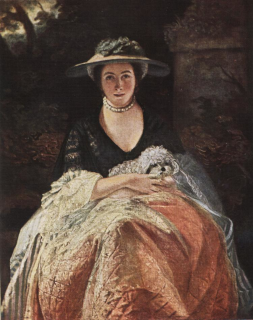
Ellen Lucy or Nelly O’Brien, Irish miniaturist, landscape artist, and Gaelic League activist, dies suddenly on April 1, 1925, while visiting her brother Dermod at 66 Elm Park Gardens, London.

O’Brien is born Ellen Lucy O’Brien on June 4, 1864, at Cahirmoyle, County Limerick. She is the eldest child of Edward William O’Brien and Mary O’Brien (née Spring Rice). Her siblings are Lucy and Dermod, with Dermod also becoming an artist. Her father is a landowner, and her mother is a sculptor and painter and sister of Thomas Spring Rice. Her grandfather is William Smith O’Brien.

While a young child, O’Brien spends two years living on the French Riviera from 1866 to 1868. Her mother later dies of tuberculosis, and the three children are raised by their aunt, the writer and nationalist, Charlotte Grace O’Brien. Their father remarries in 1880, to Julia Marshall, with whom he has two sons and two daughters.

O’Brien attends school in England from 1879, and later enrolls to study painting at the Slade School of Fine Art. She meets Walter Osborne through her brother Dermod, and considers herself engaged to him, but Osborne dies on April 24, 1903. A portrait of O’Brien by Osborne is held in the Hugh Lane Gallery.

O’Brien returns to Ireland and begins to paint miniatures on ivory using a magnifying glass. She also paints watercolour landscapes. Her first exhibition with the Royal Hibernian Academy (RHA) is in 1896, where she shows three works including Sketch near Malahide. She exhibits with the RHA on and off until 1922. During some of her time in Dublin, she lives with her half-brother, Edward Conor Marshall O’Brien, on Mount Street.

As part of an exhibition of Irish painters, O’Brien exhibits a number of portrait miniatures at the London Guildhall in 1904. The 1906 Oireachtas na Gaeilge features a number of her paintings, and in the same year she becomes honorary secretary of a newly established art committee. At the MunsterConnacht exhibition in Limerick of 1906, she exhibits a miniature of William Smith O’Brien amongst her 12 works on show. She produces many portraits, including one of Douglas Hyde, which is exhibited by the RHA in 1916.

O’Brien is an early member of the Gaelic League, being present at its first Oireachtas na Gaeilge in 1897 and founding the Craobh na gCúig gCúigí (Branch of the Five Provinces). In 1905, she writes a long letter in defence of Douglas Hyde and the Gaelic League in The Church of Ireland Gazette. She holds meetings of Craobh na gCúig gCúigí in her flat at 7 St. Stephen’s Green every Saturday night in 1907. In 1911, she founds Coláiste Eoghain Uí Chomhraí (O’Curry Irish College) in Carrigaholt, County Clare, which is named in honour of Eugene O’Curry, with the help of her cousin and friend Mary Spring Rice.

One of her ultimate goals is to create a national Irish church, which would unite Protestants and Catholics through the Irish language. To this end, she establishes the Irish Guild of the Church with Seoirse de Rút in 1914. The aim of the organisation is to provide a communal union for members of the Church of Ireland who are dedicated to “Irish Ireland” ideals.

Acting as a representative for the Gaelic League, she travels to the United States with Fionan MacColuim in 1914 to 1915, to fund raise and promote Irish art and industries. At Coláiste Eoghain Uí Chomhraí, she stresses the importance of the Irish language in the home, as well as the skills of housewives and those in domestic service in strengthening the language and Irish culture.

O’Brien notes that she initially thought that the 1916 Easter Rising was “in the nature a demonstration against conscription as it had been announced that the volunteers would resist disarmament.” She is staying with the Hydes at 1 Earlsfort Place during the Rising, as her flat at College Park Chambers had been destroyed. She protests the conscription bill in Ireland as a mass meeting of women at the Mansion House in 1918. She launches the Gaelic Churchman in 1919 as the official publication of the Irish Guild of the Church. In one article entitled A plea for the Irish services, she promotes her campaign for Irish language services in Protestant churches. In her capacity of vice-president of the guild, she invites Éamon de Valera to attend one of their meetings in 1921.

O’Brien dies suddenly on April 1, 1925, while visiting Dermod at 66 Elm Park Gardens, London. She is buried at the family plot in Cahirmoyle.

(Pictured: Nelly O’Brien by Sir Joshua Reynolds, 1723-1792)


Leave a comment

Birth of Rosaleen Brigid Ganly, Painter & Sculptor

Brigid Ganly HRHA, Irish painter and sculptor, is born Rosaleen Brigid O’Brien on January 29, 1909, in Dublin.

Ganly is one of five children born to Dermod O’Brien, a painter, and his wife Mabel Smiley. Her great-grandfather is the Irish Republican William Smith O’Brien. She grows up on a farm in Cahirmoyle, County Limerick, until the family moves to Fitzwilliam Square in Dublin. She goes on to attend the Metropolitan School of Art where she has the opportunity to study under Patrick Tuohy, Seán Keating and Oliver Sheppard. She is a talented sculptor and wins several awards, including the Taylor scholarship in 1929, for her allegorical male nude, Pity. She spends time in Paris in 1951 where she trains with André Lhote. She travels to Greece where Lhote continues to influence her work.

Ganly also studies painting in the Royal Hibernian Academy School where she has Margaret Clarke and Seán O’Sullivan as teachers. She is made an associate of the Royal Hibernian Academy (RHA) in 1928 and becomes a member in 1935 though, in 1969, resigns her membership in protest of the lack of young artists being given the opportunity to exhibit. In 1972 she is made an honorary member and returns.

Ganly is a representational artist and while known as a portrait artist, she also paints landscapes, interiors and may be best known for her still lifes. Some of her best works are portraits of her husband, her sister Ethel, her father, and her friend Sheila Pim. She illustrates the book-jackets of Sheila Pim’s works. She has many exhibitions, with the RHA and the Water Colour Society of Ireland. There is a retrospective of her life in 1998 at the Hugh Lane Gallery and her works are in the collections there. She is also in the collections of the Waterford Municipal Gallery, Crawford Art Gallery, Cork and in The National Self-Portrait Collection of Ireland. She is part of the 2014 exhibition ‘Irish Women Artists: 1870-1970.’

Ganly’s sister-in-law is Kitty Wilmer O’Brien with whom she often exhibits. She marries Andrew Ganly, a dental surgeon and writer with a strong involvement in theatre, in 1936. He dies in 1982. They have two children, Eoghan and Phillida.

Brigid Ganly dies on March 25,2002.

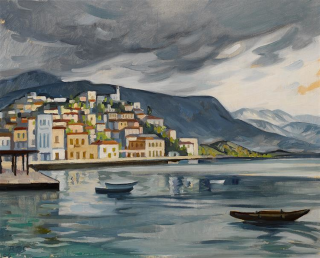
(Pictured: “Storm Over Poros” (1964) by Rosaleen Brigid Ganly, HRHA)


Leave a comment

Birth of William James “Willie” Pearse

William James “Willie” Pearse, Irish republican executed for his part in the 1916 Easter Rising, is born in Dublin on November 15, 1881. He is a younger brother of Patrick Pearse, a leader of the rising.

Throughout Pearse’s life he lives in the shadow of his brother to whom he is devoted and with whom he forms a particularly close relationship.

Pearse inherits his father’s artistic abilities and becomes a sculptor. He is educated at the Christian Brothers School, Westland Row. He studies at the Dublin Metropolitan School of Art under Oliver Sheppard. He also studies art in Paris. While attending the Royal College of Art in London he gains notice for several of his artworks. Some of his sculptures are to be found in St. John’s Cathedral in Limerick, the Cathedral of St. Eunan and St. Columba in Letterkenny and several Dublin churches. He is trained to take over his father’s stonemason business but gives it up to help Patrick run St. Enda’s School which he founds in 1908. He is involved in the arts and theatre at St. Enda’s and aids the overall running of the school.

Pearse follows his brother into the Irish Volunteers and the republican movement. He takes part in the Easter Rising in 1916, always staying at his brother’s side at the General Post Office. Following the surrender, he is court-martialed and sentenced to death. It has been said that as he is only a minor player in the struggle it is his surname that condemns him. However, at his court martial he emphasizes his involvement.

On May 3, 1916, Pearse is granted permission to visit his brother in Kilmainham Gaol, to see him for the final time. However, while he is en route, Patrick is executed. He is executed on May 4. He and his brother are the only two brothers to be executed after the Easter Rising.

There are many more public commemorations of Patrick Pearse than of William. In 1966, Dublin’s Westland Row railway station is renamed Dublin Pearse railway station to honour both brothers. Pearse Square and Pearse Street in Dublin are renamed in honour of both, Pearse Street (then Great Brunswick Street) having been their birthplace. Many streets and roads in Ireland bear the name Pearse. Few name William, but there is a Pearse Brothers Park in Rathfarnham. The bridge over the River Dodder on the Rathfarnham Road, between Terenure and Rathfarnham is named after them and carries a plaque depicting the brothers in profile.

Brothers Pearse Athletic Club, founded in Rathfarnham, is named after the two brothers. A number of Gaelic Athletic Association clubs and playing fields are named after both Pearses, and at least one after William.


Leave a comment

Death of Sculptor Alexandra Wejchert

Alexandra Wejchert, Polish-Irish sculptor known for her use of perspex (plexiglass), stainless steel, bronze and neon colours, dies in Dún Laoghaire, County Dublin, on October 24, 1995.

Wejchert was born in Kraków, Poland on October 16, 1921. Her father is Tedeusz Wejchert, who ran a shipping business out of Gdańsk. She enters University of Warsaw to study architecture in 1939, and while there witnesses the German invasion of Poland during World War II. Having graduated in 1949, she works as a town planner and architect in Warsaw, where she graduates from the Academy of Fine Arts in 1956 with a degree before moving to Italy.

Wejchert holds her first solo show in 1959 in the Galeria dell’ Obelisco, Rome. She then returns to Warsaw where she is featured in the National Museum “Fifteen years of Polish art” exhibition in 1961. At this time she is still working as an architect, but does not support the social realism of Soviet architecture, which leads her to decide to concentrate solely on art from 1963. She leaves communist Poland in 1964, when she accompanies her younger brother, the architect Andrej Wejchert, when he and his wife Danuta moved to Dublin.

She holds her first solo show in Dublin in November 1966 with an exhibition of 30 paintings at The Molesworth Gallery. In 1967 she shows Blue relief at the Irish Exhibition of Living Art, which is a wall relief of “sculpted paintings” which are precursors to her later free-standing sculpture. She wins the Carroll Open award of £300 at the 1968 Irish Exhibition of Living Art for Frequency No. 5. Also in 1968 she holds a solo exhibition in the Galerie Lamert, Paris, becoming a regular exhibitor there. During this period her work is used as a setting for an electronic music concert with the critic Dorothy Walker noting her designs have a rhythmic quality.

From the 1970s, Wejchert wins commissions for public art, starting with the 1971 wood and acrylic wall relief in the arts building at University College Dublin. In the same year, the Bank of Ireland purchases Blue form 1971 and then Flowing relief in 1972. Her 1971 triptych, Life, is commissioned for the Irish Life headquarters in Abbey Street. The Lombard and Ulster Bank in Dublin commissions untitled in 1980, and Allied Irish Banks (AIB) purchases Freedom in 1985 for their branch in Ballsbridge. Her entry wins a competition in 1975 for a stamp marking International Women’s Year, and features an image of hands reaching for a dove with an olive branch.

Wejchert becomes an Irish citizen in 1979, a member of Aosdána in 1981, and a member of the Royal Hibernian Academy (RHA) in 1995. She is recognised internationally when she is the only Irish sculptor included in Louis Redstone’s new directions (1981). She is shown at the Solomon gallery from 1989 numerous times, including a solo show in 1992. A number of her most important pieces are for Irish universities, such as Geometric form at the University of Limerick and Flame at the University College Cork in 1995, her last work.

Wejchert dies suddenly at her home on Tivoli Road, Dún Laoghaire on October 24, 1995. She has one son, Jacob. The RHA holds a posthumous exhibition of her work in 1995. She is said to have influenced the younger generation of Irish sculptors, including Vivienne Roche, Eilis O’Connell, and Michael Warren. Flame is selected to be a part of the Irish Artists’ Century exhibition at the RHA in 2000.

(Pictured: “Flame,” 1995, brass and granite, University College Cork. This sculpture commemorates the people who bequested their bodies to the UCC Anatomical Gift Programme for the purpose of science and learning. It represents the flame of knowledge which leads to the light of understanding.)


Leave a comment

Birth of Sean Scully, Painter, Printmaker, Sculptor & Photographer

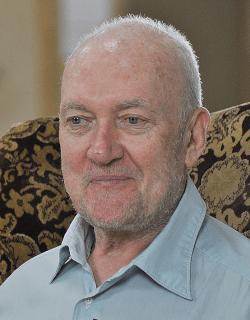
Sean Scully, Irish-born American-based artist working as a painter, printmaker, sculptor and photographer, is born in Dublin on June 30, 1945. His work is held in museum collections worldwide and he has twice been named a Turner Prize nominee.

Four years after his birth, Scully’s family moves to London where they live in a working-class part of South London, moving from lodging to lodging for a number of years. By the age of 9, he knows he wants to become an artist. From the age of 15 until he is 17, he is apprenticed at a commercial printing shop in London as a typesetter, an experience that greatly influences his future artwork.

Scully studies at Croydon School of Art between 1965-67 and at Newcastle University between 1967-71. He is awarded the Frank Knox Memorial Fellowship in 1972 to attend Harvard University. It is during this first stay in the United States that he begins to experiment with new techniques such as tape and spray paint. In 1975 he is awarded a Harkness Fellowship and establishes a studio in New York, where he settles, becoming an American citizen in 1983.

Over the years, Scully develops and refines his own recognisable style of geometric abstraction and most notably his characteristic motif of the ‘stripe.’ Although he is predominately known for his monumental paintings, he is also a gifted printmaker who has made a notable body of woodcuts and etchings.

Scully has his first solo exhibition at the Rowan Gallery, London in 1973. He has his first retrospective at the Ikon Gallery in Brindleyplace, Birmingham, in 1981, which travels throughout the United Kingdom. In 1989 his first solo exhibition in a European museum travels from the Whitechapel Gallery in London to Palacio Velázquez in Madrid and Städtische Galerie im Lenbachhaus in Munich. He has further solo exhibitions at Kunstsammlung Nordrhein Westfalen in Düsseldorf (2001) which travels to Haus der Kunst in Munich and the Institut Valencià d’Art Modern in Valencia; The Phillips Collection in Washington, D.C. (2005) travels to the Modern Art Museum of Fort Worth in Texas, the Cincinnati Art Museum in Ohio and finally the Metropolitan Museum of Art in New York City. A major retrospective tours multiple venues in China between 2015 and 2017.

Scully’s paintings and prints are held in the collections of Tate in London, the Albertina in Vienna, Museo Nacional Centro de Arte Reina Sofía in Madrid, Instituto Valencia d’Arte Modern in Valencia, the Metropolitan Museum of Art and the Solomon R. Guggenheim Museum in New York City, the National Gallery of Art in Washington D.C., Modern Art Museum of Fort Worth in Texas, Guangzhou Museum of Art in Guangzhou, China, and the Central Academy of Fine Arts in Beijing, China.

Scully has held teaching positions at Chelsea College of Arts and Goldsmith’s College of Art and Design, both in London, Princeton University in New Jersey, Parsons School of Design in New York, and most recently at the Akademie der Bildenden Künste in Munich. He is shortlisted for the Turner Prize in 1989 and in 1993, and is elected a Royal Academician in 2013. He participates for the first time at the Venice Biennale in 2014.

Sean Scully lives and works in New York and in Bavaria, Germany.


Leave a comment

Birth of Robert Gibbings, Wood Engraver & Sculptor

LEAD Technologies Inc. V1.01

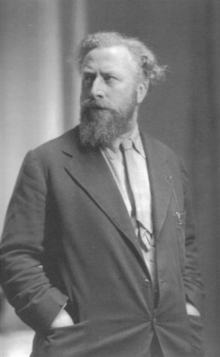
Robert John Gibbings, Irish artist and author most noted for his work as a wood engraver and sculptor, and for his books on travel and natural history, is born into a middle-class family in Cork, County Cork on March 23, 1889. Along with Noel Rooke he is one of the founder members of the Society of Wood Engravers in 1920 and is a major influence in the revival of wood engraving in the twentieth century.

Gibbings’ father, the Reverend Edward Gibbings, is a Church of Ireland minister. His mother, Caroline, is the daughter of Robert Day, Fellow of the Royal Society of Antiquaries of Ireland and president of The Cork Historical and Archaeological Society. He grows up in the town of Kinsale where his father is the rector of St. Multose Church.

Gibbings studies medicine for three years at University College Cork before deciding to persuade his parents to allow him to take up art. He studies under the painter Harry Scully in Cork and later at the Slade School of Fine Art and the Central School of Art and Design.

During World War I Gibbings serves in the Royal Munster Fusiliers and is wounded at Gallipoli before eventually being invalided out of the army in 1918. He then resumes his studies in London.

Gibbings is very much at the centre of developments in wood engraving. He is a founder member and leading light of the Society of Wood Engravers, which he sets up with Noel Rooke in 1920. In 1922 he contributes two wood engravings, “Clear Waters” and “Hamrun,” to Contemporary English Woodcuts, an anthology of wood engravings produced by Thomas Balston, a director at Gerald Duckworth & Company and an enthusiast for the new style of wood engravings. In 1923 he receives a commission for a set of wood engravings for The Lives of Gallant Ladies for the Golden Cockerel Press, his most important commission to date at 100 guineas.

Gibbings is working on the wood engravings The Lives of Gallant Ladies when Hal Taylor, the owner of the press, becomes very ill with tuberculosis and has to put it up for sale. He seeks a loan from a friend, Hubert Pike, a director of Bentley Motors, to buy the press. He takes over in February 1924 and owns and runs the press until 1933.

Gibbings illustrates numerous books on travel and natural history, including Charles Darwin’s The Voyage of the Beagle, and writes a series of bestselling river books, notably Sweet Thames Run Softly. He does a huge amount to popularise the subject of natural history, travelling extensively through Polynesia, Bermuda and the Red Sea to gather inspiration for his work.

Gibbings is the first man to draw underwater, the illustrations filling his Penguin classic Blue Angels and Whales. He is one of the first natural history presenters on the BBC.

In September 1955 Gibbings and his wife, Patience, purchase Footbridge Cottage, a tiny beehive of a cottage in Gibbings’s words, in Long Wittenham on the banks of the River Thames. Life there suits him, and he has a period of tranquility that he had not known previously. They live there until he dies of cancer in an Oxford hospital on January 19, 1958. He is buried in the churchyard at Long Wittenham. The grave is marked by a simple headstone featuring his device of a crossed quill and graver, carved by Michael Black, a young sculptor who is a friend of Gibbings.


Leave a comment

Birth of Sculptor Augustus Saint-Gaudens

augustus-saint-gaudens

Augustus Saint-Gaudens, sculptor of the statue for the Charles Stewart Parnell monument which is installed at the North end of Dublin‘s O’Connell Street in 1911, is born in Dublin on March 1, 1848. He is generally acknowledged to be the foremost American sculptor of the late 19th century, noted for his evocative memorial statues and for the subtle modeling of his low reliefs.

Saint-Gaudens is born to a French father and an Irish mother. His family moves to New York City when he is an infant and at age 13, he is apprenticed to a cameo cutter. He earns his living at this craft, while studying at night at Cooper Union (1861–65) and the National Academy of Design (1865–66) in New York. In 1867 he travels to Paris and is admitted to the École des Beaux-Arts. Along with Olin Levi Warner and Howard Roberts, he is one of the first Americans to study sculpture in Paris. Late in 1870 he sets out for Rome, where, still supporting himself by cameo cutting, he works for two years copying famous antique statues on commission. He also starts to create his first imaginative compositions during this period.

After 1875 Saint-Gaudens settles in New York, where he befriends and collaborates with a circle of men who form the nucleus of an American artistic renaissance. The group includes the architects Henry Hobson Richardson, Stanford White, and Charles Follen McKim and the painter John La Farge. The most important work of Saint-Gaudens’s early career is the monument to Admiral David Farragut (1880, Madison Square Garden, New York), the base of which is designed by White.

From 1880 to 1897 Saint-Gaudens executes most of the well-known works that gain him his great reputation and many honours. Working with La Farge, in 1881 he creates two caryatids for a fireplace in Cornelius Vanderbilt’s residence. In 1887 he begins the Amor Caritas, which, with variations, preoccupies him from about 1880 to 1898, and also a statue of a standing Abraham Lincoln (Lincoln Park, Chicago). The memorial to Marian Hooper Adams (1891) in Rock Creek Cemetery, Washington, D.C., is considered by many to be his greatest work. In 1897 he completes a monument in Boston depicting Robert Gould Shaw, colonel of an African American regiment in the American Civil War. The statue is remarkable for its expression of movement. Shortly thereafter, he leaves for Paris, where, over the next three years, he prepares his final major public sculpture, the Sherman Monument (1903), which is eventually erected in Grand Army Plaza in New York.

Saint-Gaudens also makes many medallions, originally as a diversion from more serious tasks. These works show the influence of Renaissance medals as well as his early cameos. Among them are designs for U.S. coins and a considerable number of portraits. His autobiography, The Reminiscences of Augustus Saint-Gaudens, is published in 1913.

Diagnosed with cancer in 1900, Saint-Gaudens dies at the age of 59 on August 3, 1907, in Cornish, New Hampshire.


Leave a comment

Birth of Sculptor Jerome Connor

jerome-connor

Jerome Connor, recognized world-class Irish sculptor, is born on February 23, 1874, in Coumduff, Annascaul, County Kerry.

In 1888, Connor emigrates to Holyoke, Massachusetts. His father is a stonemason, which leads to Connor’s jobs in New York as a sign painter, stonecutter, bronze founder and machinist. Inspired by his father’s work and his own experience, he would steal his father’s chisels as a child and carve figures into rocks.

It is believed Connor possibly assisted in the manufacture of bronzes such as the Civil War monument in Town Green in South Hadley, Massachusetts erected in 1896 and The Court of Neptune Fountain at the Library of Congress in Washington, D.C., completed in 1898.

Connor joins the Roycroft arts community in 1899 where he assists with blacksmithing and later starts creating terracotta busts and reliefs. Eventually he is recognized as Roycroft’s sculptor-in-residence.

After four years at Roycroft, Connor then works with Gustav Stickley and becomes well known as a sculptor being commissioned to create civic commissions in bronze for placement in Washington, D.C., Syracuse, East Aurora, New York, San Francisco, and in his native Ireland. In 1910, he establishes his own studio in Washington, D.C. From 1902 until his death, he produces scores of designs ranging from small portrait heads to relief panels to large civic commissions realized in bronze.

Connor is a self-taught artist who is highly regarded in the United States where most of his public works can be seen. He appears to be heavily influenced by the work of Irish American sculptor Augustus Saint-Gaudens. He uses the human figure to give expression to emotions, values and ideals. Many of the commissions he receives are for civic memorials and secular figures which he casts in bronze, a pronounced departure from the Irish tradition of stone carved, church sponsored works.

Connor’s best-known work is Nuns of the Battlefield located at the intersection of Rhode Island Avenue NW, M Street and Connecticut Avenue NW in Washington, D.C. It serves as a tribute to the over six hundred nuns who nursed soldiers of both armies during the American Civil War and is one of two monuments in the District that represent women’s roles in the Civil War. The sculpture is authorized by the United States Congress on March 29, 1918, with the agreement that the government will not fund it. The Ancient Order of Hibernians raises $50,000 for the project and Connor is selected since he focuses on Irish Catholic themes, being one himself. Connor, however, ends up suing the Order for nonpayment.

Connor works in the United States until 1925 at which time he moves to Dublin and opens his own studio but suffers from lack of financial support and patrons. In 1926 he is contacted by Roycroft and asked to design and cast a statue of Elbert Hubbard who, with his wife Alice, had died in the sinking of the RMS Lusitania. It is unveiled in 1930 and today stands on the lawn of East Aurora’s Middle School across the street from the Roycroft Chapel building.

While working on the Hubbard statue, Connor receives a commission to create a memorial for all the RMS Lusitania victims. It is to be erected in Cobh, County Cork where many of the victims are buried. The project is initiated by the New York Memorial Committee, headed by William Henry Vanderbilt whose father, Alfred Gwynne Vanderbilt, perished on the RMS Lusitania. He dies before the memorial is completed and based on Connor’s design its installation falls to another Irish artist.

Jerome Connor dies on August 21, 1943, of heart failure and reputably in poverty. There is a now a “Jerome Connor Place” in Dublin and around the corner there is a plaque in his honour on Infirmary Road, overlooking Dublin’s Phoenix Park, his favourite place.


Leave a comment

Birth of Sculptor John Hughes

john-hughes

John Hughes, Irish sculptor, is born in Dublin on January 30, 1865.

Hughes is educated at North Richmond Street CBS. He enters the Metropolitan School of Art in Dublin in 1878 and trains as a part-time student for ten years. In 1890 he wins a scholarship to the South Kensington School of Art in London, after which another scholarship takes him to Paris, France. He then studies further in Italy.

Hughes is appointed as teacher to the Metropolitan School of Art in Dublin in 1894 and in 1902 becomes Professor of Sculpture in the Royal Hibernian Academy School. His last residence in Dublin is at 28 Lennox Street, Portobello.

From 1903 Hughes lives in Italy and in France, dying in Nice in 1941.

Hughes’s influences are mainly from the Italian Renaissance and include:


Leave a comment

The Dublin Society Renamed Royal Dublin Society

royal-dublin-society

The Dublin Society for Improving Husbandry, Manufactures and Other Useful Arts, which is originally founded on June 25, 1731, becomes the Royal Dublin Society on June 19, 1820.

The society is founded by members of the Dublin Philosophical Society, chiefly Thomas Prior. On July 1, 1731, at the second meeting of the Society, the designation “and Sciences” is added to the end of its name. The Society’s broad agenda is to stimulate economic activity and aid the creation of employment in Ireland. For the first few years of its existence, the Dublin Society concentrates on tillage technology, land reclamation, forestry, the production of dyestuffs, flax cultivation and other agricultural areas.

In 1738, following the publication of his pamphlet entitled Reflections and Resolutions Proper for the Gentlemen of Ireland, Samuel Madden initiates a grant or “premium” scheme to create incentives for improvements in Irish agricultural and arts. He proposes that a fund of £500 be raised for this purpose and he personally contributes £130. By 1740 the premium scheme has raised £900 and is adjudicated upon the following January and awarded to enterprises in earthenware, cotton, leatherwork, flax, surveying, as well as a number of painters and sculptors.

In 1761 the Irish Parliament votes for £12,000 to be given to the Dublin Society for the promotion of agriculture, forestry, arts and manufactures. This funding is used to increase the amount of premiums distributed by the Dublin Society. Further funds are given by Parliament to the Dublin Society on a sporadic basis until 1784 when an annual parliamentary vote of £5,000 is put in place and remains so until the dissolution of Grattan’s Parliament in 1800.

The “Royal” prefix is adopted in 1820 when George IV becomes Society patron.

The society purchases Leinster House, home of the Duke of Leinster, in 1815 and founds a natural history museum there. The society acquires its current premises at Ballsbridge in 1879 and has since increased from the original fifteen to forty acres. The premises consist of a number of exhibition halls, a stadium, meeting rooms, bars, restaurants, and RDS Simmonscourt Pavilion, a multi-purpose venue.

The Boyle Medal, named after Robert Boyle (1627–1691), is inaugurated in 1899 and is awarded jointly by the RDS and The Irish Times for scientific research of exceptional merit in Ireland. As of 2014 the medal has been awarded to 39 scientists.