seamus dubhghaill

Promoting Irish Culture and History from Little Rock, Arkansas, USA


Leave a comment

Death of Rosie Hackett, Trade Union Leader & Insurgent

Rosanna “Rosie” Hackett, Irish insurgent and trade union leader, dies on May 4, 1976, at St. Vincent’s Hospital, Fairview, Dublin. She is a founder-member of the Irish Women Workers’ Union (IWWU) and supports strikers during the 1913 Dublin lock-out. She later becomes a member of the Irish Citizen Army and is involved in the 1916 Easter Rising. In the 1970s, the labour movement awards her a gold medal for decades of service, and in 2014 a Dublin city bridge is named in her memory.

Hackett is born into a working-class family in Dublin on July 25, 1893, the daughter of John Hackett, a hairdresser, and Roseanna Dunne. According to the 1901 census, she is living with her widowed mother and five other family members in a tenement building on Bolton Street in Dublin. The available documents suggest that her father dies when she is still very young. She joins the Irish Transport and General Workers’ Union (ITGWU) when it is established in 1909 by James Larkin, which marks the beginning of her lifelong activity in trade unionism. By 1911 she is living with her family in a cottage on Old Abbey Street, and her mother has remarried to Patrick Gray.

Hackett fights for many decades for the rights of workers. Through her affiliation and work with the ITGWU, the IWWU and the Irish Citizen Army, she helps carve out and secure modern-day working conditions. Her career begins as a packer in a paper store, then becoming a messenger for Jacob’s biscuits. At that time the working conditions in the factory are poor.

On August 22, 1911, Hackett helps organise the withdrawal of women’s labour in Jacob’s factory to support their male colleagues who are already on strike. With the women’s help, the men secure better working conditions and a pay rise. Two weeks later, at the age of eighteen, she co-founds the IWWU with Delia Larkin. During the 1913 lock-out she helps mobilise the Jacob’s workers to come out in solidarity with other workers. They, in turn, are locked out by their own employers. This does not stop her work to help others, and she, along with several of her IWWU colleagues, set up soup kitchens in Liberty Hall to help feed the strikers. However, in 1914 her Jacob’s employers sack her over her role in the lock-out.

Hackett begins work as a clerk in the printshop in Liberty Hall, and it is here she becomes involved with the Irish Citizen Army. She is involved in preparations for the 1916 Rising, working in a union shop, helping with printers, and making first-aid kits and knap-sacks.

If other members of the ITGWU were looking for James Connolly, Hackett aids in bringing them to him. She “worked as canvasser and traveler and was called on to carry out many confidential jobs.”

Hackett takes up first aid training provided by Dr. Kathleen Lynn for six months before the Rising and attends night marches organised by the Irish Citizen Army. According to her own account, she says, “A week before Easter, I took part in the ceremony of hoisting the challenge flag over Hall.” Like other girls and women who are involved in the Rising, she carries messages and guns and prepares uniforms and food for Irish Republican Army (IRA) members “and sometimes risky work.”

Three weeks before the Easter Rising, the Royal Irish Constabulary (RIC) raid a shop where Hackett is working. She is alone when they come, and they are looking for a copy of “Gael.” She says to them, “wait until I get the head” and she calls for Connolly. The police are stopped by Connolly and Helena Molony who are armed, and Hackett immediately hides everything, so that when the police come back, they cannot get anything.

Through her experience of working in the printshop, Hackett helps to print the Proclamation of the Irish Republic. She is in the printing room in Liberty Hall as a trusted messenger in 1916 when the Proclamation is printed, and it is the first time she is allowed in. Three men are there when she enters the room and one comes over to her, shakes her hand and congratulates her. It makes her very proud, especially since no one else is allowed to get in. She subsequently tells family members of handing it still wet to James Connolly before it is read by Patrick Pearse outside the entrance to the General Post Office (GPO).

Hackett is an active member of the Irish Citizen Army. On Easter Tuesday, under the command of Constance Markievicz, she takes part in the 1916 Rising and is located in the area of St. Stephen’s Green and the Royal College of Surgeons in Ireland. This position is heavily attacked with guns, short of first aid and “looked like a death trap.” However, after moving from an initially overlooked position in St. Stephen’s Green, it is one of the last positions to surrender. In the Royal College, as a first-aid practitioner, she is allowed entry to the lecture room sanctioned to the Red Cross only. Another first-aider, Aider Nora O’Daily, later reports that during those days, “I have a very kind remembrance of Little Rosie Hackett of the Citizen Army, always cheerful and always willing; to see her face about the place was a tonic itself.”

After surrendering, the rebels are taken to Dublin Castle. Hackett is imprisoned in Kilmainham Gaol for ten days.

In 1917, on the anniversary of Connolly’s death, Hackett, together with Helena Molony, Jennie Shanahan and Brigid Davis, print and hang a poster detailing the anniversary. After the first poster displayed by the ITGWU members is taken down by the police, they work to ensure that their poster will stay on Liberty Hall much longer by staying on top of the roof to defend it. They barricade the door using a ton of coal and nails on the windows. The poster is hanging there until 6:00 p.m. and thousands of people can see it.

After the Rising, Hackett returns to the IWWU which, at its strongest, organises over 70,000 women. After the 1945 laundry strike, they win an extra week of paid holidays for the workers. She attends many important labour union events such as the opening of the new Liberty Hall on May 2, 1965, and Arbour Hill memorial services. Until her retirement, she runs the trade union shops resulting in over five decades of active participation in the Irish trades union movement work to improve conditions for Irish workers. In 1970 she is awarded a gold medal for fifty years of ITGWU membership.

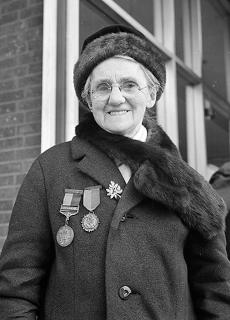
In the 1970s, Walter McFarlane, then branch secretary of the ITGWU, awards an honorary badge for Hackett’s fifty years contribution to the union.

Hackett never marries and lives in Fairview, Dublin, with her brother Tommy until her death on May 4, 1976. She is buried at St. Paul’s plot in Glasnevin Cemetery next to her mother and stepfather. At her burial, she is honoured with a military salute and her coffin is covered with the Irish flag. After her passing, her legacy is remembered in the union’s newspaper, a tale of the strife of Hackett together with the rest of Dublin’s working class, for which she fought to change.

In May 2014, the Rosie Hackett Bridge is officially opened by the Lord Mayor of Dublin. The Hackett Bridge Campaign began in October 2012, led by three women Angelina Cox, an active member of Labour Youth, Jeni Gartland and Lisa Connell. The final shortlist of contending names for the new bridge were Rosie Hackett, Kathleen Mills, Willie Bermingham, Bram Stoker and Frank Duff.

In April 2015, a plaque is unveiled on Foley Street by the North Inner City Folklore Project to commemorate the women of the Irish Citizen Army. The plaque lists Hackett as a member of the St. Stephen’s Green/College of Surgeons garrison during the 1916 Easter Rising.
Leave a comment

Birth of Patrick Hennessy, Irish Realist Painter

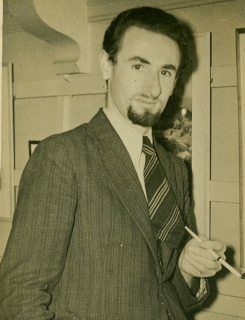
Patrick Anthony Hennessy RHA, Irish realist painter known for his highly finished still lifes, landscapes and trompe-l’œil paintings, is born in Cork, County Cork, on August 28, 1915. The hallmark of his style is his carefully observed realism and his highly finished surfaces, the result of a virtuoso painting technique.

Hennessy is the son of John Hennessy an army sergeant major from County Kerry and Bridget Hennessy from Cork. His father is killed in World War I at the Battle of Passchendaele in 1917. In 1921, when he is five years old, his mother remarries in Cork. Her second husband is a Scot named John Duncan and shortly afterwards the whole family moves to Arbroath, Scotland, where Duncan has relatives.

Hennessy is educated in Arbroath at St. Thomas RC Primary School followed by secondary education at Arbroath High School, where he begins to show an aptitude for art, leaving in 1933 with the Dux for Art and an accompanying medal. In the autumn of 1933 he enrolls at the Dundee of Jordanstone College of Art & Design, for a four-year Diploma course in Drawing and Painting under James McIntosh Patrick and Edward Baird. Here he meets Harry Robertson Craig who becomes his lifelong companion. He plays a full part in the social activities of the college, winning a fancy-dress award at the Christmas revels in 1935 and producing a ballet “Paradise Lost” the following year. He gains a First-Class Pass in each year of the course along with winning first prize in 1934 and 1936 for work done during the summer vacation. He graduates with a First-Class Distinction in 1937.

Having gained a scholarship, Hennessy continues his studies at the Dundee of Jordanstone College of Art & Design for a further year by doing a Post-Graduate Diploma course in Drawing and Painting. Within a month of gaining his Post-Graduate Diploma he holds his first joint exhibition at the Art Galleries in Arbroath. In June 1938 he is awarded the Annual Travelling Scholarship for further studies in Paris and Italy. In Paris he meets up with the artists Robert Colquhoun and Robert MacBryde, whom he had met the previous year, the three travelling south together to Marseilles towards the end of that year. On his return to Scotland he is selected for the residential summer school course at Hospitalfield House near Arbroath under James Cowie. Two of his paintings, a still life and a self-portrait, are accepted that year by the Royal Scottish Academy for their Annual Exhibition. However, by the autumn of 1939 with war looming and feeling somewhat disenchanted on his return to Scotland, he decides to return to Ireland.

On arrival in Dublin Hennessy is offered an exhibition in December 1939 at the Country Shop on St. Stephen’s Green which is opened by Mainie Jellett. This attracts favourable attention. During the early 1940s he lives at various addresses in and around Dublin with frequent trips to Cork. In 1940 he is invited to join the Society of Dublin Painters and holds regular annual exhibitions of his work there during the 1940s and early 1950s. These exhibitions are supplemented by an eclectic mix of commissions, mostly portraits which he undertakes during this period. In 1941 he has three of his paintings accepted by the Royal Hibernian Academy (RHA) for their annual exhibition. This is the beginning of a long relationship with the RHA. He exhibits there virtually every year from 1941 until 1979, the year before his death.

From the early 1940s onwards, Hennessey’s work sometimes incorporates a homosexual visual subtext. He re-unites with Harry Robertson Craig in 1946 and soon after they move to Crosshaven, County Cork, and later to Cobh. In 1947, Time magazine selects him as one of Ireland’s outstanding painters, in recognition of the important position he has then attained in the art world. In 1948 he has an exhibition at the Victor Waddington Gallery, Dublin, and that same year is elected an associate of the Royal Hibernian Academy and a full member the following year. In 1950 his painting De Profundis is selected for the Contemporary Irish Painting exhibition that tours North America. As a result of this tour, the American public and critics begin to take notice of his work. In 1951 he visits Italy, taking in Venice and Sicily and returning to Dublin with many of his canvases painted abroad. One of these paintings, Bronze Horses of St. Marks, is exhibited at the Royal Academy of Arts in London in 1954.

In 1956, a friend of Hennessy, David Hendriks, opens the Ritchie Hendriks Gallery on St. Stephen’s Green, Dublin and it is this gallery that is to be the main outlet for his work over the following 22 years. In October 1956 the Thomas Agnew Gallery in London holds an exhibition of his work comprising 38 of his paintings. However, during the winter of 1959 he becomes seriously ill with pneumonia. As a consequence of this, in the autumn of that year he and Craig decide to winter in Morocco. This is the beginning of a new era in both their lives. They would never again spend a full year in Ireland. His exhibitions at the Ritchie Hendriks Gallery had for many years enjoyed favourable reviews from the art critics but in the 1960s this changes with critics claiming his paintings to be dull, repetitive and suggest he needs to explore new areas. Despite the barrage of criticism, in 1965 the Guildhall Gallery in Chicago offers him a major exhibition. Shortly after this exhibition takes place in 1966, he becomes one of the artists on permanent display at the gallery with an annual exhibition. The North American market is extremely lucrative for him and by the end of the decade he is selling more of his work in the United States than in Ireland. In 1968 he finally moves to Tangier, Morocco on a permanent basis and in 1970 sells his studio on Raglan Lane, Dublin.

In Morocco, Hennessy paints prolifically for nine years to keep up with demand from the Hendriks Gallery and Guildhall Gallery along with the RHA. In 1975 the Guildhall Gallery mounts a highly successful Retrospective of his work. In 1978 he has his last exhibition in Dublin at the Hendriks Gallery. By this time he has moved to the Algarve, Portugal and is beginning to have health problems.

In November 1980, with his health deteriorating, Craig brings Hennessy to a hospital in London for treatment. However, on December 30, 1980 he dies from cancer. Following cremation his ashes are buried in nearby Golders Green Crematorium. He leaves his entire estate to Harry Robertson Craig with the proviso that on Craig’s death the Royal Hibernian Academy should be the beneficiary. This legacy has been used to set up the annual Hennessy Craig Scholarship for aspiring artists.

Hennessy falls into the category of painter who develops a distinctive personal style, labelled at various times in his life as a Traditional Realist, Romantic, Photo Realist, Illusionary and Surrealist. However, he always remains intrinsically himself. His subjects range from still life and interiors to landscapes and portraits.

Examples of Hennessy’s work can be found in the public collections of the Crawford Art Gallery, the Dublin City Gallery The Hugh Lane, the Irish Museum of Modern Art (IMMA), the Limerick City Gallery of Art (LCGA), the National Gallery of Ireland (NGI), the National Self-Portrait Collection of Ireland (NSPCI) at the University of Limerick (UL), and in the collections of University College Cork (UCC) and University College Dublin (UCD).


Leave a comment

Birth of Rosie Hackett, Trade Union Leader & Insurgent

Rosanna “Rosie” Hackett, Irish insurgent and trade union leader, is born into a working-class family in Dublin on July 25, 1893. She is a founder-member of the Irish Women Workers’ Union (IWWU) and supports strikers during the 1913 Dublin lock-out. She later becomes a member of the Irish Citizen Army and is involved in the 1916 Easter Rising. In the 1970s, the labour movement awards her a gold medal for decades of service, and in 2014 a Dublin city bridge is named in her memory.

Hackett is the daughter of John Hackett, a hairdresser, and Roseanna Dunne. According to the 1901 census, she is living with her widowed mother and five other family members in a tenement building on Bolton Street in Dublin. The available documents suggest that her father dies when she is still very young. She joins the Irish Transport and General Workers’ Union (ITGWU) when it is established in 1909 by James Larkin, which marks the beginning of her lifelong activity in trade unionism. By 1911 she is living with her family in a cottage on Old Abbey Street, and her mother has remarried to Patrick Gray.

Hackett fights for many decades for the rights of workers. Through her affiliation and work with the ITGWU, the IWWU and the Irish Citizen Army, she helps carve out and secure modern-day working conditions. Her career begins as a packer in a paper store, then becoming a messenger for Jacob’s biscuits. At that time the working conditions in the factory are poor.

On August 22, 1911, Hackett helps organise the withdrawal of women’s labour in Jacob’s factory to support their male colleagues who are already on strike. With the women’s help, the men secure better working conditions and a pay rise. Two weeks later, at the age of eighteen, she co-founds the IWWU with Delia Larkin. During the 1913 lock-out she helps mobilise the Jacob’s workers to come out in solidarity with other workers. They, in turn, are locked out by their own employers. This does not stop her work to help others, and she, along with several of her IWWU colleagues, set up soup kitchens in Liberty Hall to help feed the strikers. However, in 1914 her Jacob’s employers sack her over her role in the lock-out.

Hackett begins work as a clerk in the printshop in Liberty Hall, and it is here she becomes involved with the Irish Citizen Army. She is involved in preparations for the 1916 Rising, working in a union shop, helping with printers, and making first-aid kits and knap-sacks.

If other members of the ITGWU were looking for James Connolly, Hackett aids in bringing them to him. She “worked as canvasser and traveller and was called on to carry out many confidential jobs.”

Hackett takes up first aid training provided by Dr. Kathleen Lynn for six months before the Rising and attends night marches organised by the Irish Citizen Army. According to her own account, she says, “A week before Easter, I took part in the ceremony of hoisting the challenge flag over Hall.” Like other girls and women who are involved in the Rising, she carries messages and guns and prepares uniforms and food for Irish Republican Army (IRA) members “and sometimes risky work.”

Three weeks before the Easter Rising, the Royal Irish Constabulary (RIC) raid a shop where Hackett is working. She is alone when they come, and they are looking for a copy of “Gael.” She says to them, “wait until I get the head” and she calls for Connolly. The police are stopped by Connolly and Helena Molony who are armed, and Hackett immediately hides everything, so that when the police come back, they cannot get anything.

Through her experience of working in the printshop, Hackett helps to print the Proclamation of the Irish Republic. She is in the printing room in Liberty Hall as a trusted messenger in 1916 when the Proclamation is printed, and it is the first time she is allowed in. Three men are there when she enters the room and one comes over to her, shakes her hand and congratulates her. It makes her very proud, especially since no one else is allowed to get in. She subsequently tells family members of handing it still wet to James Connolly before it is read by Patrick Pearse outside the entrance to the General Post Office (GPO).

Hackett is an active member of the Irish Citizen Army. On Easter Tuesday, under the command of Constance Markievicz, she takes part in the 1916 Rising and is located in the area of St. Stephen’s Green and the Royal College of Surgeons in Ireland. This position is heavily attacked with guns, short of first aid and “looked like a death trap.” However, after moving from an initially overlooked position in St. Stephen’s Green, it is one of the last positions to surrender. In the Royal College, as a first-aid practitioner, she is allowed entry to the lecture room sanctioned to the Red Cross only. Another first-aider, Aider Nora O’Daily, later reports that during those days, “I have a very kind remembrance of Little Rosie Hackett of the Citizen Army, always cheerful and always willing; to see her face about the place was a tonic itself.”

After surrendering, the rebels are taken to Dublin Castle. Hackett is imprisoned in Kilmainham Gaol for ten days.

In 1917, on the anniversary of Connolly’s death, Hackett, together with Helena Molony, Jennie Shanahan and Brigid Davis, print and hang a poster detailing the anniversary. After the first poster displayed by the ITGWU members is taken down by the police, they work to ensure that their poster will stay on Liberty Hall much longer by staying on top of the roof to defend it. They barricade the door using a ton of coal and nails on the windows. The poster is hanging there until 6:00 p.m. and thousands of people can see it.

After the Rising, Hackett returns to the IWWU which, at its strongest, organises over 70,000 women. After the 1945 laundry strike, they win an extra week of paid holidays for the workers. She attends many important labour union events such as the opening of the new Liberty Hall on May 2, 1965, and Arbour Hill memorial services. Until her retirement, she runs the trade union shops resulting in over five decades of active participation in the Irish trades union movement work to improve conditions for Irish workers. In 1970 she is awarded a gold medal for fifty years of ITGWU membership.

In the 1970s, Walter McFarlane, then branch secretary of the ITGWU, awards an honorary badge for Hackett’s fifty years contribution to the union.

Hackett never marries and lives in Fairview, Dublin, with her brother Tommy until her death on July 4, 1976. She is buried at St. Paul’s plot in Glasnevin Cemetery next to her mother and stepfather. At her burial, she is honoured with a military salute and her coffin is covered with the Irish flag. After her passing, her legacy is remembered in the union’s newspaper, a tale of the strife of Hackett together with the rest of Dublin’s working class, for which she fought to change.

In May 2014, the Rosie Hackett Bridge is officially opened by the Lord Mayor of Dublin. The Hackett Bridge Campaign began in October 2012, led by three women Angelina Cox, an active member of Labour Youth, Jeni Gartland and Lisa Connell. The final shortlist of contending names for the new bridge were Rosie Hackett, Kathleen Mills, Willie Bermingham, Bram Stoker and Frank Duff.

In April 2015, a plaque is unveiled on Foley Street by the North Inner City Folklore Project to commemorate the women of the Irish Citizen Army. The plaque lists Hackett as a member of the St. Stephens Green/College of Surgeons garrison during the 1916 Easter Rising.


Leave a comment

Death of Gerard Dillon, Painter and Artist

Gerard Dillon, Irish painter and artist, dies following a second stroke on June 14, 1971.

Dillon is born in Belfast in 1915 or 1916. He leaves school at the age of fourteen and for seven years works as a painter and decorator, mostly in London. From an early age he is interested in art, cinema, and theatre. About 1936 he starts out as an artist.

Dillon’s Connemara landscapes provide the viewer with context, portraits of the characters who work the land, atmosphere and idiosyncratic colour interpretations. At the age of 18, Dillon goes to London, initially working as a decorator. With the outbreak of World War II, he returns to Belfast. Over the next five years he develops as a painter in Dublin and Belfast. His works during this period are more than simple depictions of the life and people around him, they are reactions and interactions in paint.

In 1942, Dillon’s first solo exhibition is opened by his friend and fellow artist, Mainie Jellett, at The Country Shop, St. Stephen’s Green, Dublin. “Father, Forgive Them Their Sins” features depicting his concerns about the new war that had broken out. Despite a growing reputation, he has to return to London in 1944 to work on demolition gangs to restore his finances. In the late 1940s and during the 1950s, he finds himself favouring the town of Roundstone, Connemara. In 1951 he is introduced to Noreen Rice by her piano teacher. She has no formal training and she takes Dillon and George Campbell as her mentors for decades and her work is of a similar surrealistic and primitive style.

In 1958, Dillon has the double honour of representing Ireland at the Guggenheim International, and Great Britain at the Pittsburg International Exhibition. He and his sister, Mollie, have a property on Abbey Road in 1958. They let out part of the house to Arthur Armstrong and they let a flat to Noreen Rice and her brother. He and Noreen tour junk yards to find objects like leather and string that they include in their artwork.

Dillon travels widely in Europe and teaches for brief periods in the London art schools.

In 1967, Dillon suffers a stroke and spends six weeks in hospital. From this time his work changes direction. A notion of imminent death sends his work almost into another world, a realm of dreams and paintings intimating his death. In 1968 he is back in Dublin, where he helps to design sets and costumes for Seán O’Casey‘s play Juno and the Paycock. He continues to paint and also to make tapestries, sitting at his Singer sewing machine.

In 1969, Dillon pulls his artworks from the Belfast leg of the Irish Exhibition of Living Art in purported protest during the Troubles against the “arrogance of the Unionist mob.” However, he does send work to Ulster when he donates work to Sheelagh Flanagan who had organised an exhibition for the relief of victims of the Belfast riots, in October 1969. His picture is hanged alongside the donated works of T. P. Flanagan, William Scott, F. E. McWilliam, Deborah Brown and Carolyn Mulholland as well as more than twenty others. Michael Longley retorts in a further letter, “Belfast needed creativity, it needed people like Gerard Dillon.” During his last years, he is invited to be involved in a children’s art workshop in the National Gallery of Ireland.

Dillon dies of a second stroke at the age of 55 on June 14, 1971. His grave, as requested, is unmarked in Belfast’s Milltown Cemetery. Danlann Gerard Dillon/The Gerard Dillon Gallery in Cultúrlann McAdam Ó Fiaich is named in his honour.

In his biography of the artist, James White briefly touches on the artists homosexuality: “such was his religious feeling that although he was drawn to people of that type, if he once had an encounter I believe that it never occurred again.” The artist’s nephew, Martin Dillon, recalls that after his uncle’s death he found a diary entry describing a homosexual encounter with a sense of guilt, but the author Gerard Keenan insists he was “a very well-adjusted homosexual.” Reihill expands on this, pointing to a probably unrequited love for the painter Daniel O’Neill and also highlighted Dillon’s association with Basil Rákóczi and The White Stag Group‘s Kenneth Hall both strong gay connections. Pictures with both overt and covert references are known.

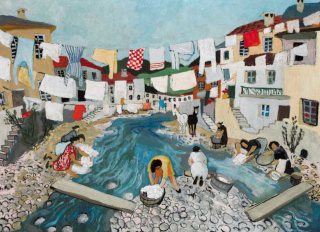
(Pictured: “Washing Day” by Gerard Dillon)


Leave a comment

Birth of Patrick Campbell, 3rd Baron Glenavy

Patrick Gordon Campbell, 3rd Baron Glenavy, Irish journalist, humorist and television personality, is born in Dublin on June 6, 1913. He writes sixteen books, including Life in Thin Slices, Rough Husbandry, and How to Become a Scratch Golfer.

Campbell is the first son of Charles Campbell, 2nd Baron Glenavy, and Beatrice, Lady Glenavy (the artist Beatrice Elvery). He is educated Crawley’s preparatory school (St. Stephen’s Green, Dublin), Castle Park preparatory school (Dalkey), Rossall School (Lancashire), and, briefly, Pembroke College, Oxford. He leaves Oxford without completing his degree. In 1935, he is taken on by The Irish Times by R. M. “Bertie” Smyllie and reports on “Courts Day by Day.” During World War II, he serves as a chief petty officer in the Irish Marine Service. After the war he re-joins The Irish Times, using the pseudonym “Quidnunc,” and is given charge of the column “Irishman’s Diary.” He has a weekly column for the Irish edition of the Sunday Dispatch before working on the paper in London from 1947 to 1949. He is assistant editor of Lilliput from 1947 to 1953. His writings also appear in The Sunday Times.

Campbell’s books, mostly collections of humorous pieces that were originally published in newspapers and magazines, include A Long Drink of Cold Water (1949), A Short Trot with a Cultured Mind (1950), An Irishman’s Diary (1950), Life in Thin Slices (1951), Patrick Campbell’s Omnibus (1954), Come Here Till I Tell You (1960), Constantly in Pursuit (1962), How to Become a Scratch Golfer (1963), Brewing Up in the Basement (1963), Rough Husbandry (1965), The P-P-Penguin Patrick Campbell (1965), All Ways on Sundays (1966), A Bunch of New Roses (1967), an autobiography My Life and Easy Times (1967), The Coarse of Events (1968), Gullible Travels (1969), The High Speed Gasworks (1970), Waving All Excuses (1971), Patrick Campbell’s Golfing Book (1972), Fat Tuesday Tails (1972), 35 Years on the Job (1973), and The Campbell Companion (1987). Many of his books are illustrated by Quentin Blake.

Campbell is married three times, first in 1941 to Sylvia Alfreda Willoughby Lee, whom he divorces in 1947. He then marries Chery Louise Munro in 1947. The two divorce in 1966, the year he marries Vivienne Orme.

Campbell speaks with a stammer, but nevertheless delights television audiences with his wit, notably as a regular team captain on the long-running show Call My Bluff, opposite his longtime friend, Frank Muir. Muir notes that “When he was locked solid by a troublesome initial letter he would show his frustration by banging his knee and muttering ‘Come along! Come along!'” Some of his funniest short stories describe incidents involving his stammer. He stands six feet five inches tall, and several of his funniest pieces deal with the problems faced by a man of his build in merely finding shoes or clothes that fit him. He also makes regular appearances in That Was The Week That Was.

Campbell lives for many years in the South of France, commuting to England for his television work and continuing to produce his weekly column in The Sunday Times, which he drops in 1978.

In 1972 a period of illness leads to the discovery that Campbell had suffered an undetected heart attack some years previously and has a permanent heart weakness. An attack of viral pneumonia in 1980 exacerbates this condition, and he dies suddenly on November 9, 1980 while talking to a nurse at University College Hospital, London. He is succeeded as the 4th and last Lord Glenavy by his novelist brother Michael.


Leave a comment

Birth of Shelah Richards, Actress, Manager, Director & Producer

Shelah Geraldine Richards, Irish actress, manager, director and producer, is born in Dublin on May 23, 1903.

Richards is born to John William Richards, a lawyer, and Adelaide Roper, suffragist who had chained herself to the railings in St. Stephen’s Green. She goes to school at Alexandra College, Dublin, and after that she attends a finishing school in Paris. Though her family is not in the arts, her godmother is Beatrice Elvery. Shes attends Elvery’s salons with her parents as a child. She meets W. B. Yeats when she is sixteen. Her niece, Geraldine Fitzgerald, daughter of her sister, Edith Catherine Richards, is also one of Ireland’s pre-eminent actresses.

Richards’s acting career starts while attending the Dublin drama league and she is asked at short notice to replace Eileen Crowe in Juno and the Paycock, playing the role of Mary Boyle in the Abbey Theatre production. Richards gets the role of Nora Clithero in the 1926 production of The Plough and the Stars, Seán O’Casey‘s next production. This role means that she ends up with police protection for the duration of the run due to the disturbances the play engenders. Another important role is to take on playing the lead in The Player Queen by Yeats. Maire O’Neill had previously made the role her own and Yeats had let no one perform the part since then so taking on such a challenge is intimidating. Richards continues to take on leading roles with the Abbey Theatre but in 1926 she also begins to direct.

On December 28, 1928, Richards marries playwright Denis Johnston in St. Anne’s Church in Dublin. She tours the United States with the Abbey players in 1932 and with the Irish Players in the mid 1930s. A role in 1938 in Molly Keane‘s Spring Meeting starring Gladys Cooper and A. E. Matthews takes her to Broadway in New York City. War in Europe breaks out while the run is still going on and Richards is advised to stay in the United States. However, by then she has two children, producer Micheal and novelist Jennifer Johnston, so she returns to Dublin. There she runs her own theater company at the Olympia Theatre with Nigel Heseltine. Her marriage to Johnston, broken in 1938, ends with divorce in February 1945.

Richards next challenge is to take over the Abbey School of Acting. During her time there one of the designers she works with is Louis le Brocquy. With Siobhán McKenna she produces The Playboy of the Western World in Edinburgh to huge success allowing her to stage it in London and Dublin and later in Toronto‘s Library Theater. She brings Marcel Marceau to Dublin for the first time. She continues to act and has some film roles.

In 1961 Ireland launches its first television service, Raidió Teilifís Éireann. Richards is one of the first producers, recommended to the station by Hilton Edwards. She is one of the few women in the new station. The first Irish play produced during the opening week is directed by her and she is nominated for a Best Actress award in another production, Inquiry at Lisieux. She works as producer on a wide number of programs for the station including documentaries, soap operas and religious programming. Both Tolka Row and The Riordans are produced by her as well as Denis Johnston’s The Moon on the Yellow River, George Bernard Shaw‘s Arms and the Man and John Millington Synge‘s Riders to the Sea.

Richards retires from her RTÉ career in the early 1970s though she continues to raise funds for the Gate Theatre through the Edwards–MacLiammóir Playhouse Society. In 1983, for her 80th birthday, the Abbey puts on a party for her which includes a special rendition of “Nora” from The Plough and the Stars. Richards is the last living member of the original 1926 cast. The song is repeated at her funeral in 1985. She died in Ballybrack, County Dublin, on January 19, 1985. Her funeral is held in St. Anne’s Church in Dublin and she is cremated in Glasnevin Cemetery.


Leave a comment

First Exhibition of the Society of Dublin Painters

The first exhibition of the Society of Dublin Painters or Dublin Painters Group takes place at its premises at 7 St. Stephen’s Green on August 5, 1920. The Society is formed to promote Irish modern art.

The Society of Dublin Painters is founded in 1920 by Paul and Grace Henry, Mary Swanzy, Letitia Marion Hamilton, Jack B. Yeats, and Harry Clarke. As the original meeting notes have been lost, there is some uncertainty as to which artists are there at the inaugural meeting. Along with these potential founding members, Clare Marsh, E.M. O’Rorke Dickey, and James Sleator are featured in the first exhibition. The Society’s first exhibition runs until September 1 and attracts good reviews. Yeats, Marsh, and Paul Henry are all signatories to the lease of this premises. The group seeks to bring modernism to Ireland, and provide a freer, less academic space for artistic expression and experimentation less focused on accuracy and realism. Its foundation is seen as providing an alternative public exhibition space to the more conservative Royal Hibernian Academy (RHA), which does not favour exhibiting Irish modern art. At its 1923 exhibition, Mary Swanzy exhibits one of her earliest cubist paintings, Decoration. The membership always has a large proportion of women.

The Society holds annual exhibitions and one-person shows at its premises on St. Stephen’s Green. Unlike the Royal Hibernian Academy, the Society does not mandate a particular style of painting for inclusion in its exhibitions, with the only limitation on the number of paintings an artist can submit. The members are free to submit paintings to other exhibitions such as the Royal Hibernian Academy, The White Stag Group and Irish Exhibition of Living Art. Membership is limited, with just ten members initially, rising to twelve in 1932, and eighteen in 1934 owing to limited exhibition and studio space. By 1943, the Society is being overtaken by exhibitions like the Irish Exhibition of Living Art and is no longer seen as the premier outlet for avant-garde Irish art. After a decline in membership, the Society ceases to exist by the early 1960s.

(Pictured: “The Post Car” by Jack B. Yeats displayed at the first exhibition, Adam’s Auctioneers of Dublin)


Leave a comment

Éamon de Valera Visits Butte, Montana During His American Tour

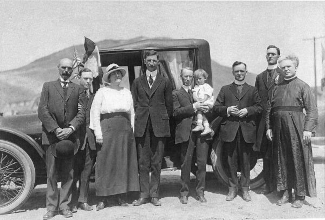
President Éamon de Valera visits Butte, Montana, on July 25, 1919, during his American Tour of 1919-20. Montana Lieutenant Governor W. W. McDowell meets his train and rides with de Valera through the streets to where de Valera then addresses over 10,000 people who have come out to hear him. The next day, de Valera addresses a joint session of the Montana State Legislature.

De Valera’s eventful 1919 begins in Lincoln Jail and ends in New York City’s Waldorf Astoria, the largest and most luxurious hotel in the world. Smuggled aboard the SS Lapland in Liverpool in June, he sails for the United States during the closing stages of the Paris Peace Conference. As London’s Sunday Express complains in August 1919, “there is more Irish blood in America than in Ireland,” making the United States the obvious destination for a sustained propaganda and fundraising mission.

After his highly-publicised American debut at New York’s Waldorf Astoria, the self-styled “President of the Irish Republic” embarks on the first leg of what is to be an eighteen-month tour of the United States. The purpose of his mission is twofold: to gain formal recognition of the Irish Republic and to raise funds via a bond issue to support the independence movement and the newly established Dáil Éireann.

Between July and August 1919, de Valera and his entourage travel over 6,000 miles from New York to San Francisco, addressing enormous crowds at dozens of venues. He fills Madison Square Garden to capacity and receives a thirty-minute standing ovation from 25,000 people in Chicago’s Wrigley Field. Twice as many people fill Boston’s Fenway Park on June 29, cheering the arrival of the “Irish Lincoln.” The Sinn Féin envoys also visit less obvious Irish communities of the period, such as Scranton, Savannah, New Orleans and Kansas City. For de Valera’s personal secretary, Seán Nunan, the public meeting in Butte, Montana is like “an election meeting at home – there were so many first-generation Irishmen working on the mines – mainly from around Allihies in West Cork.” In San Francisco de Valera dedicates a statue of Robert Emmet by Irish-born sculptor Jerome Connor in Golden Gate Park, a replica of which stands sentinel in St. Stephen’s Green in Dublin. This is one of many symbolic gestures linking the American and Irish struggles for independence played out before the flashing bulbs of the ubiquitous press photographers. On August 15, The Cork Examiner notes that the enthusiastic American exchanges “indicate that few public missionaries from other lands – possibly only Mr. Parnell – have ever had such receptions as were accorded to the Sinn Féin leader.”

De Valera’s team deserves credit for the incredible logistical triumph that is the U.S. tour. As chief organiser, Liam Mellows travels ahead to each city, ensuring a suitable reception is prepared and a venue secured for a mass meeting. Seán Nunan is de Valera’s fastidious personal secretary and Harry Boland, Sinn Féin TD for South Roscommon and Irish Republican Brotherhood (IRB) envoy, is at his side troubleshooting, speechmaking and shaking hands. As the tour progresses, de Valera’s supporting cast expands to include Kerry-born Kathleen O’Connell who becomes de Valera’s full-time personal secretary from 1919.

The next stage of de Valera’s American odyssey begins on October 1, 1919, in Philadelphia, a city with a rich Irish heritage and rife with symbolism of America’s struggle for independence. Over the next three weeks, de Valera and his team travel from the Atlantic to the Pacific seaboard and back again, delivering seventeen major public speeches and a host of smaller ones to aggregate crowds of over half a million.

The pace is relentless as the Irish team makes its way through middle America. De Valera is received as a visiting dignitary at multiple state legislatures and presented with honorary degrees from six American universities. In line with his secondary objective to foster the interest of “wealthy men of the race in the industrial development of Ireland,” he addresses the Chambers of Commerce in a number of cities and arranges a personal meeting with Henry Ford, the son of an Irish emigrant, during his visit to Detroit in October. In the same month in Wisconsin, he is made a Chief of the Chippewa Nation, an honour he later says meant more to him than all the freedoms of all the cites he was ever given. It is not surprising that by the time they reach Denver on October 30, The Irish World reports that “the President looked tired.” Still, he musters the energy to make high profile visits to Portland, Los Angeles and San Diego before beginning the return journey to New York at the end of November.

After a short break for Christmas, the Irish team prepares for the launch of the Bond Certificate Drive. A week-long frenzy of publicity kicks off on January 17 at New York City Hall where Mayor John F. Hylan presents de Valera with the Freedom of the City. During the spring of 1920, de Valera addresses the Maryland General Assembly at Annapolis before making the swing through the southern states of America.

It is not all plain sailing for the Sinn Féin representatives in America. The tour of the west coast in late 1919 sees increasing tensions with American patriotic bodies who are critical of de Valera’s perceived pro-German stance during World War I. He is heckled during a speech in Seattle and a tricolour is ripped from his car in Portland by members of the American Legion. The trip through the southern states in the spring of 1920 coincides with rising American anti-immigration and anti-Catholic nativism. A small number of counter demonstrations are organised by right-wing Americans. Most notably, members of the Ku Klux Klan make unwelcome appearances at several rallies in the American south, making clear their opposition to de Valera’s presence.

The Irish envoys also contend with antagonism from the leaders of Friends of Irish Freedom (FOIF), the broad-based popular front of Clan na Gael headed by veteran Fenian John Devoy and Judge Daniel Cohalan. The FOIF uses its significant resources to finance de Valera’s tour and facilitate the Bond Certificate Drive, but behind the scenes there are significant personality clashes and tensions over tactics.

The increasingly public dispute comes to a head in a row over strategies at the Republican National Convention in Chicago in June 1920. Drawing on his influential political contacts, Cohalan persuades the Republican Party to include Irish self-determination in their election platform. However, much to Cohalan’s fury, de Valera leads a separate delegation to the Convention and insists on a resolution calling for recognition of the Irish Republic. The result is that two resolutions are submitted to the Platform Committee, which indicates dissension in the Irish ranks and gives the Committee the excuse to include neither in the final platform. After de Valera also fails to secure the endorsement of the Democratic convention in San Francisco in June, it is clear that the Irish question will not be a significant factor in the ensuing presidential election. Relations between the FOIF and de Valera reach a new low. In November 1920, de Valera makes the final break with the FOIF and sets up a new organisation, the American Association for the Recognition of the Irish Republic.

De Valera is in Washington, D.C. on October 25 when Terence MacSwiney dies after 74 days on hunger strike. Six days later, at the last great meeting of the American tour, 40,000 people fill New York’s Polo Grounds to commemorate MacSwiney’s death. By late November, de Valera knows that it is time to return to Ireland. Smuggled aboard SS Celtic in New York harbour on December 10, he prepares for the nine-day journey home. He had failed to obtain the recognition of the United States Government for the Republic, but his cross-continental tour and associated press coverage raised international awareness and over $5 million for the Irish cause.

(From: An article by Helene O’Keeffe that was first published in the Irish Examiner on March 24, 2020 | Photo: Eamon de Valera, center, president of the Provisional Government of the Irish Republic, in Butte, Montana, in 1919 to encourage support for Ireland’s fight for independence. Courtesy of Butte-Silver Bow Public Archives)


2 Comments

Death of Nelly O’Brien, Miniaturist, Artist & Activist

Ellen Lucy or Nelly O’Brien, Irish miniaturist, landscape artist, and Gaelic League activist, dies suddenly on April 1, 1925, while visiting her brother Dermod at 66 Elm Park Gardens, London.

O’Brien is born Ellen Lucy O’Brien on June 4, 1864, at Cahirmoyle, County Limerick. She is the eldest child of Edward William O’Brien and Mary O’Brien (née Spring Rice). Her siblings are Lucy and Dermod, with Dermod also becoming an artist. Her father is a landowner, and her mother is a sculptor and painter and sister of Thomas Spring Rice. Her grandfather is William Smith O’Brien.

While a young child, O’Brien spends two years living on the French Riviera from 1866 to 1868. Her mother later dies of tuberculosis, and the three children are raised by their aunt, the writer and nationalist, Charlotte Grace O’Brien. Their father remarries in 1880, to Julia Marshall, with whom he has two sons and two daughters.

O’Brien attends school in England from 1879, and later enrolls to study painting at the Slade School of Fine Art. She meets Walter Osborne through her brother Dermod, and considers herself engaged to him, but Osborne dies on April 24, 1903. A portrait of O’Brien by Osborne is held in the Hugh Lane Gallery.

O’Brien returns to Ireland and begins to paint miniatures on ivory using a magnifying glass. She also paints watercolour landscapes. Her first exhibition with the Royal Hibernian Academy (RHA) is in 1896, where she shows three works including Sketch near Malahide. She exhibits with the RHA on and off until 1922. During some of her time in Dublin, she lives with her half-brother, Edward Conor Marshall O’Brien, on Mount Street.

As part of an exhibition of Irish painters, O’Brien exhibits a number of portrait miniatures at the London Guildhall in 1904. The 1906 Oireachtas na Gaeilge features a number of her paintings, and in the same year she becomes honorary secretary of a newly established art committee. At the MunsterConnacht exhibition in Limerick of 1906, she exhibits a miniature of William Smith O’Brien amongst her 12 works on show. She produces many portraits, including one of Douglas Hyde, which is exhibited by the RHA in 1916.

O’Brien is an early member of the Gaelic League, being present at its first Oireachtas na Gaeilge in 1897 and founding the Craobh na gCúig gCúigí (Branch of the Five Provinces). In 1905, she writes a long letter in defence of Douglas Hyde and the Gaelic League in The Church of Ireland Gazette. She holds meetings of Craobh na gCúig gCúigí in her flat at 7 St. Stephen’s Green every Saturday night in 1907. In 1911, she founds Coláiste Eoghain Uí Chomhraí (O’Curry Irish College) in Carrigaholt, County Clare, which is named in honour of Eugene O’Curry, with the help of her cousin and friend Mary Spring Rice.

One of her ultimate goals is to create a national Irish church, which would unite Protestants and Catholics through the Irish language. To this end, she establishes the Irish Guild of the Church with Seoirse de Rút in 1914. The aim of the organisation is to provide a communal union for members of the Church of Ireland who are dedicated to “Irish Ireland” ideals.

Acting as a representative for the Gaelic League, she travels to the United States with Fionan MacColuim in 1914 to 1915, to fund raise and promote Irish art and industries. At Coláiste Eoghain Uí Chomhraí, she stresses the importance of the Irish language in the home, as well as the skills of housewives and those in domestic service in strengthening the language and Irish culture.

O’Brien notes that she initially thought that the 1916 Easter Rising was “in the nature a demonstration against conscription as it had been announced that the volunteers would resist disarmament.” She is staying with the Hydes at 1 Earlsfort Place during the Rising, as her flat at College Park Chambers had been destroyed. She protests the conscription bill in Ireland as a mass meeting of women at the Mansion House in 1918. She launches the Gaelic Churchman in 1919 as the official publication of the Irish Guild of the Church. In one article entitled A plea for the Irish services, she promotes her campaign for Irish language services in Protestant churches. In her capacity of vice-president of the guild, she invites Éamon de Valera to attend one of their meetings in 1921.

O’Brien dies suddenly on April 1, 1925, while visiting Dermod at 66 Elm Park Gardens, London. She is buried at the family plot in Cahirmoyle.

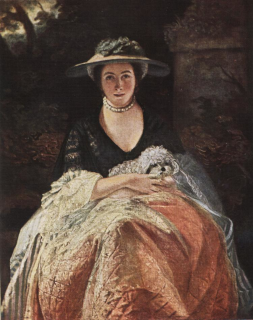
(Pictured: Nelly O’Brien by Sir Joshua Reynolds, 1723-1792)


Leave a comment

Michael Collins Letter Fetches Record Price at Auction

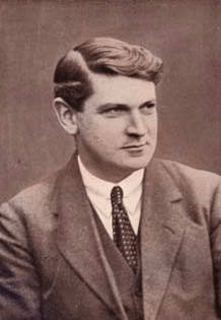
On February 21, 2003, a letter signed by Irish revolutionary leader Michael Collins, written in 1922 upon his return from London, fetches a record price of €28,000 at an auction at James Adam & Sons Ltd. on Dublin’s St. Stephen’s Green. Estimated to fetch up to €8,000.00, despite fierce bidding by the National Library of Ireland, the letter is purchased by singer Enya’s manager, Mickey Ryan, who says he wants the letter to remain in Ireland.

The letter is a three-page document sent by Collins to prominent Derry republican Louis J. Walsh in 1922, telling him about his opposition to the Northern Ireland border. Replying to a letter from Walsh, he outlines his position regarding negotiations with Winston Churchill and unionist leader James Craig.

The letter is written after Collins returns to Dublin from a meeting in London with Churchill and Craig. He states in the letter that Craig’s stance on partition is seen as “an unreasonable one and not ours.”

“All the British statesmen are agreed that it was most disastrous on Craig’s part to talk about agreeing to nothing less than the six county area,” Collins writes.

Collins expresses his belief that ties would increase between leaders in the north and south, leading to a united Ireland in the long term. He tells Walsh that he is “no lover of partition, no matter what form it appears,” and that any form of partition is “distasteful” to him. “It would be far better to fix our minds for a time on a united Ireland, for this course will not leave minorities which would be impossible to govern,” he writes. He also says he hopes that one day a multi-denominational party might be formed in the north east, developing links with the Free State and destabilising the northern administration.