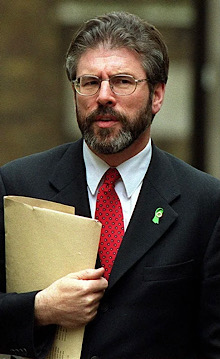
With a report due on Monday, January 31, and widely expected to state that the IRA is not ready to disarm, the Northern Ireland peace process appears headed for a fresh crisis. The report by Canadian Gen. John de Chastelain, head of the province’s independent commission overseeing the handing in of weapons, is expected to confirm that no arms have been turned in.
The Ireland on Sunday newspaper says de Chastelain will tell the British and Irish governments that the IRA has put most of its weapons into secret, sealed dumps in the Republic of Ireland. Such disclosures put enormous pressure on Adams, the leader of the Irish republican political party, Sinn Féin.
The UUP, the province’s main Protestant political group, has already threatened to pull out of Northern Ireland‘s fledgling power-sharing government if the IRA does not start disarming.
The UUP calls a top-level party meeting for February 12. A negative report from the decommissioning body will heighten fears that UUP leader David Trimble will make good on his threat to resign as leader of the new government, effectively allowing his party to shut down the province’s first government in 25 years.
Of Adams’s role in the disarmament process, Trimble says, “He asked us to create the circumstances to help him … we did that … we took the risk and created the situation he asked us to create. “Now we hope he now is able to demonstrate his good faith by responding.”
Adams says, “I am concerned at what appears to be an attempt by unionists to hijack the entire process, put up unilateral demands, perhaps in the course of that, tear down the institutions that are only two months in being. I understand why unionists want decommissioning. It is just not within my grasp to deliver it on their terms, and neither is it my responsibility.”
Adams says he can give no assurances that the IRA will hand over its weapons by May 22, the date set by the 1998 Good Friday Agreement for the completion of disarmament, although he stresses he is committed to decommissioning. “No, I can’t and it isn’t up to me,” Adams tells BBC Television when asked if he can guarantee disarmament by May.
Political insiders hint that the report will not be published until Monday (January 31) afternoon, suggesting the highly sensitive document is still being worked on by de Chastelain.
Any unionist pullout from the home-rule government on February 12 will create a political vacuum. Britain may intervene before that to suspend the fledgling executive, in the hope that it can be resurrected quickly if progress eventually is made on disarmament. Sinn Féin warns that either course of action could lead to the IRA breaking off contact with de Chastelain and the ending of disarmament prospects.
Meanwhile, on the eve of the report, thousands of Roman Catholics mark an event and day that symbolizes the province’s past troubles — Bloody Sunday.
Waving Irish flags, some 5,000 protesters retrace the steps of a civil rights march in Londonderry in 1972 that ended in bloodshed when British troops fired on unarmed protesters and killed thirteen people, mostly teenagers. A fourteenth man died later from his wounds. Victims’ relatives and local children carry fourteen white crosses, photos of the dead and a banner that reads, “Bloody Sunday, the day innocence died.” The march passes the scene of the killings and ends in front of Londonderry’s city hall — a spot where the 1972 march was supposed to have finished.
Organizers issue a message to British Prime MinisterTony Blair that they want a forthcoming inquiry not to end in the same way as a probe held within months of the killings, which exonerated the British soldiers by suggesting that some of the victims had handled weapons that day. “Twenty-eight years on from Bloody Sunday, there is still no recognition of the role the British government played in the premeditated attack on unarmed demonstrators,” Barbara de Brun, a top IRA official, tells the crowd.
Relatives of those killed are upset that soldiers who took part in the shootings would be allowed to remain anonymous during the new probe. They are also concerned about a newspaper report that the army recently destroyed thirteen of the rifles used by the soldiers, complicating any ballistics tests at the inquiry.
“Once again, the political and military establishment are up to their old tricks. We won’t accept a public relations exercise,” Alana Burke, who was injured by an armored car during the Bloody Sunday march, tells the crowd.
(From: “Hopes dim for IRA disarmament, peace accord” by Nic Robertson and Reuters, CNN, cnn.com, January 30, 2000)
The Traditional Unionist Voice (TUV), a unionistpolitical party in Northern Ireland, is founded on December 7, 2007, by Jim Allister after he and others had resigned from the Democratic Unionist Party (DUP) in March of that year. In common with all other Northern Irish unionist parties, the TUV’s political programme has as its sine qua non the preservation of Northern Ireland’s place within the United Kingdom. A founding precept of the party is that “nothing which is morally wrong can be politically right.”
Prior to the St. Andrews Agreement, the DUP presents itself as an “anti-Agreement” unionist party opposed to numerous aspects of the Good Friday Agreement, e.g., the release of paramilitary prisoners before the end of their jail sentences, and the participation of Sinn Féin in the Northern Ireland government without complete decommissioning of Provisional Irish Republican Army (IRA) weapons and cessation of all IRA activity. The TUV has been an exception among Northern Irish unionist parties in consistently opposing the presence of Sinn Féin in the Northern Ireland government. After Allister’s resignation from the DUP, he continues to occupy his European Parliament seat, sitting as an Independent MEP until the 2009 European Parliament election in the United Kingdom, when he is not re-elected.
In terms of electoral success and financial income, Traditional Unionist Voice is the third largest unionist party in Northern Ireland, behind the Democratic Unionist Party and the Ulster Unionist Party (UUP). It is usually considered by political commentators to be a small party and characterised as being more hardline than other Northern Irish unionist parties.
Since 2011, the TUV has occupied one seat in the Northern Ireland Assembly. In 2024, they win their first seat in the United Kingdom House of Commons. The party also holds some seats on local councils in Northern Ireland. Its most prominent elected representative and best-known figure remains Jim Allister whose North Antrim constituency is the heartland of the party.
In March 2024, the party forms an electoral pact with Reform UK, stating that the two parties will stand mutually agreed candidates in Northern Ireland constituencies in the 2024 United Kingdom general election. In this election, the party wins its first Westminster Member of Parliament (MP), electing Jim Allister as MP for North Antrim.
An opinion poll, released by LucidTalk in August 2025, shows the TUV as the third most popular party for the first time, coming ahead of both the Alliance Party and Ulster Unionists, with 13%.
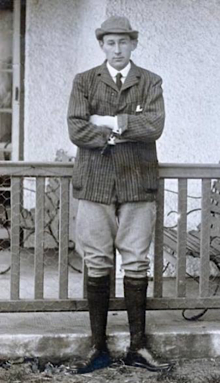
Babington is called to the Irish Bar in 1900. He briefly lectures in Equity at King’s Inns, and it is during this time, in 1910, that he re-arranges and re-writes R.E. Osborne’s Jurisdiction and Practice of County Courts in Ireland in Equity and Probate Matters. He takes silk in 1917.
In 1947, Babington chairs the Babington Agricultural Enquiry Committee, named in his honour, which is established in 1943 to examine agriculture in Northern Ireland. The committee’s first recommendation under Babington’s leadership is that Northern Ireland should direct all its energies to the production of livestock and livestock products and to their efficient processing and marketing.
Babington retires from the judiciary in 1949, taking up the chairmanship of the Northern Ireland Transport Tribunal, which exists until 1967, established under the Ulster Transport Act – promoting a car-centred transport policy – and which is largely responsible for the closure of the Belfast and County Down Railway. He endorses the closure on financial grounds and is at cross purposes with his co-chair, Dr. James Beddy, who advises against the closure, citing the disruption of life in the border region between the north and the south as his primary reason in addition to financial grounds.
Babington also chairs a government inquiry into the licensing of clubs, the proceeds of which results in new regulatory legislation at Stormont. While Attorney General, he is a proponent of renaming Northern Ireland as “Ulster.”
Babington is critical of the newly proposed Irish constitution, in which the name of the Irish state is changed to “Ireland,” laying claim to jurisdiction over Northern Ireland.
Michael McDunphy, Secretary to the President of Ireland, then Douglas Hyde, recalls Ernest Alton‘s correspondence with Babington on the question of Irish unity, in which Alton and Babington are revealed to be at cross purposes. The discussion is used as an example by Brian Murphy, in Forgotten Patriot: Douglas Hyde and the Foundation of the Irish Presidency, as an example of the office of the Irish President becoming embroiled in an initiative involving Trinity College Dublin and a senior Northern Ireland legal figure, namely Babington.
Babington writes to Alton, then Provost of Trinity College, Dublin, expressing his view that, as Murphy summarises, “… Severance between the two parts of Ireland could not continue, that it was the duty of all Irishmen to work for early unification and that in his opinion Trinity College was a very appropriate place in which the first move should be made.” When Alton arrives to meet with Hyde, it emerges, after conversing with Hyde’s secretary McDunphy, that he and Babington are at cross purposes. “It soon became clear that the united Ireland contemplated by Mr. [sic] Justice Babington of the Northern Ireland Judiciary was one within the framework of the British Commonwealth of Nations, involving recognition of the King of England as the Supreme Head, or as Dr. Alton put it, the symbol of unity of the whole system,” writes McDunphy.
Babington is a keen golfer. He is an international golfer from 1903 to 1913, during which he is runner-up in the Irish Amateur Golf Championships in 1909 and one of the Irish representatives at an international match in 1913. The Babington Room in the Royal Portrush Golf Club is named after him, as is the 18th hole on the course as a result of the key role he plays in shaping its history.
Babington dies at the age of 94 on April 10, 1972 at his home, Creevagh, Portrush, County Antrim.
The gunmen, who are wearing workmen’s overalls, escape in a car afterward, killing Ken Campbell, a caretaker, as they leave. The people with whom Bradford had been meeting, most of them elderly, dive under tables for cover, and dozens of teenagers dancing nearby break into hysterical tears, but there are no injuries.
The killing is part of an escalation of IRA violence, both in London and in Northern Ireland, after the collapse of the prison hunger strike the previous month. The previous night an IRA bomb damages the London home of Britain’s Attorney General for Northern Ireland, Michael Havers. The home is empty and no one is seriously injured.
Bradford, a 40-year-old Methodist minister who is married and has a 6-year-old daughter, is shot several times, according to witnesses, and he dies almost immediately. His brother, Roy, who lives near the scene of the killing, in South Belfast, is at his side within moments. “But he was unconscious when I reached him, and he only lived for about a minute,” Roy Bradford says. News of the killing arouses fears of a Protestant reaction that could lead to serious civil unrest in Northern Ireland.
John “Jack” Hermon, the Chief Constable of the Royal Ulster Constabulary, issues an appeal to both the Protestant majority and the Roman Catholics to show “good sense and restraint.” He says security is being tightened in the province as a precautionary measure. He orders a wide-ranging search for the gunmen, who number at least three and possibly four, a point upon which the witnesses differ.
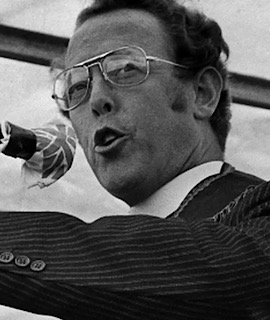
Bradford, who has been in Parliament since 1974, is an outspoken critic of the Irish nationalist guerrillas. He repeatedly calls for the reimposition of capital punishment in the province and for other strong deterrent measures.
With the Rev. Ian Paisley, another hard-line Member of Parliament, Bradford had planned to visit the United States In early 1982 to counteract the publicity of the IRA, which depends heavily on the money it receives from its American sympathizers. “There is a need for Americans to recognize that Ulster is not an occupied country,” Bradford says the previous month, “and that our political history is one of which we can be proud.”
The IRA, in a statement claiming responsibility for the killing, calls Bradford “one of the key people responsible for winding up the loyalistparamilitarysectarian machine in the North.” All twelve of Northern Ireland’s Members of Parliament – ten Protestants and two Catholics – are considered likely targets in the sectarian struggle that has claimed 2,100 lives in the province since 1969.
O’Callaghan is born into a family with a Fenianparamilitary history. His paternal grandfather had taken the Anti-Treaty side during the Irish Civil War, and his father had been interned by the Irish Government at the Curragh Camp in County Kildare for IRA activity during World War II.
By the late 1960s, O’Callaghan ceases to practise his Catholic faith, adopts atheism and has become interested in the theories of Marxist revolutionary politics, which finds an outlet of practical expression in the sectarian social unrest in Northern Ireland at the time, centered on the activities of the Northern Ireland Civil Rights Association. In 1969, communal violence breaks out in Northern Ireland and believing that British imperialism is responsible, he joins the newly founded Provisional IRA at the age of 17.
Soon afterward, O’Callaghan is arrested by local Gardaí after he accidentally detonates a small amount of explosives, which cause damage to the homes of his parents and their neighbours. After demanding, and receiving, treatment as a political prisoner, he quietly serves his sentence.
After becoming a full-time paramilitary with the IRA, in the early to mid-1970s O’Callaghan takes part in over seventy operations associated with Irish Republican political violence including bomb materials manufacture, attacks on IRA targets in Northern Ireland, and robberies to provide funding for the organisation.
In 1976, O’Callaghan ends his involvement with the IRA after becoming disillusioned with its activities. He later recalls that his disenchantment with the IRA began when one of his compatriots openly hoped that a female police officer who had been blown up by an IRA bomb had been pregnant so they could get “two for the price of one.” He is also concerned with what he perceives as an undercurrent of ethnic hatred in its rank and file toward the Ulster Scots population. He leaves Ireland and moves to London. In May 1978, he marries a Scottish woman of Protestantunionist descent. During the late 1970s, he runs a successful mobile cleaning business. However, he is unable to fully settle into his new life, later recalling, “In truth there seemed to be no escaping from Ireland. At the strangest of times I would find myself reliving the events of my years in the IRA. As the years went on, I came to believe that the Provisional IRA was the greatest enemy of democracy and decency in Ireland.”
In 1979, O’Callaghan is approached by the IRA seeking to recruit him again for its paramilitary campaign. In response, he decides to turncoat against the organisation and becomes an agent within its ranks for the Irish Government. He decides to become a double agent even though he knows that even those who hate the IRA as much as he now does have a low opinion of informers. However, he feels it is the only way to stop the IRA from luring teenagers into their ranks and training them to kill.
Soon after being approached by the IRA to re-join, O’Callaghan returns to Tralee from London, where he arranges a clandestine meeting with an officer of the Garda Special Detective Unit in a local cemetery, at which he expresses his willingness to work with it to subvert the IRA from within. At this point, he is still opposed to working with the British Government. A few weeks later, he makes contact with Kerry IRA leader Martin Ferris and attends his first IRA meeting since 1975. Immediately afterward, he telephones his Garda contact and says, “We’re in”.
During the 1981 hunger strike in the Maze Prison, O’Callaghan attempts to start his own hunger strike in support of the Maze prisoners but is told to desist by the IRA for fear it will detract focus from the prisoners. He successfully sabotages the efforts of republicans in Kerry from staging hunger strikes of their own.
In 1984, O’Callaghan notifies the Garda of an attempt to smuggle seven tons of AK-47assault rifles from the United States to Ireland aboard a fishing trawler named Valhalla. The guns are intended for the arsenal of the Provisional IRA’s units. As a result of his warning, a combined force of the Irish Navy and Gardaí intercept the boat that received the weaponry, and the guns are seized. The seizure marks the complete end of any major attempt by the IRA to smuggle guns out of the United States.
In 1983, O’Callaghan claims to be tasked by the IRA with placing 25 lbs. of Frangex in the Dominion Theatre in London, in an attempt to kill Prince Charles and Princess Diana who are due to attend a charity pop music concert there. A warning is phoned into the Garda, and the Royal couple are hurriedly ushered from the theatre by their police bodyguard during the concert. The theatre had been searched before the concert and a second search following the warning reveals no device.
In 1985, O’Callaghan is elected as a Sinn Féin councillor for Tralee Urban District Council, and unsuccessfully contests a seat on Kerry County Council.
After becoming disillusioned with his work with the Irish Government following the murder of another of its agents within the IRA, which it had failed to prevent despite O’Callaghan’s warnings of the threat to him, and sensing a growing threat to himself from the organisation which had become suspicious of his own behaviour, he withdraws from the IRA and leaves Ireland to live in England, taking his wife and children with him. His marriage ends in a divorce in 1987, and on November 29, 1988, he walks into a police station in Tunbridge Wells, Kent, England, where he presents himself to the officer on duty at the desk, confesses to the murder of Ulster Defence Regiment (UDR) Greenfinch (female member) Eva Martin and the murder of D.I. Peter Flanagan during the mid-1970s, and voluntarily surrenders to British prosecution.
Although the Royal Ulster Constabulary (RUC) offers him witness protection as part of the informer policy, O’Callaghan refuses it and is prosecuted under charges of two murders and 40 other crimes, to all of which he pleads guilty, committed in British jurisdiction with the IRA. Having been found guilty, he is sentenced to a total of 539 years in prison. He serves his sentence in prisons in Northern Ireland and England. While in jail, he publishes his story in The Sunday Times. He is released after being granted the royal prerogative of mercy by Queen Elizabeth II in 1996.
In 1998, O’Callaghan publishes an autobiographical account of his experiences in Irish Republican paramilitarism, entitled The Informer: The True Life Story of One Man’s War on Terrorism (1998).
In 2002, O’Callaghan is admitted to Nightingale Hospital, Marylebone, an addiction and rehab center where he undergoes a rehabilitation program for alcohol dependency. His identity and past activities are not revealed to the other patients. He lives relatively openly in London for the rest of his life, refusing to adopt a new identity. He is befriended in the city by the Irish writer Ruth Dudley Edwards, and works as a security consultant, and also occasional advisor to the Ulster Unionist Party (UUP) on how to handle Irish republicanism in general, and Sinn Féin in particular.
In 2006, O’Callaghan appears in a London court with regard to an aggravated robbery that occurs in which he is the victim.
In 2015, O’Callaghan publishes James Connolly: My Search for the Man, the Myth & his Legacy (2015), a book containing a critique of the early 20th century Irish revolutionary James Connolly, and what he considers to be his destructive legacy in Ireland’s contemporary politics.
O’Callaghan dies by drowning after suffering a heart attack at the age of 63 while in a swimming pool in Kingston, Jamaica, on August 23, 2017, while visiting his daughter. A memorial service is held in his memory on March 21, 2018, at St. Martin’s-in-the-Fields, a Church of England parish church at the northeast corner of Trafalgar Square in the City of Westminster, London. The service is attended by representatives from Ulster Unionist parties and the Irish Government.
Discontented with James Chichester-Clark and Brian Faulkner who come to government after O’Neill’s 1969 fall from power, Boal resigns from the UUP in 1971 and joins Ian Paisley in establishing the Democratic Unionist Party (DUP) in order to provide dissident unionist opinion with a viable political alternative. He works as the first chairman and one of the first public representatives of the DUP and continues to sit in Stormont during the years of 1971–1972. He later resumes his practice as a barrister.
While Boal’s interest in federalism diminishes after the 1970s, the federalist Boal scheme of January 1974 is again put forward by liberal protestants such as John Robb as late as 2007. His friendship with Paisley finally breaks when the DUP agrees to enter government with Sinn Féin in 2007. He tells Paisley, who takes the breach very hard, that he had betrayed everything he ever advocated.
Kilfedder leaves the UUP in 1977 in opposition to the party’s policies tending to integrationism, preferring to advocate the restoration of the Stormont administration. For a time he sits as an “Independent Ulster Unionist.” He contests the 1979 European Parliament election under that label, finishing fourth in the count for the three seats, having overtaken the UUP leader Harry West on transfers.
On March 20, 1995, while traveling by train into London from Gatwick Airport, Kilfedder dies of a heart attack. This is the same day that the Belfast Telegraph carries a front-page story saying that an Ulster MP has been targeted as one of twenty MPs invited by the LGBT rights organisation OutRage! in a letter to come out. He dies unmarried and is survived by two sisters.
MacDermott is born in Belfast on April 12, 1896, the third surviving son and sixth of seven children of the Reverend John MacDermott DD, a Presbyterian clergyman who is minister of Belmont and moderator of the Presbyterian Church in Ireland, and of his wife Lydia Allen MacDermott (née Wilson), the daughter of a Strabane solicitor. He is educated at Campbell College, Belfast, from where he wins a scholarship to read Law at the Queen’s University Belfast (QUB) in 1914.
Eight years later MacDermott is appointed to determine industrial assurance disputes in Northern Ireland, and in 1931 becomes a lecturer in Jurisprudence at Queen’s University Belfast, teaching for four years.
In 1940, MacDermott is appointed Minister of Public Security in the Government of Northern Ireland, and the following year becomes the Attorney General for Northern Ireland. He is succeeded in this post by William Lowry, whose son, Lord Lowry, would eventually succeed MacDermott as Lord Chief Justice. In 1944, he resigns his parliamentary seat on appointment as a High Court Judge for Northern Ireland, and three years later, on April 23, 1947, is made a Lord of Appeal in Ordinary, becoming a life peer as Baron MacDermott, of Belmont in the city of Belfast.
MacDermott returns from the House of Lords to take up his appointment as Lord Chief Justice of Northern Ireland. His successors to the latter office become Law Lords subsequently. Whilst Lord Chief Justice, he is affectionately known as “the Baron.”
In 1977, aged over eighty, MacDermott offers to redeliver a lecture at the Ulster College, which had been interrupted by a bomb meant for him and which had severely wounded him.
Having been made a Northern Ireland Privy Counsellor seven years earlier, MacDermott is sworn of the British Privy Council in 1947.
Four years later, in 1951, MacDermott is appointed Lord Chief Justice of Northern Ireland, a post he holds for twenty years. He is also Pro-Chancellor of his alma mater from 1951 to 1969. In 1958, he chairs the commission on the Isle of ManConstitution. He dies at his home in Belfast on July 13, 1979.
In 1926, MacDermott weds Louise Palmer Johnston, later Lady MacDermott. Their son, Sir John MacDermott, is also sworn into the British Privy Council in 1987, as a Lord Justice of Appeal in Northern Ireland. He later became a Surveillance Commissioner for Northern Ireland.
Perceval-Maxwell is born in 1870, the only son of John Perceval-Maxwell, eldest son of Robert Perceval-Maxwell DL (1813–1905), of Finnebrogue House, Downpatrick, County Down.
Perceval-Maxwell is educated at Eton College. He plays a significant part in the raising of the 36th (Ulster) Division on the outbreak of World War I. He is commissioned Major in the 13th (County Down) Battalion, Royal Irish Rifles, which he had raised, in September 1914, and is appointed second-in-command in December 1914. He is promoted to the temporary rank of Lieutenant-Colonel and commands a battalion from November 1916 and commands a battalion of the Royal Munster Fusiliers from May 1918. He is seriously wounded during the war. He resigns his commission in January 1919.
He is appointed to the Privy Council of Ireland in the honours for the opening of the Parliament of Northern Ireland in July 1921, entitling him to the style “The Right Honourable.” He serves in the Northern Ireland Senate from 1921 to 1925.
In 1895, Perceval-Maxwell marries Edith Grace Head. They have five sons: John Robert Perceval-Maxwell (born 1896), Richard Henry (born 1897, killed in action in 1916), Patrick Edward (born 1900), Brian Stephen (born 1908), and David (born 1911).
Perceval-Maxwell dies at the age of 62 on May 24, 1932, in a Belfast nursing home. He is buried in Inch Parish Churchyard, Downpatrick.
Ford stands unsuccessfully for Antrim Borough Council in 1989 and enters politics full-time when he becomes general secretary of the Alliance Party. In that role, he is best known as a strong supporter of the then-leader John Alderdice and an advocate of better political organisation and community politics. He is elected to Antrim Borough Council in 1993, 1997 and – after leaving the Council in 2001 to concentrate on Assembly business – again in 2005.
In 2001, Seán Neeson resigns from the Party leadership following poor election results. Ford wins the leadership election on October 6 by 86 votes to 45, ahead of Eileen Bell.
Ford gives Alliance a stability which it has lacked since the departure of John Alderdice, but the Party has declined seriously in the late 1990s and all he can do is stabilise the situation. Within a month of taking over the leadership, however, he has a chance to establish Alliance’s relevancy in the post-Good Friday Agreement environment. On November 6, 2001, the Northern Ireland Executive is to be re-established. Due to defections within his own Ulster Unionist Party (UUP), First MinisterDavid Trimble has insufficient support within the Unionist bloc in the Assembly to be re-elected to his post. Ford and two of his five colleagues re-designate as Unionist for just 22 minutes in order to secure Trimble’s position and thereby enable the devolved institutions to operate for another year. However, Alliance fails to make any political gains from their move, and the UUP and Sinn Féin fail to reach agreement on the decommissioning issue, ensuring that the institutions collapse again in October 2002.
In the 2003 Northern Ireland Assembly election, Ford’s seat in the Assembly is perceived to be under severe threat from Sinn Féin’s Martin Meehan, with many commentators expecting him to lose it. However, his expertise in nuts-and-bolts electioneering stands him in good stead. Although Alliance’s vote almost halved, his own vote in South Antrim increases from 8.6% to 9.1%. Meehan’s vote increases dramatically, from 7.3% to 11.5%, and he starts the election count ahead. Ford has much greater transfer appeal and finishes 180 votes ahead of Meehan at the end of a dramatic three-way fight for the last two seats, with Thomas Burns of the Social Democratic and Labour Party (SDLP) just 14 votes ahead of Ford. Despite the dramatic fall in vote, Alliance holds on to its six seats in the Assembly, which remains suspended.
In 2004, Ford makes good his leadership election pledge to work with other parties, as Alliance joins with the Workers’ Party, Northern Ireland Conservatives and elements of the Northern Ireland Women’s Coalition to support Independent candidate John Gilliland in the European elections, achieving the best result for the centre ground for 25 years.
Ford’s greatest triumph comes in the 2007 Northern Ireland Assembly election, when the party achieves its highest vote share since Alderdice’s departure and picks up a seat in what is an otherwise poor election for the moderates. Despite media predictions once again of his demise, Ford himself is elected third in South Antrim, with over 13% of the poll.
On April 12, 2010, Ford is chosen by the Assembly to become Northern Ireland’s first Justice Minister in 38 years. He is supported in the Assembly by the Democratic Unionist Party (DUP), Sinn Féin, the Alliance Party, the Green Party and the Progressive Unionist Party (PUP). Separate candidates for the position are put forward by both the UUP and the SDLP, being Danny Kennedy and Alban Maginness respectively.
Ford announces his resignation as Leader in October 2016 on the fifteenth anniversary of his election as leader noting, “The team is working well, and I think it’s an appropriate time to hand over to a new leader who will lead the party forward in the next stage of its development and growth.”
Ford and his wife Anne have four grown children and live in rural County Antrim. Until the spring of 2013, he is an elder in the Second Donegore congregation of the Presbyterian Church in Ireland. He is removed from his role as a ruling elder over differences with fellow congregants on the subject of same-sex marriage. In a 2016 interview he says he is still hurt by the decision by his fellow elders who chose not to work with him because of his support for equal marriage. “It saddened me that there was, if I may put it, a lack of understanding from some people about the role I had as a legislator, compared to the role I have within the church.”