Mitchel is born in Camnish, near Dungiven, County Derry, on November 3, 1815, the son of a Presbyterian minister. At the age of four, he is sent to a classical school, run by an old minister named Moor, nicknamed “Gospel Moor” by the students. He reads books from a very early age. When a little over five years old, he is introduced to Latin grammar by his teacher and makes quick progress. In 1830, not yet 15 years old, he enters Trinity College, Dublin (TCD) and obtains a law degree in 1834.
In the spring of 1836, Mitchel meets Jane Verner, the only daughter of Captain James Verner. Though both families are opposed to the relationship, they become engaged in the autumn and are married on February 3, 1837, by the Rev. David Babington in Drumcree Church, the parish church of Drumcree.
Mitchel works in a law office in Banbridge, County Down, where he eventually comes into conflict with the local Orange Order. He meets Thomas Davis and Charles Gavan Duffy during visits to Dublin. He joins the Young Ireland movement and begins to write for The Nation. Deeply affected by the misery and death caused by the Great Famine, he becomes convinced that nothing will ever come of the constitutional efforts to gain Irish freedom. He then forms his own paper, United Irishmen, to advocate passive resistance by Ireland’s starving masses.
In May 1848, the British tire of Mitchel’s open defiance. Ever the legal innovators in Ireland, they invent a crime especially for the Young Irelanders – felony-treason. They arrest him for violating this new law and close down his paper. A rigged jury convicts him, and he is deported first to Bermuda and then to Australia. However, in June 1853, he escapes to the United States.
Mitchel works as a journalist in New York City and then moves to the South. When the American Civil War erupts, he is a strong supporter of the Southern cause, seeing parallels with the position of the Irish. His family fully backs his commitment to the Southern cause. He loses two sons in the war, one at the Battle of Gettysburg in 1863 and another at the Battle of Fort Sumter in 1864, and another son loses an arm. His outspoken support of the Confederacy causes him to be jailed for a time at Fort Monroe, where one of his fellow prisoners is Confederate PresidentJefferson Davis.
In 1874, the British allow Mitchel to return to Ireland and in 1875 he is elected in a by-election to be a member of the Parliament of the United Kingdom representing the Tipperary constituency. However, his election is invalidated on the grounds that he is a convicted felon. He contests the seat again in the resulting by-election and is again elected, this time with an increased vote.
Unfortunately, Mitchel, one of the staunchest enemies to English rule of Ireland in history, dies in Newry on March 20, 1875. He is buried in his parents’ grave in the unitarian cemetery, High Street, Newry, where a monument is later erected by his widow. He is also commemorated by a statue in Newry. Thirty-eight years later, his grandson, John Purroy Mitchel, is elected Mayor of New York City.
Patterson is born in Belfast on April 18, 1802, the eldest son among three sons and a daughter of Robert Patterson, ironmonger, who supplies equipment for linen mills, and his wife Catherine Patterson (neé Clarke), who is from Dublin. He attends Belfast Royal Academy, and from 1814 is one of the first pupils of the Belfast Academical Institution. He is apprenticed in 1818 to his father, and takes over the business on his father’s death in 1831. Even as a boy, he devotes his leisure time to the study of natural history, and during summer holidays investigates the flora and fauna of the countryside and seaside resorts near Belfast. One of his brothers, William (1805–37), has similar interests.
At the age of 18, Patterson is a founder along with seven others, including James Lawson Drummond, James MacAdam and George Crawford Hyndman, of the Belfast Natural History Society in 1821 (from 1842 “and Philosophical” is added to the society’s name). He is the society’s president for many years, taking a leading role in setting up its museum in 1830–31, and over the years giving many lectures, mostly published in its proceedings. Like many contemporaries, he is an enthusiast for the study of phrenology, and lectures on the subject in Belfast in 1836.
In 1871, Patterson is presented with an illuminated address by the BNHPS for his work to promote the study of natural history, especially as a subject in education. He is the only recipient of the Society’s Templeton medal. Though still engaged in business, he makes a reputation as Belfast’s most distinguished amateur naturalist, publishing monographs such as Letters on the Insects Mentioned by Shakespeare (1838). During dredging excursions in Belfast Lough he discovers several forms of marine life new to Great Britain and Ireland. He is one of the earliest members of the British Association for the Advancement of Science, and secretary of its natural history section from 1839 to 1844. When the Association meets in Belfast in 1852, he acts as local treasurer. He corresponds with prominent naturalists, including Charles Darwin.
In 1843, Patterson publishes in The Zoologist magazine The Reptiles Mentioned by Shakespeare. His Zoology for Schools (2 volumes, 1846, 1848) is followed by First Steps in Zoology (2 volumes, 1849, 1851). A large volume, Zoological Diagrams, with colour illustrations, is published in 1853. All his books have a wide circulation, particularly in the national schools, and stimulates the study of zoology. In accordance with the will of his friend William Thompson, Patterson and James Ramsey Garrett begin to prepare the final volume of Thompson’s Natural History of Ireland for publication. Garrett dies in 1855 and Patterson completes the volume in 1856. He is elected Member of the Royal Irish Academy (MRIA) in 1856, and Fellow of the Royal Society (FRS) in 1859.
Patterson is in the vanguard of a generation of Ulster naturalists who through their work encourage the study of Irish flora and fauna and the establishment of field clubs and natural history societies. He also takes an active part in the public life of Belfast, and in philanthropy. He is a member of the unitarian congregation. He is one of the founders of the Ulster Society for the Prevention of Cruelty to Animals and is particularly interested in the Belfast Society for Promoting Knowledge (the Linen Hall Library), in the Botanic Gardens, and in his old school, Royal Belfast Academical Institution. As a Belfast harbour commissioner (1858–70), he brings commercial and environmental insights to decisions concerning port development.
Patterson marries Mary Elizabeth Ferrar in 1833. She is the daughter of a Belfast magistrate, William H. Ferrar, and writes poetry. Patterson also writes poetry, as well as hymns. Many of their poems are collected in Verses by Robert and Mary Patterson (1886), and they are represented in Selections from the British Poets, published for the use of national schools in 1849. They have five sons and six daughters. His second son, Robert Lloyd Patterson, is also a naturalist. Another son was William H. Patterson. His grandson Robert Patterson, editor of the Irish Naturalist, is secretary of the Belfast Natural History and Philosophical Society, secretary and president of the Belfast Naturalists’ Field Club and secretary of the Ulster Fisheries and Biology Association, which he founds. Robert M. Patterson, a grandson, is a prominent businessman and highly regarded amateur artist. Rosamond Praeger is a granddaughter, and Robert Lloyd Praeger a grandson. The latter writes of his grandfather: “After seventy-five years I can still see him – a man of middle height, and rather formal manner, pursuing his country rambles on Saturday afternoons in black frock-coat and top hat, and pointing out to us delighted children lady-birds and tree-creepers.”
Patterson retires from business in 1865, and dies on February 14, 1872, at his residence in College Square North, Belfast. He is buried in Belfast City Cemetery, where there is a monument to his memory.
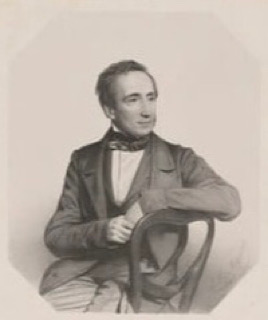
(From: “Patterson, Robert” by Andrew O’Brien, Dictionary of Irish Biography, http://www.dib.ie, October 2009 | Pictured: “Robert Patterson” by Thomas Herbert Maguire, printed by M & N Hanhart lithograph, 1849, National Portrait Gallery)
Dorrian is born in Downpatrick, County Down, on March 29, 1814, one of four sons of Patrick Dorrian and his wife Rose (née Murphy). He is educated first by a Unitarian minister in the classical school in the town, where he excels, and then in St. Patrick’s College, Maynooth, where he is ordained in 1833.
Dorrian’s first appointment is as a curate in the then developing town of Belfast, attached to St Patrick’s Church, Belfast, where he ministers for ten years. At a relatively young age he is appointed parish priest in Loughinisland, County Down, (1847-60) at which time he becomes Bishop of Gabala (Qabala) and Coadjutor Bishop of the Diocese of Down and Connor to assist the ailing, frail and irenic Bishop Cornelius Denvir.
Dorrian is consecrated bishop on August 19, 1860, in St. Malachy’s Church, Belfast, and eventually succeeds as bishop five years later on May 4, 1865. He is known for his authoritarian style of leadership, referred to as “Cullenite“. As the post-famine population of Belfast grows, so too does sectarian attitudes, especially among those moving into the city from rural districts all over Ulster looking for work. He seeks to defend Catholic interests, insisting on the necessity of separate Catholic education and seeking, where possible, to influence the social and political interests of his church.
In this respect, historiansSean Connolly and Gillian McIntosh refer to Dorrian’s “pugnacious” presiding over the rapid expansion in priests, churches and religious houses in contrast to the “scholarly but ineffective” Bishop Denvir.
It is estimated Dorrian is responsible for doubling the number of Catholic churches in the city of Belfast, and in 1866, early in his episcopate, St. Peter’s Cathedral, Belfast in Derby Street in the Lower Falls area is first used as a pro-cathedral. His episcopal chair, placed in that church for the occasion, is still in use by the bishops of the Diocese of Down and Connor. He attends the First Vatican Council and is one of the leading Irish delegation to the event.
Dorrian dies at the Episcopal Palace, Chichester Park, Belfast, at 7:00 a.m., on November 3, 1885. His remains are interred within the chancel of St. Patrick’s Church, Belfast, on Friday, November 6.
At a meeting of the parish priests held in the chapel of St. Malachy’s College, on November 6, 1885, immediately after Dorrian’s funeral, Patrick MacAlister is elected Vicar Capitular of Down and Connor. McAllister is then named by Pope Leo XIII as Dorrian’s successor as the 24th Lord Bishop of Down and Connor.
In November 2017, the historic chapel of Belfast’s Mater Infirmorum Hospital is re-opened after extensive refurbishment. It has, as a result of its connection with Dorrian, become known as the Dorrian Chapel.
Dunphy grows up in Drumcondra, Dublin, in what he describes as “a one-room tenement flat [with] no electricity, no hot water.” He attends Saint Patrick’s National School, Drumcondra. In 1958, he gets a one-year government scholarship to Sandymount High School but has to work as a messenger at the tweed clothing shop Kevin and Howlin.
A promising footballer, Dunphy leaves Dublin while still a teenager to join Manchester United as an apprentice. He does not break into the first team at United, and subsequently leaves to play for York City, Millwall, Charlton Athletic, Reading and Shamrock Rovers. It is at Millwall that he makes the most impact. He is considered an intelligent and skillful player in the side’s midfield. He is a member of “The Class of ’71,” the Millwall side that fails by just one point to gain promotion to the Football League First Division.
Dunphy accompanies Johnny Giles back to Ireland to join Shamrock Rovers in 1977. Giles wants to make the club Ireland’s first full-time professional club and hopes to make Rovers into a force in European football by developing talented young players at home who would otherwise go to clubs in England. Dunphy is originally intended to be in charge of youth development. However, despite an FAI Cup winners medal in 1978, his only medal in senior football, and two appearances in the UEFA Cup Winners’ Cup, he becomes disillusioned with the Irish game and drops out of football altogether to concentrate on a career in journalism.
Since the 1980s, Dunphy has written a number of books. His first and most widely praised book is Only a Game? The Diary of a Professional Footballer, which is an autobiographical account of his days playing for Millwall. Written in diary form, it records events from the dressing room of his 1973–74 season, which begins well for him at Millwall but subsequently ends in disillusionment: after being substituted in an October 27, 1973, home loss to eventual league winners Middlesbrough, he does not play another game all season, the club finishing mid-table.
In 1985, rock band U2 and manager Paul McGuinness commission Dunphy to write the story of their origins, formation, early years and the time leading up to their highly successful album The Joshua Tree. His book Unforgettable Fire – Past, Present, and Future – The Definitive Biography of U2 is published in 1988. It receives some favourable reviews, but critics close to the band speak of many inaccuracies. A verbal war erupts in the press during which he calls lead singer Bono a “pompous git.”
Dunphy also writes a biography of long-serving Manchester United manager Matt Busby and in 2002 ghost writes the autobiography of Republic of Ireland and Manchester United player Roy Keane.
Since the mid-1980s, Dunphy has regularly appeared as an analyst during football coverage on Raidió Teilifís Éireann (RTÉ). Since RTÉ acquired the rights to show English football, he has been a regular contributor to Premier Soccer Saturday. He also contributes to analysis of UEFA Champions League games and, in international football, RTÉ’s coverage of FIFA World Cups, UEFA European Football Championships and qualifying matches involving the Republic of Ireland national football team.
In 2001, Dunphy becomes the first male host of the quiz show The Weakest Link, which airs on TV3, for just one series. In 2003, he is hired again by TV3 to host their new Friday night chat show, entitled The Dunphy Show. Pitted head-to-head with RTÉ’s long-running flagship programme, The Late Late Show, Dunphy’s show loses what is a highly publicised “ratings war,” and is cancelled before its original run concludes.
Dunphy is the first presenter of a made-for-mobile television show on the 3 mobile network in Ireland. His rants and “Spoofer of the Week” are watched by thousands of 3 Mobile customers. The shows are awarded “Best Entertainment Show” at Ireland’s Digital Media Awards. He admits he never uses a mobile himself but enjoys filming for a mobile audience from his living room in Ranelagh.
In July 2018, Dunphy announces that he is leaving RTÉ after 40 years with the broadcaster, and that he intends to focus on his podcastThe Stand with Eamon Dunphy.
Dunphy has also has a prominent radio career with several stations, including Today FM, Newstalk and RTÉ Radio 1. He is the original host in 1997 of the popular current affairs show The Last Word on Today FM. In September 2004, he takes over The Breakfast Show slot on the Dublin radio station Newstalk 106 from David McWilliams. The show tries to court controversy and listeners in equal measure. He fails to attract the large listenership predicted, with only a few additional thousand tuning in. He announces in June 2006 his intention to leave Newstalk 106, citing an inability to sustain the demands of an early morning schedule. After his departure from Newstalk 106, he confirms he is suffering from a viral illness from which he later recovers.
In July 2006, RTÉ announces that Dunphy will present a new weekly programme as part of the new RTÉ Radio 1 autumn schedule.
Dunphy rejoins Newstalk but leaves again in 2011 “due to interference from management and a push to put a more positive spin on the news.” On his last show he accuses his boss, Denis O’Brien, of “hating journalism.” He quits after Sam Smyth is sacked from Today FM (also owned by O’Brien) and says management at Newstalk is trying to remove “dissenting voices” like Constantin Gurdgiev from the airwaves.
Dunphy is a daily Mass-goer until he is preparing for marriage to his first wife, Sandra from Salford, when he is 21. He is Catholic and she is Protestant. The priest instructing them for marriage disapproves strongly of the mixed couple, saying that he should not marry her because she is “not a proper person.” Dunphy’s observance is already weakening but he quits his daily Mass-going at this point. He and Sandra have two children, a boy and a girl, and he is now a grandfather. His first marriage ends, and he moves to Castletownshend in County Cork for two years in the early 1990s. He lives with another partner, Inge, before meeting his second wife, RTÉ commissioning editor Jane Gogan, in the Horseshoe Bar in Dublin in 1992. They marry at the Unitarian Church on St. Stephen’s Green on September 24, 2009.
In an interview with An Phoblacht, Dunphy, who had previously written highly critical articles on the Provisional IRA and Sinn Féin, states that he is now a Sinn Féin supporter and declares he had voted for them in the 2011 Irish general election. He describes their representatives as “incredibly hard-working and incredibly intelligent.”
Dunphy publishes his autobiography entitled The Rocky Road in October 2013.
Today, Dunphy generally resides at his home near Ranelagh in Dublin. He also owns a holiday home in Deauville, France.
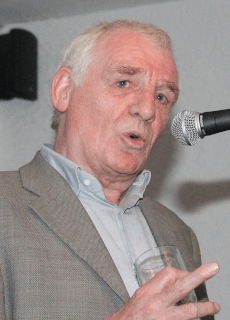
(Pictured: Éamon Dunphy at the Sinn Féin Summer School, 2013)
Orr is the son of James Orr, who farms a few acres and is a linen weaver. His mother’s name is unknown. They live in the small village of Ballycarry, in the parish of Broadisland, County Antrim. He is an only child, born when his parents are middle-aged. They are unwilling to risk sending him to school, so they carefully educate him at home, his father having been very well educated. A near-contemporary source George Pepper (1829), claims that the youngster is something of a prodigy, able to read Spectator essays at the age of six. Later in life, partly thanks to membership of a local reading society, he is remarkably well read. Handloom weavers are reputedly one of the most literate and politically radical groups in the period, and he certainly fits the stereotype. Pepper also claims that William Orr is James Orr’s uncle, and that the younger man lives for three years with William Orr and his family, where his literary talents are nurtured and where he develops an interest in radical politics. Other sources do not support this account, but if there is a relationship it might explain an almost morbid interest in assizes, executions, and gallows, evident in several poems. This also might have been prompted by witnessing William Orr’s trial and execution.
Pepper “heard from good authority” that Orr in 1797 is secretary to the Antrim Association, of which William Orr is president; presumably this means the Society of United Irishmen. He sings a patriotic song called “The Irishman,” one of his most celebrated compositions, at a meeting of that body. The earliest publications traced are poems published pseudonymously (1796–97) in the Northern Star newspaper. This paper, edited by Samuel Neilson, is sympathetic to United Irish views, and it is clear that Orr, like many of his neighbours, is actively involved in the 1798 rebellion. Several poems dealing with the events of June 1798, provide a rare participant’s perspective. He takes part in the skirmish at Donegore, and flees after the defeat at the Battle of Antrim. Local sources record his successful efforts to prevent cruelty and looting by his colleagues. He goes into hiding in an Irish-speaking area, perhaps in the Glens of Antrim or in the Sperrin Mountains. After a short time, he escapes to the United States, but unlike many of his former comrades he finds himself unable to settle there, and very soon returns home to Ballycarry, and thenceforth makes his living as a weaver. In 1800, he seeks to join the militia set up to counter a feared Napoleonic invasion, but the local gentry in command rejects his application because of his United Irish associations.
Orr’s first verses are composed at meetings of a local singing school, where rival versifiers produce impromptu verses for the company to sing to the psalm tunes being practised, and he later writes songs for masonic meetings. He publishes poems in the Belfast newspapers. A few carefully written essays on morality and education, signed “Censor, Ballycarry,” are apparently also his work. A collection of poems is published in 1804, with almost 400 subscribers, and another selection is published in 1817 after his death by his friend Archibald McDowell. Orr had requested that the proceeds should go to help the poor of Ballycarry. His poems are an excellent source of information about the life and concerns of a fairly humble stratum of late eighteenth-century Ulster society.
Many of Orr’s best poems deal with subjects of interest to his community – weaving, social life, and farming – and are written in the Scots language still widely spoken in the area. He expertly uses Scots stanza forms, and joyously participates in the almost competitive composition of verse typical of the Scots tradition. Several of his poems rework themes found in Robert Burns or other earlier writers. His An Irish Cottier’s Death and Burial is derived from a Burns poem, The Cottier’s Saturday Night, but later critics acknowledge that the Orr poem is much more successful. He and his friend Samuel Thomson are pioneers in the use of written Scots in Ulster and are regarded as the two most skillful Scots poets in Ulster. Both are celebrated in their day, and their work in Scots has been rediscovered in the twentieth-century revival of interest in the traditional literature and history of the north of Ireland.
Orr’s verse in standard English is equally competent, even more ambitious and almost as interesting. The best of his work, particularly in Scots, is characterised by pleasing cadences and assured control of tone and technique. His novel and generally impressive experiments with soliloquies, verse epistles, and versified direct speech, in English and Scots, parallel his interest in extending the registers in which he could use the vernacular Scots language. He seems not to have known of William Wordsworth‘s poetry, but, apparently independently and arguably more successfully, produces verse written in “the language really used by men” (Wordsworth, preface to Lyrical Ballads (1798)). As well as fascinating foreshadowings of romanticism, his work more often reveals the influence of the enlightenment and of New Light presbyterianism. He is a member of the congregation of the Rev. John Bankhead, whose theological views are decidedly liberal, tending even towards unitarianism. His poems provide a great deal of evidence on his reading, interests, radical aspirations and convictions; and in them and in the prose essays, the reader encounters a humane and generous personality. Like many other United Irishmen, he is an enthusiastic freemason, and believes that freemasonry and education will help to usher in a peaceful millennium. His poetry reveals humanitarian concerns, not yet common in the period. He opposess slavery and cruelty to animals and children and expresses support for a contemporary popular rising in Haiti. In 1812, he signs a petition in favour of Catholic emancipation.
Orr never marries. His friend McDowell believes that the resulting lack of domestic comforts drives the poet to socialise in taverns, and it is said that local fame and popularity encourages his excessive drinking. He suffers from ill health in later life. A neglected cold in 1815 leads to tuberculosis. He dies on April 24, 1816, and is buried in the old Templecorran graveyard at Ballycarry. Some years later, freemasons erect an impressive monument over the grave.
Orr’s poems are republished by a group of local enthusiasts in 1935. Another selection appears in 1992. A plaque put up by the local district council commemorates “the bard of Ballycarry,” probably the most significant eighteenth-century English-language poet in Ulster.
(From: “Orr, James” by Linde Lunney, Dictionary of Irish Biography, http://www.dib.ie, October 2009)
In 1726, the Synod expels ministers, grouped together as the Synod of Antrim, who refuse to subscribe to the Westminster Confession of Faith. Later there is a further secession by those who, insisting on the sole kingship of Christ, reject the Confession. In 1763 they organise a distinct Reformed Presbyterian Church, and in 1811 establish their own provincial synod. In 1746, some of the more doctrinaire Calvinists withdraw, forming the Secession Synod.
Within the mainline Synod there is a continuing distinction between ‘Old Light‘ supporters of theological orthodoxy and ‘New Light‘ elements more inclined to defer to conscience rather than doctrine. In the first decades of the 19th century, positions harden with New Light ministers adopting a Unitarian or Arian skepticism regarding the doctrine of the Trinity. In 1829, when the leading conservative evangelical, Henry Cooke, succeeds in pressing the General Synod for a firm declaration of Trinitarian belief they withdraw to form their own Remonstrant Synod.
The departure of the latitudinarian party makes possible a reconciliation with the earlier Seceders. Purged of its heterodox elements, in 1840 the Synod of Ulster joins with the Secession Synod to form the General Assembly of the Presbyterian Church in Ireland.
Brooke is born in the rectory of Glendoen, near Letterkenny, County Donegal on November 14, 1832, the eldest son of the Rev. Richard Sinclair Brooke, later incumbent of the Mariners’ Church, Kingstown (now Dún Laoghaire). His maternal grandfather, Joseph Stopford, is then rector of the parish. He is educated at Trinity College, Dublin. He is ordained in the Church of England in 1857 and holds various charges in London. From 1863 to 1865 he is chaplain to Victoria, Princess Royal in Berlin. In 1869, with his brother Edward, he makes long tours of Counties Donegal and Sligo, and spends much time at Kells, County Meath studying Irish antiquities. Between 1866 and 1875 he is the minister at St. James’s Chapel, a proprietary chapel. After it closes, he takes services at Bedford Chapel, Bloomsbury where he continues to attract large congregations. In 1875, he becomes chaplain in ordinary to Queen Victoria. But in 1880 he secedes from the Church, being no longer able to accept its leading dogmas, and officiates as an independent preacher for some years at Bedford Chapel, Bloomsbury.
Bedford Chapel is pulled down about 1894, and from that time Brooke has no church of his own, but his eloquence and powerful religious personality continues to make themselves felt among a wide circle. A man of independent means, he is always keenly interested in literature and art, and a fine critic of both. The two-volume Life and Letters of Stopford Brooke, written by his son-in-law L. P. Jacks and published in 1917, contains many details of different facets of his life.
In 1890-1891 Brooke takes the lead in raising the funds to purchase Dove Cottage, William Wordsworth’s home in Grasmere from 1800 to 1808, and establishing it “for the eternal possession of those who love English poetry all over the world.” Dove Cottage is now administered by the Wordsworth Trust.
Brooke publishes in 1865 his Life and Letters of FW Robertson (of Brighton), and in 1876 writes an admirable primer of English Literature, followed in 1892 by The History of Early English Literature down to the accession of Alfred the Great, and English Literature from the Beginnings to the Norman Conquest (1898).
Brooke gives the inaugural lecture to the Irish Literary Society, London, on “The Need and Use of Getting Irish Literature into the English Tongue” at Bloomsbury House, March 11, 1893. He delivers a sermon on “The Kingdom of God Within” to the International Council of Unitarian and Other Liberal Religious Thinkers and Workers, meeting in London in May 1901. He continues preaching at Bedford Chapel and to unitarian congregations throughout Britain until forced to retire because of ill-health in 1895.
Samuel Haughton, scientist, mathematician, and doctor, is born in Carlow, County Carlow on December 21, 1821. He is “famous” for calculating the drop required to kill a hanged man instantly.
Haughton has a distinguished career at Trinity College, Dublin and in 1844 he is elected a fellow. Working on mathematical models under James MacCullagh, he is awarded in 1848 the Cunningham Medal by the Royal Irish Academy. In 1847 he has his ordination to the priesthood, but he is not someone who preaches. He is appointed as professor of geology at Trinity College in 1851 and holds the position for thirty years. He begins to study medicine in 1859. He earns his MD degree in 1862 from the University of Dublin.
Haughton becomes registrar of the Medical School. He focuses on improving the status of the school and representing the university on the General Medical Council from 1878 to 1896. In 1858 he is elected fellow of the Royal Society. He gains honorary degrees from Oxford, Cambridge and Edinburgh. At Trinity College Dublin he moves the first-ever motion at the Academic Council to admit women to the University on March 10, 1880. Through his work as Professor of Geology and his involvement with the Royal Zoological Society, he has witnessed the enthusiasm and contribution of women in the natural sciences. Although thwarted by opponents on the Council he continues to campaign for the admission of women to TCD until his death in 1897. It is 1902 before his motion is finally passed, five years after his death.
In 1866, Haughton develops the original equations for hanging as a humane method of execution, whereby the neck is broken at the time of the drop, so that the condemned person does not slowly strangle to death. “On hanging considered from a Mechanical and Physiological point of view” is published in the London, Edinburgh, and Dublin Philosophical Magazine and Journal of Science, Vol. 32 No. 213 (July 1866), calling for a drop energy of 2,240 ft-lbs. From 1886 to 1888, he serves as a member of the Capital Sentences Committee, the report of which suggests an Official Table of Drops based on 1,260 ft-lbs. of energy.
Haughton is president of the Royal Irish Academy from 1886 to 1891, and secretary of the Royal Zoological Society of Ireland for twenty years. In 1880 he gives the Croonian Lecture on animal mechanics to the Royal Society.
Haughton is also involved in the Dublin and Kingstown Railway company, in which he looks after the building of the first locomotives. It is the first railway company in the world to build its own locomotives.
Samuel Haughton dies on October 31, 1897, and is buried in the Church of the Holy Cross Cemetery in Killeshin, County Laois.
Stopford Augustus Brooke, churchman, royal chaplain and writer, is born in the rectory of Glendoen, near Letterkenny, County Donegal on November 14, 1832. His maternal grandfather, Joseph Stopford, is then rector of the parish.
Brooke is the eldest son of the Rev. Richard Sinclair Brooke, later incumbent of the Mariners’ Church, Kingstown (now Dún Laoghaire), and is educated at Trinity College, Dublin. He is ordained in the Church of England in 1857 and holds various charges in London. From 1863 to 1865 he is chaplain to Victoria, Princess Royal in Berlin. In 1869, with his brother Edward, he makes long tours of Counties Donegal and Sligo, and spends much time at Kells, County Meath studying Irish antiquities. Between 1866 and 1875 he is the minister at St. James’s Chapel, a Proprietary Chapel. After it closes, he takes services at Bedford Chapel, Bloomsbury where he continues to attract large congregations. In 1875, he becomes chaplain in ordinary to Queen Victoria. But in 1880 he secedes from the Church, being no longer able to accept its leading dogmas, and officiates as an independent preacher for some years at Bedford chapel, Bloomsbury.
Bedford chapel is pulled down about 1894, and from that time Brooke has no church of his own, but his eloquence and powerful religious personality continues to make themselves felt among a wide circle. A man of independent means, he is always keenly interested in literature and art, and a fine critic of both. The two-volume Life and Letters of Stopford Brooke, written by his son-in-law L. P. Jacks and published in 1917, contains many details of different facets of his life.
In 1890-1891 Brooke takes the lead in raising the funds to purchase Dove Cottage, William Wordsworth’s home in Grasmere from 1800 to 1808, and establishing it “for the eternal possession of those who love English poetry all over the world.” Dove Cottage is now administered by the Wordsworth Trust.
Brooke publishes in 1865 his Life and Letters of FW Robertson (of Brighton), and in 1876 writes an admirable primer of English Literature, followed in 1892 by The History of Early English Literature down to the accession of Alfred the Great, and English Literature from the Beginnings to the Norman Conquest (1898).
Brooke gives the inaugural lecture to the Irish Literary Society, London, on “The Need and Use of Getting Irish Literature into the English Tongue” at Bloomsbury House, March 11, 1893. He delivers a sermon on “The Kingdom of God Within” to the International Council of Unitarian and Other Liberal Religious Thinkers and Workers, meeting in London in May 1901.
Haughton, son of Samuel Pearson Haughton (1748–1828), by Mary, daughter of James Pim of Rushin, Queen’s County (now County Laois), is born in Carlow, County Carlow, and educated at Ballitor, County Kildare, from 1807 to 1810, under James White, a quaker. After filling several situations to learn his business, in 1817 he settles in Dublin, where he becomes a corn and flour factor, in partnership with his brother William. He retires in 1850. Although educated as a Friend, he joins the Unitarians in 1834 and remains throughout his life a strong believer in their tenets.
Haughton supports the anti-slavery movement at an early period and takes an active part in it until 1838, going in that year to London as a delegate to a convention. Shortly after the Temperance campaigner Father Theobald Mathew takes the pledge, on April 10, 1838, Haughton becomes one of his most devoted disciples. For many years he gives most of his time and energies to promoting total abstinence and to advocating legislative restrictions on the sale of intoxicating drinks.
In December 1844 Haughton is the chief promoter of a fund which is raised to pay some of the debts of Father Mathew and release him from prison. About 1835 he commences a series of letters in the public press which make his name widely known. He writes on temperance, slavery, British India, peace, capital punishment, sanitary reform, and education. His first letters are signed “The Son of a Water Drinker,” but he soon commences using his own name and continues to write until 1872.
Haughton takes a leading part in a series of weekly meetings which are held in Dublin in 1840, when so numerous are the social questions discussed that a newspaper editor calls the speakers the “Anti-everythingarians.” In association with Daniel O’Connell, of whose character he has a very high opinion, he advocates various plans for the amelioration of the condition of Ireland and the Repeal of the Union but is always opposed to physical force.
Haughton becomes a vegetarian in 1846, both on moral and sanitary grounds. For two or three years before his death he is president of the Vegetarian Society of the United Kingdom. He is one of the first members of the Statistical Society of Dublin (1847), a founder of the Dublin Mechanics’ Institute (1849), in the same year is on the committee of the Dublin Peace Society, aids in abolishing Donnybrook Fair in 1855, and takes a chief part in 1861 in opening the National Botanic Gardens at Glasnevin on Sundays.
James Haughton dies at 35 Eccles Street, Dublin, on February 20, 1873, and is buried in Mount Jerome Cemetery on February 24 in the presence of an immense crowd of people.
Haughton’s son, Samuel Haughton, publishes a memoir of his father’s life including extracts from his public correspondence in 1877.





 seamus dubhghaill