William Grattan Tyrone Power, Irish stage actor, comedian, author and theatrical manager known professionally as Tyrone Power, is born in Kilmacthomas, County Waterford, on November 20, 1797. He is an ancestor of actor Tyrone Power and is also referred to as Tyrone Power I.
The young Power takes to the stage, achieving prominence throughout the world as an actor and manager. He is well known for acting in such Irish-themed plays as Catherine Gore‘s King O’Neil (1835), his own St. Patrick’s Eve (1837), Samuel Lover‘s Rory O’More (1837) and The White Horse of the Peppers (1838), Anna Maria Hall‘s The Groves of Blarney (1838), Eugene Macarthy’s Charles O’Malley (1838), and William Bayle Bernard‘s His Last Legs (1839) and The Irish Attorney (1840). In his discussion of these works, Richard Allen Cave argues that Power, both in his acting as well as his choice of plays, seeks to rehabilitate the Irishman from the derogatory associations with “stage Irishmen.”
Power has a number of notable descendants by his wife Anne, daughter of John Gilbert of the Isle of Wight:
Sir Tyrone Guthrie, British theatrical director (1900–1971)
Maurice Henry Anthony O’Reilly Power (1821–1849), trained as a barrister but later took up acting
Frederick Augustus Dobbyn Nugent Power (1823–1896), civil engineer, left a large estate of £197,000, equivalent to £15.6 million or 28 million US dollars in 2006
Clara Elizabeth Murray Power (born 1825)
Mary Jane Power (born 1827)
Harold Littledale Power (1833–1901), actor, wine merchant, mine agent & engineer
Tyrone Power, Sr. (1869–1931), English theatre and silent movie star
Tyrone Power (1914–1958), American Hollywood star of the 1930s to 1950s
Romina Power (born 1951), American singer and film actress
Power is said to have purchased the land that is later occupied by Madison Square Garden, New York, shortly before his death. The lawyer who holds the papers cannot be found so the Power family is unable to claim right to the property.
Power is lost at sea on March 17, 1841, when the SS President disappears without trace in the North Atlantic shortly after departing for England. Anne Power is buried in the churchyard of St. Mary The Virgin Church in High Halden, Kent, England.
Derrig is born on November 26, 1897, in Westport, County Mayo. He is educated locally and later at University College Galway. During his time in college, he organises a corps of the Irish Volunteers. After the 1916 Easter Rising, he is arrested and imprisoned, and sent to the prisons of Woking, Wormwood Scrubs and Frongoch internment camp. He is arrested in 1918 and is accused of attempting to disarm a soldier. He is sentenced to five months imprisonment by a court in Belfast. When he is released, he supports Joseph MacBride at the 1918 Irish general election. He also graduates from college and becomes headmaster in a technical college in Mayo.
At the June 1927 Irish general election Derrig is elected to Dáil Éireann as a Fianna Fáil TD for Carlow–Kilkenny. In Éamon de Valera‘s first government in 1932 Derrig is appointed Minister for Education. He initiates a review of industrial and reformatory schools and the rules under the Children Act 1908, resulting in the critical 1936 Cussen Report that follows which he shelves, and a report in 1946-48 by the Irish American priest Father Edward J. Flanagan, which is also shelved. His lack of action wis noted in 2009 when the Ryan Report examines the subsequent management of these “residential institutions.” He is the first Minister to seek a report that could result in much-needed reforms. It is suggested that he does not want to follow British law reforms in the 1920s and 1930s, because of his strong anti-British views, and that Irish children have suffered needlessly as a result. From 1939 to 1943, he serves as Minister for Lands. He is re-appointed to Education in 1943 until 1948. During this period a bitter teachers’ strike, involving the Irish National Teachers Organisation (INTO), takes place, lasting from March 20 to October 30. Between 1951 and 1954, he becomes Minister for Lands again.
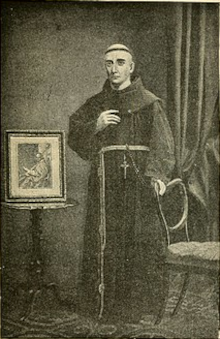
Ó Maolchonaire is born in the townland of Figh, civil parish of Tibohine, barony of Frenchpark, County Roscommon. His father and mother are Fíthil and Onóra Ó Maolchonaire. Two other sons survive to adulthood, Maoilechlainn and Firbisigh. They belong to a well-known family of historians and poets. He is brought up in the family profession.
Ó Maolchonaire studies for the priesthood at Salamanca, entering the Irish college founded in 1592. He first studies the liberal arts and philosophy. In 1593 he translates into Irish a short Castilian catechism by Jerónimo de Ripalda SJ. The original is a simple catechetical work written in Aristotelian master-pupil dialogue. According to Mícheál Mac Craith, Ó Maolchonaire’s translation pointedly refers to the Irish as Eirinnach rather than Gaedheal.
After five years at the Salamanca Irish college, Ó Maolchonaire leaves to join the Franciscan province of Santiago. Aodh Mac Cathmhaoil is among his classmates in the Salamanca Franciscan friary. They and nine of their peers in the Santiago province are later raised to the episcopacy, an unprecedented development in the history of the order.
At the height of the Nine Years’ War, Ó Maolchonaire sails to Ireland where he serves as a confessor and preacher to troops under the command of Hugh O’Neill and Hugh Roe O’Donnell. In 1601, they request a bishopric for Ó Maolchonaire “in recognition of his diligence, commending his sound judgment on Irish affairs.” After the disaster of Kinsale in 1601, he accompanies O’Donnell to Spain as his confessor and adviser, hoping to see a renewal of Spanish military intervention in Ireland.
In 1602, Ó Maolchonaire attempts to get approval for O’Donnell to meet Philip III in person, but they are kept at arm’s length by the Spanish court. During this time, they also drafted an official complaint against the Jesuit superiors of the Irish college at Salamanca over presumed discrimination in favour of Old English students at the expense of students from Connacht and Ulster.
While waiting for a response to his repeated calls for military support in Ireland, O’Donnell becomes seriously ill and dies at Simancas, being assisted on his deathbed by Ó Maolconaire. In keeping with his patronage of the order of friars minor in Donegal, O’Donnell is buried in the Franciscan habit. Ó Maolchonaire accompanies the remains to their last resting place in the Franciscan church at Valladolid. He continues to press for military support after O’Donnell’s death. He participates in an abandoned maritime expedition which reaches Achill Sound in 1603 but never lands in Ireland. He subsequently assists the Spanish councils of state and war to stem the flow of Irish military migrants and their dependents in Spain.
As adviser to Puñonrostro, the king’s appointee as protector of Irish exiles in Spain, Ó Maolchonaire helps to secure funds for widows, orphans and clerics. Trained as a chronicler and genealogist, he sponsors the entry of Irish soldiers into Spanish military orders and successfully calls for the promotion of Henry O’Neill, second eldest son of the earl of Tyrone, as colonel of Irish infantry units in Flanders, the O’Neill tercio in 1604.
In 1606, the Franciscan general chapter is held in Toledo where Ó Maolchonaire is selected as minister-provincial of the Irish friars minor. The most notable act of his tenure as provincial is the founding of a new Irish Franciscan college at Leuven in the Habsburg Netherlands. A year before his appointment, he begins his efforts in earnest with an appeal to the Spanish king. The loss of five Franciscan houses during the Nine Years’ War makes a new foundation essential. In response, Philip III instructs Albert VII, Archduke of Austria, to provide a perpetual grant for a new college in the university town of Leuven. Ó Maolchonaire’s part in founding the college clearly influences the Catholic pastoral mission to Ireland during the seventeenth century. The first and most active Irish printing press on the continent is long in operation at Leuven.
After Hugh O’Neill and Rory O’Donnell leave Ireland in 1607, Ó Maolconaire accompanies them from Douai to Rome as interpreter and advisor. Christopher St. Laurence, baron of Howth, implicates him in a plot to seize Dublin Castle and raises a new rebellion just before the Flight of the Earls. In recognition of his losses, Philip III and Paul V offer O’Neill the concession of Ó Maolchonaire’s promotion to the archbishopric of Tuam. On Sunday, May 3, 1609, he is consecrated archbishop by CardinalMaffeo Barberini in the centre of Rome at the Chiesa Santo Spirito in Sassia. He remains in Rome until his appointment as archbishop of Tuam before returning to Madrid on behalf of Hugh O’Neill.
In response to the 1613–15 Parliament of Ireland, Ó Maolchonaire writes from Valladolid a remonstrance to the Catholic members of the parliament, rebuking them for assenting to the bill of attainder that confiscated the estates of O’Neill, O’Donnell and their adherents. As Archbishop of Tuam, he never takes possession of his episcopal see, governing through vicars general. He continues to live in Madrid and Leuven, as is the case with many Irish clergy at the time. Like his fellow-Franciscan, Luke Wadding, and Peter Lombard, Archbishop of Armagh, he serves as a key intermediary and his influence in Irish matters is considerable. In 1626, a year after Charles I declared war on Spain, he makes the case for an invasion of Ireland under the joint leadership of the earls of Tyrone and Tyrconnell.
Ó Maolconaire dies at the Franciscan friary of San Francisco el Grande in Madrid on November 18, 1629. In 1654, two Irish friars bring his remains back to St. Anthony’s College in Leuven where he is buried near the high altar in the collegiate chapel.
The Sweepstake is generally referred to as the Irish Sweepstake or Irish Sweepstakes, frequently abbreviated to Irish Sweep or Irish Sweeps. The Public Charitable Hospitals (Temporary Provisions) Act, 1930 is the act that establishes the lottery. This act expires in 1934, in accordance with its terms, and the Public Hospitals Acts are the legislative basis for the scheme thereafter. The main organisers are Richard Duggan, Captain Spencer Freeman and Joseph McGrath. Duggan is a well known Dublinbookmaker who has organised a number of sweepstakes in the decade prior to setting up the Hospitals’ Sweepstake. Captain Freeman is a Welsh-born engineer and former captain in the British Army. After the Constitution of Ireland is enacted in 1937, the name Irish Hospitals’ Sweepstake is adopted.
The sweepstake is established because there is a need for investment in hospitals and medical services and the public finances are unable to meet this expense at the time. As the people of Ireland are unable to raise sufficient funds, because of the low population, a significant amount of the funds are raised in the United Kingdom and United States, often among the emigrant Irish. Potentially winning tickets are drawn from rotating drums, usually by nurses in uniform. Each such ticket is assigned to a horse expected to run in one of several horse races, including the Cambridgeshire Handicap, Epsom Derby and the Grand National. Tickets that draw the favourite horses thus stand a higher likelihood of winning and a series of winning horses have to be chosen on the accumulator system, allowing for enormous prizes.
The original sweepstake draws are held at the Mansion House, Dublin on May 19, 1939 under the supervision of the Chief Commissioner of Police, and are moved to a more permanent fixture at the Royal Dublin Society (RDS) in Ballsbridge later in 1940.
The Adelaide Hospital in Dublin is the only hospital at the time to not accept money from the Hospitals Trust, as the governors disapprove of sweepstakes.
From the 1960s onwards, revenues decline. The offices are moved to Lotamore House in County Cork. Although giving the appearance of a public charitable lottery, with nurses featured prominently in the advertising and drawings, the Sweepstake is in fact a private for-profit lottery company, and the owners are paid substantial dividends from the profits. Fortune magazine describes it as “a private company run for profit and its handful of stockholders have used their earnings from the sweepstakes to build a group of industrial enterprises that loom quite large in the modest Irish economy. Waterford Glassworks, Irish Glass Bottle Company and many other new Irish companies are financed by money from this enterprise and up to 5,000 people are given jobs.” At the time of his death in 1966, Joe McGrath has interests in the racing industry, and holds the Renault dealership for Ireland in addition to large financial and property assets. He is notorious throughout Ireland for his ruthless business attitude and his actions during the Irish Civil War.
In 1986, the Irish government creates a new public lottery, the National Lottery, and the company fails to secure the new contract to manage it. The final sweepstake is held in January 1986 and the company is unsuccessful for a licence bid for the National Lottery, which is won by An Post later that year. The company goes into voluntary liquidation in March 1987. The majority of workers do not have a pension scheme but the sweepstake has fed many families during lean times and is regarded as a safe job. The Public Hospitals (Amendment) Act, 1990 is enacted for the orderly winding up of the scheme, which has by then almost £500,000 in unclaimed prizes and accrued interest.
A collection of advertising material relating to the Irish Hospitals’ Sweepstakes is among the Special Collections of National Irish Visual Arts Library.
Born to John Lawler and Elizabeth Kelly, they move to the United States four years later and settle initially in Frederick County, Maryland. In 1819, they move to rural Gallatin County, Illinois. On December 20, 1837, Lawler marries Elizabeth Crenshaw. He receives an appointment as a captain in the Mexican-American War and commands two companies in separate deployments to Mexico. He first leads a company from Shawneetown, Illinois that guards the supply route from Veracruz to General Winfield Scott‘s army. After the fall of Veracruz his company is discharged. He makes a visit to Washington after which he is asked by Illinois Governor Thomas Ford to organize a company of riflemen. He serves in the campaign to take Matamoros, Tamaulipas.
Lawler then returns to his farm in Illinois, where he is residing at the outbreak of the American Civil War. He establishes a thriving mercantile business, dealing in hardware, dry goods, and shoes. He studies law, passes his bar exam, and uses his legal license to help the claims of Mexican War veterans.
Following the surrender of Jackson, Mississippi, the XIII Corps is split up and divided among other operations in the Western Theater. For the rest of the war, Lawler serves as commander of the 1st Division, XIII Corps in Louisiana in the Department of the Gulf, taking command of the division during the disastrous Red River campaign and leading it on an expedition in June 1864 to secure a crossing of the Atchafalaya River used by Confederate forces.
In the omnibus promotions at the end of the American Civil War, Lawler receives a promotion for distinguished service to major general in the Union army backdated from March 13, 1865. After mustering out of the army in 1866, he returns home and resumes his legal practice and farming near Shawneetown, Illinois.
Lawler dies in Shawneetown on July 22, 1882, and is buried in the Lawler Family Cemetery near Equality, Illinois, at the rear of the Old Slave House property.
A memorial to Lawler stands in Equality, Illinois. He also is honored with a marble bust in Vicksburg National Military Park in Vicksburg, Mississippi. Chicago renames a street to Lawler Avenue in his memory.
Pearse follows his brother into the Irish Volunteers and the republican movement. He takes part in the Easter Rising in 1916, always staying at his brother’s side at the General Post Office. Following the surrender, he is court-martialed and sentenced to death. It has been said that as he is only a minor player in the struggle it is his surname that condemns him. However, at his court martial he emphasizes his involvement.
On May 3, 1916, Pearse is granted permission to visit his brother in Kilmainham Gaol, to see him for the final time. However, while he is en route, Patrick is executed. He is executed on May 4. He and his brother are the only two brothers to be executed after the Easter Rising.
There are many more public commemorations of Patrick Pearse than of William. In 1966, Dublin’s Westland Row railway station is renamed Dublin Pearse railway station to honour both brothers. Pearse Square and Pearse Street in Dublin are renamed in honour of both, Pearse Street (then Great Brunswick Street) having been their birthplace. Many streets and roads in Ireland bear the name Pearse. Few name William, but there is a Pearse Brothers Park in Rathfarnham. The bridge over the River Dodder on the Rathfarnham Road, between Terenure and Rathfarnham is named after them and carries a plaque depicting the brothers in profile.
Brothers Pearse Athletic Club, founded in Rathfarnham, is named after the two brothers. A number of Gaelic Athletic Association clubs and playing fields are named after both Pearses, and at least one after William.
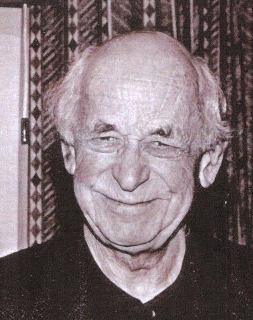
McFadden is born to Roland Victor MCFadden and his wife Maud Steele. A short time after his birth the family relocates to Belfast. He is educated at Knock Grammar School, Regent House School in Newtownards, and later graduates in Law from Queen’s University Belfast in 1944. He becomes a prominent lawyer and an influential figure in the Belfast literary scene.
McFadden’s first poem is published before he is thirteen. His earliest influences are from magazines and journals that his father brings home, and by Francis Turner Palgrave‘s Golden Treasury. He first comes to prominence as a promoter of Ulster literature in the 1940s when he edits two anthologies of poetry, Ulster Voices and Irish Voices in 1943. In 1948, he co-founds with Barbara Edwards (née Hunter) the Northern Irish poetry magazine Rann and then, co-edits it with her during its whole run, until 1953. Like its predecessor Lagan, it is unapologetically regionalist.
McFadden is the author of nine volumes of poetry, from Swords and Ploughshares (1943) to the posthumously published Last Poems (2002). Among his poems are “Saint Francis and the Birds” and “Independence”. His book, The Garryowen, is published by Chatto & Windus in the Phoenix Living Poets series. Most recently, his poem “Post-War” has been anthologised in Armistice: A Laureate’s Choice of Poems of War and Peace (Faber Poetry) (2018). There is a long gap between 1947 and 1971 when he publishes no collections of his work, however he continues to write and publishes in periodicals and newspapers such as The Irish Times where in that time he has sixty poems printed. His voice is well known on local BBC Radio through the Poetry Notebooks series, and he also has several verse-plays broadcast.
In 1952 McFadden marries Margaret Ferguson. Together they produce three sons and two daughters. He lives for a number of years in Lisburn, County Antrim. Inspired by Herbert Read and Alex Comfort, he describes himself as a pacifist and an anarchist in 1999. McFadden dies at his Belfast home on September 15, 1999.
The Roy McFadden Papers, comprising the poet’s personal manuscripts and papers, are lodged at Queen’s University Belfast. The Roy McFadden Library at Trinity College Dublin comprises books and journals on Irish and world literature from his collection. A comprehensive collection of his published work is held at the National Poetry Library, Southbank Centre, London.
In the summer of 1647, Murrough O’Brien (later created the Earl of Inchiquin), commander of the English Parliamentarian forces in Cork, ravages and burns the Confederate territory in Munster. This causes severe food shortages and earns O’Brien the Irish nickname, Murchadh na d’Tóiteán (Murrough the Burner). In addition, Inchiquinn takes the Rock of Cashel, which is garrisoned by Confederate troops and rich in emotive religious symbolism. In the sack of the castle, O’Brien’s troops massacre the garrison and all the clergy they find there.
The Confederates’ Munster army is incapable of stopping O’Brien because of political infighting between officers who support a deal with the English Royalists and those who reject such a deal. Eventually, in reaction to the sack of Cashel and famine conditions, the Confederate Supreme Council replaces Donough MacCarthy, 2nd Viscount Muskerry, as commander of the Munster army with Theobald Taaffe, 1st Earl of Carlingford, and order him to bring O’Brien to battle.
Taaffe is an English Catholic and not an experienced soldier. Although he has an excellent contingent of veteran troops under Alasdair Mac Colla, most of his men are similarly inexperienced. Furthermore, the Irish troops are demoralised by the internal factionalism in their ranks and most of them have little loyalty to Taafe. O’Brien, on the other hand, has been commanding his force since 1642 and is well experienced in battle. His troops are a mixture of well trained Parliamentarian soldiers from England and British settlers who have been driven from their homes in the Irish Rebellion of 1641. The two armies meet at Knocknanuss near Mallow, approximately 29 kilometers north of Cork.
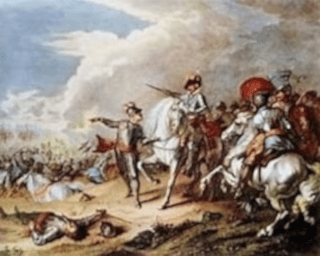
The battle that follows is essentially an uncoordinated rout of the Irish forces. Taaffe positions his men on either side of a hill, so that they cannot see one another. The result is that one wing of the Confederate army has no idea of what the other wing is doing. Mac Colla’s men charge the Parliamentarians opposite them putting them to flight and killing a large number of them. Thinking the battle is over, they then take to looting the enemy’s baggage train.
However, on the other wing, O’Brien’s cavalry has charged the raw Irish horsemen, causing them to run away. Despite Taaffe’s desperate attempt to rally them, the Irish infantry follow suit, many of them being cut down by the pursuing roundheads. The pursuit continues for miles and not only results in heavy casualties among the Irish, but also in the loss of most of their equipment and supplies. Inchiquin loses several senior officers, including the Judge-Advocate, Sir Robert Travers. Mac Colla and his men surrender when they realise what has happened but are subsequently killed by their captors. Around 3,000 Confederates die at Knocknanauss, and up to 1,000 English Parliamentarians. The carnage does not stop after the fighting is finished. The next day a couple of hundred Irish soldiers are found sheltering in a nearby wood. These are promptly put to the sword.
When combined with the Battle of Dungan‘s Hill in County Meath, the defeat leads to the collapse of the Confederate Catholic cause and forces them to make a deal with the English Royalists.
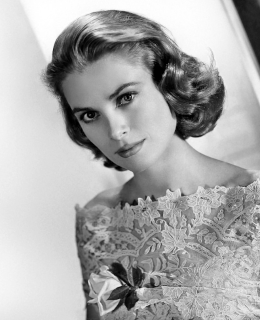
Kelly’s father, Irish AmericanJohn B. Kelly, Sr., wins three Olympic gold medals for sculling, and owns a successful brickwork contracting company that is well known on the East Coast. As Democratic nominee in the 1935 election for Mayor of Philadelphia, he loses by the closest margin in the city’s history. In later years he serves on the Fairmount Park Commission and, during World War II, is appointed by PresidentFranklin D. Roosevelt as National Director of Physical Fitness. Her mother, Margaret Majer, has German parents. She teaches physical education at the University of Pennsylvania and is the first woman to coach women’s athletics at Penn. She also models for a time in her youth. After marrying John Kelly in 1924, she focuses on being a housewife until her four children are of school age, following which she begins actively participating in various civic organizations.
Kelly receives her elementary education in the parish of Saint Bridget’s in East Falls. While attending Ravenhill Academy, a reputable Catholic girls’ school, she models fashions at local charity events with her mother and sisters. In 1942, at the age of 12, she plays the lead in Don’t Feed the Animals, a play produced by the Old Academy Players also in East Falls. In May 1947, she graduates from Stevens School, a socially prominent private institution in nearby Chestnut Hill, where she participates in drama and dance programs. Owing to her low mathematics scores, she is rejected by Bennington College in July 1947. Despite her parents’ initial disapproval, she decides to pursue her dreams of becoming an actress.
Kelly retires from acting at age 26 to marry Rainier and begins her duties as Princess of Monaco. Hitchcock hopes that she will appear in more of his films which require an “icy blonde” lead actress, but he is unable to coax her out of retirement. The Prince and Princess have three children: Princess Caroline, Prince Albert, and Princess Stéphanie. Princess Grace retains her link to America by her dual U.S. and Monégasque citizenship. Her charity work focuses on young children and the arts, establishing the Princess Grace Foundation-USA to support local artisans in 1964. Her organization for children’s rights, World Association of Children;s Friends (AMADE), gains consultive status within UNICEF and UNESCO. Her final film contribution is in 1977 to documentary The Children of Theatre Street directed by Robert Dornhelm, where she serves as the narrator. The documentary is nominated for an Academy Award for Best Documentary Feature.
On September 13, 1982, Princess Grace suffers a small stroke while driving back to Monaco from her country home in Roc Agel. As a result, she loses control of her 1971 Rover P6 3500 and drives off the steep, winding road and down the 120-foot mountainside. Her teenage daughter Stéphanie, who is in the passenger seat, tries but fails to regain control of the car. The Princess is taken to the Monaco Hospital (later named the Princess Grace Hospital Centre) with injuries to the brain and thorax and a fractured femur. She dies the following night at 10:55 PM after Rainier decides to turn off her life support. Stéphanie suffers a slight concussion and a hairline fracture of a cervical vertebra and is unable to attend her mother’s funeral.
McAuley is born on September 29, 1778, at Stormestown House in Dublin to James and Elinor (née Conway) McAuley. Her father dies in 1783 when she is five and her mother dies in 1798. She first goes to live with a maternal uncle, Owen Conway, and later joins her brother James and sister Mary at the home of William Armstrong, a Protestant relative on her mother’s side. In 1803, she becomes the household manager and companion of William and Catherine Callaghan, an elderly, childless, and wealthy Protestant couple and friends of the Armstrongs, at their estate in Coolock, a village northeast of Dublin. For 20 years she gives catechetical instruction to the household servants and the poor village children. Catherine Callaghan, who is raised in the Quaker tradition, dies in 1819. When William Callaghan dies in 1822, McAuley becomes the sole residuary legatee of their estate.
McAuley inherits a considerable fortune and chooses to use it to build a house where she and other compassionate women can take in homeless women and children to provide care and education for them. A location is selected at the junction of Lower Baggot Street and Herbert Street in Dublin, and in June 1824, the cornerstone is laid by the Rev. Dr Blake. As it is being refurbished, she studies current educational methods in preparation for her new endeavour. On the feast of Our Lady of Mercy, September 24, 1827, the new institution for destitute women, orphans, and schools for the poor is opened and McAuley, with two companions, undertake its management.
For three years, McAuley and her companions continue their work as lay women. She never intends to found a community of religious women. Her initial intention is to assemble a lay corps of Catholic social workers. In 1828 Archbishop of DublinDaniel Murray permits the staff of the institute to assume a distinctive dress and to publicly visit the sick. The uniform adopted is a black dress and cape of the same material reaching to the belt, a white collar and a lace cap and veil – such a costume as is now worn by the postulants of the congregation. In the same year the archbishop desires McAuley to choose some name by which the little community might be known, and she chooses that of “Sisters of Mercy,” having the design of making the works of mercy the distinctive feature of the institute.
McAuley is desirous that the members should combine with the silence and prayer of the Carmelites, with the active labours of a Sister of Charity. The position of the institute is anomalous, its members are not bound by vows nor are they restrained by rules. The clergy and people of the church of the time, however, are not supportive of groups of laywomen working independently of church structures. The main concern is for the stability and continuity of the works of mercy which the women had taken on. Should any of them get married or lose interest, the poor and the orphans whom they are caring for would then be at a loss.
McAuley’s clerical mentor urges her to form a religious institute. Along with two other women, Mary Ann Doyle and Mary Elizabeth Harley, she enters the novitiate of the Presentation Sisters to formally prepare for life as women religious in September 1830. On December 12, 1831, they profess vows and return to the House of Mercy. The Sisters of Mercy consider December 12, 1831, as the day of their founding as a religious community. Archbishop Murray assists McAuley in founding the Sisters of Mercy and professes the first three members. He then appoints her Mother Superior.
The rule of the Sisters of Mercy is formally confirmed by Pope Gregory XVI on June 6, 1841. McAuley lives only ten years as a Sister of Mercy, Sister Mary Catherine.
McAuley dies of tuberculosis at the age of sixty-three on November 11, 1841, at Baggot Street. She is buried at Baggot Street Cemetery. At the time of her death, there are 100 Sisters of Mercy in ten foundations. Shortly thereafter, small groups of sisters leave Ireland to establish new foundations on the east and west coasts of the United States, in Newfoundland, Australia, New Zealand, and Argentina.
Total worldwide membership consists of about 5,500 Sisters of Mercy, 5,000 Associates, and close to half a million partners in ministry. The Mercy International Centre in Dublin is the international “home” of Mercy worldwide and the mercyworld.org website is the virtual home.





 seamus dubhghaill