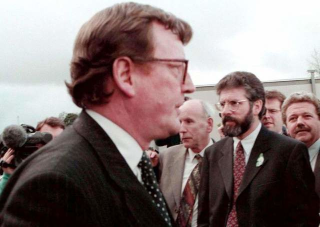
Sinn Féin says the meeting is a hugely significant move. “This is the first time in Irish history that a republican leader and a leader of unionism have sat down together in a room on their own,” says a spokesman. “This is about normalising relations between Sinn Féin and the First Minister.”
But the two men are not expected to shake hands after Trimble says Adams is still holding arms. They are likely to discuss decommissioning terrorist weapons.
The men meet briefly on Monday, September 7, in a round-table discussion of party leaders on procedural matters of the future government of the province, the Northern Ireland Assembly.
News of Trimble’s invitation to Adams breaks the previous week after the Sinn Féin President issues a firm denunciation of violence. But Trimble is adamant that the Irish Republican Army (IRA) must hand over arms before Sinn Féin can take seats in the new government. Sinn Féin has made moves in this direction by appointing strategist Martin McGuinness as an intermediary between the international arms decommissioning body and the IRA.
The 1998 Good Friday Agreement includes a power sharing administration under British rule and an all-Ireland ministerial council to promote island-wide co-operation. London is due to hand over a large measure of home rule powers by February 1999. In the meantime a “shadow” ruling executive must up be set up and mechanisms put in place to ensure smooth implementation of all aspects of the Agreement.
Meanwhile, two rebel Ulster Unionists who ran against official candidates in the 1998 Northern Ireland Assembly election are waiting to learn if they have been expelled from the party. Party officials say it will take several days to decide the future of the two members of the new parliament, Denis Watson and Boyd Douglas, who contested the June poll on an anti-Agreement ticket.
(From: “Trimble and Adams make history,” BBC News, news.bbc.co.uk, September 10, 1998)
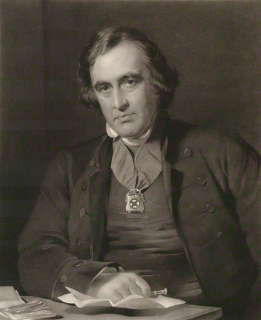
Trench is the son of Richard Trench (1774–1860), barrister-at-law, and the Dublin writer Melesina Chenevix (1768–1827). His elder brother is Francis Chenevix Trench. He is educated at Harrow School, and graduates from Trinity College, Cambridge in 1829. In 1830 he visits Spain. While incumbent of Curdridge Chapel near Bishop’s Waltham in Hampshire, he publishes The Story of Justin Martyr and Other Poems (1835), which is favourably received, and is followed by Sabbation, Honor Neale, and other Poems (1838), and Poems from Eastern Sources (1842). These volumes reveal the author as the most gifted of the immediate disciples of William Wordsworth, with a warmer colouring and more pronounced ecclesiastical sympathies than the master, and strong affinities to Alfred, Lord Tennyson, John Keble and Richard Monckton Milnes.
In 1841 Trench resigns his living to become curate to Samuel Wilberforce, then rector of Alverstoke, and upon Wilberforce’s promotion to the deanery of Westminster Abbey in 1845 he is presented to the rectory of Itchen Stoke. In 1845 and 1846 he preaches the Hulsean Lectures, and in the former year is made examining chaplain to Wilberforce, now Bishop of Oxford. He is shortly afterwards appointed to a theological chair at King’s College London.
Trench joins the Canterbury Association on March 27, 1848, on the same day as Samuel Wilberforce and Wilberforce’s brother Robert.
In 1851 Trench establishes his fame as a philologist by The Study of Words, originally delivered as lectures to the pupils of the Diocesan Training School, Winchester. His stated purpose is to demonstrate that in words, even taken singly, “there are boundless stores of moral and historic truth, and no less of passion and imagination laid up” — an argument which he supports by a number of apposite illustrations. It is followed by two little volumes of similar character — English Past and Present (1855) and A Select Glossary of English Words (1859). All have gone through numerous editions and have contributed much to promote the historical study of the English tongue. Another great service to English philology is rendered by his paper, read before the Philological Society, On some Deficiencies in our English Dictionaries (1857), which gives the first impulse to the great Oxford English Dictionary. He envisages a totally new dictionary that is a “lexicon totius Anglicitatis.” As one of the three founders of the dictionary, he expresses his vision that it will be “an entirely new Dictionary; no patch upon old garments, but a new garment throughout.”
Trench’s advocacy of a revised translation of the New Testament (1858) helps promote another great national project. In 1856 he publishes a valuable essay on Pedro Calderón de la Barca, with a translation of a portion of Life is a Dream in the original metre. In 1841 he had published his Notes on the Parables of our Lord, and in 1846 his Notes on the Miracles, popular works which are treasuries of erudite and acute illustration.
In 1856 Trench becomes Dean of Westminster Abbey, a position which suits him. Here he introduces evening nave services. In January 1864 he is advanced to the post of Archbishop of Dublin. Arthur Penrhyn Stanley had been first choice, but is rejected by the Church of Ireland, and, according to Bishop Wilberforce’s correspondence, Trench’s appointment is favoured neither by the Prime Minister nor the Lord Lieutenant. It is, moreover, unpopular in Ireland, and a blow to English literature, yet it turns out to be fortunate. He cannot prevent the disestablishment of the Church of Ireland, though he resists with dignity. But, when the disestablished communion has to be reconstituted under the greatest difficulties, it is important that the occupant of his position should be a man of a liberal and genial spirit.
This is the work of the remainder of Trench’s life. It exposes him at times to considerable abuse, but he comes to be appreciated and, when he resigns his archbishopric because of poor health in November 1884, clergy and laity unanimously record their sense of his “wisdom, learning, diligence, and munificence.” He finds time for Lectures on Medieval Church History (1878), and his poetical works are rearranged and collected in two volumes (last edition, 1885). He dies at Eaton Square, London, on March 28, 1886, after a lingering illness. He is buried at Westminster Abbey.
George W. E. Russell describes Trench as “a man of singularly vague and dreamy habits” and recounts the following anecdote of his old age:
“He once went back to pay a visit to his successor, Lord Plunket. Finding himself back again in his old palace, sitting at his old dinner-table, and gazing across it at his wife, he lapsed in memory to the days when he was master of the house, and gently remarked to Mrs. Trench, ‘I am afraid, my love, that we must put this cook down among our failures.'”
Martin first meets John Mitchel while attending Dr. Henderson’s private school in Newry. He receives an Arts degree at Trinity College Dublin in 1832 and proceeds to study medicine but has to abandon this in 1835 when his uncle dies, and he has to return to manage the family landholding.
In 1847 Martin is moved by the Great Famine to join Mitchel in the Repeal Association but subsequently leaves it with Mitchel. He contributes to Mitchel’s journal, United Irishman, and then following Mitchel’s arrest on May 27, 1848, he continues with his own anti-British journal, The Irish Felon, and establishes “The Felon Club.” This leads to a warrant for his arrest, and he turns himself in on July 8, 1848. He is sentenced on August 18, 1848, to ten years transportation to Van Diemen’s Land.
Martin arrives on the Elphinstone with Kevin Izod O’Doherty in Hobart, Tasmania, in November 1849. He accepts a “ticket of leave” which allows him to live in relative freedom at Bothwell, provided he promises not to escape.
While in Tasmania, Martin continues to meet in secret with his fellow exiles Kevin Izod O’Doherty, Thomas Francis Meagher, William Smith O’Brien, and John Mitchel. He and Mitchel live together before the arrival of Mitchel’s wife, Jenny. He chooses not to join Mitchel when Mitchel revokes his ticket of leave and escapes. Instead, he remains in Tasmania until he is granted a “conditional pardon” in 1854. This allows him to leave for Paris, and he returns to Ireland on being granted a full pardon in 1856.
On return to Ireland Martin becomes a national organiser for the Tenant Right League. He begins to write for The Nation in 1860. He forms the National League with others in January 1864 – it is mainly an educational organisation but Fenians disrupt its meetings. He remains in contact with Mitchel in Paris through 1866. He opposes the Fenians’ support of armed violence, yet, together with Alexander Martin Sullivan in December 1867, he heads the symbolic funeral march honouring the Manchester Martyrs as it follows the MacManus route to Glasnevin Cemetery, Dublin. He is briefly arrested for these activities, but the charges are dropped.
Martin is in the United States in December 1869 when he is nominated by Isaac Butt and his nationalists as the Irish nationalist Home Rule candidate to oppose Reginald Greville-Nugent, who is supported by the Catholic clergy, in the Longfordby-election. Greville-Nugent initially wins the vote, but the result is nullified by Judge Fitzgerald on the grounds that voters had been illegally influenced in the non-secret voting process. In the May 1870 re-run, Butt’s second candidate, Edward Robert King-Harman, like Martin a Protestant landlord, is also defeated, but this time legally.
Contradictions and factionalism are symptomatic of the struggle for influence and leadership at the time between the waning Church of Ireland and the rising Irish Catholic Church. Hence a secular Protestant land-owning, non-violent elite reformist nationalist who desires Home Rule like Martin, can find himself both sympathetic to and at odds with a militant organisation like the Fenians with their Jacobin– and American-influenced ideas of revolutionary republicanism and different social roots. Until Charles Stewart Parnell, the Isaac Butt-originated Home Rule forces could not obtain the support of the Catholic Church under the anti-Fenian CardinalPaul Cullen or manage to achieve more than short-term tactical alliances with Fenians, leading to a split and uncoordinated opposition to British rule. Protestants such as Martin and John Mitchel, with their early political roots in Young Ireland, are, whatever their political ideals, not part of the majority Catholic mainstream, which consists largely of tenants rather than landlords.
In the January 1871 by-election, Martin is elected by a margin of 2–1 to the seat of Meath in the British parliament as the first Home Rule MP, representing first Isaac Butt’s Home Government Association and from November 1873 the Home Rule League. This is unusual for a Protestant in a Catholic constituency, and is a measure of the popular esteem Martin is held in. He retains his seat in the 1874 United Kingdom general election as one of 60 Home Rule members. He is commonly known as “Honest John Martin.” In parliament he speaks strongly for Home Rule for Ireland and opposes Coercion Bills.
Martin dies in Newry, County Down, on March 29, 1875, homeless and in relative poverty, having forgiven tenant fees during preceding years of inflation and low farm prices. His parliamentary seat of County Meath is taken up by Charles Stewart Parnell.
Martin marries Henrietta Mitchel, the youngest sister of John Mitchel, on November 25, 1868, after twenty years of courtship. She shares her husband’s politics, and after his death campaigns for home rule believing this to be a continuation of the Young Ireland mandate. After the split in the party, she sides with Charles Stewart Parnell. She dies at her home in Dublin on July 11, 1913, and is buried in Newry.
The first organised action against British military forces since the 1916 Easter Rising, takes place at Fermoy, County Cork, on September 7, 1919. It is carried out by the Cork No. 2 Brigade of the Irish Republican Army (IRA) under the command of Liam Lynch. Their objective is an armed party of British soldiers who attend Sunday service at the Wesleyan Church at the eastern end of the town, the church being about half a mile from their barracks. It is not known if the rifles they carry are loaded but the assumption is that they are and plans are made for that contingency.
At around 10:30 a.m. on Sunday morning, September 7, 1919, fourteen soldiers and a corporal leave their barracks and march through the town towards the Wesleyan Church. They carry their rifles at the slope. Approximately twenty-five volunteers from Fermoy company, armed with just six revolvers between them, assemble in groups of two and three in the vicinity of the church, remaining well spread out to avoid attracting attention. The main attacking party of which Larry Condon is in charge, includes John Fanning Michael Fitzgerald, Patrick Ahern and James Fitzgerald. Another group is detailed to collect the rifles and transfer them to cars parked nearby, while the remainder are to close in from the rear when the attack begins and prevent any attempt by the British to get back to their barracks. Any volunteers who are unarmed carry short clubs hidden on their person.
One of the cars, with George Power in charge, is halted near the church, with two men attending to an imaginary breakdown. The second car, which includes Liam Lynch, drives up Patrick Street behind the party of soldiers, timing it to arrive at the church at the same moment as the soldiers. A whistle blast begins the assault. Liam Lynch calls on the soldiers to surrender but they immediately resist. The attackers rush them, shots are fired and for a minute or two there is a confused struggle. A soldier swinging a rifle butt at Lynch is shot dead while three others are wounded. When the soldiers are finally overpowered, their rifles are taken from them and piled into the Buick driven by Leo O’Callaghan. Into that car also goes Liam Lynch, Owen Harold, Ned Waters, Tom Griffin, Larry Condon, Michael Fitzgerald and John Fanning while Jack Mulvey’s Ford contains Pat Leahy, John Joe Hogan, Peter O’Callaghan, George Power and Dan Hegarty. Both cars head out the Tallow road while the remaining volunteers scatter on foot.
Shortly afterwards a bugle call at the barracks raises the alarm and within minutes two lorry loads of soldiers are speeding out the Lismore road in pursuit. However, at Carrigabrick, a mile and a quarter from the town, two trees on the roadside have been partly sawn through and then held in position by ropes. The moment the cars carrying the rifles pass, the trees come down with a crash thereby forcing the pursuers to make a detour and lose the trail. At Kilmagner, five miles from Fermoy, the rifles are taken to a pre-arranged spot and safely concealed. The following night they are transferred to a dump in the Araglen company area.
Much thought had been given to the selection of officers and men for the task. It is inevitable that those of them who are well known locally would thereafter have to evade arrest. Intensive searches by military and police continue throughout the day. Parties of military in lorries scour the countryside, cars are held up and many people questioned. Two days later the district is proclaimed a military area.
On the Monday night following the raid a large party of soldiers from the British garrison at Fermoy descend upon the town. They smash the windows in most of the shops in Pearse Square, MacCurtain Street and Patrick Street and loot the contents. The following night the troops are confined to barracks, but on Wednesday night they assemble again but find a large crowd of residents waiting for them in Emmet Street. Armed with sticks, stones and other weapons, the local people attack the soldiers so furiously that they are driven back to their barracks. Many citizens barricade their homes and premises and prepare to defend them against further attack, but by Thursday the spate of lawlessness appears to be over for the time being.
However, arrests soon follow. Local Battalion Commandant Michael Fitzgerald, Vice Commandant Larry Condon and Fermoy Company Captain, John Fanning, are among those detained. Others arrested are James Fanning, John Swaine, John Joe Hogan, Martin O’Keeffe, Dick O’Keeffe, Pat Leahy, Tom Griffin, Peter O’Callaghan and Jack Mulvey. Two months later further arrests are made at Mallow. Dan Hegarty, Brian Kelly, Ned Waters, Owen Harold and Leo O’Callaghan are detained. After a series of weekly remands, the prisoners are returned for trial at the Cork Assizes in July, 1920. At Cork the Grand Jury finds against Michael Fitzgerald, John Joe Hogan and Dan Hegarty. The remainder are released.
Although one of the finest cyclists of his generation and admired for his pedalling style, Roche struggles with knee injuries and never contends in the Grand Tours post-1987. He has 58 professional career wins. All of these wins still stand, despite Roche having been accused by an Italian judge of taking erythropoietin (EPO) in the later part of his career.
Roche is born in Dundrum, County Dublin, on November 28, 1959. On completion of his apprenticeship as a machinist in a Dublin dairy and following a successful amateur career in Ireland with the “Orwell Wheelers” club, he joins the Athletic Club de Boulogne-Billancourt amateur team in Paris to prepare for the 1980 Summer Olympics in Moscow. Soon after his arrival he wins the amateur Paris–Roubaix on the track at Roubaix. However, a knee injury caused by a poorly fitted shoe plate leads to a disappointing 45th place finish in Moscow. However, on return to France, August to October sees him win 19 races. That leads to a contract with the Peugeot professional cycling team for 1981.
Roche scores his first professional victory in 1981 by beating Bernard Hinault in the Tour of Corsica. In total, his debut year yields ten victories. In 1982 his best performance is second in the Amstel Gold Race, but his rise continues in 1983 with victories in the Tour de Romandie, Grand Prix de Wallonie, Étoile des Espoirs and Paris–Bourges. In 1984, riding for La Redoute following contractual wrangles with Peugeot, he repeats his Tour de Romandie win, and wins Nice-Alassio and Subida a Arrate. He finishes 25th in that year’s Tour de France.
In 1985, Roche wins the Critérium International and the Tour Midi-Pyrénées. In the Tour de France he wins Stage 18 to the Col d’Aubisque and finishes on the podium in third position, 4 minutes and 29 seconds behind winner Bernard Hinault. In 1986 at a six-day event with UK professional Tony Doyle at Paris-Bercy, he crashes at speed and damages his right knee. This destroys his 1986 season with little to show other than second in a stage of the Giro d’Italia. He finishes 48th in the 1986 Tour de France.
In 1987, Roche has a tremendous season. In the spring, he wins the Volta a la Comunitat Valenciana, taking a third victory in the Tour de Romandie and fourth place plus a stage win in Paris–Nice. In the Giro d’Italia, he takes three stage wins en route to overall victory and becomes the first Giro victor from outside Continental Europe. He goes into the 1987 Tour de France as the favorite. On stage 21, crossing the Galibier and Madeleine and finishing at La Plagne, he attacks early but is caught on the last climb. His nearest rival, Pedro Delgado, then attacks. Despite being almost one-and-a-half minutes behind midway up the last climb, he pulls the deficit back to 4 seconds. He then collapses and loses consciousness and is given oxygen.
The yellow jersey, worn by the leader of the general classification, changes hands several times with Charly Mottet, Roche, Jean-François Bernard and Delgado all wearing it before Roche uses the final 35 km time trial to overturn a half-minute gap and win the Tour by 40 seconds, which is at the time the second-narrowest margin. He becomes only the fifth cyclist in history to win the Tour and the Giro in the same year. He is also the only Irishman to win the Tour de France. Irish TaoiseachCharles Haughey joins Roche on the podium on the Champs-Élysées.
With victory at the World Professional Road Race Championship on September 6, 1987, in Villach, Austria, Roche becomes only the second to win the Triple Crown of Cycling. He arrives with insufficient training although he works during the 23-lap, 278 km undulating terrain for his teammate Sean Kelly and escapes in the race-winning break only while covering for his countryman. With Moreno Argentin in the following group, Kelly does not chase and as the break slows and jostling for position begins for a sprint, Roche attacked 500 m from the finish and crosses the line with metres to spare.
The 1988 season begins badly with a recurrence of the knee injury and Roche begins a gradual decline, retiring at the end of an anonymous 1993 which yields a single win, in the post-Tour de France criterium at Château-Chinon.
Sinn Féin President Gerry Adams announces on September 5, 2017, he will seek re-election as the party president in November and then outline his own future intentions as the former political wing of the Irish Republican Army (IRA) prepares to complete a generational shift in its leadership.
Adams, Sinn Féin leader for over thirty years, will seek re-election to the one-year post at the party’s annual conference and set out his future plans at that time. “I will be allowing my name to go forward for the position of Uachtaran Shinn Féin (President of Sinn Féin),” Adams says in a speech at a meeting of the party’s lawmakers. “And if elected I will be setting out our priorities and in particular our planned process of generational change, including my own future intentions.”
“We have no ambition to be part of the system. Our ambition is to change it. That means we must be in government – North and South,” Adams says.
Reviled by many as the face of the IRA during its campaign against British rule in Northern Ireland, Adams reinvented himself as a peacemaker in the troubled region and then as a populist opposition lawmaker in the Irish Republic. Around 3,600 people were killed during Northern Ireland’s “Troubles,” three decades of sectarian bloodshed between pro-British Protestantunionists and Catholicnationalists seeking a united Ireland that was ended by the 1998 Good Friday Agreement.
Whenever Adams decides to step down, he will almost certainly hand over to a successor with no direct involvement in the decades of conflict in Northern Ireland, say political analysts, making Sinn Féin a more palatable coalition partner in the Irish Republic where it has never been in power. Deputy leader Mary Lou McDonald, who has been at the forefront of a new breed of Sinn Féin politicians transforming the left-wing party’s image, is the clear favorite to take over. Michelle O’Neill, another Sinn Féin lawmaker in her 40s, succeeded Martin McGuinness as leader in Northern Ireland shortly before the former IRA commander’s death in March 2017.
With McGuinness, Adams turned Sinn Féin into the dominant nationalist party in Northern Ireland and the third largest party south of the border. Adams said the previous month that he intended to lead the party into the next parliamentary election in the Irish republic where suspicion of Sinn Féin’s role in the Northern Ireland troubles still runs deep among the main political parties.
The far larger ruling Fine Gael and main opposition Fianna Fáil, a more natural ally, have ruled out governing with Sinn Féin but analysts say a change of leader could soften that stance. The next election is expected in the next 12 months.
(From: “Sinn Féin’s Adams to outline succession plan in November” by Padraic Halpin | Photo: Sinn Féin President Gerry Adams speaks at an event in Gormanstown, Ireland, September 5, 2017, REUTERS/Clodagh Kilcoyne)
Soon afterwards Hazell transfers to the Royal Flying Corps. In April and May he is assigned to No. 5 Reserve Squadron, based at Castle Bromwich. He is appointed a flying officer on June 5 and survives a severe crash before completing his training. He eventually joins No. 1 Squadron on the Western Front. Flying Nieuport 17 Scouts, he shoots down 20 enemy aircraft between March and August 1917, being appointed a flight commander with the acting rank of captain on May 25, and is awarded the Military Cross on July 26.
After serving as an instructor at the Central Flying School in 1918, Hazell takes command of “A” Flight, No. 24 Squadron, flying the S.E.5a. On August 22, 1918, he shoots down an observation balloon despite its escort of seven Fokker D.VIIs. The escort is led by German ace Ernst Udet, who attacks and riddles Hazell’s petrol tank, propeller, and two longerons with bullets. In spite of this Hazell fights his way back, eyes full of petrol, and lands safely. Udet thinks he has forced the British pilot to crash and actually claims him as his 60th victory. Hazell finishes the war with 43 confirmed kills, the top British surviving ace of the war (excluding Dominion airmen). He is twice awarded the Distinguished Flying Cross. On June 11, 1927, he returns to the RAF Depot at Uxbridge and is placed on the retired list on July 20, 1927, at his own request.
In 1944, at the age of 52, Hazell becomes the commander of “D” Company, 24th (Tettenhall) Battalion, South Staffordshire Home Guard during the later part of World War II.
Hazell dies in Newport, County Mayo, on September 4, 1946, and is buried at the BurrishooleChurch of Ireland Cemetery there. In 2014 his grave, which had been largely forgotten and neglected, is restored, repaired, and re-dedicated in a ceremony on August 4, 2014, the 100th anniversary of the declaration of World War I.
Marmion is born April 1, 1858, in Dublin, the seventh of nine children of William Marmion and Herminie Marmion (née Cordier). He attends St. Laurence O’Toole’s, a primary school run by the Augustinian Fathers of John’s Lane. On January 11, 1869, he transfers to Belvedere College, where he receives an excellent grounding in Greek and Latin from the Jesuit Fathers. From there, he proceeded in January 1874 to Clonliffe College, where he remains until December 1879, when the new Archbishop of Dublin, Dr. Edward MacCabe, selects him for further theological studies in Rome.
Marmion is in Rome at the Pontifical Irish College, studying theology at the Propaganda College, for eighteen months (December 1879 – July 1881). Although invited by the authorities at Propaganda to present himself for the doctorate degree, he turns down the offer for health reasons, on account of the necessary extra year in Rome which this would entail. On returning to Dublin, he spends the first year as curate in Dundrum parish. This is followed by four years (1882–86) as professor of philosophy at Clonliffe. On October 25, 1886, he receives from the newly appointed Archbishop of Dublin, Dr. William Walsh, his dimissorial letters, granting him permission to join the Benedictine order. On November 21, 1886, he enters the newly founded BelgianMaredsous Abbey, with which, by virtue of the Benedictine vow of stability, he is to be associated for the rest of his life.
The first thirteen years of his monastic life (1886–99) are spent at Maredsous Abbey itself. After an unsuccessful start in the abbey school as a kind of housemaster to the junior boys, he finds his feet within the community through congenial work, notably the teaching of Thomistic philosophy to the junior monks. He also gradually builds up a reputation as a spiritual guide through the exercise of ministry on a small scale in the surrounding area. The next decade (1899–1909) finds him in Leuven as prior and professor of dogmatic theology at Mont César Abbey, which is founded and staffed by Maredsous. This decade provides a wide outlet for his matured spiritual doctrine through his lectures on dogmatic theology in Mont César, his retreats to priests and religious, and his private correspondence. The third and final phase of his monastic life begins when the chapter of Maredsous elects him as its third abbot in 1909.
An invitation is received from the Belgian government from December 1909 to April 1910 to undertake a Benedictine foundation in Katanga, part of the Belgian Congo. In spite of pressure from government quarters the chapter of Maredsous refuses the offer, and Marmion accepts this negative decision. In 1913 the entire community of Anglican Benedictines of Caldey Island, Wales, transfer their allegiance from Canterbury to Rome. Marmion becomes deeply involved in the spiritual and canonical process of the reception of the community into the Catholic church.
The outbreak of World War I ushers in four years of grave anxiety for Marmion. Belgium is not completely occupied but retains sovereignty over an area extending inland about twenty miles to the Ypres Salient. This enables the young monks of Maredsous, for whom Marmion had found a temporary home in Edermine, County Wexford, to travel to and from the Western Front, where they are being called up to serve as stretcher bearers in the Belgian army. He does his utmost to maintain the unity of his community between those who had remained in Maredsous and the Edermine group.
The first of Marmion’s great spiritual books, Christ, the Life of the Soul, appears in 1916, and its phenomenal success has been described as a silent plebiscite. This is followed by Christ in His Mysteries (1919), Christ the Ideal of the Monk (1922), and Sponsa Verbi (1923). The books are able to appear in rapid succession since they are compiled from his existing conference notes.
One final piece of important monastic and ecclesiastical and even political business absorbs much of Marmion’s energies, although strictly speaking it is not of his remit. His strenuous efforts to install Belgian monks in the Abbey of the Dormition on Mount Zion in Jerusalem following the internment (November 1918) of the original German Benedictine community by the victorious British forces are of no avail, the question being finally settled by the reinstallation of the German (Beuronese) monks in 1921.
Marmion dies at Maredsous on January 30, 1923, following a brief illness which originates in a chill and is aggravated by influenza.
Marmion is beatified by Pope John Paul II on September 3, 2000. This is the outcome of a popular reputation for holiness which had increased steadily since his death and the procedures for beatification prompted in 1954 by Mgr. Montini, the future Pope Paul VI. The canonical steps are: diocesan process at Namur (1957–61); examination at Rome of Marmion’s writings (1960–73); a critical biography (1987–94), written by Mark Tierney, OSB, for the Roman process on the ‘heroicity’ of Marmion’s virtues which concluded in June 1999; and finally, an inexplicable cure of cancer through Marmion’s intercession, judged as miraculous by Rome on January 25, 2000.
The originality of Marmion’s spiritual doctrine lay in his truly central emphasis on the doctrine of our adoption as the children of God in baptism. Many of his predecessors had also emphasised this doctrine, but few had made it the focus from which everything radiated and to which everything returned. The second characteristic of Marmion’s teaching, a much more personal trait, is the conviction of authenticity communicated by his writings, of the greatness of our sharing in the sonship of the Word. This makes a deep and lasting impression on the reader and gives an infinitely sacred meaning to the title ‘children of God’ and thereby to the whole of life. The third characteristic of Marmion’s teaching is the simplicity with which the deepest theological truths are presented – truths which preachers often feel their people cannot ‘take,’ and hence are left unsaid. Marmion presents these truths directly from St. John and St. Paul, and not merely in familiar extracts but in the whole sweep of their texts.
(From: “Marmion, Dom Columba” by Placid Murray, Dictionary of Irish Biography, http://www.dib.ie)
On April 9, 1980, the unit lures the Royal Ulster Constabulary (RUC) into an ambush on Stewartstown Road, killing one constable and wounding two others. On May 2 the unit is planning another attack and has taken over a house on Antrim Road, when an eight-man patrol from the SAS arrive in plain clothes, after being alerted by the RUC. A car carrying three SAS members goes to the rear of the house, and another car carrying five SAS members arrives at the front of the house. As the SAS members at the front of the house exit their car the IRA unit opens fire with the M60 machine gun from an upstairs window, hitting Captain Herbert Westmacott in the head and shoulder, killing him instantly. He is the highest-ranking member of the SAS killed in Northern Ireland. The remaining SAS members, armed with Colt Commando automatic rifles, submachine guns and Browning pistols, return fire but are forced to withdraw. Magee is apprehended by the SAS members at the rear of the house while attempting to prepare the IRA unit’s escape in a transit van, while the other three IRA members remain inside the house. More members of the security forces are deployed to the scene, and after a brief siege the remaining members of the IRA unit surrender.
The trial of Fusco and the other members of the M60 gang begins in early May 1981, with them facing charges including three counts of murder. On June 10 Fusco and seven other prisoners, including Joe Doherty and the other members of the IRA unit, take a prison officer hostage at gunpoint in Crumlin Road Jail. After locking the officer in a cell, the eight take other officers and visiting solicitors hostage, also locking them in cells after taking their clothing. Two of the eight are wearing officer’s uniforms while a third wears clothing taken from a solicitor, and the group moves towards the first of three gates separating them from the outside world. They take the officer on duty at the gate hostage at gunpoint and force him to open the inner gate. An officer at the second gate recognises one of the prisoners and runs into an office and presses an alarm button, and the prisoners run through the second gate towards the outer gate. An officer at the outer gate tries to prevent the escape but is attacked by the prisoners, who escape onto Crumlin Road. As the prisoners are moving towards the car park where two cars are waiting, an unmarked RUC car pulls up across the street outside Crumlin Road Courthouse. The RUC officers open fire, and the prisoners returned fire before escaping in the waiting cars. Two days after the escape, Fusco is convicted in absentia and sentenced to life imprisonment with a minimum recommended term of thirty years.
Fusco escapes across the border into the Republic of Ireland before being arrested in January 1982 and is sentenced to ten years imprisonment for the escape and firearms offences under extra-jurisdictional legislation. A further three years are added to his sentence in 1986 after he attempts to escape from Portlaoise Prison, and he is released in January 1992. Upon his release, he is immediately served with extradition papers from the British government for his return to the Maze Prison in Northern Ireland to serve his sentence for the murder conviction. The extradition is granted by a District Court but Fusco appeals, and in 1995 he wins a legal victory when a judge at the High Court in Dublin rules it would be “unjust, oppressive and invidious” to order his extradition due to the time lag involved. Fusco settles in Tralee with his wife and three children until February 1998, when the Supreme Court of Ireland brings an end to the six-year legal battle by ordering his extradition, but he has already fled on bail and a warrant is issued for his arrest.
Fusco is arrested at a Garda checkpoint in Castleisland, County Kerry, on January 3, 2000. The following day he is being escorted back to Northern Ireland to be handed over to the RUC, when his handover is halted by a successful court appeal by Sinn Féin. The arrest and abortive return of Fusco undermines the Northern Ireland peace process, with Unionist politicians including Ken Maginnis criticising the extradition being halted. Republicans are critical of Fusco’s arrest, with leading Sinn Féin member Martin Ferris stating, “The Irish government should immediately move to rescind the warrant against Angelo Fusco. The action will cause great anger and resentment within the nationalist community,” and graffiti in one republican area reads “Extradite Bloody Sunday war criminals, not Fusco.” On January 6 Fusco is refused bail and remanded to prison in Castlerea, County Roscommon, to await a legal review of his extradition, prompting scuffles outside the court between police and Sinn Féin supporters.
Fusco is freed on bail on March 21 pending the outcome of his legal challenge, and in November 2000 the Irish government informs the High Court that it is no longer seeking to return him to Northern Ireland. This follows a statement from Secretary of State for Northern IrelandPeter Mandelson saying that “it is clearly anomalous to pursue the extradition of people who appear to qualify for early release under the Good Friday Agreement scheme, and who would, on making a successful application to the Sentence Review Commissioners, have little if any of their original prison sentence to serve.” After the court hearing Fusco states, “I’m relieved it’s over,” and that he will continue to live in Tralee with his family and work for Sinn Féin.
In December 2000 Fusco and three other IRA members, including two other members of the M60 gang, are granted a royal prerogative of mercy which allows them to return to Northern Ireland without fear of prosecution.
Casement is born into an Anglo-Irish family, and lives his very early childhood at Doyle’s Cottage, Lawson Terrace, Sandycove. His father, Captain Roger Casement of the (King’s Own) Regiment of Dragoons, is the son of Hugh Casement, a Belfast shipping merchant who goes bankrupt and later moves to Australia. After the family moves to England, Casement’s mother, Anne Jephson (or Jepson), of a DublinAnglican family, purportedly has him secretly baptised at the age of three as a Roman Catholic in Rhyl, Wales.
The family lives in England in genteel poverty. Casement’s mother dies when he is nine years old. His father takes the family back to County Antrim in Ireland to live near paternal relatives. His father dies when he is thirteen years old. He is educated at the Diocesan School, Ballymena (later the Ballymena Academy). He leaves school at 16 and goes to England to work as a clerk with Elder Dempster Lines, a Liverpool shipping company headed by Alfred Lewis Jones.
Casement is a British consul in Portuguese East Africa (1895–98), Angola (1898–1900), Congo Free State (1901–04), and Brazil (1906–11). He gains international fame for revealing atrocious cruelty in the exploitation of native labour by white traders in the Congo and the Putumayo River region of Peru. His Congo report, published in 1904, leads to a major reorganization of Belgian rule in the Congo in 1908, and his Putumayo report of 1912 earns him a knighthood, which is ultimately forfeited on June 29, 1916.
Ill health forces Casement to retire to Ireland in 1912. Although he comes from an Ulster Protestant family, he has always sympathized with the predominantly Roman Catholic Irish nationalists. Late in 1913 he helps form the National Volunteers, and in July 1914 he travels to New York City to seek American aid for that anti-British force. After World War I breaks out in August, he hopes that Germany might assist the Irish independence movement as a blow against Great Britain. On arriving in Berlin in November 1914, he finds that the German government is unwilling to risk an expedition to Ireland and that most Irish prisoners of war would refuse to join a brigade that he intends to recruit for service against England.
Later, Casement fails to obtain a loan of German army officers to lead the Irish rising planned for Easter 1916. In a vain effort to prevent the revolt, he sails for Ireland on April 12 in a German submarine. Put ashore near Tralee, County Kerry, he is arrested on April 24 and taken to London, where, on June 29, he is convicted of treason and sentenced to death. An appeal is dismissed, and he is hanged at London’s Pentonville Prison on August 3, 1916, despite attempts by influential Englishmen to secure a reprieve in view of his past services to the British government. During this time, diaries reputedly written by Casement and containing detailed descriptions of homosexual practices are circulated privately among British officials. After years of dispute over their authenticity, the diaries are made available to scholars by the British home secretary in July 1959. It is generally considered that the passages in question are in Casement’s handwriting.
In 1965 Casement’s remains are repatriated to Ireland. Despite the annulment, or withdrawal, of his knighthood in 1916, the 1965 UK Cabinet record of the repatriation decision refers to him as “Sir Roger Casement.”
Casement’s last wish is to be buried at Murlough Bay on the north coast of County Antrim, in present-day Northern Ireland, but Prime MinisterHarold Wilson‘s government had released the remains only on condition that they could not be brought into Northern Ireland, as “the government feared that a reburial there could provoke Catholic celebrations and Protestant reactions.”
Casement’s remains lay in state at the Garrison Church, Arbour Hill (now Arbour Hill Prison) in Dublin for five days, close to the graves of other leaders of the 1916 Easter Rising. After a state funeral, his remains are buried with full military honours in the Republican plot in Glasnevin Cemetery in Dublin, alongside other Irish republicans and nationalists. The President of Ireland, Éamon de Valera, then the last surviving leader of the Easter Rising, attends the ceremony, along with an estimated 30,000 others.



 seamus dubhghaill