Henry II returns to England on April 17, 1172, having granted a charter to Dublin, the first granted to an Irish town.
Toward the end of 1171, Henry II, the first king of England to set foot on Irish soil, lands at Crook, County Waterford. His visit to Ireland serves two purposes. Firstly, it allows him to bring his adventurous English barons to heel and put the royal seal on their conquests in Ireland. Secondly, it means he can avoid meeting the cardinal legates who have been dispatched from Rome to investigate his complicity in the murder of the Archbishop of Canterbury, Thomas Becket, in 1170.
When the King of Leinster, Diarmait Mac Murchada, finds himself exiled in the late 1160s, he quickly finds help across the Irish Sea. He finds Henry II on the banks of the Loire in 1166 and is then pointed in the direction of south Wales by a Bristol merchant to find Richard FitzGilbert de Clare, more commonly known as Strongbow, who is then out of royal favour due to his prior support of Henry II’s competition for the kingship, Stephen of Blois.
Bolstered by English forces, Diarmait returns to Ireland and retakes his kingdom with Strongbow’s help, the latter earning the hand in marriage of Diarmait’s daughter, Aoife, in return. None of this has greatly concerned Henry II, until Diarmait dies, and Strongbow seizes the Kingdom of Leinster for himself in 1171. Leinster encompasses not only the counties of Carlow, Kilkenny, Wexford, Kildare, and parts of Wicklow, Laois, and Offaly, but the kings of Leinster are often the overlords of the flourishing Hiberno-Norse ports of Wexford and Dublin, both of which have considerable trading links with England and wider Europe.
Concerned with the growing power of Strongbow in Ireland, Henry II decides to head across the Irish Sea. He originally intends to arrive in Ireland in September 1171, but unfavourable winds on the coast of southwest Wales delay his journey for 17 days. He finally embarks from Pembroke on October 16 and arrives on the County Waterford coast the following day.
Naturally, Henry does not come alone and is at the head of an estimated 4,000 strong army comprised of 500 knights and their esquires and a large body of archers, all of which are carried, along with horses, in 400 ships. The undertaking is vast, and a large quantity of supplies are gathered to provision this considerable force. These ingredients include salted meats and fish, 1,000 lbs. of wax to ensure that Henry can seal charters and mandates, and, of course, the oil on which the medieval war machine runs, wine.
With the arrival of Henry II in Ireland, Strongbow surrenders the kingdom of Leinster and the Hiberno-Norse towns of Dublin, Wexford, and Waterford. Henry II regrants Leinster to Strongbow as a lordship, and later grants him Wexford. However, Waterford and Dublin become, and remain, royal ports.
Henry II then tours Ireland, showing the clergymen and native kings who their new lord is. He first visits Lismore and Cashel, then back to Waterford for a brief rest, before journeying by way of Kilkenny to Dublin, where he arrives around November 11. At all of his stop he collects the submissions of the Irish kings, with the probable exception of Ruaidrí Ua Conchobair (Rory O’Connor), who is the claimant to the high kingship of Ireland at the time.
Outside the city walls of Dublin, Henry II constructs a palace at the present-day southern side of Dame Street, where he celebrates the winter festivities until February 2. At this time, he also grants Dublin its first charter, on a piece of parchment measuring only 121 x 165 mm, which, extraordinarily, survives to this day. Henry’s charter to Dublin grants the right to live in the city to the men of Bristol, with whom the men of Dublin have enjoyed pre-existing economic relations.
About March 1, 1172, Henry II makes his way to Wexford, before finally departing for England on Easter Sunday, April 17, after celebrating Mass. It is probable that he had intended to stay in Ireland longer than he did, but events in England and Normandy divert his attention. In Normandy, Henry II’s son, Henry, has gone into rebellion against his father, while in England, the cardinal legates are threatening to interdict Henry’s lands unless he comes to meet with them regarding Becket’s murder.
The circumstances which lead to Henry II’s departure are more telling for Ireland’s future than any member of contemporary society could have realised. Now, Ireland has to compete with the other segments of a vast transnational realm, with lands stretching across England, Wales and France. Although Henry II is the first king of England to arrive in Ireland, his visit does not mean that royal visits would become a routine occurrence. Throughout the Middle Ages, the kings of England only directly visit Ireland in 1185, 1210, 1394–5, and 1399. As such, Henry’s visit and departure marks the beginning of absentee lordship over Ireland.
(From: “The royal visit: what did Henry II do in Ireland 850 years ago?” by John Marshall, PhD student in the Department of History at Trinity College Dublin, RTÉ, http://www.rte.ie | Pictured: Henry at Waterford, Ireland, October 18, 1172. Illustration by James E. Doyle (1864). Image: Historical Picture Archive/ Corbis via Getty Images)
Sheridan is born in Castlebar, County Mayo, on October 15, 1889. She has her early vocal training while at school at the Dominican Convent in Eccles Street, Dublin, with additional lessons from Vincent O’Brien. In 1908, she wins a gold medal at the Feis Ceoil. From 1909 to 1911 she studies at the Royal Academy of Music in London, during which time she is introduced to the Italian inventor Guglielmo Marconi, who is instrumental in arranging further studies for her in opera in Rome.
Sheridan returns to Italy, where her career continues to grow, with performances at the Teatro Dal Verme in Milan and at the Teatro di San Carlo in Naples, primarily in Puccini roles. In 1922 she first sings at La Scala, Milan, in La Wally by Alfredo Catalani under the direction of Arturo Toscanini. For the next few years, she sings at La Scala with great success. Perhaps her greatest role is Madama Butterfly, which she sings extensively in Italy and at Covent Garden. When she plays the part of Madama Butterfly, Puccini is said to be spellbound.
Despite her successes, Sheridan’s career is short. Suffering vocal difficulties, she goes into retirement around 1930 except for a few concerts. Bríd Mahon, in her 1998 book While Green Grass Grows, states that “It was rumoured that an Italian whose overtures she had rejected had blown his brains out in a box in La Scala, Milan, while she was on stage and that after the tragedy, she never sang in public again.”
Margaret Sheridan dies in relative obscurity on April 16, 1958, having lived in Dublin for many years, and her remains are buried in Glasnevin Cemetery, Dublin.
(Pictured: Margaret Burke Sheridan meets Italian conductor Vincenzo Bellezza in London, 1938. Photograph by Erich Salomon)
Long comes from a carpentry and blacksmithing background. In 1959, he enters Queen’s University Belfast to study civil engineering. He graduates with first class honours and then takes a PhD at Queens. In 1967, he moves to Canada, working as a bridge designer for Fenco Engineering in Toronto.
Long, however, spends only a year in Canada, returning to Belfast in 1968 to become an associate professor of civil engineering at Queen’s University Belfast. In 1976, he is promoted to a full professorship. His work is largely in the field of concrete structures, particularly in chloride resistance, maintenance problems and arch bridge structures. He publishes twenty papers in journals managed by the Institution of Civil Engineers and wins eight of the institution’s medals for these, including the ICE Gold Medal.
From 1997 Long works on the FlexiArch, a precast concrete arch in which the individual voussoirs are joined by a flexible polymeric membrane. The arch arrives to site flat packed and when lifted into position by a crane, the gaps between the voussoirs close under gravity and form the correct arch profile. He patents the product, which is produced by Irish precast manufacturer Macrete, in 2004. The product can be constructed within a day and, containing no corrodible elements, has been stated to have a design lifespan of 300 years. More than fifty FlexiArch bridges have been constructed in the UK and Ireland and spans up to 30m are possible.
By 2002, Long is appointed dean of the faculty of engineering at QUB. In November of that year, he is appointed president of the ICE for the 2002–2003 session, the first Northern Irish person to hold that position. He is also a Fellow of the Royal Academy of Engineering and of the Institute for the Advancement of Engineering.
Long is appointed an officer of the Order of the British Empire in the 2006 New Year Honours for services to higher education and civil engineering. He resigns as professor at QUB in 2006 but remains there as an emeritus professor in the School of Natural and Built Environment. Since 2015, the ICE Northern Ireland awards the Adrian Long medal to the best paper in an ICE journal to be authored by a Northern Ireland member. The medal features a bust of Long.
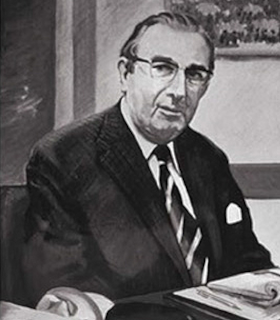
Dunne is born as Bernard Dunn in the village of Rostrevor, County Down, on May 19, 1908. He is the eldest son and second among three children of Barney Dunn, a businessman, and Margaret (née Byrne). His father inherits the Woodside Restaurant Temperance Refreshment Rooms and an auctioneering firm, and his mother runs a drapery business and later a shipping agency. He attends St. Mary’s School in Rostrevor until he is fourteen years old. While still in school he takes on a number of jobs, including repairing bicycles, rearing sheep, and working as a boot-boy at the home of Sir John Foster George Ross of Bladensburg. He is convinced not to emigrate to the United States by a family friend, Edward Whitaker.
Dunne moves to Drogheda in the newly established Irish Free State in 1926. He is employed as an apprentice first in Anderson’s of West Street, Drogheda, and later in Cameron’s Drapery store in Longford. It is after his move to Longford that he adds an “e” to his surname. In the mid-1930s, he moves to Cork, where he works as a buyer for Roches Stores in the menswear department. In 1944, he leaves Roches Stores to open a drapery shop with his friend, Des Darrer, across the road from Roches Stores on St. Patrick’s Street. A high-profile advertising campaign, combined with low prices, launches the venture successfully.
A second store opens on North Main Street, Cork, in 1947, which is followed by stores in Waterford and Mallow. Dunne and Darrer remain in partnership until 1952, when it is dissolved and Darrer takes ownership of the Waterford Dunnes Stores, renaming it Darrers.
The tenth store, in Wexford, opens in 1955, and the first store in Dublin opens in 1958. In 1960, Dunne launches the store’s first own-brand product, a lady’s jacket under the label St. Bernard. By 1964, Dunnes Stores has expanded into grocery and has an annual turnover of £6 million. He purchases two other Dublin stores, Bolger’s and Cassidy’s, in 1972, which have eleven shops across Dublin combined. Dunnes Stores opens its first branch in Northern Ireland in 1976.
Dunne meets his wife, Nora Maloney, while working at Roches Stores. They are married in September 1939 and have six children, including Margaret (Dunne) Heffernan, Frank, Elizabeth (Dunne) McMahon, Therese, and Ben Junior. Ben and later Margaret go on to work in the family business.
The family lives in Douglas, Cork, at Brownington Park, and in Blackrock, Cork, at Barnstead and at Ringmahon House. Following the establishment of the Dunnes Stores headquarters in Dublin in the early 1970s, the family moves to Jury’s Hotel, Dame Street. He and Nora later move to the Shelbourne Hotel, where they live until his death on April 14, 1983.
O’Connell had rejected a suggestion from “friends of emancipation,” and from the English Roman Catholic bishop, John Milner, that the fear of Catholic advancement might be allayed if the Crown were accorded the same right exercised by continental monarchs: a veto on the confirmation of Catholic bishops. O’Connell insists that Irish Catholics would rather “remain forever without emancipation” than allow the government “to interfere” with the appointment of their senior clergy. Instead, he relies on their confidence in the independence of the priesthood from Ascendancy landowners and magistrates to build his Catholic Association into a mass political movement. On the basis of a “Catholic rent” of a penny a month (typically paid through the local priest), the Association mobilises not only the Catholic middle class, but also poorer tenant farmers and tradesmen. Their investment enables O’Connell to mount “monster” rallies that stay the hands of authorities and embolden larger enfranchised tenants to vote for pro-emancipation candidates in defiance of their landlords.
O’Connell’s campaign reaches its climax when he himself stands for parliament. In July 1828, he defeats a nominee for a position in the British cabinet, William Vesey-FitzGerald, in a County Clare by-election, 2057 votes to 982. This makes a direct issue of the parliamentary Oath of Supremacy by which, as a Catholic, he will be denied his seat in the Commons.
As Lord Lieutenant of Ireland, Wellington’s brother, Richard Wellesley, had attempted to placate Catholic opinion, notably by dismissal of the long-serving Attorney-General for Ireland, William Saurin, whose rigid Ascendancy views and policy made him bitterly unpopular, and by applying a policy of prohibitions and coercion against not only the Catholic Ribbonmen but also the Protestant Orangemen. But now both Wellington and his Home Secretary, Robert Peel, are convinced that unless concessions are made, a confrontation is inevitable. Peel concludes, “though emancipation was a great danger, civil strife was a greater danger.” Fearing insurrection in Ireland, he drafts the Relief Bill and guides it through the House of Commons. To overcome the vehement opposition of both the King and of the House of Lords, Wellington threatens to resign, potentially opening the way for a new Whig majority with designs not only for Catholic emancipation but also for parliamentary reform. The King initially accepts Wellington’s resignation and the King’s brother, Ernest Augustus, Duke of Cumberland, attempts to put together a government united against Catholic emancipation. Though such a government would have considerable support in the House of Lords, it would have little support in the Commons and Ernest abandons his attempt. The King recalls Wellington. The bill passes the Lords and becomes law.
The key, defining, provision of the Acts is its repeal of “certain oaths and certain declarations, commonly called the declarations against transubstantiation and the invocation of saints and the sacrifice of the mass, as practised in the Church of Rome,” which had been required “as qualifications for sitting and voting in parliament and for the enjoyment of certain offices, franchises, and civil rights.” For the Oath of Supremacy, the act substitutes a pledge to bear “true allegiance” to the King, to recognise the Hanoverian succession, to reject any claim to “temporal or civil jurisdiction” within the United Kingdom by “the Pope of Rome” or “any other foreign prince … or potentate,” and to “abjure any intention to subvert the present [Anglican] church establishment.”
This last abjuration in the new Oath of Allegiance is underscored by a provision forbidding the assumption by the Roman Church of episcopal titles, derived from “any city, town or place,” already used by the United Church of England and Ireland. (With other sectarian impositions of the Act, such as restrictions on admittance to Catholic religious orders and on Catholic-church processions, this is repealed with the Roman Catholic Relief Act 1926.)
The one major security required to pass the Act is the Parliamentary Elections (Ireland) Act 1829. Receiving its royal assent on the same day as the relief bill, the act disenfranchises Ireland’s forty-shilling freeholders, by raising the property threshold for the county vote to the British ten-pound standard. As a result, “emancipation” is accompanied by a more than five-fold decrease in the Irish electorate, from 216,000 voters to just 37,000. That the majority of the tenant farmers who had voted for O’Connell in the Clare by-election are disenfranchised as a result of his apparent victory at Westminster is not made immediately apparent, as O’Connell is permitted in July 1829 to stand unopposed for the Clare seat that his refusal to take the Oath of Supremacy had denied him the year before.
In 1985, J. C. D. Clark depicts England before 1828 as a nation in which the vast majority of the people still believed in the divine right of kings, and the legitimacy of a hereditary nobility, and in the rights and privileges of the Anglican Church. In Clark’s interpretation, the system remained virtually intact until it suddenly collapsed in 1828, because Catholic emancipation undermined its central symbolic prop, the Anglican supremacy. He argues that the consequences were enormous: “The shattering of a whole social order. … What was lost at that point … was not merely a constitutional arrangement, but the intellectual ascendancy of a worldview, the cultural hegemony of the old elite.”
Clark’s interpretation has been widely debated in the scholarly literature, and almost every historian who has examined the issue has highlighted the substantial amount of continuity before and after the period of 1828 through 1832.
Eric J. Evans in 1996 emphasises that the political importance of emancipation was that it split the anti-reformers beyond repair and diminished their ability to block future reform laws, especially the great Reform Act of 1832. Paradoxically, Wellington’s success in forcing through emancipation led many Ultra-Tories to demand reform of Parliament after seeing that the votes of the rotten boroughs had given the government its majority. Thus, it was an ultra-Tory, George Spencer-Churchill, Marquess of Blandford, who in February 1830 introduced the first major reform bill, calling for the transfer of rotten borough seats to the counties and large towns, the disfranchisement of non-resident voters, the preventing of Crown officeholders from sitting in Parliament, the payment of a salary to MPs, and the general franchise for men who owned property. The ultras believed that a widely based electorate could be relied upon to rally around anti-Catholicism.
In Ireland, emancipation is generally regarded as having come too late to influence the Catholic-majority view of the union. After a delay of thirty years, an opportunity to integrate Catholics through their re-emerging propertied and professional classes as a minority within the United Kingdom may have passed. In 1830, O’Connell invites Protestants to join in a campaign to repeal the Act of Union and restore the Kingdom of Ireland under the Constitution of 1782. At the same, the terms under which he is able to secure the final measure of relief may have weakened his repeal campaign.
George Ensor, a leading Protestant member of the Catholic Association in Ulster, protests that while “relief” bought at the price of “casting” forty-shilling freeholders, both Catholic and Protestant, “into the abyss,” might allow a few Catholic barristers to attain a higher grade in their profession, and a few Catholic gentlemen to be returned to Parliament, the “indifference” demonstrated to parliamentary reform will prove “disastrous” for the country.
Seeking, perhaps, to rationalise the sacrifice of his freeholders, O’Connell writes privately in March 1829 that the new ten-pound franchise might actually “give more power to Catholics by concentrating it in more reliable and less democratically dangerous hands.” The Young IrelanderJohn Mitchel believes that the intent is to detach propertied Catholics from the increasingly agitated rural masses.
In a pattern that had been intensifying from the 1820s as landlords clear land to meet the growing livestock demand from England, tenants have been banding together to oppose evictions and to attack tithe and process servers.
Born in Blackwater Street off Grosvenor Road in west Belfast in 1916, White is one of ten children (five sons and five daughters) of Billy White, water technician with Belfast Corporation, and his wife Kathleen (née McKane). As a boy he sings in the choir of Clonard Monastery. He plays in a céilí band as a teenager and is a lifelong aficionado of Irish music and plays the banjo and other string instruments (often smuggling guns in their cases). As a young man he is also an active member of Granuaile GAA club, playing hurling and Gaelic football.
White works as a plumber and joins the Irish Republican Army (IRA) at an early age, being imprisoned several times during the 1930s. He travels to England to take part in the IRA’s “S-Plan” bombing campaign of 1939 to 1940, then returns to Dublin to pass his bomb-making skills on to new recruits, including Brendan Behan. He then returns to England to become the IRA’s Manchester Operations Officer but, after a bomb he is working on goes off in the flat he is renting, he flees to Glasgow, then back to Ireland.
Shortly after returning to Ireland, White is arrested while giving a lecture on explosives in County Offaly and is interned at the Curragh Camp. The republican prisoners are split into two groups, one led by Pearse Kelly, and the other by Liam Leddy. White is unhappy with the situation and refuses to take sides. Shortly after his arrival, IRA Chief of StaffSeán McCool is also interned, and is concerned that the locations of many of the IRA’s arms caches are known only to him. McCool asks him to get the information to the new leadership by “signing out,” declaring that he is no longer involved with a paramilitary group. He refuses as doing so would be breaking IRA orders, but McCool persists, suggesting that he could resign from the army before signing out, thereby not contravening IRA rules. Once released, he immediately rejoins the IRA and passes on the information. He is also made IRA Quartermaster General by Chief of StaffCharlie Kerins. However, he is suspected of involvement in the killing of a police officer, Dinny O’Brien – something which he always denies – and has to go on the run.
In October 1942, White and a comrade are cornered in a house. Here the details are unclear. Tim Pat Coogan claims that White is in a house in Donnycarney in County Dublin with Maurice O’Neill (executed in Mountjoy Prison on November 12, 1942), while Danny Morrison claims that White is at a wedding reception in Cavan with Paddy Dermody. Both agree that there is a shoot-out in which one officer is killed, enabling White to escape, but he falls down a railway embankment and hides for two days before emerging, hoping that the police hunt is over. In Coogan’s version, he catches a bus to Dublin, covered in blood and mud; while, according to Morrison, he is assisted by a sympathetic soldier who helps him recover and cycles to Dublin with him. They agree that he reaches a safe house once in the capital. Morrison claims that the Donnycarney shootout occurs four months later and that White travels north, rather than returning to Dublin a second time.
On arrival in the north, White is made Officer Commanding of the IRA Northern Command. Kerins is arrested in Dublin in June 1944 and later tried for murder and hanged. White becomes the only member of the IRA leadership still free. A wanted man, he travels around until work is arranged for him by supporters in Altaghoney, County Londonderry, Northern Ireland. There, he works as a handyman and barber and sets up a dance band, also managing to acquire some explosives from a local Royal Ulster Constabulary (RUC) officer who wants rocks cleared from his field. For at least part of his time in Altaghoney, he serves as the IRA Chief of Staff.
White is finally captured and tried in October 1946 and is handed over to the Irish authorities. He is sentenced to death, but this is reduced to twelve years’ imprisonment on appeal, a defence in which his former comrade Seán MacBride is involved. He is actually released early in 1948 following a change in government which leaves Mac Bride in a ministerial post.
Following his release, White remains active in the IRA, but in a less high-profile way, as he is married and settles in Dublin. He supports the Provisional IRA following its split in 1970 and is involved in smuggling weapons across the border.
White publishes his autobiography in 1985, actually ghostwritten by Uinseann MacEoin. Entitled Harry, it attracts press attention for naming the IRA members who killed Kevin O’Higgins, names which Peadar O’Donnell separately confirms. White’s nephew, Danny Morrison, becomes a prominent Irish republican from the 1970s onward.
Henry is the third of four sons of the Rev. Robert Mitchell Henry, minister of the Reformed Presbyterian Church, and his wife Kate Ann Berry, eldest of four daughters of Thomas Berry, minister of the Baptist church, Athlone. His father becomes a Baptist in 1858 and pastor of Great Victoria Street Baptist Church, Belfast, resigning in 1875 to join the Plymouth Brethren.
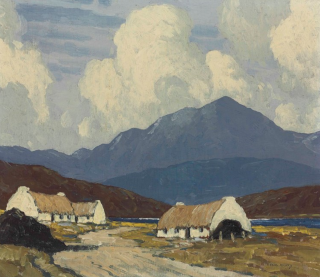
Henry marries the painter Emily Grace Mitchell on September 17, 1903, in London at St Peter’s Anglican church, Bayswater. He returns to Ireland in 1910. From then until 1919 he lives on Achill Island, where he learns to capture the peculiar interplay of light and landscape specific to the west of Ireland. In 1919, he moves to Dublin and in 1920 he is one of the founders of the Society of Dublin Painters, originally a group of ten artists. He designs several railway posters, some of which, notably Connemara Landscape, achieves considerable sales. He separates from his wife in 1929. His second wife is the artist Mabel Young.
In the 1920s and 1930s, Henry is Ireland’s best-known artist, one who has a considerable influence on the popular image of the west of Ireland. Although he seems to cease experimenting with his technique after leaving Achill and his range is limited, he creates a large body of fine images whose familiarity is a testament to its influence.
Henry’s use of colour is affected by his red-green colour blindness. He loses his sight in 1945 and does not regain his vision before his death.
A commemorative exhibition of Henry’s work is held at Trinity College, Dublin, in 1973 and the National Gallery of Ireland holds a major exhibition of his work in 2004.
A painting by Henry is featured on an episode of the BBC‘s Antiques Roadshow, broadcast on November 12, 2006. The painting is given a value of approximately £40,000–60,000 by the Roadshow. However, due to the buoyancy of the Irish art market at the time, it sells for €260,000 on December 5, 2006, in James Adams’ and Bonhams’ joint Important Irish Art sale.
Pictured: “Roadside Cottages, below Mweelrea Mountain” by Paul Henry, RHA, oil on panel, 1940)
Brownlow’s father, grandfather, and great-grandfather had been MPs, and in 1753 he wins a hotly contested by-election in which his opponents accuse him of papist and Jacobite sympathies. The unsuccessful candidate is Francis Caulfeild, brother of James, 1st Earl of Charlemont, his petition to parliament causing a furor and is defeated by only one vote in one of the most celebrated electoral struggles of the day. Brownlow represents the county for over forty years, from 1753 until his death. In 1753, he supports the government on the controversial money bill.
Brownlow marries Judith, daughter of the Rev. Charles Meredyth, Dean of Ardfert, of County Meath, on May 25, 1754. They have two sons. After her death in Lyon, France, in October 1763, he marries Catherine, daughter of Roger Hall of Newry, County Down, on November 25, 1765. They have two sons and five daughters, three who marry into the nobility. In 1758, he is one of the Wide Streets commissioners in Dublin and owns an imposing house in Merrion Square. He is a trustee of the linen board in Ulster, and makes many improvements to his estate, castle, and demesne, the local church, and the town of Lurgan. However, it is alleged that private roads in his demesne were built with public money. He is one of a few landowners in County Armagh who are believed to have misappropriated the unusually high county cess levied by the grand jury, of which he is a member. In 1758, he suggests that salaries be paid to government officials, and one official, Henry Meredyth, his first wife’s uncle, subsequently receives an annual salary of £500.
In June 1763, large numbers of Presbyterian farmers and weavers, calling themselves the Hearts of Oak, in a notable show of dissatisfaction with the privileges of landlords, march on the homes of the gentry to demand redress. Brownlow is in England and avoids a confrontation. Despite the allegations of abuse of public money, he is generally recognised as one of the more independent and reform-minded MPs of the day. He captains a Volunteer troop of dragoons which march from Lurgan to assist Belfast after the French commander François Thurot lands at Carrickfergus in 1760. As one of the supporters of Henry Grattan, he is prominent in the Volunteer movement of the 1780s. He is captain of the Lurgan Volunteer company and lieutenant-colonel of the northern battalion and backs the movement in parliament until displeased by the Volunteer national convention (November 10 – December 2, 1783), which seeks franchise reform and seems to challenge the authority of the existing parliament.
Brownlow subscribes £9,000 to help found the Bank of Ireland in 1783, and in parliament on February 7, 1785, vigorously opposes William Pitt‘s proposals on Ireland’s commercial relations with England, seeing in them the danger that Ireland would become a “tributary nation.” He is appointed a privy councilor in 1765. He organises horse races in his locality and is a talented harpsichord player. After his death on October 28, 1794, the Belfast News Letter prints an unusually long and glowing tribute, expressing admiration for his “incorruptible integrity” and patriotism, as well as two poetic elegies. He is succeeded by his son William Brownlow.
(From: “Brownlow, William” by Linde Lunney, Dictionary of Irish Biography, http://www.dib.ie, October 2009 | Pictured: Portrait of the Right Honorable William Brownlow, oil on canvas by Gilbert Stuart, circa 1790)
Kelly is raised in Ireland until he moves to England with his parents in 1969.
Kelly is an electronics student while performing part-time in the progressive/psychedelic band Chemical Alice, who releases their EPCuriouser and Curiouser in 1981. He is invited to join Marillion when they supported Chemical Alice, replacing founding keyboardist Brian Jelliman. His first performance with the band is at the Great Northern at Cambridge on December 1, 1981. He appears on every Marillion studio album. He also appears on John Wesley‘s album Under the Red and White Sky in 1994 and on Jump’s album Myth of Independence in 1995 on production and keyboards.
Kelly plays keyboards with Travis for their headlining set at the Isle of Wight Festival (June 10-12, 2005), and at T in the Park in 2005. He plays keyboards for Edison’s Children‘s new album In the Last Waking Moments…, featuring fellow Marillion member Pete Trewavas and Eric Blackwood, for the song “The ‘Other’ Other Dimension” as well as performing vocals with Steve Hogarth and Andy Ditchfield (DeeExpus) on the Edison’s Children track “The Awakening” in 2011.
Kelly is credited with inventing online crowdfunding to fund the recording of Marillion’s 2001 album Anoraknophobia, following a fan funded Marillion tour of the United States in 1997, and pioneers many of the ideas copied by other music artists since. He is made Co-CEO of the Featured Artists’ Coalition (FAC), an organization which represents the interests of music artists in the digital age. He stands down as a director of the FAC in 2018. From 2009 until 2020 he is an elected performer-director of Phonographic Performance Limited (PPL).
In 2016, Kelly is cast as a guest keyboardist in Ayreon‘s 2017 album The Source.
In September 2020, Kelly releases a single “Amelia” with his new solo band, Mark Kelly’s Marathon. The debut album is released in November 2020.
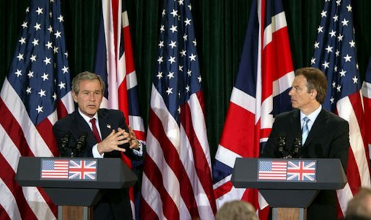
The two leaders meet at Hillsborough Castle and begin their sessions on April 7 with a half-hour walk through the gardens before dinner. The following day they hold a press conference and further talks, including a session on the Northern Ireland peace effort.
Bush and Blair, Bush’s closest ally in confronting Saddam Hussein, come together to discuss questions made increasingly urgent by the rapid military progress American and British forces have made and to plan for a postwar Iraq. They seek to bridge their differences over how much of a role to give the United Nations in rebuilding the country and putting together a new government.
Blair has been under pressure at home and from much of Europe to support giving the United Nations a strong role in stabilizing Iraq. The White House, however, has consistently signaled that it wants the United States and Britain to play the lead role in creating a new Iraqi government.
United States Secretary of StateColin L. Powell tells reporters traveling with the president that the United States is sending officials to the region to begin assembling a group of Iraqis who will constitute an interim governing authority and will be put in place alongside the American-led military and civilian authorities. In a sign of the speed with which the maneuvering for power in post-Hussein Iraq is unfolding, Ahmed Chalabi, the leader of the main Iraqi exile opposition group, the Iraqi National Congress (INC), is reported to be heading to Baghdad from southern Iraq.
“The hostilities phase is coming to a conclusion,” Powell says. “It’s time for all of us to think about the post-hostilities phase, how we create a representative government consisting of all elements of Iraqi society.”
Powell and British officials play down the magnitude of the differences between the United States and Britain over the United Nations role. The United Nations, Powell says, will have “an endorsing role to play to the interim authority to give it legitimacy,” a formulation that appears to reserve for the United States and Britain the right to select the leaders of the temporary postwar administration. A spokesman for Blair uses similar language, referring to the United Nations’ being involved “in a way that endorses that new Iraqi authority” as a step toward establishing a full-fledged Iraqi government.
Initially, primary responsibility for administering Iraq would rest with a team led by a retired United States Armylieutenant general, Jay Garner, and the interim Iraqi authority would be likely to begin assuming power after that, perhaps 90 days later, the British spokesman says.
Clearly wary of getting into another diplomatic squabble with other members of the United Nations Security Council, Powell and other administration officials have emphasized in recent days that the United States and Britain, having waged the war and paid for it with blood and money, will not be drawn into a negotiation with countries like France and Germany over the immediate postwar period.
Powell emphasizes, however, that part of his focus will now be on “healing” diplomatic wounds and granting the United Nations an important role once Iraq is stabilized.
At the United Nations, Secretary-GeneralKofi Annan says he will travel to Britain, France, Germany and Russia in the coming week to test whether the Security Council might be able to agree on a postwar plan. He announces that he has been working on post-conflict issues with a special adviser, Rafeeuddin Ahmed. He says he expects the United Nations to play an important role, whether as a political facilitator or dealing with issues like reconstruction or human rights. “Above all, the U.N. involvement does bring legitimacy, which is necessary, necessary for the country, for the region and for the peoples around the world,” Annan says.
Bush’s trip to see Blair here is the third British-American summit meeting in as many weeks. It coincides with news that American forces are attacking the presidential palaces and other symbols of the Iraqi government in the heart of Baghdad and that British soldiers have taken control of Iraq’s second-largest city, Basra.
The presence of the two leaders draws crowds of antiwar protesters and set off a local debate about whether this city, which has been trying to put behind it a history of sectarian violence, is an appropriate location for a war council.
The city authorities in Belfast have to divert traffic and clear public buildings in various locations following a series of bomb scares. The scenes are reminiscent of the conflicted time before the Northern Ireland peace agreement in 1998 put an end to organized sectarian violence that cost the lives of more than 3,600 people over three decades.
In the conversations about Iraq, Blair plays his customary role of trying to bridge trans-Atlantic differences. He hopes to placate criticism at home and ease relations with his European neighbors by pushing for a United Nations resolution authorizing an interim governing authority.
He had earlier envisaged a more prominent role for the United Nations, but he emerged from his last meeting with Bush, at Camp David on March 27, emphasizing the need for the United Nations to endorse the transition plans rather than play a central part in the plans, as he had advocated at the first summit meeting, in the Azores on March 16.
Europeans express alarm at what they see as the marginalization of the United Nations. At the same time, European critics of the war, like France, Germany and Russia, may object to Blair’s compromise proposal on grounds that it legitimizes a war they oppose. Even in Britain, the one European country where the war has majority support, there is great resistance to American domination of the postwar running of Iraq. An opinion poll in The Daily Telegraph shows that while Britons’ enthusiasm for the war has grown to a high of 60 percent and their approval of Blair’s conduct has also risen, there is only 2 percent approval of an American-controlled administration of Iraq.
Powell says the United States is only trying to lay out a plan under which military control of Iraq can give way to a mix of civilian and military control, including substantial involvement by Iraqis, and then to a full-fledged government. He says United Nations involvement might be necessary to convince banks and financial markets that they can safely and legally lend money to Iraq. Asked about peacekeeping duties, he says NATO is open to the possibility of helping to provide postwar security or assisting in the search for weapons of mass destruction.
Planning for the peace has exposed differences not only between the United States and Britain, but also within the Bush administration and between the administration and Congress.
Blair chose to hold his meeting with Bush in Northern Ireland in part so that the president can lend his support to the long-running efforts by Britain and Ireland to find a peaceful solution to the strife between Catholics and Protestants in the province. The White House, however, seems not to be paying much attention to Northern Ireland diplomacy. The schedules and credentials it distributes to reporters list the site as “Belfast, Ireland.”
(From: “Bush Meets With Blair to Discuss Postwar Iraq” by Richard W. Stevenson and Warren Hoge, The New York Times, http://www.nytimes.com, April 8, 2003)






 seamus dubhghaill