In May 2017, Kenny announces that he is planning to resign as Taoiseach and Fine Gael leader. Varadkar stands in the leadership election to replace him. Although more party members vote for his opponent, Simon Coveney, he wins by a significant margin among Fine Gael members of the Oireachtas and is elected leader on June 2. Twelve days later, he is appointed Taoiseach, and at 38 years of age becomes the youngest person to hold the office. He is Ireland’s first, and the world’s fourth, openly gay head of government and the first Taoiseach of Indian heritage.
In 2020, Varadkar calls a general election to be held in February. While polls in 2019 have suggested a favourable result for Fine Gael, they ultimately come in third in terms of seats and votes, behind Fianna Fáil and Sinn Féin, with 35 seats, a loss of 15 seats for the party from the previous general election, when it had finished in first position. He resigns and is succeeded by Micheál Martin as Taoiseach. He is subsequently appointed Tánaiste and Minister for Enterprise, Trade and Employment as part of a three-party coalition composed of Fianna Fáil, Fine Gael and the Green Party.
Cowen is exposed to politics at a young age. His grandfather was a councillor in the Fianna Fáil party, and his father, Bernard Cowen, held a seat in Dáil Éireann, the lower house of the Oireachtas (Irish parliament). He is an exemplary debater in school and often speaks at his father’s election rallies. He studies at University College Dublin and at the Incorporated Law Society of Ireland, where he is trained as a solicitor. His father’s death in 1984 prompts a by-election for the seat he had held in the Dáil. At the age of 24, he captures the seat, becoming one of the youngest members ever to sit in the Dáil.
Cowen’s political mentor is Albert Reynolds, who becomes Taoiseach in 1992 when Fianna Fáil is in a coalition government with the Progressive Democrats. He is an outspoken critic of the coalition, famously stating about the Progressive Democrats, “When in doubt, leave them out!” He serves as Minister for Labour (1992–93), and in 1993, after the breakup of the Fianna Fáil–Progressive Democrats government, he helps to negotiate the short-lived coalition of Fianna Fáil and the Labour Party. He then serves as Minister for Transport, Energy, and Communications (1993–94), leaving office after Fianna Fáil is forced into opposition by the formation of a Fine Gael–Labour–Democratic Left coalition.
During Fianna Fáil’s years out of government, Cowen serves successively as opposition Spokesperson for Agriculture, Food, and Forestry (1994–97) and Spokesperson for Health (1997). Following elections in 1997, Fianna Fáil leader Bertie Ahern forms a coalition government with the Progressive Democrats, and the party once again returns to power. Cowen serves as Minister for Health and Children (1997–2000), Minister for Foreign Affairs (2000–04), and Minister for Finance (2004–08). In June 2007 he was appointed Tánaiste.
Cowen is known for his sharp tongue and sometimes rough-hewn manner, but he is also recognized for his fierce intelligence, wit, and jovial demeanour. A combative politician and loyal party member, he is for many years seen as an obvious successor to Ahern. In April 2008, amid an investigation into possible past financial misconduct, Ahern announces that he will resign as Taoiseach and Leader of Fianna Fáil the following month. Cowen, who had remained supportive of Ahern throughout, is elected Leader of Fianna Fáil in April 2008. He becomes Taoiseach the following month and is faced with leading the country amid the global financial crisis that creates Ireland’s worst economy since the 1930s.
Cowen’s government oversees the bailout of Ireland’s banking system, which had been thrown into crisis by the collapse of the housing market, but the rescue comes at the cost of a skyrocketing deficit. As the country’s economic difficulties deepen, he seeks a cure that he hopes would obviate the need of foreign intervention, proposing an increase in income taxes and cuts in services. In November 2010, however, as concern for Ireland’s financial stability grows among its eurozone partners, he agrees to accept a bailout of more than $100 million from the European Union and the International Monetary Fund. There is concern in Ireland that one condition for foreign aid might be an increase in Ireland’s comparatively low corporate taxes. The Green Party, Fianna Fáil’s junior partner in the governing coalition, responds to the situation by calling for early elections.
In mid-January 2011 Cowen’s leadership of Fianna Fáil is challenged by Minister for Foreign Affairs Micheál Martin, partly in response to rumours that had swirled of a golf course meeting that had taken place between the Taoiseach and the former head of the Anglo Irish Bank before the government’s bailout of the Irish banking industry. He survives a leadership vote, but about one-third of the party’s parliamentary bloc votes against him. In a rapid succession of events that occur over the course of a few days, an unsuccessful reshuffle of the cabinet follows the resignation of six cabinet ministers, after which Cowen calls for an election to be held on March 11 and then announces that he will step down as party leader but continue as caretaker Taoiseach until the election. The Green Party then withdraws from the ruling coalition, forcing an even earlier election. Waiting until the parliament passes a finance bill that is necessary to meet the conditions of an International Monetary Fund–European Union loan but which imposes austerity measures that had proved very unpopular with much of the Irish public, he officially calls the election for February 25. Martin takes over as the Leader of Fianna Fáil, which suffers a crushing defeat in the election at the hands of Fine Gael.
In May 2014, Cowen becomes part of the board of Topaz Energy. He is appointed to the board of Beacon Hospital in February 2015. In July 2017, he is conferred with an honorary doctorate from the National University of Ireland. During his 50-minute acceptance speech he criticises the EU for its behaviour towards Ireland during the financial crisis and expresses regret that so many jobs were lost during the recession. Following the conferring ceremony, the NUI faces considerable public criticism for deciding to make the award to Cowen. Former (and founding) President of the University of Limerick, Edward M. Walsh, announces that he will hand back his own honorary doctorate in protest, and does so on November 14, 2018.
On July 5, 2019, Cowen is admitted to Beacon Hospital after suffering a major brain hemorrhage. He is then transferred to St. Vincent’s University Hospital where he spends five months before transferring to a physical rehabilitation facility. As of late 2020, while he is still in hospital following a stroke the previous year, he has been making steady progress.
Higgins is born on April 24, 1896, on the west coast of Ireland in Foxford, County Mayo. He is the eldest son of Joseph, a policeman stationed in Foxford at the time of his son’s birth, and Annie Higgins. His poem “Father and Son” is a loving tribute to his father. He grows up in Ballivor, County Meath, where his family has farmed for several generations. He spends the largest part of his adult life in Dublin, in a house he has built beside the River Dodder in Rathfarnham. His health is poor, and though his friends are inclined to regard him as a hypochondriac, his frequent predictions that he would die young prove to be accurate.
Higgins marries Beatrice May Moore in 1921. The marriage is a happy one. Even Frank O’Connor, who dislikes him, praises him as a kind and considerate husband. He is however reputed to have had a number of affairs, notably with the actress Ria Mooney.
Higgins is a student of William Butler Yeats and serves on the board of the Abbey Theatre from 1935 until his death. His best-known book of poetry is The Gap of Brightness (1940). He is also well known for his poem “Father and Son.” He writes a moving elegy for his fellow poet Pádraic Ó Conaire. He is generally acknowledged to be a fine poet but is less successful in his Abbey Theatre work. Frank O’Connor says unkindly that Higgins could not direct a children’s poetry recitation.
In 1937 Higgins is tour manager of the Abbey Theatre production of Teresa Deevy‘s Katie Roche, which tours to the Ambassador Theatre in New York City. There are five performances from October 2-6. His Abbey career can be seen in the Abbey Theatre archives.
Higgins is a popular and convivial man. Even O’Connor, who comes to regard him with deep suspicion, admits that he is a delightful person to know. His circle of friends includes many of the leading Irish literary figures of his time, including Yeats, Padraic O Conaire, George William Russell, Lennox Robinson, and for a time O’Connor. O’Connor, however, comes to regard him as untrustworthy and a troublemaker, and describes him unflatteringly in his memoir My Father’s Son. For Yeats, Higgins seems to feel a genuine affection, once remarking that he never left Yeats’ house without “feeling like a thousand dollars.” He is also capable of great kindness and generosity to younger writers like Patrick Kavanagh.
(Pictured: “F. R. Higgins,” Oil on Canvas by Sean O’Sullivan, courtesy of the Abbey Theatre, Dublin)
Ria Mooney, Irish stage and screen actress, artistic director of the Abbey Theatre (1948-1963) and director of the Gaiety School of Acting, dies in Dublin on January 3, 1973. She is the first female producer at the Abbey Theatre.
After spells abroad and at the Gate Theatre, Mooney is put in charge of the new Peacock Theatre and the Abbey Experimental Theatre Company at the Abbey in 1937. Her memoirs allude to an affair with the poet F. R. Higgins who is on the board of the Abbey. Ria and Higgins discover they are related, as third cousins, due to a chance conversation when they are both travelling to the United States together. She is shocked at his sudden death of a heart attack on January 6, 1941.
After Higgins’ death Ernest Blythe is named managing director. Mooney leaves the Abbey in 1944 to direct the Gaiety School of Acting. In January 1948 she becomes resident producer at the Abbey. It is a difficult time for the Abbey, and she has to contend with Blythe, a demanding manager with whom she does not see eye-to-eye. An unexpected blow is the death of F. J. McCormick on April 24, 1947. On July 17, 1951, fire destroys the Abbey Theatre. The company leases the old Queen’s Theatre in September and continues in residence there until 1966. She takes the opportunity to employ younger actors, many of whom she knows from her time teaching at the Gaiety. Among them are Ronnie Masterson, Joan O’Hara, Ray McAnally, Philip O’Flynn, Angela Newman, Bill Foley and Doreen Madden. Between 1948 and 1963, seventy-five new plays are produced at the two Abbey locations, with most of these directed by Mooney, and most receive excellent reviews from the Dublin critics.
Gregory becomes involved in republican politics, joining Sinn Féin and the Irish Republican Army (IRA) in 1964. In UCD he helps found the UCD Republican Club, despite pressure from college authorities, and becomes involved with the Dublin Housing Action Committee. Within the party he is a supporter of Wicklow Republican Seamus Costello. Costello, who is a member of Wicklow County Council, emphasises involvement in local politics and is an opponent of abstentionism. Gregory sides with the Officials in the 1970 split within Sinn Féin. Despite having a promising future within the party, he resigns in 1972 citing frustration with ideological infighting in the party. Later, Costello, who had been expelled by Official Sinn Féin, approaches him and asks him to join his new party, the Irish Republican Socialist Party. He leaves the party after Costello’s assassination in 1977. He is briefly associated with the Socialist Labour Party.
Gregory contests the 1979 local elections for Dublin City Council as a “Dublin Community Independent” candidate. At the February 1982 general election, he is elected to Dáil Éireann as an Independent TD. On his election he immediately achieves national prominence through the famous “Gregory Deal,” which he negotiates with Fianna Fáil leader Charles Haughey. In return for supporting Haughey as Taoiseach, he is guaranteed a massive cash injection for his inner-city Dublin constituency, an area beset by poverty and neglect.
Although Gregory is reviled in certain quarters for effectively holding a government to ransom, his uncompromising commitment to the poor is widely admired. Fianna Fáil loses power at the November 1982 general election, and many of the promises made in the Gregory Deal are not implemented by the incoming Fine Gael–Labour Party coalition.
Gregory is involved in the 1980s in tackling Dublin’s growing drug problem. Heroin had largely been introduced to Dublin by the Dunne criminal group, based in Crumlin, in the late 1970s. In 1982 a report reveals that 10% of 15- to 24-year-olds have used heroin at least once in the north inner city. The spread of heroin use also leads to a sharp increase in petty crime. He confronts the government’s handling of the problem as well as senior Gardaí, for what he sees as their inadequate response to the problem. He co-ordinates with the Concerned Parents Against Drugs group in 1986, who protest and highlight the activities of local drug dealers and defend the group against accusations by government Ministers Michael Noonan and Barry Desmond that it is a front for the Provisional IRA. He believes that the solution to the problem is multi-faceted and works on a number of policy level efforts across policing, service co-ordination and rehabilitation of addicts. In 1995 in an article in The Irish Times, he proposes what would later become the Criminal Assets Bureau, which is set up in 1996, catalysed by the death of journalistVeronica Guerin. His role in its development is later acknowledged by then Minister for JusticeNora Owen.
Gregory also advocates for Dublin’s street traders. After attending a sit-down protest with Sinn Féin Councillor Christy Burke, and future Labour Party TD Joe Costello on Dublin’s O’Connell Street in defence of a street trader, he, Burke and four others are arrested and charged with obstruction and threatening behaviour. He spends two weeks in Mountjoy Prison after refusing to sign a bond to keep the peace.
Gregory remains a TD from 1982 and, although he never holds a government position, remains one of the country’s most recognised Dáil deputies. He always refuses to wear a tie in the Dáil chamber stating that many of his constituents could not afford them.
Gregory dies on January 2, 2009, following a long battle with cancer. Following his death, tributes pour in from politicians from every party, recognising his contribution to Dublin’s north inner city. During his funeral, politicians from the Labour Party, Fianna Fáil and Fine Gael are told that although they speak highly of Gregory following his death, during his time in the Dáil he had been excluded by many of them and that they were not to use his funeral as a “photo opportunity.” He is buried on January 7, with the Socialist Party‘s Joe Higgins delivering the graveside oration.
Patrick Anthony HennessyRHA, Irish realist painter known for his highly finished still lifes, landscapes and trompe-l’œil paintings, dies in London on December 30, 1980. The hallmark of his style is his carefully observed realism and his highly finished surfaces, the result of a virtuoso painting technique.
Hennessy is born in Cork, County Cork, on August 28, 1915. The son of John Hennessy an army sergeant major from County Kerry and Bridget Hennessy from Cork. His father is killed in World War I at the Battle of Passchendaele in 1917. In 1921, when he is five years old, his mother remarries in Cork. Her second husband is a Scot named John Duncan and shortly afterwards the whole family moves to Arbroath, Scotland, where Duncan has relatives.
Hennessy is educated in Arbroath at St. Thomas RC Primary School followed by secondary education at Arbroath High School, where he begins to show an aptitude for art, leaving in 1933 with the Dux for Art and an accompanying medal. In the autumn of 1933 he enrolls at the Dundee of Jordanstone College of Art & Design, for a four-year Diploma course in Drawing and Painting under James McIntosh Patrick and Edward Baird. Here he meets Harry Robertson Craig who becomes his lifelong companion. He plays a full part in the social activities of the college, winning a fancy dress award at the Christmas revels in 1935 and producing a ballet “Paradise Lost” the following year. He gains a First Class Pass in each year of the course along with winning first prize in 1934 and 1936 for work done during the summer vacation. He graduates with a First Class Distinction in 1937.
Having gained a scholarship, Hennessy continues his studies at the Dundee of Jordanstone College of Art & Design for a further year by doing a Post-Graduate Diploma course in Drawing and Painting. Within a month of gaining his Post-Graduate Diploma he holds his first joint exhibition at the Art Galleries in Arbroath. In June 1938 he is awarded the Annual Travelling Scholarship for further studies in Paris and Italy. In Paris he meets up with the artists Robert Colquhoun and Robert MacBryde, whom he had met the previous year, the three travelling south together to Marseilles towards the end of that year. On his return to Scotland he is selected for the residential summer school course at Hospitalfield House near Arbroath under James Cowie. Two of his paintings, a still life and a self-portrait, are accepted that year by the Royal Scottish Academy for their Annual Exhibition. However, by the autumn of 1939 with war looming and feeling somewhat disenchanted on his return to Scotland, he decides to return to Ireland.
On arrival in Dublin Hennessy is offered an exhibition in December 1939 at the Country Shop on St. Stephen’s Green which is opened by Mainie Jellett. This attracts favourable attention. During the early 1940s he lives at various addresses in and around Dublin with frequent trips to Cork. In 1940 he is invited to join the Society of Dublin Painters and holds regular annual exhibitions of his work there during the 1940s and early 1950s. These exhibitions are supplemented by an eclectic mix of commissions, mostly portraits which he undertakes during this period. In 1941 he has three of his paintings accepted by the Royal Hibernian Academy (RHA) for their annual exhibition. This is the beginning of a long relationship with the RHA. He exhibits there virtually every year from 1941 until 1979, the year before his death.
From the early 1940s onwards, Hennessey’s work sometimes incorporates a homosexual visual subtext. He re-unites with Harry Robertson Craig in 1946 and soon after they move to Crosshaven, County Cork, and later to Cobh. In 1947, Time magazine selects him as one of Ireland’s outstanding painters, in recognition of the important position he has then attained in the art world. In 1948 he has an exhibition at the Victor Waddington Gallery, Dublin, and that same year is elected an associate of the Royal Hibernian Academy and a full member the following year. In 1950 his painting De Profundis is selected for the Contemporary Irish Painting exhibition that tours North America. As a result of this tour, the American public and critics begin to take notice of his work. In 1951 he visits Italy, taking in Venice and Sicily and returning to Dublin with many of his canvases painted abroad. One of these paintings, Bronze Horses of St. Marks, is exhibited at the Royal Academy of Arts in London in 1954.
In 1956, a friend of Hennessy, David Hendriks, opens the Ritchie Hendriks Gallery on St. Stephen’s Green, Dublin and it is this gallery that is to be the main outlet for his work over the following 22 years. In October 1956 the Thomas Agnew Gallery in London holds an exhibition of his work comprising 38 of his paintings. However, during the winter of 1959 he becomes seriously ill with pneumonia. As a consequence of this, in the autumn of that year he and Craig decide to winter in Morocco. This is the beginning of a new era in both their lives. They would never again spend a full year in Ireland. His exhibitions at the Ritchie Hendriks Gallery had for many years enjoyed favourable reviews from the art critics but in the 1960s this changes with critics claiming his paintings to be dull, repetitive and suggest he needs to explore new areas. Despite the barrage of criticism, in 1965 the Guildhall Gallery in Chicago offers him a major exhibition. Shortly after this exhibition takes place in 1966 he becomes one of the artists on permanent display at the gallery with an annual exhibition. The North American market is extremely lucrative for him and by the end of the decade he is selling more of his work in the United States than in Ireland. In 1968 he finally moves to Tangier, Morocco on a permanent basis and in 1970 sells his studio on Raglan Lane, Dublin.
In Morocco, Hennessy paints prolifically for nine years to keep up with demand from the Hendriks Gallery and Guildhall Gallery along with the RHA. In 1975 the Guildhall Gallery mounts a highly successful Retrospective of his work. In 1978 he has his last exhibition in Dublin at the Hendriks Gallery. By this time he has moved to the Algarve, Portugal and is beginning to have health problems.
In November 1980, with his health deteriorating, Craig brings Hennessy to a hospital in London for treatment. However, on December 30, 1980 he dies from cancer. Following cremation his ashes are buried in nearby Golders Green Crematorium. He leaves his entire estate to Harry Robertson Craig with the proviso that on Craig’s death the Royal Hibernian Academy should be the beneficiary. This legacy has been used to set up the annual Hennessy Craig Scholarship for aspiring artists.
Hennessy falls into the category of painter who develops a distinctive personal style, labelled at various times in his life as a Traditional Realist, Romantic, Photo Realist, Illusionary and Surrealist. However, he always remains intrinsically himself. His subjects range from still life and interiors to landscapes and portraits.
O’Toole makes his motion picture debut in Kidnapped in 1960 and two years later becomes an international star for his portrayal of T.E. Lawrence in David Lean’s epic Lawrence of Arabia (1962). In 1964 he plays Henry II of England in Becket, and he has the title role in Lord Jim (1965). He appears as Henry II again in The Lion in Winter (1968), a film notable for the witty verbal sparring matches between O’Toole and costar Katharine Hepburn. The Ruling Class (1972), a controversial black comedy that has become a cult classic, casts O’Toole as a schizophrenic English earl with a messiah complex.
Personal problems contribute to a decline in his popularity during the 1970s, but he makes a strong comeback in the early 1980s with three well-received efforts. He portrays a duplicitous and domineering movie director in The Stunt Man (1980), and his performance as the Roman commander Lucius Flavius Silva in the acclaimed television miniseries Masada (1981) is hailed as one of the finest of his career. His most popular vehicle during this period is My Favorite Year (1982), an affectionate satire on the early days of television, in which he plays Alan Swann, a faded Errol Flynn-type swashbuckling screen star with a penchant for tippling and troublemaking.
O’Toole subsequently maintains his status with fine performances in such films as the Oscar-winning The Last Emperor (1987), the cult favourite Wings of Fame (1989), and Fairy Tale: A True Story (1997), in which he portrays Sir Arthur Conan Doyle. Notable screen roles in the 21st century included King Priam in the historical epic Troy (2004), an aging romantic in Venus (2006), the voice of a haughty food critic in the animated Ratatouille (2007), and a priest in the historical drama For Greater Glory (2012). In addition, in 2008 he portrays Pope Paul III in the TV series The Tudors.
In 1992 O’Toole publishes a lively memoir, Loitering with Intent: The Child. A second volume, Loitering with Intent: The Apprentice, appears in 1996. He is nominated for an Academy Award eight times — for Lawrence of Arabia, Becket, The Lion in Winter, Goodbye, Mr. Chips (1969), The Ruling Class, The Stunt Man, My Favorite Year, and Venus — but never wins. In 2003 he is awarded an honorary Oscar. He receives an Emmy Award for his performance as Bishop Pierre Cauchon in the television miniseries Joan of Arc (1999).
O’Toole dies on December 14, 2013, at Wellington Hospital in St. John’s Wood, London, at the age of 81. His funeral is held at Golders Green Crematorium in London on December 21, 2013, where his body is cremated in a wicker coffin. His ashes are planned to be taken to Connemara, Ireland. They are kept at the residence of the President of Ireland, Áras an Uachtaráin, by President Michael D. Higgins, an old friend of O’Toole. His family has stated their intention to fulfill his wishes and take his ashes to the west of Ireland.
Wynne-Jones is born to landowner Charles Llewellyn Wynne-Jones and Sybil Mary Gella Scott. The family spends half the year in Wales and half the year in Thornhill, Stalbridge, Dorset, England. She has two brothers, Andrew and Ronald (“Polly”), both of whom die in Africa during World War II.
Wynne-Jones is educated at home. Her skill in art leads to her getting lessons in Sherborne from a children’s book illustrator. Her music is encouraged by the family doctor, and she begins to compose and study the violin, receiving lessons in Bournemouth with the first violinist of the symphony orchestra and continues in Aberystwyth after the start of World War II. She goes on to study the violin and composition at the Royal Academy of Music, London (1940–43). While in London she also serves as a Voluntary Aid Detachment nurse until 1943 and later as a draughtswoman at the Ordnance Survey.
After the war Wynne-Jones purchases and manages a bookshop on the King’s Road in Chelsea, but it is not a financial success. She returns to painting, studying at the Heatherley School of Fine Art, London (1951-52) and the Chelsea School of Art (1952–55). She travels extensively through Portugal and Italy painting landscapes. An interest in completing landscapes in an abstract manner leads her to study with Peter Lanyon in St. Ives, Cornwall.
Wynne-Jones begins study in Cornwall in 1957 and remains there for fifteen years. Her first public exhibition is in a group show (1957) at the Pasmore Edwards Gallery, Newlyn. Other group shows are Jefferson Place Gallery, Washington, D.C., (1959), and in Falmouth, Cornwall (1960). Her solo exhibitions are at the New Vision Centre, London (1962 and 1965), Florence (1963) and Dolgellau (1964). From the 1960s through the 1990s she exhibits in Great Britain, Italy, Belgium, Germany, Ireland, Spain, Holland, South Africa, and the United States.
In 1962 Wynne-Jones purchases Trevaylor House near Penzance and provides accommodation for other artists including renowned Irish painter Tony O’Malley, sculptor Conor Fallon, and English poet and writer W. S. ‘Sydney’ Graham. In the 1970s she exhibits in Ireland at the Project Arts Centre, Dublin (1970) and at the Emmet Gallery, Dublin (1975 and 1977). During the 1980s she exhibits at the Lincoln and Hendricks galleries in Dublin before joining the Taylor Galleries, run by John and Patrick Taylor. She is elected honorary member of the Royal Hibernian Academy (RHA) in 1994 and becomes a member of Aosdána in 1996. Originally an abstract artist, her contact with the Irish countryside slowly transforms her work to that of a landscape artist, albeit with an influence of abstraction attached to it. She becomes well known in Irish art circles as an eminent Irish landscape artist.
Wynne-Jones is involved with artist Derek Middleton before moving to Cornwall. There she becomes romantically involved with Graham who is in an open marriage, however it is the death of her mentor Peter Lanyon that devastates her. She meets the sculptor Conor Fallon through their mutual friend Tony O’Malley. Fallon had arrived in Cornwall ostensibly to meet Lanyon. They marry in 1966. Their honeymoon in Provence is immortalised in expressionist paintings done by Wynne-Jones. The couple adopts a boy and a girl, siblings, John and Bridget. In 1972 she moves with her family to Kinsale, County Cork. It is in this area that a number of her paintings are created. She moves to Ballard House, near Rathdrum, County Wicklow in 1987. There she paints the mountain visible from her home.
Wynne-Jones dies at the age of 83 on November 9, 2006. She is buried in Ballinatone (Church of Ireland), Rathdrum.
(Pictured: “Klein Constantia with Table Mountain” by Nancy Wynne-Jones, acrylic on paper, 16 1/2″ x 23″)
Zappone is nominated by Taoiseach Enda Kenny to the 24th Seanad in 2011, having been recommended by Eamon Gilmore, the then leader of Fine Gael‘s coalition partners, the Labour Party. With her Seanad nomination, she becomes the first openly lesbian member of the Oireachtas and the first member in a recognised same-sex relationship.
Zappone is elected to the Dáil for the Dublin South-West constituency at the 2016 Irish general election, becoming the first openly lesbian TD and, by her own reckoning, the world’s 32nd lesbian to be elected to a national parliament. In May 2016, after a delay in government formation, due to prolonged talks, she becomes Ireland’s first openly lesbian government Minister and the first Minister to have been openly gay at the time of appointment to cabinet, when Taoiseach Enda Kenny appoints her as the Minister for Children and Youth Affairs. She loses her seat at the February 2020 Irish general election and continues to serve as a minister until June 2020 on the election of a new government.
In July 2021, it is announced that Zappone is to be appointed to the newly created position of Special Envoy to the UN for Freedom of Opinion and Expression. It subsequently emerges that the proposed appointment had not been flagged in advance of the Cabinet meeting where it was proposed by Minister Simon Coveney, raising the concerns of the Taoiseach, Micheál Martin. However, he does not block the appointment, attracting criticism from within government, the opposition and the public, with Sinn Féin describing the appointment as “cronyism.”
In the following days it is reported that Zappone had lobbied for the creation of an appointment to the part-time position, which was not openly advertised or subject to a competition. Further controversy arises when it is reported that shortly prior to the announcement of her appointment, she had hosted a party for 50 guests, including politicians such as Leo Varadkar, at the Merrion Hotel, while the COVID-19 pandemic in the Republic of Ireland was ongoing. Comparisons are made between the party and the Oireachtas Golf Society scandal from earlier in the pandemic. On August 4, 2021, she announces that she will not take up the envoy role, saying “While I am honoured to have been appointed by the Government to be the Special Envoy on Freedom of Opinion and Expression, it is clear that criticism of the appointment process has impacted the legitimacy of the role itself. It is my conviction that a Special Envoy role can only be of real value to Ireland and to the global community if the appointment is acceptable to all parties.”
In September 2021, Zappone is invited to appear before the Oireachtas Committee on Foreign Affairs and Defence, but chooses not to attend. As a U.S. citizen and resident, the committee has no power to compel her attendance.
Kelly’s father, Irish AmericanJohn B. Kelly, Sr., wins three Olympic gold medals for sculling, and owns a successful brickwork contracting company that is well known on the East Coast. As Democratic nominee in the 1935 election for Mayor of Philadelphia, he loses by the closest margin in the city’s history. In later years he serves on the Fairmount Park Commission and, during World War II, is appointed by PresidentFranklin D. Roosevelt as National Director of Physical Fitness. Her mother, Margaret Majer, has German parents. She teaches physical education at the University of Pennsylvania and is the first woman to coach women’s athletics at Penn. She also models for a time in her youth. After marrying John Kelly in 1924, she focuses on being a housewife until her four children are of school age, following which she begins actively participating in various civic organizations.
Kelly receives her elementary education in the parish of Saint Bridget’s in East Falls. While attending Ravenhill Academy, a reputable Catholic girls’ school, she models fashions at local charity events with her mother and sisters. In 1942, at the age of 12, she plays the lead in Don’t Feed the Animals, a play produced by the Old Academy Players also in East Falls. In May 1947, she graduates from Stevens School, a socially prominent private institution in nearby Chestnut Hill, where she participates in drama and dance programs. Owing to her low mathematics scores, she is rejected by Bennington College in July 1947. Despite her parents’ initial disapproval, she decides to pursue her dreams of becoming an actress.
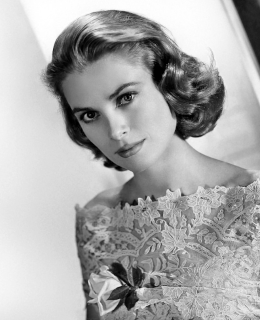
Kelly retires from acting at age 26 to marry Rainier and begins her duties as Princess of Monaco. Hitchcock hopes that she will appear in more of his films which require an “icy blonde” lead actress, but he is unable to coax her out of retirement. The Prince and Princess have three children: Princess Caroline, Prince Albert, and Princess Stéphanie. Princess Grace retains her link to America by her dual U.S. and Monégasque citizenship. Her charity work focuses on young children and the arts, establishing the Princess Grace Foundation-USA to support local artisans in 1964. Her organization for children’s rights, World Association of Children;s Friends (AMADE), gains consultive status within UNICEF and UNESCO. Her final film contribution is in 1977 to documentary The Children of Theatre Street directed by Robert Dornhelm, where she serves as the narrator. The documentary is nominated for an Academy Award for Best Documentary Feature.
On September 13, 1982, Princess Grace suffers a small stroke while driving back to Monaco from her country home in Roc Agel. As a result, she loses control of her 1971 Rover P6 3500 and drives off the steep, winding road and down the 120-foot mountainside. Her teenage daughter Stéphanie, who is in the passenger seat, tries but fails to regain control of the car. The Princess is taken to the Monaco Hospital (later named the Princess Grace Hospital Centre) with injuries to the brain and thorax and a fractured femur. She dies the following night at 10:55 PM after Rainier decides to turn off her life support. Stéphanie suffers a slight concussion and a hairline fracture of a cervical vertebra and is unable to attend her mother’s funeral.






 seamus dubhghaill