seamus dubhghaill

Promoting Irish Culture and History from Little Rock, Arkansas, USA


Leave a comment

Birth of Erskine B. Childers, Writer, Correspondent & Civil Servant

erskine-barton-childers

Erskine Barton Childers, Irish writer, BBC correspondent and United Nations senior civil servant, is born in Dublin on March 11, 1929.

Childers is born to Erskine Hamilton Childers (Ireland’s fourth President) and his first wife Ruth Ellen Dow. He grows up in a multi-cultural atmosphere which influences his whole life. From an early age, he has an obvious fascination with history and world affairs. He studies at Newtown School, Waterford and much later on at Trinity College, Dublin and Stanford University. At Stanford he is actively involved with the National Student Association and rises to Vice-President of the organisation by 1949.

By 1960, Childers is in London working for the BBC in both radio and television. His broadcasts from the BBC World Service range on varying topics from the Suez Crisis and Palestine to the John F. Kennedy assassination in 1963. He is one of the first presenters at the start of the BBC TV show The Money Programme in 1966. The Suez Canal and Palestine issues later form the basis of his writing on the subjects.

Childers is distinguished as one of the first mainstream writers in the West to systematically challenge the contention that Palestinian Arab refugees of the 1947–1948 Civil War in Mandatory Palestine and the 1948 Arab–Israeli War fled their homes primarily from Arab broadcast evacuation orders, rather than from the use of force and terror by armed forces of the newly forming state of Israel.

Childers specialises in UN issues, even serving as a periodic consultant including a special mission in the Congo for Secretary-General U Thant. In 1967, under the leadership of Henry Richardson Labouisse, Jr., he is hired to lead a United Nations, UNICEF and United Nations Development Programme (UNDP) programme called Development Support Communication. In 1968 he co-authors a paper with United Nations colleague Mallica Vajrathon called “Project Support Communication,” later published in an important anthology about social change.

From 1975 to 1988, Childers is based in New York as Director of Information for UNDP. By his retirement in 1989 after 22 years of service as Senior Advisor to the UN Director General for Development and International Economic Co-operation, Childers had worked with most of the organisations of the UN system, at all levels and in all regions.

After his retirement, Childers continues to strive relentlessly for the ideals for which he had worked so hard. He co-authors several notable books for the Ford Foundation and the Dag Hammarskjöld Foundation on the reform of the United Nations with his colleague and equally devoted United Nations civil servant, Sir Brian Urquhart. The best known of these publications is A World in Need of Leadership. He continues writing on United Nations matters while traveling constantly and lecturing on the Organisation and the many challenges confronting it, such as globalisation and democracy, conflict prevention and peacekeeping, humanitarian assistance, human rights, famine, ageing and development, health, financial arrangement of the United Nations, citizen’s rights, female participation, design and perceptions, education, the North South divide and world economy. In 1995 he co-authors a paper with his international law colleague Marjolijn Snippe called The Agenda for Peace and the Law of the Sea, for Pacem in Maribus XXIII, the Annual Conference of the International Ocean Institute, that is held in Costa Rica, December 1995.

Childers becomes Secretary General of the World Federation of United Nations Associations in March 1996. Having served for only five months, he dies on August 25, 1996, during the organisation’s fiftieth anniversary congress. He is buried in Roundwood, County Wicklow.


Leave a comment

Frederick A. Sterling’s Ambassadorship to Ireland Ends

frederick-a-sterling

Frederick Augustine Sterling, United States diplomat and first U.S. Ambassador to Ireland, completes his mission in Ireland on March 7, 1934. He later serves as U.S. minister to Bulgaria and Sweden.

Sterling is born in St. Louis, Missouri on August 13, 1876 and is an 1898 graduate of Harvard University. After working on a ranch in Texas and manufacturing woolen goods, he becomes a career Foreign Service Officer in 1911. Assignments include work in Peru, China, Russia, and England.

On July 27, 1927, Sterling is the first person appointed U.S. minister to the Irish Free State. After confirmation by the United States Senate, and presentation of his credentials to Irish leaders W. T. Cosgrave and Timothy Healy in July, he holds the formal title of Envoy Extraordinary and Minister Plenipotentiary.

Sterling’s post in Ireland ends on March 7, 1934, when he becomes U.S. minister to Bulgaria, a position he remains in until 1936. In 1937, he is appointed to minister roles for both Latvia and Estonia, however he does not accept the post. In 1938, he becomes U.S. minister to Sweden and remains in that role until 1941.

For years Sterling owns a summer house in Newport, Rhode Island, which he shares with his wife, two sons and one daughter. He dies in Washington, D.C., on August 21, 1957, and is buried in Falls Church, Virginia.


Leave a comment

Birth of Ron Delany, Olympic Gold Medalist

ron-delany

Ronald Michael Delany, athlete who specialises in middle distance running, is born in Arklow, County Wicklow on March 6, 1935. He wins a gold medal in the 1500 metres event at the 1956 Summer Olympics in Melbourne. He later earns a bronze medal in the 1500 metres event at the 1958 European Athletics Championships in Stockholm.

Delany moves with his family to Sandymount, Dublin 4 when he is six. He later goes to Sandymount High School and then to Catholic University School. He studies commerce and finance at Villanova University in the United States. While there he is coached by the well-known track coach James F. “Jumbo” Elliott.

Delany’s first achievement of note is reaching the final of the 800 metres at the 1954 European Athletics Championships in Bern. In 1956, he becomes the seventh runner to join the club of four-minute milers but nonetheless struggles to make the Irish team for the 1956 Summer Olympics, held in Melbourne.

Delany qualifies for the Olympic 1500 metres final, in which local runner John Landy is the big favourite. Delany keeps close to Landy until the final lap, when he starts a crushing final sprint, winning the race in a new Olympic record. He thereby becomes the first Irishman to win an Olympic gold medal in athletics since Bob Tisdall in 1932. The Irish people learn of its new champion at breakfast time. He would be Ireland’s last Olympic champion for 36 years, until Michael Carruth wins the gold medal in boxing at the 1992 Summer Olympics in Barcelona.

Delany wins the bronze medal in the 1500 metres event at the 1958 European Athletics Championships. He goes on to represent Ireland once again at the 1960 Summer Olympics held in Rome, this time in the 800 metres. He finishes sixth in his quarter-final heat.

Delany continues his running career in North America, winning four successive Amateur Athletic Union (AAU) titles in the mile, adding to his total of four Irish national titles, and three NCAA titles. He is next to unbeatable on indoor tracks over that period, which includes a 40-race winning streak. He breaks the World Indoor Mile Record on three occasions. In 1961 he wins the gold medal in the World University Games in Sofia, Bulgaria.

Delany retires from competitive running in 1962, securing his status as Ireland’s most recognisable Olympian as well as one of the greatest sportsmen and international ambassadors in his country’s history.


Leave a comment

Death of Historian Thomas P. O’Neill

eamon-de-valera-biography

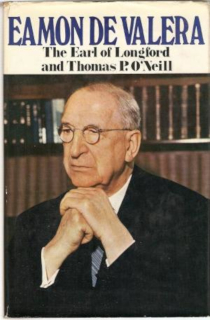
Thomas P. O’Neill, Irish historian who wrote Éamon de Valera‘s official biography with Frank Pakenham, 7th Earl of Longford, dies in Dublin on March 2, 1996.

Born in County Carlow, O’Neill is educated at St. Mary’s Knockbeg College and University College Dublin (UCD). While assistant keeper of the National Library of Ireland, he is asked to undertake the work on de Valera. Frank Gallagher, head of the Government Information Services and later a member of the library’s staff had been working on a biography for several years but dies in 1962 without completing the work.

De Valera knows of O’Neill’s reputation as a historian and asks him to undertake the project. A contract is signed with the publishers in 1963, and O’Neill moves to Áras an Uachtaráin to work on the book. He is later joined by Lord Longford as co-author.

O’Neill’s other works include a biography in Irish of James Fintan Lalor and a major study of the Great Famine, which establishes his reputation as a historian.

After the completion of the de Valera work, O’Neill is appointed lecturer and later professor of history in University College, Galway. On his retirement, he returns to live in Dublin, where he renews his association with the National Library, becoming a strong supporter of its expansion.

O’Neill continues historical research until shortly before his death. He discovers evidence that the 1916 Proclamation of the Irish Republic was signed by the seven signatories at the home of the president of Cumann na mBan, Jennie Wyse Power, in Henry Street, Dublin, before the Easter Rising and not merely printed in Liberty Hall from an unsigned manuscript on Easter Sunday.

O’Neill is survived by his wife, Marie, and six children. His funeral Mass takes place at St. Joseph’s Church on March 5, followed by his interment at Shanganagh Cemetery.

(From: “Biographer of de Valera dies at 74,” The Irish Times, Monday, March 4, 1996)


Leave a comment

Ahern & Blair Push for Implementation of the Good Friday Agreement

ahern-and-blair-1998

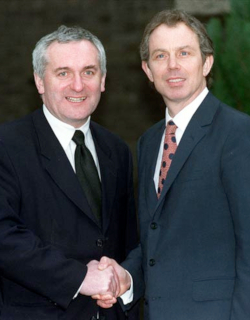
At an informal European Union summit near Bonn on February 26, 1999, Taoiseach Bertie Ahern and British Prime Minister Tony Blair agree to push for implementation of the Good Friday Agreement by the March 10 deadline.

As EU delegates discuss the Union’s budget and Europe‘s farming subsidies, the two prime ministers vow to battle on with the peace deal’s outstanding problems.

“We’re very clear on what we have to do in the Good Friday agreement … we have just got to keep pushing the thing forward as well as we possibly can,” says Blair.

Both Ahern and Blair say the way forward on the outstanding deadlocked issue of paramilitary disarmament is through the official decommissioning commission. Chaired by former Canadian General John de Chastelain, the international commission is working to take arms out of the province’s political arena.

The republican party Sinn Féin insists it is fully cooperating with the commission, which is implementing the final deadline for the handover of arms in May 2000. But some Ulster Unionists oppose further peace moves because of the Irish Republican Army‘s (IRA) failure to begin disarming.

According to Ahern and Blair, the following few weeks will be a key time to try and finalise disarmament issues.

“During the month of March … we can conclude the central aspects,” says Blair.

However, in a separate development on February 26, the chairman of the IRA’s political wing, Sinn Féin’s Mitchel McLaughlin, warns that pressure on disarmament could cause irreparable damage to the fragile peace process. He adds that disarmament should not become a litmus test for progress.

“Those who are now demanding prior decommissioning before we move to setting up the executive are reneging on the Good Friday Agreement,” says McLaughlin in an interview with BBC Radio.

(From BBC News Online Network, Friday, February 26, 1999 | Pictured: Bertie Ahern with Tony Blair at the signing of the Good Friday Agreement in April 1998)


Leave a comment

Neil Jordan Receives Silver Bear for Best Director

neil-patrick-jordan

Neil Patrick Jordan, director of The Butcher Boy (1997), is awarded a Silver Bear for Best Director at the 48th Berlin International Film Festival on February 22, 1998.

Jordan is born in County Sligo on February 25, 1950. His first book, Night in Tunisia, wins a Somerset Maugham Award and the Guardian Fiction Prize in 1979. He also wins an Academy Award for Best Original Screenplay for The Crying Game (1992).

Jordan is educated at St. Paul’s College, Raheny. Later, Jordan attends University College Dublin, where he studies Irish history and English literature. He is raised a Catholic and is quite religious during the early stages of his life. Regarding his current beliefs, he states that “God is the greatest imaginary being of all time. Along with Einstein‘s General Theory of Relativity, the invention of God is probably the greatest creation of human thought.”

When John Boorman is filming Excalibur in Ireland, he recruits Jordan as a “creative associate.” A year later Boorman is executive producer on Jordan’s first feature, Angel, a tale of a musician caught up in the Troubles, starring Stephen Rea who subsequently appears in almost all of Jordan’s films to date. During the 1980s, he directs films that win him acclaim, including The Company of Wolves and Mona Lisa, both made in England. The Company of Wolves becomes a cult favorite.

As a writer/director, Jordan has a highly idiosyncratic body of work, ranging from mainstream hits like Interview with the Vampire to commercial failures like We’re No Angels to a variety of more personal, low-budget arthouse pictures. He is also the driving force behind the cable TV series The Borgias.

Unconventional sexual relationships are a recurring theme in Jordan’s work, and he often finds a sympathetic side to characters that audiences would traditionally consider deviant or downright horrifying. His film The Miracle, for instance, follows two characters who struggle to resist a strong, incestuous attraction, while The Crying Game makes complicated, likable characters out of an IRA volunteer and a transgender woman. Interview with the Vampire, like the Anne Rice book it is based on, focuses on the intense, intimate interpersonal relationship of two undead men who murder humans nightly, accompanied by an equally lusty vampire woman who is eternally trapped in the body of a little girl. While Lestat (Tom Cruise) is depicted in an attractive but villainous manner, his partner Louis (Brad Pitt) and the child vampire Claudia (Kirsten Dunst) are meant to capture the audience’s sympathy despite their predatory nature.

In addition to the unusual sexuality of Jordan’s films, he frequently returns to the Troubles of Northern Ireland. The Crying Game and Breakfast on Pluto both concern a transgender character, both concern the Troubles, and both feature frequent Jordan leading man Stephen Rea. The two films, however, are very different, with The Crying Game being a realistic thriller/romance and Breakfast on Pluto a much more episodic, stylized, darkly comic biography. Jordan also frequently tells stories about children or young people, such as The Miracle and The Butcher Boy. While his pictures are most often grounded in reality, he occasionally directs more fantastic or dreamlike films, such as The Company of Wolves, High Spirits, Interview with the Vampire, and In Dreams.

The critical success of Jordan’s early pictures leads him to Hollywood, where he directs High Spirits and We’re No Angels. Both are critical and financial disasters. He later returns home to make the more personal The Crying Game, which is nominated for six Academy Awards. Jordan wins the Academy Award for Best Original Screenplay for the film. Its unexpected success leads him back to American studio filmmaking, where he directs Interview with the Vampire. He also directs the crime drama The Brave One starring Jodie Foster.

Jordan also writes and directs the Irish-made film Ondine (2009), starring Colin Farrell and Alicja Bachleda-Curuś. He also directs Byzantium, an adaptation of the vampire play of the same name starring Saoirse Ronan, Gemma Arterton, and Jonny Lee Miller.

Jordan lives in Dalkey, which is a part of the larger town of Dún Laoghaire.


Leave a comment

The Stardust Nightclub Fire

stardust-ballroom-artane

The Stardust nightclub in Artane, Dublin goes up in flames in the early hours of February 14, 1981. Some 841 people had attended a disco there, of whom 48 die and 214 are injured as a result of the fire.

The fire starts due to an electrical fault in a first-floor storeroom inside the building that is open to the roof space. The non-compliant storage room contains dangerously flammable materials including drums of cooking oil. The staff observes a small fire outbreak on a seat in an alcove behind a curtain and fail in an attempt to extinguish it. This fire apparently starts after fire in the roof space comes through the roof tiles and falls onto the seat. The fire then spreads to tables and chairs and patrons notice smoke. The disc jockey announces that there is a small fire and requests a calm evacuation.

Outside, the fire is first spotted by a lady 200 metres from the Stardust and she calls the Dublin Fire Brigade. Within the same minute of her call, two other calls are made from the Stardust building to tell the Fire Brigade that there is a small fire on a seat in the ballroom. The fire is very small when first seen in the ballroom. Within two minutes a ferocious burst of heat and lots of thick black smoke quickly start coming from the ceiling, causing the material in the ceiling to melt and drip on top of patrons and other highly flammable materials including the seats and carpet tiles on the walls. The fire flashover envelopes the club and the lights fail.

The attendees at a trade union function taking place in the same building make their escape but the escape of some of the Stardust patrons is hampered by a number of obstructions. Some of the main fire exits are padlocked around the push bars and consequently are impossible to open.

The failure of the lighting in the club leads to widespread panic causing mass trampling as many of the patrons instinctively run for the main entrance. Many people mistake the entrance to the men’s toilets for the main entrance doors but the windows there have metal plates fixed on the inside and iron bars on the outside. Firemen attempt in vain to pull off the metal bars using a chain attached to a fire engine. Firemen rescue 25 to 30 of those trapped in the front toilets.

Ambulances from Dublin Fire Brigade, the Eastern Health Board, Civil Defence Ireland, the Irish Red Cross, the Order of Malta Ambulance Corps and St. John Ambulance Ireland are dispatched to the scene. Many ambulances leave the scene carrying up to 15 casualties. CIÉ also sends buses to transport the injured, and local radio stations ask people in the vicinity with cars to come to the club. The city’s hospitals are overwhelmed by the influx of injured and dying, in particular Mater Misericordiae University Hospital, Jervis Street Hospital and Dr. Steevens’ Hospital.

The investigation at the time reports that the cause of the fire is arson. The finding of arson has recently been ruled out by investigators, as there was never any evidence to support the arson finding, even at the time of the tragedy.

There are allegations of a huge cover-up as to the cause of so many fatalities. There is a meeting before the public inquiry in 1981 of all of the experts including the Judge when the concept of arson is determined to be the cause to protect the Dublin Corporation from having to pay out millions in compensation to the victims and families. The Coolock Garda investigation is excellent, but the Tribunal distorts the evidence. The Inquiry Report and the team of experts and coached witnesses conspire to conceal the truth and determine arson to be the cause without any evidence.

The club was located where Butterly Business Park now lies, opposite Artane Castle Shopping Centre.


Leave a comment

The Clones Ambush

clones-train-station-11-22-1960

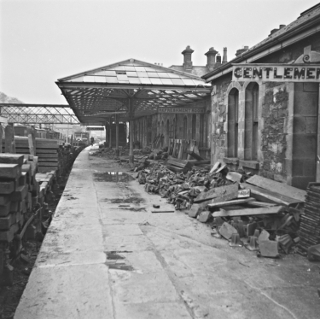
On February 11, 1922, Irish Republican Army (IRA) volunteers stop a group of Ulster Special Constabulary (USC) constables on a train at Clones, County Monaghan, a short distance into Southern territory in an event recorded in history as the “Clones Ambush.” A gunfight begins in which one IRA officer and four USC constables are killed. The remaining USC constables are captured.

On January 22, the Ulster Gaelic Football Final is played in Derry. The previous evening six cars leave Monaghan to bring the Monaghan players to Derry, many of the members of the team being members of the IRA. They are stopped by a B Specials (Ulster Special Constabulary) check point at Dromore station. After a search the Specials discover weapons in the cars and arrest ten of the men. The IRA men are led by Dan Hogan O/C of the Fifth Northern Division. The men are taken to Omagh and interned.

The IRA waits impatiently for a chance at reprisal and on February 11, a group of Irish Republican Army volunteers attempt to ambush a party of Ulster Special Constabulary policemen travelling on a train through Clones. The volunteers enter a carriage of a train and order the Specials to put their hands up. IRA Commandant Matthew Fitzpatrick is shot and killed in the ensuing fight and five members of the Specials, Doherty, McMahon, McCullough, Lewis and McFarland are shot and killed. Several members of the Specials run down the track and cross the border into Fermanagh. The few remaining B Specials on the train decide to surrender and are arrested.

The IRA lifts the body of the Commandant Fitzpatrick and it is attended to by Monsignor E.C. Ward who gives him his Last Rites.

The Clones railway station is on the Dundalk and Enniskillen Railway. The Dundalk and Enniskillen Railway opens the station on June 26, 1858. The station closes on October 1, 1957.

(Photo: Clones Train Station, Co Monaghan, caught in mid-demolition by photographer James O’Dea on November 22, 1960)


Leave a comment

Crash of Manx2 Flight 7100 at Cork Airport

manx2-flight-7100

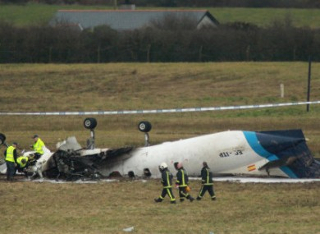
Manx2 Flight 7100 (NM7100/FLT400C), a scheduled commercial flight from George Best Belfast City Airport in Belfast, Northern Ireland, to Cork Airport in Cork, County Cork, crashes on February 10, 2011 on its third attempt to land at Cork Airport, which is experiencing dense fog at the time. The aircraft is carrying ten passengers and two crew. Six people, including both pilots, perish in the crash. Six passengers survive, four receiving serious injuries, while two are described as walking wounded.

After two aborted landing attempts, the flight crew enters a holding pattern and maintains an altitude of 3,000 feet. During the hold the flight crew requests weather conditions for Waterford Airport which are below minima. The flight crew nominates Shannon Airport as their alternate and requests the latest weather. Again the weather there is below minima. Weather for Dublin Airport is passed on to the flight crew and is also below minima. Cork Approach informs the flight crew about weather conditions at Kerry Airport which are “good” with 10 km visibility. The decision is made to make a third attempt at Cork Airport.

The approach is continued beyond the Outer Marker (OM), the commander takes over operation of the Power Levers. Descent is continued below the Decision Height (DH). A significant reduction in power and significant roll to the left follows, just below 100 feet, a third go-around is called by the commander which the co-pilot acknowledges. Coincident with the application of go-around power by the commander, control of the aircraft is lost. The aircraft rolls rapidly to the right beyond the vertical which brings the right wingtip into contact with the runway surface. The aircraft continues to roll and impacts the runway inverted. The stall warning sounds continuously during the final seven seconds of the Cockpit Voice Recorder (CVR) recording.

At 09:50:34 following both initial impacts the aircraft continues inverted for an additional 207 yards and comes to a rest in soft ground to the right of the runway. During this time the Emergency Locator Transmitter (ELT) begins to sound in the control tower at Cork Airport. Post impact fires ensue in both engines and from fuel leaking from the outboard right fuel tank. The fires are put out by the Airfield Fire Service (AFS) before they reach the fuselage. A witness inside the airport terminal building states that the fog is so thick that the crashed aircraft could not be seen. The Airport Fire Service extinguish both post impact fires within ten minutes of the accident and begin to remove the casualties from the wreckage. The injured are taken to Cork University Hospital for treatment. As a result of the accident, Cork Airport is closed until the evening of February 11 and all flights are diverted.

The final report on the incident is sent to the bereaved families and the six survivors over a week in advance of its official release on January 28, 2014, almost three years after the crash. The report states that the probable cause of the accident is loss of control during an attempted go-around below decision height in instrument meteorological conditions. It notes that there is an inappropriate pairing of flight crews, inadequate command training and checking and inadequate oversight of the chartered operation by the operator and the operator’s state as contributory factors in the accident.


Leave a comment

Death of Vincent “Mad Dog” Coll, Mob Hitman

vincent-mad-dog-coll

Vincent “Mad Dog” Coll, born Uinseann Ó Colla, Irish American mob hitman in the 1920s and early 1930s in New York City, dies on February 8, 1932.

Coll is born in Gweedore, County Donegal, on July 20, 1908. When he is not quite one year old, the Coll family emigrates to New York in search of a better life. At age 12, he is sent to a reform school. After being expelled from multiple Catholic reform schools, he joins The Gophers street gang. He joins up with Dutch Schultz‘s gang and quickly rises through the ranks. By the late 1920s he is working as an armed guard for the illegal beer delivery trucks of Schultz’s mob.

Coll is a loose cannon, and Schultz soon grows tired of his reckless behavior. In 1929, Coll robs a dairy in the Bronx of $17,000 without Schultz’s permission. When Schultz confronts him about the robbery, rather than being apologetic, Coll demands he be made an equal partner.

By January 1930 Coll has formed his own gang and is engaged in a shooting war with Schultz. One of the earliest victims is Peter Coll, shot dead on May 30, 1931, while driving down a Harlem street. Coll goes into a rage of grief and vengeance. Over the next three weeks he guns down four of Schultz’s men. In all, around 20 men are killed in the bloodletting. The exact figure is hard to pin down as New York is also in the midst of the vicious Castellammarese War at the same time. It is mayhem on the streets of Manhattan and the police often have difficulty in deciding which corpse belongs to which war.

On July 28, 1931, Coll allegedly participates in a kidnapping attempt that results in the shooting death of a child. His target is bootlegger Joseph Rao, a Schultz underling who is lounging in front of a social club. Several children are playing outside a nearby apartment house. A large touring car pulls up to the curb, and several men point shotguns and submachine guns towards Rao and start shooting. Rao throws himself to the sidewalk, however, and four young children are wounded in the attack. One of them, five-year-old Michael Vengalli, later dies at Beth David Hospital. After the Vengalli killing, New York City Mayor Jimmy Walker dubs Coll a “Mad Dog”.

On October 4, 1931, after an extensive manhunt, New York police arrest Coll at a hotel in the Bronx. He surrenders peacefully. On October 5, a grand jury in New York city indicts Coll in the Vengalli murder. The trial begins in December 1931. He retains famed defense lawyer Samuel Leibowitz. The prosecution case soon falls apart. At the end of December, the judge issues a directed verdict of not guilty.

It was said that both Dutch Schultz and Owney Madden put a $50,000 bounty on Coll’s head. On February 1, 1932, four or five gunmen invade a Bronx apartment which Coll is rumored to frequent and open fire with pistols and submachine guns. Three people, Coll gangsters Patsy Del Greco and Fiorio Basile and bystander Emily Tanzillo, are killed. Three others are wounded. Coll himself does not show up until 30 minutes after the shooting.

At 12:30 AM on February 8, one week after the Bronx shootings, Coll is using a phone booth at a drug store at Eighth Avenue and 23rd Street in Manhattan. He is reportedly talking to Madden, demanding $50,000 from the gangster under the threat of kidnapping his brother-in-law. Madden keeps Coll on the line while it is traced. Three men in a dark limousine soon arrive at the drug store. While one waits in the car, two others step out. One man waits outside while the other walks inside the store. The gunman tells the cashier to stay calm, draws a Thompson submachine gun from under his overcoat and opens fire on Coll in the glass phone booth. He dies instantly. The killers take off in their car and are chased unsuccessfully up Eighth Avenue.

A total of 15 bullets are removed from Coll’s body at the morgue and even more may have passed through him. He is buried next to his brother Peter at Saint Raymond’s Cemetery in the Bronx. Dutch Schultz sends a floral wreath bearing a banner with the message, “From the boys.”