Traynor is born into a strongly nationalist family in Dublin. He is educated by the Christian Brothers. In 1899, he is apprenticed to John Long, a famous woodcarver. As a young man he is a noted footballer and tours Europe as a goalkeeper with Belfast Celtic F.C. whom he plays with from 1910 to 1912. He rejects claims soccer is a foreign sport calling it “a Celtic game, pure and simple, having its roots in the Highlands of Scotland.”
When the Irish Civil War breaks out in June 1922, Traynor takes the Anti-Treaty IRA side. The Dublin Brigade is split, however, with many of its members following Michael Collins in taking the pro-Treaty side. During the Battle of Dublin, he is in charge of the Barry’s Hotel garrison, before making their escape. He organises guerilla activity in south Dublin and County Wicklow, before being captured by Free State troops in September. He is then imprisoned for the remainder of the war.
In 1936, Traynor is first appointed to the Cabinet as Minister for Posts and Telegraphs. In September 1939, he is appointed Minister for Defence and holds the portfolio to February 1948. In 1948, he becomes President of the Football Association of Ireland, a position he holds until his death. He serves as Minister for Defence in several Fianna Fáil governments and as Minister for Justice, where he is undermined by his junior minister, and later Taoiseach, Charles Haughey, before he retires in 1961.
Traynor dies in Dublin at the age of 77 on December 15, 1963. He has a road named in his memory, running from the Malahide Road through Coolock to Santry in Dublin’s northern suburbs.
(Pictured: Minister for Defence Oscar Traynor at his desk, June 1940)
Mitchel is born in Camnish, near Dungiven, County Derry on November 3, 1815, the son of a Presbyterian minister. At the age of four, he is sent to a classical school, run by an old minister named Moor, nicknamed “Gospel Moor” by the students. He reads books from a very early age. When a little over five years old, he is introduced to Latin grammar by his teacher and makes quick progress. In 1830, not yet 15 years old, he enters Trinity College, Dublin and obtains a law degree in 1834. In the spring of 1836 he meets Jane Verner, the only daughter of Captain James Verner. Though both families are opposed to the relationship, they become engaged in the autumn and are married on February 3, 1837, by the Rev. David Babington in Drumcree Church, the parish church of Drumcree.
Mitchel works in a law office in Banbridge, County Down, where he eventually comes into conflict with the local Orange Order. He meets Thomas Davis and Charles Gavan Duffy during visits to Dublin. He joins the Young Ireland movement and begins to write for The Nation. Deeply affected by the misery and death caused by the Great Famine, he becomes convinced that nothing will ever come of the constitutional efforts to gain Irish freedom. He then forms his own paper, United Irishmen, to advocate passive resistance by Ireland’s starving masses.
In May 1848, the British tire of Mitchel’s open defiance. Ever the legal innovators in Ireland, they invent a crime especially for the Young Irelanders – felony-treason. They arrest him for violating this new law and close down his paper. A rigged jury convicts him, and he is deported first to Bermuda and then to Australia. However, in June 1853, he escapes to the United States.
Mitchel works as a journalist in New York City and then moves to the South. When the American Civil War erupts, he is a strong supporter of the Southern cause, seeing parallels with the position of the Irish. His family fully backs his commitment to the Southern cause. He loses two sons in the war, one at the Battle of Gettysburg in 1863 and another at the Battle of Fort Sumter in 1864, and another son loses an arm. His outspoken support of the Confederacy causes him to be jailed for a time at Fort Monroe, where one of his fellow prisoners is Confederate PresidentJefferson Davis.
In 1874, the British allow Mitchel to return to Ireland and in 1875 he is elected in a by-election to be a member of the Parliament of the United Kingdom representing the Tipperary constituency. However, his election is invalidated on the grounds that he is a convicted felon. He contests the seat again in the resulting by-election and is again elected, this time with an increased vote.
Unfortunately, Mitchel, one of the staunchest enemies to English rule of Ireland in history, dies eight days later in Newry on March 20, 1875, and is buried there. Thirty-eight years later, his grandson, John Purroy Mitchel, is elected Mayor of New York City.
Dalton is born to Irish American parents James F. and Katharine L. Dalton. The family moves back to Ireland when he is two years old. He grows up in a middle-class Catholic background in Drumcondra in North Dublin and lives at No. 8 Upper St. Columba’s Road. He is educated by the Christian Brothers at O’Connell School in North Richmond Street. He joins the nationalist militia, the Irish Volunteers, in 1913 and the following year, though only fifteen, is involved in the smuggling of arms into Ireland.
Dalton joins the British Army in 1915 for the duration of the Great War. His decision is not that unusual among Irish Volunteers, as over 20,000 of the National Volunteers join the British New Army on the urgings of Nationalist leader John Redmond. His father, however, disagrees with his son’s decision. He initially joins the 7th battalion of the Royal Dublin Fusiliers (RDF) as a temporary 2nd Lieutenant. By 1916 he is attached to the 9th Battalion, RDF, 16th (Irish) Division under Major-General William Hickie, which contains many Irish nationalist recruits.
During the Battle of the Somme in September 1916, Dalton is involved in bloody fighting during the Battle of Ginchy, in which over 4,000 Irishmen are killed or wounded. He is awarded the Military Cross for his conduct in the battle. Afterwards he is transferred to the 6th Battalion, Leinster Regiment, and sent to Thessaloniki then Palestine, where he commands a company and then supervises a sniper school in el-ʻArīsh. In 1918 he is re-deployed again to France, and in July promoted to captain, serving as an instructor.
On demobilisation in April 1919, Dalton returns to Ireland. There, finding that his younger brother Charlie had joined the IRA, he himself follows suit. He later comments on the apparent contradiction of fighting both with and against the British Army by saying that he had fought for Ireland with the British and fought for Ireland against them.
Dalton follows Collins in accepting the Anglo-Irish Treaty in 1922 and is one of the first officers, a Major General, in the new National Army established by the Irish Provisional Government of the Irish Free State. The Treaty is opposed by much of the IRA and Civil War between pro and anti-treaty factions eventually results.
Dalton is in command of troops assaulting the Four Courts in the Battle of Dublin which marks the start of the war in June 1922. At Collins’ instigation he, as Military liaison officer with the British during the truce, takes control of the two 18 pounder guns from the British that are trained on the buildings. He becomes commander of the Free State Army under Richard Mulcahy‘s direction. He is behind the Irish Free State offensive of July–August 1922 that dislodges the Anti-Treaty fighters from the towns of Munster. He proposes seaborne landings to take the Anti-Treaty positions from the rear and he commands one such naval landing that takes Cork in early August. In spite of firm loyalty to the National Army, he is critical of the Free State’s failure to follow up its victory, allowing the Anti-Treaty IRA to regroup resuming the guerrilla warfare started in 1919.
On August 22, 1922, he accompanies Collins in convoy, touring rural west Cork. The convoy is ambushed near Béal na Bláth and Collins is killed in the firefight. He had advised Collins to drive on, but Collins, who is not an experienced combat veteran, insists on stopping to fight.
Dalton is married shortly afterwards, on October 9, 1922, to Alice Shannon in Cork’s Imperial Hotel. By December 1922 he has resigned his command in the Army. He does not agree with the execution of republican prisoners that mark the latter stages of the Civil War. After briefly working as clerk of the Irish Senate, Seanad Éireann, he leaves the job to work in the movie industry.
Dalton dies in his daughter Nuala’s house in Dublin on March 4, 1978, his 80th birthday, never having seen the film that Cathal O’Shannon of RTÉ had made on his life. During the making of the film, they visit the battlefields in France, Kilworth Camp in Cork, Béal Na Bláth, and other places that Dalton had not visited since his earlier years. He wishes to be buried as near as possible to his friend Michael Collins in Glasnevin Cemetery in Dublin and is buried there in March 1978 after a military funeral. None of the ruling Fianna Fáil government ministers or TDs attend.
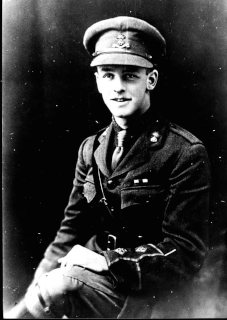
(Pictured: Dalton photographed in lieutenant’s uniform, Royal Dublin Fusiliers, taken circa. 1914-1918)
Dillon is the eldest of five children of Sir James Charles Mathew and Elizabeth Blackmore Mathew. Her family is related to the Butler family, but she does not visit Ireland until 1886. Living in Queen’s Gate Gardens, Kensington, London, she is educated at home. From a young age she attends the ladies’ gallery of the House of Commons, while mixing a busy social life with charitable works.
Dillon begins keeping a diary in 1879, which she continues to write until her death. Her ancestor, Mary Mathew, is also a diarist and keeps the diary for the discipline of the daily activity. She soon begins to write for the love of it, and some have surmised she wrote with the intention her diaries would be read by others. She attends lectures in Old English and literature at King’s College, London from late 1882 to 1884, and begins to learn Irish in 1893.
Dillon’s father supports land reform in Ireland, chairs the evicted tenants commission in 1892, and is a huge influence on her politics. She makes her first political reference on February 25, 1883, when she notes the arrest of the Invincibles, and she then regularly comments on land reform. She travels to Ireland for the first time in August 1886, staying in Killiney, County Dublin. In October 1886, she meets John Dillon and begins to follow the Plan of Campaign so that she can discuss it with him during his visits to the Mathew house in London.
During this time, John Dillon is deeply immersed in politics and is imprisoned on a number of occasions. Being a careful follower of Irish politics, she becomes an anti-Parnellite. She confronts John Dillon in autumn 1895 about their relationship, saying that they can no longer meet as they had become the subject of gossip. He proposes within two weeks, and they are married on November 21, 1895, in Brompton Oratory. They are busy and often apart, with Dillon spending time in a warm climate due to his ill health. She tries to accompany him when she can, but the couple’s large family makes that difficult. They have one daughter and five sons, John Dillon (1896-1970), Anne Elizabeth Dillon (born October 29, 1897), Theobald Wolfe Tone (1898-1946), Myles, James, and Brian.
Finances are strained until John’s uncle Charles bequeaths him his house, 2 North Great George’s Street, Dublin in 1898, and a business in Ballaghaderreen, County Mayo is bequeathed him by a cousin, Anne Deane, in 1905. Dillon runs the business successfully, while also carrying out duties as a politician’s wife such as opening the Belfast ladies’ branch of the United Irish League in June 1905. Her busy life results in her neglecting her diary.
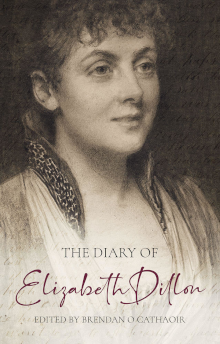
Dillon dies on May 14, 1907, in Dublin, having given birth to a stillborn daughter that morning. Pneumonia is given as the cause of death, but it could have been medical incompetence. She is buried in the family vault in Glasnevin Cemetery. Her husband writes of her death in June 1907, A short narrative of the illness and death of my dearest love. Trinity College Dublin holds her diary and correspondence. Her diaries, edited by Brendan Ó Cathaoir, are published in 2019.
Holmes appears to be a stern judge, who does not suffer fools gladly and often imposes exceptionally severe sentences in criminal cases. Although the story is often thought to be apocryphal, Maurice Healy maintains that Holmes did once sentence a man of great age to 15 years in prison, and when the prisoner pleaded that he could not do 15 years, replied “Do as much of it as you can.” His judgments do however display some good humour and humanity, and the sentences he imposes often turned out to be less severe in practice than those he announces in Court.
The quality of his judgments is very high and Holmes, together with Christopher Palles and Gerald FitzGibbon, is credited with earning for the Irish Court of Appeal its reputation as perhaps the strongest tribunal in Irish legal history. His retirement, followed by that of Palles (FitzGibbon had died in 1909), causes a loss of expertise in the Court of Appeal from which its reputation never recovers. Among his more celebrated remarks is that the Irish “have too much of a sense of humour to dance around a maypole.” His judgment in The SS Gairloch remains the authoritative statement in Irish law on the circumstances in which an appellate court can overturn findings of fact made by the trial judge.
Hope is born in Templepatrick, County Antrim, on August 25, 1764 to a Presbyterian family originally of Covenanter stock. He is apprenticed as a linen weaver but attends night school in his spare time. Influenced by the American Revolution, he joins the Irish Volunteers, but upon the demise of that organisation and further influenced by the French Revolution, he joins the Society of the United Irishmen in 1795.
Hope quickly establishes himself as a prominent organiser and is elected to the central committee in Belfast, becoming close to leaders such as Samuel Neilson, Thomas Russell, and Henry Joy McCracken. He is almost alone among the United Irish leaders in targeting manufacturers as well as landowners as the enemies of all radicals. In 1796, he is sent to Dublin to assist the United Irish organisation there to mobilise support among the working classes, and he is successful in establishing several branches throughout the city and especially in The Liberties area. He also travels to counties in Ulster and Connacht, disseminating literature and organizing localities.
Upon the outbreak of the 1798 rebellion in Leinster, Hope is sent on a failed mission to Belfast by Henry Joy McCracken to brief the leader of the County Down United Irishmen, Rev. William Steel Dickson, with news of the planned rising in County Antrim, unaware that Dickson had been arrested only a couple of days before. He manages to escape from Belfast in time to take part in the Battle of Antrim where he plays a skillful and courageous role with his “Spartan Band,” in covering the retreat of the fleeing rebels after their defeat.
Hope manages to rejoin McCracken and his remaining forces after the battle at their camp upon Slemish mountain, but the camp gradually disperses, and the dwindling band of insurgents are then forced to go on the run. He successfully eludes capture, but his friend McCracken is captured and executed on July 17. Upon the collapse of the general rising, he refuses to avail of the terms of an amnesty offered by Charles Cornwallis, 1st Marquess Cornwallis on the grounds that to do so would be “not only a recantation of one’s principles, but a tacit acquiescence in the justice of the punishment which had been inflicted on thousands of my unfortunate associates.”
Hope lives the years following 1798 on the move between counties Dublin, Meath and Westmeath but is finally forced to flee Dublin following the failure of Robert Emmet‘s rebellion in 1803. He returns to the north and evades the authorities attentions in the ensuing repression by securing employment with a sympathetic friend from England. He is today regarded as the most egalitarian and socialist of all the United Irish leadership.
After suffering poor health for some years, Hope dies on February 10, 1847 at his son Henry’s home, 1 Lancaster St., Belfast. He is buried in the Mallusk Cemetery, Newtownabbey, County Antrim. The headstone is raised by his friends, Henry Joy McCracken’s sister Mary Ann, and the Shankill Road United Irishman Isreal Milliken. The historian Richard Robert Madden, who had encouraged Hope to write his memoirs, supplies the inscription. The headstone features the outline of a large dog, which supposedly brought provisions to him and his compatriots when they were hiding following the Battle of Antrim.
From an early age Ford has an interest in painting and sailing, and in July 1914 moves to California, where his older brother Francis is an actor with a small film company. Adopting the name ‘Jack Ford,’ he learns his trade as a filmmaker and acts in a number of silent pictures. Reveling in his Irish heritage, he makes his director’s debut with The Tornado (1917) and follows it with more than forty movies over the next six years. On July 3, 1920, he marries Mary McBryde Smith, a former officer in the army medical corps. They meet at a party thrown by the director Rex Ingram and have one son and one daughter.
In 1921 Ford visits Ireland for the first time and later claims to have travelled on the same boat that brought Michael Collins back from the treaty negotiations. He meets his relatives at Spiddal, falls in love with the countryside, and becomes a fervent Irish nationalist. It is later claimed that he brought over funds for his cousin Martin Feeney, a member of an Irish Republican Army (IRA) flying column.
Returning to Hollywood, Ford becomes friends with the retired marshal Wyatt Earp and makes a number of commercially successful films, now as ‘John Ford’. In 1926 he directs The Shamrock Handicap, a horse-racing yarn partly set in Ireland. In 1928 he shoots Mother Machree, a movie about Irish emigration, starring Victor McLaglen, a regular collaborator. McLaglen also stars in Hangman’s House, made the same year, Ford’s first major movie about Ireland.
In 1934 Ford purchases a luxury yacht which he names the Araner after the Aran Islands. He also begins shooting The Informer, a film set in Ireland during the Irish War of Independence, and based on a short novel by Liam O’Flaherty. The picture is a major box office success and wins four Academy Awards, including Best Director. O’Flaherty is so impressed with the film that he dedicates his next book, Famine, to Ford.
In 1934 Ford visits Ireland for the second time, and approaches Seán O’Casey about directing a version of The Plough and the Stars. Released in 1936, the film stars Barry Fitzgerald as Fluther, but it is reedited by the studio, much to Ford’s fury, and is a commercial and critical flop.
In 1952 Ford returns to Ireland to film The Quiet Man, starring Wayne, McLaglen, and Maureen O’Hara. Shot at Ashford Castle, County Mayo, the picture becomes one of the most popular Irish films of all time. He is immensely proud of the work and is in tears leaving Ireland. The following year he makes Mogambo, with Clark Gable, Grace Kelly and a young English actor, Donald Sinden, who later recalls that Ford berated him personally for all the problems of Ireland from the time of William of Orange. Ford’s strong sense of Irishness is central to his character and is crucial for any understanding of his work. Back in Ireland in 1956, he shoots The Rising of the Moon, a portmanteau film for which he takes no salary, starring Tyrone Power, Cyril Cusack, and Noel Purcell. A minor film, it makes no impact at the box office.
Two of Ford’s finest movies are made in his later years. The Searchers (1956) is a powerful study of vengeance, while The Man Who Shot Liberty Valance (1962) is an elegiac revisionist western which concludes with the famous line, “When the legend becomes fact, print the legend.”
Struck with cancer in his final years, Ford dies on August 31, 1973 at his home in Palm Desert, California, and is buried at Holy Cross Cemetery, Culver City. His will disinherits his son, Michael Patrick Roper, and leaves everything to his wife, daughter, and grandchildren.
When asked to name the finest American directors, Orson Welles replies simply, “John Ford, John Ford, and John Ford.” An alcoholic, Ford is a difficult and often tyrannical director, but he makes films of extraordinary power and vision. He ranks as one of the greatest film-makers of the twentieth century. As Frank Capra concludes, “John is half-tyrant, half-revolutionary; half-saint, half-Satan; half-possible, half-impossible; half-genius, half-Irish.”
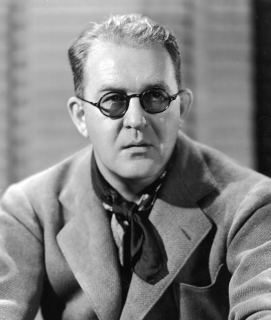
(From: “Ford, John,” contributed by Patrick M. Geoghegan, Dictionary of Irish Biography, http://www.dib.ie)
Ganly also studies painting in the Royal Hibernian Academy School where she has Margaret Clarke and Seán O’Sullivan as teachers. She is made an associate of the Royal Hibernian Academy (RHA) in 1928 and becomes a member in 1935 though, in 1969, resigns her membership in protest of the lack of young artists being given the opportunity to exhibit. In 1972 she is made an honorary member and returns.
Ganly is a representational artist and while known as a portrait artist, she also paints landscapes, interiors and may be best known for her still lifes. Some of her best works are portraits of her husband, her sister Ethel, her father, and her friend Sheila Pim. She illustrates the book-jackets of Sheila Pim’s works. She has many exhibitions, with the RHA and the Water Colour Society of Ireland. There is a retrospective of her life in 1998 at the Hugh Lane Gallery and her works are in the collections there. She is also in the collections of the Waterford Municipal Gallery, Crawford Art Gallery, Cork and in The National Self-Portrait Collection of Ireland. She is part of the 2014 exhibition ‘Irish Women Artists: 1870-1970.’
Ganly’s sister-in-law is Kitty Wilmer O’Brien with whom she often exhibits. She marries Andrew Ganly, a dental surgeon and writer with a strong involvement in theatre, in 1936. He dies in 1982. They have two children, Eoghan and Phillida.
Brigid Ganly dies on March 25,2002.
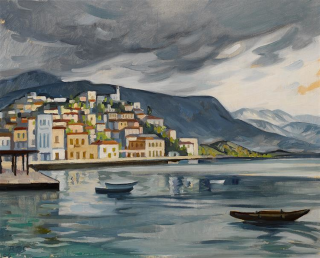
(Pictured: “Storm Over Poros” (1964) by Rosaleen Brigid Ganly, HRHA)
Gearóid O’Sullivan, soldier and politician, is born on January 28, 1891, at Coolnagrane, near Skibbereen, County Cork, fourth son among six sons and three daughters of Michael O’Sullivan, farmer, of Loughine, and Margaret Sullivan (née McCarthy) of Coolnagrane.
Christened Jeremiah but known in later life as Gearóid, O’Sullivan is an outstanding pupil at national school and secondary school in Skibbereen. Encouraged by his teachers, he acquires a love of the Irish language. Not yet ten, he joins the Gaelic League in Skibbereen in October 1900. He takes part in the Oireachtas debates of 1909. In 1911 he qualifies at St. Patrick’s College, Dublin, as a national schoolteacher and teaches at Kildorrery, County Cork, but returns to Dublin in 1912 to take up a post at St. Peter’s National School, Phibsborough. He takes an honours degree in Celtic studies at University College Dublin (UCD) (1913), an H.Dip.Ed. (1914), and an M.Ed. (1915). At the same time, he is an organiser and teacher with the Gaelic League, a member of its Keating branch at Parnell Square, Dublin, and a founder of the League’s “fáinne” proficiency badge.
O’Sullivan joins the F Company, 1st Battalion, Dublin Brigade of the Irish Volunteers at their foundation in November 1913, is aide-de-camp to Seán Mac Diarmada during the 1916 Easter Rising and is ordered by Patrick Pearse to raise the flag of rebellion over the General Post Office (GPO) stronghold in Dublin. Interned at Frongoch internment camp in Wales after the rising, he belongs to the Irish Republican Brotherhood (IRB) group of prisoners closely linked with Michael Collins, a proximity that continues throughout the crisis years to follow. Released in the amnesty of December 1916, he intensifies his Volunteer activity, playing a prominent role in Carlow Brigade, for which he is briefly detained while working as a teacher at St. Mary’s Knockbeg College, County Carlow. When the Irish Volunteers become the Irish Republican Army (IRA) in 1919, he is arrested again and goes on hunger strike at Mountjoy Prison, which leads to his release. Active throughout the Irish War of Independence (1919–21) and narrowly avoiding recapture during meetings with Collins, he joins the supreme council of the IRB in November 1921, remaining there for the remainder of his military career.
From February 1920, O’Sullivan replaces Collins as adjutant general of the IRA, a position he retains until the Anglo–Irish Treaty of December 1921 (which he supports), resuming it a month later as a lieutenant general of the new National Army, responsible for personnel and promotions. He is also elected to Dáil Éireann for Carlow–Kilkenny in 1921 and again in 1922, retiring in 1923. His intellectual and organisational abilities guarantee that his position within the army is safe after the death in August 1922 of Collins, to whom he owes much for his initial rise to prominence. On August 28 he is appointed to the newly created army council, whose most draconian prerogative becomes the military execution of republican prisoners.
After the Irish Civil War (1922–23), wholesale demobilisation of officers and other ranks takes place, but O’Sullivan and his council colleagues Richard Mulcahy, Seán Mac Mahon, and Seán Ó Murthuile survive the fiscal axe. Their privileged position angers some officers, led by Major GeneralLiam Tobin, alarmed at the rate of demobilisation and the state’s apparent abandonment of Collins’s republican ideals. Through the Irish Republican Army Organisation, they deplore the devaluation of their pre-treaty IRA service and the retention of certain former British Army officers and instructors. O’Sullivan’s brief time as adjutant general places him in the role of personnel manager. As the Defence Forces (Temporary Provisions) Act, 1923, transforms the National Army into the defence forces of an Irish dominion, he is clearly in the sights of those who disagree with how these forces took shape.
As demobilisation continues and former British personnel become more evident, O’Sullivan and his colleagues become targets of suspicion that a hostile IRB clique had controlled the army council since its formation after the death of Collins. Exaggerated or not, such claims precipitate the army crisis of March 1924, in which O’Sullivan personally orders a raiding party under Colonel Hugo MacNeill to arrest its leaders. To defuse the crisis, he and his army council colleagues are forced to stand down, while the arrested dissidents are summarily retired. The subsequent army inquiry (April–June 1924) absolves him and his colleagues of any wrongdoing, but their active military careers are over. O’Sullivan, however, is for some time secretary of the military service pensions board.
Civilian life treats O’Sullivan well, as he enters a legal career and in 1926 is called to the bar. In 1927 he is appointed Judge Advocate General and remains so until 1932. After the assassination of Minister for JusticeKevin O’Higgins in July 1927, he fills the vacated Dublin County seat in a by-election in August, retaining it at subsequent elections until 1937. In August 1928 he is a Free State delegate to the Empire Parliamentary Association conference in Canada. Openly supporting Gen. Eoin O’Duffy and the short-lived ‘Blueshirts’ vanguard of the fledgling Fine Gael party during 1933–34, he pointedly refuses to surrender his legally held revolver when gardaí demand it as a precaution against a feared Blueshirt coup d’étât. In 1937 he becomes a barrister on the western circuit, and in 1940 commissioner for special purposes of the income tax acts, a post he holds for life.
O’Sullivan lives at St. Kevin’s Park, Dartry, Dublin, where he dies at the age of 57 on March 26, 1948. His military funeral to Glasnevin Cemetery, with his coffin draped in the same flag that had covered the coffin of Michael Collins, reflects his high national profile.
In 1922, O’Sullivan marries Maude Kiernan, sister of Kitty Kiernan and daughter of Peter and Bridget Kiernan, whose family is closely involved with the Irish political leadership, notably Michael Collins and Harry Boland. After Maude’s death he marries Mary Brennan of Belfast. They have three daughters and a son, all of whom survive him. O’Sullivan is commemorated in County Cork by a plaque at Skibbereen town hall.
Lynch is born in Dublin on March 25, 1859. Her father, who is a committed, non-violent Fenian, dies when she is young. Her mother, Anna Theresa Calderwood, is married twice. She grows up in a very female house with her mother and ten sisters and half-sisters. Her stepfather is James Cantwell, also a Fenian, who runs the Star and Garter Hotel. After finishing school, she works as a sub-editor for a provincial paper and as a governess in Europe.
A nationalist like her father and stepfather, Lynch is an executive member of the Ladies’ Land League and as a result closely associates with Fanny Parnell. She writes extensively, producing short stories and satirical sketches, as well as Land War fiction, travel writing, translations and literary criticism. Her satirical pieces include “A Dublin Literary Coterie Sketched by a Non-Pretentious Observer” (1888) and “My Friend Arcanieva” (1895). She publishes William O’Brien‘s paper United Ireland from France, after it is suppressed in Ireland. She disagrees with William Butler Yeats on the literary merit of Emily Lawless, calling her work “highly polished literary stories.”
Lynch also writes fiction on the subject of political and cultural affairs in Ireland, sometimes meeting controversy. Her first novel, Through Troubled Waters (1885), is a fictionalised version of a real-life incident in Galway in which the daughters of a prosperous landowning family are murdered to make way for the sons to inherit the land. The novel also depicts the rural clergy as complicit, by denouncing the victims from the pulpit. The newspaper United Ireland strongly criticises the novel, claiming it peddles in anti-Irish stereotypes for a British audience. She responds by stating that she had intended the book for an Irish publisher and audience, and that she should not be asked “to prove my patriotism at the expense of truth.”
Lynch publishes across Ireland, the United Kingdom and from Paris. By 1896, she has settled in Paris, having also lived in both Spain and Greece. She speaks Greek and French. She then returns to lecture in Ireland and is a part of the salons of Paris in the Belle Époque as well as the Irish Literary Revival in Dublin. She is friends with the historian, biographer and literary critic Arvède Barine (pseudonym of Louise-Cécile Vincens), the writers Mabel and Mary Robinson, and the medievalist Gaston Paris. Her work however does not bring significant income, and she is forced to apply to the Royal Literary Fund for help on multiple occasions. Eventually it takes a toll on her health. She spends time in hospital in Margate, England in 1903.






 seamus dubhghaill