A serious interest in poetry and literature begins to manifest itself during his years at TCD. In 1900, he makes the acquaintance of W. B. Yeats and George Moore and begins to frequent Dublin literary circles. In 1904 and 1905 he publishes several short poems in the London publication The Venture and in John Eglinton‘s journal Dana. His name also appears in print as the renegade priest Fr. Oliver Gogarty in George Moore’s 1905 novel The Lake.
In 1905, Gogarty becomes one of the founding members of Arthur Griffith‘s Sinn Féin, a non-violent political movement with a plan for Irish autonomy modeled after the Austro-Hungarian dual monarchy.
In July 1907, his first son, Oliver Duane Odysseus Gogarty, is born, and in autumn of that year he leaves for Vienna to finish the practical phase of his medical training. Returning to Dublin in 1908, he secures a post at Richmond Hospital, and shortly afterward purchases a house in Ely Place opposite George Moore. Three years later, he joins the staff of the Meath Hospital and remains there for the remainder of his medical career.
Gogarty maintains close friendships with many of the Dublin literati and continues to write poetry in the midst of his political and professional duties. He also tries his hand at playwriting, producing a slum drama in 1917 under the pseudonym “Alpha and Omega,” and two comedies in 1919 under the pseudonym “Gideon Ouseley,” all three of which are performed at the Abbey Theatre. He devotes less energy to his medical practice and more to his writing during the twenties and thirties.
With the onset of World War II, Gogarty attempts to enlist in the Royal Air Force (RAF) and the Royal Army Medical Corps (RAMC) as a doctor. He is denied on grounds of age. He then departs in September 1939 for an extended lecture tour in the United States, leaving his wife to manage Renvyle House, which has since been rebuilt as a hotel. When his return to Ireland is delayed by the war, he applies for American citizenship and eventually decides to reside permanently in the United States. Though he regularly sends letters, funds, and care-packages to his family and returns home for occasional holiday visits, he never again lives in Ireland for any extended length of time.
Gogarty suffers from heart complaints during the last few years of his life, and in September 1957 he collapses in the street on his way to dinner. He dies on September 22, 1957. His body is flown home to Ireland and buried in Cartron Church, Moyard, near Renvyle, County Galway.
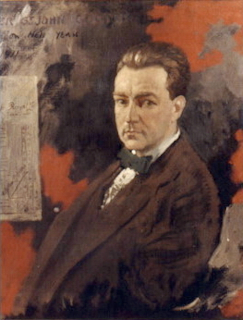
(Pictured: 1911 portrait of Oliver St. John Gogarty painted by Sir William Orpen, currently housed at the Royal College of Surgeons in Ireland)
Nationalist forces enter Newcastle West, County Limerick, on Monday, August 7, 1922, after a twelve-hour battle, in which twelve anti-Treaty Irish Republican Army (IRA) members, sometimes referred to as Irregulars, are killed. The casualties of the Nationalists are less than those of the Irregulars.
Taking little respite after Sunday’s labors, the Nationals advance from Rathkele on Monday morning, and by midday are in sight of their fresh objective. Armored cars enter the town and machine gun fire is directed against a party of Irregulars, causing many casualties.
When the artillery goes into action against the headquarters of the Irregulars, the Irregulars flee precipitately along Cord road.
Owing to the slow progress in the operations in Southern Ireland, the meeting of Dáil Éireann, scheduled to open Saturday, is postponed again.
The official army bulletin announces that the Nationals captured Castle Island on Saturday, August 5. It says that the counties of Cork and Kerry with a part of South Tipperary and a small area in County Waterford are the only districts held by the Irregulars with any degree of security.
The streets of Dublin are lined with great crowds of people on Tuesday, August 8, for the military funeral of nine National Army soldiers who were killed in fighting the Republican Irregulars in County Kerry. Michael Collins, Chairman of the Provisional Government, and all the leading officers of the army in Dublin march beside the hearses. Each coffin is covered with the Republican tricolour. There are many clergymen and other civilians in the funeral procession.
Prominent Catholics of Dublin and Belfast are trying to effect a better understanding between the Ulster and Free State Governments, according to the Daily Mail. This newspaper further states that all efforts to this end, which have all been taken with the advice and approval of leading English Catholics, are without official character.
A message from Strabane, County Tyrone, received by the Exchange Telegraph Company on August 8 states that a settlement between the Ulster Government and the Free State authorities is imminent, the terms of agreement having been practically arranged in negotiations proceeding in London.
In Downing Street, however, all knowledge of any such Irish negotiations is disclaimed and a telegram from Belfast quotes Ulster Government officials as denying that a settlement with the Free State is imminent.
The Free State Government is also unaware of any negotiations for a settlement between the Ulster Government and the Free State authorities. It is further states that such negotiations are unlikely to take place.
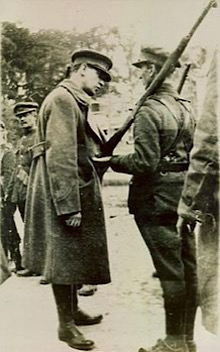
(From: “Irish Irregulars Routed With Loss,” The New York Times, August 9, 1922 | Pictured: General Michael Collins inspects a soldier at Newcastle West, County Limerick, August 8, 1922)
The battle consists of ten days of fighting in the countryside around Kilmallock in County Limerick, in which the National Army of the Irish Free State, advancing south from Limerick city, find their path blocked by anti-Treaty IRA troops, dug into a number of villages at Bruff, Bruree and Patrickswell. The fighting end with the retreat of the anti-Treaty fighters and the occupation of Kilmallock by Free State forces.
The prelude to the battle is the fall of Limerick city to Free State forces. The Republican forces in the city under Liam Deasy withdraw from their positions after a week of fighting and concentrate in Kilmallock and the nearby towns of Bruff and Bruree. The Free State forces, advancing south from the city, find their path blocked by the Republicans dug in at the three hilltop towns.
The National Army’s attempt to break through this position produces the only “line battle” of the war with the two sides facing each other along clear front-lines. The Kilmallock-Bruff-Bruree triangle sees some of the war’s most intense fighting.
Whereas in the fighting in Dublin, Limerick and Waterford, Free State troops equipped with artillery overcome Anti-Treaty resistance relatively easily, at Kilmallock they have a much harder time. The main reason for this is that the Free State troops, most of whom are new recruits, are facing some of the best of the IRA forces without an advantage in numbers or firepower. General Eoin O’Duffy complains of shortage of arms and ammunition. He estimates that while his forces have about 1,300 rifles, the Republicans could muster over 2,000. He is also critical of the quality of the troops at his disposal, whom he describes as, “a disgruntled, undisciplined and cowardly crowd.”
The Republicans know this and are confident of success. Nevertheless, the Republican commanders have their own issues with logistical support and lack of co-operation between forces from different counties. Deasy’s command includes Volunteers from counties Limerick itself, Cork and Kerry, all of whom have their own commanders. They have three improvised armoured cars, some mortars and heavy machine guns but no artillery.
O’Duffy draws up plans for the advance on Kilmallock with the assistance of his second-in-command Major GeneralW. R. E. Murphy who had been a lieutenant colonel in World War I. His experience in the trenches has a major effect on his approach – pre-disposing him to cautious advances and use of trenches for cover.
The Republican forces have the better of the first clashes. On Sunday, July 23, Free State forces take Bruff and begin their advance on Kilmallock, but are twice beaten back by determined Republican resistance. The following day, the Republicans manage to retake Bruff in a counter-attack, taking 76 prisoners. As a result of this setback, O’Duffy calls off the advance for the time being and waits for reinforcements.
National Army forces quickly retake Bruff after reinforcements arrive. However, things get worse for the National Army as the week goes on. They make slow progress in taking the Republican strongpoints, and their casualties also mount. On Tuesday, July 25, a unit of the Dublin Guard under Tom Flood is ambushed on a narrow road. They fight their way clear, but only after losing four men. Three more Free State soldiers are killed two days later. On July 30, Major General Murphy launches an attack to take Bruree. The Dublin Guards attack the town from the southeast, supported by armoured cars and an 18-pound field gun. The Republicans hold out for five hours until Free State artillery is brought into action. At least 13 Free State soldiers and nine Anti-Treaty fighters are killed in the action and more are wounded before the Free State troops secure Bruree.
The Republican commander, Deasy, knows how important Bruree is to the defence of Kilmallock and draws up plans to recapture the town using three armoured cars, trench mortars and machine guns. On August 2, Republicans capture Patrickswell south of Limerick. The armoured cars then attack Bruree, taking Free State forces by surprise. One car attacks Commandant Flood’s headquarters at the Railway Hotel. The Commandant and his men manage to escape out the back of the building under the cover of Lewis gun fire. The second armoured car rams the front door of another post in the school house, which persuades the twenty-five troops inside to surrender.
However, when Free State reinforcements, along with armoured cars arrive, the Republican counter-attack stalls. The Free State reinforcements are led by Commandant General Seamus Hogan, who personally leads his forces, riding in the armoured car nicknamed “The Customs House.” Having failed to secure the surrender of the town, Republican forces retreat.
Having held Bruree against a Republican counterattack, Free State forces prepare to capture Kilmallock itself, but anticipate there will be heavy fighting. Republican Adjutant General Con Moloney comments on August 2, “Up to yesterday we have had the best of the operations there [the Kilmallock area]. There will, I fear, be a big change there now as the enemy have been reinforced very considerably.” In the 3rd Western Division area they have all but disbanded, unwilling to fight Free Staters, destroy roads, and now discouraged by the Catholic church.
On Thursday, August 3, a force of 2,000 Free State troops, backed up by armoured cars and artillery, advance on Kilmallock from Bruree, Dromin and Bulgaden. Seven hundred troops arrive the next day with an armoured car and a field gun. By Saturday, the town is surrounded by Free State forces. The Dublin Guard are also on hand to prevent Republican forces from escaping. Three miles away, Free State artillery is deployed and shells Republican forces on Kilmallock Hill and Quarry Hill. The two hills are soon controlled by Free State forces.
The National Army has, therefore, assembled sufficient force to smother resistance at Kilmallock. They are still, however, expecting hard fighting before they take the town. To their surprise, when the Free State troops enter the town, they encounter only light resistance from a Republican rearguard (volunteers from Cork). Most of the Republican troops have already abandoned their positions and retreated to Charleville.
They departed not because the Free State troops are stronger, but because they have been outflanked by Free State seaborne landings on the coasts of County Kerry and County Cork on August 2 and 8 respectively. The landings in Cork and Kerry force Commandant General Deasy to release units from this area to return home to their own areas. Although the landings in Cork occur after the retreat from Kilmallock, the subsequent loss of brigades from Cork adds to Commandant General Deasy’s problems. The final phase of the fighting in County Limerick comes when the Free State advance south is held up at Newcastle West. Another day of heavy fighting ensues in which the National Army troops have to bring up armoured cars and artillery to dislodge the Republicans, who reportedly lose up to 12 men before they retreat in the direction of Cork.
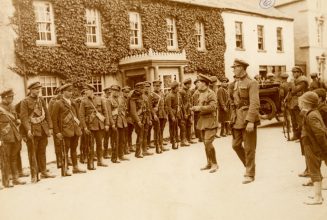
(Pictured: National Army troops lined up for a roll call during the Irish Civil War with local children casting an eye over the proceedings)
Kilfedder leaves the UUP in 1977 in opposition to the party’s policies tending to integrationism, preferring to advocate the restoration of the Stormont administration. For a time he sits as an “Independent Ulster Unionist.” He contests the 1979 European Parliament election under that label, finishing fourth in the count for the three seats, having overtaken the UUP leader Harry West on transfers.
On March 20, 1995, while traveling by train into London from Gatwick Airport, Kilfedder dies of a heart attack. This is the same day that the Belfast Telegraph carries a front-page story saying that an Ulster MP has been targeted as one of twenty MPs invited by the LGBT rights organisation OutRage! in a letter to come out. He dies unmarried and is survived by two sisters.
William Richard English-Murphy, DSOMC, Irish soldier and policeman known as W. R. E. Murphy, dies on March 5, 1975, in Ardee, County Louth. He serves as an officer with the British Army in World War I and later in the National Army. In the Irish Civil War, he is second in overall command of the National Army from January to May 1923. He is first Irish Commissioner of the Dublin Metropolitan Police (DMP) and the last Commissioner of the force before its merger with the Garda Síochána in 1925. Thereafter he is the Deputy Commissioner of the Gardaí until his retirement in 1955.
Murphy is born in Danecastle, Bannow, County Wexford, on January 26, 1890. His parents die when he is four years old. His grandparents also die during his childhood. He and his sister Mae (Mary Sarah) are separately raised by relatives in Belfast and Waterford. He is completing his master’s degree at Queens University Belfast (QUB) when he follows the call of John Redmond to join the war effort and ensure Irish independence. Ulster regiments reject him because he is Catholic. Seeking a regiment that treats Irish volunteers with respect, he joins the British Army in Belfast in 1915 as an officer cadet in the South Staffordshire Regiment.
Murphy serves in the Battle of Loos in 1915 and is wounded but returns to action for the start of the Battle of the Somme in July 1916. He becomes commanding officer of the 1st Battalion, the South Staffordshire Regiment in August 1918, reaching the rank of temporary lieutenant colonel. In 1918, his regiment is posted to the Italian Front, at the Piave River, where they are when the armistice is declared on November 4, 1918. He is granted the rank of substantive lieutenant colonel on the retired list on May 16, 1922.
After he returns to Ireland, Murphy resumes his career as a teacher. At some point, he joins the Irish Republican Army (IRA), an organisation fighting to end British rule in Ireland.
In December 1921, the Anglo-Irish Treaty is signed between British and Irish leaders, resulting in the setting up of the Irish Free State. Conflict over the Treaty among Irish nationalists ultimately leads to the outbreak of the Irish Civil War in June 1922. Murphy enlists as a general in the new National Army of the Irish Free State. After the start of the Irish Civil War, he is put in command of troops charged with taking posts held by the anti-Treaty IRA in Limerick.
At the Battle of Kilmallock in July–August 1922, Murphy is second in command to Eoin O’Duffy. His troops successfully dislodge the anti-Treaty IRA from positions around Kilmallock in County Limerick, but he is criticised for his tendency to “dig in” and resort to trench warfare rather than rapid offensive action.
Afterward, Murphy is put in overall command of Free State forces in County Kerry until January 1923. He lobbies Richard Mulcahy, commander in chief, for 250 extra troops, to bring his command up to 1,500 and help to put down the guerrilla resistance there. In the early stages of the guerrilla war, he organises large-scale “sweeps” to break up the republican concentrations in west Cork and east Kerry. These meet with little success, however. He exercises overall command in the county, but day-to-day operations are largely run by Brigadier Paddy Daly, of the Dublin Guard.
In October, in response to continuing guerrilla attacks on his troops, Murphy orders a nightly curfew to be put into place in Tralee.
In December, Murphy writes to Mulcahy that the “Irregular [Anti-Treaty] organisation here is well-nigh broken up,” and suggests the end of the war in the county is in sight. His optimistic prediction, however, proves premature.
On December 20, Murphy sentences four captured republican fighters to death under the fictitious “Public Safety Act” for possession of arms and ammunition. However, the sentences are to be called off if local guerrilla activity ceases. Humphrey Murphy, the local IRA Brigade commander, threatens to shoot eight named government supporters in reprisal if the men are executed. Eventually, their sentence is commuted to penal servitude.
In January 1923, Murphy is promoted from his command in Kerry to “responsibility for operations and organisation at the national level” in the army. Paddy Daly takes over as commanding officer in Kerry. Murphy later voices the opinion that Daly had been a bad choice, given his implication in the Ballyseedy massacre and other events of March 1923, in which up to 30 anti-Treaty prisoners were killed in the county.
Murphy leaves the National Army after the end of the Irish Civil War in May 1923 and becomes the first Irish commissioner of the Dublin Metropolitan Police. He later becomes deputy commissioner of the Garda Síochána, when DMP is merged with the new national police force in 1925. He holds this post until his retirement in 1955.
Murphy is at the forefront of efforts to close down Dublin’s red-light district, the Monto, in the early 1920s. Between 1923 and 1925, religious missions led by Frank Duff of the Legion of Mary, a Roman Catholic organisation, and Fr. R.S. Devane work to close down the brothels. They receive the cooperation of Murphy in his role as Dublin Police Commissioner, and the campaign ends with 120 arrests and the closure of the brothels following a police raid on March 12, 1925.
Murphy lives with his daughter, Joan McMahon, in Ardee, County Louth, after his wife, Mary Agnes Fortune, dies on July 31, 1958. He dies on March 5, 1975, and is buried in St. Peter’s Churchyard, Bray, County Wicklow.
(Pictured: Major-General W. R. E. Murphy, as depicted on a Wills’ Irish Sportsmen cigarette card, from their boxing series)
Walsh is born in the townland of Rathroon, near Bandon, County Cork, on February 20, 1880. His family comes from a farming background, “working a substantial holding of medium but well-cultivated land.” Until the age of fifteen, he attends a local school in Bandon, but by his own account “as far as learning went, I may as well have been at home.” Together with his school friend P. S. O’Hegarty, he passes the Civil Service exams for the Postal service. He later works locally as a clerk in the Post Office. Like O’Hegarty, he spends three years in London at King’s College, studying for the Secretary’s Office “a syllabus (which) differed little from the Indian Civil Service.” While O’Hegarty succeeds in his studies, Walsh does not, and returns to Cork where a friend, Sir Edward Fitzgerald, arranges work for him on the Entertainments Committee of the Cork International Exhibition.
Walsh is active in the GAA, promoting Gaelic games in many areas, but particularly in Cork city and county. His interest in organised sports has a strong political dimension.
“I happened to be one of those who realised the potentialities of the GAA as a training ground for Physical Force. Contamination with the alien and all his works was taboo. I gathered around me a force of youthful enthusiasts from the University, Civil Service and Business. With this intensely organised instrument, war was declared on foreign games which were made to feel the shock so heavily that one by one, Soccer and Rugby Clubs began to disappear.”
Walsh participates in the Easter Rising in 1916 in the General Post Office (GPO). He claims he is responsible for mobilising 20 members of the Hibernian Rifles and takes them to the GPO. However, Rifles commandant John J. Scollan contradicts this account. He is promoted from Rifleman to Vice-Commandant of the Hibernian Rifles in 1915.
Walsh is arrested following the general surrender and sentenced to death after a court-martial at Richmond Barracks. This is almost immediately commuted to life imprisonment, but he is released the following year under a general amnesty.
In later 1917 Walsh is arrested and imprisoned after making a speech declaring “the only way to address John Bull is through the barrel of a rifle.”
Walsh is elected as a Sinn FéinMember of Parliament (MP) in the 1918 United Kingdom general election for the Cork City constituency. As a member of the First Dáil he is arrested for partaking in an illegal government. He is released in 1921 and supports the Anglo-Irish Treaty and goes on to become a founding member of the new political party, Cumann na nGaedheal. He serves as Postmaster General from 1922 until 1924 and joins the cabinet of W. T. Cosgrave between 1924 and 1927, after the office is reconstituted as the Department of Posts and Telegraphs. He is elected at every election for the Cork Borough constituency until 1927 when he retires from government.
In August 1922 Walsh is part of a government committee which is intended to consider what the Irish Free State’s policy towards north-east Ulster will be.
During World War II, known at the time in Ireland as “the Emergency,” Walsh’s connections with fascism, including his association with Ailtirí na hAiséirghe, bring him to the attention of the Directorate of Military Intelligence, the Intelligence branch of the Irish Army. Their request to the Minister for Justice, Gerald Boland, to place a tap on Walsh’s phone is, however, refused. He is closely associated with Irish-based pro-Nazi initiatives through his association with Ailtirí na hAiséirghe, frequently expressing his views with anti-semitic rhetoric.
After leaving politics Walsh founds a bus company which operates with great success between the city centre and south Dublin. When private bus services are bought out by the Dublin Tramway Co., he invests his profits in other Irish companies including Clondalkin Paper Mills, Solus Teoranta and Benbulben Barytes. He is also a director of Killeen and Newbrook Paper Mills, timber exporters Dinan Dowds, the Moore Clothing Co., and Fancy Goods. In 1937 he is elected president of the Federation of Irish Manufacturers, having previously held the vice-presidency. His businesses benefit greatly from the protectionist measures introduced by Fianna Fáil after 1932. Nonetheless, he complains that not enough has been done to make capital available to native entrepreneurs, and that “alien” interests are allowed too much scope to penetrate the Irish market.
In 1944 Walsh publishes a short memoir, Recollections of a Rebel. In his later years he suffers from deteriorating health, leading to his resignation from the presidency of the Federation of Irish Manufacturers in 1946. He dies in Dublin on February 3, 1948. He is buried in St. Finbarr’s Cemetery, Cork, County Cork.
On April 24, 2016, a plaque commemorating Walsh is unveiled in Kilbrittain, County Cork.
Costello is born on June 20, 1891, in Fairview, Dublin, the younger son of John Costello senior, a civil servant, and Rose Callaghan. He is educated at St. Joseph’s, Fairview, and then moves to O’Connell School, for senior classes, and later attends University College Dublin (UCD), where he graduates with a degree in modern languages and law. He studies at King’s Inns to become a barrister, winning the Victoria Prize there in 1913 and 1914. He is called to the Irish Bar in 1914, and practises as a barrister until 1922.
In 1922, Costello joins the staff at the office of the Attorney General in the newly established Irish Free State. Three years later he is called to the inner bar, and the following year, 1926, he becomes Attorney General of Ireland, upon the formation of the Cumann na nGaedheal government, led by W. T. Cosgrave. While serving in this position he represents the Free State at Imperial Conferences and League of Nations meetings.
Costello is also elected a Bencher of the Honourable Society of King’s Inns. He loses his position as Attorney General of Ireland when Fianna Fáil comes to power in 1932. The following year, however, he is elected to Dáil Éireann as a Cumann na nGaedheal TD. Cumann na nGaedheal soon merges with other parties to form Fine Gael.
During the Dáil debate on the Emergency Powers Act 1939, Costello is highly critical of the Act’s arrogation of powers, stating that “We are asked not merely to give a blank cheque, but to give an uncrossed cheque to the Government.” He loses his seat at the 1943 Irish general election but regains it when Éamon de Valera calls a snap election in 1944. From 1944 to 1948, he is the Fine Gael front-bench Spokesman on External Affairs.
In 1948, Fianna Fáil has been in power for sixteen consecutive years and has been blamed for a downturn in the economy following World War II. The 1948 Irish general election results show Fianna Fáil short of a majority, but still by far the largest party, with twice as many seats as the nearest rival, Fine Gael. It appears that Fianna Fáil is headed for a seventh term in government. However, the other parties in the Dáil realise that between them, they have only one seat fewer than Fianna Fáil, and if they band together, they would be able to form a government with the support of seven Independent deputies. Fine Gael, the Labour Party, the National Labour Party, Clann na Poblachta and Clann na Talmhan join to form the first inter-partygovernment in the history of the Irish state.
While it looks as if cooperation between these parties will not be feasible, a shared opposition to Fianna Fáil and Éamon de Valera overcomes all other difficulties, and the coalition government is formed.
Since Fine Gael is the largest party in the government, it has the task of providing a suitable candidate for Taoiseach. Naturally, it is assumed that its leader, Richard Mulcahy, will be offered the post. However, he is an unacceptable choice to Clann na Poblachta and its deeply republican leader, Seán MacBride. This is due to Mulcahy’s record during the Irish Civil War. Instead, Fine Gael and Clann na Poblachta agree on Costello as a compromise candidate. Costello had never held a ministerial position nor was he involved in the Civil War. When told by Mulcahy of his nomination, Costello is appalled, content with his life as a barrister and as a part-time politician. He is persuaded to accept the nomination as Taoiseach by close non-political friends.
During the campaign, Clann na Poblachta had promised to repeal the Executive Authority (External Relations) Act 1936 but does not make an issue of this when the government is being formed. However, Costello and his Tánaiste, William Norton of the Labour Party, also dislike the act. During the summer of 1948, the cabinet discusses repealing the act, however, no firm decision is made.
In September 1948, Costello is on an official visit to Canada when a reporter asks him about the possibility of Ireland leaving the British Commonwealth. For the first time, he declares publicly that the Irish government is indeed going to repeal the External Relations Act and declare Ireland a republic. It has been suggested that this is a reaction to offence caused by the Governor General of Canada at the time, Harold Alexander, 1st Earl Alexander of Tunis, who is of Northern Irish descent and who allegedly arranges to have placed symbols of Northern Ireland in front of Costello at an official dinner. Costello makes no mention of these aspects on the second reading of the Republic of Ireland Bill on November 24 and, in his memoirs, claims that Alexander’s behaviour had in fact been perfectly civil and could have had no bearing on a decision which had already been made.
The news takes the Government of the United Kingdom and even some of Costello’s ministers by surprise. The former had not been consulted and following the declaration of the Republic in 1949, the UK passes the Ireland Act that year. This recognises the Republic of Ireland and guarantees the position of Northern Ireland within the United Kingdom for so long as a majority there want to remain in the United Kingdom. It also grants full rights to any citizens of the Republic living in the United Kingdom. Ireland leaves the Commonwealth on April 18, 1949, when The Republic of Ireland Act 1948 comes into force. Frederick Henry Boland, Secretary of the Department of External Affairs, says caustically that the affair demonstrates that “the Taoiseach has as much notion of diplomacy as I have of astrology.” The British envoy, John Maffey, 1st Baron Rugby, is equally critical of what he calls a “slipshod and amateur” move.
Many nationalists now see partition as the last obstacle on the road to total national independence. Costello tables a motion of protest against partition on May 10, 1949, without result.
In 1950, the independent-minded Minister for Health, Noël Browne, introduces the Mother and Child Scheme. The scheme would provide mothers with free maternity treatment and their children with free medical care up to the age of sixteen, which is the normal provision in other parts of Europe at that time. The bill is opposed by doctors, who fear a loss of income, and Roman Catholic bishops, who oppose the lack of means testing envisaged and fear the scheme could lead to birth control and abortion. The cabinet is divided over the issue, many feeling that the state cannot afford such a scheme priced at IR£2,000,000 annually. Costello and others in the cabinet make it clear that in the face of such opposition they will not support the Minister. Browne resigns from the government on April 11, 1951, and the scheme is dropped. He immediately publishes his correspondence with Costello and the bishops, something which had hitherto not been done. Derivatives of the Mother and Child Scheme are introduced in Public Health Acts of 1954, 1957 and 1970.
The Costello government has a number of noteworthy achievements. A new record is set in housebuilding, the Industrial Development Authority and Córas Tráchtála are established, and the Minister for Health, Noel Browne, with the then new Streptomycin, bring about an advance in the treatment of tuberculosis. Ireland also joins a number of organisations such as the Organization for European Economic Co-operation and the Council of Europe. However, the government refuses to join NATO, allegedly because the British remain in Northern Ireland. The scheme to supply electricity to even the remotest parts of Ireland is also accelerated.
While the “Mother and Child” incident does destabilise the government to some extent, it does not lead to its collapse as is generally thought. The government continues; however, prices are rising, a balance of payments crisis is looming, and two TDs withdraw their support for the government. These incidents add to the pressure on Costello and so he decides to call a general election for June 1951. The result is inconclusive but Fianna Fáil returns to power. Costello resigns as Taoiseach. It is at this election that his son Declan is elected to the Dáil.
Over the next three years while Fianna Fáil is in power a dual-leadership role of Fine Gael is taking place. While Richard Mulcahy is the leader of the party, Costello, who has proved his skill as Taoiseach, remains as parliamentary leader of the party. He resumes his practice at the Bar. In what is arguably his most celebrated case, the successful defence of The Leader against a libel action brought by the poet Patrick Kavanagh, dates from this period. Kavanagh generously praises Costello’s forensic skill, and the two men become friends.
At the 1954 Irish general election Fianna Fáil loses power. A campaign dominated by economic issues results in a Fine Gael-Labour Party-Clann na Talmhan government coming to power. Costello is elected Taoiseach for the second time.
The government can do little to change the ailing nature of Ireland’s economy, with emigration and unemployment remaining high, and external problems such as the Suez Crisis compounding the difficulty. Measures to expand the Irish economy such as export profits tax relief introduced in 1956 would take years have sizable impact. Costello’s government does have some success with Ireland becoming a member of the United Nations in 1955, and a highly successful visit to the United States in 1956, which begins the custom by which the Taoiseach visits the White House each Saint Patrick’s Day to present the U.S. President with a bowl of shamrock. Although the government has a comfortable majority and seems set for a full term in office, a resumption of Irish Republican Army (IRA) activity in Northern Ireland and Great Britain causes internal strains. The government takes strong action against the republicans.
In spite of supporting the government from the backbenches, Seán MacBride, the leader of Clann na Poblachta, tables a motion of no confidence, based on the weakening state of the economy and in opposition to the government’s stance on the IRA. Fianna Fáil also tables its own motion of no confidence, and rather than face almost certain defeat, Costello again asks PresidentSeán T. O’Kelly to dissolve the Oireachtas. The general election which follows in 1957 gives Fianna Fáil an overall majority and starts another sixteen years of unbroken rule for the party. Some of his colleagues questioned the wisdom of his decision to call an election. The view is expressed that he was tired of politics and depressed by his wife’s sudden death the previous year.
Following the defeat of his government, Costello returns to the bar. In 1959, when Richard Mulcahy resigns the leadership of Fine Gael to James Dillon, he retires to the backbenches. He could have become party leader had he been willing to act in a full-time capacity. He remains as a TD until 1969, when he retires from politics, being succeeded as Fine Gael TD for Dublin South-East by Garret FitzGerald, who himself goes onto to become Taoiseach in a Fine Gael-led government.
During his career, Costello is presented with a number of awards from many universities in the United States. He is also a member of the Royal Irish Academy from 1948. In March 1975, he is made a freeman of the city of Dublin, along with his old political opponent Éamon de Valera. He practises at the bar until a short time before his death at the age of 84, in Ranelagh, Dublin, on January 5, 1976. He is buried at Dean’s Grange Cemetery in Dublin.
The statute increases the sovereignty of the self-governing Dominions of the British Empire from the United Kingdom. It also binds them all to seek each other’s approval for changes to monarchical titles and the common line of succession. The statute is effective either immediately or upon ratification. It thus becomes a statutory embodiment of the principles of equality and common allegiance to the Crown set out in the Balfour Declaration of 1926. As the statute removes nearly all of the British parliament’s authority to legislate for the Dominions, it is a crucial step in the development of the Dominions as separate, independent, and sovereign states.
The Irish Free State never formally adopts the Statute of Westminster, its Executive Council (cabinet) taking the view that the Anglo-Irish Treaty of 1921 has already ended Westminster‘s right to legislate for the Irish Free State. The Constitution of the Irish Free State gives the Oireachtas “sole and exclusive power of making laws.” Hence, even before 1931, the Irish Free State does not arrest British Army and Royal Air Force deserters on its territory, even though the UK believes post-1922 British laws give the Free State’s Garda Síochána the power to do so. The UK’s Irish Free State Constitution Act 1922 says, however, “[n]othing in the [Free State] Constitution shall be construed as prejudicing the power of [the British] Parliament to make laws affecting the Irish Free State in any case where, in accordance with constitutional practice, Parliament would make laws affecting other self-governing Dominions.”
Motions of approval of the Report of the Commonwealth Conference had been passed by Dáil Éireann and Seanad Éireann in May 1931 and the final form of the Statute of Westminster includes the Irish Free State among the Dominions the British Parliament cannot legislate for without the Dominion’s request and consent. Originally, the UK government wants to exclude from the Statute of Westminster the legislation underpinning the 1921 treaty, from which the Free State’s constitution had emerged. Executive Council President (Prime Minister) W. T. Cosgrave objects, although he promises that the Executive Council will not amend the legislation unilaterally. The other Dominions back Cosgrave and, when an amendment to similar effect is proposed at Westminster by John Gretton, parliament duly votes it down. When the statute becomes law in the UK, Patrick McGilligan, the Free State Minister for External Affairs, states, “It is a solemn declaration by the British people through their representatives in Parliament that the powers inherent in the Treaty position are what we have proclaimed them to be for the last ten years.” He goes on to present the statute as largely the fruit of the Free State’s efforts to secure for the other Dominions the same benefits it already enjoys under the treaty. The Statute of Westminster has the effect of granting the Irish Free State internationally recognised independence.
Éamon de Valera leads Fianna Fáil to victory in the 1932 Irish general election on a platform of republicanising the Free State from within. Upon taking office, he begins removing the monarchical elements of the Constitution, beginning with the Oath of Allegiance. De Valera initially considers invoking the Statute of Westminster in making these changes, but John J. Hearne advises him to not do so. Abolishing the Oath of Allegiance in effect abrogates the 1921 treaty. Generally, the British believe that this is morally objectionable but legally permitted by the Statute of Westminster. Robert Lyon Moore, a Southern Unionist from County Donegal, challenges the legality of the abolition in the Irish Free State’s courts and then appeals to the Judicial Committee of the Privy Council (JCPC) in London. However, the Free State has also abolished the right of appeal to the JCPC. In 1935, the JCPC rules that both abolitions are valid under the Statute of Westminster. The Irish Free State, which in 1937 is renamed Ireland, leaves the Commonwealth in 1949 upon the coming into force of The Republic of Ireland Act 1948.
The Statute of Westminster’s modified versions are now domestic law in Australia and Canada. It has been repealed in New Zealand and implicitly in former Dominions that are no longer Commonwealth realms.
Cosgrave is born at 174 James’s Street, Dublin, on June 5, 1880, to Thomas Cosgrave, grocer, and Bridget Cosgrave (née Nixon). He is educated at the Christian Brothers School at Malahide Road, Marino, Dublin, before entering his father’s publican business. He first becomes politically active when he attends the first Sinn Féin convention in 1905.
At an early age, Cosgrave is attracted to the Irish nationalist party Sinn Féin. He becomes a member of the Dublin Corporation in 1909 and is subsequently reelected to represent Sinn Féin interests. He joins the Irish Volunteers in 1913, although he never joins the Irish Republican Brotherhood (IRB) because he does not believe in secret societies. When the group splits in 1914 upon the outbreak of World War I, he sides with a radical Sinn Féin minority against the constitutional nationalists led by John Redmond, who supports the British war effort.
Cosgrave takes part in the 1916 Easter Rising and is afterward interned by the British for a short time. In 1917, he is elected to Parliament for the city of Kilkenny. In the sweeping election victory of Sinn Féin in the 1918 United Kingdom general election, he becomes a member of the First Dáil. He is made Minister for Local Government in the first republican ministry, and during the Irish War of Independence (1919–21) his task is to organize the refusal of local bodies to cooperate with the British in Dublin.
Cosgrave is a supporter of the 1921 Anglo-Irish Treaty settlement with Great Britain, and he becomes Minister of Local Government in Ireland’s provisional government of 1922. He replaces Michael Collins as Chairman of the Provisional Government when the latter becomes commander-in-chief of the National Army in July 1922. He also replaces Arthur Griffith as president of the Dáil after Griffith’s sudden death on August 12, 1922. As the first president of the Executive Council of the Irish Free State, he, who had helped found the political party Cumann na nGaedheal in April 1923 and became its leader, represents Ireland at the Imperial Conference in October 1923. A month earlier he is welcomed as Ireland’s first spokesman at the assembly of the League of Nations.
Cosgrave’s greatest achievement is to establish stable democratic government in Ireland after the Irish Civil War (1922–23). In the Dáil there is no serious opposition, since the party headed by Éamon de Valera, which refuses to take the oath prescribed in the treaty, abstains from attendance. But neither Cosgrave nor his ministry enjoy much popularity. Order requires drastic measures, and taxation is heavy and sharply collected. He seems sure of a long tenure only because there is no alternative in sight.
In July 1927, shortly after a general election, the assassination of Kevin O’Higgins, the vice president, produces a crisis. The Executive Council introduces a Public Safety Act, which legislates severely against political associations of an unconstitutional character and introduces a bill declaring that no candidature for the Dáil should be accepted unless the candidate declares willingness to take a seat in the Dáil and to take the oath of allegiance. The result of this measure is that de Valera and his party decide to attend sessions in the Dáil, and, since this greatly alters the parliamentary situation, Cosgrave obtains leave to dissolve the assembly and hold a general election. The September 1927 Irish general election leaves his party numerically the largest in the Dáil but without an overall majority. He continues in office until de Valera’s victory at the 1932 Irish general election. Cumann na nGaedheal joins with two smaller opposition parties in September 1933 to form a new party headed by Cosgrave, Fine Gael (“Irish Race”), which becomes Ireland’s main opposition party. In 1944 he resigns from the leadership of Fine Gael.
Cosgrave dies on November 16, 1965, at the age of 85. The Fianna Fáil government under Seán Lemass awards him the honour of a state funeral, which is attended by the Cabinet, the leaders of all the main Irish political parties, and Éamon de Valera, then President of Ireland. He is buried in Goldenbridge Cemetery in Inchicore, Dublin. Richard Mulcahy says, “It is in terms of the Nation and its needs and its potential that I praise God who gave us in our dangerous days the gentle but steel-like spirit of rectitude, courage and humble self-sacrifice, that was William T. Cosgrave.”
While Cosgrave never officially holds the office of Taoiseach (prime minister), Ireland considers him to be its first Taoiseach due to having been the Free State’s first head of government.
Cosgrave’s son, Liam, serves as a TD (1943-81), as leader of Fine Gael (1965-77) and Taoiseach (1973-77). His grandson, also named Liam, also serves as a TD and as Senator. His granddaughter, Louise Cosgrave, serves on the Dún Laoghaire–Rathdown County Council (1999-2009).
In October 2014, Cosgrave’s grave is vandalised, the top of a Celtic cross on the headstone being broken off. It is again vandalised in March 2016.
An earlier “Fianna” is organised “to serve as a Junior Hurling League to promote the study of the Irish Language” on June 26, 1902, at the Catholic Boys’ Hall, Falls Road, in West Belfast, the brainchild of Bulmer Hobson. Hobson, a Quaker influenced by suffragism and nationalism, joins the Irish Republican Brotherhood in 1904 and is an early member of Sinn Féin during its monarchist-nationalist period, alongside Arthur Griffith and Constance Markievicz. Hobson later relocates to Dublin and the Fianna organisation collapses in Belfast. Markievicz, inspired by the rapid growth of Robert Baden-Powell‘s Boy Scouts, forms sometime before July 1909 the Red Branch Knights, a Dublin branch of Irish National Boy Scouts. After discussions involving Hobson, Markievicz, suffragist and labour activist Helena Molony and Seán McGarry, the Irish National Boy Scouts change their name to Na Fianna Éireann at a meeting in 34 Lower Camden Street, Dublin, on August 16, 1909, at which Hobson is elected as president, thus ensuring a strong IRB influence, Markievicz as vice-president and Pádraig Ó Riain as secretary. Seán Heuston is the leader of the Fianna on Dublin’s north side, while Cornelius “Con” Colbert is the leader on the south side. The Fianna forms as a Nationalist alternative to Powell’s Scouts with the aim to achieve the full independence of Ireland by training and teaching scouting and military exercises, Irish history, and the Irish language.
The Fianna finds its first years difficult and by 1912 has barely 1,000 members and a skeleton structure outside of the cities of Dublin, Cork, Belfast and Galway. But in the next couple of years the momentum of events carries the Fianna forward. It is involved in initiating the militarisation of the IRB, the launch of the Irish Volunteers and showing solidarity with the striking Irish Transport and General Workers’ Union (ITGWU). It is also crucial to the success of the Howth and Kilcoole gun-running operations. Alongside these headline-grabbing activities, the Fianna continues with classes, drilling, camps and protests and reaps the benefits of an expanding membership and structure. When the fighting starts, the Fianna are not found wanting either. In 1916, Na Fianna members are present in all areas that mobilise and fight alongside all the other Republican organisations. They continue to fight throughout the Irish War of Independence and Irish Civil War. Seeing comrades being killed in action or executed or suffering imprisonment does not dim their enthusiasm for the fight. In Na Fianna Éireann’s March 1922 Árd Fheis, the 187 delegates representing 30,000 members vote unanimously to reject the Anglo-Irish Treaty.
The Fianna are declared an illegal organisation by the government of the Irish Free State in 1931. This is reversed when Fianna Fáil comes to power in 1932 but re-introduced in 1938. During the splits in the Republican movement of the later part of the 20th century, the Fianna and Cumann na mBan support Provisional Sinn Féin in 1969 and Republican Sinn Féin in 1986. The Fianna have been a proscribed organisation in Northern Ireland since 1920.
While the events in which the Fianna members are involved over the revolutionary years have a special place in Irish history, the specific role of the Fianna is absent from most written histories. This, allied with the failure to adequately commemorate the organisation’s centenary, marks a kind of revisionism of omission.





 seamus dubhghaill