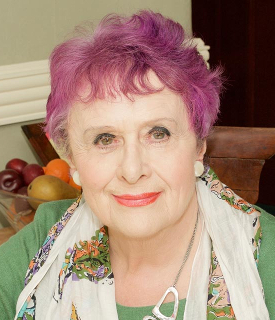
Kenny is one of the founding members of the Irish Women’s Liberation Movement. Although the group has no formal structure of officials, she is often seen as the “ringleader” of the group. In March 1971, as part of an action by the IWLM, she walks out of Haddington Road church after the Archbishop of Dublin‘s pastoral is read out from the pulpit, confirming that “any contraceptive act is always wrong,” saying “this is Church dictatorship.” In a follow-up letter to The Irish Times she explains her actions by saying Ian Paisley was right, “Home Rule is Rome Rule.”
In 1973, Kenny is allegedly “disturbed in the arms of a former cabinet minister of President Obote of Uganda during a party,” which leads poet James Fenton to coin the euphemism “Ugandan discussions” to mean sexual intercourse. The phrase is first used by the magazine Private Eye on March 9, 1973, but has been widely used since then and is included by the BBC in a list of “The 10 most scandalous euphemisms” in 2013.
Peig Sayers, Irish author and seanchaí, is born in the townland of Vicarstown, Dunquin, County Kerry, on March 29, 1873. Seán Ó Súilleabháin, the former archivist for the Irish Folklore Commission, describes her as “one of the greatest woman storytellers of recent times.”
Sayers is born Máiréad (Margaret) Sayers, the youngest child of the family. She is called Peig after her mother, Margaret “Peig” Brosnan, from Castleisland. Her father Tomás Sayers is a renowned storyteller who passes on many of his tales to Peig. At age 12, she is taken out of school and goes to work as a servant for the Curran family in the nearby town of Dingle. She spends two years there before returning home due to illness.
She spends the next few years as a domestic servant working for members of the growing middle class produced by the Land War. She plans to join her best friend, Cáit Boland, in the United States, but Boland writes that she has had an accident and can not forward the cost of the fare. Peig moves to the Great Blasket Island after marrying Pádraig Ó Guithín, a fisherman and native of the island, on February 13, 1892. She and Pádraig have eleven children, of whom six survive.
The Norwegian scholar Carl Marstrander, who visits the island in 1907, urges Robin Flower of the British Museum to visit the Blaskets. Flower is keenly appreciative of Sayers’ stories and tales. He records them and brings them to the attention of the academic world.
In the 1930s, a Dublin teacher, Máire Ní Chinnéide, who is a regular visitor to the Blaskets, urges Sayers to tell her life story to her son Micheál. She is illiterate in the Irish language, although she receives her early schooling through the medium of English. She dictates her biography to Micheál. He then sends the manuscript pages to Máire Ní Chinnéide in Dublin, who edits them for publication. It is published in 1936.
Over several years beginning in 1938 she dictates 350 ancient legends, ghost stories, folk stories, and religious stories to Seosamh Ó Dálaigh of the Irish Folklore Commission.
Sayers continues to live on the island until 1942, when she leaves the Island and returns to her native Dunquin. She is moved to a hospital in Dingle, County Kerry where she dies on December 8, 1958. She is buried in the Dún Chaoin Burial Ground on the Dingle Peninsula. Her surviving children, except for her son Micheál, emigrate to the United States and live with their descendants in Springfield, Massachusetts.
Melesina Trench (née Chenevix), Irish writer, poet and diarist, is born in Dublin on March 22, 1768. During her lifetime she is known more for her beauty than her writing. It is not until her son, Richard Chenevix Trench, publishes her diaries posthumously in 1861 that her work receives notice.
Melesina Chenevix is born to Philip Chenevix and Mary Elizabeth Gervais. She is orphaned before her fourth birthday and is brought up by her paternal grandfather, Richard Chenevix (1698–1779), the AnglicanBishop of Waterford and Lismore. The family is of Huguenot extraction.
After the death of Richard Chenevix she goes to live with her other grandfather, the Archdeacon Gervais. On October 31, 1786, she marries Colonel Richard St. George, who dies only four years later in Portugal, leaving one son, Charles Manners St. George, who becomes a diplomat.
On March 3, 1803, in Paris she marries her second husband, Richard Trench, who is the sixth son of Frederick Trench and brother of Frederick Trench, 1st Baron Ashtown.
After the breakdown of the Peace of Amiens, Richard Trench is detained in France by Napoleon‘s armies, and in August 1805 Melesina takes it upon herself to petition Napoleon in person and pleads for her husband’s release. Her husband is released in 1807, and the couple settles at Elm Lodge in Bursledon, Hampshire, England.
Their son, Francis Chenevix Trench, is born in 1805. In 1807, when they are on holiday in Dublin, their son Richard Chenevix Trench is born. He goes on to be the Archbishop of Dublin, renowned poet and contemporary of Alfred, Lord Tennyson. Her only daughter dies a few years later at the age of four.
Trench corresponds with, amongst others, Mary Leadbeater, with whom she works to improve the lot of the peasantry at her estate at Ballybarney. She dies at the age of 59 in Malvern, Worcestershire on May 27, 1827.
Melesina Trench’s diaries and letters are compiled posthumously by Richard Chenevix Trench as The remains of the late Mrs. Richard Trench in 1861 with an engraving of her taken from a painting by George Romney. Another oil painting, The Evening Star by Sir Thomas Lawrence, has her as a subject, and she is reproduced in portrait miniatures – one in Paris by Jean-Baptiste Isabey and another by Hamilton that is copied by the engraver Francis Engleheart.
At Swim-Two-Birds, a novel by Irish writer Brian O’Nolan writing under the pseudonym Flann O’Brien, is published on March 13, 1939. It is widely considered to be O’Brien’s masterpiece, and one of the most sophisticated examples of metafiction.
At Swim-Two-Birds is accepted for publication by Longman on the recommendation of Graham Greene, who is a reader for them at the time. It is published under the pseudonym of Flann O’Brien, a name O’Nolan had already used to write hoax letters to The Irish Times. O’Nolan suggests using “Flann O’Brien” as a penname during negotiation with Longman. The novel’s title derives from Snámh dá Én, a ford on the River Shannon, between Clonmacnoise and Shannonbridge, reportedly visited by the legendary King Sweeney, a character in the novel.
The book does not sell well after it is published. By the outbreak of World War II, it has sold scarcely more than 240 copies. In 1940, Longman’s London premises are destroyed during a bombing raid by the Luftwaffe and almost all the unsold copies are incinerated. The novel is republished by Pantheon Books in New York City in 1950, on the recommendation of James Johnson Sweeney, but sales remain low. In May 1959 Timothy O’Keeffe, while editorial director of the London publishing house MacGibbon & Kee, persuades O’Nolan to allow him to republish At Swim-Two-Birds. More recently, the novel is republished in the United States by Dalkey Archive Press.
The initial reviews for At Swim-Two-Birds are not enthusiastic. The Times Literary Supplement says that the book’s only notable feature is a “schoolboy brand of mild vulgarity.” The New Statesman complains that “long passages in imitation of the Joycean parody of the early Irish epic are devastatingly dull” and the Irish novelist Seán Ó Faoláin comments in John O’London’s Weekly that although the book had its moments, it “had a general odour of spilt Joyce all over it.”
However, most of the support for At Swim-Two-Birds comes not from newspaper reviewers but from writers. Dylan Thomas, in a remark that would be quoted on dust jackets in later editions of the book, says “This is just the book to give your sister – if she’s a loud, dirty, boozy girl.” Anthony Burgess considers it one of the ninety-nine greatest novels written between 1939 and 1984. Graham Greene’s enthusiastic reader’s report is instrumental in getting the book published in the first place.
Stephen Fry has declared At Swim-Two-Birds one of his favourite books. In 2011, the book is placed on Time‘s top 100 fiction books written in English since 1923.
Eilís Dillon, Irish author of 50 books, is born in Galway, County Galway on March 7, 1920. Her work has been translated into 14 languages.
Dillon is the third of five children of Professor Thomas Dillon and his wife Geraldine (née Plunkett), who is the sister of Joseph Mary Plunkett. She is raised at Dangan House outside of Galway City before moving to the small fishing village of Barna. She attends the local primary school where she becomes proficient in the Irish language and gains an intimate knowledge of tradition in the Connemara. Her family is involved in Irish revolutionary politics. Her uncle, Joseph Mary Plunkett, is a signatory of the 1916 Proclamation of the Irish Republic and is executed after the Easter Rising.
Educated by the Ursuline nuns in Sligo, she works briefly in the hotel and catering trade. In 1940 she marries Cormac Ó Cuilleanáin, an academic from University College Cork and 17 years her senior. They have at least three children, including the Irish poet and Trinity College Dublin professor Eiléan Ní Chuilleanáin and her brother, Cormac Ó Cuilleanáin, also a Trinity professor, who writes novels as Cormac Millar.
Dillon’s first books are written in Irish including An Choill Bheo, published in 1948, Oscar agus an Cóiste sé nEasóg in 1952 and Ceol na coille in 1955. After the success of The Lost Island, published in 1952, she writes almost exclusively in English. Most of her books are aimed at teen readers with themes of self-discovery and problem solving evident.
Dillon’s adult fiction career begins in 1953 with the publication of the detective novel Death at Crane’s Court. This is followed by Sent to His Account in 1954 and Death in the Quadrangle in 1956. These novels are known for their depiction of contemporary Ireland. Over the following decade Dillon publishes many novels including The Bitter Glass (1959), Across the Bitter Sea (1973) and The Wild Geese (1981).
In 1964 she moves to Rome due to her husband’s poor health. While there she acts as adviser to International Commission on English in the Liturgy. She returns to Cork with her husband in 1969 where he dies the following year. She continues to visit Italy over the next several years, setting some of her stories there including Living in Imperial Rome (1974) and The Five Hundred (1972), though these are not as popular as her Irish books. In 1974 she marries the American-based critic and professor Vivian Mercier, dividing her time between California, Italy and Dublin.
In her later years Dillon plays a prominent role in Irish culture. She is a Fellow of the Royal Society for Literature and a member of Aosdána, serves on the Irish Arts Council 1974–1979, chairs the Irish Writers’ Union and the Irish Writers’ Centre, and founds the Irish Children’s Book Trust. In 1987 she and her husband move permanently to Dublin where she supports up and coming Irish authors. Her last story is Children of Bach published in 1993.
Life in New York is difficult during the Great Depression, so John and his two brothers are shipped back to Ireland in 1933. The two eldest are sent to their maternal grandmother’s house in Fintona, County Tyrone, but John is sent to his father’s ancestral home at Garvaghey, then maintained by two spinster aunts.
A year of graduate school at University of California, Berkeley convinces Montague that he should return to Ireland. He settles in Dublin working at the Irish Tourist Office. In 1961 he moves to Bray, County Wicklow. A regular rhythm of publication sees his first book of stories, Death of a Chieftain (1964) after which the musical group The Chieftains is named, his second book of poems, A Chosen Light (1967), Tides (1970).
All during the 1960s, Montague continues to work on his long poem, The Rough Field, a task that coincides with the outbreak of the Northern Ireland civil rights movement. A Patriotic Suite appears in 1966, Hymn to the New Omagh Road and The Bread God in 1968, and A New Siege, dedicated to Bernadette Devlin which he reads outside Armagh Jail in 1970.
Montague settles in Cork in 1974 and publishes an anthology, theFaber Book of Irish Verse (1974) with a book of lyrics, A Slow Dance (1975). Recognition is now beginning to come, with the award of the Irish American Cultural Institute in 1976, the first Marten Toonder Award in 1977, and the Alice Hunt Bartlett Award for The Great Cloak in 1978.
In 1987, Montague is awarded an honorary doctor of letters by the State University of New York at Buffalo. He serves as distinguished writer-in-residence for the New York State Writers Institute during each spring semester, teaching workshops in fiction and poetry and a class in the English Department of the University at Albany. In 1998, he is named the first Irish professor of poetry, a three-year appointment to be divided among Queen’s University Belfast, Trinity College Dublin, and University College Dublin. In 2008, he publishes A Ball of Fire, a collection of all his fiction including the short novella The Lost Notebook.
John Montague dies at the age of 87 in Nice, France on December 10, 2016, after complications from a recent surgery.
Ó Faoláin writes his first stories in the 1920s, eventually completing 90 stories over a period of 60 years. From 1929 to 1933 he lectures at the Catholic college, St. Mary’s College, at Strawberry Hill in Twickenham, England, during which period he writes his first two books. His first book, Midsummer Night Madness, is published in 1932. It is a collection of stories partly based on his Civil War experiences. He afterwards returns to his native Ireland. He publishes novels, short stories, biographies, travel books, translations, and literary criticism – including one of the rare full-length studies of the short story, The Short Story (1948). He also writes a cultural history, The Irish, in 1947.
Daniel Corkery, Irish politician, writer and academic, is born in Cork, County Cork on February 14, 1878. He is unquestionably best known as the author of The Hidden Ireland, his 1924 study of the poetry of eighteenth-century Irish Language poets in Munster.
After leaving St. Patrick’s, Corkery teaches art for the local technical education committee, before becoming inspector of Irish in 1925, and later Professor of English at University College Cork in 1930. Among his students in UCC are Seán Ó Faoláin and Seán Ó Tuama. He is often a controversial figure in academia for his “nativist” views on Irish literature, views which result in conflict with many Irish Language scholars, most notably Pádraig de Brún and his niece Máire Mhac an tSaoi. Ó Tuama, however, is frequently a staunch defender of Corkery’s reputation.
In his late twenties Corkery learns Irish and this brings him into contact with leading members of the Irish Language revival movement, including Terence MacSwiney, T. C. Murray and Con O’Leary, with whom he founds the Cork Dramatic Society in 1908. His plays Embers and The Hermit and the King are performed by the society. Later plays are staged at the famous Abbey Theatre, including The Labour Leader (1919) and The Yellow Bittern (1920).
Corkery is also a writer of short stories, including the collections A Munster Twilight (1916), The Hounds of Banba (1920), The Stormy Hills (1929), and Earth Out of Earth (1939), and a novel, The Threshold of Quiet (1917).
Corkery also writes non-fiction works, including The Hidden Ireland (1924), a highly influential work about the riches of eighteenth-century Irish poetry. In this he attempts to reconstruct a worldview preserved by Gaelic poets amongst the poor and oppressed Catholic peasantry of the Penal Laws era, virtually invisible in the Anglo-Irish tradition that has dominated the writing of Irish history. “An instant, influential classic,” writes Patrick Walsh, “its version of the past provided powerful cultural underpinning to the traditional nationalist history that became, in the 1930s, the educational orthodoxy of the new state.”
Corkery serves as a member of Seanad Éireann from 1951 to 1954 when he is nominated by the Taoiseach.
Daniel Corkery dies on December 31, 1964. His papers are held in the Boole Library of University College Cork.
Stephens’ mother works in the home of the Collins family of Dublin and is adopted by them. He is committed to the Meath Protestant Industrial School for Boys as a small child and spends his childhood there. He attends school with his adopted brothers Thomas and Richard before graduating as a solicitor’s clerk. He is known affectionately in school as “Tiny Tim” due to his 4’10” stature. He is much enthralled by the tales of military valour of his adoptive family and would have become a soldier if not for his height.
By the early 1900s Stephens is increasingly inclined to socialism and the Irish language and by 1912 is a dedicated Irish Republican. He is a close friend of the 1916 Easter Rising leader Thomas MacDonagh, who is then editor of The Irish Review and deputy headmaster in St. Enda’s School, the radical bilingual school run by Patrick Pearse. His growing nationalism brings a schism with his adopted family, but probably wins him his job as registrar in the National Gallery of Ireland, where he works between 1915 and 1925, having previously had an ill-paid job with the Mecredy solicitors’ firm.
Stephens produces many retellings of Irish myths and fairy tales. His retellings are marked by a rare combination of humour and lyricism. He also writes several original novels, The Crock of Gold, Etched in Moonlight and Demi-Gods, based loosely on Irish fairy tales. The Crock of Gold in particular has achieved enduring popularity and has often been reprinted.
Stephens begins his career as a poet under the tutelage of “Æ” (George William Russell). His first book of poems, Insurrections, is published in 1909. His last book, Kings and the Moon (1938), is also a volume of verse.
Stephens’s influential account of the 1916 Easter Rising, Insurrection in Dublin, describes the effect of the deaths by execution of his friend Thomas MacDonagh and others as being “like watching blood oozing from under a door.” Of MacDonagh he writes:
No person living is the worse off for having known Thomas MacDonagh, and I, at least, have never heard MacDonagh speak unkindly or even harshly of anything that lived. It has been said of him that his lyrics were epical; in a measure it is true, and it is true in the same measure that his death was epical. He was the first of the leaders who was tried and shot.
Stephens lives between Paris, London and Dublin. During the 1930s he is a friend of James Joyce, and they mistakenly believe that they share a birthday. Joyce, who is concerned about his ability to finish what later becomes Finnegans Wake, proposes that Stephens assist him, with the authorship credited to JJ & S, short “Jameses Joyce & Stephens,” but also a pun on the popular Irish whiskey made by John Jameson & Sons. The plan is never implemented, as Joyce is able to complete the work on his own.
During the last decade of Stephens’ life, he finds a new audience through a series of broadcasts on the BBC. He dies at Eversleigh on Saint Stephen’s Day, December 26, 1950.
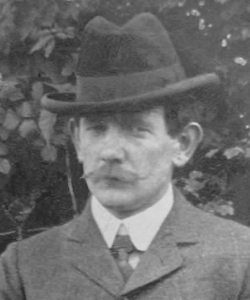
Noonan is born in Dublin on April 18, 1870, the illegitimate son of Samuel Croker, a senior member of the Royal Irish Constabulary. He is baptised and raised a Roman Catholic by his mother Mary Noonan. His father, who is not Catholic, has his own family, but attempts to provide for Robert until his death in 1875.
By 1875 Noonan is living in London. When he is sixteen, he shows signs of a radical political consciousness. He leaves his family declaring he “would not live on the family income derived largely from absentee landlordism.” It is around this time he changes his surname to his mother’s maiden name.
In 1890, Noonan is a sign writer living in Queen’s Road, Everton, Liverpool. On June 10, 1890, he appears at Liverpool County Intermediate Sessions court at Sessions House, Islington, Liverpool on charges of housebreaking and larceny. He is found guilty and given a six-month prison sentence.
By 1891, Noonan has moved to Cape Town, South Africa, where he is a painter and decorator. He marries in 1891, but the marriage is an unhappy one, with his wife having numerous affairs after the birth of their daughter, Kathleen. They divorce in 1895, and Noonan acquires all the property, including their house in an affluent suburb of Cape Town.
Noonan and his daughter move to Johannesburg, where he secures a well-paying job with a construction company. It is here that he learns the ways of the industry he would later write about in his novel, although Noonan’s actual circumstances vary greatly from the proletarian characters of the book. After becoming Secretary of the Transvaal Federated Building Trades Council, he is able to send his daughter to an exclusive convent school and also to employ a black manservant called Sixpence.
In 1897, Noonan leads a successful protest against the employment of black skilled labour. During 1898, he becomes a member of the Transvaal Executive Committee of the Centennial of 1798 Association, which commemorates the revolutionary nationalistSociety of United Irishmen. As a 1798 Association member, he helps form the Irish Brigades, an anti-British force that fights alongside the Boers in the Second Boer War. At this point, accounts of his life differ. Some assert he takes up arms and is interned by the British until the end of the war, when he returns to Britain. Others say he leaves South Africa just before hostilities began in October 1899.
In any event, around the turn of the century, Noonan ends up in Hastings, Sussex. Here, he finds work as a sign writer, but at much lower wages and in far poorer conditions than he had experienced in South Africa. He has to take part-time jobs in addition to his full-time position.
Influenced by the Marxist-influenced ideas of designer and socialist William Morris, he joins the Social Democratic Federation in 1906. The next year, after a dispute with his employer, he loses his job. Despite the demand for his skills, his health begins to deteriorate, and he eventually develops tuberculosis. Unemployed and unable to remain politically active, he starts writing, something he hopes will earn enough money to keep him from the workhouse.
He writes under the pen name Robert Tressell as he fears the socialist views expressed in the book will have him blacklisted. He completes The Ragged Trousered Philanthropists in 1910, but the 1,600-page hand-written manuscript is rejected by three publishing houses. The rejections severely depress him, and his daughter has to save the manuscript from being burned.
Unhappy with his life in Britain, Noonan decides that he and Kathleen should emigrate to Canada. However, he only reaches Liverpool when he is admitted to the Royal Liverpool Infirmary, where he dies of pulmonary tuberculosis on February 3, 1911, at the age of 40. He is buried in a pauper’s grave at Liverpool Parochial Cemetery, later known as Walton Park Cemetery. The location of the grave is not rediscovered until 1970. Twelve other people are buried in the same plot. The plot is now marked although the land is no longer used as a cemetery and is now used by Rice Lane City Farm.
Kathleen mentions her father’s novel to a friend, writer Jessie Pope, who recommends it to her publisher. In April 1914, the publisher purchases the rights to the book for £25, and it appears in Britain, Canada and the United States later that year, in the Soviet Union in 1920, and in Germany in 1925. The version as originally published is heavily abridged by Pope, with much of the socialist ideology removed.
The original manuscript is subsequently located by F. C. Ball and, after he raises funds to acquire and reassemble the original version, an unabridged edition is published in 1955.