After some years as curate at St. Paul’s Church, Dublin, Murray is transferred to Arklow and is there in 1798 when the rebellion breaks out. The yeomanry shoots the parish priest in bed and Murray, to escape a similar fate, flees to the city where for two years he serves as curate at St. Andrew’s Chapel on Hawkins Street. As a preacher, he is said to be particularly effective, especially in appeals for charitable causes, such as the schools. He is then assigned to the Chapel of St. Mary in Upper Liffey Street where Archbishop John Troy is the parish priest.
Murray is an uncompromising opponent of a proposal granting the British government a “veto” over Catholic ecclesiastical appointments in Ireland, and in 1814 and 1815, makes two separate trips to Rome concerning the controversy.
Murray becomes Archbishop of Dublin in 1825 and on November 14, 1825, celebrates the completion of St. Mary’s Pro-Cathedral. He enjoys the confidence of successive popes and is held in high respect by the British government. His life is mainly devoted to ecclesiastical affairs, the establishment and organisation of religious associations for the education and relief of the poor. With the outbreak of cholera in the 1830s, in 1834 he and Mother Aikenhead found St. Vincent’s Hospital. He persuades Edmund Rice to send members of the Christian Brothers to Dublin to start a school for boys. The first is opened in a lumber yard on the city-quay. He assists Catherine McAuley in founding the Sisters of Mercy, and in 1831 professes the first three members.
Edward Bouverie Pusey has an interview with Murray in 1841, and bears testimony to his moderation, and John Henry Newman has some correspondence with him prior to Newman’s conversion from the Anglican Church to the Roman Catholic Church in 1845. A seat in the privy council at Dublin, officially offered to him in 1846, is not accepted. He takes part in the synod of the Roman Catholic clergy at Thurles in 1850.
Towards the end of his life, Murray’s eyesight is impaired, and he reads and writes with difficulty. Among his last priestly functions is a funeral service for Richard Lalor Sheil who had died in Italy, and whose body had been brought back to Ireland for burial. Murray dies in Dublin on February 26, 1852, at the age of eighty-four. He is interred in the St. Mary’s Pro-Cathedral, Dublin, where a marble statue of him has been erected in connection with a monument to his memory, executed by James Farrell, president of the Royal Hibernian Academy of Fine Arts.
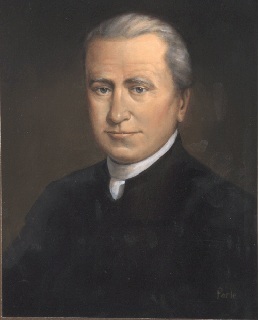
(Pictured: Portrait of Daniel Murray, Archbishop of Dublin, by unknown 19th century Irish portrait painter)
Rinuccini is born in Rome on September 15, 1592. He is educated by the Jesuits in Rome and studies law at the Universities of Bologna and Perugia. In due course, he is ordained a priest, having at the age of twenty-two obtained his doctor’s degree from the University of Pisa. He is named a camariere (chamberlain) by Pope Gregory XV and in 1625 becomes Archbishop of Fermo. In 1631 he carefully refuses an offer to be made Archbishop of Florence.
Rinuccini departs France from Saint-Martin-de-Ré near La Rochelle on October 18, 1645, on the frigate San Pietro and arrives in Kenmare, County Kerry, on October 21, 1645, with a retinue of twenty-six Italians, several Irish officers, and the Confederation’s secretary, Richard Bellings. He proceeds to Kilkenny, the Confederate capital, where Richard Butler, 3rd Viscount Mountgarret, the president of the Confederation, receives him at the castle. He speaks Latin to Montgarret, but all the official business of the Confederates is done in English. He asserts in his discourse that the object of his mission is to sustain the King, but above all to help the Catholic people of Ireland in securing the free and public exercise of their religion, and the restoration of the churches and church property to the Catholic Church.
Rinuccini had sent ahead arms and ammunition: 1,000 braces of pistols, 4,000 cartridge belts, 2,000 swords, 500 muskets and 20,000 pounds of gunpowder. He arrives twelve days later with a further two thousand muskets and cartridge-belts, four thousand swords, four hundred braces of pistols, two thousand pike-heads, and twenty thousand pounds of gunpowder, fully equipped soldiers and sailors and 150,658 livres tournois to finance the Irish Catholic war effort. These supplies give him a huge input into the Confederate’s internal politics because he doles out the money and arms for specific military projects, rather than handing them over to the Confederate government, or Supreme Council.
Rinuccini hopes that by doing so he can influence the Confederates’ strategic policy away from making a deal with Charles I and the Royalists in the English Civil War and towards the foundation of an independent Catholic-ruled Ireland. In particular, he wants to ensure that churches and lands taken in the rebellion would remain in Catholic hands. This is consistent with what happened in Catholic-controlled areas during the Thirty Years’ War in Germany. His mission can be seen as part of the Counter-Reformation in Europe. He also has unrealistic hopes of using Ireland as a base to re-establish Catholicism in England. However, apart from some military successes such as the Battle of Benburb on June 5, 1646, the main result of his efforts is to aggravate the infighting between factions within the Confederates.
The Confederates’ Supreme Council is dominated by wealthy landed magnates, predominantly of “Old English” origin, who are anxious to come to a deal with the Stuart monarchy that will guarantee them their land ownership, full civil rights for Catholics, and toleration of Catholicism. They form the moderate faction, which is opposed by those within the Confederation, who want better terms, including self-government for Ireland, a reversal of the land confiscations of the plantations of Ireland and establishment of Catholicism as the state religion. A particularly sore point in the negotiations with the English Royalists is the insistence of some Irish Catholics on keeping in Catholic hands the churches taken in the war. Rinuccini accepts the assurances of the Supreme Council that such concerns will be addressed in the peace treaty negotiated with James Butler, 1st Duke of Ormond, negotiated in 1646, now known as the First Ormond Peace.
However, when the terms are published, they grant only the private practice of Catholicism. Alleging that he had been deliberately deceived, Rinuccini publicly backs the militant faction, which includes most of the Catholic clergy and some Irish military commanders such as Owen Roe O’Neill. On the other side there are the Franciscans Pierre Marchant, and later Raymond Caron. In 1646, when the Supreme Council tries to get the Ormond Peace ratified, Rinuccini excommunicates them and helps to get the Treaty voted down in the Confederate General Assembly. The Assembly has the members of the Supreme Council arrested for treason and elects a new Supreme Council.
However, the following year, the Confederates’ attempts to drive the remaining English (mainly Parliamentarian) armies from Ireland meets with disaster at the battles of Dungan’s Hill on August 8, 1647 and Knocknanuss on November 13, 1647. As a result, the chastened Confederates hastily conclude a new deal with the English Royalists to try to prevent a Parliamentarian conquest of Ireland in 1648. Although the terms of this second deal are better than those of the first one, Rinuccini again tries to overturn the treaty. However, on this occasion, the Catholic clergy are split on whether to accept the deal, as are the Confederate military commanders and the General Assembly. Ultimately, the treaty is accepted by the Confederacy, which then dissolves itself and joins a Royalist coalition. Rinuccini backs Owen Roe O’Neill, who used his Ulster army to fight against his former comrades who had accepted the deal. He tries in vain to repeat his success of 1646 by excommunicating those who support the peace. However, the Irish bishops are split on the issue and so his authority is diluted. Militarily, Owen Roe O’Neill is unable to reverse the political balance.
Despairing of the Catholic cause in Ireland, Rinnuccini leaves the country on February 23, 1649, embarking at Galway on the ship that had brought him to Ireland, the frigate San Pietro. In the same year, Oliver Cromwell leads a Parliamentarian re-conquest of the country, after which Catholicism is thoroughly repressed. Roman Catholic worship is banned, Irish Catholic-owned land is widely confiscated east of the River Shannon, and captured Catholic clergy are executed.
Rinuccini returns to Rome, where he writes an extensive account of his time in Ireland, the Commentarius Rinuccinanus. His account blames personal vainglory and tribal divisions for the Catholic disunity in Ireland. In particular, he blames the Old English for the eventual Catholic defeat. The Gaelic Irish, he writes, despite being less civilised, are more sincere Catholics.
Rinuccini returns to his diocese in Fermo in June 1650 and dies there on December 13, 1653.
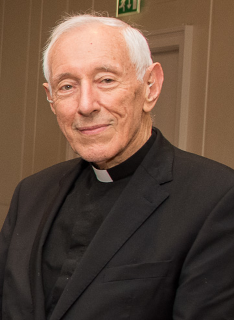
Ryan is Professor of Oriental Languages at University College Dublin before his appointment by Pope Paul VI as Archbishop of Dublin and Primate of Ireland on December 29, 1971. Maintaining his connection and interest in oriental studies, he serves as chairman of the trustees of the Chester Beatty Library from 1978 to 1984.
During his term, Ryan consolidates much of the expansion of the archdiocese which had taken place during the term of his predecessor. He also oversees the fuller implementation of the reforms of Vatican II. He is particularly interested in liturgical reform.
Ryan also takes a traditional stand on social issues, including poverty, family life and opposition to abortion. He strongly promotes the Eighth Amendment of the Constitution of Ireland in 1983, granting the equal right to life to mother and unborn.
As Archbishop, Ryan gives the people of Dublin a public park on a site earmarked by his predecessors for a proposed cathedral. It is named “Archbishop Ryan Park” in his honour. The land, at Merrion Square, is a gift from the archbishop to the city of Dublin.
Ryan is named in the Murphy Report, released in 2009, on sexual abuse of children in Dublin. His actions in respect of complaints against priest Fr. McNamee are described in the report as “an example of how, throughout the 1970s, the church authorities were more concerned with the scandal that would be created by revealing Fr. McNamee’s abuse rather than any concern for the abused.” He also does not act on complaints against other priests who are also subsequently confirmed to be abusers.
In January 2010, after Ryan has been criticised in the Murphy Report the previous year, Dublin City Council seeks public views on renaming “Archbishop Ryan Park.” Later that same year it is renamed “Merrion Square Park” by the City Council.
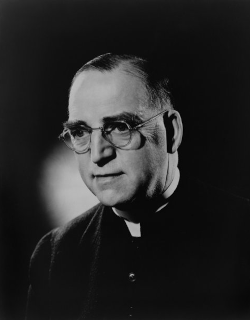
Flannery edits the Dominican bi-monthly journal entitled Doctrine and Life from 1958 to 1988, while at St. Saviour’s Priory, Dublin, where he also serves as prior from 1957 to 1960. He also edits the Religious Life Review. He publishes many English language documents on the Second Vatican Council.
Walsh is born in Waterford, County Waterford, in or before 1538. He is the son of Patrick Walsh, Bishop of Waterford and Lismore (d. 1578). The identity of his mother is unknown. She was Patrick’s concubine for many years and they apparently married only after 1558, meaning their son was born outside marriage. About 1551 Walsh leaves Ireland to study at the universities of Paris, Oxford, and Cambridge, eventually graduating BA at Cambridge in 1562 or 1563. He receives the MA from Cambridge in 1567. He is appointed chancellor of St. Patrick’s Cathedral, Dublin, in 1571.
As a fluent Irish speaker, Walsh is deeply committed to the propagation of the Protestant faith through the medium of the Irish language. In 1571 he helps to secure the publication in Dublin of a catechism written in Irish by John Kearney (Irish: Seán Ó Cearnaigh), whom he has known since his time at Cambridge. He then procures a government order for printing the Book of Common Prayer in Irish, and for the liturgy and a sermon to be communicated in Irish in a church in each large town. In practice this order has no effect. From about 1573 he and Kearney begin work on an Irish translation of the New Testament. This project is finally completed and published in 1602 or 1603. He also writes a collection of sermons in Latin.
In 1572 Walsh is offered the bishopric of Kilmacduagh in Connacht but declines as this diocese lay in a dangerous part of the country. In February 1578 he becomes Bishop of Ossory, upon which he resigns his chancellorship at St. Patrick’s Cathedral and presumably sets aside his translation of the New Testament. Through his family he has links with the area of his diocese, and he is assured of the protection of the dominant magnate, Thomas Butler, Earl of Ormond. However, Catholicism is very strong in Ossory, particularly in the diocesan capital of Kilkenny. His arrival at Kilkenny is ignored by the citizens, and he finds himself presiding over an empty St. Canice’s Cathedral during Sunday services. In November 1578 he writes for support to the Lord Justice of Ireland, Sir William Drury, who empowers Walsh to fine recusants. That month Drury comes to Kilkenny and heavily fines a number of prominent citizens of Kilkenny for recusancy. However, these punitive efforts have little long-term impact and only increased Walsh’s unpopularity.
Walsh is further hampered by a lack of revenues from his diocese, which leads him in April 1581 to seek additional benefices that he can hold in commendam. in July 1582 he seeks a licence to solicit charitable donations in England. He also initiates legal proceedings to recover church property. At a time when the Church of Ireland episcopate is characterised by venality, cynicism, and crypto-Catholicism, he stands head and shoulders above his colleagues owing to his dedication, ability, and evangelising zeal. At the installation of the Bishop of Meath in 1584 he criticises his fellow bishops for neglecting their spiritual duties for political concerns. He is married to an Englishwoman and has four children.
Walsh’s life comes to a violent end on December 14, 1585, when he is stabbed to death in his own house at Kilkenny by James Dullerde, whom he had cited for adultery in his consistory court. He is buried in a tomb in St. Canice’s Cathedral, Kilkenny. Dullerde is caught and beheaded by Domhnall Spanaigh Kavanagh MacMurrough and his brother Cahir Carroughe.
(From: “Walsh, Nicholas (Nicolás Bhailis)” by Anthony M. McCormack and Terry Clavin, Dictionary of Irish Biography, http://www.dib.ie, October 2009 | Pictured: Coat of arms of the Bishop of Ossory)
Swift’s father, an attorney, also named Jonathan Swift, dies just two months before he is born. Without steady income, his mother struggles to provide for her newborn. Moreover, he is a sickly child. It is later discovered that he suffers from Ménière’s disease, a condition of the inner ear that leaves the afflicted nauseous and hard of hearing. In an effort to give her son the best upbringing possible, Swift’s mother gives him over to Godwin Swift, her late husband’s brother and a member of the respected professional attorney and judges group Gray’s Inn. Godwin Swift enrolls his nephew with one of his cousins in Kilkenny College, which is perhaps the best school in Ireland at the time. He arrives there at the age of six, where he is expected to have already learned the basic declensions in Latin. He has not and thus begins his schooling in a lower form. He graduates in 1682, when he is 15. His transition from a life of poverty to a rigorous private school setting proves challenging. He does, however, make a fast friend in William Congreve, the future poet and playwright.
In 1682, Swift commences his undergraduate studies at Trinity College, Dublin. In 1686, he receives a Bachelor of Arts degree and goes on to pursue a master’s degree. Not long into his research, huge unrest breaks out in Ireland. The king of Ireland, England and Scotland is soon to be overthrown. What becomes known as the Glorious Revolution of 1688 spurs him to move to England and start anew. For 10 years, Swift works in Surrey‘s Moor Park and acts as an assistant to Sir William Temple, 1st Baronet.
During his Moor Park years, Swift meets the daughter of Temple’s housekeeper, an 8-year-old named Esther Johnson, known as “Stella.” They become lovers for the rest of their lives until Johnson’s death in 1728. It is rumored that they marry in 1716, and that Swift keeps of lock of Johnson’s hair in his possession at all times.
During his decade of work for Temple, Swift returns to Ireland twice. On a trip in 1695, he takes all necessary requirements to become an ordained priest in the Anglican tradition. Under Temple’s influence, he also begins to write, first short essays and then a manuscript for a later book. Temple dies in 1699. Swift completes the task of editing and publishing Temple’s memoirs. He then leans on his priestly qualifications and finds work ministering to a pea-sized congregation just 20 miles outside of Dublin. For the next ten years, he gardens, preaches and works on the house provided to him by the church. He also returns to writing. His first political pamphlet is titled A Discourse on the Contests and Dissentions in Athens and Rome.
In 1704, Swift anonymously releases A Tale of a Tub and The Battle of the Books. Tub, although widely popular with the masses, is harshly disapproved of by the Church of England. Ostensibly, it criticizes religion, but Swift means it as a parody of pride. Nonetheless, his writings earn him a reputation in London and when the Tories come into power in 1710, they ask him to become editor of The Examiner, their official paper. After a time, he becomes fully immersed in the political landscape and begins writing some of the most cutting and well-known political pamphlets of the day, including The Conduct of the Allies, an attack on the Whigs. Privy to the inner circle of Tory government, he lays out his private thoughts and feelings in a stream of letters to his beloved Stella. They are later published as The Journal to Stella.
When he sees that the Tories will soon fall from power, Swift returns to Ireland. In 1713, he takes the post of Dean at St. Patrick’s Cathedral, Dublin. While leading his congregation at St. Patrick’s, he begins to write what would become his best-known work. In 1726, at last finished with the manuscript, he travels to London and benefits from the help of several friends, who anonymously publish it as Travels into Several Remote Nations of the World, in Four Parts. By Lemuel Gulliver, First a Surgeon, and then a Captain of Several Ships, more simply known as Gulliver’s Travels. The book is an immediate success and has not been out of print since its first run.
Not long after the celebration of this work, Esther Johnson, falls ill. She dies in January 1728. Her death moves Swift to write The Death of Mrs. Johnson.
In 1742, Swift suffers a stroke and loses the ability to speak. He dies on October 19, 1745. He is laid to rest next to Esther Johnson inside Dublin’s St. Patrick’s Cathedral.
Rokeby is born at Kirk Sandall, eldest of the five sons of John Rokeby (died 1506). His younger brother, Sir Richard Rokeby (died 1523), is Comptroller of the Household to CardinalThomas Wolsey and later Treasurer of Ireland. He retains a deep affection for Kirk Sandall and returns there to die. He goes to school at Rotherham, studies at the University of Oxford and becomes a fellow of King’s Hall, later Trinity College, Cambridge. He becomes vicar of his home parish in 1487 and is transferred to Halifax, another town for which he has a deep attachment, in about 1499. In 1507 he is made Bishop of Meath.
On the death of Walter Fitzsimon in 1511, Rokeby becomes Archbishop of Dublin. It has been suggested that his elevation is due at least in part to his English birth, as the Crown is anxious to place Englishmen high up in the Irish hierarchy. No doubt his brother’s close connection to Wolsey also plays a part. He is Lord Chancellor of Ireland from 1512 to 1513 and from 1516 to 1522.
As Archbishop Rokeby makes a reputation as a peacemaker, settling a long and bitter dispute between the Dean and Chapter of St. Patrick’s Cathedral, Dublin. He gives permission to Gerald FitzGerald, 9th Earl of Kildare, for the original foundation of Maynooth College, which is suppressed in 1535. He is frequently at the English Court, so often indeed that he is accused of neglecting his official duties back in Ireland. He participates in the christening of the future Queen Mary I in 1516 and the ceremony by which Wolsey receives his cardinal’s hat.
As Archbishop of Dublin, Rokeby is best remembered for the Synod of 1518. The Synod prohibits the use of any tin chalice at Mass, and the disposal of Church property by laymen; and attempts to regulate the procedure for dealing with intestate estates, the payment of tithes and burial fees and the rules for admission to the clergy. Rather comically, he strictly forbids clergymen to play football.
Rokeby is appointed Archdeacon of Surrey on March 27, 1519. By 1521 his health is failing, and he retires to Kirk Sandall, where he dies on November 29. In his will he leaves £200 to rebuild St. Mary’s Church, Beverley, whose tower had collapsed the previous year.
Rokeby makes elaborate provisions in his will for the disposal of his remains. In accordance with his wishes, his body is buried in St. Oswald’s Church, Kirk Sandall, but his heart and bowels are buried in the Church of St. John the Baptist, Halifax (now known as Halifax Minster). Mortuary chapels are erected at both spots, which still exist today.
O’Flanagan praises Rokeby as a good man, a good bishop and, so far as we can tell from the scanty records, a good judge. Irish author F. Elrington Ball, while acknowledging his good qualities, suggests that he was a failure as Irish Lord Chancellor, due partly to his frequent absences in England.
(Pictured: Halifax Minster, where Rokeby’s heart is buried)
Hayes is born into a family languishing in poverty. One of ten siblings, seven of Hayes’ brothers and sisters die of malnutrition and disease over a twelve-year period. The family had been evicted from Lord Cloncurry‘s estate in 1872 for non-payment of rent, forcing them into destitution. The family returns to the estate in 1894.
During the 1920s Hayes becomes an admirer of Benito Mussolini, with whom he is granted an audience during a visit to Rome in 1930. He is intrigued by corporatism and comes to believe it can uplift rural communities. Similarly, he is influenced by continental movements such as the BelgianBoerenbond league, which encourages rural inhabitants to form cooperatives.
Hayes comes to national prominence with the foundation of Muintir na Tíre in 1931, a rural development organisation which has core principles of neighbourliness, self-help and self-sufficiency. It is to act as a rural self-help group based on collective parish organisation with a strong emphasis on the teaching of the papal encyclicals Rerum novarum (1891) and Quadragesimo anno (1931). He is successfully able to draw on the power of the media, Irish newspapers and radio, to promote Muintir na Tíre and quickly becomes a figure of national prominence in doing so. In promoting and developing Muintir na Tíre Hayes resists calls in some quarters to limit the membership to Catholics, remarking “this country is becoming so Catholic it forgets to be Christian.” Nonetheless, under his leadership, there is eventually an overlap in membership between Muintir na Tíre and the Catholic fraternal organisation the Knights of Saint Columbanus.
Hayes is appointed parish priest of Bansha and Kilmoyler in County Tipperary in 1946. Due largely to his endeavours, a factory, Bansha Rural Industries, is started and enjoys some success producing preserves for the Irish home market. Bansha is to the forefront in developing many Muintir na Tíre initiatives and for a time in the 1950s enjoys the soubriquet of The Model Parish.
Hayes spearheads many initiatives including rural electrification, the “Parish Plan for Agriculture,” and the setting up of small industry in rural areas in an attempt to stop emigration. He is later made a canon of his cathedral chapter.
Hayes dies on January 30, 1957 in a Tipperary nursing home following a minor operation. His funeral in Bansha is a national occasion, attended by leaders of Church and State. His grave is at the rear of the Church of the Annunciation, Bansha. He is later commemorated on an Irish postage stamp.
O’Rahilly is the eighth child of Thomas Francis Rahilly of Ballylongford, County Kerry and Julia Mary Rahilly (née Curry) of Glin, County Limerick. He changes his name to ‘O’Rahilly’ by deed poll in 1920. His fourteen siblings included Celtic scholars Thomas Francis and Cecile, and a first cousin is The O’Rahilly, killed during the 1916 Easter Rising. Educated at St. Michael’s College, Listowel, Blackrock College, and UCC, he undergoes a long period (1901–14) of training as a member of the Society of Jesus, but eventually leaves during the final stages of preparation for the priesthood, because of temperamental unsuitability. Appointed an assistant lecturer in the Department of Mathematics and Mathematical Physics in October 1914, he becomes the dominant figure in the institution within six years. He becomes Professor of Mathematical Physics on June 1, 1917 and registrar on February 11, 1920, before vacating these offices when he becomes president (1943–54).
O’Rahilly’s early career in UCC is set against the background of the revolutionary period, and he becomes predominantly identified, within and without the college, with the rise of post-1916 Sinn Féin. At UCC he leads the nationalist interest that ousts the perceived pro-British old regime, personified by Sir Bertram Windle, who resigns from the presidency in 1919. O’Rahilly is flamboyant, extrovert, disputatious and dynamic. During the low-key, unassertive presidency (1919–43) of Patrick J. Merriman, O’Rahilly as registrar is heir-presumptive and acts as de facto president. All in all, the whirlwind age of O’Rahilly lasts for almost four decades.
O’Rahilly is a volatile and bristling polymath of inexhaustible energy. The vast range of his scholarly interests – politics, sociology, finance, Christology, mathematical physics, history – arouse astonishment and envy. One critique of his work Money (1941) ends with the reflection that the book would enable people to relieve rural tedium by laughing the winter nights away. His contemplated multi-volume life of Christ prompts a National University colleague to observe that a life of O’Rahilly by Christ would be much more interesting. He, who is vain but not stuffy, is not offended by such descriptions of him as “a cross between Thomas Aquinas and Jimmy O’Dea,” but is not pleased by the jibe that he has the best mind of the twelfth century, since he considers himself a very modern man indeed.
There are some negative and even frivolous aspects of O’Rahilly’s UCC presidency. He has a strong appetite for the hurly-burly of academic politics and, it is said, enters no controversy that he does not aggravate. He has the reputation of being a bully and exploiter in his dealings with junior academic staff, but he can be kind, helpful, and extraordinarily generous to staff and students with problems. His zeal for vigorously promoting a Roman Catholic ethos in a nominally pluralist institution is frequently paternalistic and extends to acts of petty supervision, particularly perhaps over women students. This is the kind of atmosphere that prompts a visiting examiner to describe the UCC of the 1940s as “a convent run by a mad reverend mother.”
All this being said, O’Rahilly is one of the most vibrant and effective presidents in the history of the National University. His initiatives include extensive improvements in the library, of which he is director, and the institution of student health and restaurant services. He founds the electrical engineering department and the Cork University Press, which he believes would provide a publication outlet for the researches of his colleagues, particularly those concerned with native learning. He strengthens UCC’s links with the city and the province, and these are significantly expressed through the provision of adult education courses, an area where O’Rahilly is particularly innovative and pioneering.
As a young academic, O’Rahilly becomes caught up in the struggle for independence. He serves on Cork Corporation in the heroic age of Tomás Mac Curtain and Terence MacSwiney, and spends a patriotic period in jail and on the run. He represents Cork Borough (1923–24) in Dáil Éireann for Cumann na nGaedheal but resigns his seat in 1924. He is a constitutional adviser to the Irish delegation at the Anglo-Irish Treaty negotiations in 1921, argues publicly for the acceptance of the treaty, and helps to draft the Constitution of the Irish Free State. His links with the local labour and trade-union movement are long and close, and at national level he serves as Irish government chief representative in successive sessions of the International Labour Organization conference in Geneva. He is also a member of government commissions on banking and vocational organisation. After retirement he goes to reside at Blackrock College, where he is ordained a priest on December 18, 1955, and becomes a domestic prelate (monsignor) in 1960.
O’Rahilly dies at the age of 84 in Dublin on August 1, 1969.
No other layman of his day so self-confidently assumes a central role in so many areas of Catholic life – philosophy, sociology, theology, scriptural studies. The controversies in which be becomes involved are a source of interest and pride to UCC students. Their president is a pugnacious polemicist (who jousts with such eminences as H. G. Wells and George Bernard Shaw), a man of stature, and a formidable Catholic intellectual.
(From: “O’Rahilly, Alfred” by John A. Murphy, Dictionary of Irish Biography, http://www.dib.ie)
In 1726, the Synod expels ministers, grouped together as the Synod of Antrim, who refuse to subscribe to the Westminster Confession of Faith. Later there is a further secession by those who, insisting on the sole kingship of Christ, reject the Confession. In 1763 they organise a distinct Reformed Presbyterian Church, and in 1811 establish their own provincial synod. In 1746, some of the more doctrinaire Calvinists withdraw, forming the Secession Synod.
Within the mainline Synod there is a continuing distinction between ‘Old Light‘ supporters of theological orthodoxy and ‘New Light‘ elements more inclined to defer to conscience rather than doctrine. In the first decades of the 19th century, positions harden with New Light ministers adopting a Unitarian or Arian skepticism regarding the doctrine of the Trinity. In 1829, when the leading conservative evangelical, Henry Cooke, succeeds in pressing the General Synod for a firm declaration of Trinitarian belief they withdraw to form their own Remonstrant Synod.
The departure of the latitudinarian party makes possible a reconciliation with the earlier Seceders. Purged of its heterodox elements, in 1840 the Synod of Ulster joins with the Secession Synod to form the General Assembly of the Presbyterian Church in Ireland.