Among those to welcome the new organisation is Sinn Féin President, Éamon de Valera, who promises all the support he can offer. CardinalMichael Logue, CatholicPrimate of Ireland, also offers his assistance: “Even if peace were restored, of which there seems little prospect at present, all the help which can be obtained shall be necessary, to restore the country from the wreck to which it has been reduced, and to help those who have been left destitute by the murder of those on whom they depended, or ruined by the destruction of their property.”
The Irish White Cross is managed by the Quaker businessman, and later Irish Free Statesenator, James G. Douglas. The organisation continues to operate until the Irish Civil War and its books are officially closed in 1928. From 1922, its activities are essentially wound down and remaining funds divested to subsidiary organisations. The longest running of these aid committees is the Children’s Relief Association which distributes aid to child victims of this troubled period, north and south of the border, until 1947. The head of the Children’s Relief Association is Áine Ceannt, the widow of Éamonn Ceannt who is perhaps one of the least known signatories of the 1916 Proclamation of the Irish Republic.
Hume does not complete his clerical studies but does obtain an M.A. degree in French and history from the college in 1958. He then returns home to his native Derry, where he becomes a teacher at his alma mater, St. Columb’s College. He is a founding member of the Credit Union movement in the city and is chair of the University for Derry Committee in 1965, an unsuccessful fight to have Northern Ireland’s second university established in Derry in the mid-1960s.
Hume becomes the youngest ever President of the Irish League of Credit Unions at age 27. He serves in the role from 1964 to 1968. He once says that “all the things I’ve been doing, it’s the thing I’m proudest of because no movement has done more good for the people of Ireland, north and south, than the credit union movement.”
Hume becomes a leading figure in the civil rights movement in the late 1960s along with people such as Hugh Logue. He is a prominent figure in the Derry Citizens’ Action Committee. The DCAC is set up in the wake of the October 5, 1968, march through Derry which had caused much attention to be drawn towards the situation in Northern Ireland. The purpose of the DCAC is to make use of the publicity surrounding recent events to bring to light grievances in Derry that had been suppressed by the Unionist Government for years. The DCAC, unlike the Northern Ireland Civil Rights Association (NICRA), is aimed specifically at a local campaign, improving the situation in Derry for everyone, and maintaining a peaceful stance. The committee also has a Stewards Association that is there to prevent any violence at marches or sit-downs.
In October 1971, Hume joins four Westminster MPs in a 48-hour hunger strike to protest at the internment without trial of hundreds of suspected Irish republicans. State papers that have been released under the 30-year rule that an Irish diplomat eight years later in 1979 believes Hume supported the return of internment.
Hume is directly involved in secret talks with the British government and Sinn Féin, in an effort to bring Sinn Féin to the discussion table openly. The talks are speculated to lead directly to the Anglo-Irish Agreement in 1985.
The vast majority of unionists reject the agreement and stage a massive and peaceful public rally in Belfast City Centre to demonstrate their distaste. Many Republicans and nationalists also reject it, as they see it as not going far enough. Hume, however, continues dialogue with both governments and Sinn Féin. The “Hume–Adams process” eventually delivers the 1994 Irish Republican Army (IRA) ceasefire which ultimately provides the relatively peaceful backdrop against which the Good Friday agreement is brokered.
In 2015, Hume is diagnosed with Alzheimer’s disease, of which he had first displayed symptoms in the late 1990s. He dies in the early hours of August 3, 2020, at a nursing home in Derry, at the age of 83. On his death, former Labour Party leader and prime ministerTony Blair says, “John Hume was a political titan; a visionary who refused to believe the future had to be the same as the past.” The Dalai Lama says on Twitter, “John Hume’s deep conviction in the power of dialogue and negotiations to resolve conflict was unwavering… It was his leadership and his faith in the power of negotiations that enabled the 1998 Good Friday Agreement to be reached. His steady persistence set an example for us all to follow.”
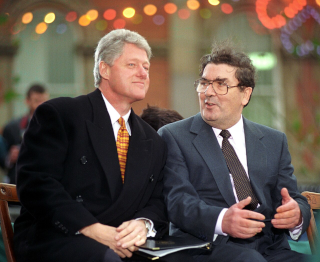
(Pictured: John Hume with U.S. President Bill Clinton in 1995)
Browne is an important and outspoken member of the Irish hierarchy. His time as Bishop has been described by the historian James S. Donnelly Jr. as “far-reaching and … controversial,” while the historian of Irish CatholicismJohn Henry Whyte claims that Browne’s “readiness to put forward his views bluntly is welcome at least to the historian.”
On August 6, 1937, at the relatively young age of 41, Browne is appointed Bishop of Galway and Kilmacduagh by Pope Pius XI, receiving his episcopal consecration from Archbishop Thomas Gilmartin on the following August 10. He supports TaoiseachÉamon de Valera‘s defence of arrests and police searches for cached Irish Republican Army (IRA) arms, declaring, “Any Irishman who assists any foreign power to attack the legitimate authority of his own land is guilty of the most terrible crime against God’s law, and there can be no excuse for that crime – not even the pretext of solving partition or of securing unity.”
In 1939, Browne is selected by Éamon de Valera to chair the Commission on Vocational Organisation.
Browne is attentive to the state of public morality in the diocese, and James S. Donnelly Jr. has noted his role in directing episcopal and clerical censorship of newsagents and county librarians. He is also concerned about public intoxication and other misconduct at the Galway Races, controversies over dancing and the commercial dance halls, as well as immodesty in dress and the closely related issue of so-called “mixed bathing” in Galway and Salthill.
In 1957, in response to a growing tension between Catholics and Protestants at Fethard-on-Sea, including the Fethard-on-Sea boycott, Browne says, “non-Catholics do not protest against the crime of conspiring to steal the children of a Catholic father, but they try to make political capital when a Catholic people make a peaceful and moderate protest.”
The most enduring monument or physical legacy of Browne’s time as Bishop is the Cathedral of Our Lady Assumed into Heaven and St Nicholas, commonly known as Galway Cathedral, which is dedicated in 1965 by CardinalRichard James Cushing of Boston, Massachusetts. The site of the old jail had come into the possession of the diocese in 1941 and Browne leads the campaign to construct a new Cathedral. This includes a 1957 audience with Pope Pius XII where the plans are approved.
Browne attends the Second Vatican Council from 1962 to 1965 and retires in 1976. He dies four years later, at the age of 84, on February 24, 1980.
Browne is parodied in Breandán Ó hÉithir`s novel Lig Sinn i gCathu, which fictionalises late 1940s Galway as “Baile an Chaisil” and Browne as “An tEaspag Ó Maoláin.”
The Irish cabinet minister Noël Browne (no known relation) in his 1986 memoir Against the Tide describes the physical attributes of his episcopal namesake:
“The bishop had a round soft baby face with shimmering clear cornflower-blue eyes, but his mouth was small and mean. Around his great neck was an elegant glinting gold episcopal chain with a simple pectoral gold cross. He wore a ruby ring on his plump finger and wore a slightly ridiculous tiny scullcap on his noble head. The well-filled semi-circular scarlet silk cummerbund and sash neatly divided the lordly prince into two.”
The BBC‘s Northern Ireland correspondent says the historic trip is intended as a gesture to reassure the province’s unionists, while at the same time trying not to alienate the nationalist population.
The Queen is invited to Armagh by the authorities to present the royal charter renewing Armagh’s status as a city.
In her speech, the Queen addresses all the people of Northern Ireland. She says, “For many difficult years the people of Northern Ireland have shown courage and compassion of an extraordinary kind. Today as they begin to look towards a more peaceful future, Armagh with its two great cathedrals standing so close together presents a powerful symbol of the strength spirit and hopes of people across Northern Ireland.”
Cardinal Cahal Daly says the Queen’s visit is a tribute to the progress made in the peace process since the IRA ceasefire came into effect on August 31, 1994.
Archbishop Robin Eames says, “Look how far we’ve come in a year. It’s a message of symbolism. Be patient, we’ve a long, long way to go but today is one little part of that jigsaw.”
Hendron says, “Things are different now. People must stand up and be counted. You can’t hide in your home. There are two communities here and I think it’s important to go out and shake hands with people like the Queen and from my point of view, she’s very welcome.”
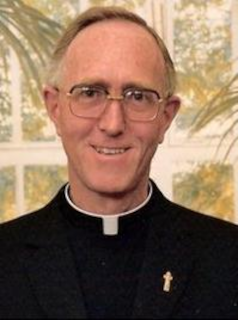
Ryan is Professor of Oriental Languages at University College Dublin before his appointment by Pope Paul VI as Archbishop of Dublin and Primate of Ireland on December 29, 1971. Maintaining his connection and interest in oriental studies, he serves as chairman of the trustees of the Chester Beatty Library from 1978 to 1984.
During his term, Ryan consolidates much of the expansion of the archdiocese which had taken place during the term of his predecessor. He also oversees the fuller implementation of the reforms of Vatican II. He is particularly interested in liturgical reform.
Ryan also takes a traditional stand on social issues, including poverty, family life and opposition to abortion. He strongly promotes the Eighth Amendment of the Constitution of Ireland in 1983, granting the equal right to life to mother and unborn.
As Archbishop, Ryan gives the people of Dublin a public park on a site earmarked by his predecessors for a proposed cathedral. It is named “Archbishop Ryan Park” in his honour. The land, at Merrion Square, is a gift from the archbishop to the city of Dublin.
Ryan is named in the Murphy Report, released in 2009, on sexual abuse of children in Dublin. His actions in respect of complaints against priest Fr. McNamee are described in the report as “an example of how, throughout the 1970s, the church authorities were more concerned with the scandal that would be created by revealing Fr. McNamee’s abuse rather than any concern for the abused.” He also does not act on complaints against other priests who are also subsequently confirmed to be abusers.
In January 2010, after Ryan has been criticised in the Murphy Report the previous year, Dublin City Council seeks public views on renaming “Archbishop Ryan Park.” Later that same year it is renamed “Merrion Square Park” by the City Council.
Rokeby is born at Kirk Sandall, eldest of the five sons of John Rokeby (died 1506). His younger brother, Sir Richard Rokeby (died 1523), is Comptroller of the Household to CardinalThomas Wolsey and later Treasurer of Ireland. He retains a deep affection for Kirk Sandall and returns there to die. He goes to school at Rotherham, studies at the University of Oxford and becomes a fellow of King’s Hall, later Trinity College, Cambridge. He becomes vicar of his home parish in 1487 and is transferred to Halifax, another town for which he has a deep attachment, in about 1499. In 1507 he is made Bishop of Meath.
On the death of Walter Fitzsimon in 1511, Rokeby becomes Archbishop of Dublin. It has been suggested that his elevation is due at least in part to his English birth, as the Crown is anxious to place Englishmen high up in the Irish hierarchy. No doubt his brother’s close connection to Wolsey also plays a part. He is Lord Chancellor of Ireland from 1512 to 1513 and from 1516 to 1522.
As Archbishop Rokeby makes a reputation as a peacemaker, settling a long and bitter dispute between the Dean and Chapter of St. Patrick’s Cathedral, Dublin. He gives permission to Gerald FitzGerald, 9th Earl of Kildare, for the original foundation of Maynooth College, which is suppressed in 1535. He is frequently at the English Court, so often indeed that he is accused of neglecting his official duties back in Ireland. He participates in the christening of the future Queen Mary I in 1516 and the ceremony by which Wolsey receives his cardinal’s hat.
As Archbishop of Dublin, Rokeby is best remembered for the Synod of 1518. The Synod prohibits the use of any tin chalice at Mass, and the disposal of Church property by laymen; and attempts to regulate the procedure for dealing with intestate estates, the payment of tithes and burial fees and the rules for admission to the clergy. Rather comically, he strictly forbids clergymen to play football.
Rokeby is appointed Archdeacon of Surrey on March 27, 1519. By 1521 his health is failing, and he retires to Kirk Sandall, where he dies on November 29. In his will he leaves £200 to rebuild St. Mary’s Church, Beverley, whose tower had collapsed the previous year.
Rokeby makes elaborate provisions in his will for the disposal of his remains. In accordance with his wishes, his body is buried in St. Oswald’s Church, Kirk Sandall, but his heart and bowels are buried in the Church of St. John the Baptist, Halifax (now known as Halifax Minster). Mortuary chapels are erected at both spots, which still exist today.
O’Flanagan praises Rokeby as a good man, a good bishop and, so far as we can tell from the scanty records, a good judge. Irish author F. Elrington Ball, while acknowledging his good qualities, suggests that he was a failure as Irish Lord Chancellor, due partly to his frequent absences in England.
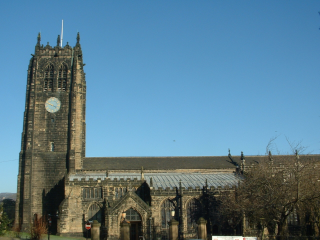
(Pictured: Halifax Minster, where Rokeby’s heart is buried)
Following the Irish War of Independence, Mountjoy Prison is transferred to the control of the Irish Free State, which becomes the State of Ireland in 1937. In the 1920s, the families of the dead men request their remains be returned to them for proper burial. This effort is joined in the later 1920s by the National Graves Association. Through the efforts of the Association, the graves of the men are identified in 1934, and in 1996 a Celtic cross is erected in Glasnevin Cemetery, Dublin, to commemorate them.
The campaign to rebury the men drags on for 80 years from their deaths. Following an intense period of negotiations, the Irish government relents. Plans to exhume the bodies of the ten men are announced on November 1, 2000, the 80th anniversary of the execution of Kevin Barry. On October 14, 2001, the Forgotten Ten are afforded full state honours, with a private service at Mountjoy Prison for the families of the dead, a Requiem Mass at St. Mary’s Pro-Cathedral and burial in Glasnevin Cemetery.
According to The Guardian, some criticise the event as glorifying militant Irish republicanism. It coincides with the Fianna FáilArdfheis. The progress of the cortège through the centre of Dublin is witnessed by crowds estimated as being in the tens of thousands who break into spontaneous applause as the coffins pass. On O’Connell Street, a lone piper plays a lament as the cortège pauses outside the General Post Office (GPO), the focal point of the 1916 Easter Rising. In his homily during the Requiem Mass, CardinalCahal Daly, a long-time critic of the IRA campaign in Northern Ireland, insists that there is a clear distinction between the conflict of 1916–22 and the paramilitary-led violence of the previous 30 years:
“The true inheritors today of the ideals of the men and women of 1916 to 1922 are those who are explicitly and visibly committed to leaving the physical force tradition behind… Surely this state funeral can be an occasion for examination of conscience about the ideals of the men who died, and about our responsibility for translating those ideals into today’s realities.”
In his graveside oration TaoiseachBertie Ahern echoes these sentiments and also pays tribute to the Ten:
“These 10 young men were executed during the War of Independence. The country was under tremendous pressure at the time. There was a united effort. Meanwhile, elected by the people, Dáil Éireann was developing, in spite of a war going on. Democracy was being put to work. Independent civic institutions, including the Dáil courts, were beginning to function. Before their deaths, the ten had seen the light of freedom. They understood that Ireland would be free and independent.”
The state funeral, broadcast live on national television and radio, is only the 13th since independence. Patrick Maher is not reburied with his comrades. In accordance with his wishes, and those of his family, he is reinterred in Ballylanders, County Limerick.
A feature length Irish language documentary on the re-interments, An Deichniúr Dearmadta (The Forgotten Ten) airs on TG4 on March 28, 2002.
(Pictured: The grave of nine of the Forgotten Ten in Glasnevin Cemetery, Dublin)
Martin first meets John Mitchel while attending Dr. Henderson’s private school in Newry. He receives an Arts degree at Trinity College Dublin in 1832 and proceeds to study medicine but has to abandon this in 1835 when his uncle dies, and he has to return to manage the family landholding.
In 1847 Martin is moved by the Great Famine to join Mitchel in the Repeal Association but subsequently leaves it with Mitchel. He contributes to Mitchel’s journal, United Irishman, and then following Mitchel’s arrest on May 27, 1848, he continues with his own anti-British journal, The Irish Felon, and establishes “The Felon Club.” This leads to a warrant for his arrest, and he turns himself in on July 8, 1848. He is sentenced on August 18, 1848, to ten years transportation to Van Diemen’s Land.
Martin arrives on the Elphinstone with Kevin Izod O’Doherty in Hobart, Tasmania, in November 1849. He accepts a “ticket of leave” which allows him to live in relative freedom at Bothwell, provided he promises not to escape.
While in Tasmania, Martin continues to meet in secret with his fellow exiles Kevin Izod O’Doherty, Thomas Francis Meagher, William Smith O’Brien, and John Mitchel. He and Mitchel live together before the arrival of Mitchel’s wife, Jenny. He chooses not to join Mitchel when Mitchel revokes his ticket of leave and escapes. Instead, he remains in Tasmania until he is granted a “conditional pardon” in 1854. This allows him to leave for Paris, and he returns to Ireland on being granted a full pardon in 1856.
On return to Ireland Martin becomes a national organiser for the Tenant Right League. He begins to write for The Nation in 1860. He forms the National League with others in January 1864 – it is mainly an educational organisation but Fenians disrupt its meetings. He remains in contact with Mitchel in Paris through 1866. He opposes the Fenians’ support of armed violence, yet, together with Alexander Martin Sullivan in December 1867, he heads the symbolic funeral march honouring the Manchester Martyrs as it follows the MacManus route to Glasnevin Cemetery, Dublin. He is briefly arrested for these activities, but the charges are dropped.
Martin is in the United States in December 1869 when he is nominated by Isaac Butt and his nationalists as the Irish nationalist Home Rule candidate to oppose Reginald Greville-Nugent, who is supported by the Catholic clergy, in the Longfordby-election. Greville-Nugent initially wins the vote, but the result is nullified by Judge Fitzgerald on the grounds that voters had been illegally influenced in the non-secret voting process. In the May 1870 re-run, Butt’s second candidate, Edward Robert King-Harman, like Martin a Protestant landlord, is also defeated, but this time legally.
Contradictions and factionalism are symptomatic of the struggle for influence and leadership at the time between the waning Church of Ireland and the rising Irish Catholic Church. Hence a secular Protestant land-owning, non-violent elite reformist nationalist who desires Home Rule like Martin, can find himself both sympathetic to and at odds with a militant organisation like the Fenians with their Jacobin– and American-influenced ideas of revolutionary republicanism and different social roots. Until Charles Stewart Parnell, the Isaac Butt-originated Home Rule forces could not obtain the support of the Catholic Church under the anti-Fenian CardinalPaul Cullen or manage to achieve more than short-term tactical alliances with Fenians, leading to a split and uncoordinated opposition to British rule. Protestants such as Martin and John Mitchel, with their early political roots in Young Ireland, are, whatever their political ideals, not part of the majority Catholic mainstream, which consists largely of tenants rather than landlords.
In the January 1871 by-election, Martin is elected by a margin of 2–1 to the seat of Meath in the British parliament as the first Home Rule MP, representing first Isaac Butt’s Home Government Association and from November 1873 the Home Rule League. This is unusual for a Protestant in a Catholic constituency, and is a measure of the popular esteem Martin is held in. He retains his seat in the 1874 United Kingdom general election as one of 60 Home Rule members. He is commonly known as “Honest John Martin.” In parliament he speaks strongly for Home Rule for Ireland and opposes Coercion Bills.
Martin dies in Newry, County Down, on March 29, 1875, homeless and in relative poverty, having forgiven tenant fees during preceding years of inflation and low farm prices. His parliamentary seat of County Meath is taken up by Charles Stewart Parnell.
Martin marries Henrietta Mitchel, the youngest sister of John Mitchel, on November 25, 1868, after twenty years of courtship. She shares her husband’s politics, and after his death campaigns for home rule believing this to be a continuation of the Young Ireland mandate. After the split in the party, she sides with Charles Stewart Parnell. She dies at her home in Dublin on July 11, 1913, and is buried in Newry.
Lenny is appointed parish priest in Mullavilly in 1972. Less than two years later he is named coadjutor bishop of Armagh, receiving his episcopal consecration with the titular see of Rotdon from Cardinal Conway on June 16, 1974. Financial secretary to the Bishops’ Financial and General Purposes Committee, upon Conway’s death, he becomes vicar capitular of the archdiocese until Tomás Ó Fiaich is named his successor.
Lenny is a well-known canonist, and it is he who transfers a major relic of Saint Oliver Plunkett from Downside Abbey to Ireland in 1975, and is presently preserved in Oldcastle, County Meath, Plunkett’s birthplace.
A man of great charity and deep disposition, Lenny experiences great opposition from members of the Protestant community of Mullavilly, refusing to leave the village despite threats he receives. His bungalow is maliciously set on fire, and he dies at the early age of forty-nine on July 16, 1978, the fourth anniversary of his episcopal consecration, from injuries received complicated by a heart attack. Dressed in chasuble and mitre, he is laid to rest in a simple solid oak coffin following the celebration of a Funeral Mass celebrated at St. Patrick’s Cathedral in Armagh, presided by Archbishop Ó Fiaich which sees the participation of thousands.
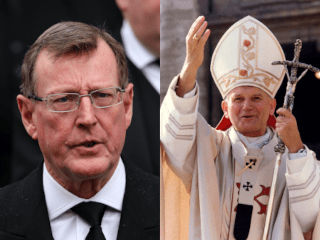
David Trimble becomes the first Ulster Unionist leader to meet a Pope when his historic meeting with John Paul II takes place in Rome on April 21, 1999. The meeting is widely welcomed as a sign that old prejudices are ending but Trimble is hotly criticised by both Protestants and Catholics in his Upper Bann constituency.
The First Minister is one of 54 Nobel Peace Prizelaureates who meets Pope John Paul II briefly at the Vatican, as part of a two-day trip organised by former Russian leader Mikhail Gorbachev. The Nobel Prize winners meet the Pope as a group and are then introduced and shake hands individually. There is a group photograph but no filming of the event. Careful stage-management ensures there are no public photographs of the two men close together.
A spokesman for Trimble says the UUP leader told the Pope he hopes this will be the year when peace will be secured in Northern Ireland. The Pope recalls his visit to Ireland and says murder cannot be condoned or called by another name.
Although the meeting is welcomed on both sides of the North divide, it does little to enhance Trimble’s standing in Upper Bann, particularly in troubled Portadown. In Portadown’s loyalist estates, there is open hostility toward Trimble. Many residents accusing their MP of “putting his personal status above the interests of his constituents.” The response is typified by one angry woman who says, “The loyalist people of this town and Drumcree, put David Trimble into office. Now he has turned his back on us. That’s a fatal mistake, this town and Drumcree will now destroy Trimble.”
“It’s unbelievable that this meeting is actually taking place,” says Orangeman Ivor Young. “It totally contradicts the oath that David Trimble took when he joined the Orange Order. We all knew Trimble was a traitor, this latest escapade puts the final nail in his political coffin here in Upper Bann. There is no way that he will ever be elected here again.”
Trimble also comes in for further criticism from Portadown Orange District, whose Drumcree protest has continued for the past 288 days. David Jones, the District’s press officer says that the people of Portadown once again see their local MP on “a world stage,” instead of being involved locally. “There are a lot of people around Portadown who aren’t very impressed that David Trimble has gone off to meet the Pope and hasn’t got more involved in trying to get the situation here solved,” says Jones.
On Portadown’s Garvaghy Road, Catholics are also critical of Trimble’s visit to Rome. “It’s amazing how he can travel to Rome to meet and talk to strangers,” says one nationalist resident, “yet he can’t be bothered to travel less than 30 miles to meet us, to talk about the serious issues that confront this community. After all we are as much his constituents as are the loyalists in this town.”
The meeting is the first time that the First Minister of Northern Ireland or the head of the Ulster Unionist Party has met the Pope in Rome. It also represents a rare appearance by an Orangeman at the heart of the Roman Catholic Church. Trimble and his entourage meet the Pope in the sumptuous surroundings of the Consistory Hall, the same room where the Cardinals of the Church gather to advise the Pope.
Earlier in the morning Trimble says in an interview with the Vatican radio that besides giving an update on developments in Northern Ireland, he wishes to “express to his Holiness the Pope that he and the Church will do what it can to persuade the paramilitaries to commit themselves irrevocably to peaceful means.”