seamus dubhghaill

Promoting Irish Culture and History from Little Rock, Arkansas, USA


Leave a comment

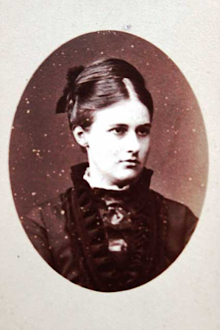
Birth of Sarah Atkinson, Writer & Philanthropist

Sarah (née Gaynor) Atkinson, Irish writer, biographer, essayist and philanthropist, is born in Athlone, County Westmeath, on October 23, 1823.

She is the eldest daughter of John and Anne Gaynor, of Athlone. At the age of fifteen she moves with her family to Dublin where her education is completed. Two of her sisters, Anna and Marcella, become nuns with Religious Sisters of Charity. At twenty-five, she marries the much older George Atkinson, a medical doctor and, with Sir John Gray, joint proprietor of the Freeman’s Journal. They are both interested in art and she accompanies her husband on many trips abroad, taking in the cultural centres of Europe. At home they make the acquaintance of prominent politicians, journalists and musicians. Regular guests at their house are Dr. John Shaw, editor of the Evening MailRosa Mulholland and Katharine Tynan.

The loss of her only child in his fourth year deeply affected Atkinson and she throws herself into charitable and other good works. She moves with her husband to Drumcondra in Dublin, where she makes the acquaintance of Ellen Woodlock. Woodlock, a sister of Francis Sylvester Mahony, is born in Cork, County Cork, in 1811 and is married in 1830 and widowed quite young, just before the birth of her only son. Woodlock is the sister-in-law of Rev. Dr. Bartholomew Woodlock, who is President of All Hallows College. She intends to join a religious community in France but after spending a few years in that country (with her son in a nearby school) returns to Cork and then moves to Dublin. At this time the post-famine city is inundated with poverty-stricken families and abandoned children. Fever and disease are rife, and the Poor Law of the day is insufficient to meet the needs of the starving population. Many evictions are taking place in deplorable circumstances, which force the poor, however reluctantly, to seek refuge in the workhouses. The most vulnerable sections of the community are single women (including widows) and children. Woodlock is totally against placing children in workhouses and founds St. Joseph’s Industrial Institute in 1855 to rescue girls from that situation. With her, Atkinson interests herself in the female paupers of the South Dublin Union. With much difficulty in the 1860s, she gains permission for ladies like herself to enter and inspect the condition of young girls in the North and South Dublin Unions, after which she opens a better home to which many were transferred. She campaigns for years to improve the state of the workhouses and provide better conditions for the poverty-stricken. One of her sisters runs the Our Lady’s Hospice in Dublin, to which she donates funds. She helps Woodlock establish the Children’s Health Ireland at 9 Buckingham Street in 1872, which later moves to Temple Street, which she visits every day. Every week she visits hospitals and prisons, in the 1880s accompanying Katharine Tynan to visit the last of the Land Leaguers incarcerated in Kilmainham Gaol.

From the 1850s Atkinson contributes a large number of historical and biographical articles and essays to several publications, including Duffy’s Hibernian MagazineThe MonthThe Nation and the Freeman’s Journal. She later writes for the Irish Monthly after it is established, and for the Irish Quarterly Review. Her Life of Mary Aikenhead is published in 1875 and is very well received. She follows this with biographies of the Irish sculptors John Henry Foley and John Hogan and also a life of Catherine of Siena. A collection of her essays, with a preface and biography by Rosa Mulholland, is published posthumously in 1895.

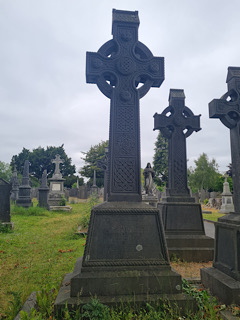
Atkinson dies in County Dublin on July 8, 1893, and is buried in Glasnevin Cemetery, Dublin, where the cemetery committee places a Celtic cross as a monument to her and her husband after his death on December 8, 1893.


Leave a comment

The Copley Street Riot

The Copley Street riot occurs on August 13, 1934, at the Copley Street Repository, Cork, County Cork, after Blueshirts opposed to the collection of annuities from auctioned cattle ram a truck through the gate of an ongoing cattle auction. The Broy Harriers open fire and one man, 22 year old Michael Lynch, is killed and several others injured.

Following the Irish War of Independence (1919–21), Britain relinquishes its control over much of Ireland. However, aspects of the Anglo-Irish Treaty, which had marked the end of the war, lead to the Irish Civil War (1922–23). The aftermath leaves Ireland with damaged infrastructure and hinders its early development.

Éamon de Valera, who had voted against the Anglo-Irish treaty and headed the Anti-Treaty movement during the civil war, comes to power following the 1932 Irish general election and is re-elected in 1933. While the treaty stipulates that the Irish Free State should pay £3.1 million in land annuities to Great Britain, and despite advice that an economic war with Britain could have catastrophic consequences for Ireland (as 96% of exports are to Britain), de Valera’s new Irish government refuses to pay these annuities – though they continue to collect and retain them in the Irish exchequer.

This refusal leads to the Anglo-Irish trade war (also known as the “Economic War”), which persists until 1935, when a new treaty, the Anglo-Irish Trade Agreement, is negotiated in 1938. During this period, a 20% duty is imposed on animals and agricultural goods, resulting in significant losses for Ireland. Specifically, poultry trade declines by 80%, butter trade by 50% and cattle prices drop by 50%. Some farmers are forced to kill and bury animals because they cannot afford to maintain them.

In 1933, Fine Gael emerges as a political party—a merger of Cumann na nGaedheal and the National Centre Party. Fine Gael garners substantial support from rural farmers who are particularly affected by the Economic War. They strongly object to the collection of land annuities by the Fianna Fáil government. The Blueshirts, a paramilitary organisation founded as the Army Comrades Association in 1932 and led by former Garda Commissioner Eoin O’Duffy, transforms into an agrarian protest organisation, mobilising against seizures, cattle auctions, and those tasked with collecting annuities.

O’Duffy, a key figure in Irish politics, encourages farmers to withhold payment of land annuities to the government. Arising from this stance, Gardaí start to seize animals and farm equipment, auctioning them to recover the outstanding funds. While seized cattle are auctioned, local farmers rarely participate. Instead, Northern Ireland dealers, often associated with the name O’Neill, are the primary buyers. These auctions are protected by the Broy Harriers, an armed auxiliary group linked to the police.

By 1934, tensions escalate, and a series of anti-establishment incidents are attributed to the Blueshirts. These incidents range from minor acts of violence, such as breaking windows, to more serious offenses like assault and shootings.

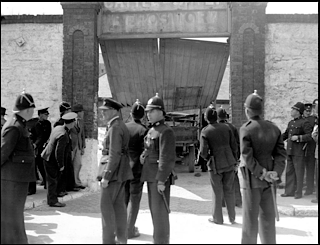
On August 13, 1934, an auction takes place at Marsh’s Yard on Copley Street in Cork, featuring cattle seized from farms in Bishopstown and Ballincollig. The police establish a cordon by 10:00 a.m., with 300 officers on duty. Lorries arrived at 11:00 a.m.

Around noon, three thousand protestors assemble. Within twenty-five minutes, an attempt is made to breach the yard gate by ramming it with a truck. According to Oireachtas records, there are approximately 20 men in the truck which they run against the gate. The Minister for Justice P. J. Ruttledge, says that the truck “with those people in it charged through those cordons of Guards; that several Guards jumped on to the lorry and tried to divert the driver by catching hold of the steering wheel and trying to twist it.” Some contemporary news sources suggest that the ramming truck knocked down the surrounding police cordon “like ninepins and crush[ed] a police inspector against a gate.” Later sources suggest that the senior officer (a superintendent) was injured in a fall, while attempting to avoid being struck, rather than being hit directly by the truck.

A man named Michael Lynch, wearing the distinctive blue shirt, and approximately 20 others reportedly manage to enter the yard. As soon as they enter the yard they are fired upon by armed “special branch” police detectives who are in the yard. Lynch later succumbs to his injuries at the South Infirmary. Thirty-six others are wounded. Despite the violence, the auction proceeds after a one-hour delay.

Following the shooting, a riot ensues, but when news of Lynch’s death reaches the participants, they cease rioting, kneel, and recited a Rosary.

The funeral of Michael Lynch occurs on August 15, 1934. The funeral procession is planned to depart from Saints Peter and Paul’s Church, Cork at 2:30 PM.

The occasion allows for a significant show of force for Eoin O’Duffy and the Blueshirts, and features Roman salutes and military drills. Farmers in Munster reportedly stop work for an hour, and Blueshirt members ask shopkeepers to close their businesses, as a show of respect for the “martyr.” Lynch is afforded a “full Blueshirt burial,” and the coffin is adorned with the flag of the Blueshirts (the Army Comrades Association).

According to the  Minister for Justice, at the funeral W. T. Cosgrave stands beside O’Duffy as the Blueshirt leader gives an oration saying, “We are going to carry on until our mission is accomplished […] those 20 brave men, whose deed will live for ever, not only in Cork but in every county in Ireland, broke through in the lorry […] all Blueshirts should try to emulate his bravery and nobleness. Every Blueshirt is prepared to go the way of Michael for his principles.”

The court grants the family £300 in 1935. This is appealed to the High Court, followed by the Supreme Court, which dismisses the case. In the Supreme Court, Henry Hanna describes the Broy Harriers as “an excrescence” upon the Garda Síochána.

When the matter is discussed in the Seanad in September 1934, and before a vote is taken to “[condemn] the action of the members of the special branch of the Gárda Síochána […] on Monday, the 13th August 1934,” the senators who support Éamon de Valera’s government walk out.

In August 1940, a memorial is unveiled on the tomb of Lynch in Dunbulloge Cemetery in Carrignavar, County Cork, consisting of a limestone Celtic cross and pedestal. The pedestal is engraved with a quote from the American orator, William Jennings Bryan: “The humblest citizen of all the land, when clad in the armour of a righteous cause is stronger than all the hosts of error.”

(Pictured: Aftermath of the ramming of Marsh’s Yard, Copley Street, that leads to the death of Michael Lynch and the Copley Street Riot on August 13, 1934)


Leave a comment

Birth of Catherine Drew, Journalist & Writer

Catherine Drew, Anglo-Irish journalist and writer, is born in Broughshane, County Antrim, on May 27, 1832.

Drew’s parents are the Rev. Thomas Drew and Isabella (née Dalton) Drew. She is the third of the couple’s eight daughters and four sons, although most of her siblings die young. She spends her childhood in Belfast, where her father is the rector of Christ Church in Durham Street from 1833 to 1859. In 1866, she moves to 60 Upper Sackville Street, Dublin, to live with her brother, the architect Thomas Drew.

From here she appears to begin her journalist career, writing articles for the Irish Builder, going on to eventually become its assistant editor. She goes on to write for Belfast’s News Letter, and following advice from its proprietor James Alexander Henderson, she moves to London in 1871 becoming the paper’s London correspondent. She writes two columns, Metropolitan gossip and Ladies’ letter, which are among some of the earliest regular columns written specifically for women, providing society news for her readers in Belfast. Articles by her also appear in The Literary WorldThe British Architect and London Society.

Drew is one of the founding members of the Ladies’ Press Association, and campaigns for greater rights for women journalists. She becomes a prominent figure in the Institute of Journalists, representing the Institute at several international congresses. She is serving as the vice-president of the Institute at the time of her death. She also works on its Orphan Fund for many years, an initiative she originally suggests in 1891.

In 1894, Drew is one of the signatories of the Frances Power Cobbe memorial campaigning for greater recognition and rights for women journalists, alongside Millicent Fawcett and Jessie Boucherett. She writes a number of novels, including Harry Chalgraves’s Legacy (1876) and The Lutanistes of St. Jacobi’s (1881). In March 1885, she gives a lecture titled Dress, Economic and Technical at the Loan Exhibition of Women’s Industries in Bristol, which later appears as a pamphlet.

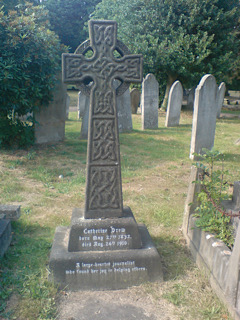
Drew dies at her home in Holland Street, Kensington, on August 26, 1910, and is buried at the Royal Borough of Kensington and Chelsea Cemetery, Hanwell. Lady Drew, her sister-in-law, erects a Celtic cross memorial there in her honour. She bequeaths a jewel-studded gold bracelet to the Institute of Journalists, which had been presented to her by the Institute to mark her retirement in 1908. It is worn by women presidents or the wives of male presidents, and is known as the “Drew Bracelet.”


Leave a comment

Death of W. T. Cosgrave, First President of the Free State Executive Council

William Thomas Cosgrave, Irish Fine Gael politician who serves as the first president of the Executive Council of the Irish Free State (1922-32), dies in The Liberties, Dublin, on November 16, 1965. He also serves as Leader of the Opposition in both the Free State and Ireland (1932-44), Leader of Fine Gael (1934-44), founder and leader of Fine Gael’s predecessor, Cumann na nGaedheal (1923-33), Chairman of the Provisional Government of the Irish Free State (August 1922-December 1922), the President of Dáil Éireann (September 1922-December 1922), the Minister for Finance (1922-23) and Minister for Local Government (1919-22). He serves as a Teachta Dála (TD) (1921-44) and is a member of parliament (MP) for the North Kilkenny constituency (1918-22).

Cosgrave is born at 174 James’s Street, Dublin, on June 5, 1880, to Thomas Cosgrave, grocer, and Bridget Cosgrave (née Nixon). He is educated at the Christian Brothers School at Malahide Road, Marino, Dublin, before entering his father’s publican business. He first becomes politically active when he attends the first Sinn Féin convention in 1905.

At an early age, Cosgrave is attracted to the Irish nationalist party Sinn Féin. He becomes a member of the Dublin Corporation in 1909 and is subsequently reelected to represent Sinn Féin interests. He joins the Irish Volunteers in 1913, although he never joins the Irish Republican Brotherhood (IRB) because he does not believe in secret societies. When the group splits in 1914 upon the outbreak of World War I, he sides with a radical Sinn Féin minority against the constitutional nationalists led by John Redmond, who supports the British war effort.

Cosgrave takes part in the 1916 Easter Rising and is afterward interned by the British for a short time. In 1917, he is elected to Parliament for the city of Kilkenny. In the sweeping election victory of Sinn Féin in the 1918 United Kingdom general election, he becomes a member of the First Dáil. He is made Minister for Local Government in the first republican ministry, and during the Irish War of Independence (1919–21) his task is to organize the refusal of local bodies to cooperate with the British in Dublin.

Cosgrave is a supporter of the 1921 Anglo-Irish Treaty settlement with Great Britain, and he becomes Minister of Local Government in Ireland’s provisional government of 1922. He replaces Michael Collins as Chairman of the Provisional Government when the latter becomes commander-in-chief of the National Army in July 1922. He also replaces Arthur Griffith as president of the Dáil after Griffith’s sudden death on August 12, 1922. As the first president of the Executive Council of the Irish Free State, he, who had helped found the political party Cumann na nGaedheal in April 1923 and became its leader, represents Ireland at the Imperial Conference in October 1923. A month earlier he is welcomed as Ireland’s first spokesman at the assembly of the League of Nations.

Cosgrave’s greatest achievement is to establish stable democratic government in Ireland after the Irish Civil War (1922–23). In the Dáil there is no serious opposition, since the party headed by Éamon de Valera, which refuses to take the oath prescribed in the treaty, abstains from attendance. But neither Cosgrave nor his ministry enjoy much popularity. Order requires drastic measures, and taxation is heavy and sharply collected. He seems sure of a long tenure only because there is no alternative in sight.

In July 1927, shortly after a general election, the assassination of Kevin O’Higgins, the vice president, produces a crisis. The Executive Council introduces a Public Safety Act, which legislates severely against political associations of an unconstitutional character and introduces a bill declaring that no candidature for the Dáil should be accepted unless the candidate declares willingness to take a seat in the Dáil and to take the oath of allegiance. The result of this measure is that de Valera and his party decide to attend sessions in the Dáil, and, since this greatly alters the parliamentary situation, Cosgrave obtains leave to dissolve the assembly and hold a general election. The September 1927 Irish general election leaves his party numerically the largest in the Dáil but without an overall majority. He continues in office until de Valera’s victory at the 1932 Irish general election. Cumann na nGaedheal joins with two smaller opposition parties in September 1933 to form a new party headed by Cosgrave, Fine Gael (“Irish Race”), which becomes Ireland’s main opposition party. In 1944 he resigns from the leadership of Fine Gael.

Cosgrave dies on November 16, 1965, at the age of 85. The Fianna Fáil government under Seán Lemass awards him the honour of a state funeral, which is attended by the Cabinet, the leaders of all the main Irish political parties, and Éamon de Valera, then President of Ireland. He is buried in Goldenbridge Cemetery in Inchicore, Dublin. Richard Mulcahy says, “It is in terms of the Nation and its needs and its potential that I praise God who gave us in our dangerous days the gentle but steel-like spirit of rectitude, courage and humble self-sacrifice, that was William T. Cosgrave.”

While Cosgrave never officially holds the office of Taoiseach (prime minister), Ireland considers him to be its first Taoiseach due to having been the Free State’s first head of government.

Cosgrave’s son, Liam, serves as a TD (1943-81), as leader of Fine Gael (1965-77) and Taoiseach (1973-77). His grandson, also named Liam, also serves as a TD and as Senator. His granddaughter, Louise Cosgrave, serves on the Dún Laoghaire–Rathdown County Council (1999-2009).

In October 2014, Cosgrave’s grave is vandalised, the top of a Celtic cross on the headstone being broken off. It is again vandalised in March 2016.


Leave a comment

The First Famine Ship Arrives at Grosse Île

The Syria, the first ship to arrive during what Québécois call the “Summer of Sorrow,” lands at the Canadian quarantine station in the St. Lawrence River, just north of Quebec on May 15, 1847.

When the authorities in Quebec hear the news of ships arriving with sick passengers, they quickly set up Grosse Île as a port of entry and quarantine station at which all ships are required to dock before moving on to the mainland. The island had dealt with epidemics before. In 1830, about 30,000 immigrants arrived in Quebec, and two-thirds were Irish. These huge waves of immigration were concurrent with cholera epidemics in Great Britain and Europe.

Areas in the west of Ireland – mostly Mayo, Donegal, and Galway – are experiencing potato crop failure. In fact, the crop fails to various degrees all over the country throughout the 1830s, though no one is sure exactly when the blight that caused the successive crop failures of 1845-49 arrived in Ireland. In 1847, 100,000 Irish people travel to Grosse Île to escape starvation, unaware of the hardships they will encounter upon arrival.

The Syria, the first “coffin ship,” named for their crowded and deadly conditions, arrives on May 17, 1847, the ice still an inch thick on the river. Of the ship’s 241 passengers, 84 are stricken with fever and 9 died on board during the Atlantic crossing. The first victim dies on the day the Syria arrives. Her name is Ellen Kane, a four-year-old from Kilmore, County Mayo.

With the hospital equipped for only 150 cases of fever, the situation quickly spins out of control. More and more ships arrive at Grosse Île each day, sometimes lining up for miles down the St. Lawrence River throughout the summer. On these coffin ships the number of passengers stricken by fever increases exponentially.

The island is ill-equipped, to say the least. Hastily built, the quarantine hospitals lack proper sanitation, supplies, and space to accommodate all the sick patients. Many of the doctors dispatched to Grosse Île have never even seen the effects of cholera let alone treated it, and all are overworked. Being taken to a quarantine hospital is soon viewed as more of a death sentence than an opportunity to get better.

Between 1832 and 1937, Grosse Île’s term of operation, the official register lists 7,480 burials on the island. In 1847 alone, 5,424 burials take place, the majority are Irish immigrants. In that same year, over 5,000 Irish people on ships bound for Canada are listed as having been buried at sea.

Today, the island is a National Historic Site that serves as a Famine memorial. It is dedicated in 1996 after a four-year-long campaign to protect the mass gravesite.

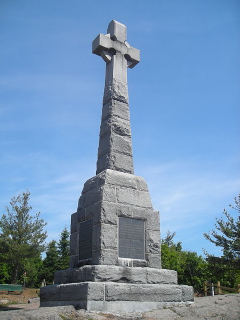
The Grosse Île Celtic Cross, erected by the Ancient Order of Hibernians in 1909, bears an inscription in Irish commemorating the victims of the epidemic and condemning colonial rule. In English, it reads: “Children of the Gael died in their thousands on this island having fled from the laws of foreign tyrants and an artificial famine in the years 1847-48. God’s blessing on them. Let this monument be a token and honor from the Gaels of America. God Save Ireland.”

(From: “When 40 Irish Famine ships anchored at Grosse Île quarantine station in 1847” by Aliah O’Neill, IrishCentral, http://www.irishcentral.com, May 31, 2023)


Leave a comment

Birth of Martin Sheridan, Three-Time Olympic Gold Medalist

Martin John Sheridan, three-time Olympic Games gold medalist, is born in Bohola, County Mayo, on March 28, 1881. He is part of a group of Irish American athletes known as the “Irish Whales.”

At 6 ft. 3 in. (191 cm) and 194 lbs. (88 kg), Sheridan is the best all-around athlete of the Irish American Athletic Club, and like many of his teammates, serves from 1906 until his death in 1918 with the New York City Police Department. He is so well respected in the NYPD, that he serves as the Governor’s personal bodyguard when the governor is in New York City.

A five-time Olympic gold medalist, with a total of nine Olympic medals, Sheridan is called “one of the greatest figures that ever represented this country in international sport, as well as being one of the most popular who ever attained the championship honor.” He wins the discus throw event at the 1904, 1906, and 1908 Summer Olympics as well as the shot put at the 1906 Olympics and the Greek discus in 1908. At the 1906 Intercalated Games in Athens, Greece, he also wins silver medals in the standing high jump, standing long jump and the stone throw.

In 1907, Sheridan wins the National Amateur Athletic Union (AAU) discus championship and the Canadian championship, and in 1908 he wins the Metropolitan, National and Canadian championships as well as two gold medals in the discus throw and a bronze medal in the standing long jump at the 1908 Olympic Games.

Two of Sheridan’s gold medals from the 1904 Olympic Games in St. Louis, Missouri, and one of his medals from the 1906 Olympic Games in Athens, are currently located in the USA Track & Field‘s Hall of Fame History Gallery, in Washington Heights, Manhattan.

It is often claimed that Sheridan fueled a controversy in London in 1908, when flagbearer Ralph Rose refused to dip the flag to King Edward VII. Sheridan supposedly supports Rose by explaining, “This flag dips to no earthly king,” and it is claimed that his statement exemplified both Irish and American defiance of the British monarchy. However, careful research has shown that this was first reported in 1952. Sheridan himself makes no mention of it in his published reports on the Games and neither does his obituary.

Sheridan dies in St. Vincent’s Hospital in Manhattan, New York, on March 27, 1918, the day before his 37th birthday, a very early casualty of the 1918 flu pandemic. He is buried in Calvary Cemetery, Queens, New York. The inscription on the granite Celtic Cross monument marking his grave says in part: “Devoted to the Institutions of his Country, and the Ideals and Aspirations of his Race. Athlete. Patriot.”

According to his obituary in The New York Times, Sheridan was “one of the greatest athletes the United States has ever known.”

(Pictured: Martin Sheridan from the historical picture collection of Knut Gulbrandsen)


Leave a comment

Great Famine Monument Dedicated at Grosse Île, Quebec

On August 15, 1909, the Ancient Order of Hibernians dedicate a monument to victims of the Great Famine at Grosse Île, Quebec, Canada.

Grosse Île, in the Gulf of Saint Lawrence, acts as a quarantine station for Irish people fleeing the Great Famine between 1845 and 1849. It is believed that over 3,000 Irish people died on the island and over 5,000 are buried in the cemetery there.

In 1847, 100,000 Irish people travel to Grosse Île to escape starvation, unaware of the hardships they would encounter upon arrival. The first coffin ship – named for their crowded and deadly conditions – arrives on May 17, 1847, the ice still an inch thick on the river. Of that ship’s 241 passengers, 84 are stricken with fever and 9 have died on board. With the hospital only equipped for 150 cases of fever, the situation quickly spins out of control. More and more ships arrive at Grosse Île each day, sometimes lining up for miles down the St. Lawrence River throughout the summer. On these coffin ships the number of passengers stricken by fever increases exponentially.

Between 1832 and 1937, Grosse Île’s term of operation, the official register lists 7,480 burials on the island. In 1847 alone, 5,424 burials take place, the majority being Irish immigrants. In that same year, over 5,000 Irish people on ships bound for Canada are listed as having been buried at sea.

When the monument is unveiled in 1909, more than 60 years have passed since the more than 5,000 Irish men, women, and children were buried on the island, but the ancestors and relatives of those victims have not forgotten them. Through the hard work of the Ancient Order of Hibernians, thousands of dollars are collected to erect a fitting memorial to those innocent victims of man’s inhumanity to man. The symbol they choose to use is a Celtic cross. Designed by Jeremiah Gallagher, a member of the Ancient Order of Hibernians in Quebec, the cross is carved from granite and stands 48 feet high atop its pedestal.

The monument bears an inscription in Irish commemorating the victims of the epidemic and condemning colonial rule. In English, it reads: “Children of the Gael died in their thousands on this island having fled from the laws of foreign tyrants and an artificial famine in the years 1847-48. God’s blessing on them. Let this monument be a token and honor from the Gaels of America. God Save Ireland.”

To ensure that no one traveling up or down the St. Lawrence River fails to see the monument, it is placed on Telegraph Hill, the highest point on the island. The monument is unveiled by the Papal Legate before a crowd of 9,000, including several hundred French Canadians, some perhaps from families that had adopted one or more of the over 600 Irish orphans whose parents were left behind on Gross Île. The cross stands as a beacon to those who pass up and down the busy waterway, reminding them not only of the tragedy that once happened on that island but also of the ultimate triumph of those who survived.

Today, the island is a National Historic Site that serves as a Famine memorial. It is dedicated in 1996 after a four-year-long campaign to protect the mass gravesite.


Leave a comment

Birth of Myles Byrne, United Irishman & French Army Officer

Myles Byrne, United Irishman, French army officer and author, is born into a Catholic farming family in the townland of Ballylusk, near Monaseed, County Wexford, on March 20, 1780.

At the age of 17, Byrne is asked to join the government Yeomanry. He chooses instead to join the Society of United Irishmen. In defiance of the British Crown and the Protestant Ascendancy the oath-bound movement is determined to achieve an independent and representative government for Ireland. He participates in preparations in Wexford for the Irish Rebellion of 1798 and, at the age of 18, fights at the Battle of Tubberneering on June 4 and, in command of a division of pikemen, in the Battle of Arklow on June 9, in which the rebel leader Father Michael Murphy is killed. In the face of a general rout, he leads a rebel charge in the Battle of Vinegar Hill on June 21.

Keeping command of a small band, Byrne seizes Goresbridge on June 23 but has to deplore the murder of several prisoners and other atrocities committed by his men in revenge for the torture and executions that had been visited upon the peasantry by the yeomanry and government militia. After further skirmishes he joins Joseph Holt and Michael Dwyer in taking to the Wicklow Mountains to continue a guerrilla resistance.

After Holt accepts transportation to Australia in November, Byrne, assisted by his sister, escapes to Dublin. He recalls of his sister, “If I had not remarked a long scar on her neck, she would not have mentioned anything herself. A yeoman … threatened to cut her throat with his sabre if she did not tell instantly the place in which I was hiding. The cowardly villain, no doubt, would have put his threat in execution had not some of his comrades interfered to prevent him.”

In the winter of 1802-03, Byrne enters into the plans of Robert Emmet and Anne Devlin for a renewed uprising. In his Memoirs he describes a meeting he arranged between Robert Emmet and the Wexford rebel leader Thomas Cloney at Harold’s Cross Green, Dublin, just prior to Emmet’s Rebellion, “I can never forget the impression this meeting made on me at the time – to see two heroic patriots, equally devoted to poor Ireland, discussing the best means of obtaining her freedom.”

In July 1803, the plans unravel when Anne Devlin’s cousin, Michael Dwyer, still holding out in Wicklow, recognises that there are neither the promised arms nor convincing proof of an intended French landing. In the north Thomas Russell and James Hope find no enthusiasm for a renewal of the struggle in what in 1798 are the strongest United Irish and Catholic Defender districts.

In Dublin, with their preparations revealed by an accidental explosion of a rebel arms depot, Emmet proceeds with a plan to seize the centres of government. The rising, for which for Byrne turns out with Emmet and Malachy Delaney in gold-trimmed green uniforms, is broken up after a brief confrontation in Thomas Street.

Two days after the fight in Thomas Street, Byrne meets with the fugitive Emmet and agrees to go to Paris to procure French assistance. But in Paris he finds Napoleon‘s attentions focused elsewhere. The First Consul uses a cessation of hostilities with Britain to pursue a very different venture, the re-enslavement of Haiti.

Byrne is commissioned as a captain in Napoleon’s Irish Legion. But at a time when he is convinced that “all Catholic Ireland” is “ready to rise the moment a rallying point was offered,” the Irish exiles cannot deflect the First Consul from other priorities. Rather than in Ireland, with his diminishing Irish contingent, he is to see action in the Low Countries, Germany and Spain.

Byrne rises to the rank of brigadier general and is awarded the Legion of Honour in 1813. Following the Bourbon Restoration, with fellow legionnaire John Allen, he narrowly avoids deportation as a foreign Bonapartist. An introduction to the Prince de Broglie, then vice-president of the Chamber of Deputies, and two audiences with the Minister of War, Marshal Henri Clarke, the Duke of Feltre, contribute to the latter’s decision to quash the deportation order. In August 1817 Byrne is naturalised as a French citizen.

For much of the next decade Byrne finds himself effectively retired on half pay. Returned to active military service in 1828, he distinguishes himself in the French expedition to Morea during the Greek War of Independence. He retires in 1835 with the rank of Chef de Bataillion.

In the 1840s, Byrne is Paris correspondent for The Nation in Dublin, the Young Irelander newspaper that does much to rehabilitate the memory of the United Irishmen.

In his last years Byrne writes his Memoirs, which are an account of his participation in the Irish Rebellion and his time in the Irish Legion of Napoleon. These are first published in three volumes in 1863, but there have been many subsequent reprints. Against the portrayal of 1798 as a series of disjointed, unconnected risings, his memoirs present the United Irishmen as a cohesive revolutionary organisation whose aim of a democratic, secular, republic had captured the allegiance of a great mass of the Irish people.

Byrne dies at his house in the rue Montaigne (now rue Jean Mermoz, 8th arrondissement, near Champs-Élysées), Paris on January 24, 1862, and is buried in Montmartre Cemetery. His grave there is marked by a Celtic Cross, however this headstone appears to be a 1950s replacement for an earlier one.

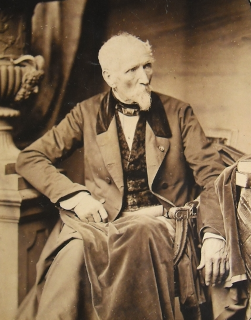
(Pictured: Miles Byrne (1780-1862), United Irishman. Photograph taken by an unknown photographer in Paris in February 1859. The photograph now resides in Áras an Uachtaráin, the residence of the President of Ireland, in Dublin.)


1 Comment

The Execution of IRA Member George Plant

George Plant, member of the Irish Republican Army (IRA), is executed by the Irish Government on March 5, 1942.

Plant is born into a Church of Ireland farming family in Fethard, County Tipperary, on January 5, 1904, the second eldest child and son in a family of six children. His parents are John William Albert Plant, a farmer, and Catherine Hayden.

One Sunday in 1916, George and his older brother Jimmy are arrested by the Royal Irish Constabulary (RIC) after being seen speaking to two well-known republicans, Seán Hayes and Dan Breen. In custody the two brothers are beaten and mistreated resulting in a hatred of the RIC. He serves with the Irish Republican Army during the Irish War of Independence and with the Anti-Treaty IRA in the Irish Civil War.

In 1923, George and Jimmy leave Ireland for Canada and the United States but continue as active IRA members. In 1929 they return to Ireland and carry out a bank raid in Tipperary on behalf of the IRA. They are arrested two days later at the family farm and subsequently sentenced to seven years in prison. They are released in a general amnesty after the Fianna Fáil and Éamon de Valera election victory in 1932. He is a strong supporter of Seán Russell. In 1939 following the outbreak of World War II, known in Ireland as The Emergency, de Valera is determined to maintain Irish neutrality and is not going to allow the IRA to jeopardize this. The IRA links with Germany and campaign in Britain are severely straining Anglo-Irish relations so emergency legislation is introduced.

Russell, the IRA Chief of Staff, dies in August 1940 after taking ill on board a U-boat and Stephen Hayes from County Wexford becomes IRA Chief of Staff. In late August 1940 an address on Lansdowne Road, Dublin, is raided by the Garda Síochána. Among the men arrested is Michael Devereux, a 24-year-old married truck driver from County Wexford who is also Quartermaster of the IRAs Wexford Brigade. He is released after three days without charge. Shortly afterwards Gardaí in County Wexford find an IRA arms dump. Many in the IRA suspect that Devereux had turned informer, so Stephen Hayes orders Devereux’s execution. George Plant and another man, Michael Walsh from County Kilkenny, are ordered to carry out the order. Devereux meets Plant and Walsh who tell Devereux that Tom Cullimore, the Wexford Brigade’s OC is blamed for the arms dump and that they have shot him. They order Devereux to drive them to an IRA safe house at Grangemockler in south County Tipperary. Devereux, believing he is the prime suspect in a murder, stays willingly at the safe house. A week later, on September 27, 1940, Devereux is invited to go for a walk with Plant and Paddy Davern, the owner of the safe house. Somewhere along the walk Plant accuses Devereux of being an informer and shoots him dead. Plant is arrested nine weeks later on suspicion of IRA membership and brought before the Special Criminal Court in Dublin. On February 10, 1941, Radio Éireann broadcasts a radio appeal for Michael Devereux on behalf of his wife.

In September 1941, Stephen Hayes is accused of being an informer by a group of Northern IRA members led by Seán McCaughey. He manages to escape to a garda station. Shortly afterwards a large force of Garda Síochána and Irish Army descend on the area around the Davern farmhouse where they find Devereux’s car buried under an onion bed and eventually discover Devereux’s body, a year to the day after his death. Two weeks later, Plant, already in prison on IRA membership charges, is charged with Devereux’s murder. A trial is held with a senior IRA officer, Joseph O’Connor, also charged with Devereux’s murder. The first trial collapses after two days when Paddy Davern and Micheal Walsh, two of the prosecution witnesses, refuse to give evidence. This result leads to the court issuing a nolle prosequi order which should have meant the end of the affair, however both men are rearrested and recharged with the same offence, under Emergency Order 41f. Minister for Justice Gerald Boland transfers the case to a Special Military Court with army officers acting as judges. In addition to Plant, Paddy Davern and Michael Walsh are also now charged with Devereux’s murder. The second trial begins at Collins Barracks, Dublin in February 1942 with Seán MacBride, a former IRA Chief of Staff and future government minister as the defendant’s barrister. Davern states his original statement was given at gunpoint but under the new order even statements given under duress are admissible. The court only has two sentencing options – death or acquittal. Joseph O’Connor is acquitted and despite MacBride’s best efforts the other three are sentenced to death. Davern and Walsh have their sentences commuted to life imprisonment and are both released in 1946.

Just one week after sentence is passed, Plant is executed on March 5, 1942, in Portlaoise Prison by a six-man firing squad drawn from the Irish Army. Much bitterness is caused by the treatment of Plant’s relatives. Neither his wife or mother or infant son are allowed to visit him in the week before his execution. Censorship ensures there is little mention in the newspapers, so his family only learns of his execution from a brief radio broadcast shortly before they receive a telegram. He is buried in the grounds of Portlaoise Prison, but is reinterred in 1948, when he is buried with full IRA military honours in his local church St. Johnstown in County Tipperary, and a Celtic cross is erected over his grave.

Plant’s wife moves to the United States where she remarries. His brother Jimmy dies in London in 1978. The Plant’s family farm is now part of the Coolmore Estate.


Leave a comment

State Funeral in Honour of the “Forgotten Ten”

On October 14, 2001, the first multiple state funeral is held in honour of the “Forgotten Ten,” a term applied to ten Irish Republican Army (IRA) volunteers who were executed by British forces in Mountjoy Prison, Dublin, following courts martial for their role in the Irish War of Independence.

Based upon military law at the time, they are buried within the prison precincts, their graves unmarked in the unconsecrated ground. The names of the Forgotten Ten are Kevin Barry, Thomas Whelan, Patrick Moran, Patrick Doyle, Bernard Ryan, Thomas Bryan, Frank Flood, Thomas Traynor, Edmond Foley, and Patrick Maher. The hangman is John Ellis.

Following the Irish War of Independence, Mountjoy Prison is transferred to the control of the Irish Free State, which becomes the State of Ireland in 1937. In the 1920s, the families of the dead men request their remains be returned to them for proper burial. This effort is joined in the later 1920s by the National Graves Association. Through the efforts of the Association, the graves of the men are identified in 1934, and in 1996 a Celtic cross is erected in Glasnevin Cemetery, Dublin, to commemorate them.

The campaign to rebury the men drags on for 80 years from their deaths. Following an intense period of negotiations, the Irish government relents. Plans to exhume the bodies of the ten men are announced on November 1, 2000, the 80th anniversary of the execution of Kevin Barry. On October 14, 2001, the Forgotten Ten are afforded full state honours, with a private service at Mountjoy Prison for the families of the dead, a Requiem Mass at St. Mary’s Pro-Cathedral and burial in Glasnevin Cemetery.

According to The Guardian, some criticise the event as glorifying militant Irish republicanism. It coincides with the Fianna Fáil Ardfheis. The progress of the cortège through the centre of Dublin is witnessed by crowds estimated as being in the tens of thousands who break into spontaneous applause as the coffins pass. On O’Connell Street, a lone piper plays a lament as the cortège pauses outside the General Post Office (GPO), the focal point of the 1916 Easter Rising. In his homily during the Requiem Mass, Cardinal Cahal Daly, a long-time critic of the IRA campaign in Northern Ireland, insists that there is a clear distinction between the conflict of 1916–22 and the paramilitary-led violence of the previous 30 years:

“The true inheritors today of the ideals of the men and women of 1916 to 1922 are those who are explicitly and visibly committed to leaving the physical force tradition behind… Surely this state funeral can be an occasion for examination of conscience about the ideals of the men who died, and about our responsibility for translating those ideals into today’s realities.”

In his graveside oration Taoiseach Bertie Ahern echoes these sentiments and also pays tribute to the Ten:

“These 10 young men were executed during the War of Independence. The country was under tremendous pressure at the time. There was a united effort. Meanwhile, elected by the people, Dáil Éireann was developing, in spite of a war going on. Democracy was being put to work. Independent civic institutions, including the Dáil courts, were beginning to function. Before their deaths, the ten had seen the light of freedom. They understood that Ireland would be free and independent.”

The state funeral, broadcast live on national television and radio, is only the 13th since independence. Patrick Maher is not reburied with his comrades. In accordance with his wishes, and those of his family, he is reinterred in Ballylanders, County Limerick.

A feature length Irish language documentary on the re-interments, An Deichniúr Dearmadta (The Forgotten Ten) airs on TG4 on March 28, 2002.

(Pictured: The grave of nine of the Forgotten Ten in Glasnevin Cemetery, Dublin)