O’Brien is a ship builder and designer, and his notable boats include the Kelpie (used for gun running in 1914), the Saoirse (in which he circumnavigates the globe) and the Ilen (a Falkland Islands service ship).
O’Brien is credited with two buildings in his lifetime: the Co-operative Hall in County Donegal and the People’s Hall in County Limerick. He is also known as a naval architect, having designed two ships, the Saoirse and the llen. He later captains both of these ships himself.
In Saoirse, a 20-ton, 42-foot ketch designed and built in 1922 in Baltimore, County Cork, he and three crew members circumnavigate the globe between 1923 and 1925 – the first recorded by an amateur skipper from west to east, the first yacht circumnavigation by way of the three great capes: Cape Horn, Cape of Good Hope and Cape Leeuwin, and the first boat flying the Irish tri-colour to enter many of the world’s ports and harbours. His voyage begins and ends at the Port of Foynes, County Limerick, where he lives. His account of the voyage, Across Three Oceans, (1927) becomes one of the classics of maritime literature.
Up until O’Brien’s circumnavigation, this route is the preserve of square-rigged grain ships taking part in the grain race from Australia to England via Cape Horn (also known as the clipper route).
O’Brien’s seagoing experiences are put to use in his design of the Ilen, which is built for the Falkland Islands as a service boat and launched in the spring of 1926. In 1998, Ilen returns to the site where she was first built, on the River Ilen near Baltimore, County Cork, where she undergoes a full restoration and is re-launched in May 2018. This task provides work-based learning for the students of the Ilen School.
O’Brien has some involvement with gun running in 1914 on behalf of the Irish Volunteers, for political reasons and because he has experience in sailing. On July 26, 1914, nine hundred guns are brought to Howth harbour aboard Erskine Childers‘ yacht Asgard. As part of the same operation, O’Brien transports arms on his yacht, Kelpie. The guns on Kelpie are transshipped to another yacht, Chotah, owned by Sir Thomas Myles, before being landed at Kilcoole in County Wicklow on August 1, 1914. After the gun running incidents, he serves in the Royal Naval Volunteer Reserve.
In 1928, O’Brien marries a well-known artist, Kathleen Francis, the youngest daughter of Sir George Clausen, RA. The couple thereafter moves to Ibiza, where they live on the Saoirse until Kathleen’s death in 1936. They have no children. Relocating to Cornwall, where he lives with his sister, he writes books on sailing and works of fiction for children. Although too old for active service when war with Germany breaks out in 1939, he assists the British war effort by serving in the Small Ships Pool, which delivers support vessels across the Atlantic and brings food supplies from the United States in private yachts.
In 1940 O’Brien sells Saoirse to the Royal Cornwall Yacht Club. The boat remains in use until 1980, when it is lost off the Jamaican coast. After the war he retires to another sister’s home in Foynes, County Limerick, where he lives and continues to write books for children until his death on April 18, 1952.
Together with his brother Norman, Leslie’s early education begins at home where a German governess, Clara Woelke, is their first teacher. As children the brothers have more contact with servants than they have with their parents. His own daughter, Anita, says, “In my parents’ view schools performed the same functions that kennels did for dogs. They were places where pets could be conveniently deposited while their owners travelled.”
Leslie is educated at Ludgrove School, then Eton College and King’s College, Cambridge. While at Cambridge University he becomes a Roman Catholic and a supporter of Irish Home Rule. He adopts an anglicised Irish variant of his name (“Shane”). Not overly impressed by Eton, as a lower boy he and his roommates occupy “an old, battered warren betwixt the chapel cemetery and Wise’s horse yard … [T]he food was wretched and tasteless … As for thrashings which tyrannised rather than disciplined our house, they were excessive. Bullying was endemic and Irish boys were ridiculed, especially on St Patrick’s Day.”
Leslie refuses to send his own sons to Eton. They are educated at Roman Catholic Benedictine schools: Jack at Downside School and Desmond at Ampleforth College.
During the war Leslie is in a British Ambulance Corps, until invalided out. He is then sent to Washington, D.C. to help the British Ambassador, Sir Cecil Spring Rice, soften Irish American hostility toward England and obtain American intervention in the war in the aftermath of the 1916 Easter Rising in Dublin and the execution of its leaders. But he also looks to Ireland for inspiration when writing and edits a literary magazine that contains much Irish verse. He becomes a supporter of the ideals of Irish nationalism, although not physical force republicanism.
In the 1918 United Kingdom general election in Ireland, the Irish Parliamentary Party loses massively to Sinn Féin, putting an end to Leslie’s political career, but as the first cousin of Winston Churchill he remains a primary witness to much that is said and done outside the official record during the negotiation of the Anglo-Irish Treaty of 1921. Disappointed, he feels unwanted in Ireland and abandoned by the British. Like many members of the landed gentry from the 1880s who were obliged to turn to other occupations, he can no longer rely on income from landholdings.
Leslie writes extensively, in a wide range of styles, in verse, prose, and polemic, over several decades. His writings include The End of a Chapter (1916), while hospitalised during World War I, The Oppidan (1922), a roman à clef about his life and contemporaries at Eton, an edition of the Letters of Herbert Cardinal Vaughan to Lady Herbert of Lea (1942), and a biography Mrs. Fitzherbert: a life chiefly from unpublished sources (1939), together with an edition of her letters (with Maria Anne Fitzherbert), The letters of Mrs. Fitzherbert and connected papers; being the second volume of the life of Mrs. Fitzherbert (1944). He also writes Mark Sykes: His Life and Letters (1923), a biography of the English traveler, Conservative Party politician and diplomatic advisor. He advises budding novelist Scott Fitzgerald on the title of his first novel, they share correspondence with the future Mnsg. William A. Hemmick, who is Fitzgerald’s teacher at the Newman School.
A passionate advocate of reforestation, Leslie finds the business of running an estate uncreative and boring, and transfers the estate entailed to him to his eldest son, John Norman Leslie, who succeeds as the 4th Baronet. He transfers St. Patrick’s Purgatory on Lough Derg to the Roman Catholic Bishop of Clogher, Eugene O’Callaghan.
The wealth of the Leslies wanes by the 1930s following the Wall Street crash of 1929 and a farm that is loss making. In his unpublished memoirs, Leslie writes “a gentleman’s standing in his world was signalled by his list of clubs and it was worth paying hundreds of pounds in subs.” They continue to maintain their lifestyle, involving attendance at the London season and the entertainment of distinguished visitors, including Anthony Eden at Glaslough. At the outbreak of World War II in 1939 he joins the Home Guard. He spends the remainder of his life between Glaslough and London.
Leslie’s first wife, Marjorie, dies on February 8, 1951. On May 30, 1958, at the Catholic Church of St. Peter & Edward, Westminster, he marries Iris Carola Frazer, who is the daughter of Charles Miskin Laing and Etheldreda Janet Laing.
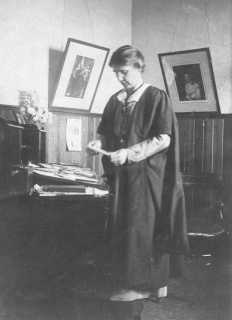
Gwynn is appointed first lady registrar of Trinity College Dublin in February 1905. Women had only been admitted to the university the previous year. Despite coming from a family of academics, she had been unable to get a university education herself. She is 39 years old when appointed to her position in the university.
Students describe Gwynn as a pioneer. Her role as women’s registrar is described by one of her charges as “to control our movements to some extent and to protect the college and the students from criticism.”
In 1907, Gwynn is summoned before the Fry Commission on Dublin University to defend the position of women at Trinity. She is supported by the parents of the students. The result is that the commission endorses the principle of women’s admission to the university.
In 1922, the Dublin University Women Graduates’ Association is founded, under Gwynn’s presidency.
Gwynn never marries. As an eldest daughter she is required to assist in the management of her parents’ household and attend to them in their old age. From her mother’s brother, architect Robert Donough O’Brien, she inherits the house he had designed and built at Parteen-a-Lax in County Clare, close to Limerick. It is there that she retires at the end of her working life. Her hobby is tending its beautiful garden which lay next to the River Shannon.
Gwynn dies in County Clare in 1947.
Founded, by subscription, in 1948 in memory of Lucy Gwynn, the Lucy Gwynn Memorial Prize is awarded annually in the Michaelmas term to a Junior Sophister woman student for distinction in her course. The award is made by two women on the university staff nominated by the Board, and one of the female tutors. The value of the prize is €1,207.
The Battle of Collooney, also called the Battle of Carricknagat, occurs on September 5, 1798, during the Irish Rebellion of 1798 when a combined force of French troops and Irish rebels defeat a force of British troops outside of Collooney near Sligo.
A long-anticipated French landing to assist the Irish rebellion takes place on August 22, when almost 1,100 troops under the command of General Jean Joseph Amable Humbert land at Kilcummin Strand (Cill Chuimín), Killala Bay, County Mayo. Although the force is small, the remote location ensures an unopposed landing away from the tens of thousands of British soldiers concentrated in the east in Leinster, engaged in mopping up operations against remaining pockets of rebels. The nearby town of Killala is quickly captured after a brief resistance by local yeomen and Ballina is also taken two days later, following the rout of a force of cavalry sent from the town to oppose their march. Irish volunteers begin to trickle into the French camp from all over Mayo following the news of the French landing.
The victory of General Humbert at Castlebar, despite gaining him about 5,000 Irish recruits, does not lead to a renewed outbreak of the rebellion as hoped. A British army of some 26,000 men is assembled under Field MarshalCharles Cornwallis, 1st Marquess Cornwallis, the newly appointed Lord Lieutenant of Ireland, and is steadily moving towards his forces. Abandoning Castlebar, Humbert moves towards Ulster via Sligo with the intention of igniting a rising there.
The combined Franco-Irish forces march northeast towards Sligo on their way to County Donegal in Ulster. When they get to the village of Collooney they are confronted by a unit of British troops from the garrison in Sligo, which is approximately five miles to the north of Collooney. A minor battle ensues at Carricknagat, a small townland to the immediate north of Collooney, hence the alternate name for the battle: the Battle of Carricknagat.
On September 5, 1798, the Franco-Irish troops push north through County Sligo but are halted by a cannon which the British forces have installed above Union Rock near Collooney.
A young Irish aide to General Humbert, LieutenantBartholomew Teeling, distinguishes himself during the encounter. Teeling clears the way for the advancing Irish-French army by single-handedly disabling a British gunnery post located high on Union Rock when he breaks from the French ranks and gallops toward the gunner’s position. Teeling is armed with a pistol and he shoots the cannon’s marksman and captures the cannon. After the loss of the cannon position, the French and Irish advance and the British retreat toward their barracks at Sligo, leaving 120 dead and 100 prisoners.
Colonel Charles Vereker, who commands the Limerick militia in the standoff, is awarded a peerage for his role in the battle.
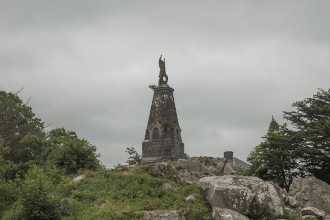
In 1898, the centenary year of the battle, a statue of Teeling is erected in Carricknagat. Johnnie Woods of Aughamore, Sligo, County Sligo, a far-famed reliable scaffolder, erects the spire for this monument.
The O’Neills and O’Donnells retain their lands and titles, although with much-diminished extent and authority. However, the countryside is laid bare in a campaign of destruction in 1602, which induces famine in 1603. Hugh O’Neill, Earl of Tyrone, is pardoned under the terms of the Treaty of Mellifont in March 1603 and submits to the crown.
When King James VI and I takes the English throne in 1603, he quickly proceeds to issue pardons for the Irish lords and their rebel forces. Already reigning as king of Scotland, he has a better understanding of the advantages from working with local chiefs in the Scottish Highlands. However, as in other Irish lordships, the 1603 peace involves O’Neill losing substantial areas of land to his cousins and neighbors, who would be granted freeholds under the English system, instead of the looser arrangements under the former Brehon law system. This is not a new policy but is a well-understood and longstanding practice in the Tudor conquest of Ireland.
On September 10, 1602, the Prince of Tyrconnell has already died, allegedly assassinated, in Spain, and his brother succeeds him as 25th Chieftain of the O’Donnell clan. He is later granted the Earldom of Tyrconnell by King James I on September 4, 1603, and restored to a somewhat diminished scale of territories in Tyrconnell on February 10, 1604.
In 1605, the new Lord Deputy of Ireland, Sir Arthur Chichester, begins to encroach on the former freedoms of the two Earls and The Maguire, enforcing the new freeholds, especially that granted in North Ulster to the O’Cahan chief. The O’Cahan had formerly been important subjects of the O’Neills and required protection; in turn, Chichester wants to reduce O’Neill’s authority. O’Cahan has also wanted to remove himself from O’Neill’s overlordship. An option is to charge O’Neill with treason if he does not comply with the new arrangements. The discovery of the Gunpowder Plot in the same year makes it harder for Catholics to appear loyal to both the crown and the papacy. A lengthy legal battle however finds in O’Neill’s favor.
By 1607, O’Neill’s allies the Maguires and the Earl of Tyrconnell are finding it hard to maintain their prestige on lower incomes. They plan to seek Spanish support before news of the Battle of Gibraltar arrives. When their ship drops anchor, O’Neill seems to have joined them on impulse. He had three options:
Flee with his friends and hope for a reinvasion by Spain
Go to London and stay at court until his grievances are redressed
Do nothing and live on a reduced income as a large landowner in Ulster
Fearing arrest, they choose to flee to Continental Europe, where they hope to recruit an army for the invasion of Ireland with Spanish help. However, earlier in 1607 the main Spanish fleet in Europe had been defeated by the Dutch in the Battle of Gibraltar. But the oft-repeated theory that they are all about to be arrested contradicts writer Tadhg Ó Cianáin, the main historical source on the Flight, who says at the start of his account that O’Neill heard news of the ship anchored at Rathmullen on Thursday September 6, and “took his leave of the Lord Justice (Chichester) the following Saturday.” They had been meeting at Slane for several days, and there is no proof that warrants for his arrest have been drawn up, nor is it a hurried departure.
Also, as the Anglo-Spanish War (1585–1604) has been ended by the Treaty of London in 1604, King Philip III of Spain wants to remain at peace with England under its new Stuart dynasty. As a part of the peace proposals, a Spanish princess is to marry James’ son, Henry, though this never happens. Spain had also gone bankrupt in 1598. Tyrone ignores all these realities, remains in Italy, and persists with his invasion plan until his death in exile in 1616.
The earls set sail from Rathmullan, a village on the shore of Lough Swilly in County Donegal, with some of the leading Gaelic families in Ulster. Several leave their wives behind, hoping either to return or retrieve them later. They travel down Lough Swilly on a French ship. Their departure is the end of the old Gaelic order, in that the earls are descended from Gaelic clan dynasties that had ruled their parts of Ulster for centuries. They finally reach the Continent on October 4, 1607.
Their destination is Spain, but they disembark in France. The party proceeds overland to Spanish Flanders, some remaining in Leuven, while the main party continues to Italy. Tadhg Ó Cianáin subsequently describes the journey in great detail. While the party is welcomed by many important officials in the Spanish Netherlands, he makes no mention of any negotiations or planning between the earls and the Spanish to start a new war to regain the earls’ properties.
James I soon plants the O’Neill and O’Donnell lands with Protestant settlers, helping to sow the seeds of the present “Troubles.” O’Donnell dies in Rome in 1608 and O’Neill dies there also in 1616.
Ó Cianáin’s diary is important as the only continuous and contemporaneous account of the Flight. Its original title, Turas na dTaoiseach nUltach as Éirinn – the departure of the Chiefs of Ulster from Ireland – has been changed since the creation of the more dramatic phrase “Flight of the Earls” to the latter’s modern literal translation, Imeacht na nIarlaí.
The Flight of the Earls is a watershed event in Irish history, as the ancient Gaelic aristocracy of Ulster goes into permanent exile. Despite their attachment to and importance in the Gaelic system, the Earls’ ancestors had accepted their Earldoms from the English-run Kingdom of Ireland in the 1540s, under the policy of surrender and regrant. Some historians argue that their flight is forced upon them by the fallout from the Tudor conquest of Ireland, while others that it is an enormous strategic mistake that clears the way for the Plantation of Ulster.
From 1616, a number of bards outside Ulster have a poetic debate in the “Contention of the bards” and one of the arguments celebrates King James’s Gaelic-Irish Milesian ancestry through Malcolm III of Scotland. So, it is debatable whether the Gaelic order has ended or is evolving.
(Pictured: A bronze sculpture commemorating the Flight in Rathmullan, County Donegal)
The treaty had been intended to enter into force on January 1, 2009, but has to be delayed following the Irish rejection. However, the Lisbon treaty is approved by Irish voters when the Twenty-eighth Amendment of the Constitution of Ireland is approved in the second Lisbon referendum, held in October 2009.
The Treaty of Lisbon is signed by the member states of the European Union on December 13, 2007. It is in large part a revision of the text of the Treaty establishing a Constitution for Europe (TCE) after its rejection in referendums in France in May 2005 and in the Netherlands in June 2005. The Treaty of Lisbon preserves most of the content of the Constitution, especially the new rules on the functioning of the European Institutions but gives up any symbolic or terminologic reference to a constitution.
Because of the decision of the Supreme Court of Ireland in Crotty v. An Taoiseach (1987), an amendment to the Constitution is required before it can be ratified by Ireland. Ireland is the only one of the then fifteen EU member states to put the Treaty to the people in a referendum. Ratification of the Treaty in all other member states is decided upon by national parliaments alone.
The government parties of Fianna Fáil and the Progressive Democrats are in favour of the treaty, but the other government party, the Green Party, is divided on the issue. At a special convention on January 19, 2008, the leadership of the Green Party fails to secure a two-thirds majority required to make support for the referendum official party policy. As a result, the Green Party itself does not participate in the referendum debate, although individual members are free to be involved in whatever side they chose. All Green Party members of the Oireachtas support the Treaty. The main opposition parties of Fine Gael and the Labour Party are also in favour. Only one party represented in the Oireachtas, Sinn Féin, is opposed to the treaty, while minor parties opposed to it include the Socialist Party, the Workers’ Party and the Socialist Workers Party. Independent TD’s Tony Gregory and Finian McGrath, Independent MEPKathy Sinnott, and Independent members of the Seanad from the universities David Norris, Shane Ross and Rónán Mullen advocate a “No” vote as well.
The Government sends bilingual booklets written in English and Irish, explaining the Treaty, to all 2.5 million Irish households. However, compendiums of the two previous treaties, of which the Lisbon Treaty is intended to be a series of reforms and amendments, remain unavailable in Ireland. Some commentators argue that the treaty remains essentially incomprehensible in the absence of such a compendium.
On March 12, 2008, the Libertas Institute, a lobby group started by businessman Declan Ganley, launches a campaign called Facts, not politics which advocates a “No” vote in the referendum. A month later, the German Chancellor, Angela Merkel, appeals to Irish people to vote “Yes” in the referendum while on a visit to Ireland. The anti-Lisbon Treaty campaign group accuses the government and Fine Gael of a U-turn on their previous policy of discouraging foreign leaders from visiting Ireland during the referendum campaign. The European Commissioner for Internal MarketCharlie McCreevy admits he had not read the Treaty from cover to cover and says, “he would not expect any sane person to do so.”
At the start of May, the Irish Alliance for Europe launches its campaign for a “Yes” vote in the referendum this consists of trade unionists, business people, academics and politicians. Its members include Garret FitzGerald, Ruairi Quinn, Pat Cox and Michael O’Kennedy. The TaoiseachBrian Cowen states that should any member of the Fianna Fáil parliamentary party campaign against the treaty, they will likely be expelled from the party.
On May 21, 2008, the executive council of the Irish Congress of Trade Unions votes to support a “Yes” vote in the referendum. Rank and file members of the individual unions are not balloted, and the Technical, Engineering and Electrical Union (TEEU) advises its 45,000 members to vote “No.” The Irish bishops conference states the Catholic Church‘s declaration that the treaty will not weaken Ireland’s constitutional ban on abortion, however the conference does not advocate either a “Yes” or “No” vote. By the start of June, Fianna Fáil, Fine Gael and the Labour Party have united in their push for a “Yes” vote despite earlier divisions. The two largest farming organisations, the Irish Creamery Milk Suppliers Association (ICMSA) and the Irish Farmers’ Association call for a “Yes” vote, the latter giving its support after assurances from Taoiseach Brian Cowen that Ireland will use its veto in Europe if a deal on World Trade reform is unacceptable.
There were 3,051,278 voters on the electoral register. The vast majority of voting takes place on Thursday, June 12, between 7:00 a.m. and 10:00 p.m. Counting begins at 9:00 a.m. the following morning. Several groups vote before the standard polling day, with some casting postal votes before June 9. These include members of the Irish Defence Forces serving in United Nations peacekeeping missions, Irish diplomats and their spouses abroad, members of the Garda Síochána, those unable to vote in person due to physical illness or disability, those who are unable to vote in person due to their employment (including students) and prisoners.
Votes are counted separately in each Dáil constituency. The overall verdict is formally announced by the Referendum Returning officer in Dublin Castle by accumulating the constituency totals.
(Pictured: Campaign posters in St. Stephen’s Green, Dublin)
Gwynn spends his early childhood in rural County Donegal, which is to shape his later view of Ireland. He attends Brasenose College, Oxford, where, as scholar, in 1884 he is awarded first-class honours in classical moderations and in 1886 literae humaniores. During term holidays he returns to Dublin, where he meets several of the political and literary figures of the day.
After graduating, Gwynn spends ten years from 1886 tutoring as a schoolmaster, for a time in France, which creates a lifelong interest in French culture, as expressed in his Praise of France (1927). By 1896 he has developed an interest in writing, becoming a writer and journalist in London focused on English themes, until he comes into contact with the emerging Irish literary revival, when he serves as secretary of the Irish Literary Society.
This is the beginning of a long and prolific career as a writer covering a wide range of literary genres, from poetry and biographical subjects to general historical works. The eighteenth century is Gwynn’s particular specialism. He writes numerous books on travel and on the topography of his own homeland, as well as on his other interests: wine, eighteenth-century painting and fishing.
Gwynn returns to Ireland in 1904 when he enters politics. In the 1906 Galway Borough by-election he wins a seat for Galway Borough, which he represents as a member of the Irish Parliamentary Party until 1918. During this period, he is active in the Gaelic League and is one of the few Irish MPs to have close links to the Irish literary revival. Along with Joseph Maunsel Hone and George Roberts he founds the Dublin publishing house of Maunsel and Company. He is opposed to the demand for the Irish language to be a compulsory subject for matriculation. He supports the campaign which wins the establishment of a Catholic university when he serves on the Irish University Royal Commission in 1908. During the debate on the third Home Rule Bill, and at the request of his party leader John Redmond, he writes The case for Home Rule (1911) and is in charge of much of the party’s official publicity and its replies to criticism from Sinn Féin.
On the outbreak of World War I in August 1914, Gwynn strongly supports Redmond’s encouragement of Irish nationalists and the Irish National Volunteers to support the Allied and British war effort by enlisting in Irish regiments of the Irish Divisions, especially as a means to ensure the implementation of the suspended Home Rule Act at the end of an expectedly short war. Now over fifty, he enlists in January 1915 with the 7th Leinster Regiment in the 16th (Irish) Division. In July he is commissioned as a captain in the 6th (Service) Battalion, Connaught Rangers and serves with them on the Western Front at Messines, the Somme and elsewhere.
Gwynn is one of five Irish Nationalist MPs who enlist and serve in the army, the others being John L. Esmonde, Willie Redmond, William Redmond and D. D. Sheehan, as well as former MP Tom Kettle. Together with Kettle and William Redmond, he undertakes a recruitment drive for the Irish divisions, co-operating with Kettle on a collection of ballads called Battle Songs for the Irish Brigade (1915). He is made a chevalier of the Legion of Honour in July 1915. In 1916, he is appointed to the Dardanelles Commission.
Recalled to Ireland in late 1917 to participate in the Irish Convention chaired by Sir Horace Plunkett, Gwynn sides with the Redmondite faction of the Irish Party in supporting a compromise with the southern unionists in an attempt to reach consensus on a Home Rule settlement which would avoid partition. On the death of Redmond in March 1918, he takes over as leader of the moderate nationalists in the Convention. He opposes the threat of compulsory military service during the Conscription Crisis of 1918, though as a member of the Irish Recruiting Council he continues to support voluntary recruitment, encountering intense opposition led by Sinn Féin.
Gwynn forms the Irish Centre Party in 1919 and stands unsuccessfully as an Independent Nationalist for Dublin University in the 1918 Irish general election. The party merges with Plunkett’s Irish Dominion League to press for a settlement by consent on the basis of dominion status, but Gwynn subsequently breaks with Plunkett due to his willingness to accept partition as a temporary compromise. The polarities which divide Ireland during the Irish War of Independence and Irish Civil War increasingly sideline his brand of moderate cultural nationalism. Although he supports the newly emergent nation, he equally condemns some of the excesses, such as the burning of houses belonging to Free State senators.
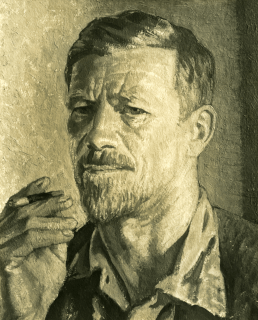
Gwynn’s personal life also becomes complicated at this stage and around 1920. He has a romantic association with married artist Grace Henry who is perhaps the best-known female artist in Ireland at the time. During this period, he and Grace travel in France and Italy and at various stages in his life she painted portraits of him including a very distinguished looking one of him in his late 60s or early 70s. Their relationship contributes significantly to the separation of Henry from her artist husband Paul Henry in 1930.
During the 1920s, Gwynn also devotes himself to writing, covering political events as Irish correspondent to The Observer and The Times. Later in his career, he writes some substantial works, and together with his son Denis Gwynn (The Life of John Redmond, 1932) does much to shape the retrospective image and self-justification of John Redmond. In the mid-1930s he authors three books with a connecting theme of fishing with the artist Roy Beddington serving as illustrator: The Happy Fisherman (1936), From River to River (1937), and Two in a Valley (1938).
Gwynn is awarded an honorary D.Litt. by the National University of Ireland in 1940, and a Litt.D. by the University of Dublin in 1945. The Irish Academy of Letters awards him the Gregory Medal in April 1950. In his literary writings he stands for a humanism and tolerance, which qualities, due to political upheavals, were relatively rare in the Ireland of his day.
Gwynn dies on June 11, 1950, at his home in Terenure, Dublin, and is buried at Tallaght Cemetery, south County Dublin.
Gwynn marries his cousin Mary Louisa (d. 1941), daughter of Rev. James Gwynn. She later converts to Catholicism. They have three sons and two daughters who are brought up in her religion, of whom Aubrey (1892–1983) becomes a Jesuit priest and professor of medieval history at University College Dublin (UCD). Their second son, Denis Rolleston (1893–1971), is professor of modern Irish history at University College Cork (UCC).
Gwynn’s brother Edward John (1868–1941) becomes provost of Trinity College and another brother Robert Malcolm becomes its senior dean. His sister Lucy Gwynn is the first woman registrar of Trinity. A third brother, Charles, has a successful career in the British Army and retires as a Major General. Younger brothers Lucius and Jack are noted cricketers.
Ernest Bernard (Ernie) O’Malley, Irish republican revolutionary and writer, is born on May 26, 1897, in Ellison Street, Castlebar, County Mayo, the second child among nine sons and two daughters of Luke Malley, solicitor’s clerk, of County Mayo, and Marion Malley (née Kearney) of County Roscommon. Christened Ernest Bernard Malley, his adoption of variations on this name reflects his enthusiasm for a distinctively Irish identity – an enthusiasm that lay at the heart of his republican career and outlook.
In 1906, O’Malley’s family moves to Dublin, where he attends the Christian Brothers‘ School, North Richmond Street. In 1915, he begins to study medicine at University College Dublin (UCD). Having initially intended to follow his older brother into the British Army, he rather joins the Irish Volunteers in the wake of the 1916 Easter Rising, as a member of F Company, 1st Battalion, Dublin Brigade. He becomes a leading figure in the Irish Republican Army (IRA) during the Irish War of Independence which the Easter Rising helps to occasion. In 1918, having twice failed his second-year university examination, he leaves home to commit himself to the republican cause. He is initially a Volunteer organiser with the rank of second lieutenant, under the instruction of Richard Mulcahy, operating in Counties Tyrone, Offaly, Roscommon, and Donegal. His work in 1918 involves the reorganisation, or new establishment, of Volunteer groups in the localities.
In August 1918, O’Malley is sent to London by Michael Collins to buy arms. During 1919 he works as an IRA staff captain attached to General Headquarters (GHQ) in Dublin, and also trains and organises Volunteers in Counties Clare, Tipperary, and Dublin. He has a notable military record with the IRA during the Irish War of Independence and is a leading figure in attacks on Hollyford barracks in County Tipperary (May 1920), Drangan barracks in County Kilkenny (June 1920), and Rearcross barracks in County Tipperary (July 1920). His IRA days thus involve him with comrades such as Dan Breen, Séumas Robinson, and Seán Treacy. In December 1920, he is captured in County Kilkenny by Crown forces. He escapes from Dublin’s Kilmainham Gaol in February 1921, to take command of the IRA’s 2nd Southern Division, holding the rank of commandant-general.
O’Malley’s republican commitment has political roots in his conviction that Ireland should properly be fully independent of Britain, and that violence is a necessary means to achieve this end. But the causes underlying his revolutionism are layered. Family expectations of respectable, professional employment combined with a religious background and an enthusiasm for soldiering provide some of the foundations for his IRA career. As an IRA officer he enjoys professional, military expression for a visceral CatholicIrish nationalism. He also finds excitement, liberation from the frequent dullness of his life at home, defiant rebellion against his non-republican parents, an alternative to his stalled undergraduate career, and, in political and cultural Irish separatism, a decisive resolution of the profound tension between his anglocentrism and his anglophobia.
O’Malley rejects the 1921 Anglo–Irish Treaty as an unacceptable compromise. He spends the 1921 truce period training IRA officers in his divisional area, in preparation for a possible renewal of fighting. He is, in the event, to be a leading anti-treatyite in the 1922–23 Irish Civil War. In the Four Courts in 1922, at the start of the latter conflict, he is captured on the republicans’ capitulation on June 30 but then manages to escape from captivity. Subsequently he is appointed assistant Chief of Staff of the anti-Treaty IRA and also becomes part of a five-man anti-Treaty army council, along with Liam Lynch, Liam Deasy, Frank Aiken and Thomas Derrig.
O’Malley is dramatically captured and badly wounded by Free State forces in Dublin in November 1922. Imprisoned until July 1924, he is during the period of his incarceration elected as a TD for Dublin North in the 1923 Irish general election and is also a forty-one-day participant in the republican hunger strike later that year. Following release from prison, he returns home to live with his parents in Dublin. He decides not to focus his post-revolutionary energy on a political career. During 1926–28 and 1935–37 he unsuccessfully tries to complete his medical degree at UCD, but increasingly his post-1924 efforts are directed toward life as a Bohemian traveler and writer. He spends much of 1924–26 on a recuperative journey through France, Spain, and Italy; and 1928–35 traveling widely in North America. During 1929–32 he spends time in New Mexico and Mexico City. In Taos, New Mexico, he mixes with, and is influenced by, writers and artists as he works on what are to become classic autobiographies of the Irish revolution: On Another Man’s Wound (1936) and The Singing Flame (1978).
O’Malley meets Helen Hooker, daughter of Elon and Blanche Hooker, in Connecticut in 1933. They marry in London in 1935, each rejecting something of their prior lives in the process: he, his Irish republicanism, through marriage to somebody entirely unconnected with that world; she, her wealthy and respectable upbringing, through liaison with a Catholic, Irish, unemployed, bohemian ex-revolutionary. They settle first in Dublin then, from 1938 onward, primarily in County Mayo. Burrishoole Lodge, near Newport, is his main base until 1954, when he moves to Dublin. Three children are born to the O’Malleys: Cahal (1936), Etáin (1940), and Cormac (1942). Sharing enthusiasm for the arts, he and Helen enjoy several years of intimacy. However, by the mid-1940s their relationship has frayed. In 1950, Helen kidnaps (the word is used by both parents and by all three children) the couple’s elder two children and takes them to the United States. From there she divorces O’Malley in 1952. Cormac remains with his father.
O’Malley’s post-American years are devoted to a number of projects. He writes extensively, including work for The Bell and Horizon. He is involved with the film director John Ford in the making of his Irish films, including The Quiet Man (1952). He gives radio broadcasts on Mexican painting for BBC Third Programme (1947), and on his IRA adventures for Radio Éireann (1953). In the latter year he suffers a heart attack, and his remaining years are scarred by ill health. He dies of heart failure on March 25, 1957, in Howth, County Dublin, at the house of his sister Kathleen. Two days later he is given a state funeral with full military honours. He is buried in the Malley family plot in Glasnevin Cemetery, Dublin.
O’Malley exemplifies some important themes in modern Irish political and intellectual history. His powerful memoirs form part of a tradition of writing absorbedly about Ireland, while under idiosyncratic emigrant influences which lend the writing much of its distinctiveness. His aggressive republicanism exemplifies a persistent but ultimately unrealisable tradition of uncompromising IRA politics. His unflinching single-mindedness is the condition for much courageous and striking activity, but also lay behind his infliction and his suffering of much pain. Literary, intellectual, and defiantly dissident, he is the classic bohemian revolutionary. His historical significance lies in his having been both a leading Irish revolutionary and the author of compelling autobiographical accounts of those years. His memoirs are distinguished from their rivals on the shelf by subtlety, self-consciousness, and literary ambition. In particular, his preparedness to identify motives for Irish revolutionary action, beyond the terms of ostensible republican purpose, renders his writing of great value to historians. Similarly, the large body of archival material left in his name (especially, perhaps, the papers held in UCD archives, and those in the private possession of his children) leaves scholars in his debt. The most striking and evocative visual images of O’Malley are, arguably, the set of photographic portraits taken in 1929 by Edward Weston and held at the University of Arizona‘s Center for Creative Photography (CCP). These capture with precision his reflective concentration, his piercing earnestness, and his troubled intensity.
(From: “O’Malley, Ernest Bernard (‘Ernie’)” by Richard English, Dictionary of Irish Biography, http://www.dib.ie, October 2009 | Pictured: Photograph of Ernie O’Malley taken by Helen Hooker, New York City, 1934)
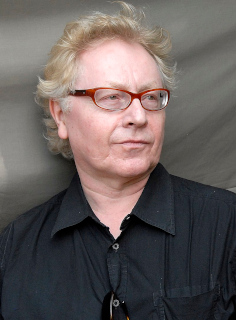
Paul Joseph Brady, Irish singer-songwriter and musician, is born in Belfast, Northern Ireland, on May 19, 1947. Interested in a wide variety of music from an early age, his work straddles folk and pop.
Brady begins learning piano around age six and by the age of eleven he has begun to play guitar, spending hours of his school holidays learning every song that the Shadows had recorded. He is also influenced by Chuck Berry.
In 1963, Brady begins performing as a piano player in a hotel in Bundoran, County Donegal. In October 1964, he attends University College Dublin and performs with a number of R&B groups, covering songs by the likes of Ray Charles and James Brown. The first of these is the Inmates (late 1964–about April 1965), which evolves into the Kult (about April–December 1965), featuring Brady, Jackie McAuley (ex-Them, and future Belfast Gypsies and Trader Horne), Brendan Bonass, and Dave Pennefather. He can be seen in the documentary film Charlie Is My Darling waiting outside Dublin‘s Adelphi Cinema for the Rolling Stones‘ concert of September 3, 1965. He next joins Rootzgroup (late 1965–May 1966) and Rockhouse (about May–December 1966).
During Brady’s time at college in Dublin, the country sees a huge rise in interest in traditional Irish music. He joins the popular Irish band The Johnstons when Michael Johnston leaves in May 1967. They move to London in 1969 and subsequently to New York City in 1972 to expand their audience. Despite some success, he returns to Ireland in 1974 to join the Irish group Planxty, the band that subsequently launches the solo careers of Andy Irvine, Liam O’Flynn, Dónal Lunny, and Christy Moore.
When Planxty disbands in late 1975, Brady forms a duo with Irvine from 1976 to 1978, a partnership that produces the successful album, Andy Irvine/Paul Brady. The next few years see him establish his popularity and reputation as one of Ireland’s best interpreters of traditional songs. His versions of ballads like “Arthur McBride” and “The Lakes of Pontchartrain” are considered definitive and are still popular at concerts today. In 1975 in New York, he records three albums for Shanachie Records as guitar accompanist to resident Irish fiddlers Andy McGann, Paddy Reynolds and John Vesey. He also records a 1976 album, The High Part of the Road, for the same label with Irish fiddler Tommy Peoples.
In 1978, Brady releases his first solo album, Welcome Here Kind Stranger, which wins him critical acclaim and is voted the “Folk Album of the Year” by Melody Maker magazine. However, it proves to be his last album covering traditional material. He decides to delve into pop and rock music and releases his first album of this genre in 1981, Hard Station.
Brady releases a number of successful solo albums throughout the 1980s: True for You (1983), Back to the Centre (1985), and Primitive Dance (1987). By the end of the decade, he is recognised and accepted as a respected performer and songwriter. His songs are being covered by a number of other artists, including Santana and Dave Edmunds.
Dylan is sufficiently impressed by Brady’s work to name-check him in the booklet of his 1985 box set, Biograph. The actual quote is “(…) people get too famous too fast these days and it destroys them. Some guys got it down – Leonard Cohen, Paul Brady, Lou Reed, secret heroes, John Prine, David Allen Coe, Tom Waits. I listen more to that kind of stuff than whatever is popular at the moment. They’re not just witchdoctoring up the planet, they don’t set up barriers (…)”.
In 1991, Brady reaches number 5 in the Irish Singles Chart with Nobody Knows.
Since his Hard Station album (1981), Brady is on various major labels until he creates his own label, PeeBee Music, in the late 1990s. He releases three albums in the 1990s: Trick or Treat, Songs & Crazy Dreams (a remixed compilation of earlier songs) and Spirits Colliding, which are met with critical acclaim. Trick or Treat is on Fontana/Mercury Records and receives a lot of promotion. As a result, some critics consider it his debut album and note that the record benefits from the expertise of experienced studio musicians, as well as producer Gary Katz, who works with the rock group Steely Dan. Rolling Stone, after praising his earlier but less-known solo records, calls Trick or Treat Brady’s “most compelling collection.”
Brady goes on to record several other albums, fifteen in total since going solo in 1978, and collaborates with a number of other established musicians including Bonnie Raitt and Richard Thompson. In 2006, he collaborates with Cara Dillon on the track “The Streets of Derry” from her album After the Morning. He also works with Fiachra Trench.
Brady’s fifteenth studio album, Hooba Dooba, is released in March 2010.
In 2017, a friendship is struck with Theo Katzman (Vulfpeck) and Brady tours Ireland in 2019 as half of this duo with Joe Dart, also of vulfpeck, Louis Cato and Lee Pardini. He continues to tour, record and collaborate with other artists. In 2019, Jimmy Buffett begins performing a cover of Brady’s hit, “The World is What you Make It.” In September 2019, Brady joins Buffett on his tour stops in both Dublin and London.
Brady releases the album Unfinished Business on his own label, PeeBee Music, licensed to Proper Music UK, in 2017.
While Brady and Andy Irvine’s planned tour of their 1976 album Andy Irvine/Paul Brady is impacted by the COVID-19 pandemic, they finish the tour in 2022. Musicians to join them on the tour include fiddle player Kevin Burke and multi-instrumentalist Dónal Lunny, both of whom had played on the original album.
In 2009, Brady receives an honorary degree of Doctor of Letters from the University of Ulster, in recognition of his services to traditional Irish music and songwriting.
When the authorities in Quebec hear the news of ships arriving with sick passengers, they quickly set up Grosse Île as a port of entry and quarantine station at which all ships are required to dock before moving on to the mainland. The island had dealt with epidemics before. In 1830, about 30,000 immigrants arrived in Quebec, and two-thirds were Irish. These huge waves of immigration were concurrent with cholera epidemics in Great Britain and Europe.
Areas in the west of Ireland – mostly Mayo, Donegal, and Galway – are experiencing potato crop failure. In fact, the crop fails to various degrees all over the country throughout the 1830s, though no one is sure exactly when the blight that caused the successive crop failures of 1845-49 arrived in Ireland. In 1847, 100,000 Irish people travel to Grosse Île to escape starvation, unaware of the hardships they will encounter upon arrival.
The Syria, the first “coffin ship,” named for their crowded and deadly conditions, arrives on May 17, 1847, the ice still an inch thick on the river. Of the ship’s 241 passengers, 84 are stricken with fever and 9 died on board during the Atlantic crossing. The first victim dies on the day the Syria arrives. Her name is Ellen Kane, a four-year-old from Kilmore, County Mayo.
With the hospital equipped for only 150 cases of fever, the situation quickly spins out of control. More and more ships arrive at Grosse Île each day, sometimes lining up for miles down the St. Lawrence River throughout the summer. On these coffin ships the number of passengers stricken by fever increases exponentially.
The island is ill-equipped, to say the least. Hastily built, the quarantine hospitals lack proper sanitation, supplies, and space to accommodate all the sick patients. Many of the doctors dispatched to Grosse Île have never even seen the effects of cholera let alone treated it, and all are overworked. Being taken to a quarantine hospital is soon viewed as more of a death sentence than an opportunity to get better.
Between 1832 and 1937, Grosse Île’s term of operation, the official register lists 7,480 burials on the island. In 1847 alone, 5,424 burials take place, the majority are Irish immigrants. In that same year, over 5,000 Irish people on ships bound for Canada are listed as having been buried at sea.
Today, the island is a National Historic Site that serves as a Famine memorial. It is dedicated in 1996 after a four-year-long campaign to protect the mass gravesite.
The Grosse Île Celtic Cross, erected by the Ancient Order of Hibernians in 1909, bears an inscription in Irish commemorating the victims of the epidemic and condemning colonial rule. In English, it reads: “Children of the Gael died in their thousands on this island having fled from the laws of foreign tyrants and an artificial famine in the years 1847-48. God’s blessing on them. Let this monument be a token and honor from the Gaels of America. God Save Ireland.”
(From: “When 40 Irish Famine ships anchored at Grosse Île quarantine station in 1847” by Aliah O’Neill, IrishCentral, http://www.irishcentral.com, May 31, 2023)





 seamus dubhghaill