seamus dubhghaill

Promoting Irish Culture and History from Little Rock, Arkansas, USA


Leave a comment

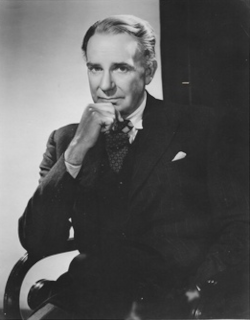
Birth of Anew McMaster, Anglo-Irish Stage Actor

Anew McMaster, Anglo-Irish stage actor, is born in Birkenhead, England, on December 24, 1891. During his nearly 45 year acting career he tours Ireland, Britain, Australia and the United States. For almost 35 years he tours as actor-manager of his own theatrical company performing the works of Shakespeare and other playwrights.

McMaster is born as Andrew McMaster, the son of Liverpool-born Andrew McMaster (1855–1940), a master stevedore, and Alice Maude née Thompson (1865–1895). A number of sources make the erroneous claims, based on details supplied by McMaster himself, that he is born in 1893 or 1894 or even 1895 in County Monaghan in Ireland but, according to the Birth Register and the 1901 United Kingdom Census, he is actually born in 1891 in Birkenhead, England. Like his future brother-in-law Micheál Mac Liammóir, who is born in London as Alfred Willmore but claims to have been born in Cork to Gaelic-speaking parents, McMaster reinvents himself as Irish and claims for himself the town of Monaghan as his birthplace, and Warrenpoint, County Down, as the scene of his earliest memories.

At the age of nineteen McMaster gives up a career in banking to pursue one on the stage. He moves to Ireland and tours the country with the O’Brien-Ireland theatrical company from 1910 to 1914. Success quickly follows with his appearance as Jack O’Hara in Paddy the Next Best Thing at the Savoy Theatre (1920). From 1921 he tours Australia in this and other plays, and in 1925 forms his own company, the McMaster Intimate Theatre Company, a ‘fit-up‘ company to tour in the works of Shakespeare, mainly in Ireland but also in Britain and Australia, touring with his theatrical company until 1959. One of the last actor-managers “of the old school – and an epitome of the type,” on occasions he persuades a ‘big name’ to act with his company as a draw for audiences. Frank Benson (1928), Sara Allgood (1929) and Mrs. Patrick Campbell appear with him.

In 1933 at the Shakespeare Memorial Theatre in Stratford-upon-Avon McMaster appears as Hamlet opposite Esme Church as Gertrude, Coriolanus, Macduff in Macbeth, Leonato in Much Ado About Nothing, Prince Escalus in Romeo and Juliet, and Petruchio in The Taming of the Shrew. His greatest roles are as Othello and as Shylock in The Merchant of Venice, to which he adds King Lear in 1952. Just before World War II he and his company appear at the Chiswick Empire in a Shakespeare season. He tours the United States as James Tyrone in Eugene O’Neill‘s Long Day’s Journey into Night in 1956. Having ‘a great organ voice,’ Harold Pinter, who acts in his company in Ireland from 1951 to 1953 and calls him ‘perhaps the greatest actor-manager of his time,’ later describes McMaster as ‘evasive, proud, affectionate, shrewd, merry.’ In his brief biography Mac (1968), Pinter recalls, “Mac gave about a half dozen magnificent performances of Othello while I was with him… At his best he was the finest Othello I have seen. [He] stood dead in the centre of the role, and the great sweeping symphonic playing would begin, the rare tension and release within him, the arrest, the swoop, the savagery, the majesty and repose.”

McMaster’s only film role is an uncredited appearance as the Judge in Sword of Sherwood Forest (1960).

In 1924 McMaster marries the actress and designer Marjorie Willmore (1894–1970), the sister of Micheál Mac Liammóir. They have two children, the actors John Christopher McMaster (1925–1995) and Mary-Rose McMaster (1926–2018).

Anew McMaster dies at the age of 70 at his home in Dublin on August 24, 1962. He is buried with his wife in Deans Grange Cemetery in County Dublin.

McMaster trains a generation of actors who tour with his company and go on to achieve success as actors. These include Pauline Flanagan, Milo O’Shea, T. P. McKenna, Kenneth Haigh, Henry Woolf, Harold Pinter, Donal Donnelly and Patrick Magee. It is while they are touring with McMaster’s company that the actor and dramatist Micheál Mac Liammóir and the actor and producer Hilton Edwards first meet and begin their lifelong partnership.

McMaster’s biography, A Life Remembered: A Memoir of Anew McMaster by his daughter Mary-Rose McMaster, is published in 2017. Harold Pinter also publishes a short biography, Mac, in 1968.


Leave a comment

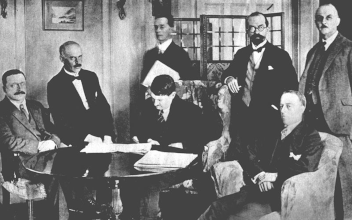
British Ultimatum to the Irish Delegation at the Anglo-Irish Treaty Talks

The Irish delegation at the Anglo-Irish Treaty talks in London are given an ultimatum by British Prime Minister David Lloyd George on December 5, 1921. Sign the treaty or face “immediate and terrible war.”

In 1920, during the Irish War of Independence, the Government of Ireland Act not only establishes the new state of Northern Ireland but gives that state the right to opt-out of a future self-governing Irish Free State within the British Commonwealth of Nations.

The Northern state consists of the six northeastern counties of Ulster with a unionist majority. They are Antrim, Down, Armagh, Derry, Tyrone, and Fermanagh. Belfast is to be the seat of a government and hold limited devolved powers. The counties of Donegal, Cavan, and Monaghan are to be absorbed within the Irish Free State controlled from parliament in Dublin.

Irish nationalists are dismayed with the plan. Protestant Unionists, particularly those living within the boundaries of the new state, accept and start to implement the Act. Sectarian attacks are launched upon Catholic homes in Belfast, Derry, Banbridge, Lisburn, and Dromore. Catholics are driven from Belfast shipyards and from various engineering works in the city. Supposedly these attacks are in revenge for Irish Republican Army (IRA) assassinations.

The IRA continues the campaign to establish a republic with the Irish War of Independence. By the middle of 1921, both sides are exhausted, and a truce is called on June 9.

In July 1921, Éamon DeValera, the president of Dáil Éireann, goes to London to meet with Prime Minister Lloyd George. They agree an Irish delegation will come to London to discuss terms in the autumn.

The delegation appointed by the Dáil to travel to London consists of Arthur Griffith (Minister for Foreign Affairs and chairman of the delegation); Michael Collins (Minister for Finance and deputy chairman of the delegation); Robert Barton (Minister for Economic Affairs); George Gavan Duffy and Éamonn Duggan, with Erskine Childers, Fionán Lynch, Diarmuid O’Hegarty, and John Chartres providing secretarial assistance. DeValera himself does not attend. Future historians wonder if he knew they would not be able to negotiate a 32 county Irish Republic.

During the debate, Lloyd George insists Ireland remain part of the Commonwealth and Dáil Éireann members take the oath of allegiance to the British throne. After a delay of two months, Lloyd George delivers the ultimatum on December 5, sign a treaty within three days or there will be war.

The Anglo-Irish Treaty is to give Ireland a 26 county Free State with Dominion status. The right to raise taxes, regulate foreign trade, independence in internal affairs, own an army, and the oath of allegiance is changed to one of fidelity.

The British are to retain three naval bases within the jurisdiction of the Free State, at Cobh, Lough Swilly, and Berehaven. The Northern Ireland boundary is to be determined by a commission. This gives false hope to large tracts of Tyrone, Fermanagh, Down, Armagh, and Derry City would be given to the Free State as they have Catholic majorities.

Just after 2:00 AM on December 6, 1921, the Irish delegation, without consulting the Dáil, finally sign a treaty with the British. Collins writes, prophetically, later on the day of the signing, “early this morning I signed my death warrant.”

The Treaty displeases the Catholics in the north and the unionists in the south. Meanwhile, many of those involved in the conflict are abhorred at the fact that not all of Ireland is to leave the United Kingdom.

(From: “The Anglo-Irish Treaty (1921)” by Brian O’Neill, Your Irish Culture, http://www.yourirish.com, May 20, 2020)


Leave a comment

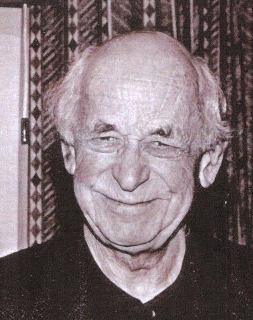
Birth of Roy McFadden, Poet, Editor & Lawyer

Roy McFadden, Northern Irish poet, editor, and lawyer, is born in Downpatrick, County Down, on November 14, 1921.

McFadden is born to Roland Victor MCFadden and his wife Maud Steele. A short time after his birth the family relocates to Belfast. He is educated at Knock Grammar School, Regent House School in Newtownards, and later graduates in Law from Queen’s University Belfast in 1944. He becomes a prominent lawyer and an influential figure in the Belfast literary scene.

McFadden’s first poem is published before he is thirteen. His earliest influences are from magazines and journals that his father brings home, and by Francis Turner Palgrave‘s Golden Treasury. He first comes to prominence as a promoter of Ulster literature in the 1940s when he edits two anthologies of poetry, Ulster Voices and Irish Voices in 1943. In 1948, he co-founds with Barbara Edwards (née Hunter) the Northern Irish poetry magazine Rann and then, co-edits it with her during its whole run, until 1953. Like its predecessor Lagan, it is unapologetically regionalist.

McFadden is the author of nine volumes of poetry, from Swords and Ploughshares (1943) to the posthumously published Last Poems (2002). Among his poems are “Saint Francis and the Birds” and “Independence”. His book, The Garryowen, is published by Chatto & Windus in the Phoenix Living Poets series. Most recently, his poem “Post-War” has been anthologised in Armistice: A Laureate’s Choice of Poems of War and Peace (Faber Poetry) (2018). There is a long gap between 1947 and 1971 when he publishes no collections of his work, however he continues to write and publishes in periodicals and newspapers such as The Irish Times where in that time he has sixty poems printed. His voice is well known on local BBC Radio through the Poetry Notebooks series, and he also has several verse-plays broadcast.

In 1952 McFadden marries Margaret Ferguson. Together they produce three sons and two daughters. He lives for a number of years in Lisburn, County Antrim. Inspired by Herbert Read and Alex Comfort, he describes himself as a pacifist and an anarchist in 1999. McFadden dies at his Belfast home on September 15, 1999.

The Roy McFadden Papers, comprising the poet’s personal manuscripts and papers, are lodged at Queen’s University Belfast. The Roy McFadden Library at Trinity College Dublin comprises books and journals on Irish and world literature from his collection. A comprehensive collection of his published work is held at the National Poetry Library, Southbank Centre, London.


Leave a comment

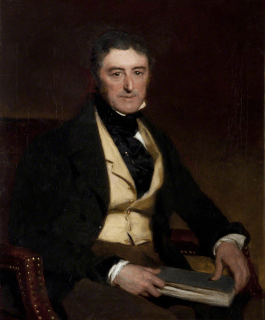
Birth of William Sharman Crawford, Irish Politician

William Sharman Crawford, Irish politician with liberal and radical views, is born William Sharman on September 3, 1780 in at Moira Castle in County Down.

Sharman is the eldest son of Colonel William Sharman, for many years a member of the Parliament of Ireland for Lisburn, who dies in 1803 leaving him large estates. In 1805 he marries a wealthy heiress, Mabel Fridiswid Crawford, whose surname and arms he adds to his own.

Sharman Crawford supports Catholic Emancipation and the rights of tenants. He is also a member of the landed gentry. He is High Sheriff of Down for 1811. He is a member of the Parliament of the United Kingdom for Dundalk in 1835–37 and for Rochdale in 1841–52. He greatly increases the prosperity of the tenants on his large estates by extending and confirming the Ulster custom of tenant-right. The main objective of his long parliamentary career is to give legal effect to this right and extend it to other parts of Ireland.

In 1848 with James MacKnight, editor of the liberal Londonderry Standard, Sharman Crawford forms the Ulster Tenant Right Association which is supported by a group of radical Presbyterian ministers. He also supports MacKnight in forming, with Charles Gavan Duffy, editor of the Young Ireland newspaper The Nation, the all-Ireland Tenant Right League.

Sharman Crawford is the father of James Sharman Crawford, member of the Parliament of the United Kingdom for Down, (1874-78), Arthur Sharman Crawford, unsuccessful candidate for Down in 1884 and John Sharman Crawford, unsuccessful candidate for Down in 1880. His daughter is Mabel Sharman Crawford, adventurer, feminist and writer.

Sharman Crawford dies unexpectedly and peacefully at Crawfordsburn, County Down on October 17, 1861. He is buried in the family vault at Kilmore, County Down, where there is a monumental inscription. A great stone obelisk is erected in his memory on a hill at Rademon Estate, near Crossgar, County Down.


Leave a comment

Birth of Robert Lloyd Praeger, Writer & Librarian

Robert Lloyd Praeger, Irish naturalist, writer and librarian, is born on August 25, 1865 in Holywood, County Down, in what is now Northern Ireland.

From a Unitarian background, Praeger is raised in Holywood and attends the school of the Reverend McAlister and then the nearby Sullivan Upper School.

Praeger works in the National Library of Ireland in Dublin from 1893 to 1923. He co-founds and edits The Irish Naturalist, and writes papers on the flora and other aspects of the natural history of Ireland. He organises the Lambay Survey in 1905-06 and, from 1909 to 1915, the wider Clare Island Survey. He is an engineer by qualification, a librarian by profession and a naturalist by inclination.

Praeger is awarded the Veitch Memorial Medal of the Royal Horticultural Society in 1921. He becomes the first President of both An Taisce and the Irish Mountaineering Club in 1948, and serves as President of the Royal Irish Academy for 1931–34.

Praeger is instrumental in developing advanced methodologies in Irish botany by inviting Knud Jessen, the acclaimed Danish expert in Glacial and Post-Glacial flora, to undertake research and teaching in Ireland. This leads to the establishment of ‘paleoecology‘ as a distinct field of study in Ireland.

A vice-county system is adopted by Praeger dividing Ireland into forty vice-counties based on the counties. However, the boundaries between them does not always correspond to the administrative boundaries and there are doubts as to the correct interpretation of them.

Praeger dies on May 5, 1953 and is buried in Deans Grange Cemetery, Dublin, together with his wife Hedwig. His younger sister Rosamond Praeger is a sculptor and botanical artist.

(Pictured: Portrait of Robert Lloyd Praeger by Sarah Cecilia Harrison, National Museums Northern Ireland)


Leave a comment

1990 Armagh City Roadside Bomb Attack

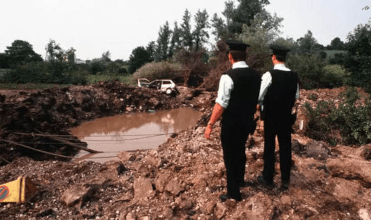
The Provisional Irish Republican Army (IRA) carries out an IED roadside bomb attack at the Killylea Road on the outskirts of Armagh, County Armagh, Northern Ireland, on July 24, 1990. An IRA active service unit detonates a large bomb as an unmarked Royal Ulster Constabulary (RUC) vehicle and a civilian car pass, killing three RUC officers and a Catholic nun.

Leading up to the attack, on April 9, 1990 four Ulster Defence Regiment (UDR) soldiers (Michael Adams, John Birch, John Bradley, Steven Smart) are killed in a similar attack when the IRA detonates a land mine under their patrol vehicle on Ballydugan Road, Downpatrick, County Down. The land mine contains over 1,000 lbs. of explosives.

On the afternoon of July 24, 1990, 37-year-old nun Catherine Dunne is driving an Austin Metro car with a passenger, Cathy McCann, a 25-year-old social worker. Some hours previously, members of the IRA take over a house close to Killylea Road, two miles outside Armagh, County Armagh, holding its occupants, a married couple and their children, at gunpoint.

A detonating wire is placed from the house to a 1,000 lb. bomb, placed in a culvert under Killylea Road. At approximately 2:00 PM, as Dunne’s car is driving to Armagh, a Royal Ulster Constabulary patrol car is traveling in the opposite direction. Dunne’s car passes by the patrol car just as the police drive over the culvert, at which point the IRA detonate the bomb. Constable William James Hanson (37), and reserve officers Joshua Cyril Willis (35) and David Sterritt (34), are all killed instantly. Their car is blown into the air and lands upside down. Dunne and McCann are both severely injured with Dunne later dying of her injuries.

Witness Paul Corr, owner of a petrol filling station nearby, says, “The ground shook beneath us and it was accompanied by a very large explosion. At first we did not see the police car. The whole place was a terrible mess. Then we saw two young girls in the [Austin Metro]. They were unconscious and looked in a pretty bad way. There was nothing we could do for the policemen. Nobody could have come out of that car alive. It was dreadful.”

The bomb leaves a 20-foot-diameter crater in the two-lane road.

Taoiseach Charles Haughey is quoted as saying, “I know all the people of Ireland join me in my condemnation of this atrocity.”

The IRA releases a message claiming responsibility for the attack, and calls Dunne a victim of “unforeseen and fluke circumstances.” The statement is rejected in advance by political and Catholic and Protestant leaders alike and politicians in Ireland and Great Britain.

Sinn Féin‘s Martin McGuinness says, “Our sorrow at these deaths is genuine and profound, but will be abused by our political opponents who will cynically exploit yesterday’s events for their own political purpose.”

Pope John Paul II sends a message to be read at Dunne’s funeral in which he condemns the “grievous injustice and futility” of the murders that leave him “deeply shocked and saddened.” He implores “the men and women who espouse violence to recognise the grievous injustice and futility of terrorism.”

Two men, Henry McCartney (26) and Tarlac Connolly (29), are charged with the killings. They are later given life sentences but are released in 2000 under the terms of the Good Friday Agreement.


Leave a comment

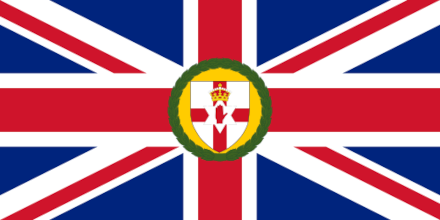
Office of Governor of Northern Ireland Abolished

The mainly ceremonial office of Governor of Northern Ireland is abolished on July 18, 1973 under Section 32 of the Northern Ireland Constitution Act 1973. The Secretary of State for Northern Ireland, a cabinet office created in 1972, takes over the functions of the Governor on December 20, 1973 under Letters Patent.

The office of the Governor of Northern Ireland is established on 9 December 9, 1922 under Letters Patent to “do and execute in due manner as respects Northern Ireland all things which by virtue of the [1920] Act and our said Letters Patent of 27 April 1921 or otherwise belonged to the office of Lord Lieutenant at the time of the passing of the Irish Free State Constitution Act 1922.”

The 1922 “Instructions” sent alongside the letters patent establishing the office require the Governor of Northern Ireland to get the monarch’s permission to leave Northern Ireland, and empowers the Governor in such cases to issue letters patent under the Great Seal of Northern Ireland appointing a “Deputy or Deputies, Justice or Justices” during his absence. This emulates the practice of appointing Lords Justices of Ireland when the Lord Lieutenant is absent from Ireland. Each new Governor upon taking office selects a slate of eligible deputies from among the Privy Council of Northern Ireland, and at each of his subsequent absences a subset of these are sworn in for its duration. Many are Lord Chief Justice or Lord Justice of Appeal, including Denis Henry, William Moore, James Andrews, Anthony Babington, John MacDermott, Baron MacDermott, and Samuel Clarke Porter. Others are Senators and/or county lieutenants, including Robert Sharman-Crawford, Robert David Perceval-Maxwell, Henry Armstrong, Sir Thomas Dixon, 2nd Baronet, Maurice McCausland, and Francis Needham, 4th Earl of Kilmorey.

The Governor has possession of the Great Seal of Northern Ireland and is the successor to the Lord Lieutenant of Ireland in Northern Ireland, itself established on May 3, 1921. The official residence of the Governor of Northern Ireland is Hillsborough Castle in County Down. Following refurbishment of the Castle, James Hamilton, 3rd Duke of Abercorn, takes up residence in 1925. It remained the official residence until the abolition of the office of governor in 1973. Henceforth it has been the official residence of the Secretary of State for Northern Ireland.


Leave a comment

Birth of Joseph Campbell, Poet & Lyricist

Joseph Campbell, Irish poet and lyricist, is born in Belfast on July 15, 1879. He writes under the Gaelic form of his name Seosamh Mac Cathmhaoil (also Seosamh MacCathmhaoil), as Campbell is a common anglicisation of the old Irish name MacCathmhaoil. He is now remembered best for words he supplied to traditional airs, such as “My Lagan Love” and “Gartan Mother’s Lullaby.” His verse is also set to music by Arnold Bax and Ivor Gurney.

Campbell is born into a Catholic and Irish nationalist family from County Down. He is educated at St. Malachy’s College, Belfast. After working for his father he teaches for a while. He travels to Dublin in 1902, meeting leading nationalist figures. His literary activities begin with songs, as a collector in Antrim, County Antrim and working with the composer Herbert Hughes. He is then a founder of the Ulster Literary Theatre in 1904. He contributes a play, The Little Cowherd of Slainge, and several articles to its journal Uladh edited by Bulmer Hobson. The Little Cowherd of Slainge is performed by the Ulster Literary Theatre at the Clarence Place Hall in Belfast on May 4, 1905, along with Lewis Purcell’s The Enthusiast.

Campbell moves to Dublin in 1905 and, failing to find work, moves to London the following year where he is involved in Irish literary activities while working as a teacher. He marries Nancy Maude in 1910, and they move shortly thereafter to Dublin, and then later to County Wicklow. His play Judgement is performed at the Abbey Theatre in April 1912.

Campbell takes part as a supporter in the Easter Rising of 1916, doing rescue work. The following year he publishes a translation from Irish of the short stories of Patrick Pearse, one of the leaders of the Rising.

Campbell becomes a Sinn Féin Councillor in Wicklow in 1921. Later in the Irish Civil War he is on the Republican side, and is interned in 1922-23. His marriage breaks up, and he emigrates to the United States in 1925 where he settles in New York City. He lectures at Fordham University, and works in academic Irish studies, founding the University’s School of Irish Studies in 1928, which lasts four years. He is the editor of The Irish Review (1934), a short lived “magazine of Irish expression.” The business manager is George Lennon, former Officer Commanding of the County Waterford Flying Column during the Irish War of Independence. The managing editor is Lennon’s brother-in-law, George H. Sherwood.

Campbell returns to Ireland in 1939, settling at Glencree, County Wicklow. He dies at Lacken Daragh, Enniskerry, County Wicklow on June 6, 1944.


Leave a comment

Birth of Sir Joseph Larmor, Physicist & Mathematician

Sir Joseph Larmor FRS FRSE, Irish and British physicist and mathematician who makes breakthroughs in the understanding of electricity, dynamics, thermodynamics, and the electron theory of matter, is born in Magheragall, County Antrim, on July 11, 1857. His most influential work is Aether and Matter, a theoretical physics book published in 1900.

Larmor is the son of Hugh Larmor, a Belfast shopkeeper and his wife, Anna Wright. The family moves to Belfast around 1860, and he is educated at the Royal Belfast Academical Institution, and then studies mathematics and experimental science at Queen’s College, Belfast, where one of his teachers is John Purser. He obtains his BA in 1874 and MA in 1875. He subsequently studies at St. John’s College, Cambridge where in 1880 he is Senior Wrangler and Smith’s Prizeman and obtains his MA in 1883. After teaching physics for a few years at Queen’s College, Galway, he accepts a lectureship in mathematics at Cambridge in 1885. In 1892 he is elected a Fellow of the Royal Society of London, and he serves as one of the Secretaries of the society. He is made an Honorary Fellow of the Royal Society of Edinburgh in 1910.

In 1903 Larmor is appointed Lucasian Professor of Mathematics at Cambridge, a post he retains until his retirement in 1932. He never marries. He is knighted by King Edward VII in 1909.

Motivated by his strong opposition to Home Rule for Ireland, in February 1911 Larmor runs for and is elected as Member of Parliament for Cambridge University (UK Parliament constituency) with the Conservative Party. He remains in parliament until the 1922 general election, at which point the Irish question has been settled. Upon his retirement from Cambridge in 1932 he moves back to County Down in Northern Ireland.

Larmor receives the honorary Doctor of Laws (LLD) from the University of Glasgow in June 1901. He is awarded the Poncelet Prize for 1918 by the French Academy of Sciences. He is a Plenary Speaker in 1920 at the International Congress of Mathematicians (ICM) at Strasbourg and an Invited Speaker at the ICM in 1924 in Toronto and at the ICM in 1928 in Bologna.

Larmor dies in Holywood, County Down, Northern Ireland, on May 19, 1942.


Leave a comment

Death of Brigadier General Robert Nugent of the U.S. Army

Brigadier General Robert Nugent, Irish-born American United States Army officer during the American Civil War and the Indian Wars, dies at the age of 76 in Brooklyn, New York on June 20, 1901.

Born in Kilkeel, County Down on June 27, 1824, Nugent serves with the 69th New York Infantry Regiment, from its days as a militia unit and into its incorporation into the Union Army at the start of the war and is one of its senior officers at the First Battle of Bull Run.

When the unit is originally mustered out of service, the 90-day enlistment terms having expired, Nugent accepts a commission as a captain in the regular army. He is immediately assigned to the 13th Infantry Regiment whose commanding officer, General William Tecumseh Sherman, personally requests. Taking a leave of absence to return to New York, he assists Thomas Francis Meagher in organizing the Irish Brigade. The newly reformed 69th Infantry Regiment is the first unit assigned to the Irish Brigade and, with Nugent as its colonel, he leads the “Fighting 69th” at the Battles of Seven Pines, Gaines’ Mill, Savage’s Station, White Oak Swamp, Glendale, and Malvern Hill.

Nugent is wounded, shot in the stomach, at the Battle of Fredericksburg and is eventually forced to resign his command. He is appointed acting assistant provost marshal for the southern district of New York, which includes New York City and Long Island, by the U.S. Department of War. An Irishman and Democrat, his appointment is thought to assure the Irish American population that conscription efforts would be carried out fairly. The Irish-American, a popular Irish language newspaper, writes that the selection is a “wise and deservedly popular one.” He does encounter resistance from city officials wanting him to remain uninvolved, however by mid-June he reports to his superior officer and provost marshal general Colonel James Fry that conscription efforts are “nearing completion without serious incident.”

Understanding the seriousness of the situation, Nugent attempts to keep the draft selections quiet and in isolated parts of the city. In Manhattan however, lotteries are placed in the heart of Irish tenement and shanty neighborhoods where the draft is most opposed.

In the ensuing New York City draft riots, Nugent takes command of troops and attempts to defend the city against the rioters. Despite issuing the cancellation of the draft, the riots continue for almost a week. His home on West 86th Street is looted and burned by the rioters during that time, his wife and children barely escaping from their home. Upon breaking into his house, furniture is destroyed, and paintings of Nugent and Meagher are slashed, although Brigadier General Michael Corcoran‘s is left untouched.

On October 28, Nugent is relieved of his post and succeeded by General William Hayes. Returning to active duty, he assumes command of the Irish Brigade in November 1864, shortly after the death of Corcoran, and is present at the Battle of Spotsylvania Court House, the Siege of Petersburg and the Appomattox campaign. As its last commanding officer, he and the Irish Brigade also march in the victory parade held in Washington, D.C. following Robert E. Lee‘s surrender at Appomattox Court House.

Nugent is brevetted Brigadier General for distinguished leadership of the 69th Regiment on March 13, 1865. The veterans of the Irish Brigade are honorably discharged and mustered out three months later. Nugent, however, remains in the regular U.S. Army for the next twenty years, a formidable “Indian fighter” during the America Indian Wars with the 13th and 24th Infantry Regiments. In 1879, he retires at the rank of major and resides in New York where he is involved in the Grand Army of the Republic, the War Veterans’ Association of the 7th Regiment and an honorary member of The Old Guard.

Nugent becomes ill in his old age, complications arising from his wounds suffered at Fredericksburg, and remains bedridden for two months before his death at his McDonough Street home in Brooklyn on June 20, 1901. In accordance with his last wishes, he is buried at Cypress Hills National Cemetery, located in the Cypress Hills neighborhood of Brooklyn.