seamus dubhghaill

Promoting Irish Culture and History from Little Rock, Arkansas, USA


Leave a comment

John Dillon Announces the “Plan of Campaign”

John Dillon announces the “Plan of Campaign” for Irish tenants against unfair rents on October 17, 1886.

The Plan of Campaign is a stratagem adopted in Ireland between 1886 and 1891, co-ordinated by Irish politicians for the benefit of tenant farmers, against mainly absentee and rack-rent landlords and the tyrannical regime of enforced massive rents and evictions. It is launched to counter agricultural distress caused by the continual depression in prices of dairy products and cattle from the mid-1870s, which leaves many tenants in arrears with rent. Bad weather in 1885 and 1886 also cause crop failure, making it harder to pay rents. The Land War of the early 1880s is about to be renewed after evictions increase and outrages become widespread.

The Plan, conceived by Timothy Healy, is devised and organised by Timothy Harrington, secretary of the Irish National League, William O’Brien and John Dillon. It is outlined in an article headed Plan of Campaign by Harrington which is published on October 23, 1886, in the League’s newspaper, the United Ireland, of which O’Brien is editor.

Dillon is among those who organise a campaign whereby tenants pay their rents to the Land League instead of their landlords. If the tenants are evicted, they are to receive financial assistance from a general fund established for that purpose. As a result of his involvement in this campaign, Dillon spends a number of months in jail.

The measures are to be put into operation on 203 estates, mainly in the south and west of the country though including some scattered Ulster estates. Initially sixty landlords accept the reduced rents, twenty-four holding out but then agreeing to the tenant conditions. Tenants give in on fifteen estates. The chief trouble occurs on the remaining large estates.

The organisers of the Plan decide to test a number of their measures, expecting the remainder will then give in. Widespread attention is focused on it being implemented by Dillon and O’Brien on the estate of Hubert de Burgh-Canning, 2nd Marquess of Clanricarde, at Portumna, County Galway, on November 19, 1886, where the landlord is an absentee ascendancy landlord. The estate comprising 52,000 acres, or 21,000 hectare, yields 25,000 sterling annually in rents paid by 1,900 tenants. The hard-pressed tenants look for a reduction of twenty-five percent. The landlord refuses to give any abatement. The tenant’s reduced rents are then placed into an estate fund, and the landlord informed he will only receive the monies when he agrees to the reduction. Tenants on other estates then follow the example of the Clanricarde tenants, the Plan on each estate led by a member of the Irish Parliamentary Party (IPP) Campaign activists including Pat O’Brien, Alexander Blane or members of its constituency organisation, the National League. Some 20,000 tenants are involved.

In 1887, a rent strike takes place on the estate of Lady Kingston near Mitchelstown, County Cork. Another of the Land Leaguers, William O’Brien, is brought to court on charges of inciting non-payment of rent. Dillon organises an 8,000 strong crowd to demonstrate outside the courthouse. Three estate tenants are shot by police and others are injured. This incident becomes known as the “Mitchelstown Massacre.”

In December 1890, following the verdict in the O’Shea v O’Shea and Parnell divorce case, the IPP splits. This diverts attention from the Campaign which slowly peters out. The IPP also wants to disassociate itself from the more violent aspects on the approach to the Second Home Rule Bill that narrowly succeeds with a majority of 30 in the House of Commons but is then defeated by the House of Lords in 1893.

The Irish land question is addressed after the 1902 Land Conference by the main reforming Land Purchase (Ireland) Act 1903, during Arthur Balfour‘s short tenure as Prime Minister in 1902–05, allowing Irish tenant farmers to buy the freehold title to their land with low annuities and affordable government-backed loans.

(Pictured: Eviction scene, Woodford Galway 1888, during the Plan of Campaign. The Woodford evictions become some of the most highly resisted with numerous pamphlets, during the period, referring to them)


Leave a comment

Birth of Irish Writer Gabriel Rosenstock

Gabriel Rosenstock, Irish writer who works chiefly in the Irish language, is born in Kilfinane, County Limerick, on September 29, 1949. A member of Aosdána, he is poet, playwright, haikuist, tankaist, essayist, and author/translator of over 180 books, mostly in Irish.

Rosenstock’s father, George, is a doctor and writer from Schleswig-Holstein, Germany, who serves as a medical officer with the Wehrmacht in World War II. His mother is a nurse from County Galway. He is the third of six children and the first born in Ireland. He is educated locally in Kilfinane, then in Mount Sackville, County Dublin.

Rosenstock exhibits an early interest in anarchism and is expelled from Gormanston College in County Meath and exiled to Rockwell College near Cashel, County Tipperary. Later, he attends University College Cork (UCC).

Rosenstock works for some time on the television series Anois is Arís on RTÉ, then on the weekly newspaper Anois. Until his retirement he works with An Gúm, the publications branch of Foras na Gaeilge, the North-South body which promotes the Irish language.

Although he has worked in prose, drama and translation, Rosenstock is primarily known as a poet. He has written or translated over 180 books.

Rosenstock has edited and contributed to books of haiku in Irish, English, Scots and Japanese. He is a prolific translator into Irish of international poetry (among others Ko Un, Seamus Heaney, K. Satchidanandan, Rabindranath Tagore, Muhammad Iqbal, Hilde Domin, Peter Huchel), plays (Samuel Beckett, Max Frisch, W. B. Yeats) and songs (Bob Dylan, Kate Bush, The Pogues, Leonard Cohen, Bob Marley, Van Morrison, Joni Mitchell). He also has singable Irish translations of Lieder and other art songs. His being named as Lineage Holder of Celtic Buddhism inspires the latest title in a rich output of haiku collections: Antlered Stag of Dawn (Onslaught Press, Oxford, 2015), haiku in Irish and English with translations into Japanese and Scots Lallans.

Rosenstock also writes for children, in prose and verse. Haiku Más É Do Thoil É! (An Gúm) wins the Children’s Books Judges’ Special Prize in 2015.

Rosenstock appears in the anthology Best European Fiction 2012, edited by Aleksandar Hemon, with a preface by Nicole Krauss (Dalkey Archive Press). He gives the keynote address to Haiku Canada in 2015.

Rosenstock has worked with American photographer Ron Rosenstock, Indian Photographer Debiprasad Mukherjee, Greek photographer Kon Markogiannis, Dublin photographer Jason Symes, French photographer Jean-Pierre Favreau and many more to create the new guise of a photo-haiku (or a haiga) – the interplay of visual aesthetic and literature.

Rosenstock currently resides in Dublin. His son, Tristan, is a member of the Irish traditional music quintet Téada, and impressionist/actor Mario Rosenstock is his nephew.


Leave a comment

The Second Battle of Sabine Pass

A small Confederate force commanded by Lieutenant Richard W. Dowling, a red-headed 25-year-old native of Knockballyvishteal, Milltown, County Galway, and Houston saloon owner, wins one of the most remarkable victories of the American Civil War on September 8, 1863. The Second Battle of Sabine Pass is a failed Union Army attempt to invade the Confederate state of Texas. The Union Navy supports the effort and loses three gunboats during the battle, two captured and one destroyed. It is often credited as the war’s most one-sided Confederate victory. Confederate President Jefferson Davis writes in 1876 that he “considered the [second] battle of Sabine pass the most remarkable in military history.”

On the afternoon of September 8, 1863, Union Navy Lieutenant Frederick Crocker (“Acting Captain”) is in command of the advance squadron composed of four gunboats. Crocker is a veteran officer of considerable recent experience in Union river-gunboat actions and blockade duty. His ship is the USS Clifton, a steam-powered side-wheeler. Besides the USS Clifton, Crocker’s advance squadron includes USS Granite City, USS Sachem, and USS Arizona, all recently commissioned ironclad warships. Less than three miles southeast downriver, well out of range of the Confederate fort’s cannons, are anchored seven U.S. Navy transports carrying most of the Union Army soldiers of the landing force. The USS Suffolk, hosting invasion force commander Union Army Major General William B. Franklin and his staff, heads the seven-vessel squadron. Outside the principal Gulf shore sandbar, an additional two miles downstream of this squadron, lay at anchor the remaining ships of the 22-vessel invasion fleet. The total number of Union infantry assault troops in the landing force is given as 5,000 infantrymen, which includes 500 listed as aboard the USS Granite City, those aboard the six troop transports in the seven-ship squadron headed by USS Suffolk, plus an artillery company somewhere among them. The first wave of 500 men aboard USS Granite City, which steams as close behind USS Clifton as possible but out of range of the fort’s guns, are to land in the open space adjacent to and downstream of the fort. This is a flat, often muddy area already cleared of brush by the Confederate garrison as a clear field of fire for the canister and grapeshot of the fort’s artillery. The Union Army’s invasion plan, therefore, absolutely requires that the Confederate guns be silenced before any troops are debarked. This engagement is to be the largest amphibious assault on enemy territory in the history of the U.S. military to date.

Confederate Captain Leon Smith, who is at Beaumont, Texas, immediately orders all Confederate troops in Beaumont, some eighty men, aboard the steamer Roebuck and sends them down the river to reinforce Fort Griffin. Smith and a Captain Good ride to the fort on horseback, reaching the fort some three hours before the steamer, arriving just as the Union gunboats USS Clifton and USS Sachem come within range, and assist in the defense of the fort.

Dowling’s well practiced Irish-Texan artillerymen, whose chosen and officially approved unit name is “Jefferson Davis Guards,” had placed range-stakes in the two narrow and shallow river channels. These are the “Texas channel” near the southwest shore and the “Louisiana channel” against the Louisiana shore. The white-painted stakes are for determining accurate range of the fort’s six old smooth-bore cannons. Each “Davis Guards” gun crew during gunnery practice thereby works to predetermine the approximate amount of gunpowder needed for each type of projectile (ball, canister, or grapeshot) available for their specific gun and which specific guns, charges, and loads have the best potential to hit each range-stake.

Crocker’s squadron has no local river pilots, only general knowledge of the river’s channels, no assurance of locations of the constantly varying depths especially of large oystershell “reefs” or “banks” between the river’s two channels. There is no mention in official U.S. Navy reports of whether Union sailors were making observations and taking depth soundings from the gunboats now dangerous top decks, while the Confederate cannon shots pounded and shook their ships. The few maps to which they have access are old and outdated and cannot account for recent changes in river-bottom conditions. On Captain Crocker’s signal the USS Sachem, followed by USS Arizona, advance up the right channel (Louisiana side) as fast as they dare, firing their port-side guns at the fort. USS Clifton approaches in the lead, ascending the Texas channel at full speed. USS Granite City hovers out of range behind USS Clifton, having orders not to risk debarking the 500 assault troops until the fort surrenders or its guns are silenced. As USS Sachem enters among the range-stakes, the Confederates open fire. Then USS Clifton comes into range, followed by USS Arizona. Despite their old smoothbore cannon, one of which has just become inoperable, after only a few rounds it is obvious the Confederate artillerymen’s months of training and target practice is an astounding success as their aim is deadly accurate.

The Confederates capture USS Clifton and USS Sachem with a total of 13 heavy cannon, including at least two new potent Parrott rifles, which are handed over to Leon Smith’s Texas Marine Department. The Union casualties amount to two dozen killed and badly wounded, about 37 missing, and 315 Navy men captured. The combined Union Army and Navy invasion force withdraw and return to New Orleans. The Confederates have no casualties.

In recognition of the victory, the Confederate States Congress passes a resolution of special thanks to the officers and men of the Davis Guard. In addition, Houston residents raise funds to provide medals to the Guard. The Davis Guards Medals are made from silver Mexican pesos by smoothing off the coins, then hand-stamping and hand-engraving on one side the battle name and date and on the other side the initials “D G” and a cross pattée. The medals are hung on green ribbons and presented to the members of the Davis Guard. The official Confederate silver medals are presented in a public ceremony a year later and are the only such medal ever awarded by that government.

The Battle of Sabine Pass is of moderate tactical or strategic significance to the American Civil War. It is successful in ensuring that the anticipated overland Union invasion of Texas is delayed indefinitely. A Confederate supply line from Mexico to Texas had existed out of the Port of Bagdad since the outbreak of the war but is held by the increasingly isolated Mexican Republicans. By the time Imperial French and Mexican forces capture Baghdad in 1864, a supply line to anywhere in the Confederacy east of the Mississippi River is no longer feasible on account of the Union victory at Vicksburg in July 1863. The Confederacy is therefore forced to continue its reliance on blockade running to import valuable materials and resources.

In 1937 a statue of Dowling is unveiled on the site of the fort. In 1998 a bronze plaque honoring Dowling is unveiled at the Tuam Town Hall in County Galway.

(Pictured: Richard William “Dick” Dowling, circa 1865)


Leave a comment

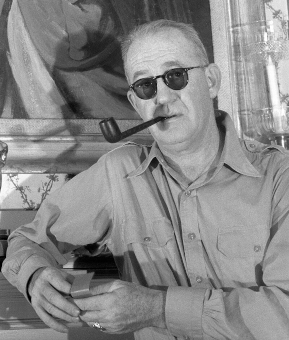
Death of John Ford, Irish American Film Director

John Ford, American film director of Irish descent and one of the most important and influential filmmakers of his generation, dies in Palm Desert, California, on August 31, 1973.

Ford is born John Martin Feeney on February 1, 1894, at Cape Elizabeth, Maine. He is the fourth son among five sons and six daughters of Seán Feeney, Roman Catholic farmer and saloonkeeper, and Barbara ‘Abby’ Feeney (née Curran). His father had emigrated to the United States from Spiddal, County Galway, and his mother from Kilronan, Inishmore, one of the Aran Islands.

From an early age Ford has an interest in painting and sailing, and in July 1914 moves to California, where his older brother Francis is an actor with a small film company. Adopting the name ‘Jack Ford,’ he learns his trade as a filmmaker and acts in a number of silent films. Reveling in his Irish heritage, he makes his director’s debut with The Tornado (1917) and follows it with more than forty movies over the next six years. On July 3, 1920, he marries Mary McBryde Smith, a former officer in the army medical corps. They meet at a party thrown by the director Rex Ingram and have one son and one daughter.

In 1921 Ford visits Ireland for the first time and later claims to have travelled on the same boat that brought Michael Collins back from the treaty negotiations. He meets his relatives at Spiddal, falls in love with the countryside, and becomes a fervent Irish nationalist. It is later claimed that he brought over funds for his cousin Martin Feeney, a member of an Irish Republican Army (IRA) flying column.

Returning to Hollywood, Ford becomes friends with the retired marshal Wyatt Earp and makes a number of commercially successful films, now as ‘John Ford’. In 1926 he directs The Shamrock Handicap, a horse-racing yarn partly set in Ireland. In 1928 he shoots Mother Machree, a movie about Irish emigration, starring Victor McLaglen, a regular collaborator. McLaglen also stars in Hangman’s House, made the same year, Ford’s first major movie about Ireland.

In 1934 Ford purchases a luxury yacht which he names the Araner after the Aran Islands. He also begins shooting The Informer, a film set in Ireland during the Irish War of Independence and based on a short novel by Liam O’Flaherty. The picture is a major box office success and wins four Academy Awards, including Best Director. O’Flaherty is so impressed with the film that he dedicates his next book, Famine, to Ford.

In 1934 Ford visits Ireland for the second time, and approaches Seán O’Casey about directing a version of The Plough and the Stars. Released in 1936, the film stars Barry Fitzgerald as Fluther, but it is reedited by the studio, much to Ford’s fury, and is a commercial and critical flop.

Stagecoach, shot in 1938, is one of Ford’s masterpieces. It was a western starring his protégé, John Wayne, and marks the beginning of his golden decade. In 1940 and 1941 he wins Best Director Oscars successively for The Grapes of Wrath and How Green Was My Valley. With American entry into World War II, he serves in the U.S. Navy, and makes important documentaries such as The Battle of Midway (1942).

In 1952 Ford returns to Ireland to film The Quiet Man, starring Wayne, McLaglen, and Maureen O’Hara. Shot at Ashford Castle, County Mayo, the picture becomes one of the most popular Irish films of all time. He is immensely proud of the work and is in tears leaving Ireland. The following year he makes Mogambo, with Clark Gable, Grace Kelly and a young English actor, Donald Sinden, who later recalls that Ford berated him personally for all the problems of Ireland from the time of William of Orange. Ford’s strong sense of Irishness is central to his character and is crucial for any understanding of his work. Back in Ireland in 1956, he shoots The Rising of the Moon, a portmanteau film for which he takes no salary, starring Tyrone Power, Cyril Cusack, and Noel Purcell. A minor film, it makes no impact at the box office.

Two of Ford’s finest movies are made in his later years. The Searchers (1956) is a powerful study of vengeance, while The Man Who Shot Liberty Valance (1962) is an elegiac revisionist western which concludes with the famous line, “When the legend becomes fact, print the legend.”

Struck with cancer in his final years, Ford dies on August 31, 1973 at his home in Palm Desert, California, and is buried at Holy Cross Cemetery, Culver City. His will disinherits his son, Michael Patrick Roper, and leaves everything to his wife, daughter, and grandchildren.

When asked to name the finest American directors, Orson Welles replies simply, “John Ford, John Ford, and John Ford.” An alcoholic, Ford is a difficult and often tyrannical director, but he makes films of extraordinary power and vision. He ranks as one of the greatest filmmakers of the twentieth century. As Frank Capra concludes, “John is half-tyrant, half-revolutionary; half-saint, half-Satan; half-possible, half-impossible; half-genius, half-Irish.”

(From: “Ford, John,” contributed by Patrick M. Geoghegan, Dictionary of Irish Biography, http://www.dib.ie)


Leave a comment

The Electricity Supply Board (ESB) is Established

The Electricity Supply Board (ESB; Irish: Bord Soláthair an Leictreachais), a state-owned electricity company operating in the Republic of Ireland, is established on August 11, 1927, by the fledgling Irish Free State government under the Electricity (Supply) Act 1927, to manage Ireland’s electricity supply after the successful Shannon hydroelectric scheme at Ardnacrusha and take over all existing projects for the electrification of Ireland. While historically a monopoly, the ESB now operates as a commercial semi-state concern in a “liberalised” and competitive market. It is a statutory corporation whose members are appointed by the government of Ireland.

The Shannon hydroelectric scheme at Ardnacrusha is Ireland’s first large-scale electricity plant and, at the time, it provides 80% of the total energy demands of Ireland. To give an idea of the growth in demand, the output of Ardnacrusha is now approximately two per cent of national peak demand for power.

By 1937, plans are being finalised for the construction of several more hydroelectric plants. The plans called for stations at Poulaphouca, Golden Falls, Leixlip (all in Leinster), Clady, Cliff and Cathaleen’s Fall (between Belleek and Ballyshannon in County Donegal), Carrigadrohid and Inniscarra (in County Cork). All these new plants are completed by 1949 and together harness approximately 75% of Ireland’s inland waterpower potential. Many of these plants are still in operation, however, as can be expected with continuing growth in demand, their combined capacity falls far short of Ireland’s modern needs.

With Ireland’s towns and cities benefiting from electricity, the new government pushes the idea of Rural Electrification. Between 1946 and 1979, the ESB connects in excess of 420,000 customers in rural Ireland. The Rural Electrification Scheme is described as “the Quiet Revolution” because of the major socio-economic change it brings about. The process is greatly helped in 1955 by the Electricity Supply Amendment Act, 1955.

In 1947, the ESB, needing ever more generation capacity, builds the North Wall station on a 7.5-acre site in Dublin‘s industrial port area on the north side of the River Liffey on the site of an old oil refinery. The original station consists of one 12.5 MW steam turbine that is originally purchased for a power station at Portarlington but instead used at North Wall. Other power stations built around this time include the peat fired stations at Portarlington, County Laois, and Allenwood, County Kildare.

Because of the risks of becoming dependent on imported fuel sources and the potential for harvesting and utilising indigenous peat, the ESB – in partnership with Bord na Móna – establishes those stations and ESB also builds Lanesboro power station in 1958. Located in County Longford, the plant burns peat, cut by Bord na Móna in the bogs of the Irish midlands. In 1965, the Shannonbridge station, located in County Offaly, is commissioned. The two stations have been replaced by new peat-fired stations near the same locations, and peat is also used to power the independent Edenderry Power Station in County Offaly.

As in most countries, energy consumption is low at night and high during the day. Aware of the substantial waste of night-time capacity, the ESB commissions the Turlough Hill pumped-storage hydroelectric station in 1968. This station, located in County Wicklow, pumps water uphill at night with the excess energy created by other stations, and releases it downhill during the day to turn turbines. The plant can generate up to 292 MW of power, but output is limited in terms of hours because of the storage capacity of the reservoir.

The 1970s bring about a continued increase in Ireland’s industrialisation and with it, a greater demand for energy. This new demand is to be met by the construction of the country’s two largest power stations – Poolbeg Generating Station in 1971 and Moneypoint Power Station in 1979. The latter, in County Clare, remains Ireland’s only coal-burning plant and can produce 915 MW, just shy of the 1015 MW capacity of Poolbeg. In 2002 and 2003, new independent stations, Huntstown Power (north Dublin) and Dublin Bay Power (Ringsend, Dublin), are constructed.

In 1991, the ESB establishes the ESB Archive to store historical documents relating to the company and its impact on Irish life.

On September 8, 2003, two of the last remaining places in Ireland unconnected to the national grid – Turbot Island and Inishturk Island (off the coast of County Galway)- are finally connected to the main supply. Some islands are still powered by small diesel-run power stations.

Sixty wind farms are currently connected to the power system and have the capacity to generate 590 MW of power, depending on wind conditions. These wind farms are mainly owned by independent companies and landowners.

On March 16, 2005, the ESB announces that it is to sell its ShopElectric (ESB Retail) chain of shops, with the exception of the Dublin Fleet Street and Cork Academy Street outlets, to Bank of Scotland (Ireland), converting them into main street banks. Existing staff are offered positions as bank tellers.

On March 27, 2008, the ESB announces a €22bn capital investment programme in renewable energy technology, with the aim to halve its carbon emissions within 12 years and achieve carbon net-zero by 2035.


Leave a comment

Birth of Norman Stronge, 8th Baronet & UUP Politician

Sir Charles Norman Lockhart Stronge, 8th Baronet, senior Ulster Unionist Party (UUP) politician in Northern Ireland, is born on July 23, 1894, in Bryansford, County Down.

Stronge is the only son among two children of Sir Charles Edmond Sinclair Stronge (1862–1939) of Tynan Abbey, County Armagh, and Marian Iliff Stronge (née Bostock) of Walton Heath, Epsom, England. The family holds one of Ulster‘s oldest baronetcies and has a distinguished tradition in public life. Educated at Eton College, he serves in the Royal Inniskilling Fusiliers during World War I and is mentioned in dispatches by Sir Douglas Haig after the opening Battle on the Somme in July 1916. He is awarded the Military Cross (MC) and the Belgian Croix de guerre. After the war he begins farming in County Londonderry. While in Londonderry he serves as High Sheriff of the county from 1934. Seven years later he moves to his ancestral home, Tynan Abbey, on the death of his cousin Sir James Stronge. He becomes the 8th Baronet in 1939, a year after his election to the House of Commons for Northern Ireland for Mid Armagh. He is appointed High Sheriff for Armagh in 1940.

At the outbreak of war in 1939, Stronge joins the North Irish Horse as a lieutenant but has to relinquish his commission the following year due to ill health. He is then granted the rank of captain. Resuming his political career, he becomes Assistant Parliamentary Secretary at the Ministry of Finance (Assistant Whip) (1941–42) and then Parliamentary Secretary at the Ministry of Finance (Chief Whip) (1942–44). His period as Chief Whip is marked by more robust and “fluid” debate within the party and significant backbench discontent in early 1943. In June 1944 he is elected chairman of Armagh County Council, and in the following year is returned unopposed in the general election. He becomes Speaker of the House of Commons of Northern Ireland in 1945 and in this position he earns the respect of, and makes friends with, politicians of every hue, and is regarded as a moderating influence. It has been said of him that he disproved the myth that politicians at Stormont never spoke to each other. He is unopposed in every postwar election up to 1965, when he sees off the challenge of the Liberal candidate. He does not contest the 1969 general election. He is made Chevalier of the Order of Leopold in 1946 and in the same year is appointed to the Privy Council of Northern Ireland. A member of the Commonwealth Parliamentary Association, he is a delegate to its 1950 conference in New Zealand. Another interest is the Royal Over-Seas League, of which he is president for a time.

Stronge is closely associated with Sir Basil Brooke, Dame Dehra Parker and Sir Henry Mulholland. He is president of the Northern Ireland area council of the Royal British Legion, sovereign grand master of the Royal Black Institution, president of the Federation of Boys’ Clubs, and chairman of the Commercial Insurance Co. and of the Central Advisory Council for the Employment of the Disabled. It is this last position that causes a brief interruption of his speakership, with an act of parliament deemed necessary to remove any doubt about it having been an office of profit. A prominent member of the Orange Order, he is also chairman of the BBC appeals advisory committee and the Northern Ireland scout council. His retirement from public life in 1977 is marked by his investiture as a Knight of Grace by Prince Richard, Duke of Gloucester.

A leading member of the Church of Ireland, Stronge becomes Commander of the Order of Saint John in 1952 and is for many years on the Armagh diocesan synod and council. Until his death, he is a nominator for the position of rector and reads the lessons each Sunday morning in Tynan parish church. In September 1921 he marries Gladys Olive, daughter of Major Henry Thomas Hall of Knockbrack, Athenry, County Galway. They have three daughters and a son, James. In his later life he lives with James, a bachelor, on their 800-acre estate near the border. James is educated at Eton College and Christ Church, Oxford. He succeeds his father in the Mid Armagh constituency in 1969, serving as Ulster Unionist MP in the Stormont parliament until 1972. He is firmly opposed to the Sunningdale Agreement of December 1973, which he describes as a “great act of political appeasement.” Although both are known in the locality, neither seeks public attention and both live relatively quiet lives. Stronge likes to work in the garden but has little interest in the farm, most of which is let out to tenants.

Stronge and his son become prominent victims of the Troubles when a unit of the Provisional Irish Republican Army shoots them dead on January 21, 1981, at Tynan Abbey and sets the mansion alight, destroying it. The Provisional IRA statement describes them as “symbols of hated unionism” and their killings as “direct reprisal for a whole series of loyalist assassinations and murder attacks on nationalist people.” The killings come five days after an attempted assassination of the former MP Bernadette Devlin McAliskey and her husband. Tynan Abbey is long held to have been an easy target, given its relative isolation and its proximity to the border. In 1985 a man is tried for their murders but is acquitted. In 1999 the shell of Tynan Abbey is demolished.

(From: “Stronge, Sir Charles Norman Lockhart” by Tom Feeney, Dictionary of Irish Biography, http://www.dib.ie, October 2009)

Leave a comment

Birth of Edward Flanagan, Founder of Boys Town

Edward Joseph Flanagan, Irish-born priest of the Catholic Church in the United States, is born on July 13, 1886, in the townland of Leabeg, County Roscommon, near the village of Ballymoe, County Galway. He founds the orphanage known as Boys Town located in Boys Town, Douglas County, Nebraska, which now also serves as a center for troubled youth.

Flanagan is born to John and Honoria Flanagan. He attends Summerhill College, Sligo.

In 1904, Flanagan emigrates to the United States and becomes a U.S. citizen in 1919. He attends Mount St. Mary’s University in Emmitsburg, Maryland, where he receives a Bachelor of Arts degree in 1906 and a Master of Arts degree in 1908. He studies at Saint Joseph’s Seminary in Dunwoodie, Yonkers, New York. He continues his studies in Italy and at the University of Innsbruck in Austria where he is ordained a priest on July 26, 1912. His first parish is in O’Neill, Nebraska, where from 1912 he serves as an assistant pastor at St. Patrick’s Catholic Church. He then moves to Omaha, Nebraska, to serve as an assistant pastor at St. Patrick’s Church and later at St. Philomena’s Church.

In 1917, Flanagan founds a home for homeless boys in Omaha. Bishop Jeremiah James Harty of the Diocese of Omaha has misgivings but endorses Flanagan’s experiment. Because the downtown facilities are inadequate, he establishes Boys Town, ten miles west of Omaha in 1921. Under his direction, Boys Town grows to be a large community with its own boy-mayor, schools, chapel, post office, cottages, gymnasium, and other facilities where boys between the ages of 10 and 16 can receive an education and learn a trade.

Boys Town, a 1938 film starring Spencer Tracy based on Flanagan’s life, wins Tracy an Academy Award for Best Actor for his performance. Mickey Rooney also stars as one of the residents. Tracy spends his entire Oscar acceptance speech talking about Flanagan. Without confirming it with Tracy, an overzealous MGM publicity representative announces incorrectly that Tracy is donating his Oscar to Flanagan. The Academy of Motion Picture Arts and Sciences hastily strikes another inscription so Tracy keeps his statuette and Boys Town gets one as well. A sequel also starring Tracy and Rooney, Men of Boys Town, is released in 1941.

Flanagan himself appears in a separate 1938 MGM short, The City of Little Men, promoting Boys Town and giving a tour of its facilities. The actor Stephen McNally plays Flanagan in a 1957 episode of the ABC religion anthology series, Crossroads.

Flanagan receives many awards for his work with the delinquent and homeless boys. Pope Pius XI names him a Domestic Prelate with the title Right Reverend Monsignor in 1937. He serves on several committees and boards dealing with the welfare of children and is the author of articles on child welfare. Internationally known, he travels to the Republic of Ireland in 1946, where he is appalled by the children’s institutions there, calling them “a national disgrace.” When his observations are published after returning to Omaha, instead of improving the horrid conditions, vicious attacks are leveled against him in the Irish print media and the Oireachtas. He is invited by General Douglas MacArthur to Japan and Korea in 1947 to advise on child welfare, as well as to Austria and Germany in 1948. While in Berlin, Germany, he dies of a heart attack on May 15, 1948. He is interred at Dowd Memorial Chapel of the Immaculate Conception Parish in Boys Town, Nebraska.

In 1986, the United States Postal Service issues a 4¢ Great Americans series postage stamp honoring Flanagan. He is a member of the Nebraska Hall of Fame.

On February 25, 2012, the Catholic Archdiocese of Omaha, Nebraska opens the canonization process of Flanagan. At a March 17, 2012 prayer service at Boys Town’s Immaculate Conception Church, he is given the title “Servant of God,” the first of three titles bestowed before canonization as a Catholic saint. The investigation is completed in June 2015 and the results forwarded to the Vatican. If the Vatican approves the local findings, Flanagan will be declared venerable. The next steps will be beatification and canonization.

There is a portrait statue dedicated to Fr. Edward J. Flanagan in Ballymoe, County Galway.


Leave a comment

Prince Charles & the Duchess of Cornwall Visit Ireland

Britain‘s Prince Charles and the Duchess of Cornwall arrive at Shannon Airport in Ireland on Tuesday, May 19, 2015, to start their historic four-day visit to Ireland. The Prince of Wales says he is excited by the prospect of his first visit to the Republic of Ireland in 13 years.

The couple are welcomed at NUI Galway by the Tánaiste (Deputy Prime Minister) Joan Burton, among the guests are Gerry Adams and Martin McGuinness.The highlight of Tuesday’s engagements is the historic handshake between the Prince and Gerry Adams. This is the first time a member of the British royal family and the Sinn Féin President have formerly engaged. They shake hands and speak briefly at a reception in NUI Galway, where the prince makes the first of two scheduled speeches.

Charles and Camilla then go on to visit the Burren in County Clare, fulfilling one of Charles’ life-long goals, by exploring the karst landscape for almost an hour.

They conclude their first day by dining with the President of Ireland, Michael D. Higgins, and his wife Sabina, at Lough Cutra Castle in south County Galway. They dine on blanched Highgrove asparagus to start, followed by pan-seared halibut, with panna cotta and poached Highgrove rhubarb for dessert.

Their packed itinerary for Wednesday begins with a trip to Lissadell House with a civic reception and a viewing of the Niland Collection at The Model contemporary arts centre in Sligo. Mayor of Sligo, Seán MacManus, formerly of Sinn Féin, attends the reception. MacManus’ son was killed in a gun battle with security forces in Northern Ireland in 1992.

The prince then visits the Institute of Technology, Sligo, and the couple has lunch at Lissadell. They then visit the grave of W. B. Yeats and attend a service at St. Columba’s Church, in Drumcliff. The royal couple takes part in a tree-planting and unveil a plaque. The theme of this service and the tree-planting is peace and reconciliation.

The prince then visits Mullaghmore Harbour on Wednesday afternoon. On August 27, 1979, his great-uncle, Lord Louis Mountbatten, is killed in a bomb attack executed by the Irish Republican Army (IRA). Mountbatten holidayed every summer at Classiebawn Castle near the harbor. He had, along with family and friends, embarked on a lobster-potting and angling expedition when a bomb on board was detonated just a few hundred yards from the harbor. He died of his injuries, along with his grandson Nicholas Knatchbull (14), Paul Maxwell (15), from County Fermanagh, and Lady Brabourne (83), his eldest daughter’s mother-in-law.

Charles and Camilla conclude their Wednesday itinerary with a trip to the Sligo races.

On Thursday and Friday, Charles and Camilla travel to Northern Ireland. Their engagements include a reception and a concert featuring a selection of local performers at Hillsborough Castle. They make a trip to Mount Stewart House and gardens to mark the completion of a three-year restoration programme. They also visit the Corrymeela Community, Northern Ireland’s oldest peace and reconciliation centre, which is celebrating its 50th anniversary in 2015.

(From: “History is made as Prince Charles fulfills life-long dream in Ireland” by Cathy Hayes, IrishCentral, http://www.irishcentral.com, May 20, 2015 | Pictured: The Prince of Wales and the Duchess of Cornwall at Mullaghmore pier on May 20, 2015)


Leave a comment

Death of William Wilde, Surgeon, Author & Father of Oscar Wilde

Sir William Robert Wills Wilde, Irish otoophthalmologic surgeon and the author of significant works on medicine, archaeology and folklore, particularly concerning his native Ireland dies on April 19, 1876. He is the father of poet and playwright Oscar Wilde.

Wilde is born in March 1815 at Kilkeevin, near Castlerea, County Roscommon, the youngest of the three sons and two daughters of a prominent local medical practitioner, Thomas Wills Wilde, and his wife, Amelia Flynne. His family are members of the Church of Ireland, and he is descended from a Dutchman, Colonel de Wilde, who came to Ireland with King William of Orange‘s invading army in 1690, and numerous Anglo-Irish ancestors. He receives his initial education at the Elphin Diocesan School in Elphin, County Roscommon. In 1832, he is bound as an apprentice to Abraham Colles, the pre-eminent Irish surgeon of the day, at Dr. Steevens’ Hospital in Dublin. He is also taught by the surgeons James Cusack and Sir Philip Crampton and the physician Sir Henry Marsh. He also studies at the private and highly respected school of anatomy, medicine, and surgery in Park Street (later Lincoln Place), Dublin. In 1837, he earns his medical degree from the Royal College of Surgeons in Ireland. In the same year, he embarks on an eight-month-cruise to the Holy Land with a recovering patient, visiting various cities and islands throughout the Mediterranean. Porpoises are flung on board the ship, Crusader, and Wilde dissects them. Taking notes, he eventually composes a two-volume book on the nursing habits of the creatures. Among the places he visits on this tour is Egypt. In a tomb he finds the mummified remains of a dwarf and salvages the torso to bring back to Ireland. He also collects embalmed ibises.

Once back in Ireland, Wilde publishes an article in the Dublin University Magazine suggesting that one of the “Cleopatra’s Needles” be transported to England. In 1878, one of the Needles is transported to London, and in 1880 the other one is brought to New York City‘s Central Park. In 1873 he is awarded the Cunningham Gold Medal by the Royal Irish Academy.

Wilde runs his own hospital, St. Mark’s Ophthalmic Hospital for Diseases of the Eye and Ear, in Dublin and is appointed to serve as Oculist-in-ordinary to Queen Victoria. At one point, he performs surgery on the father of another famous Irish dramatist, George Bernard Shaw.

Wilde had a very successful medical practice and is assisted in it by his natural son, Henry Wilson, who had been trained in Dublin, Vienna, Heidelberg, Berlin, and Paris. Wilson’s presence enables him to travel, and he visits Scandinavia, where he receives an honorary degree from Uppsala University, and is welcomed in Stockholm by Anders Retzius, among others. King Charles XV of Sweden confers on him the Nordstjärneorden (Order of the Polar Star). In 1853, he is appointed Surgeon Occulist in Ordinary to the Queen in Ireland, the first position of its kind, probably created for him.

Wilde is awarded a knighthood in a ceremony at Dublin Castle on January 28, 1864, more for his involvement with the Irish census than for his medical contributions, although he had been appointed medical commissioner to the Irish census in 1841. In 1845, he becomes editor of the Dublin Journal of Medical & Chemical Science, to which he contributes many articles.

Wilde marries the poet Jane Francesca Agnes Elgee on November 12, 1851, who writes and publishes under the pen name of Speranza. The couple has two sons, William (Willie) and Oscar, and a daughter, Isola Francesca, who dies in childhood.

In addition to his children with his wife, Wilde is the father of three children born out of wedlock before his marriage: Henry Wilson, born in 1838, and Emily and Mary Wilde, born in 1847 and 1849, respectively, of different parentage to Henry. He acknowledges paternity of his illegitimate children and provides for their education, but they are reared by his relatives rather than with his wife and legitimate children. Emily and Mary both die in 1871 following a Halloween party at which their dresses accidentally catch fire.

From 1855 until his death in 1876, Wilde lives at 1 Merrion Square, now the headquarters of American College Dublin. The building is named Oscar Wilde House after William Wilde’s son, who also lives at the address from 1855 until 1878. There is a plaque at 1 Merrion Square dedicated to him.

Wilde’s reputation suffers when Mary Travers, a long-term patient of his and the daughter of a colleague, claims that he had seduced her two years earlier. She writes a pamphlet crudely parodying Wilde and Lady Wilde as Dr. and Mrs. Quilp, and portraying Dr. Quilp as the rapist of a female patient anaesthetised under chloroform. She distributes the pamphlets outside the building where Wilde is about to give a public lecture. Lady Wilde complains to Mary’s father, Robert Travers, which results in Mary bringing a libel case against her. Mary Travers wins her case but is awarded a mere farthing in damages by the jury. Legal costs of £2,000 are awarded against Lady Wilde. The case is the talk of all Dublin, and Wilde’s refusal to enter the witness box during the trial is widely held against him as ungentlemanly behaviour.

From this time onwards, Wilde begins to withdraw from Dublin to the west of Ireland, where he had started in 1864 to build what becomes Moytura, his house overlooking Lough Corrib in Connemara, County Galway. His health deteriorates in 1875. He dies, likely of cancer, at the age of 61 on April 19, 1876. He is buried in Mount Jerome Cemetery in Dublin.

(Pictured: Sketch of William Wilde by J.H. Maguire, 1847)


1 Comment

Birth of Patrick Ford, Irish American Journalist & Land Reformer

Patrick Ford, Irish American journalist, Georgist land reformer and fund-raiser for Irish causes, is born in Galway, County Galway, on April 12, 1837.

Ford is the son of Edward Ford (1805-1880) and Anne Ford (1815-1893). He emigrates with his parents to Boston, Massachusetts, in 1845, never returning to Ireland. Although he devotes his life to Irish causes, he writes in The Irish World in 1886 that “I might as well have been born in Boston. I know nothing of England. I brought nothing with me from Ireland—nothing tangible to make me what I am. I had consciously at least, only what I found and grew up with in here.”

Ford is educated in Boston’s public schools and the Latin school of the parish of St. Mary in the North End. He leaves school at the age of thirteen and two years later is working as a printer’s devil for William Lloyd Garrison‘s abolitionist newspaper The Liberator. He begins writing for Boston newspapers in 1855 and by 1861 is editor and publisher of the Boston Tribune, also known as the Boston Sunday Tribune or Boston Sunday Times. He is an abolitionist and pro-union.

During the American Civil War, Ford serves in the Union Army with his father and brother. He serves in the 9th Massachusetts Infantry Regiment and sees action in the Northern Virginia campaign, including the Battle of Fredericksburg on December 13, 1862.

After the Civil War, Ford spends four years in Charleston, South Carolina, editing the South Carolina Leader which promotes the welfare of newly freed slaves. He later edits the Irish American Charleston Gazette. He settles in New York City in 1870 and founds the populist The Irish World, which promotes Irish and Catholic interests and becomes the principal newspaper of Irish America. It promises “more reading material than any other paper in America” and outsells John Boyle O’Reilly‘s Boston Pilot. In 1878, he re-titles his newspaper The Irish World and American Industrial Liberator. During the early 1880s, he promotes the writings of land reformer Henry George in his paper.

The American economic depression of 1873 convinces Ford that the Irish rural poor and the American urban poor share the same plight. He believes that the Homestead Act of 1862 is exploited by big business, especially the railroads, and by speculators who leave the poor without access to the western land meant for settlement. He calls for land reform with the belief that land monopoly is the cause of poverty and that a single tax based on land valuation is the solution. In the mid–1870s he leaves the Democratic Party. Critical of Tammany corruption and attracted to the fiscal policies of the Greenback Party, he is a member of the party’s New York State central committee as early as 1876 and backs the Greenback presidential candidates Peter Cooper and James B. Weaver in 1876 and 1880. Even the Greenbacks fail to offer the land reforms envisaged by Ford, so he forms the short-lived National Cooperative Democracy Party in 1879.

In 1880, Ford begins to solicit donations through The Irish World to support Land League activities in Ireland. Funds received are tabulated weekly under the heading “Land League Fund.” Between January and September 1881 alone, more than $100,000 is collected in donations. British Prime Minister William Ewart Gladstone later states that without the funds from The Irish World, “there would have been no agitation in Ireland.”

In the 1884 and 1888 elections, Ford turns to the Republican Party, encouraging Irish American voters to abandon their traditional loyalty to the Democrats for the Republican candidate James G. Blaine, whom he promotes in The Irish World as supportive of labour and of Ireland. The Republican patronage of the financially troubled The Irish World is a factor in the endorsement, but he believes Blaine’s promise to introduce high trade tariffs will protect American labour interests.

After the Irish Parliamentary Party split in 1891, Ford supports the Parnellite faction of John Redmond and endorses the terms of the Third Home Rule Bill of 1912.

Ford dies on September 23, 1913, at his home at 350 Clermont Street, Brooklyn. After an impressive funeral, he is buried in Brooklyn’s Holy Cross Cemetery.

In 1863, Ford marries Odele McDonald, who predeceases him. They have eleven children, three daughters and eight sons. At the time of his death, his son Patrick is managing editor of The Irish World, and his brother Augustine is business manager and publisher. He appears to have destroyed his personal papers. The files of The Irish World are the best record of his life and work.