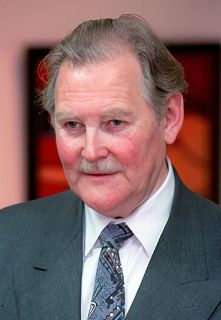
Best known as a centre half-forward, Purcell plays in most outfield positions during his career. In 2009, he is named in the Sunday Tribune‘s list of the “125 Most Influential People in GAA History.”
Purcell’s footballing career spans three decades, from the 1940s to the 1960s. He forms a successful on-field partnership with Frank Stockwell at Galway, culminating in the team winning their fourth All-Ireland championship in 1956 and leading to their nickname as the “Terrible Twins.”
Further successes in which Purcell is involved include winning the National Football League title in 1957, three Railway Cups, one of which he captains, the 1950 Sigerson Cup, appearances with the Combined Universities side and ten county titles with the Tuam Stars, including seven in a row from 1954 to 1960.
Purcell’s involvement in the GAA continues long after his playing days as he serves in a number of positions as team mentor and administrator in Galway.
Purcell dies on August 27, 2005, at the age of 76, following a short illness at the Blackrock Clinic, County Dublin. He is buried in the Athenry Road graveyard at Tuam.
Purcell marries Rita Shannon in 1961. They have four daughters and two sons before the marriage ends. His son, Robert Purcell, marries Tessa Robinson, daughter of former Irish PresidentMary Robinson, in 2005. His grandson, Simon Carr, is a professional tennis player. Another grandson, Sam McCartan, has played Gaelic football at senior level for Westmeath. His teenage grandson, Rory Purcell, dies in 2022.
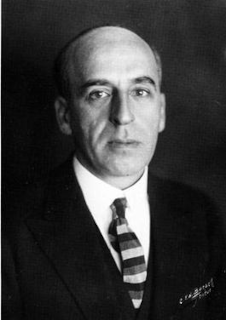
Hayes-McCoy is born to Thomas Hayes-McCoy and Mary Kathleen Hayes-McCoy (née Wallace). His grandfather, Thomas Hayes-McCoy, is a Dubliner who as a child came to Galway in 1834 and is later a well-known Parnellite. His maternal grandfather, Thomas Burke, is a Galway artist. He grows up on Eyre Square where his father runs a gentleman’s hairdressing business. His two older siblings are Ignatius and Marguerite. The latter receives a PhD-degree in History at University College Galway (UCG), and later teaches at the Galway Technical School.
Hayes-McCoy receives his early education from the Patrician Brothers, Galway. His earliest notebook of 1927 and a manuscript history of Poland of the same year, now at the National Library of Ireland (NLI), testify to an early interest in history and heritage. From 1928 to 1932 he is a student scholarship holder at University College Galway, graduating in 1932 with a Bachelor of Commerce, and a Bachelor of Arts, with first-class honours in both, and a specialisation in “History, Ethics, Politics” for the latter. Mary Donovan O’Sullivan is one of his professors of history, and Liam Ó Briain, professor of Romance languages, is a stimulating influence. At this time, Hayes-McCoy is a member of the Republican Club, a committee member of the Literary and Debating Society, and in 1931 he is one of the founding members of a new Irish Students’ Association.
Hayes-McCoy pursues his PhD at the University of Edinburgh, and then spends two years at the Institute of Historical Research, London, in the Tudor seminar of J. E. Neale, rewriting his PhD and eventually publishing it as Scots mercenary forces in Ireland, 1565–1603 (Dublin and London, 1937), with a foreword by Eoin MacNeill. This is characterised by meticulous archival research, and it anticipates by sixty years the much-vaunted New British History of the late twentieth century by tracing the interconnections between events in England, Ireland, and Scotland.
In the absence of an academic post, Hayes-McCoy becomes an assistant keeper in the Art and Industrial Division at the National Museum of Ireland (1939–1959), with a responsibility for the Military History, and the Irish War of Independence collections. One of his first tasks is to prepare a standing exhibition on Irish history before 1916. His research, long-standing personal interest in the military, and his curatorial experience, helps form an expert knowledge of historical Irish warfare. This leads to his role in co-founding The Military History Society of Ireland in 1949 whose journal, The Irish Sword, he edits. He describes the vagaries of setting up such a body, its reception, and the historiographical considerations attendant on it, in a paper published posthumously in The Irish Sword.
On August 19, 1941, Hayes-McCoy marries Mary Margaret “May” O’Connor, daughter of C.J. and M.B. O’Connor of New Ross/Enniscorthy. They have three daughters and two sons: Mary, Ann, Ian, Robert, Felicity. The family home is in Dublin.
Earning high reputation by continued research and by publishing leads to Hayes-McCoy’s receipt of the D.Litt. degree from the National University, and to his membership in the Royal Irish Academy in 1950. In his professional career, apart from the broad spectrum of press publications, he publishes prolifically. The works that are judged most influential, are his Scots mercenary forces in Ireland 1565–1603 (1937), the papers “The early history of guns in Ireland” (1938–1939), “Strategy and tactics in Irish warfare, 1593–1601” (1941), “The army of Ulster, 1593–1601” (1951), the controversial “Gaelic society in Ireland in the late sixteenth century” (1963), and the monographs “Irish battles” (London 1969), and “A history of Irish flags from earliest times” (Dublin 1979). A member of the Irish Manuscripts Commission, his most notable contribution is the publication “Ulster and other Irish maps, c.1600” (Dublin 1964).
In 1946, Hayes-McCoy is appointed to a committee of eight historians to advise on setting up the Bureau of Military History, a body established for the creation and compilation of material on the history of the Irish movements for independence, 1913–1921, specifically from witness statements. The committee is also to further offer guidance and oversee progress of the Bureau in coordination with the Ministry of Defence. It subsequently expresses concerns about the state’s role and methods in the collection of statements.
Having begun writing for the press at an early stage, Hayes-McCoy’s public position at the Museum encourages him to go further. He has broad involvement with local history groups to whom he presents papers, and also works for newspapers and for radio and television. To the national and Galway press he usually contributes articles on military aspects of Irish history, as well as book reviews, but he also uses them as a platform to engage with what he sees are flaws in the education of history in Ireland which during his lifetime is constrained by a certain degree of political and cultural state control.
During the 1940s and 1950s, Hayes-McCoy becomes involved in a number of paratheatrical events of national significance one of which – the “Pageant of St.Patrick” for which he writes the script (An Tóstal 1954) – is realised on an immense scale. He scripts these works to begin with and is later principally engaged as historical consultant. In that capacity, he collaborates in 1955 and 1956 with Micheál Mac Liammóir and Denis Johnston on their scripts for pageants on St. Patrick and on the Táin Bó Cuailgne, at times finding it difficult to square the historical liberties taken by these artists with his own role.
On Irish radio and television Hayes-McCoy is most active in the mid-1960s, editing and contributing to Thomas Davis lectures series, writing scripts for a series of thirty children’s programmes on all aspects of Irish history, and preparing/contributing on air to the television series “Irish battles” and “The long winter.” As well as writing for RTÉ, Ireland’s national broadcaster, he contributes scripts to BBC Northern Ireland‘s schools radio programmes.
In 1959, Hayes-McCoy succeeds to the chair of his former history professor at UCG with the full remit of lecturing, administering examinations to undergraduates, and supervising postgraduate theses. Among his students who continue in the field of history are Nicholas Canny, Martin Coen, Patrick Melvin, Peter Toner, Tony Claffey, and Breandán Ó Bric. After his appointment to UCG, the family home remains in Dublin, and he commutes to Galway weekly during term time.
In the early 1960s, Hayes-McCoy becomes a spokesperson for the movement rekindled by the Old Galway Society to preserve the landmark “Lion’s Tower” in the city. The ultimate failure of the campaign informs his regret, expressed a year later, that Ireland is forgetful about its past and that “we don’t bother to find out about it or to maintain our ancient heritage,” and, on a perceived spirit of conformity, “take my own city of Galway, it is now more prosperous than it was, but it is no longer distinctive. I do not believe that it is essential for progress that we should lose our heritage.”
While at one time member and secretary of the London Sinn Féin office and informed by a pride of country and place, Hayes-McCoy’s professional and private outlook are marked by a distrust of nationalism or of any antagonising national agendas compromising genuine scholarship. In a paper drafted on tendencies in modern historical studies, he criticises the two historiographical extremes, each to be avoided, each unfortunately characteristic of the moment – extreme de-bunking and extreme “adding for effect.” “A history is a record of fact; to add pseudo-facts is as grave a sin as to leave out real facts that may change the colour of the whole.”
Hayes-McCoy’s abiding pastime is drawing. Among his papers in the James Hardiman Library, NUI Galway are approximately 40 items with predominantly maritime subjects, and he has a special regard for the history of ships, and a romantic liking of the sea. He also has a lifelong interest in Robert Louis Stevenson, Sir Walter Scott, and their works, and in the Pre-Raphaelite movement.
Hayes-McCoy’s middle age is marked by intermittent ill health. He dies on November 27, 1975, in his room at the Great Southern Hotel, Eyre Square, Galway.
Hayes-McCoy’s papers are held at the James Hardiman Library, National University of Ireland, Galway.
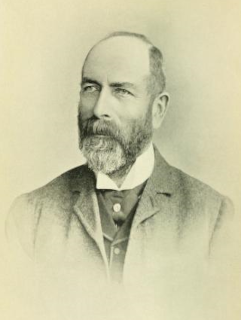
Burke is born in St. Clerens, County Galway on May 6, 1821, the second of three sons of James Hardiman Burke, an officer in the British Army7th Royal Fusiliers, and Anne Louisa Burke (nee O’Hara).
Burke enters the Royal Military Academy, Woolwich in May 1835. In December 1836 he fails his probationary exam and goes to Belgium to further his education. In 1841, he enters the Imperial Austrian Army and spends most of his time posted to northern Italy. Towards the end of 1847 he suffers health problems and ultimately resigns from the Austrian army in June 1848.
After returning to Ireland in 1848, he joins the Irish Constabulary (later the Royal Irish Constabulary). He does his cadet training at Phoenix Park Depot in Dublin between November 1849 and January 1850. At the end of 1850 he transfers to the Mounted Police in Dublin.
Burke emigrates to Australia, arriving in Hobart, Tasmania on February 12, 1853, and promptly sails for Melbourne. On April 1, 1853, he joins the recently established Victoria Police force.
After the South Australian explorer John McDouall Stuart reaches the centre of Australia, the South Australian parliament offers a reward of £2,000 for the promotion of an expedition to cross the continent from south to north, generally following Stuart’s route. In June 1860, Burke is appointed to lead the Victorian Exploring Expedition with William John Wills, his third-in-command, as surveyor and astronomical observer.
The expedition leaves Melbourne on August 20, 1860, with a total of 19 men, 27 camels and 23 horses. They reach Menindee on September 23, 1860, where several people resign.
Cooper Creek, 400 miles further on, is reached on November 11, 1860, by the advance group, the remainder being intended to catch up. After a break, Burke decides to make a dash to the Gulf of Carpentaria, leaving on December 16, 1860. William Brahe is left in charge of the remaining party. The small team of Burke, William Wills, John King and Charley Gray reach the mangroves on the estuary of the Flinders River, near where the town of Normanton now stands, on February 9, 1861. They never see open ocean due to flooding rains and swamps.
Already weakened by starvation and exposure, progress on the return journey is slow and hampered by the tropical monsoon downpours of the wet season. Gray dies four days before they reach the rendezvous at Cooper Creek. The other three rest for a day when they bury him. They eventually reach the rendezvous point on April 21, 1861, nine hours after the rest of the party had given up waiting and left, leaving a note and some food, as they had not been relieved by the party supposed to be returning from Menindee.
Burke’s party attempts to reach Mount Hopeless, the furthest outpost of pastoral settlement in South Australia, which is closer than Menindee, but fail and return to Cooper Creek. While waiting for rescue Wills dies of exhaustion and starvation. Soon after, Burke also dies, at a place now called Burke’s Waterhole on Cooper Creek in South Australia. The exact date of Burke’s death is uncertain but has generally been accepted to be June 28, 1861.
King survives with the help of Aborigines until he is rescued in September by Alfred William Howitt. Howitt buries Burke and Wills before returning to Melbourne. In 1862, Howitt returns to Cooper Creek and disinters Burke and Wills, taking them first to Adelaide and then by steamer to Melbourne where they are laid in state for two weeks. On January 23, 1863, Burke and Wills receive a State Funeral and are buried in Melbourne General Cemetery. Ironically, on that same day John McDouall Stuart and his companions, having successfully completed the south-north crossing, are received back at a large ceremony in Adelaide.
Mac Aonghusa is the son of Criostóir Mac Aonghusa, a writer and Irish language activist, and Mairéad Ní Lupain, a nurse and native Irish speaker. The eldest of four siblings, he grows up speaking Irish as his first language and allegedly does not learn English until the age of eleven. His parents are left-wing Irish republicans who support Fianna Fáil and associate with the like-minded Máirtín Ó Cadhain and Peadar O’Donnell. His parents split when he is ten years of age. His mother takes his siblings away to Dublin while he and his father remain in Rosmuc, a remote village and part of the Galway Gaeltacht. As a teenager he is educated at Coláiste Iognáid (also known as St. Ignatius College), a bilingual school in Galway.
Upon leaving school, Mac Aonghusa first works as an actor at the Abbey Theatre in Dublin, performing in Irish language productions. In 1952, he becomes involved in Radio Éireann, first as an actor but later as a reader of short stories before advancing to becoming a newsreader, presenter and interviewer. As he advances his career, he works for RTÉ, UTV and BBC television from the 1960s. In 1962, he begins presenting An Fear agus An Sceal (The Man & his Story) on RTÉ television, an Irish language show which sees him interviewing a different guest of note about their life each episode. That same year he wins a Jacob’s Award for An Fear agus an Sceal, which he continues to host until 1964.
As well as attracting awards, An Fear agus an Sceal also brings controversy. Two interviews, one with Máirtín Ó Cadhain, one with Con Lehane, both criticise the measures practised by the Fianna Fáil government during World War II to suppress and imprison Irish republicans. In response, the Fianna Fáil government intervenes with RTÉ, and those episodes are not aired. This is not to be Mac Aonghusa’s only run-in with the Fianna Fáil government. After he recorded a programme in which he questioned the effectiveness of Ireland’s civil defence measures in the face of nuclear war, then Minister for DefenceKevin Boland has the episode suppressed. He once again runs afoul of the Fianna Fáil government when, after criticising the party in his anonymous weekly political gossip column in the Sunday Independent, then Minister for AgricultureNeil Blaney sees to it that the column is dropped. He is not deterred and returns anonymously as “Gulliver” in The Sunday Press and a gossip column on the back page of The Hibernia Magazine.
The latter half of Mac Aonghusa’s 1960s/70s broadcasting career is primarily associated with the Irish language current events show Féach, which he both presents and edits. He resigns from Féach in 1972 following a bitter dispute with the broadcaster and commentator Eoghan Harris.
In 1959, Mac Aonghusa writes a series of six articles for The Irish Times in which he vehemently opposes the Fianna Fáil government’s proposal to abolish single transferable vote in Ireland in favour of first-past-the-post voting. He contends that first-past-the-post voting gives too much influence to party bosses, while proportional representation gives even small minorities representation, preventing them from feeling excluded by the state such as nationalists in Northern Ireland. In the referendum held on the matter on June 17, 1959, voters reject first past the vote by a margin of 2%. Fianna Fáil attempts to repeal proportional representation again in the late 60s, at which point Mac Aonghusa once again throws himself into the fight, leading a group called “Citizens for PR.” In the referendum of 1968, voters reject the first past the post system by over 20%. He later recalls that his defence of proportional representation his greatest achievement in politics.
In the 1960s, both Mac Aonghusa and his wife, Catherine, join the Sean Connolly branch of the Labour Party in Dublin. The branch had established a reputation as a haven for intellectuals who want a branch to themselves away from the many other Labour branches dominated by trade unionists. The branch comes to advocate for expressly socialist policies combined with on-the-ground grass-roots campaigning. Through the Sean Connolly Branch, both he and his wife begin to develop significant influence over the leader of the Labour party Brendan Corish.
In the 1965 Irish general election, Mac Aonghusa stands on behalf of the Labour party in the Louth constituency but is not elected. In 1966, he publishes a book of speeches by Corish, the speeches themselves mostly having been ghostwritten by his wife Catherine. The introduction of the book proclaims that Corish had developed a “brand of democratic republican socialism … broadened by experience and built firmly on Irish‐Ireland roots” and had rid the party of “do‐nothing backwoodsmen”, thereby becoming the “first plausible and respected Labour leader in Ireland”. It is at this same time that he is elevated to vice-chairman of the party. As vice-chair, he tries to convince Corish to stand in the 1966 Irish presidential election. When he fails to do so, he supports Fine Gael‘s Tom O’Higgins in his bid for the presidency. O’Higgins comes within 0.5% of beating the incumbent, an ageing Éamon de Valera.
It was around this same time that Mac Aonghusa becomes active in the Wolfe Tone Societies, a republican organisation linked almost directly to Sinn Féin. He suggests that republicans with “progressive views” should join the Labour party. In 1966, alongside Máirtín Ó Cadhain and other Gaeilgeoirí, he counter-protests and disrupts the Language Freedom Movement, an organisation seeking the abolition of compulsory Irish in the education system. For this, he and his allies are criticised as acting illiberally, while he maintains that those who oppose the Irish language are “slaves” unworthy of tolerance.
Mac Aonghusa’s open disdain for the conservative and trade union wings of the Labour, as well as his open embrace of republican sensibilities and tendency to make pronouncements on Labour policy without first consulting the party’s structures, bring him many internal enemies. An attempt is made to censure him for backing breakaway trade unions, but he is able to survive this. In 1966, he encourages the formation of the Young Labour League, an unofficial youth wing of the party led by Brian Og O’Higgins, son of former Sinn Féin president Brian O’Higgins. Mirroring his own position, the Youth League are Corish loyalists that openly rebel against the views of Labour’s conservative deputy leader James Tully. When the youth league begins publishing their own weekly newsletter, Labour’s administrative council condemns it after discovering material which is “violently” critical of Tully and other Labour conservatives. An ensuing investigation into the newsletter leads to Mac Aonghusa admitting that he had financed it and written some of the content, but not the anti-Tully material. After he refuses to co-operate with further investigations into the matter, he is expelled on January 12, 1967 for “activities injurious” to the party. In the aftermath, he portrays himself a left-wing martyr purged by a right-wing “Star chamber,” a tactic that garners him sympathy. Nevertheless, his expulsion is confirmed at the October 1967 party conference, despite one last appeal. His wife leaves the party alongside him.
In the aftermath of his expulsion from Labour, Mac Aonghusa expresses an interest in the social democratic wing of Fine Gael, which had been developing under Declan Costello since the mid-1960s. However, he does not join the party and instead runs as an independent candidate in the 1969 Irish general election in Dún Laoghaire–Rathdown. When he is not elected, he begins to refocus on the revival of the Irish language and with nationalist politics rather than being elected himself.
Upon the onset of the Troubles, Mac Aonghusa is initially supportive of Official Sinn Féin, however by 1972 he comes to resent them and, through the Ned Stapleton Cumann, their secret influence over RTÉ. During the Arms Crisis in 1970, he supports Charles Haughey and Neil Blaney, who stand accused of arranging to supply weapons to the Provisional IRA, in the pages of the New Statesman and other left‐wing journals. In this time period, he warns editors not to reprint his material in the Republic of Ireland as there is a de facto ban on him, and indeed, official attempts are made to block the transmission of his telexed reports.
Despite his earlier famed stark criticism of Fianna Fáil, Mac Aonghusa’s defence of Haughey leads to a friendship between the two men which results in him becoming one of Haughey’s loudest defenders throughout the rest of his career. His columns in The Sunday Press and Irish language paper Anois are accused of descending into self-parody in their stringent defences of Haughey.
During the 1970s, Mac Aonghusa writes a number of books covering significant figures in Irish republicanism. In order, he releases books on James Connolly, Patrick Pearse, Wolfe Tone and Éamon de Valera. In his work on De Valera, he emphasises what he perceives as the more radical aspects of the Fianna Fáil founder. During 1974 and 1975, he works as a United Nations Special Representative to the Southern Africa region with Seán MacBride, where they involve themselves in the South African Border War, and during which time Mac Aonghusa becomes involved in setting up a radio station in Namibia, linked to the South West Africa People’s Organisation (SWAPO) nationalist party.
In the 1980s, Haughey twice appoints Mac Aonghusa to the Arts Council as well as naming him president of Bord na Gaeilge (1989-93). This is an issue as Mac Aonghusa is already president of Conradh na Gaeilge. Being head of the main Irish language lobbying body as well as the state body responsible for the Irish language has an obvious conflict of interest. In 1991, following the announcement by Haughey that the government is to fund the creation of an Irish-language television station (launched in 1996 as Teilifís na Gaeilge), an elated Mac Aonghusa suggests that Haughey would be “remembered among the families of the Gael as long as the Gaelic nation shall survive.”
In 1992 there are calls for Mac Aonghusa to step down from Bord na Gaeilge after he pronounces that “every respectable nationalist” in West Belfast should vote for Sinn Féin’s Gerry Adams over the Social Democratic and Labour Party (SDLP) candidate Joe Hendron in the 1992 United Kingdom general election as he considers a defeat for Adams “a victory for British imperialism.” Nevertheless, he simultaneously advises voters in South Down to vote for the SDLP’s Eddie McGrady over Sinn Féin. He rails against his detractors at the Conradh na Gaeilge ardfheis that year, declaring that “The mind of the slave, of the slíomadóir, of the hireling and the vagabond is still fairly dominant in Ireland.”
As of 1995, Mac Aonghusa continues to label himself a socialist. In the foreword to the book, he writes about James Connolly that is released that year, he declares that “the abolition of capitalism is essential if the great mass of the people in all parts of the globe are to be emancipated.”
However, with the recent collapse of the Soviet Union in mind, Mac Aonghusa declares that the Stalinist regimes of Eastern Europe have not been socialist and argues that the social democracies of Scandinavia are what James Connolly had envisioned as the desired socialist society. In the same text, he accuses the Irish education system as well as Ireland’s media of obfuscating Connolly’s views on socialism and nationalism.
Mac Aonghusa battles through ill health in his final years but remains able to continue writing a number of books. His last publication, Súil Tharam (2001), comes just two years before his death in Dublin on September 28, 2003.
In 1955, Mac Aonghusa marries Catherine Ellis, a member of the Church of Ireland from Belfast. For her married name, she chooses to use “McGuinness,” the English language equivalent of Mac Aonghusa. Catherine McGuinness goes on to become a Senator and a Judge of the Circuit Court, High Court and Supreme Court over the course of her legal career. Together they have three children together.
Lester is born on September 28, 1888, in Carrickfergus, County Antrim, as John Ernest Lester, the son of a Protestant grocer Robert Lester and his wife, the former Henrietta Ritchie. Although the town of Carrickfergus is strongly Unionist, he joins the Gaelic League as a youth and is won over to the cause of Irish nationalism. As a young man, he joins the Irish Republican Brotherhood (IRB). He works as a journalist for the North Down Herald and a number of other northern papers before he moves to Dublin, where he finds a job at the Freeman’s Journal. By 1919, he has risen to its news editor.
After the Irish War of Independence, a number of Lester’s friends join the new government of the Irish Free State. He is offered and accepts the position as director of publicity.
Lester marries Elizabeth Ruth Tyrrell in 1920 by whom he has three daughters.
In 1923, Lester joins Ireland’s Department of External Affairs. He is sent to Geneva in 1929 to replace Michael MacWhite as Ireland’s Permanent Delegate to the League of Nations. In 1930, he succeeds in organising Ireland’s election to the Council (or executive body) of the League of Nations for three years. He often represents Ireland at Council meetings and stands in for the Minister for External Affairs. He becomes increasingly involved in the work of the League, particularly in its attempts to bring a resolution to two wars in South America. His work brings him to the attention of the League Secretariat and begins his transformation from national to international civil servant.
When Peru and Colombia have a dispute over a town in the headwaters of the Amazon River, Lester presides over the committee that finds an equitable solution. He also presides over the less-successful committee when Bolivia and Paraguay go to war over the Gran Chaco.
In 1933, Lester is seconded to the League’s Secretariat and sent to Danzig (now Gdańsk, Poland), as the League of Nations’ High Commissioner from 1934 to 1937. The Free City of Danzig is the scene of an emerging international crisis between Nazi Germany and the international community over the issue of the Polish Corridor and the Free City’s relationship with the Third Reich. He repeatedly protests to the German government over its persecution and discrimination of Jews and warns the League of the looming disaster for Europe. He is boycotted by the representatives of the German Reich and the representatives of the Nazi Party in Danzig.
Lester returns to Geneva in 1937 to become Deputy Secretary General of the League of Nations. In 1940, he becomes Secretary General of the body, becoming the League’s leader a year after the beginning of World War II which shows that the League has failed its primary purpose. The League has only 100 employees, including guards and janitors, out of the original 700.
Lester remains in Geneva throughout the war and keeps the League’s technical and humanitarian programs in limited operation for the duration of the war. In 1946, he oversees the League’s closure and turns over the League’s assets and functions to the newly established United Nations.
Despite rumours that he would be prepared to stand for election as President of Ireland, Lester seeks no permanent office and retires to Recess, County Galway, in the west of Ireland, where he dies on June 13, 1959. In its obituary, The Times describes him as an “international conciliator and courageous friend of refugees.”
In August 2010, a room in the Gdańsk City Hall, the building that had been Lester’s residence during his stay, is renamed by Mayor Paweł Adamowicz as the Seán Lester Room.
The treaty had been intended to enter into force on January 1, 2009, but has to be delayed following the Irish rejection. However, the Lisbon treaty is approved by Irish voters when the Twenty-eighth Amendment of the Constitution of Ireland is approved in the second Lisbon referendum, held in October 2009.
The Treaty of Lisbon is signed by the member states of the European Union on December 13, 2007. It is in large part a revision of the text of the Treaty establishing a Constitution for Europe (TCE) after its rejection in referendums in France in May 2005 and in the Netherlands in June 2005. The Treaty of Lisbon preserves most of the content of the Constitution, especially the new rules on the functioning of the European Institutions but gives up any symbolic or terminologic reference to a constitution.
Because of the decision of the Supreme Court of Ireland in Crotty v. An Taoiseach (1987), an amendment to the Constitution is required before it can be ratified by Ireland. Ireland is the only one of the then fifteen EU member states to put the Treaty to the people in a referendum. Ratification of the Treaty in all other member states is decided upon by national parliaments alone.
The government parties of Fianna Fáil and the Progressive Democrats are in favour of the treaty, but the other government party, the Green Party, is divided on the issue. At a special convention on January 19, 2008, the leadership of the Green Party fails to secure a two-thirds majority required to make support for the referendum official party policy. As a result, the Green Party itself does not participate in the referendum debate, although individual members are free to be involved in whatever side they chose. All Green Party members of the Oireachtas support the Treaty. The main opposition parties of Fine Gael and the Labour Party are also in favour. Only one party represented in the Oireachtas, Sinn Féin, is opposed to the treaty, while minor parties opposed to it include the Socialist Party, the Workers’ Party and the Socialist Workers Party. Independent TD’s Tony Gregory and Finian McGrath, Independent MEPKathy Sinnott, and Independent members of the Seanad from the universities David Norris, Shane Ross and Rónán Mullen advocate a “No” vote as well.
The Government sends bilingual booklets written in English and Irish, explaining the Treaty, to all 2.5 million Irish households. However, compendiums of the two previous treaties, of which the Lisbon Treaty is intended to be a series of reforms and amendments, remain unavailable in Ireland. Some commentators argue that the treaty remains essentially incomprehensible in the absence of such a compendium.
On March 12, 2008, the Libertas Institute, a lobby group started by businessman Declan Ganley, launches a campaign called Facts, not politics which advocates a “No” vote in the referendum. A month later, the German Chancellor, Angela Merkel, appeals to Irish people to vote “Yes” in the referendum while on a visit to Ireland. The anti-Lisbon Treaty campaign group accuses the government and Fine Gael of a U-turn on their previous policy of discouraging foreign leaders from visiting Ireland during the referendum campaign. The European Commissioner for Internal MarketCharlie McCreevy admits he had not read the Treaty from cover to cover and says, “he would not expect any sane person to do so.”
At the start of May, the Irish Alliance for Europe launches its campaign for a “Yes” vote in the referendum this consists of trade unionists, business people, academics and politicians. Its members include Garret FitzGerald, Ruairi Quinn, Pat Cox and Michael O’Kennedy. The TaoiseachBrian Cowen states that should any member of the Fianna Fáil parliamentary party campaign against the treaty, they will likely be expelled from the party.
On May 21, 2008, the executive council of the Irish Congress of Trade Unions votes to support a “Yes” vote in the referendum. Rank and file members of the individual unions are not balloted, and the Technical, Engineering and Electrical Union (TEEU) advises its 45,000 members to vote “No.” The Irish bishops conference states the Catholic Church‘s declaration that the treaty will not weaken Ireland’s constitutional ban on abortion, however the conference does not advocate either a “Yes” or “No” vote. By the start of June, Fianna Fáil, Fine Gael and the Labour Party have united in their push for a “Yes” vote despite earlier divisions. The two largest farming organisations, the Irish Creamery Milk Suppliers Association (ICMSA) and the Irish Farmers’ Association call for a “Yes” vote, the latter giving its support after assurances from Taoiseach Brian Cowen that Ireland will use its veto in Europe if a deal on World Trade reform is unacceptable.
There were 3,051,278 voters on the electoral register. The vast majority of voting takes place on Thursday, June 12, between 7:00 a.m. and 10:00 p.m. Counting begins at 9:00 a.m. the following morning. Several groups vote before the standard polling day, with some casting postal votes before June 9. These include members of the Irish Defence Forces serving in United Nations peacekeeping missions, Irish diplomats and their spouses abroad, members of the Garda Síochána, those unable to vote in person due to physical illness or disability, those who are unable to vote in person due to their employment (including students) and prisoners.
Votes are counted separately in each Dáil constituency. The overall verdict is formally announced by the Referendum Returning officer in Dublin Castle by accumulating the constituency totals.
(Pictured: Campaign posters in St. Stephen’s Green, Dublin)
When the authorities in Quebec hear the news of ships arriving with sick passengers, they quickly set up Grosse Île as a port of entry and quarantine station at which all ships are required to dock before moving on to the mainland. The island had dealt with epidemics before. In 1830, about 30,000 immigrants arrived in Quebec, and two-thirds were Irish. These huge waves of immigration were concurrent with cholera epidemics in Great Britain and Europe.
Areas in the west of Ireland – mostly Mayo, Donegal, and Galway – are experiencing potato crop failure. In fact, the crop fails to various degrees all over the country throughout the 1830s, though no one is sure exactly when the blight that caused the successive crop failures of 1845-49 arrived in Ireland. In 1847, 100,000 Irish people travel to Grosse Île to escape starvation, unaware of the hardships they will encounter upon arrival.
The Syria, the first “coffin ship,” named for their crowded and deadly conditions, arrives on May 17, 1847, the ice still an inch thick on the river. Of the ship’s 241 passengers, 84 are stricken with fever and 9 died on board during the Atlantic crossing. The first victim dies on the day the Syria arrives. Her name is Ellen Kane, a four-year-old from Kilmore, County Mayo.
With the hospital equipped for only 150 cases of fever, the situation quickly spins out of control. More and more ships arrive at Grosse Île each day, sometimes lining up for miles down the St. Lawrence River throughout the summer. On these coffin ships the number of passengers stricken by fever increases exponentially.
The island is ill-equipped, to say the least. Hastily built, the quarantine hospitals lack proper sanitation, supplies, and space to accommodate all the sick patients. Many of the doctors dispatched to Grosse Île have never even seen the effects of cholera let alone treated it, and all are overworked. Being taken to a quarantine hospital is soon viewed as more of a death sentence than an opportunity to get better.
Between 1832 and 1937, Grosse Île’s term of operation, the official register lists 7,480 burials on the island. In 1847 alone, 5,424 burials take place, the majority are Irish immigrants. In that same year, over 5,000 Irish people on ships bound for Canada are listed as having been buried at sea.
Today, the island is a National Historic Site that serves as a Famine memorial. It is dedicated in 1996 after a four-year-long campaign to protect the mass gravesite.
The Grosse Île Celtic Cross, erected by the Ancient Order of Hibernians in 1909, bears an inscription in Irish commemorating the victims of the epidemic and condemning colonial rule. In English, it reads: “Children of the Gael died in their thousands on this island having fled from the laws of foreign tyrants and an artificial famine in the years 1847-48. God’s blessing on them. Let this monument be a token and honor from the Gaels of America. God Save Ireland.”
(From: “When 40 Irish Famine ships anchored at Grosse Île quarantine station in 1847” by Aliah O’Neill, IrishCentral, http://www.irishcentral.com, May 31, 2023)
Sir Rory O’Moore (Irish: Ruaidhrí Ó Mórdha), Irish politician and landowner also known Sir Roger O’Moore or O’More or Sir Roger Moore, dies in obscurity on February 16, 1655. He is most notable for being one of the four principal organizers of the Irish Rebellion of 1641.
O’Moore’s uncle, Rory O’More, Lord of Laois, had fought against the English during the Tudor conquest of Ireland. In 1556, Queen Mary I confiscates the O’Mores’ lands and creates “Queens County” (modern-day County Laois). Over 180 family members, who are peaceful and have taken no part in any rebellion, are murdered with virtually all of the leaders of Laois and Offaly by the English at a feast at Mullaghmast, County Kildare, in 1577. Rory Óg and his wife Maighréad O’Byrne, sister of Fiach MacHugh O’Byrne, are hunted down and killed soon afterwards. This leads to the political downfall of the O’Moore family as their estates are given to English settlers.
Given the causes of the rebellion and the Crown’s weakness during the Bishops’ Wars into 1641, O’Moore plans a bloodless coup to overthrow the English government in Ireland. With Connor Maguire, 2nd Baron of Enniskillen, he plans to seize Dublin Castle, which is held by a small garrison, on October 23, 1641. Allies in Ulster led by Sir Phelim O’Neill are to seize forts and towns there. The leaders are to assume the governing of their own country and with this provision offer allegiance to King Charles. They are betrayed, and the plan is discovered on October 22 and the rising fails in its first objective. O’Neill has some success, and O’Moore quickly succeeds in creating an alliance between the Ulster Gaelic clans and the Old English gentry in Leinster.
In November 1641, the Irish forces besiege Drogheda, and a royalist force comes north from Dublin to oppose them. O’Moore is one of the leaders of the rebel army that intercepts and defeats the relief force at the Battle of Julianstown on November 29.
The Irish historian Charles Gavan Duffy writes: “Then a private gentleman, with no resources beyond his intellect and his courage, this Rory, when Ireland was weakened by defeat and confiscation, and guarded with a jealous care constantly increasing in strictness and severity, conceived the vast design of rescuing the country from England, and even accomplished it; for, in three years, England did not retain a city in Ireland but Dublin and Drogheda, and for eight years the land was possessed and the supreme authority exercised by the Confederation created by O’Moore. History contains no stricter instance of the influence of an individual mind.”
Bishop Michael Comerford writes that after O’Moore’s defeat at the Battle of Kilrush in April 1642 he retires and dies in Kilkenny city in the winter of 1642–43, having co-founded the Irish Catholic Confederation there a few months earlier. However, this ignores his contacts with Inchiquin and Ormonde in 1647–48.
In 1652, O’Moore goes to Inishbofin off the coast of Galway, one of the last Catholic strongholds, but as the parliamentary forces approach, he makes arrangements to flee. Walter Lynch, Bishop of Clonfert, sails in the last ship to leave the island without waiting for O’Moore, who is forced to make his own way. He finally escapes into Ulster but dies in obscurity on February 16, 1655. He is buried at Steryne churchyard, in the parish of Magilligan, County Londonderry.
St. Colman’s Church on the island once bears a tablet with the inscription: “In memory of many valiant Irishmen who were exiled to this Holy Island and in particular Rory O’More a brave chieftain of Leix, who after fighting for Faith and Fatherland, disguised as a fisherman escaped from his island to a place of safety. He died shortly afterwards, a martyr to his Religion and his County, about 1653. He was esteemed and loved by his countrymen, who celebrated his many deeds of valour and kindness in their songs and reverenced his memory, so that it was a common expression among them; ‘God and Our Lady be our help and Rory O’More’.”
The Balyna estate is inherited from Calvagh O’More by Rory’s brother Lewis. Balyna is passed down to Lewis’s last surviving O’More descendant, Letitia, who is also descended from Rory O’More because her grandfather married a second cousin. Letitia marries a Richard Farrell in 1751. This Farrell family henceforth takes the surname More O’Ferrall.
Armstrong is born on January 12, 1924, at Carrickfergus, County Antrim, Northern Ireland, one of three sons among six children of James Charlton Armstrong, housepainter and decorator, and his wife Margaret (née Howard). Soon after his birth the family moves to Belfast. He attends Strandtown Primary School. He attends Queen’s University Belfast (QUB) in the early 1940s, where he initially studies political science and later architecture. Having an interest in art, which had been fostered by his father, he takes classes for a short time in the early 1940s at the Belfast School of Art. It is there he meets Gerard Dillon, who introduces him to George Campbell and Daniel O’Neill. He is largely self-taught as an artist. It is his close association with Dillon and Campbell, both some years his senior, that proves to be the most important factor in his development. In Belfast in the early 1940s they associate with the Russian artist Daniel Nietzche, who emphasises to them the importance of personal expression.
After leaving university Armstrong works at the Belfast Gas Office. At this point he is the main support for his widowed mother. Having saved some money, he leaves his job in 1946 to attempt to fulfil his ambition to paint full-time, producing a set of etchings with George Campbell, which are published by Walsh Studios. The following year he takes work as a designer for Ulster Laces in Portadown, County Armagh. In 1957, he leaves for London in the hopes of finding greater opportunities as an artist. His friends Campbell and Dillon are already living there, and he takes lodgings with Dillon’s sister at Abbey Road, north London. Though he continues to paint, he is unable to earn a living and so again has to take other work, this time in a Labour Exchange office. However, he is beginning to gain recognition. In 1957, he is awarded a traveling scholarship by the Council for the Encouragement of Music and the Arts (CEMA), which enables him to travel to Spain. He continues to visit Spain throughout the 1960s, often to see Campbell, who spends much time there.
In 1961 he has his first solo exhibition at the CEMA gallery in Belfast. He comes to live in Dublin in 1962, his work having already been exhibited there at the Irish Exhibition of Living Art in 1957 and 1958. He continues to exhibit there annually from 1961 to 1965. During the 1960s and early 1970s his work is regularly included in the Oireachtas exhibition, at which he is awarded the Douglas Hyde Gold Medal in 1968. He also shows his work with the Ritchie Hendriks Gallery and the Tom Caldwell Gallery in Dublin. Ultimately, he is to have over seventy solo exhibitions throughout his career. By 1969, when he is elected an associate member of the Royal Hibernian Academy (RHA), he has established himself as one of the leading landscape painters in Ireland. In 1972 he becomes a full member of the RHA. He exhibits there regularly until 1977.
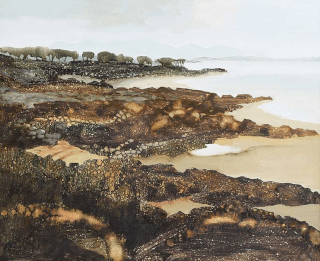
It is during this period that some of Armstrong’s best work is produced. While landscape is his predominant theme, he never sees himself as a painter of particular views, rather he responds to the abstract qualities of a scene. He sees elements such as the sea, rocks or sky as a series of interlocking textures to be rendered expressively in oil paint. The western coastline of Ireland is a vital source of inspiration for him. Roundstone, County Galway, is a favoured base for painting trips in the company of Dillon and Campbell, who by this time are also living in Dublin.
In 1981, a retrospective exhibition of Armstrong’s work is organised by the Arts Council of Northern Ireland. He is represented in many major public and corporate collections in Ireland. From 1971 he lives at 28 Chelmsford Avenue, Ranelagh, Dublin, in a house he shares with Gerard Dillon.
Armstrong dies unmarried on January 13, 1996, in Dublin. The contents of his studio are sold on February 3, 1998.
(From: “Armstrong, Arthur” by Rebecca Minch, Dictionary of Irish Biography, http://www.dib.ie, October 2009, revised November 2013 | Pictured: “Near Ballyhubbock,” oil on board by Arthur Armstrong RHA)
Joyce is a native Irish speaker who starts his education at a hedge school. He then attends school in Mitchelstown, County Cork.
Joyce starts work in 1845 with the Commission of National Education. He becomes a teacher and principal of the Model School, Clonmel. In 1856 he is one of fifteen teachers selected to re-organize the national school system in Ireland. Meanwhile he earns his B.A. in 1861 and M.A. in 1863 from Trinity College Dublin.
Joyce is a key cultural figure of his time. His wide interests include the Irish language, Hiberno-English, music, education, Irish literature and folklore, Irish history and antiquities, place names and much else. He produces many works on the history and culture of Ireland. His most enduring work is the pioneering The Origin and History of Irish Names of Places (first edition published in 1869). He is a member of the Royal Irish Academy.
In 1856 Joyce marries Caroline Waters of Baltinglass, County Wicklow, with whom he has two daughters and three sons, one of whom is the author Weston St. John Joyce. He dies on January 7, 1914, at his home, Barnalee, Rathmines, Dublin, and is buried two days later in Glasnevin Cemetery.
The P.W. Joyce collection at the Cregan Library in St. Patrick’s College, Drumcondra, Dublin, reflects many of Joyce’s interests and includes several rarities. These include autographed presentation copies by Joyce and his brother Robert, as well as books from Joyce’s own library. The collection also contains nine manuscripts associated with Joyce and his family members, including a manuscript in P.W. Joyce’s own hand of Echtra Cormaic itir Tairngiri agus Ceart Claíd Cormaic (Adventures of Cormac in the Land of Promise), a passage from the Book of Ballymote, which Joyce translated into English.