Muriel Enid Gifford is born at 12 Cowper Road, Rathmines, on December 18, 1884. She is the fourth daughter and eighth child of twelve of Frederick and Isabella Gifford. As a child, she suffers at different times from rheumatic fever and phlebitis. She attends Alexandra College and spends a brief time in England training to as a poultry instructor. Returning to Ireland, she trains at Sir Patrick Dun’s Hospital, Dublin, as a student nurse, but her health suffers from the work.
Along with her sisters, MacDonagh is active in the Irish Women’s Franchise League and Inghinidhe na hÉireann, a nationalist organisation. She is involved in the school meals programme of 1910 to 1911, takes part in a 1914 Women’s Franchise League fundraiser, appearing in a tableau vivant as Maeve, the Warrior Queen. Less ardently feminist than her sisters, she takes delight in inviting home activists and artists for a “proper meal.” In an outgoing family, she is shy and reserved, known for her gentle manner. In 1908, she is introduced to Thomas MacDonagh by suffragette journalist Nannie Dryhurst along with her sisters, Grace and Sidney, on a visit to St. Enda’s School. Dryhurst advises Thomas to “fall in love with one of these girls and marry her,” to which he replies laughingly, “That would be easy; the only difficulty would be to decide which one.” The Gifford sisters remain acquaintances with Thomas until the autumn of 1911, when the couple has a short and intense courtship. They meet secretly in galleries and museums and have copious correspondence. When he is appointed assistant lecturer to University College Dublin (UCD) in December 1911, they marry on January 3, 1912. They have one son, Donagh MacDonagh, and one daughter, Barbara MacDonagh Redmond. The family lives first at 32 Baggot Street, and later at 29 Oakley Road, Rathmines.
MacDonagh suffers with poor health and depression, which leads to periods of convalescence and confinement. When her husband is arrested after the Easter Rising, she is unable to see him before his execution on May 3, 1916, which heightens the intensity of her bereavement. Devastated by his death and estranged from her parents due to their disapproval of his involvement in the Rising, she briefly lives with the Plunketts at Larkfield, Kimmage, and then with relatives of her husband in Thurles, County Tipperary. She later returns to Dublin to rent rooms in a Plunkett family property, 50 Marlborough Road. With two young children to support, she is nearly destitute, but like the other widows and orphans of the executed leaders of the Rising, they are aided by the Irish Volunteers Dependents’ Fund, in her case with £250. She also serves as an officer and committee member on this aid association. Her husband had named her as his literary executor, and she prepares a collected edition of his poetry that is published in October 1916. The success of this volume, and his bestselling Literature in Ireland, published at the time he is executed, ease her financial difficulties somewhat.
MacDonagh dies while swimming in the sea during a holiday with other 1916 widows and orphans in Skerries, County Dublin, on July 9, 1917. She almost does not attend the holiday, as her son is in hospital having been injured in a fall. It is believed that she is attempting to swim to Shenick Island from Skerries, possibly to place a tricolour flag on the island’s Martello tower. Her body is found near Loughshinny Beach and, as there is no water in her lungs, it is concluded that she died of heart failure and not drowning. As there is great interest in the 1916 widows and their families, her funeral at Glasnevin Cemetery attracts a large crowd of mourners estimated at 5,000 in the funeral procession.
Following MacDonagh’s death, there is a legal custody battle between the Giffords and the MacDonaghs over Donagh and Barbara. Their aunt Mary MacDonagh, a nun known as Sister Francesca and with whom MacDonagh had grown close, wins custody. Even though several of her siblings offer to take the children, she places them in a foster home.
On the centenary of MacDonagh’s death, a festival takes place in Skerries in her memory.
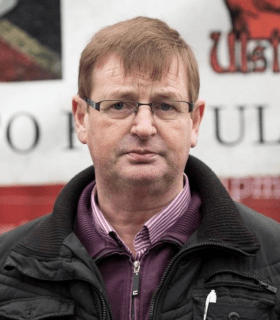
Frazer grows up in the village of Whitecross, County Armagh, Northern Ireland, as one of nine children, with his parents Bertie and Margaret. He is an ex-member of the Territorial Army and a member of the Free Presbyterian Church of Ulster. He attends a local Catholic school and plays Gaelic football up to U14 level. He describes his early years as a “truly cross-community lifestyle.” Growing up, he is a fan of the American actor John Wayne and wrestling. His father, who is a part-time member of the British Army‘s Ulster Defence Regiment (UDR) and a council worker, is killed by the Provisional Irish Republican Army (IRA) on August 30, 1975. The family home had previously been attacked with petrol bombs and gunfire which Frazer claims were IRA men, due to his father’s UDR membership. He states that his family is well respected in the area including by “old-school IRA men” and receives Mass cards from Catholic neighbours expressing their sorrow over his father’s killing. Over the next ten years, four members of Frazer’s family who are members or ex-members of the Royal Ulster Constabulary (RUC) or British Army are killed by the IRA. An uncle who is also a member of the UDR is wounded in a gun attack.
Soon after his father’s death, the IRA begins targeting Frazer’s older brother who is also a UDR member. Like many South Armagh unionists, the family moves north to the village of Markethill. After leaving school, he works as a plasterer for a period before serving in the British Army for nine years. Following this he works for a local haulage company, then sets up his own haulage company, which he later sells.
During the Drumcree conflict, Frazer is a supporter of the PortadownOrange Order who demand the right to march down the Garvaghy Road against the wishes of local residents. He is president of his local Apprentice Boys club at the time.
For a brief period after selling his haulage firm, Frazer runs “The Spot,” a nightclub in Tandragee, County Armagh, which closes down after two Ulster Protestant civilians who had been in the club, Andrew Robb and David McIlwaine, are stabbed to death in February 2000 by the Ulster Volunteer Force (UVF), after one of them had allegedly made derogatory remarks about dead UVF Mid-Ulster Brigade leader Richard Jameson. Frazer is confronted in an interview on BBC Radio Ulster about the murders by the father of one of the victims, Paul McIlwaine. During the Smithwick Tribunal, set up to investigate allegations of collusion in the 1989 Jonesborough ambush, it is alleged by a member of Garda Síochána that Frazer is a part of a loyalist paramilitary group called the Red Hand Commando. Frazer denies this allegation, saying they put his life in danger.
Frazer applies for a licence to hold a firearm for his personal protection and is turned down, a chief inspector says, in part because he is known to associate with loyalist paramilitaries.
FAIR, founded by Frazer in 1998, claims to represent the victims of IRA violence in South Armagh. It has been criticised by some for not doing the same for victims of loyalist paramilitary organisations or for those killed by security forces.
In February 2006, Frazer is an organiser of the Love Ulster parade in Dublin that has to be cancelled due to rioting. In January 2007, he protests outside the Sinn FéinArd Fheis in Dublin that votes to join policing structures in Northern Ireland. He expresses “outrage at the idea that the ‘law-abiding population’ would negotiate with terrorists to get them to support democracy, law and order.”
In January 2007, Frazer dismisses Police OmbudsmanNuala O’Loan‘s report into security force collusion with loyalist paramilitaries.
In March 2010, Frazer claims to have served a civil writ on deputy First MinisterMartin McGuinness, of Sinn Féin, seeking damages arising from the killing of his father by the Provisional IRA. Both Sinn Féin and the courts deny that any such writ had been served, but in June 2010 Frazer announces that he will seek to progress his claim in the High Court. There has since been no report of any such litigation. He previously pickets McGuinness’s home in Derry in 2007 to demand support for calls for Libya to compensate victims of IRA attacks. Accompanied by two other men, he attempts to post a letter to the house but is confronted by local residents and verbally abused. When McGuinness stands for election in the 2011 Irish presidential election, Frazer announces that he and FAIR will picket the main Sinn Féin election events, however, no such pickets take place.
In September 2010, the Special EU Programmes Body (SEUPB) revokes all funding to FAIR due to “major failures in the organisation’s ability to adhere to the conditions associated with its funding allocation” uncovered following a “thorough audit” of the tendering and administration procedures used by FAIR.
In November 2011, the SEUPB announces that it is seeking the return of funding to FAIR and another Markethill victims’ group, Saver/Naver. FAIR is asked to return £350,000 while Saver/Naver is asked to return £200,000. Former Ulster Unionist Party (UUP) leader Reg Empey demands that the conclusions about FAIR’s finances be released into the public domain.
In January 2012, Frazer announces a protest march to be held on February 25 through the mainly Catholic south Armagh village of Whitecross, to recall the killing of ten Protestant workmen by the South Armagh Republican Action Force (SARAF) in January 1976 in the Kingsmill massacre. He also names individuals whom he accuses of responsibility for the massacre. He later announces that the march is postponed “at the request of the Kingsmills families.” A 2011 report by the Historical Enquiries Team finds that members of the Provisional IRA carried out the attack despite the organisation being on ceasefire.
A delegation including Frazer, UUP politician Danny Kennedy and relatives of the Kingsmill families travel to Dublin in September 2012 to seek an apology from the Taoiseach, Enda Kenny. The apology is sought for what they describe as the Irish government‘s “blatant inaction” over the Kingmills killings. The Taoiseach says he cannot apologise for the actions of the IRA but assures the families there is no hierarchy for victims and their concerns are just as important as any other victims’ families. The families express disappointment although Frazer states he is pleased to have met the Taoiseach.
On November 16, 2012, Frazer announces that he is stepping down as director of FAIR, after he had reviewed a copy of the SEUPB audit report which, he claims, shows no grounds for demanding the reimbursement of funding. He adds, “I will still be working in the victims sector.”
In 2019, the BBC investigative journalism programme Spotlight reports that Frazer distributed assault rifles and rocket launchers from Ulster Resistance to loyalist terror groups who used them in more than 70 murders. A police report on the activities of the former Ulster Defence Association (UDA) boss Johnny Adair states he was receiving weapons from Ulster Resistance in the early 1990s and his contact in Ulster Resistance was Frazer.
In addition to his advocacy for Protestant victims, Frazer contests several elections in County Armagh. He is not elected and, on most occasions, loses his deposit. He runs as an Ulster Independence Movement candidate in the 1996 Forum Elections and the 1998 Assembly elections, and as an independent in the 2003 Assembly elections and a council by-election.
In the 2011 Northern Ireland Assembly election Frazer is listed as a subscriber for the Traditional Unionist Voice (TUV) candidate for the Newry and Armagh constituency, Barrie Halliday, who secures 1.8% of the vote. At Newry Crown Court on Wednesday, June 21, 2017, Pastor Barrie Gordon Halliday is sentenced to nine months in prison, suspended for eighteen months, when he pleads guilty to seventeen counts of VAT repayment fraud.
In November 2012, Frazer announces his intention to contest the 2013 Mid Ulster by-election necessitated by Martin McGuinness’s decision to resign the parliamentary seat to concentrate on his Assembly role. He is quoted in The Irish News in January 2013 as stating that he will not condemn any paramilitary gunman who shoots McGuinness.
Despite his earlier advocacy of Ulster nationalism, in 2013 Frazer declares himself in favour of re-establishing direct rule in Northern Ireland.
Frazer dies of cancer in Craigavon, County Armagh, Northern Ireland, on June 28, 2019. Traditional Unionist Voice (TUV) leader Jim Allister and DUP Assembly member Jim Wells pay tribute to his memory.
Gibney works as a civil servant in the Irish tax office for seven years and then joins the Bank of Ireland. She studies for a drama degree while at the bank and joins the company’s amateur dramatics group. She trains to be an actress at Dublin Oscar Theatre School.
Gibney’s first professional acting role comes in 1996, with a minor part in Some Mother’s Son, a film starring Helen Mirren. In 1999, she appears in the film Agnes Browne as Winnie the Mackerel. In 2007, she appears in Prosperity as Linda.
Gibney’s most prominent role is her portrayal of Cathy Brown, the daughter of Agnes Brown, played by her real-life husband, Brendan O’Carroll, a part she begins playing in the 1990’s in the original Mrs. Browne, and subsequently the BBC sitcom Mrs. Brown’s Boys since 2011. She also appears as Cathy in the film adaption Mrs. Brown’s Boys D’Movie and the talk show All Round to Mrs. Brown’s between 2017 and 2020. She and O’Carroll reprise their roles as the characters in the Netflix film A Madea Homecoming (2022).
In 2014, Gibney takes part in the twelfth series of Strictly Come Dancing. She is partnered with Irish professional Tristan MacManus. She and MacManus are the second couple to be eliminated in week three of the competition after dancing to ABBA‘s “Mamma Mia” on Movie Week. She competes in the bottom two against Blue star Simon Webbe and his partner Kristina Rihanoff.
Gibney has been married to Brendan O’Carroll since 2005 and has three stepchildren, Fiona and Danny, who also appear in Mrs. Brown’s Boys, and Eric.
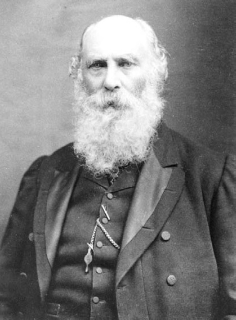
George Johnstone StoneyFRS, Irish physicist, dies on July 5, 1911, at Notting Hill, London, England. He is most famous for introducing the term “electron” as the “fundamental unit quantity of electricity.” He introduces the concept, though not the word, as early as 1874, initially naming it “electrine,” and the word itself comes in 1891. He publishes around 75 scientific papers during his lifetime.
Stoney is born on February 15, 1826, at Oakley Park, near Birr, County Offaly, in the Irish Midlands, the son of George Stoney and Anne (née Bindon Blood). His only brother is Bindon Blood Stoney, who becomes chief engineer of the Dublin Port and Docks Board. The Stoney family is an old-established Anglo-Irish family. During the time of the famine (1845–52), when land prices plummet, the family property is sold to support his widowed mother and family. He attends Trinity College Dublin (TCD), graduating with a BA degree in 1848. From 1848 to 1852 he works as an astronomy assistant to William Parsons, 3rd Earl of Rosse, at Birr Castle, County Offaly, where Parsons had built the world’s largest telescope, the 72-inch Leviathan of Parsonstown. Simultaneously he continues to study physics and mathematics and is awarded an MA by TCD in 1852.
From 1852 to 1857, Stoney is professor of physics at Queen’s College Galway. From 1857 to 1882, he is employed as Secretary of the Queen’s University of Ireland, an administrative job based in Dublin. In the early 1880s, he moves to the post of superintendent of Civil Service Examinations in Ireland, a post he holds until his retirement in 1893. He continues his independent scientific research throughout his decades of non-scientific employment duties in Dublin. He also serves for decades as honorary secretary and then vice-president of the Royal Dublin Society (RDS), a scientific society modeled after the Royal Society of London and, after his move to London in 1893, he serves on the council of that society as well. Additionally, he intermittently serves on scientific review committees of the British Association for the Advancement of Science from the early 1860s.
Stoney publishes seventy-five scientific papers in a variety of journals, but chiefly in the journals of the Royal Dublin Society. He makes significant contributions to cosmic physics and to the theory of gases. He estimates the number of molecules in a cubic millimeter of gas, at room temperature and pressure, from data obtained from the kinetic theory of gases. His most important scientific work is the conception and calculation of the magnitude of the “atom of electricity.” In 1891, he proposes the term “electron” to describe the fundamental unit of electrical charge, and his contributions to research in this area lays the foundations for the eventual discovery of the particle by J. J. Thomson in 1897.
Stoney proposes the first system of natural units in 1881. He realizes that a fixed amount of charge is transferred per chemical bond affected during electrolysis, the elementary chargee, which can serve as a unit of charge, and that combined with other known universal constants, namely the speed of lightc and the Newtonian constant of gravitationG, a complete system of units can be derived. He shows how to derive units of mass, length, time and electric charge as base units. Due to the form in which Coulomb’s law is expressed, the constant 4πε0 is implicitly included, ε0 being the vacuum permittivity.
Like Stoney, Max Planck independently derives a system of natural units (of similar scale) some decades after him, using different constants of nature.
Hermann Weyl makes a notable attempt to construct a unified theory by associating a gravitational unit of charge with the Stoney length. Weyl’s theory leads to significant mathematical innovations, but his theory is generally thought to lack physical significance.
Stoney marries his cousin, Margaret Sophia Stoney, by whom he has had two sons and three daughters. One of his sons, George Gerald Stoney FRS, is a scientist. His daughter Florence StoneyOBE is a radiologist while his daughter Edith is considered to be the first woman medical physicist. His most scientifically notable relative is his nephew, the Dublin-based physicist George Francis FitzGerald. He is second cousin of the grandfather of Ethel Sara Turing, mother of Alan Turing.
After moving to London, Stoney lives first at Hornsey Rise, north London, before moving to 30 Chepstow Crescent, Notting Hill, west London. In his later years illness confines him to a single floor of the house, which is filled with books, papers, and scientific instruments, often self-made. He dies at his home on July 5, 1911. His cremated ashes are buried in St. Nahi’s Church, Dundrum, Dublin.
MacEoin is born Vincent O’Rahilly McGuone to Malachy McGuone, owner of the Central Hotel in Pomeroy and a wine and spirit merchant, and Catherine (née Fox). He has three siblings. Both of his parents are nationalists, and name all their children after leaders of the Easter Rising in 1916. Under the First Dáil in 1918, his father is appointed a judge. This results in him being interned on the prison ship Argenta on Larne Lough from 1922 to 1923. The family moves to Dublin after his release. His father dies in 1933, which leads to his wife running a workingmen’s café in East Essex Street. The family later lives on Marlborough Road, Donnybrook.
MacEoin attends boarding school at Blackrock College and is then articled to the architectural practice of Vincent Kelly in Merrion Square. As an active republican, he lives in a house on Northumberland Road from late 1939 to May 1940 where he helps in the production and distribution of an Irish Republican Army (IRA) weekly newspaper, War News. The IRA is banned by the Irish government in 1936, and its bombing campaign in Britain in 1939 is viewed by the government as a threat to Irish neutrality. MacEoin is among a group of republicans arrested in June 1940 and imprisoned in Arbour Hill Prison for a year. Once released, he is rearrested and interned at the Curragh for three years. He is sentenced to 3-months imprisonment in October 1943 for possession of incriminating documents. He is also charged with possession of ammunition, but testifies he was given the rounds against his will and never appears to have engaged in any violence. During his internment, he is taught the Irish language by Máirtín Ó Cadhain and is exposed to the socialist views of his fellow inmates. It is at this time that he adopts the Irish form of his name, Uinseann MacEoin.
While imprisoned in the 1940s, MacEoin continues his studies by correspondence and qualifies as an architect in 1945 at University College Dublin (UCD). His designs for a memorial garden in 1946 to those who died during the Irish War of Independence are commended. In 1959, he designs the site in Ballyseedy, County Kerry, for a monument by Yann Goulet commemorating those killed in the Irish Civil War and members of the IRA from Kerry who died. In 1948, he qualifies in town planning and takes up a position with Michael Scott‘s architectural practice. He works for a short time with Dublin Corporation, with their housing department, before establishing his own practice in 1955.
During the 1950s, MacEoin is a contributing editor on interior design in Hugh McLaughlin‘s magazine Creation, becoming editor of Irish Architect and Contractor in 1955. He enters into a partnership with Aidan Kelly in 1969 as MacEoin Kelly and Associates. In the early 1970s, he designs a shopping and housing development outside Dundalk, called Ard Easmuinn. Throughout the 1960s and 1970s, he continues as an influential architectural journalist, founding and editing Build from 1965 to 1969, and later Plan. His company, Pomeroy Press, publishes Plan along with other serials such as Stream and Field. He writes a large proportion of the copy in these periodicals, much under his own name, but he also uses pseudonyms, in particular in Plan as “Michael O’Brien.” He writes about his strong views on social housing, national infrastructure, and foreign and slum landlords, often libelously.
Despite his republican and socialist views, MacEoin is a staunch advocate for the preservation of Georgian Dublin, and campaigns for their preservation. On this topic, he writes letters to newspapers, takes part in television and radio discussions, writes comment pieces and editorials, speaks at public hearings, and takes part in direct protests such as sit-ins in buildings including those on Baggot Street, Pembroke Street, Hume Street, and Molesworth Street. He is also an active member of the Irish Georgian Society, and he campaigns actively against the road widening schemes in Dublin the 1970s and 1980s.
MacEoin and his wife purchase five Georgian houses on Mountjoy Square and three on Henrietta Street in the 1960s, all almost derelict. They refurbish them and lease them out, under the company name Luke Gardiner Ltd. He renames the 5 Henrietta Street property James Bryson House. His architectural practice moves into one of the Mountjoy Square houses. Along with fellow campaigners, Mariga Guinness and Deirdre Kelly, this demonstrates that these buildings can be salvaged and are not the dangerous structures other architects and developers claim them to be. He also purchases and saves Heath House, near Portlaoise, County Laois, living there toward the end of his life. He offers free conservation and architectural advice to community groups and is a volunteer on the renovation works on projects including Tailors’ Hall.
MacEoin remains politically active, joining Clann na Poblachta, the Wolfe Tone Societies (WTS), the Dublin Civic Group, the Northern Ireland Civil Rights Association (NICRA) and the Irish Anti-Apartheid Movement. To what extent he is involved in republican or IRA activities after 1945 is not clear. However, in March 1963, he is called a witness to a case in Scotland involving a Glasgowbookmaker by the name of Samuel Docherty and the Royal Bank of Scotland. Docherty claims the bank owes him £50,000. MacEoin testifies that in February 1962 he had travelled with £50,000 in cash from Dublin to lodge to Docherty’s account in the Royal Bank of Scotland in Belfast, as a loan. When asked about the origin of this large sum of money, he states it was supplied by another person but does not divulge that person’s name. This immediately triggers the court’s suspicions, and the judge warns MacEoin he will be contempt of court if he does not name the supplier of the money. He is placed in police custody for the day, and eventually he agrees to give the name in writing in confidence to the judge. The judge ultimately rules that Docherty is guilty of attempted fraud and perjury and that MacEoin’s involvement reeks of criminality. However, no further action is ever brought forward against Docherty or MacEoin.
In Sinn Féin‘s 1971 Éire Nua social and economic programme, MacEoin writes the chapter on “Planning,” and attends meetings in Monaghan in the early 1970s on the Dáil Uladh, a parliament for the 9-county Ulster province. In 1981, during the republican hunger strikes, one of his Mountyjoy Square houses is used as the national headquarters of the National H-Block Committee. Following the 1986 Sinn Féin split, he supports Republican Sinn Féin. He is a founding member of the Constitutional Rights Campaign in 1987, a group which aims to protect the rights of Irish citizens in the European Economic Community (EEC), having campaigned against Ireland joining the EEC in the early 1970s. In 1978, he is sentenced to two weeks in Mountjoy Prison for non-payment of a fine issued for not having a television licence. He had refused to buy one to protest the lack of Irish language programming.
As an environmentalist, MacEoin opposes private car ownership, and advocates for cycleways and the redevelopment of the railway lines. He writes about the “greenhouse effect” as early as 1969. As a hill walker and mountaineer, he claims to be the first Irishman to register successful climbs of all 284 Scottish peaks, known as the Munros, in 1987. He also climbs in the Alps and the Pyrenees.
MacEoin writes three books on his memories, and those of his former comrades: Survivors (1980), on the lives of leading Irish republicans, Harry (1986), a part biography part autobiography of Harry White, and The IRA in the twilight years 1923–48 (1997). He also publishes a novel, Sybil: a tale of innocence (1992) with his publishing house, Argenta, under the name Eoin O’Rahilly. He also interviews and records dozens of Republicans as part of his research for his books. These recordings are later converted into a digital oral history archive held in trust by the Irish Defence Forces.
MacEoin marries Margaret Russell in 1956 in Navan, County Meath. They have a daughter and two sons.
MacEoin dies in a nursing home in Shankill, Dublin, on December 21, 2007. His estate at the time of his death is valued at over €3 million. His son, Nuada, takes over his father’s architectural practice.
Ahern is married to Moira Murray, and they have five sons and one daughter. His eldest son, Dylan Ahern, is found dead in his apartment on November 22, 2009.
Ahern is the elder brother of Bertie and Noel Ahern, both of whom serve as Fianna Fáil TDs, with Bertie serving as Taoiseach from 1997 to 2008.
Ahern is the Fianna Fáil candidate in the Dublin Centralby-election which is held on June 5, 2009. He loses that election being beaten into 5th place. On the same day, he also loses his council seat in the 2009 Irish local elections.
Farrell is born in 1827 in Mecklenburgh Street (later called Railway Street) in Summerhill, Dublin, one of six sons of Terence Farrell, sculptor, and Maria Farrell (née Ruxton). He trains as a sculptor in his father’s workshops. In 1842 he enters the modelling school of the Royal Dublin Society, where he is awarded the prize for “Original design in clay” the following year. He is awarded premiums by the Royal Irish Art Union in 1844 and 1846. As a student he becomes acquainted with the neoclassical sculpture of John Flaxman and John Hogan. His first commission is a monument to ArchbishopDaniel Murray in St. Mary’s Pro-Cathedral in Dublin.
Throughout his career, Farrell remains actively involved in the Royal Hibernian Academy (RHA). He is elected directly as a full member in 1860 rather than undergoing an initial phase of associate membership. He exhibits almost annually with the academy until his death. He holds a number of posts, including professor of sculpture and treasurer, before being elected president in 1893, being the first sculptor to be so honoured. His achievements are recognised with a knighthood in May 1894.
Farrell dies at his residence, Redesdale House, in Stillorgan, County Dublin, on July 2, 1900. He is a shy, retiring man, and his death is not announced to the public for three days, in keeping with his wishes to avoid any sort of elaborate display on his behalf. Intensely private, he never marries and lives a life immersed in his work. Contemporary accounts describe him as constantly dissatisfied with his work despite consistent public approval for it.
Barry returns to Bandon in early 1919. He describes in his guerilla days in Ireland a Damascus-like conversion to Irish nationalism on hearing of the Easter Rising while with the Mesopotamian expeditionary force, but he is only accepted into the IRA with considerable caution. Initially tested in intelligence and training work, in mid-1920 he takes charge of the new brigade flying column, which is used both to train officers and to stage offensive actions.
Barry adapts his military experience successfully to the demands of guerrilla warfare, becoming the most famed of column leaders during the Irish War of Independence. In his memoirs, he pours scorn on the obsession of many with military titles and orthodox procedure, complaining of a “paper army.” He stresses the need for spontaneity, initiative, and knowledge of local conditions. “The reality,” he writes, “was a group of fellows, mostly in caps and not-too-expensive clothing, wondering how to tackle their job and where they would sleep that night or get their supper.” (The Reality of the Anglo–Irish War (1974)). He well realises that the war’s character does not permit any close control from the IRA’s GHQ in Dublin, hence increasing the importance of local leaders. His tactics put strong emphasis on speed of movement and on the need to attack the enemy at his weakest point. The column’s ambush successes are small in number but among the best-remembered of the war. He admits, however, that his own and his column’s lack of experience with mines frequently weakened their offensives.
The column’s first successful ambush is at Tooreen on October 22, 1920, followed on November 28 by the dramatic ambushing of a patrol of auxiliaries at Kilmichael while travelling from their Macroom base. A column of thirty-six men, divided into three sections, kill sixteen auxiliaries, with one captured and later shot, suffering two fatalities of their own. Controversy has raged since over whether a false surrender by the British force caused the brutality of some of the deaths. Together with the Bloody Sunday killings of a week earlier in Dublin, Kilmichael has a profound effect on the British military and political establishment, with the declaration in December of martial law for much of Munster and the implementation of wide-ranging internment, together with the authorisation of official reprisals.
After a short period in hospital with a heart condition, in early 1921 Barry leads unsuccessful attacks on Kilbrittain, Innishannon, Drimoleague, and Bandon barracks. The seizure of Burgatia House, outside Rosscarbery, in early February, and the successful resistance made there to British troops, wins much publicity but has little military significance. He is a leading figure in the brutal final stage of the war in the first six months of 1921, which sees widespread shooting of suspected spies and destruction of loyalist property. By March 1921, his flying column, with 104 men, is easily the largest in Ireland, and an explosives expert, Capt. McCarthy, has joined them.
The protracted engagement between Barry’s column and encircling British forces at Crossbarry on March 19, 1921, comes at a time when large-scale sweeps are making life increasingly difficult for the IRA. It consists of a daring and courageous breakout. Crossbarry is the largest action of the war, and Barry is to regard it as even more important than Kilmichael. Soon afterwards, Rosscarbery barracks is successfully attacked by a Barry-led party, representing one of the few successful such initiatives in 1921. Isolated triumphs, however, cannot hide the fact that pressure is increasing on the column, and he becomes increasingly critical of inactive regions. He is later to say that all County Kerry does during the war is to shoot one decent police inspector at Listowel Racecourse and a colleague of his. He is strongly critical also of the lack of assistance from GHQ and of the divisionalisation policy. He visits Dublin in May, travels around with Michael Collins, and is present when two American officers demonstrate the Thompson submachine gun. He is more aware than most of his 1st Southern Division colleagues of the scarcity of arms and ammunition at the war’s end.
During the truce, Barry becomes liaison officer for Munster, riling the British by insisting on his military rank, and criticising the IRA liaison men in Dublin for being overly deferential. He joins the overwhelming majority of the Cork IRA in opposing the Anglo–Irish Treaty but plays a characteristically maverick role throughout the treaty split. His independent attitude is heightened by his dislike of Liam Lynch, the republican IRA’s Chief of Staff, and his continuing respect for Michael Collins. He shows impatience at the long-drawn-out peace initiatives. In March 1922, therefore, he advocates armed confrontation with pro-treaty units over the occupation of barracks in Limerick, and on June 18 he submits a resolution, which only narrowly fails, at the army convention, giving British troops seventy-two hours to leave Dublin.
At the beginning of the Irish Civil War, Barry is arrested entering the Four Courts disguised as a woman. He escapes from an internment camp at Gormanston in early September 1922. For the rest of the war his actions mirror its confused nature. In late October 1922, he leads successful raids on the small towns of Ballineen and Enniskean, and later on Inchigeelagh and Ballyvourney. In December his column takes Carrick-on-Suir, demonstrating the weakness of the Free State army, but his talk of advancing on the Curragh and of large-scale actions does not materialise. There is no evidence that he is acting in accordance with any coordinated plan. By February 1923, he realises that the Republican IRA cause is hopeless and he is involved with Fr. Tom Duggan in efforts to get 1st Southern Division to declare a ceasefire. He journeys to Dublin to put pressure on the intransigent Lynch in this connection, telling Lynch, “I did more fighting in one week than you did in your whole life.”
Barry avoids capture in roundups after the war, remaining on the run until 1924. Unlike many republicans, he does not turn to constitutionalism, remaining strongly militaristic. He is always an unreconstructed republican, though by no means a naive one. In 1924 he becomes attached to Cleeves Milk Co., based in Limerick and Clonmel, and from 1927 to retirement in 1965 is general superintendent with the Cork harbour commissioners. He strongly advocates preserving the independence of the IRA army executive during the republican split of 1925–27. He is instrumental in continuing the drilling of IRA members and is a strong supporter of armed opposition to the Blueshirts.
During the 1930s Barry is arrested at various times for possession of arms and seditious utterances. He promotes an attack against a Freemasons’ meeting in Cork in 1936 and gives the orders for the killing on March 4 of that year of Vice-AdmiralHenry Boyle Somerville. He is opposed to the use by Frank Ryan of IRA volunteers to support the republican cause in the Spanish Civil War and to the proposals of Seán Russell for a bombing campaign in England. To maintain the link with traditional republicanism, he is elected IRA chief of staff in 1937. His plan, however, for the seizure of Armagh city, as part of a direct northern offensive, quickly collapses due to a leak of information, and he soon resigns his position. He forcefully attacks the bombing of English cities in 1938, regarding attacks on innocent civilians as immoral and counterproductive. He enlists in the National Army on July 12, 1940, only to be demobilised a month later. In 1946, he stands as an independent candidate in a by-election in the Cork Borough constituency, finishing at the bottom of the poll. He is more comfortable the following year touring the United States on an anti-partition platform.
In 1949 his Guerilla Days in Ireland is published. It proves a best-seller and has frequently been reprinted. It is well written in a forceful and direct style, one memoir needing no assistance from a ghost writer. Age does not mellow him: lawyers and bank managers are threatened by him over matters relating to his own column, and in 1974 he publishes a fierce pamphlet, angry at perceived slights in the Irish War of Independence memoir of Liam Deasy. He does strive to achieve a public reconciliation with Collins’s memory by unveiling the memorial to Collins at Sam’s Cross in 1966. On the outbreak of the Northern Ireland crisis in the late 1960s, he takes a militant line, castigating the argument that the Six Counties can be brought into the Republic by peaceful means, and asking when had peaceful means existed there. At the memorial meeting in Carrowkennedy, County Mayo, in 1971, he claims that there is a perfect right at the opportune time to take the Six Counties by force. He remains opposed to IRA bombing of civilian targets.
Barry dies in Cork on July 2, 1980. He is buried in St. Finbarr’s Cemetery, Cork. Early in the truce of 1921 he marries Leslie Price, one of the most active of Cumann na mBan members during and after the rising. They have no children.
While Barry always remains an influential figure in republican circles, he will be remembered best as the pioneer of guerrilla warfare, the hero of Kilmichael and Crossbarry. His military flair, individualism, and ruthlessness are well suited to the 1919–21 conflict. After that, his strained relations with colleagues and his lack of flexibility reduce his importance. While his life after the revolutionary era appears anti-climactic, he retains much of his charisma. In later years, he is ever willing to remind politicians and historians how far Ireland has retreated from republican ideals. He is often prickly and autocratic yet could be generous to old colleagues of either side of the treaty split. He is arguably the most intelligent but also the most intolerant of the revolutionary leaders.
(From: “Barry, Thomas Bernadine (‘Tom’)” by M. A. Hopkinson, Dictionary of Irish Biography, http://www.dib.ie, October 2009)
Burke is born in St. Clerens, County Galway on May 6, 1821, the second of three sons of James Hardiman Burke, an officer in the British Army7th Royal Fusiliers, and Anne Louisa Burke (nee O’Hara).
Burke enters the Royal Military Academy, Woolwich in May 1835. In December 1836 he fails his probationary exam and goes to Belgium to further his education. In 1841, he enters the Imperial Austrian Army and spends most of his time posted to northern Italy. Towards the end of 1847 he suffers health problems and ultimately resigns from the Austrian army in June 1848.
After returning to Ireland in 1848, he joins the Irish Constabulary (later the Royal Irish Constabulary). He does his cadet training at Phoenix Park Depot in Dublin between November 1849 and January 1850. At the end of 1850 he transfers to the Mounted Police in Dublin.
Burke emigrates to Australia, arriving in Hobart, Tasmania on February 12, 1853, and promptly sails for Melbourne. On April 1, 1853, he joins the recently established Victoria Police force.
After the South Australian explorer John McDouall Stuart reaches the centre of Australia, the South Australian parliament offers a reward of £2,000 for the promotion of an expedition to cross the continent from south to north, generally following Stuart’s route. In June 1860, Burke is appointed to lead the Victorian Exploring Expedition with William John Wills, his third-in-command, as surveyor and astronomical observer.
The expedition leaves Melbourne on August 20, 1860, with a total of 19 men, 27 camels and 23 horses. They reach Menindee on September 23, 1860, where several people resign.
Cooper Creek, 400 miles further on, is reached on November 11, 1860, by the advance group, the remainder being intended to catch up. After a break, Burke decides to make a dash to the Gulf of Carpentaria, leaving on December 16, 1860. William Brahe is left in charge of the remaining party. The small team of Burke, William Wills, John King and Charley Gray reach the mangroves on the estuary of the Flinders River, near where the town of Normanton now stands, on February 9, 1861. They never see open ocean due to flooding rains and swamps.
Already weakened by starvation and exposure, progress on the return journey is slow and hampered by the tropical monsoon downpours of the wet season. Gray dies four days before they reach the rendezvous at Cooper Creek. The other three rest for a day when they bury him. They eventually reach the rendezvous point on April 21, 1861, nine hours after the rest of the party had given up waiting and left, leaving a note and some food, as they had not been relieved by the party supposed to be returning from Menindee.
Burke’s party attempts to reach Mount Hopeless, the furthest outpost of pastoral settlement in South Australia, which is closer than Menindee, but fail and return to Cooper Creek. While waiting for rescue Wills dies of exhaustion and starvation. Soon after, Burke also dies, at a place now called Burke’s Waterhole on Cooper Creek in South Australia. The exact date of Burke’s death is uncertain but has generally been accepted to be June 28, 1861.
King survives with the help of Aborigines until he is rescued in September by Alfred William Howitt. Howitt buries Burke and Wills before returning to Melbourne. In 1862, Howitt returns to Cooper Creek and disinters Burke and Wills, taking them first to Adelaide and then by steamer to Melbourne where they are laid in state for two weeks. On January 23, 1863, Burke and Wills receive a State Funeral and are buried in Melbourne General Cemetery. Ironically, on that same day John McDouall Stuart and his companions, having successfully completed the south-north crossing, are received back at a large ceremony in Adelaide.
Adebari arrives in Dublin with his wife and two children in 2000. After he converts from Islam to Christianity, he flees Nigeria in 2000, and makes a claim for asylum on the grounds of religious persecution. His application is rejected because of a lack of evidence that he had personally suffered persecution. He does however gain automatic residency when his wife gives birth to a son in Ireland shortly after their arrival.
Adebari and his family settle in County Laois. He completes his master’s degree in intercultural studies at Dublin City University (DCU) and sets up a firm called Optimum Point Consultancy.
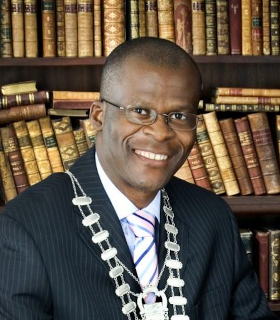
In 2004, Adebari is elected as a town councilor in local elections. On June 27, 2007, at the age of 43, he is elected mayor of the 9-member Portlaoise Town Council, by a vote of six to three and with support from Fine Gael, Sinn Féin and an Independent councilor. At a meeting attended by officials from the Nigerian, South African, and the United States embassies, the new mayor is quoted as saying his election is proof that “Ireland is not just a country of a thousand welcomes, but it is a country of equal opportunity.” In the 2009 local elections he is re-elected to the town council and also to Laois County Council for the Portlaoise electoral area.
In 2007, Adebari denies claims that he was a train operator in London who worked out of the Queen’s Park station on the Bakerloo line. Multiple London Underground employees, including Paddy Clarke, a retired tube driver from County Louth, state that Adebari worked as a train driver in London during the late 1990s before moving to Ireland. Clarke states, “at the very least fifty drivers and six or more managers will remember him. His photograph and signature are on file with London Underground’s personnel office which were used in the issue of his free travel-pass and identity card.” Adebari asserts he traveled to Ireland directly from Nigeria via Paris, and never worked or lived in London at any time.