Edward Bruce is proclaimed the last High King of Ireland on June 29, 1315. He is crowned in 1316. He reigns between 1315 and 1318. The English colonists in Ireland vehemently oppose him.
Bruce, the brother of the King of Scots, Robert the Bruce, leads a three-year military campaign, known as the Bruce campaign, against the Anglo-Norman lordship of Ireland. This invasion, which lasts from 1315 to 1318, ultimately gives rise to the two nations we recognize now as Ireland and Scotland.
In May 1315, a Scots army of up to six thousand soldiers lands on the Antrim coast. That June, near Carrickfergus, many Gaelic lords led by Donnell O’Neill of Ulster join Bruce. “All the Gaels of Ireland agreed to grant him lordship and they called him King of Ireland,” declares the Irish annals.
The invasion coincides with the Great European Famine (1315-1317), which brings hardship and disillusionment among Bruce’s followers. The annals ruefully comment, “falsehood and famine and homicide filled the country, and undoubtedly men ate each other in Ireland.”
In February 1317, Dublin, the capital of the English royal administration in Ireland, comes close to being captured by the Bruce brothers. The brothers encamp at Castleknock within sight of the city walls. The panicking Dubliners burn the suburbs of the city. In order to re-fortify the city walls, they dismantle the Dominicanpriory north of the River Liffey and tear down the bridge across the river. The Bruce brothers do not lay siege to the city and instead move south to Munster.
In 1318, the invasion is brought to an end when, after marching south from Ulster for one last push, Bruce risks an open battle with an English army north of Dundalk at Faughart and is killed. His corpse is dismembered, and portions of it hung over the gates of various Irish towns. His decapitated head is brought to King Edward II of England by the victor, John de Bermingham, a minor Anglo-Irish baron who is elevated to the status of “Earl of Louth” for bringing the Bruce campaign in Ireland to an end.
A conference at Trinity College Dublin, in 2015, entitled The Irish-Scottish World in the Middle Ages, explores this key moment in the history of Ireland and Scotland. “The Bruce Invasion was a watershed moment in that story,” says Seán Duffy, Professor of Medieval Irish History and one of the organizers of the conference.
“Although Edward Bruce was defeated and killed in 1318, the effect of the invasion was far-reaching. The tide of Anglo-Norman expansion in Ireland turned back and the late Middle Ages saw the flowering of a Gaelic literary and cultural revival. Scotland, meanwhile, was galvanized by its victory over the English at Bannockburn which secured its path to independent nationhood.”
“Few peoples have as much in common as the Irish and the Scots. The very name Scotland is an ever-present reminder of that connection, because, in the Latin of the early Middle Ages, a Scotus was an Irishman, and the homeland of the Scoti was Ireland. That the name came to be applied to the northern part of Britain is testament to the strength of Irish influence on what we now know today as Scotland.”
(From: “On This Day: Edward Bruce, the last High King of Ireland, dies in 1318” by IrishCentral Staff, http://www.irishcentral.com, October 2022 | Pictured: Grave of Edward de Bruce, High King of Ireland, in Faughart Cemetery, County Louth)
The Society of United Irishmen is formed in October 1791 by leading citizens in Belfast who seek a representative government in Ireland based on principles they believe have been modelled by the American and French Revolutions. At their first meeting they embrace the argument of Theobald Wolfe Tone for a “brotherhood of affection” between Irishmen of all religious persuasions. Tone argues that in Ireland the landed AnglicanAscendancy and the English appointed Irish executive employ division between Protestants and Catholics to balance “the one party by the other, plunder and laugh at the defeat of both.”
Despairing of reform, and in the hope of French assistance, in May 1798, the United Irishmen take up arms against the Dublin government and the British Crown. Beginning in Kildare, the insurrection spreads to other counties in Leinster before finally reaching the Presbyterian districts surrounding Belfast. On June 5, the Antrim societies of United Irishmen meet in Templepatrick where they elect textile manufacturer Henry Joy McCracken as their General. The next day McCracken issues a proclamation calling for the United army of Ulster to rise. The initial plan meets with success, as the towns of Larne, Ballymena, Maghera and Randalstown are taken and the bridge at Toome is damaged to prevent the government rushing reinforcements into Antrim from west of the River Bann.
According to the memoirs of James Burns from Templepatrick, Dickey commands the insurgents at Randalstown and kills Samuel Parker, a “traitor, with his own hands, while standing at his own door, where he went for the purpose.”
McCracken leads a body of about 6,000 rebels in an attack on Antrim town. As promised, Catholic Defenders turn out, but in the march upon the town tensions with the Presbyterian United Irish causes some desertions and a delay in McCracken’s planned assault. McCracken’s men are defeated, and his army melts away. On June 15, Dickey, together with McCracken, James Hope, James Orr and about fifty other rebel survivors from Antrim, arrive at Slemish, near Ballymena. There they set up camp for three weeks before leaving under threat of attack from Colonel Green of the Tay Fencibles.
Dickey is captured by the Sutherland fencibles on Divis, a hill northwest of Belfast. He is court-martialed and hanged at Corn Market, Belfast on June 26, 1798. Famously, before his hanging he refuses to wear a black hood saying to the hangman, “Sir, don’t cover my face!” According to local legend he shouts, “Don’t think gentlemen, I am ashamed to show my face among you, I am dying for my country!” However, a loyalist source hostile to the United Irish cause, Henry Joy of the Belfast News Letter, has Dickey on the scaffold recanting his commitment to the “brotherhood of affection” between Catholic and Protestant. He supposedly warned the assembled that had “the Presbyterians of the north succeeded in their [republican] designs, they would ultimately have had to contend with the Roman Catholics.” It is testament to the sentiment that in the north is to largely expunge the memory of his, and McCracken’s, sacrifice.
Dickey is 22 years old at the time of his execution. His head is placed on a spike outside the Market House on Belfast’s High Street.
Dickey’s brother, John Dickey of Crumlin, is also implicated in the rebellion. He is informed on by neighbours who had noticed that he was making pikes and attending secret meetings of the United Irishmen late at night. Arrested and court-martialed, he refuses the terms granted by the government to the “State Prisoners” in Dublin. He is transported to the West Indies for penal servitude but manages to escape and makes his way to the United States.
(Robert John) Douglas Gageby, one of the pre-eminent Irish newspaper editors of his generation, dies on June 24, 2004, following a lengthy illness. His life is well documented and a book of essays about him, Bright Brilliant Days: Douglas Gageby and the Irish Times, written by many of his colleagues, some of whom had attained fame for their literary achievements, is published in 2006.
Gageby is educated at Belfast Royal Academy and Trinity College Dublin, where he is elected a scholar in Modern Languages (French and German) in 1940. He is also actively involved with the student newspaper, Trinity News. He enlists in the Irish Army as a private soldier at the outbreak of World War II. He is commissioned later, and he serves as an intelligence officer. He reports from post-war Germany for The Irish Press and goes on to work under Conor Cruise O’Brien in the Irish News Agency. In 1954 he is the first editor of the Evening Press. In 1963 he becomes editor of The Irish Times, a post he holds until 1986, having been brought back from a short retirement in 1974. He is credited with moving The Irish Times from a Unionist organ into a successful Irish journal of record.
In 2003 it is revealed that a director, and later Chairman, of The Irish Times, Major Thomas Bleakley McDowell, had referred to Gageby as a “white nigger” for his views and role in the paper during the Northern Ireland civil rights movement‘s campaign in the 1960s. The comment appears in a letter from the British Ambassador to Dublin, Sir Andrew Gilchrist, to Kelvin White, head of the Irish Section of the British Foreign Office and is dated October 2, 1969. Gilchrist is referring to conversations which he had with McDowell where the latter professes himself to be fully behind the British government in the North and hostile to Gageby’s coverage of the civil rights movement. However, historian Mark O’Brien notes, “Despite his contacts with London, McDowell’s actions did not interfere with Gageby’s editorials on Northern Ireland”, due to the fact McDowell believes in editorial independence (even though McDowell strongly disagrees with Gageby’s nationalist views), and because Gageby is making the newspaper commercially successful. Under the 30 year rule, this letter is made available to newspapers on December 22 and 23, 1999, but no newspaper publishes it at that time.
The communiqué is later discovered by the historian Jack Lane and published in the Irish Political Review, a small magazine strongly antagonistic to The Irish Times, in January 2003. He brings it to the attention of The Irish Times editor, Geraldine Kennedy, on January 10, 2003, and she replies on January 15, 2003 saying she is “unable to confirm the veracity of it” and does not publish it. When, on January 26, 2003, the Sunday Independent (Ireland) publishes the story, The Irish Times finally follows the next day, January 27. Nonetheless, on April 24, 2004, Kennedy defends her position by saying, “The contents of the letter in question were published on January 27, 2003, as soon as its existence was drawn to my attention.”
Gageby dies on June 24, 2004, following a two year illness. His private funeral is conducted by Rev. Terence McCaughey, a family friend. The Irish Times endows an annual Douglas Gageby Fellowship for young journalists and a stand of trees is planted in his memory at Moynalty. His papers are presented to Dublin City University (DCU).
After the defeat of his side, Gannon spends a considerable time under internment together with numerous others. He is completely unreconciled to the victory of the “Free Staters,” and together with two fellow detainees, Archie Doyle and Timothy Coughlin, take part in forming a secret “vengeance grouping.” The three vow that once free of imprisonment they will take revenge on their opponents, whom they consider traitors to the Irish cause.
Most such private revenge pacts are broken up by the IRA leadership when it reorganises after 1924, but Gannon and his two fellow conspirators persist and carry through their deadly aim. The act which first makes Gannon, Doyle and Coughlin well-known is the assassination of Minister for JusticeKevin O’Higgins. On Sunday, July 10, 1927, the three surprise O’Higgins on the Booterstown Avenue side of Cross Avenue in Blackrock, County Dublin, and shoot him down.
O’Higgins is especially hated by IRA members for having ordered the executions of seventy-seven of their fellows during the Civil War, an act for which he outspokenly took responsibility and refused to express any remorse. Moreover, he was a dominant member of the Free State government, and the conspirators had good reasons to believe that his death would weaken it.
None of the three is ever apprehended or charged with the assassination, though Coughlin is killed by a police informer in 1928 under circumstances which remain controversial up to the present. Gannon and Doyle benefit from the amnesty for IRA members issued by Éamon de Valera on his accession to power in 1932, and after that date they can openly admit their part in assassinating O’Higgins without fear of being prosecuted.
By this time, Gannon has already turned to the Left and become a leading member of the Communist Party of Ireland when it is refounded in 1933. This decision is possibly influenced by Donal O’Reilly, his lifelong companion who had been with him at the Four Courts and who already joined the Communist Party in its earlier incarnation under Roddy Connolly. The radical left-wing commentator Jack Cleary approvingly mentions Gannon as among the few IRA militants who have “given up the gun in favor of working-class politics.” This is in marked contrast to Gannon’s aforementioned fellow-assassin Archie Doyle, who continues to take part in IRA armed raids well into the 1940s.
Being an Irish Communist in these years carries, however, its own risks. Gannon is mentioned as being among the defenders of Connolly House, the party’s Dublin headquarters, when it is attacked and ultimately set on fire by a right-wing mob in 1933. In subsequent years Communists continue to suffer constant harassment, often descending into outright violence.
Gannon is at present mainly remembered for his major part in organising Irish volunteers (the Connolly Column) to fight on the Republican side in the Spanish Civil War, a work undertaken in close co-operation with Frank Ryan and Peadar O’Donnell, and which comes to overshadow his earlier fame (or notoriety) in connection with the O’Higgins assassination.
Gannon dies at the age of 63 on September 12, 1965. He gets a well-attended party funeral; his coffin being draped with a red flag and the Irish Tricolor.
Costello is the younger son of John Costello senior, a civil servant, and Rose Callaghan. He is educated at St. Joseph’s, Fairview, and then moves to O’Connell School, for senior classes, and later attends University College Dublin (UCD), where he graduates with a degree in modern languages and law. He studies at King’s Inns to become a barrister, winning the Victoria Prize there in 1913 and 1914. He is called to the Irish Bar in 1914, and practises as a barrister until 1922.
In 1922, Costello joins the staff at the office of the Attorney General in the newly established Irish Free State. Three years later he is called to the inner bar, and the following year, 1926, he becomes Attorney General of Ireland, upon the formation of the Cumann na nGaedheal government, led by W. T. Cosgrave. While serving in this position he represents the Free State at Imperial Conferences and League of Nations meetings.
Costello is also elected a Bencher of the Honourable Society of King’s Inns. He loses his position as Attorney General of Ireland when Fianna Fáil comes to power in 1932. The following year, however, he is elected to Dáil Éireann as a Cumann na nGaedheal TD. Cumann na nGaedheal soon merges with other parties to form Fine Gael.
During the Dáil debate on the Emergency Powers Act 1939, Costello is highly critical of the Act’s arrogation of powers, stating that “We are asked not merely to give a blank cheque, but to give an uncrossed cheque to the Government.” He loses his seat at the 1943 Irish general election but regains it when Éamon de Valera calls a snap election in 1944. From 1944 to 1948, he is the Fine Gael front-bench Spokesman on External Affairs.
In 1948, Fianna Fáil has been in power for sixteen consecutive years and has been blamed for a downturn in the economy following World War II. The 1948 Irish general election results show Fianna Fáil short of a majority, but still by far the largest party, with twice as many seats as the nearest rival, Fine Gael. It appears that Fianna Fáil is headed for a seventh term in government. However, the other parties in the Dáil realise that between them, they have only one seat fewer than Fianna Fáil, and if they band together, they would be able to form a government with the support of seven Independent deputies. Fine Gael, the Labour Party, the National Labour Party, Clann na Poblachta and Clann na Talmhan join to form the first inter-partygovernment in the history of the Irish state.
While it looks as if cooperation between these parties will not be feasible, a shared opposition to Fianna Fáil and Éamon de Valera overcomes all other difficulties, and the coalition government is formed.
Since Fine Gael is the largest party in the government, it has the task of providing a suitable candidate for Taoiseach. Naturally, it is assumed that its leader, Richard Mulcahy, will be offered the post. However, he is an unacceptable choice to Clann na Poblachta and its deeply republican leader, Seán MacBride. This is due to Mulcahy’s record during the Irish Civil War. Instead, Fine Gael and Clann na Poblachta agree on Costello as a compromise candidate. Costello had never held a ministerial position nor was he involved in the Civil War. When told by Mulcahy of his nomination, Costello is appalled, content with his life as a barrister and as a part-time politician. He is persuaded to accept the nomination as Taoiseach by close non-political friends.
During the campaign, Clann na Poblachta had promised to repeal the Executive Authority (External Relations) Act 1936 but does not make an issue of this when the government is being formed. However, Costello and his Tánaiste, William Norton of the Labour Party, also dislike the act. During the summer of 1948, the cabinet discusses repealing the act, however, no firm decision is made.
In September 1948, Costello is on an official visit to Canada when a reporter asks him about the possibility of Ireland leaving the British Commonwealth. For the first time, he declares publicly that the Irish government is indeed going to repeal the External Relations Act and declare Ireland a republic. It has been suggested that this is a reaction to offence caused by the Governor General of Canada at the time, Harold Alexander, 1st Earl Alexander of Tunis, who is of Northern Irish descent and who allegedly arranges to have placed symbols of Northern Ireland in front of Costello at an official dinner. Costello makes no mention of these aspects on the second reading of the Republic of Ireland Bill on November 24 and, in his memoirs, claims that Alexander’s behaviour had in fact been perfectly civil and could have had no bearing on a decision which had already been made.
The news takes the Government of the United Kingdom and even some of Costello’s ministers by surprise. The former had not been consulted and following the declaration of the Republic in 1949, the UK passes the Ireland Act that year. This recognises the Republic of Ireland and guarantees the position of Northern Ireland within the United Kingdom for so long as a majority there want to remain in the United Kingdom. It also grants full rights to any citizens of the Republic living in the United Kingdom. Ireland leaves the Commonwealth on April 18, 1949, when The Republic of Ireland Act 1948 comes into force. Frederick Henry Boland, Secretary of the Department of External Affairs, says caustically that the affair demonstrates that “the Taoiseach has as much notion of diplomacy as I have of astrology.” The British envoy, John Maffey, 1st Baron Rugby, is equally critical of what he calls a “slipshod and amateur” move.
Many nationalists now see partition as the last obstacle on the road to total national independence. Costello tables a motion of protest against partition on May 10, 1949, without result.
In 1950, the independent-minded Minister for Health, Noël Browne, introduces the Mother and Child Scheme. The scheme would provide mothers with free maternity treatment and their children with free medical care up to the age of sixteen, which is the normal provision in other parts of Europe at that time. The bill is opposed by doctors, who fear a loss of income, and Roman Catholic bishops, who oppose the lack of means testing envisaged and fear the scheme could lead to birth control and abortion. The cabinet is divided over the issue, many feeling that the state cannot afford such a scheme priced at IR£2,000,000 annually. Costello and others in the cabinet make it clear that in the face of such opposition they will not support the Minister. Browne resigns from the government on April 11, 1951, and the scheme is dropped. He immediately publishes his correspondence with Costello and the bishops, something which had hitherto not been done. Derivatives of the Mother and Child Scheme are introduced in Public Health Acts of 1954, 1957 and 1970.
The Costello government has a number of noteworthy achievements. A new record is set in housebuilding, the Industrial Development Authority and Córas Tráchtála are established, and the Minister for Health, Noel Browne, with the then new Streptomycin, bring about an advance in the treatment of tuberculosis. Ireland also joins a number of organisations such as the Organization for European Economic Co-operation and the Council of Europe. However, the government refuses to join NATO, allegedly because the British remain in Northern Ireland. The scheme to supply electricity to even the remotest parts of Ireland is also accelerated.
While the “Mother and Child” incident does destabilise the government to some extent, it does not lead to its collapse as is generally thought. The government continues; however, prices are rising, a balance of payments crisis is looming, and two TDs withdraw their support for the government. These incidents add to the pressure on Costello and so he decides to call a general election for June 1951. The result is inconclusive but Fianna Fáil returns to power. Costello resigns as Taoiseach. It is at this election that his son Declan is elected to the Dáil.
Over the next three years while Fianna Fáil is in power a dual-leadership role of Fine Gael is taking place. While Richard Mulcahy is the leader of the party, Costello, who has proved his skill as Taoiseach, remains as parliamentary leader of the party. He resumes his practice at the Bar. In what is arguably his most celebrated case, the successful defence of The Leader against a libel action brought by the poet Patrick Kavanagh, dates from this period. Kavanagh generously praises Costello’s forensic skill, and the two men become friends.
At the 1954 Irish general election Fianna Fáil loses power. A campaign dominated by economic issues results in a Fine Gael-Labour Party-Clann na Talmhan government coming to power. Costello is elected Taoiseach for the second time.
The government can do little to change the ailing nature of Ireland’s economy, with emigration and unemployment remaining high, and external problems such as the Suez Crisis compounding the difficulty. Measures to expand the Irish economy such as export profits tax relief introduced in 1956 would take years have sizable impact. Costello’s government does have some success with Ireland becoming a member of the United Nations in 1955, and a highly successful visit to the United States in 1956, which begins the custom by which the Taoiseach visits the White House each St. Patrick’s Day to present the U.S. President with a bowl of shamrock. Although the government has a comfortable majority and seems set for a full term in office, a resumption of Irish Republican Army (IRA) activity in Northern Ireland and Great Britain causes internal strains. The government takes strong action against the republicans.
In spite of supporting the government from the backbenches, Seán MacBride, the leader of Clann na Poblachta, tables a motion of no confidence, based on the weakening state of the economy and in opposition to the government’s stance on the IRA. Fianna Fáil also tables its own motion of no confidence, and rather than face almost certain defeat, Costello again asks PresidentSeán T. O’Kelly to dissolve the Oireachtas. The general election which follows in 1957 gives Fianna Fáil an overall majority and starts another sixteen years of unbroken rule for the party. Some of his colleagues questioned the wisdom of his decision to call an election. The view is expressed that he was tired of politics and depressed by his wife’s sudden death the previous year.
Following the defeat of his government, Costello returns to the bar. In 1959, when Richard Mulcahy resigns the leadership of Fine Gael to James Dillon, he retires to the backbenches. He could have become party leader had he been willing to act in a full-time capacity. He remains as a TD until 1969, when he retires from politics, being succeeded as Fine Gael TD for Dublin South-East by Garret FitzGerald, who himself goes onto to become Taoiseach in a Fine Gael-led government.
During his career, Costello is presented with a number of awards from many universities in the United States. He is also a member of the Royal Irish Academy from 1948. In March 1975, he is made a freeman of the city of Dublin, along with his old political opponent Éamon de Valera. He practises at the bar until a short time before his death at the age of 84, in Ranelagh, Dublin, on January 5, 1976. He is buried at Dean’s Grange Cemetery in Dublin.
Stewart is born in 28 Henry Street, in Dublin’s Northside. He is the second and only surviving child of Robert Stewart (the elder) and his wife Sarah Frances Seymour-Conway. His parents marry in 1766. He has recurring health problems throughout his childhood, and is sent to The Royal School, Armagh, rather than to England for his secondary education. At the encouragement of Charles Pratt, 1st Earl Camden, who takes a great interest in him and treats him as if he is a grandson by blood, he later attends St. John’s College, Cambridge (1786–87), where he applies himself with greater diligence than expected from an aristocrat and excels in his first-year examinations. But he then withdraws, pleading an illness that he admits to Camden is something “which cannot be directly acknowledged before women,” i.e. something sexually transmitted.
Stewart organises and finances the alliance that defeats Napoleon, bringing the powers together at the Treaty of Chaumont in 1814. After Napoleon’s second abdication in 1815, he works with the European courts represented at the Congress of Vienna to frame the territorial, and broadly conservative, continental order that holds until mid-century. He blocks harsh terms against France believing that a treaty based on vengeance and retaliation will upset a necessary balance of powers. France is restored to the frontiers of 1791, and her British-occupied colonies are returned. In 1820 Stewart enunciates a policy of non-intervention, proposing that Britain hold herself aloof from continental affairs.
After 1815, at home, Stewart supports repressive measures that link him in public opinion to the Peterloo Massacre of 1819. Widely reviled in both Ireland and Great Britain, overworked, and personally distressed, he commits suicide on August 12, 1822. He is found in a dressing room seconds after he has cut his own throat using a small knife. He collapses and dies almost instantly.
(Pictured: “Robert Stewart, 2nd Marquess of Londonderry,” oil on canvas by Thomas Lawrence, National Portrait Gallery)
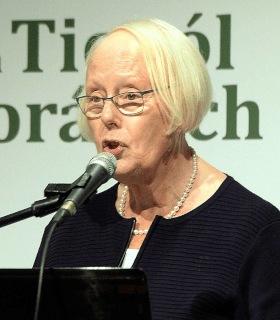
Initially after leaving school Laffoy tries primary school teaching at Carysfort College and joins the civil service. She is subsequently educated at University College Dublin (UCD) and King’s Inns. She receives the John Brooks Scholarship at the Inns for achieving the highest marks. She receives a BA from UCD in 1968 and a BCL in 1971.
Laffoy is called to the Bar in 1971 and to the Inner Bar in 1987. She devils for Brian McCracken. She becomes a Senior Counsel on the same day as future Supreme Court colleagues Susan Denham and Liam McKechnie and at the time is only one of four women seniors.
Laffoy’s expertise at the Bar is in property law. She appears in the Cityview Press case which clarifies the law on the nondelegation doctrine in Ireland. In 1983, she is appointed by the Supreme Court to argue against the constitutionality of the Electoral (Amendment) Bill 1983 following a reference made by PresidentPatrick Hillery under Article 26 of the Constitution of Ireland. She appears in another Article 26 reference made by Mary Robinson regarding the Matrimonial Home Bill 1993. For both references, the Supreme Court finds for her side.
Laffoy is appointed as a judge of the High Court in 1995, primarily presiding over cases involving chancery law.
Laffoy presides over the Commission to Inquire into Child Abuse from 1999 to 2003, an inquiry into child abuse. Her decision to resign as chair before the commission completes its report is controversial. In her letter of resignation from the commission of September 2, 2003, she outlines her belief that the actions of the Government and the Department of Education have frustrated her efforts and have slowed the commission’s work. She feels that “the cumulative effect of those factors effectively negated the guarantee of independence conferred on the Commission and militated against it being able to perform its statutory functions.” The commission is chaired from 2003 to 2009 by Judge Sean Ryan.
Laffoy presides over the High Court hearing in A v Governor of Arbour Hill Prison, ordering the release of a prisoner convicted of statutory rape due an earlier finding that the offence he was convicted of was contrary to the Constitution of Ireland. Her decision is overturned on appeal to the Supreme Court. In 2012, she dismisses an action taken by Thomas Pringle regarding the legality of the European Stability Mechanism. The European Court of Justice, after reference from the Supreme Court, also rejects his claim. During her time at the High Court, ten percent of reported judgments are written by her.
Laffoy is appointed to the Supreme Court of Ireland in July 2013. She retires from the Supreme Court on June 16, 2017. A portrait of her is unveiled in the King’s Inns in March 2020.
In July 2016, Laffoy is appointed by TaoiseachEnda Kenny to chair the Citizens’ Assembly, which she chairs until June 2018. She becomes the president of the Law Reform Commission in 2018.
Paul McGuinness, the founder of Principle Management Limited, a popular music act management company based in Dublin, is born on June 16, 1951, in Rinteln, Westphalia, Germany. He is the manager of the rock band U2 from 1978 to 2013.
McGuinness is born in a British military hospital at Rinteln where his father, Philip McGuinness, a native of Liverpool, is serving with the Royal Air Force. His mother, Sheila McGuinness (née Lyne), is a schoolteacher from County Kerry. There are three children in the family: Paul, Niall, and Katy.
McGuinness receives his early formal education in Ireland at the private Jesuit boarding school, Clongowes Wood College. From there he goes on to Trinity College Dublin, where he directs plays, edits the magazine T.C.D. Miscellany, and promotes gigs, but drops out before obtaining a degree.
Before becoming involved with U2, Guinness works as a film assistant director on productions such as John Boorman‘s Zardoz. For a time, he also manages folk-rock group Spud.
McGuinness first meets U2 at a Dublin gig on May 25, 1978, where they are supporting the Gamblers. Following this meeting, he becomes U2’s manager, having been introduced to the band by Bill Graham, a journalist with Hot Press magazine. His original agreement with the band is that the money is to be split equally five ways, though this is later changed.
McGuinness founds Principle Management Limited on March 29, 1984. He and Bill Whelan set up a music publishing company called McGuinness/Whelan Publishing in the late 1980s. Whelan later composes the music for the theatrical show Riverdance.
In 2002, McGuinness is presented with a Lifetime Achievement Award at the Meteor Music Awards at the Point Theatre in Dublin and U2 wins the best Irish Band Award.
Noted for his business acumen, McGuinness is responsible for U2 3D concert films, U2-branded iPods, sponsorship from BlackBerry and the first-ever concert streamed live on YouTube.
McGuinness is regarded as the fifth member of U2, although in an interview with The Irish Press in 1985, when asked if he is the fifth member of U2, he replies, “The fifth member of U2 is in Adam (Clayton)‘s trousers.” He is also regarded as one of the most successful managers in the music business.
McGuinness steps down as manager of U2 after 34 years on November 13, 2013, with Madonna‘s manager, Guy Oseary, succeeding him in 2014 when he sells Principle Management Limited to Live Nation.
McGuinness is a founding partner of TV3 (Ireland) and is one of the owners of Ardmore Film Studios. He becomes a member of the Arts Council of Ireland on January 1, 1988, having been appointed by Charles Haughey. He serves until February 2000 when he resigns.
McGuinness has been an advocate on behalf of artists, record labels, and music publishers. On January 28, 2008, in a speech at the Midem music industry convention in Cannes, he specifically accuses companies such as Apple, Google, Yahoo!, and Facebook of building “multi-billion dollar industries on the back of our content without paying for it.”
In 2015, McGuinness founds Primo Productions, a film and TV company. Primo produces three seasons of Riviera, a drama set in the South of France. He writes the “list of ingredients” for the show: “Rich people behaving badly in the sun, yachts, Maseratis, great clothes, beautiful women, art fraud, money laundering through the auction houses, Russians, English people, American, French. Murder, adultery.” Everyday life on the Côte d’Azur. His production partner is Kris Thykier of Archery Pictures. The show is originally commissioned by Anne Mensah of Sky Atlantic.
McGuinness marries Kathy Gilfillan in 1977. They meet while he is studying at Trinity. Gilfillan is director of The Lilliput Press. They have two children.
Dillon is born in Belfast in 1915 or 1916. He leaves school at the age of fourteen and for seven years works as a painter and decorator, mostly in London. From an early age he is interested in art, cinema, and theatre. About 1936 he starts out as an artist.
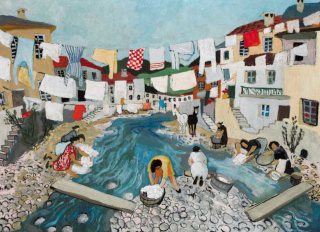
Dillon’s Connemara landscapes provide the viewer with context, portraits of the characters who work the land, atmosphere and idiosyncratic colour interpretations. At the age of 18, Dillon goes to London, initially working as a decorator. With the outbreak of World War II, he returns to Belfast. Over the next five years he develops as a painter in Dublin and Belfast. His works during this period are more than simple depictions of the life and people around him, they are reactions and interactions in paint.
In 1942, Dillon’s first solo exhibition is opened by his friend and fellow artist, Mainie Jellett, at The Country Shop, St. Stephen’s Green, Dublin. “Father, Forgive Them Their Sins” features depicting his concerns about the new war that had broken out. Despite a growing reputation, he has to return to London in 1944 to work on demolition gangs to restore his finances. In the late 1940s and during the 1950s, he finds himself favouring the town of Roundstone, County Galway. In 1951 he is introduced to Noreen Rice by her piano teacher. She has no formal training and she takes Dillon and George Campbell as her mentors for decades and her work is of a similar surrealistic and primitive style.
In 1958, Dillon has the double honour of representing Ireland at the Guggenheim International, and Great Britain at the Pittsburg International Exhibition. He and his sister, Mollie, have a property on Abbey Road in 1958. They let out part of the house to Arthur Armstrong and they let a flat to Noreen Rice and her brother. He and Noreen tour junk yards to find objects like leather and string that they include in their artwork.
Dillon travels widely in Europe and teaches for brief periods in the London art schools.
In 1967, Dillon suffers a stroke and spends six weeks in hospital. From this time his work changes direction. A notion of imminent death sends his work almost into another world, a realm of dreams and paintings intimating his death. In 1968 he is back in Dublin, where he helps to design sets and costumes for Seán O’Casey‘s play Juno and the Paycock. He continues to paint and also to make tapestries, sitting at his Singer sewing machine.
In 1969, Dillon pulls his artworks from the Belfast leg of the Irish Exhibition of Living Art in purported protest during the Troubles against the “arrogance of the Unionist mob.” However, he does send work to Ulster when he donates work to Sheelagh Flanagan who had organised an exhibition for the relief of victims of the Belfast riots, in October 1969. His picture is hanged alongside the donated works of T. P. Flanagan, William Scott, F. E. McWilliam, Deborah Brown and Carolyn Mulholland as well as more than twenty others. Michael Longley retorts in a further letter, “Belfast needed creativity, it needed people like Gerard Dillon.” During his last years, he is invited to be involved in a children’s art workshop in the National Gallery of Ireland.
Dillon dies of a second stroke at the age of 55 on June 14, 1971. His grave, as requested, is unmarked in Belfast’s Milltown Cemetery. Danlann Gerard Dillon/The Gerard Dillon Gallery in Cultúrlann McAdam Ó Fiaich is named in his honour.
In his biography of the artist, James White briefly touches on the artists homosexuality: “such was his religious feeling that although he was drawn to people of that type, if he once had an encounter I believe that it never occurred again.” The artist’s nephew, Martin Dillon, recalls that after his uncle’s death he found a diary entry describing a homosexual encounter with a sense of guilt, but the author Gerard Keenan insists he was “a very well-adjusted homosexual.” Reihill expands on this, pointing to a probably unrequited love for the painter Daniel O’Neill and also highlighted Dillon’s association with Basil Rákóczi and The White Stag Group‘s Kenneth Hall both strong gay connections. Pictures with both overt and covert references are known.
At the Athyby-election on June 12, 1741, following the death of Sir Walter Dixon Borrowes, James FitzGerald, styled Lord Ophaly and later 1st Duke of Leinster, is returned. In the course of the election there is a duel between William Paul Warren and Jack Hardy, which leads to Hardy’s right hand and arm being shattered. It is thought that it might have to be amputated.
In 1761 FitzGerald is created Earl of Offaly and Marquess of Kildare in the Peerage of Ireland and in 1766 he is further honoured when he is made Duke of Leinster, becoming by this time the Premier Duke, Marquess and Earl in the Peerage of Ireland.
FitzGerald dies at Leinster House, Dublin, on November 19, 1773, aged 51, and is buried in the city’s Christ Church Cathedral. He is succeeded by his second (but eldest surviving) son, William, Marquess of Kildare. The Duchess of Leinster causes a minor sensation by marrying her lover William Ogilvie in 1774 but continues to be known as The Dowager Duchess of Leinster. She has a further three children by him. She dies in London on March 27, 1814, aged 82.
In 1999, Irish Screen, BBC America and WGBH produce Aristocrats, a six-part limited television series based on the lives of Emily Lennox and her sisters. FitzGerald is portrayed by Ben Daniels.