seamus dubhghaill

Promoting Irish Culture and History from Little Rock, Arkansas, USA


Leave a comment

The Dungannon Land Mine Attack

The Provisional Irish Republican Army (IRA) ambushes two British Army Land Rovers with an improvised land mine outside DungannonCounty TyroneNorthern Ireland, on December 16, 1979. Four British soldiers are killed in the attack.

Since the beginning of its campaign in 1970, the Provisional IRA has carried out many improvised land mine and roadside bomb attacks on British forces in the region. In September 1972, three British soldiers are killed when their armoured vehicle is blown up by an IRA land mine at Sanaghanroe, near Dungannon. In March 1974, two IRA members are killed on the Aughnacloy Road near Dungannon when a land mine they are planting explodes prematurely.

The Dungannon attack occurs just months after the Warrenpoint ambush on August 27, 1979, where the IRA kills eighteen British soldiers with roadside bombs in south County Down — the deadliest single attack on British forces during The Troubles.

On December 16, 1979, two armoured British Army Land Rovers are driving along Ballygawley Road, about two miles outside Dungannon. A unit of the IRA had planted a 600–1,000-pound (270–450 kg) improvised land mine in a culvert under the road at Glenadush. When the second vehicle reaches the culvert, the land mine is detonated by remote control from a concealed location, showcasing their evolving tactics in guerrilla warfare and ambush strategy. The blast is powerful enough to launch the armoured Land Rover into the air and killing four soldiers from the Royal Regiment of Artillery outright: William Beck (23), Keith Richards (22), Simon Evans (19), and Allan Ayrton (23).


Leave a comment

The Proclamation of Dungannon

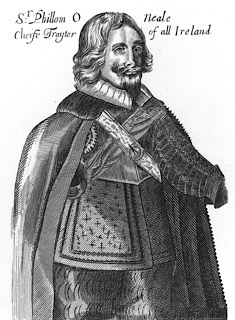
The Proclamation of Dungannon is a document produced by Sir Phelim O’Neill on October 24, 1641, in the Irish town of Dungannon. O’Neill is one of the leaders of the Irish Rebellion of 1641, which was launched the previous day. O’Neill’s Proclamation sets out a justification of the uprising. He claims to have been given a commission signed and sealed on October 1 by the King of England, Scotland and Ireland Charles I that commands him to lead Irish Catholics in defence of the Kingdom of Ireland against Protestants who sympathise with Charles’s opponents in the Parliament of England.

Following the trial and execution of the Lord Deputy of IrelandThomas Wentworth, 1st Earl of Strafford, in May 1641, Ireland is in a state of turmoil. There is growing tension between Catholics and Protestants (particularly those of a Puritan tendency) with the former generally sympathetic to King Charles while the latter supports the English Parliament and the Scottish Covenanters in the dispute that shortly leads to the outbreak of the English Civil War. This forms part of the wider War of the Three Kingdoms.

On October 23, a major uprising breaks out in Ulster organised by leading members of the Gaelic aristocracy. The rebels attack Protestant plantation settlements as well as native Irish Protestants and take garrison towns held by the Irish Army. Irish government authorities in Dublin struggle to contain the insurgency with the limited number of troops they have at their disposal. A last-minute warning saves Dublin Castle from a surprise attack, although O’Neill is clearly unaware of the failure of the Dublin plot when he issues his proclamation.

After seizing several key strategic points in Ulster over the previous twenty-four hours, O’Neill makes his proclamation in Dungannon, a town that has symbolic importance as the traditional capital of the O’Neill dynasty.

In support of his actions, O’Neill claims to have a document from King Charles commissioning him. The Commission is supposedly signed under the Great Seal of Scotland. By declaring their loyalty to the Crown and defence of the Catholic religion, O’Neill and his followers adopt a political stance which is taken up by the subsequent Irish Confederation which governs rebel-controlled territory in the name of the King from 1642 until 1649. The Proclamation encourages many Catholics to believe they can lawfully join the rising with the King’s blessing, while Protestants are left demoralised.

O’Neill’s second and more trenchant proclamation is made “from our camp at Newry” on November 4, 1641 alongside Rory Maguire. He also publishes the actual royal commission that gives authority for his earlier proclamation. It is subtly different, in that it empowers him to arrest and seize property from all of Charles’s English Protestant subjects living in Ireland, but exempts his Irish and Scottish subjects.

Until the late nineteenth century historians generally accept that the commission is genuine, or at the very least Charles had secretly encouraged the Irish Catholics to launch a rising. Since then, for a variety of reasons, it has been considered to be a forgery produced by O’Neill and his associates without the knowledge of the King. They may well have acquired a copy of the Great Seal of Scotland when they captured the garrison town of Charlemont on October 23.

The historian David Stevenson notes that it would be unlikely that the commission would have been addressed to O’Neill. Had it been genuine it would almost certainly have been issued to more senior Irish Royalists such as the James Butler, 1st Duke of Ormond, or the leading Catholic noble of Ulster, Randal MacDonnell, 1st Marquess of Antrim. It is also unlikely to have been issued at Edinburgh as O’Neill claimed. However, King Charles was in Edinburgh on October 1, dealing with Scottish political matters.

Forgery or not, King Charles publicly proclaims all the Irish rebels as traitors on January 1, 1642.

That the Commission is genuine is widely accepted in England and Scotland by the King’s opponents and even some of his own supporters. It seems to tie in with earlier rumours of an army plot which had suggested that Charles might bring over the New Irish Army, made up largely of Ulster Catholics, to impose his will on England and Scotland. Anger at the King’s alleged links with the insurgents grow – particularly as horror stories of atrocities committed, such as the Portadown Massacre, begin to filter across the Irish Sea. Tensions arising from news of the Irish rebellion is a factor in the English push to Civil War in early 1642.

The Scottish authorities dispatch an Army which quickly retakes much of Ulster from the insurgents. Once the English Civil War breaks out in October 1642, Charles’ emissaries begin negotiations with the Irish rebels for their support, which seems to present further evidence to his opponents of his links with the Catholic Ulster leaders. Many of these later dealings are exposed when Charles private letters are captured during the Battle of Naseby (1645) and published as King’s Cabinet Opened.

When O’Neill is captured in 1653 following the Cromwellian conquest of Ireland, he is put on trial for his life. The authorities offer to spare him if he will repeat his earlier claims that Charles had ordered the Catholics to rise in 1641. O’Neill now refuses to implicate the King, who had been executed four years earlier, and is put to death himself. Nonetheless, the English Republicans continue to use O’Neill’s earlier claims of the King’s involvement to justify their decision to commit regicide.


Leave a comment

The 1992 Coalisland Riots

The 1992 Coalisland riots are a series of clashes in the town of Coalisland, County Tyrone, Northern Ireland, on May 12 and 17, 1992, between local Irish nationalist civilians and British Army soldiers of the 3rd Battalion, Parachute Regiment and the King’s Own Scottish Borderers (KOSB). The Third Battalion 1992 tour’s codename is “Operation Gypsy.”

On May 12, 1992, a unit of the Provisional Irish Republican Army (IRA) East Tyrone Brigade launches a bomb attack on a British Army foot patrol near the republican stronghold of Cappagh, County Tyrone. One soldier of the Parachute Regiment, Alistair Hodgson, loses both legs as a result. The improvised land mine is described in an IRA statement as an “anti-personnel device.” Other paratroopers receive lesser wounds, according to the same statement. The incident triggers a rampage by members of the Parachute Regiment in the nearby, overwhelmingly Irish nationalist town of Coalisland, some ten miles to the east. The IRA attack is described as a “provocation” tactic, devised to produce an over-reaction by troops to make them even more unpopular among local nationalists.

The deployment of the paratroopers, which begins in April has already been criticised by republican activist and former Member of Parliament Bernadette Devlin McAliskey, who denounces beatings, shootings and damages to property reportedly carried out by the troops. These previous incidents include the destruction of fishing gear and boats in the townland of Kinturk, near Ardboe, and a brawl on April 22 between soldiers and motorists at a checkpoint in Stewartstown, in which plastic bullets are fired that end with a civilian and two paratroopers wounded. Unionist politician and Ulster Defence Regiment (UDR) officer Ken Maginnis, then-Member of Parliament for the area, calls for the withdrawal of the regiment after receiving a large number of complaints about their behaviour.

On May 12, two hours after the IRA ambush at Cappagh, members of the regiment seal off the town of Coalisland, ten miles east of Cappagh. According to a Social Democratic and Labour Party (SDLP) politician, the soldiers fabricate a bogus bomb warning, while the Royal Ulster Constabulary (RUC) states that the operation began when a joint police/military patrol was stoned by a crowd. Two pubs are ransacked by the troops and a number of civilian cars are damaged. Several people are allegedly hit with sticks. Following this, a lieutenant is suspended from duty and the regiment is removed from patrol duties in Coalisland.

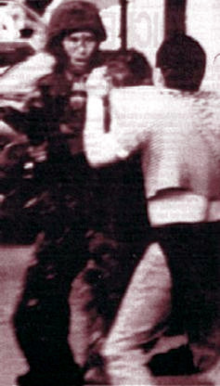
On the evening of May 17, a fistfight begins at Lineside Road, where a group of young men are having a drink. A passing four-man patrol of the King’s Own Scottish Borderers regiment is challenged to a “boxing match” by the residents. The soldiers set aside their weapons and engage the youths. Noncritical injuries are reported on both sides. The official claim is that the patrol was attacked by a mob of at least 30 people. In the melée, a rifle and a light machine gun are stolen. The rifle is later recovered nearby. The youths smash a backpack radio which is left behind by the troops. Two KOSB soldiers are hospitalised, while in the end seven other soldiers, including paratroopers, receive lesser injuries, one of them hit by a car that crashes through two roadblocks set up by the British Army.

The Parachute Regiment is called to the scene again, and at 8:30 p.m., a major riot starts outside The Rossmore pub between local people and about 20 to 25 paratroopers. The soldiers claim one of their colleagues is isolated and dragged by the crowd. Some witnesses claim paratroopers were in a frenzy, showing their guns and inviting civilians to try to take them. Suddenly, shots are fired by the troops — first into the air and then toward the people outside the pub. Three civilians are rushed to hospital in Dungannon with gunshot wounds, while the soldiers return to their barracks. Another four civilians suffer minor injuries. The paratroopers claim that a “member of the growing crowd” attempted to fire the stolen machine gun at them, but the weapon jammed. One of the wounded is the brother of IRA volunteer Kevin O’Donnell, who had been killed by the Special Air Service (SAS) in February during an ambush at the nearby hamlet of Clonoe, shortly after carrying out a machine-gun attack on the local RUC base.

About 500 people attend a protest rally in Coalisland on May 19, and the wisdom of deploying the troops to patrol the town is questioned by members of the Dáil in Dublin. The Minister for Foreign Affairs of the Republic of Ireland, David Andrews, asks the British Government to withdraw the regiment. As a result, the paratroopers are redeployed outside the urban areas. The RUC claims that the stolen machine gun is found 11 days later at a farmhouse near Cappagh, along with another light machine gun and an AK-47 rifle. The IRA denies they had the machine gun in their possession. Republicans question whether the weapon had really been stolen, suggesting this was merely an excuse for the soldiers’ rampage in Coalisland. Bernardette McAliskey goes even further, suggesting that the recovery of the machine gun near Cappagh, where the initial IRA attack had taken place, was actually staged by the security forces as a publicity stunt. British officials accuse Sinn Féin of being the instigators of the riots, while Michael Mates, then Minister of State at the Northern Ireland Office, states that the incidents were due to “a gang of thugs motivated by the IRA.” Eventually the battalion’s 1992 tour in Northern Ireland is scaled down, with the patrols suspended before the official end of the deployment. The Third Brigade’s commander, Brigadier Tom Longland, is replaced by Brigadier Jim Dutton. This is the first occasion that a high-ranking officer is disciplined in such a way during the Troubles.

The last patrol takes place on June 27, when two paratroopers drown while crossing the River Blackwater. The same day there are further clashes with local residents, this time in the town of Cookstown, when a group of people that the Belfast News Letter calls “drunken hooligans” assault a number of paratroopers trying to help an elderly man who is suffering a heart attack.

The 3rd Battalion of the Parachute Regiment is replaced by the 1st Battalion of the Coldstream Guards.

Six soldiers face criminal charges for their roles in the May riots but are acquitted one year later. Five are bound over. Maurice McHugh, the presiding magistrate, avers that the soldiers were “not entirely innocent,” while Sinn Féin sources dub the ruling “a farce.” Dungannon priest Father Denis Faul is of the opinion that the soldiers should have been charged with conspiracy. The Ulster Television documentary Counterpoint of June 1993 claims that Director of Public Prosecutions for Northern Ireland, Sir Alasdair Fraser, returned the case file to the RUC recommending no prosecution. The programme also interviews Alistair Hodgson, the soldier maimed at Cappagh, who says that “had another member of my unit been injured in the way that I was, I would have been with the rest of the lads attacking the locals.” Authors Andrew Sanders and Ian S. Wood suggest that the deployment of the battalion in Coalisland and elsewhere hindered the British policy of police primacy in Northern Ireland.

Fresh clashes between local residents and troops are reported at Coalisland on March 6, 1994, a few months before the first IRA ceasefire, when a crowd assaults two soldiers after the RUC searched a car. Plastic bullets are fired, and three civilians and two soldiers are slightly injured.

(Pictured: Confrontation between a British paratrooper and a civilian in Coalisland, May 1992)


Leave a comment

Birth of Patrick Kelly, Provisional Irish Republican Army Commander

Patrick Joseph Kelly, commander of the East Tyrone Brigade of the Provisional Irish Republican Army during the mid-1980s, is born in Carrickfergus, County Antrim, Northern Ireland, on March 19, 1957. He holds the position until his death in a Special Air Service (SAS) ambush at Loughgall, County Armagh in May 1987.

Kelly is the oldest child in a Roman Catholic family of five. He lives in Carrickfergus until he is sixteen, at which time the family returns to live in Dungannon. His uncle is the Irish Republican activist and elected official Liam Kelly.

Kelly becomes a member of the Provisional Irish Republican Army at the beginning of the 1970s and becomes one of the most experienced IRA men in County Tyrone. He is arrested in February 1982 based on testimony from an informant named Patrick McGurk but is released in October 1983 due to lack of evidence, after a trial that lasts fifteen minutes.

In 1985, Kelly becomes brigade commander in East Tyrone and begins developing tactics for attacking isolated Royal Ulster Constabulary (RUC) bases in his area. Under his leadership the East Tyrone Brigade becomes the most active IRA unit.

In 1986, Kelly attends the IRA Army Convention where the main topic of discussion is the principle of abstentionism. Gerry Adams and others argue that the abstentionist rule should be dropped and the Provisional movement should become involved in constitutional politics. Kelly votes against dropping the rule, and a rift with the majority of the IRA Army Council ensues.

Kelly is killed by the Special Air Service (SAS) on May 8, 1987, while he is participating in an attack on Loughgall police station, in which seven other IRA men, Pádraig McKearney, Declan Arthurs, Seamus Donnelly, Tony Gormley, Eugene Kelly, Jim Lynagh, and Gerard O’Callaghan, also die. His funeral in Dungannon is one of the largest in Tyrone during the Troubles.

Kelly is buried in Edendork Cemetery, two miles from his home in Dungannon.


Leave a comment

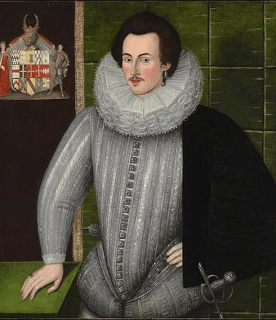
Charles Blount, 8th Baron Mountjoy, Becomes Lord Deputy of Ireland

Charles Blount, 8th Baron Mountjoy, English nobleman and soldier, becomes Lord Deputy of Ireland under Queen Elizabeth I on January 21, 1600.

Blount is born in 1563, the second son of James, 6th Baron Mountjoy, and Catherine, only daughter of Sir Thomas Legh. He is among the most distinguished of the family, succeeding as 8th Baron Mountjoy on the death in 1594 of his unmarried elder brother William, 7th Baron Mountjoy. The good fortune of his youthful and handsome looks find favour with Queen Elizabeth I which arouses the jealousy of Robert Devereux, 2nd Earl of Essex, leading to a duel between the two courtiers, who later become close friends.

Blount is returned to the House of Commons as MP for St. Ives, Cornwall in 1584 and for Bere Alston in 1586 and 1593, before entering the House of Lords in 1594. Between 1586 and 1598, he spends most of his time on the Continent, serving in the Netherlands and Brittany. He joins Lord Essex and Sir Walter Raleigh in their expedition to the Azores in 1597, along with his distant cousin, Sir Christopher Blount.

The downfall of Lord Essex does not damage Blount’s career. After the failure of his rebellion, Essex shocks many by denouncing his sister Penelope, who is Blount’s mistress, as a traitor, which inevitably raises the question of his own possible involvement. But the Crown, anxious to retain Blount’s services, and also to show as much leniency as possible to the defeated rebels, simply ignore the accusation.

On February 24, 1600, Blount lands in Ireland as Lord Deputy following Lord Essex and in the ensuing years brings the Nine Years’ War to an end. The leader of the rebellion, Hugh O’Neill, Earl of Tyrone, writes about Blount’s “refined manners” that he would lose a whole season of campaigning “while waiting until breakfast is prepared to his mind!” Despite this, Blount proves that he is quite qualified to pursue the war.

In early 1600, Blount dispatches Sir Henry Docwra with an army of 4,200 troops to land at Culmore to erect a fortress commanding the shores of Lough Foyle in the northwest of Ulster. To prevent Hugh O’Neill from sending a strong force to repulse Dowcra’s forces, Blount advances in force from Dublin to Newry causing O’Neill to fear a southern advance into Tyrone.

Blount aims to avoid the mistakes of previous Lords-Deputy. After the Battle of Moyry Pass, he has it cleared, and a garrison is established there. It had long been a problem for English forces advancing into Ulster from the south. He also establishes posts with garrisons at Mountnorris and Armagh.

On July 13, 1601, Blount and his army along with Turlough McHenry O’Neill of the Fews who had recently switched to the English side in the war, have a stand-off with Hugh O’Neill’s forces at the River Blackwater. After a few shots in vain from either side, O’Neill’s forces withdraw, and Blount sends his forces to occupy the ruined Blackwater fort destroyed by O’Neill in 1595. Later O’Neill’s forces attack Blount’s camp before withdrawing. In response, the Lord-Deputy sends his forces across the river where they find strong artificially fortified fords, which would have held out against the English.

By July 15, 1601, the Lord-Deputy has secured the surrender of O’Neill’s ally Hugh Magennis. That month, he has a new fort near the old Blackwater fort erected.

Blount reports to the council in England that O’Neill is determined to prevent his forces from advancing into Tyrone and toward Dungannon. As such, he initiates a policy of burning large quantities of corn to induce a famine to drive the rebels out of their strongholds.

Blount sets about trying to entice Hugh’s forces to come out and attack by fetching some materials for the new fort from the Tyrone side of the river as well as burning more corn. Further skirmishes between Blount and O’Neill’s forces ensue during the summer of 1601.

Spanish forces land in Munster in August 1601, forcing Blount to send his forces southward leaving O’Neill remaining in his unbroken heartland of Tyrone. The Spanish arrival culminates in the Siege of Kinsale that December, which sees a major defeat of the rebels and their allies.

O’Neill during this time has also moved south to assist some of his allies, however, after some serious defeats at the hands of the forces of Richard Burke, 4th Earl of Clanricarde of Connacht, he is in no place to offer any effective resistance once Blount marches once more to Tyrone in the summer of 1602.

Blount advances to the location he found the previous summer at the River Blackwater, which commands safe and secure passage into Tyrone, previously inaccessible, and sets about erecting a new fort. Having observed this, O’Neill burns his capital at Dungannon and flees to his last refuge in Glenconkeyne.

Advancing northward through Tyrone, Blount erects a fort in the townland of Magheralamfield, afterward known as Mountjoy Castle. He also christens the new fort at the Blackwater Charlemont Fort after himself.

Once in Tyrone, Blount carries out a campaign of devastation throughout it resulting in the mass hunting of rebels, spoiling of corn, the burning of houses and the killing of churls so as to force the submission of O’Neill and his remaining allies. Most symbolically, Blount has the inauguration site of the O’Neill’s at Tullyhogue Fort destroyed.

On March 30, 1603, six days after the death of Elizabeth and the accession of James I, O’Neill makes peace with Blount, signing the Treaty of Mellifont. Blount continues in office with the more distinguished title of Lord-Lieutenant. He declares amnesty for the rebels and grants them honourable terms, which causes some severe criticism from England. He shows similar moderation in putting down the abortive risings in Cork, Waterford and Wexford, where the aldermen, apparently with some vague idea of gaining greater toleration for Roman Catholics, refuse to proclaim the new King. In Cork, three insurgents are hanged after a summary trial, but the rest are acquitted or pardoned.

As part of the Plantation of Ulster, the majority of the barony of Loughinsholin is detached from County Tyrone and made part of the newly created County Londonderry. The rest of Loughinsholin along with the northern parts of Dungannon barony are merged to create the short-lived barony of Mountjoy. It is later amalgamated with the barony of Dungannon.

On his return to England, Blount serves as one of Sir Walter Raleigh’s judges in 1603, and in the same year King James I appoints him Master-General of the Ordnance as well as creating him Earl of Devonshire, granting him extensive estates. He is one of the founder members of the Spanish Company re-founded by royal charter in 1605.

Toward the end of Blount’s life, on December 26, 1605, at Wanstead House near London, in a ceremony conducted by his chaplain William Laud, afterward Archbishop of Canterbury, he marries his long-time mistress Lady Penelope, formerly wife of Robert Rich, 3rd Baron Rich (later 1st Earl of Warwick) and sister of Robert Devereux, 2nd Earl of Essex.

Blount leaves no legitimate children, and so his hereditary titles become extinct at his death on April 3, 1606, at Savoy House, London.


Leave a comment

The Killing of Richard Jameson, Businessman & Loyalist

Richard Jameson, Northern Irish businessman and loyalist, who serves as the leader of the paramilitary Ulster Volunteer Force‘s (UVF) Mid-Ulster Brigade, is killed on January 10, 2000, outside his home in Portadown, County Armagh, Northern Ireland, during a feud with the rival Loyalist Volunteer Force (LVF). Following his death, the feud between the UVF and LVF escalates into a series of retaliatory killings. These go on intermittently until the LVF disbands in 2005.

Jameson is born in Portadown to a Protestant Church of Ireland family in about 1953, one of five sons. He has a twin brother, Stuart. A former reservist in the Royal Ulster Constabulary (RUC) (1973-81), he works as a manager in the Jameson Group, a building firm which is a family-owned business. The building firm is regularly awarded government contracts to carry out work for the security forces and it is for this reason that his brother David loses a leg in a 1991 Provisional Irish Republican Army bombing attack. He is a member of the Orange Order‘s Drumherriff Star of Erin LOL 8 Portadown district.

It is not known exactly when Jameson becomes a member of the Ulster Volunteer Force (UVF) nor the leader of its Mid-Ulster Brigade. The Portadown unit of the Mid-Ulster Brigade had been officially stood down by the Brigade Staff in Belfast in August 1996 when it carried out an unauthorised sectarian killing while the UVF were on ceasefire. The Mid-Ulster Brigade’s commander at the time, Billy Wright, was expelled from the UVF. Wright brazenly defies a Combined Loyalist Military Command (CLMC) order to leave Northern Ireland or face execution by establishing the breakaway Loyalist Volunteer Force (LVF), taking most of the Portadown Mid-Ulster UVF with him. The units of the Mid-Ulster Brigade that remain loyal to the Brigade Staff continue to operate and Jameson becomes commander. He is said by The Guardian to be a “staunch supporter of the Good Friday Agreement.”

In the weeks prior to his killing, Jameson is in a violent street altercation with LVF member Muriel Gibson, whom he accuses of involvement in drugs and slaps forcefully in the face. This is followed by a fracas at the Portadown F.C. Social Club on December 27, 1999, where LVF members are commemorating the death of their comrade Billy Wright, shot and killed inside the Maze Prison by the Irish National Liberation Army (INLA) exactly two years previously. When he enters the club, several LVF men begin to push and jostle him and challenge him to a fight, telling him to hit them instead of women. Deeply offended, he leaves and soon returns with a UVF gang armed with pickaxe handles and baseball bats. In the violent brawl that ensues, twelve people, including three LVF prisoners out on Christmas parole, receive severe injuries. The LVF leaders subsequently make the decision that Jameson is to pay for the attack with his life.

One of the LVF members, who lives near Dungannon, gets in touch with a family of north Belfast loyalists who had been members of the UVF but who had left after Wright’s expulsion. From these former UVF members the LVF obtains the gun with which to shoot Jameson. On the evening of January 10, 2000, Jameson returns from work and drives his Isuzu Trooper jeep into the driveway outside his home on the Derrylettiff Road near Portadown. Waiting in ambush, a single gunman suddenly approaches from the passenger side of the parked jeep. Before Jameson can emerge from the vehicle and with the engine still running, the gunman opens fire through the window with a 9mm semi-automatic pistol, shooting Jameson five times in the head and chest. His assassin escapes to a nearby getaway car. He is rushed to Craigavon Area Hospital but dies of his wounds minutes after his arrival. The RUC immediately begins a murder inquiry. Within hours of the killing, the UVF Brigade Staff convene an emergency meeting at “the Eagle,” their headquarters on the Shankill Road, where they compile a list of all those they believe to be involved in Jameson’s death and plan their retaliation against the LVF.

Among those who condemn the killing is Northern Ireland’s First Minister David Trimble who releases the following statement: “This is exactly the sort of thing we thought we had finally put behind us. I’m shocked by the news.”

Jameson’s funeral is held on January 13 at the Tartaraghan Parish Church and attended by several thousand mourners including Progressive Unionist Party (PUP) leaders David Ervine and Billy Hutchinson. Drumcree Orangeman Harold Gracey and Gary McMichael, the son of slain Ulster Defence Association (UDA) brigadier John McMichael, also attend as does local politicians representing the Ulster Unionist Party (UUP) and Democratic Unionist Party (DUP). The service is officiated by Reverend David Hilliard who speaks out against vengeance and describes Jameson as a “man admired and loved by many” and who “had been so cruelly murdered.” He is buried in the adjacent churchyard.

Despite Reverend Hilliard’s pleas and LVF leader Mark “Swinger” Fulton‘s claim that his organisation had nothing to do with Jameson’s shooting, the UVF/LVF feud intensifies. In the immediate aftermath members of Jameson’s family are filmed angrily defacing LVF murals in Portadown. A month after his killing, two Protestant teenagers, Andrew Robb (19) and David McIlwaine (18), are savagely beaten and repeatedly stabbed to death in a country lane outside Tandragee, County Armagh by a local UVF gang. The young men, believed to have been LVF members, are targeted by their UVF killers after they leave a nightclub together in search of a party. However, neither teenager is part of any paramilitary organisation and only Robb had tenuous links to the LVF. It is reported in the Belfast Telegraph that according to court hearings Robb had made disparaging remarks about Jameson’s death. Two of the UVF men, Stephen Leslie Brown and Noel Dillon, are infuriated by the comments and afterward Brown drives the victims to Druminure Road where he, Dillon and another man carry out the double killing. One of Jameson’s brothers, Bobby, is among the mourners at David McIlwaine’s funeral. The West Belfast Brigade of the Ulster Defence Association, whose brigadier Johnny Adair is close to the LVF, briefly becomes involved in the feud after Adair attends Andrew Robb’s funeral and joins LVF members at the Drumcree conflict. After the UVF track down Jameson’s killer to the Oldpark area of Belfast and attempt to shoot him, he is taken away under the protection of the West Belfast Brigade. The tit-for-tat killings continue intermittently until 2005 when the UVF makes a final assault against the LVF, leaving four members dead and the LVF leadership with no alternative but to order its military units to permanently disband.

Jameson’s family has persistently denied that he was a UVF member. They maintain that he was a vigilante who was murdered in retaliation for the firm stand he had taken against drug dealing in the Portadown area. The late PUP leader David Ervine expressed the same opinion the day after the killing by stating, “Mr. Jameson had been murdered by drug dealers masquerading as loyalists because he had been a bulwark in his community against dealers.” Ervine also described him as having been a “fine and honourable man, widely respected in the community.” Northern Ireland security sources, however, have repeatedly named Jameson as the Mid-Ulster UVF commander. He is listed as a UVF member in the CAIN: Sutton Index of Deaths, an online University of Ulster-sponsored project which chronicles the Northern Ireland conflict. It also emerges that for several days prior to his killing, he had been working at the Ballykinler British Army base. Immediately after his murder by the LVF, his family begins an anti-drug campaign in Portadown by putting up posters and handing out leaflets to passing motorists.


Leave a comment

Death of William Steel Dickson, Minister & United Irishman

William Steel Dickson, Irish Presbyterian minister and member of the Society of the United Irishmen, dies on December 27, 1824, in Belfast, in what is now Northern Ireland.

Dickson is born on December 25, 1744, the eldest son of John Dickson, a tenant farmer of Ballycraigy, in the parish of Carnmoney, County Antrim. His mother is Jane Steel and, on the death of his uncle, William Steel, on May 13, 1747, the family adds his mother’s maiden name to their own.

In his boyhood, Dickson is educated by Robert White, a Presbyterian minister from Templepatrick and enters University of Glasgow in November 1761. Following graduation, he is apparently employed for a time in teaching, and in 1771 he is ordained as a Presbyterian minister. Until the outbreak of the American Revolutionary War, he occupies himself mainly with parochial and domestic duties. His political career begins in 1776, when he speaks and preaches against the “unnatural, impolitic and unprincipled” war with the American colonies, denouncing it as a “mad crusade.” On two government fast-days his sermons on “the advantages of national repentance” (December 13, 1776), and on “the ruinous effects of civil war” (February 27, 1778) create considerable excitement when published. Government loyalists denounce Dickson as a traitor.

Political differences are probably at the root of a secession from his congregation in 1777. The seceders form a new congregation at Kircubbin, County Down, in defiance of the authority of the general synod.

In 1771 Dickson marries Isabella Gamble, a woman of some means, who dies on July 15, 1819. They have at least eight children, but he outlives them all. One of his sons is in the Royal Navy and dies in 1798.

Dickson enters with zest into the volunteer movement of 1778, being warmly in favour of the admission of Roman Catholics to the ranks. This is resisted “through the greater part of Ulster, if not the whole.” In a sermon to the Echlinville volunteers on March 28, 1779, he advocates the enrolment of Catholics and though induced to modify his language in printing the discourse, he offends “all the Protestant and Presbyterian bigots in the country.” He is accused of being a papist at heart, “for the very substantial reason, among others, that the maiden name of the parish priest’s mother was Dickson.”

Though the contrary has been stated, Dickson is not a member of the Volunteer conventions at Dungannon in 1782 and 1783. He throws himself heart and soul into the famous election for County Down in August 1783, when the families of Hill and Stewart, compete for the county seat in Parliament. He, with his forty-shilling freeholders, fails to secure the election of Robert Stewart. But in 1790 he successfully campaigns for the election of Stewart’s son, better known as Lord Castlereagh. Castlereagh proves his gratitude by referring at a later date to Dickson’s popularity in 1790, as proof that he was “a very dangerous person to leave at liberty.”

In December 1791, Dickson joins Robert White’s son, John Campbell White, taking the “test” of the first Society of United Irishmen, organised in October in Belfast following a meeting held with Theobald Wolfe Tone, Protestant secretary of the Catholic Committee in Dublin. According to Dickson himself, he attends no further meetings of the Society but devotes himself to spreading its principles among the volunteer associations, in opposition to the “demi-patriotic” views of the Whig Club.

At a great volunteer meeting in Belfast on July 14, 1792, Dickson opposes a resolution for the gradual removal of Catholic disabilities and assists in obtaining a unanimous pledge in favour of total and immediate emancipation. Parish and county meetings are held throughout Ulster, culminating in a provincial convention at Dungannon on February 15, 1793. He is a leading spirit at many of the preliminary meetings, and, as a delegate from the Barony of Ards, he has a chief hand in the preparation of the Dungannon resolutions. Their avowed object is to strengthen the throne and give vitality to the constitution by “a complete and radical reform.” He is nominated on a committee of thirty to summon a national convention. The Irish parliament goes no further in the direction of emancipation than the Roman Catholic Relief Act 1793, which receives the royal assent on April 9, and remains unextended until 1829. While the passing of Lord Clare‘s Convention Act, still in force, makes illegal all future assemblies of delegates “purporting to represent the people, or any description of the people.”

In March and April 1798, Dickson is in Scotland arranging some family affairs. During his absence plans are made for an insurrection in Ulster, and soon after his return he agrees to take the place of Thomas Russell, who had been arrested, as adjutant-general of the United Irish forces for County Down. A few days before the county is to rise, he is himself arrested at Ballynahinch.

Dickson is conveyed to Belfast and lodged in the “black hole” and other prisons until August 12 when he is removed to a prison ship with William Tennant, Robert Hunter, Robert Simms, David Bailie Warden and Thomas Ledlie Birch, and detained there amid considerable discomfort. On March 25, 1799, Dickson, Tennant, Hunter, and Simms join the United Irish “State Prisoners” on a ship bound for Fort George, Highland prison in Scotland. This group, which includes Samuel Neilson, Arthur O’Connor, Thomas Russell, William James MacNeven, and Thomas Addis Emmet, arrives in Scotland on April 9, 1799. He spends two years there.

Unlike the more high-profile prisoners like O’Connor and MacNeven who are not released until June 1802, Tennant, Dickson, and Simms are permitted to return to Belfast in January 1802.

Dickson returns to liberty and misfortune. His wife has long been a helpless invalid, his eldest son is dead, his prospects are ruined. His congregation at Portaferry had been declared vacant on November 28, 1799. William Moreland, who had been ordained as his successor on June 16, 1800, at once offers to resign, but Dickson will not hear of this. He has thoughts of emigration but decides to stand his ground. At length, he is chosen by a seceding minority from the congregation of Keady, County Armagh, and installed minister on March 4, 1803.

Dickson’s political engagement ends with his attendance on September 9, 1811, of a Catholic meeting in Armagh, on returning from which he is cruelly beaten by Orangemen. In 1815 he resigns his charge in broken health and henceforth subsists on charity. Joseph Wright, an Episcopalian lawyer, gives him a cottage rent-free in the suburbs of Belfast, and some of his old friends make him a weekly allowance. His last appearance in the pulpit is early in 1824. He dies on December 27, 1824, having just passed his eightieth year, and is buried “in a pauper’s grave” at Clifton Street Cemetery, Belfast.


Leave a comment

Death of Actress Betty Chancellor

Betty Chancellor, Irish actress, dies in Dún Laoghaire, County Dublin, at the age of 74 on April 27, 1984.

Chancellor is born at 8 Fitzwilliam Place, Dublin, on January 9, 1910. Her parents are John William Chancellor, a Dublin clockmaker, jeweler, and photographer, and Cicely Chancellor (née Granger). They marry in Billericay, Essex, in 1904. She has an elder sister, Joyce Fanny, who also becomes an actress. She attends Nightingale Hall and Alexandra College, going on to train as a secretary.

Chancellor’s first appearance on stage is as a fairy in a benefit performance at the Gaiety Theatre in 1914. She appears again at the Gaiety in 1922 as Gwennie in F. Anstey‘s The Man from Blankley’s, and then studies drama under Frank Fay. In the 1920s, she acts in the Dublin Drama League’s productions in the Abbey Theatre. Once she joins the Gate Theatre her career progresses, establishing her as one of the principal actresses in the Gate by the early 1930s.

Chancellor plays Naomi alongside Orson Welles in a production of Jud Süss in October 1931. Welles becomes infatuated with her and later describes her as “the sexiest thing that ever lived.” In 1931, she debuts in J. B. Fagan‘s production of The New Gossoon by George Shiels as Biddy Henley at the Apollo Theatre. Her most noted roles are as Toots in Youth’s the Season in 1932 by Mary Manning, Laura in a production of Carmilla in 1932, based on the Gothic novella by Sheridan Le Fanu, Ophelia in 1932 and Cicely in The Importance of Being Earnest in 1933. Touring with the Gate company in 1935, she plays Stella in its production of Lord Longford‘s Yahoo performed in the Westminster Theatre, London. She stars with James Mason in the Gate’s production of Pride and Prejudice in 1937. Disappointed with the parts she is getting at the Gate after that and much to the annoyance of Micheál Mac Liammóir and Hilton Edwards, she joins Lord Longford’s first provincial tour in 1937.

In the late 1930s, Chancellor works more often in London. Following her appearance as Baby Furze in the 1938 production of Spring Meeting by Molly Keane and John Perry, she is nominated as “Star of the Future” by the Daily Mail. She acts alongside Alec Guinness and Peggy Ashcroft in 1940 in Clemence Dane‘s Cousin Muriel at the Globe Theatre, directed by John Gielgud.

Chancellor returns to the Gaiety Theatre in 1941 to act with Hilton Edwards in a production of Caesar and Cleopatra by George Bernard Shaw, a production that marks the 75th anniversary of the Gaiety. The press welcomes her return to the company, but her fellow actors are disturbed by the fact she is then living with Denis Johnston, the husband of fellow actress Shelah Richards. After Johnston’s divorce, they marry in March 1945 in Dungannon, County Tyrone. She partly retires from acting to raise their sons, but also due to her increasing deafness that had begun in her teens.

In 1947, Chancellor appears in Johnston’s The Moon in the Yellow River at the Arts Theatre in London with Jack Hawkins. The family moves to the United States in November 1948, where she has the lead role in Shaw’s Candida at Amherst College, Massachusetts in 1950.

In 1969, Chancellor returns to Ireland with her family and settles in Dalkey, County Dublin. She dies in Dún Laoghaire on April 27, 1984, and is buried in the close of St. Patrick’s Cathedral, Dublin.


Leave a comment

Birth of Adrian Long, Civil Engineer & QUB Professor

Adrian Ernest Long OBE, civil engineer and professor at Queen’s University Belfast (QUB), is born on April 15, 1941, in Dungannon, County Tyrone, Northern Ireland. He has a particular interest in concrete structures and patents FlexiArch, a precast concrete arch product. He serves as president of the Institution of Civil Engineers (ICE) for 2002–03, the first Northern Irish engineer to do so.

Long comes from a carpentry and blacksmithing background. In 1959, he enters Queen’s University Belfast to study civil engineering. He graduates with first class honours and then takes a PhD at Queens. In 1967, he moves to Canada, working as a bridge designer for Fenco Engineering in Toronto.

Long, however, spends only a year in Canada, returning to Belfast in 1968 to become an associate professor of civil engineering at Queen’s University Belfast. In 1976, he is promoted to a full professorship. His work is largely in the field of concrete structures, particularly in chloride resistance, maintenance problems and arch bridge structures. He publishes twenty papers in journals managed by the Institution of Civil Engineers and wins eight of the institution’s medals for these, including the ICE Gold Medal.

From 1997 Long works on the FlexiArch, a precast concrete arch in which the individual voussoirs are joined by a flexible polymeric membrane. The arch arrives to site flat packed and when lifted into position by a crane, the gaps between the voussoirs close under gravity and form the correct arch profile. He patents the product, which is produced by Irish precast manufacturer Macrete, in 2004. The product can be constructed within a day and, containing no corrodible elements, has been stated to have a design lifespan of 300 years. More than fifty FlexiArch bridges have been constructed in the UK and Ireland and spans up to 30m are possible.

By 2002, Long is appointed dean of the faculty of engineering at QUB. In November of that year, he is appointed president of the ICE for the 2002–2003 session, the first Northern Irish person to hold that position. He is also a Fellow of the Royal Academy of Engineering and of the Institute for the Advancement of Engineering.

Long is appointed an officer of the Order of the British Empire in the 2006 New Year Honours for services to higher education and civil engineering. He resigns as professor at QUB in 2006 but remains there as an emeritus professor in the School of Natural and Built Environment. Since 2015, the ICE Northern Ireland awards the Adrian Long medal to the best paper in an ICE journal to be authored by a Northern Ireland member. The medal features a bust of Long.

Long is married to Elaine and they have two children, Michael and Alison. Michael serves as the 80th Lord Mayor of Belfast from May 9 to June 1, 2022. He also serves as High Sheriff of Belfast in 2021 and serves on Belfast City Council since 2001, where he is the Alliance group leader from 2015 to 2021. He is married to Alliance Party leader and Minister of Justice Naomi Long.

Long dies at the age of 81 at the Ulster Hospital on April 23, 2022.


Leave a comment

1997 Coalisland Attack

On the evening of March 26, 1997, the Provisional Irish Republican Army (IRA) East Tyrone Brigade launches an improvised grenade attack on the fortified Royal Ulster Constabulary (RUC)/British Army base in Coalisland, County Tyrone, Northern Ireland. The blast sparks an immediate reaction by an undercover Special Air Service (SAS) unit, who shoots and wounds Gareth Doris, an Irish republican and alleged IRA volunteer. The SAS unit is then surrounded by a crowd of protesters who prevent them approaching Doris or leaving. RUC officers arrive and fire plastic bullets at the crowd, allowing the special forces to leave the area.

Coalisland is a town in County Tyrone that has a tradition of militant republicanism; five residents are killed by British security forces before the first IRA ceasefire in 1994. In February 1992, four IRA volunteers are killed in a gun battle with the SAS during their escape after a machine gun attack on the RUC/British Army barracks there. Three months later, an IRA bomb attack on a British Army patrol at Cappagh, in which a paratrooper loses his legs, triggers a series of clashes between local residents and British troops on May 12 and 17. A number of civilians and soldiers are injured, a soldier’s backpack radio destroyed, and two British weapons stolen. The melee is followed by a 500-strong protest in the town and bitter exchanges between Republic of Ireland and British officials. Further scuffles between civilians and soldiers are reported in the town on March 6, 1994.

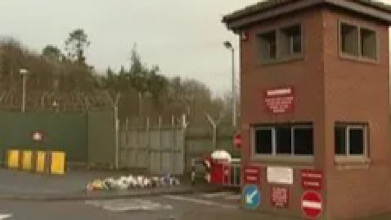
At 9:40 p.m. on Wednesday, March 26, 1997, a grenade is thrown at the joint British Army/RUC base at Coalisland, blowing a hole in the perimeter fence. The RUC reports that a 1 kg device hit the fence ten feet off the ground. Another source claims that the device is a coffee-jar bomb filled with Semtex. The grenade is thrown or fired by two unidentified men. At the time of the attack, there is an art exhibition at Coalisland Heritage Hall, also known as The Mill, from where the explosion and the gunshots that follow are clearly heard. The incident lasts less than two minutes.

Just one minute after the IRA attack, bypassers hear high-velocity rounds buzzing around them. A number of men, apparently SAS soldiers, get out of civilian vehicles wearing baseball caps with “Army” stamped on the front. A source initially describes them as members of the 14 Field Security and Intelligence Company. The men are firing Browning pistols and Heckler & Koch submachine guns. Witnesses say there are eight to ten gunshots, while a republican source claims that up to eighteen rounds are fired. Nineteen-year-old Gareth Doris is shot in the stomach and falls to the ground. He is allegedly returning from the local church and is in the company of a priest when he is shot. A local priest, Seamus Rice, is driving out of the church car park when his car is hit by bullets, smashing the windscreen.

Three minutes after the blast, hundreds of angry residents gather at the scene and confront the undercover soldiers. The soldiers fire live rounds at the ground and into the air to keep people back. The crowd keeps drawing back and moving forward again until 9:50 p.m., when the RUC arrives and begins firing plastic bullets at the protesters. Two women are wounded by plastic bullets and the undercover soldiers then flee in unmarked cars, setting off crackers or fireworks at the same time. Sinn Féin councillor Francie Molloy claims that the protesters forced the SAS to withdraw, saving Doris’s life in the process. Witnesses allegedly fear an undercover soldier brandishing a pistol would have killed the wounded Doris with a shot to his head.

Afterward, hundreds of residents are forced to leave their homes as security forces search the area near the base. This keeps tensions high, according to local republican activist Bernadette McAliskey. Two men are later questioned by the RUC about the attack.

The attack, along with two large bombings the same day in Wilmslow, England, raise concerns that the IRA is trying to influence the upcoming UK general election. Martin McGuinness describes the shooting as “murderous,” while independent councillor Jim Canning says that more than a dozen soldiers “were threatening to shoot anybody who moved […] while a young man lay shot on the ground.” Republican sources claim that this is another case of shoot-to-kill policy by the security forces. Ulster Unionist Party (UUP) MP Ken Maginnis, however, praises the SAS for their actions.

Gareth Doris is admitted to South Tyrone Hospital in Dungannon, where he is arrested after undergoing surgery. He is later transferred to Musgrave Park Hospital in Belfast. He is later convicted for involvement in the bombing and sentenced to ten years in jail, before being released in 2000 under the terms of the Good Friday Agreement. Gareth is the cousin of Tony Doris, an IRA member killed in an SAS ambush in the nearby village of Coagh on June 3, 1991, and a cousin of Sinn Féin leader Michelle O’Neill. According to Sinn Féin councillor Brendan Doris, another cousin of Gareth, “He absolutely denies being involved in terrorist activity of any description.” Amnesty International raises its concerns over the shooting and the fact that no warning is given beforehand.

DNA evidence collected in the area of the shooting leads to the arrest of Coalisland native Paul Campbell by the Police Service of Northern Ireland (PSNI) in 2015, on the charges of being the other man with Doris during the attack. In February 2020, he is convicted by a Diplock court in Belfast. He denies the charges but receives a seven-and-a-half-year sentence. The prosecutor acknowledges that Campbell would have been released by this time under the provisions of the Good Friday Agreement but argues that that was a decision for the parole commission, not the court.

On July 5, 1997, on the eve of the 1997 nationalist riots in Northern Ireland, the British Army/RUC base is the scene of another attack, when an IRA volunteer engages an armoured RUC vehicle with gunfire beside the barracks. One female officer is wounded. The former RUC station at Coalisland is eventually shut down in 2006 and sold for private development in 2010.

(Pictured: Coalisland RUC/British Army base in Coalisland, County Tyrone, Northern Ireland)