Betty Ann Norton, Irish drama teacher and founder of the Betty Ann Norton Theatre School and actor agency, is born on July 5, 1936.
Norton grows up in Dublin near the South Circular Road. Her mother, Frances, plays the violin and her father, Eugene, is a baritone singer. Frances is a full-time homemaker while Eugene works as manager of the Bacon Shops on Grafton Street. One of two children, her younger brother, Jim Norton, also becomes a successful actor. She attends school at St. Louis High School, Rathmines.
Norton attends the Ena Mary Burke School of Drama and Elocution on Kildare Street, Dublin, where Hollywood starMaureen O’Hara had also trained. Her acting school offers an annual Ena Mary Burke scholarship in Burke’s honour.
Norton originally plans to become an actor, but her family does not approve and her mother encourages her to become a teacher. In 1959, she establishes the Betty Ann Norton Theatre School on Harcourt Street in Dublin. Her husband, Michael, is co-director of the school. According to Norton, changes to traffic by the new Luas tram system causes the business to change premises to her childhood school, St. Louis High School in Rathmines in 2006.
Norton meets her husband, Michael J. Cunneen, on the Aran Islands in 1965 and they marry in 1967. They lived in Dún Laoghaire. Michael dies in the Blackrock Clinic on May 12, 2017.
The Littlejohn brothers are jailed on August 3, 1973, for a £67,000 robbery at an Allied Irish Banks branch on Grafton Street, Dublin, in October 1972, the biggest to date in Irish history.
During their trial the brothers claim to have been working for the British Government against the IRA. They say they had been told to stage the robbery to discredit the republican organisation and force the Irish Government to introduce tougher measures against its members. The British Government, however, denies all knowledge of the brothers.
Kenneth is sentenced to twenty years while his brother receives a fifteen-year term. During their time in prison the brothers exhaust all the appeals processes, with their final appeal being turned down in January 1974.
The brothers escape from Mountjoy during an exercise period. They scale the 25-foot-high main prison wall with homemade ropes while other prisoners distract the guards. However, the pair is spotted as they climb an outer wall.
Keith, 29, who has injured his ankle, is recaptured near the prison. Kenneth, 32, however, disappears without trace and is believed to be heading for the border with Northern Ireland. He is recaptured in December 1974. The brothers are released early in 1981 on condition they leave the Republic of Ireland.
Keith’s successful bid for freedom comes as a surprise. He has been weakened by a hunger strike he has been conducting since February in support of a demand for political prisoner status.
From the time the brothers are jailed the British Government steadfastly continues to deny all knowledge of them.
But the brothers’ tale does receive partial validation the prior year. Ireland’s former Taoiseach, Jack Lynch, admits he had been given diplomatic reports from the British authorities in January 1973 about the UK’s contact with the Littlejohn brothers.
In 1982, Nottingham Crown Court jails Kenneth Littlejohn for six years for his part in a £1,300 armed robbery at the Old Manor House, North Wingfield, Chesterfield, England. Keith Littlejohn, however, is cleared of a similar offence.
Davidson is the sixth of ten children of clerk of petty session, Edward Ellice Davidson, and Lucy Rising Davidson (née Doe). Her mother dies in 1888, and it is presumed that she receives a private education but as the family are not affluent, the details are unclear. She goes on to attend the Dublin Metropolitan School of Art (DMSA) from 1895 to 1905. While at the DMSA, she wins prizes in 1895 and 1896 and is awarded a scholarship and free studentship at the Royal Dublin Society (RDS) in 1897, the same year her father dies. She completes her studies in 1905. In the early 1910s, she is living in Rathmines and spends some time in England and Wales.
Davidson is commissioned by Switzer’s department store on Grafton Street to draw costumes in 1899. In 1909, her painting After Rain is exhibited by the Dublin Sketching Club, with her continuing to show work there until 1920. She exhibits The Bonfire with the Water Colour Society of Ireland in 1912, becoming a committee member in 1934 and continuing to exhibit with them until 1954. In 1914, she is one of the artists included in a sale of paintings to aid Belgian refugees. She is first exhibited at the Royal Hibernian Academy (RHA) in 1914, with The Student. Her painting exhibited by the RHA in 1916, The Harbour, St. Ives, demonstrates an influence from Stanhope Forbes and the Newlyn School, with a bright palette and contrasting illumination, which become characteristic of her work. She illustrates C. H. Bretherton’s collection of humorous poems and recollections about London Zoo, A Zoovenir (1919).
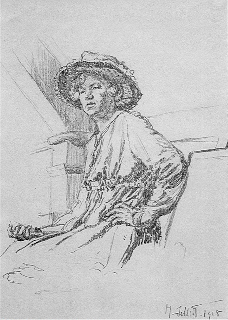
Davidson holds a joint exhibition with Mainie Jellett in 1920, at Mill’s Hall, Merrion Row, Dublin. Jellett produces a pencil portrait of Davison (pictured above), which shows her in a straw hat she frequently wears. The RHA exhibits Davidson’s oil painting, The Flax Pullers, in 1921. This work shows an influence from Paul Henry and French Impressionism in her use of colour-blocking. In the early 1920s, she travels to Switzerland, Belgium, and France, producing works such as Fish Market, Bruges. She lives in Paris in the late 1920s, exhibiting at the Salon de la Societé Nationale in 1924 and 1930. She places a self-portrait in her depiction of a peasant gathering, The Country Races. Reproductions of her drawing of Leinster House and Christ Church Cathedral by Bulmer Hobson are included in A Book of Dublin (1929). Her landscape, Low Tide, Wicklow, which is exhibited at the RHA in 1934, and Boats at Wicklow, Dusk show her ability to depict reflections in water. She continues to paint scenes of rural life, including Cottages – Keel, Achill, which shows an influence from Jack Butler Yeats in her use of space and colour. The fact that her family is not wealthy likely influences her choice of poorer people as her subjects, depicting them in a sympathetic manner. Her work is part of the painting event in the art competitions at the 1928 Summer Olympics.
Davidson’s paintings are exhibited at the Contemporary Picture Galleries, Dublin in 1930, alongside Yeats, Evie Hone, and Harry Kernoff. She is a member of the Picture Hire Club, 24 Molesworth Street, Dublin from 1941 to 1942, and is a frequent contributor to the Munster Fine Arts Club. Her work is exhibited at the Salon des Beaux Arts, Paris, the Royal Academy of Arts, London, and in Amsterdam. A large number of her works from the 1930s show the Irish-speaking area of Galway, Claddagh, such as Night in Claddagh, exhibited with the RHA in 1933. Her Irish landscapes, such as Claddagh Cottages, are included in the Oireachtas Art Exhibitions from 1932 to 1946. From around 1934, she is a member of the Society of Dublin Painters, exhibiting with them from 1939 to 1954. She influences the Society’s move toward the avant-garde in the 1940s. She is elected associate to the RHA in 1940 and continues to exhibit there until her death. Her 1946 work, Gorta, shows influence from Zola, Rilke, Dostoyevsky and Picasso.
Davidson teaches drawing at her studio at 1 Earlsfort Terrace, Dublin. Her pupils include Bea Orpen, Anne Yeats, and Mo Irwin. She also is a teacher at a number of Dublin schools, such as Belgrave school, Rathmines, Wesley College, St. Stephen’s Green, and Castle Park School, Dalkey. She travels to Abbeyleix, County Laois, once a week to teach at Glenbawn boarding school.
As well as painting, Davidson writes a number of plays, short stories, and monologues under a pseudonym, “Ulick Burke.” In 1927, a collection of her poems and Donegal rhymes is published. In 1931, Hilton Edwards directs her stage play Bride, at the Gate Theatre. Her short story, Her Only Son, is published in The Bell under a pseudonym in 1942. In 1935, she is a founder-member of the Torch Theatre, Dublin. She designs scenery, and is the co-director with Hugh Hyland in 1936, under the stage name “Jennifer Maude.”
Davidson dies at her home at 4 Wilton Terrace, Dublin on March 29, 1954. She is buried in an unmarked grave in Mount Jerome Cemetery. The National Gallery of Ireland (NGI) holds her 1938 portrait of Yeats, as well as her crayon drawing of Sarah Purser. She is a regular attendee at Purser’s “Second Tuesdays” gatherings. The Abbey Theatre holds her portrait of Joseph Holloway. She bequeaths The Golden Shawl to the Hugh Lane Gallery, which is a large self-portrait. Two of her works are included in the NGI’s 1987 exhibition, Irish Women Artists from the Eighteenth Century to the Present Day.
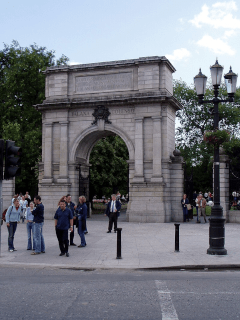
Funded by public subscription, the arch is designed by John Howard Pentland and built by Henry Laverty and Sons. Thomas Drew consults on the design and construction.
The proportions of the structure are said to be modelled on the Arch of Titus in Rome. It is approximately 8.5 m (28 ft.) wide and 10 m (33 ft.) high. The internal dimensions of the arch are 5.6 m high and approximately 3.7 m wide (18 by 12 ft.). The main structure of the arch is granite, with the inscriptions carried out in limestone and a bronze adornment on the front of the arch.
The arch is commissioned to commemorate the four battalions (two regular and two militia) of the Royal Dublin Fusiliers that served in the Second Boer War. The names of 222 dead are inscribed on the underside of the arch.
The construction of the arch coincides with a time of political and social change in Ireland, and the colonial and imperial background to the dedication are anathema to a burgeoning nationalist movement – who label the structure “Traitor’s Gate.” Though damaged in a crossfire between the Irish Citizen Army and British forces during the 1916 Easter Rising, the arch remains “one of the few colonialist monuments in Dublin not blown up” in Ireland’s post-independence history.
Engraved on the western face of the monument is the Latin text, Fortissimis suis militibus hoc monumentum Eblana dedicavit MCMVII, “To its strongest soldiers, Dublin dedicates this monument, 1907.” (Eblana is a name that appears on Ptolemy‘s 2nd century AD map of Ireland, traditionally taken as a Latin name for Dublin, although it more likely refers to a site further north, around Loughshinny.) Six battlefields are inscribed on the arch:
Tone is born Martha Witherington in Dublin on June 17, 1769. She is the eldest daughter of merchant William Witherington and his wife Catherine (née Fanning). Her father is listed as a woolen draper on Grafton Street, Dublin, from 1768 to 1784, as a wine merchant from 1784 to 1788, and finally as a merchant from 1788 to 1793. It is claimed that he is a lieutenant in the Royal Navy and sits on the merchants’ guild on Dublin’s common council from 1777 to 1783. Her mother is a housekeeper to her father after he is widowed.
Tone receives a good education and maintains an interest in drama and literature throughout her life. Katherine Wilmot visits her in Paris in 1802 and comments on the books she has by French, Italian and English authors. When she is fifteen years old, she gets to know Wolfe Tone through her older brother. He is still a student in Trinity College Dublin, and it is he that renames her Matilda. They marry when she is just sixteen, on July 21, 1785, in St. Ann’s Church, Dublin, honeymooning in Maynooth. Upon their return they live with the Witheringtons, though they are not on good terms, and then with Wolfe Tone’s parents in Bodenstown, County Kildare.
The Tone’s first child, Maria, is born before October 1786. She is followed by a son, Richard, who is named for their neighbour Richard Griffith, who dies in infancy. Tone stays with her husband’s family while he is studying for the bar in London from 1787 to 1788. When he returns, the couple has two more sons: William Theobald Wolfe Tone, born on April 29, 1791, and Francis Rawdon Tone, born on June 23, 1793. Francis is known as Frank and is named after Francis Rawdon-Hastings. William is born in Dublin and Frank is probably born in Bodenstown. By this time, the family has a cottage in Bodenstown which Wolfe Tone had inherited from his uncle Jonathan Tone, which the family jokingly refers to as Château Boue. They live there until May 1795, when they leave for Princeton, New Jersey, due to political reasons.
Tone and her children come back to Europe to join Wolfe Tone in France eighteen months later. The family settles in Paris, at first living with Colonel Henry Shee at Nanterre, later moving to the suburb, Chaillot. She educates her children at home. Very few of her letters survive, but many of her husband’s letters and diaries are addressed or intended for her. From these and her letter to her friend Eliza Fletcher, it is clear she shares her husband’s interest in politics. Following her husband’s death in November 1798, she moves to a small apartment at 51 Rue Saint-Jacques in the Latin Quarter of Paris. This is to be close to her son William, who is attending Lycée Louis-le-Grand. She is awarded a pension of 1,200 francs for herself and 400 for each of her children after the expiration of the Treaty of Amiens on May 1, 1803.
Tone’s daughter Maria dies in April 1803, and then her son Frank dies in 1807, both of tuberculosis. William is displaying symptoms of the disease as well, which prompts her to move to the United States in 1807. From there, they attempt to sort out her husband’s affairs, which had been entrusted to James Reynolds. They retrieve only a few of Wolfe Tone’s pre-1795 diaries, and all of the post-1795 letters and diaries, which they add to the autobiography she already has in her possession. When William enters the Cavalry School at Saint-Germain-en-Laye in November 1810 as a cadet, she moves to be close to him, living at the Hôtel de la Surintendance. By approaching Napoleon in 1811, who knew Wolfe Tone, she ensures that her son receives French citizenship and the privileged status of “élève du gouvernement.” In January 1813, when William begins his service, she returns to Paris to live on the Rue de Lille and later moves to the Latin Quarter.
Following the defeat of Napoleon in June 1815, William is refused entry to Ireland or to visit Britain. This leads to both mother and son returning to the United States. Before she leaves Paris, she marries her old friend Thomas Wilson on August 19, 1816. Wilson is a Scottish businessman and advocate who has taken care of her financial affairs after the death of her husband. The couple visit Scotland, and then move to New York City in 1817, and finally to Georgetown, District of Columbia, around 1820. She lives there until her death and calls herself Matilda Tone-Wilson.
Starting in 1824, The New Monthly Magazine begins the unauthorised publication of extracts from Wolfe Tone’s autobiography. In response, Tone decides to publish all of Wolfe Tone’s papers and writing, including the autobiography, pamphlets and diaries, edited by their son William. What results is two large volumes entitled the Life of Theobald Wolfe Tone, published in May 1826. She adds a memoir of her own life in Paris following his death in 1798. The book is a best-seller, and ensures the legacy of Wolfe Tone, as well as being an important contemporary document of both Irish and French revolutionary politics.
William Tone dies in 1828, after which Tone lives more privately. She dies in Georgetown on March 18, 1849. Thomas Wilson predeceases her in 1824. Just two weeks prior to her death she is interviewed by a Young Irelander, Charles Hart. She is initially buried near William Tone at Marbury burying-ground, Georgetown. After that cemetery is sold, she is reinterred in Green-Wood Cemetery, Brooklyn, New York, on October 31, 1891, by her great-grandchildren. A new monument is dedicated to her, which is later restored in 1996.
Clarke is born in Dublin on March 17, 1889, the younger son and third child of Joshua Clarke and Brigid Clarke (née MacGonigal). Church decorator Joshua Clarke moves to Dublin from Leeds, West Yorkshire, England, in 1877 and starts a decorating business, Joshua Clarke & Sons, which later incorporates a stained-glass division. Through his work with his father, Clarke is exposed to many schools of art but Art Nouveau in particular.
Clarke is educated at the Model School in Marlborough Street, Dublin, and Belvedere College, which he leaves in 1905. After his mother’s death in 1903, he is apprenticed into his father’s studio and attends evening classes in the Metropolitan College of Art and Design. His The Consecration of St. Mel, Bishop of Longford, by St. Patrick wins the gold medal for stained-glass work in the 1910 Board of Education National Competition. At the art school in Dublin, he meets fellow artist and teacher Margaret Crilley. They marry on October 31, 1914.
Clarke moves to London to seek work as a book illustrator. Picked up by London publisher George G. Harrap and Co., he starts with two commissions which are never completed. Difficulties with these projects makes Fairy Tales by Hans Christian Andersen his first printed work, in 1916. It includes 16 colour plates and more than 24 halftone illustrations. This is followed by illustrations for an edition of Edgar Allan Poe‘s Tales of Mystery and Imagination, the second version of which, published in 1923, makes his reputation as a book illustrator. His work can be compared to that of Aubrey Beardsley, Kay Nielsen, and Edmund Dulac. His final book, Selected Poems of Algernon Charles Swinburne, is published in 1928.
Clarke also continues to work in stained-glass, producing more than 130 windows. His glass is distinguished by the finesse of its drawing and his use of rich colours. He is especially fond of deep blues. His use of heavy lines in his black-and-white book illustrations echoes his glass techniques.
Clarke is plagued with ill health, in particular respiratory problems. He is diagnosed with tuberculosis in 1929 and goes to a sanatorium in Davos, Switzerland. Fearing that he will die abroad, he begins his journey back to Dublin in 1931, but dies on this journey on January 6, 1931, in Chur where he is buried. A headstone is erected but local law requires that the family pledge to maintain the grave 15 years after the death. This is not explained to the Clarke family and Harry Clarke’s remains are disinterred in 1946 and reburied in a communal grave.
Ben Briscoe, former Fianna Fáil politician, is born on March 11, 1934, in Dublin. He is a Teachta Dála (TD) for 37 years, representing constituencies in the south Dublin city area.
At the 1992 Irish general election Briscoe is involved in a marathon recount battle with Democratic Left‘s Eric Byrne to decide the fate of the final seat in Dublin South-Central. He is declared the victor after ten days of re-counting and re-checking ballot papers, leading to him describing the long count as being like “the agony and the ex-TD.”
Briscoe is sometimes critical of the leader of Fianna Fáil in the 1980s, once describing Charles Haughey‘s leadership as a “Fascist Dictatorship.” He fronts a quietly discontented anti-Haughey faction within the Parliamentary Party, which includes Charlie McCreevy, during Haughey’s time as Taoiseach.
In 1988–1989 Briscoe is Lord Mayor of Dublin, a post previously held by his father. His term covers the second half of Dublin’s Millennium Year 1988. After the Dublin City Council makes him Lord Mayor, he describes his selection for the honour as “one of the proudest moments of my life.”
The Molly Malone statue, previously at the bottom end of Grafton Street and now outside the Dublin Tourist Information Office around the corner, is unveiled by Briscoe during the Dublin Millennium celebrations in 1988, and he declares June 13 as Molly Malone Day in Dublin.
Briscoe is one of Ireland’s most famous Jewish politicians. The small Irish Jewish community have been enthusiastic and active participants in the country’s political and legal world. His father is one of several Jews involved in the Irish War of Independence and Sinn Féin movements. In his time, each of the three main political parties have a Jewish member in Ireland’s 166-member Dáil.
Isaac Weld, Irish topographical writer, explorer, and artist, is born on Fleet Street, Dublin on March 15, 1774. He is a member of the Royal Dublin Society.
Weld’s name stems from his great-grandfather Nathanael Weld’s close friendship with Sir Isaac Newton, and as such both his grandfather and father are also named Isaac. His father is a close friend of Charles James Fox. His sister marries George Ensor, and their half-brother is Charles Richard Weld, traveler and author of A Vacation Tour in the United States and Canada (London, 1855), which is dedicated to his brother, Isaac. He is sent to the school of Samuel Whyte at Grafton Street and from there to another private school Barbauld at Palgrave near the town of Diss in Norfolk. From Diss he proceeds to Norwich as a private pupil of Dr. William Enfield. He leaves Norwich in 1793.
In 1795 he sails to Philadelphia from Dublin and spends two years traveling in the United States and Canada, partly as an adventure and partly as research into suitable countries to which the Irish can emigrate. He visits Monticello and Mount Vernon and meets George Washington and Thomas Jefferson. He travels on horseback, by coach and by canoe in Canada with local native guides. He returns in 1797 “without entertaining the slightest wish to revisit it.” He finds the Americans to be obsessed with material things and prefers Canada. His published Travels (1799) quickly goes into three editions and is translated into French, German, Italian, and Dutch.
Weld writes on slavery that “there will be an end to slavery in the United States…[as] negroes will not remain deaf to the inviting call of liberty forever.” With regard to Americans in general, he states, “Civility cannot be purchased from them on any terms; they seem to think that it is incompatible with freedom.” On Washington, D.C., he writes “If the affairs of the United States go on as rapidly as they have done, it will become the grand emporium of the West, and rival in magnitude and splendour the cities of the whole world.”
Weld visits Killarney, navigates the lakes in a boat he made from compressed brown paper, and publishes Scenery of Killarney (1807), illustrated with his own drawings. He is also well known for his drawings of American life and, in particular, the Niagara Falls.
In May 1815 Weld sails from Dún Laoghaire to London in the 14 horsepower (10 kW) steamboat Thames, the first such vessel to make the passage. He compiles the Statistical Survey of the County of Roscommon (1838) for the Royal Dublin Society, of which he is Honorary Secretary and Vice-President. In later life, he spends much time in Italy and particularly Rome, where he develops a friendship with Antonio Canova.
Samuel Lover, Irish songwriter, composer, novelist, and a painter of portraits, chiefly miniatures, is born at 60 Grafton Street in Dublin on February 24, 1797. He is also known as “Ben Trovato” (“well invented”) and is the grandfather of Victor Herbert. He is noted as saying, “When once the itch of literature comes over a man, nothing can cure it but the scratching of a pen.”
Lover goes to school at Samuel Whyte’s at 79 Grafton Street, now home to Bewley’s café. By 1830 he is secretary of the Royal Hibernian Academy and lives at 9 D’Olier Street. In 1835 he moves to London and begins composing music for a series of comic stage works. To some of them, like the operetta Il Paddy Whack in Italia (1841), he contributes both words and music, for others he merely contributes a few songs.
Lover produces a number of Irish songs, of which several – including The Angel’s Whisper, Molly Bawn, and The Four-leaved Shamrock – attain great popularity. He also writes novels, of which Rory O’Moore and Handy Andy are the best known, and short Irish sketches which, with his songs, he combines into a popular entertainment called Irish Nights or Irish Evenings. With the latter, he tours North America between 1846 and 1848. He joins with Charles Dickens in founding Bentley’s Magazine.
Lover’s grandson is composer Victor Herbert whose mother is Lover’s daughter Fanny. Herbert is best remembered for his many successful musicals and operettas that premier on Broadway. As a small child he lives with the Lovers in a musical environment following the divorce of his mother.
“Poet, painter, novelist and composer, who, in the exercise of a genius as distinguished in its versatility as in its power, by his pen and pencil illustrated so happily the characteristics of the peasantry of his country that his name will ever be honourably identified with Ireland.”
MacBride is born to Patrick MacBride, a shopkeeper and trader, and the former Honoria Gill. He is educated at the Christian Brothers School in Westport and at St. Malachy’s College in Belfast. He studies medicine but gives it up and begins working with a chemist’s firm in Dublin.
MacBride joins the Irish Republican Brotherhood (IRB) and is associated with Michael Cusack in the early days of the Gaelic Athletic Association. He also joins the Celtic Literary Society through which he comes to know Arthur Griffith, who is to remain a friend and influence throughout his life. Beginning in 1893, he is termed a “dangerous nationalist” by the British government. In 1896, he travels to the United States on behalf of the IRB. Upon his return he emigrates to South Africa.
In the Second Boer War MacBride is instrumental in the raising of the Irish Transvaal Brigade and leads it into action against the British. When organised resistance collapses, he and the surviving members cross the border into Mozambique. After the war he marries Maud Gonne and they have a son, Seán MacBride, who is also to make a name for himself in Irish Politics. The marriage, however, is not a success and they go their separate ways. MacBride keeps up his associations with Republican activists but does not become personally involved other than making the odd speech in support of Ireland’s Cause.
After returning permanently from Paris to Dublin in 1905, MacBride joins other Irish nationalists in preparing for an Insurrection. Because he is so well known to the British, the leaders think it wise to keep him outside their secret military group planning a Rising. As a result, he happens to find himself in the midst of the Rising without notice.
MacBride is in Dublin early on Easter Monday morning, April 24, to meet his brother, Dr. Anthony MacBride, who is arriving from Westport to be married two days later. As MacBride walks up Grafton Street, he sees Thomas MacDonagh in uniform and leading his troops. He offers his services and is appointed second-in-command at the Jacob’s Biscuit Factory, which is occupied and held through Easter Week until the order to surrender is received. As he is dressed in civilian clothes rather than a military uniform, he could likely have escaped without too much difficulty but rather he decides to go with his comrades into captivity.
Tried by court martial under the Defence of the Realm Act, MacBride is found guilty and sentenced to death. He is executed on May 5, 1916, two days before his forty-eighth birthday. Facing the British firing squad, MacBride refuses to be blindfolded saying, “I have looked down the muzzles of too many guns in the South African war to fear death and now please carry out your sentence.”
John MacBride is buried in the cemetery at Arbour Hill Prison in Dublin.




 seamus dubhghaill