In 1972, Linehan wins a Jacob’s Award for her RTÉ Radio comedy series Get an Earful of This. She is the recipient of the Lifetime Achievement Award at the Irish Theatre Awards in 2008.
Linehan and her husband live in Dublin and have four children and eight grandchildren. Her father Daniel McMenamin was a Teachta Dála for Donegal from 1927 to 1961.
Augusta is born at Roxborough, County Galway, the youngest daughter of the Anglo-Irish gentry family Persse. She is educated at home, and her future career is strongly influenced by the family nanny, Mary Sheridan, a Catholic and a native Irish speaker, who introduces her to the history and legends of the local area.
Augusta marries Sir William Henry Gregory on March 4, 1880, in St Matthias’ Church, Dublin. He is a well-educated man with many literary and artistic interests, and the house at Coole Park houses a large library and extensive art collection. He also owns a house in London, where the couple spends a considerable amount of time, holding weekly salons frequented by many leading literary and artistic figures of the day, including Robert Browning, Lord Tennyson, John Everett Millais and Henry James.
Augusta’s earliest work to appear under her own name is Arabi and His Household (1882), a pamphlet in support of Ahmed Orabi Pasha, leader of what has come to be known as the Urabi Revolt. In 1893 she publishes A Phantom’s Pilgrimage, or Home Ruin, an anti-Nationalist pamphlet against William Ewart Gladstone‘s proposed second Home Rule Act.
Augusta continues to write prose during the period of her marriage. She also writes a number of short stories in the years 1890 and 1891, although these never appear in print. A number of unpublished poems from this period have also survived. When Sir William Gregory dies in March 1892, Lady Gregory goes into mourning and returns to Coole Park. There she edits her husband’s autobiography, which she publishes in 1894.
A trip to Inisheer in the Aran Islands in 1893 re-awakes for Lady Gregory an interest in the Irish language and in the folklore of the area in which she lives. She organises Irish lessons at the school at Coole and begins collecting tales from the area around her home. This activity leads to the publication of a number of volumes of folk material, including A Book of Saints and Wonders (1906), The Kiltartan History Book (1909) and The Kiltartan Wonder Book (1910).
With William Butler Yeats and Edward Martyn, she co-founds the Irish Literary Theatre and the Abbey Theatre and writes numerous short works for both companies. Lady Gregory produces a number of books of retellings of stories taken from Irish mythology. Born into a class that identifies closely with British rule, she turns against it. Her conversion to cultural nationalism, as evidenced by her writings, is emblematic of many of the political struggles to occur in Ireland during her lifetime.
Lady Gregory, whom George Bernard Shaw once described as “the greatest living Irishwoman” dies at home at the age of 80 from breast cancer on May 22, 1932. She is buried in the New Cemetery in Bohermore, County Galway. The entire contents of Coole Park are auctioned three months after her death, and the house is demolished in 1941.
Lady Gregory is mainly remembered for her work behind the Irish Literary Revival. During her lifetime her home at Coole Park in County Galway serves as an important meeting place for leading Revival figures. Her early work as a member of the board of the Abbey Theatre is at least as important as her creative writings for that theatre’s development. Lady Gregory’s motto is taken from Aristotle: “To think like a wise man, but to express oneself like the common people.”
At the time of his death Cotter is seen, like his father before him, as the natural leader of the Catholics of Cork. He is also a prominent patron of poetry and other literature in the Irish language. The Irish text Párliament na mBan or ‘The Parliament of Women’ is dedicated by its author, Domhnall Ó Colmáin,’ to a young James Cotter in 1697. As one of the few major landowners of the Catholic faith remaining in Ireland, and as a man of known Jacobite and Tory sympathies he is distrusted by the authorities. He is also held in suspicion by those of his landed neighbours who are part of the Protestant Ascendancy and of Whiggish political views. Amongst his overt political actions, he is believed to play a leading part in the instigation of the election riots of 1713 in Dublin. His trial, ostensibly for rape, is a cause célèbre at the time and widely seen as an example of judicial murder.
Though married, Cotter has a reputation as a ladies’ man. His wealth allows him to flaunt his independence of the Protestant ruling class and anti-Catholic laws of Ireland. These characteristics, allied to his political activities, lead to his downfall. He makes an enemy of a powerful neighbour, Alan Brodrick, 1st Viscount Midleton. Brodrick, it appears, arranges that Cotter be accused of abducting and raping a young Quaker woman named Elizabeth Squibb, reported by some to have been Cotter’s mistress. When news of this trumped-up or exaggerated charge reaches Cork City, the Quakers of the town live in fear of their lives for many weeks. Believing the charge cannot hold up in court, Cotter gives himself up to the Cork sheriff.
The judge presiding on the case is Sir St. John Brodrick who, as a close relative of James Cotter’s accuser, is hardly impartial. The jury has also been packed as all twelve of its members are justices of the peace. The trial takes place in a period of heightened rumour of Jacobite invasion. A large number of arms for cavalry are found in Cork which triggers a scare until it is discovered that they are government owned and intended for a local militia unit. James Cotter is held in jail, though bail has been granted, and is convicted of the crime.
A bizarre element in Cotter’s downfall are the pleas for mercy expressed by both the jury which has convicted him and Elizabeth Squibb, his alleged victim. Attempts to gain a pardon in Dublin are proceeding and a stay of execution is sent, however, the hanging is deliberately brought forward, and the stay does not arrive in time. Cotter has attempted to escape and spends the night before his execution in chains. The gallows erected for the execution are destroyed by some of the citizens of Cork and the hanging is extemporised using a rope attached to a metal staple in a vertical post. James Cotter is hanged in Cork City on May 7, 1720. News of his execution triggers widespread riots on a national scale. He is buried in his family’s vault at Carrigtwohill.
Some have seen the death of James Cotter as the working of a family feud. His father had been intimately involved in the assassination of the regicideJohn Lisle in Switzerland (1664). The wife of the Lord Lieutenant of Ireland at the time of James Cotter’s trial is a granddaughter of John Lisle.
Up to twenty poems in Gaelic survive which reflect the widespread dismay felt at James Cotter’s execution, including ones by Éadbhard de Nógla, son of his close friend, the lawyer Patrick Nagle.
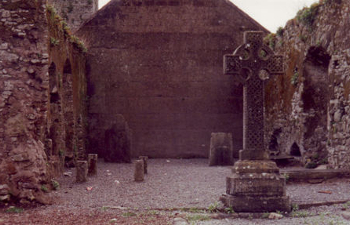
(Pictured: The Cotter Family burial vault in Carrigtwohill)
James Henthorn Todd, biblical scholar, educator, and Irish historian, is born in Rathfarnham, a Southside suburb of Dublin, on April 23, 1805. He is noted for his efforts to place religious disagreements on a rational historical footing, for his advocacy of a liberal form of Protestantism, and for his endeavours as an educator, librarian, and scholar in Irish history.
Todd is the son of Charles Hawkes Todd, a professor of surgery, and Eliza Bentley, and is the oldest of fifteen children. Noted physician Robert Bentley Todd is among his younger brothers. His father dies a year after he receives a B.A. from Trinity College, Dublin in 1825, diminishing his prospects for success. However, he is able to remain at the college by tutoring and editing a church periodical.
Todd obtains a premium in 1829, and two years later is elected Fellow, taking deacon’s orders in the same year. From that time until 1850, when he becomes a Senior Fellow, he is among the most popular tutors in Trinity College.
Todd takes priest’s orders in 1832. He begins publishing in earnest, including papers on John Wycliffe, church history, and the religious questions of his day. He is Donnellan Lecturer in 1838 and 1839, publishing works related to the Antichrist in which he opposes the views of the more extreme of his co-religionists who apply this term to the Roman Catholicism and the Pope. In 1840 he graduates Doctor of Divinity.
In 1837 Todd is installed Treasurer at St. Patrick’s Cathedral in Dublin and becomes Precentor in 1864. His style of preaching is described as simple and lucid, and his sermons interesting. He co-founds Saint Columba’s College in 1843, a school which promotes the Irish language for those who intend to take orders, as well as promoting the principles of the Church of Ireland.
In 1849 Todd is made Regius Professor of Hebrew at Trinity, and a Senior Fellow the following year. In 1852 he is appointed Librarian, and working alongside John O’Donovan and Eugene O’Curry, he classifies and arranges the collection of manuscripts. When his office receives money, he spends it on the acquisition of manuscripts and rare books, and he deserves much credit for the library’s high ranking as one of the chief libraries of Europe.
Todd’s secular achievements are no less remarkable. In 1840 he co-founds the Irish Archaeological Society and acts as its honorary secretary. He is elected a member of the Royal Irish Academy and strives actively to acquire transcripts and accurate accounts of Irish manuscripts from foreign libraries. He is honorary secretary from 1847 to 1855, and president from 1856 to 1861. In 1860 he is given an ad eundem degree at the University of Oxford.
Todd is a notable person among notable people. His work is widely respected and cited. Among his friends and acquaintances are lawyer and poet Sir Samuel Ferguson, Conservative Member of Parliament (MP) and Roman Catholic convert Edwin Wyndham-Quin, fellow historian William Reeves, artist Sir George Petrie, and the Stokes family (physician father William, future lawyer and Celticist son Whitley, and future antiquarian daughter Margaret).
James Henthorn Todd dies at his house in Rathfarnham on June 28, 1869, and is buried in the churchyard of St. Patrick’s Cathedral.
Seán O’Casey, Irish playwright renowned for realistic dramas of the Dublin slums in war and revolution, in which tragedy and comedy are juxtaposed in a way new to the theatre of his time, is born at 85 Upper Dorset Street in Dublin on March 30, 1880.
Born as John Casey into a lower middle-class Irish Protestant family, his father dies when he is six, and thereafter the family becomes progressively poorer. With only three years of formal schooling, he educates himself by reading. He starts work at 14, mostly at manual labour, including several years with the Irish railways.
O’Casey becomes caught up in the cause of Irish nationalism, and he changes his name to its Irish form and learns the Irish language. His attitudes are greatly influenced by the poverty and squalor he witnesses in Dublin’s slums and by the teachings of the Irish labour leader Jim Larkin. He becomes active in the labour movement and writes for The Irish Worker. He also joins the Irish Citizen Army, a paramilitary arm of the Irish labour unions, and draws up its constitution in 1914. At this time, he becomes disillusioned with the Irish nationalist movement because its leaders put nationalist ideals before socialist ones. He does not take part in the 1916 Easter Rising against the British authorities.
Disgusted with the existing political parties, he turns his energies to drama. His tragicomedies reflect in part his mixed feelings about his fellow slum dwellers, seeing them as incapable of giving a socialist direction to the Irish cause but at the same time admirable for their unconquerable spirit.
After several of his plays have been rejected, the Abbey Theatre in Dublin produces The Shadow of a Gunman (1923), set during the guerrilla warfare between the Irish Republican Army and British forces. In 1924 the Abbey stages Juno and the Paycock, his most popular play, set during the period of civil war over the terms of Irish independence. The Plough and the Stars (1926), with the 1916 Easter Rising as its background, causes riots at the Abbey by patriots who think the play denigrates Irish heroes. When first produced in the 1920s, these plays have an explosive effect on the audiences at the Abbey and help to enlarge the theatre’s reputation.
O’Casey goes to England in 1926, meets the Irish actress Eileen Carey Reynolds, marries her, and henceforth makes England his home. His decision to live outside Ireland is motivated in part by the Abbey’s rejection of The Silver Tassie, a partly Expressionist antiwar drama produced in England in 1929. Another Expressionist play, Within the Gates (1934), follows, in which the modern world is symbolized by the happenings in a public park. The Star Turns Red (1940) is an antifascist play, and the semiautobiographical Red Roses for Me (1946) is set in Dublin at the time of the Irish railways strike of 1911.
O’Casey’s later plays, given to fantasy and ritual and directed against the life-denying puritanism he believes has beset Ireland, include Cock-a-Doodle Dandy (1949), The Bishop’s Bonfire (1955), and The Drums of Father Ned (1958). His last full-length play is a satire on Dublin intellectuals, Behind the Green Curtains, published in 1961.
O’Casey’s three indisputably great plays are The Shadow of a Gunman, Juno and the Paycock, and The Plough and the Stars. All are tragicomedies set in the slums of Dublin during times of war and revolution. Violent death and the everyday realities of tenement life throw into relief the blustering rhetoric and patriotic swagger of men caught up in the struggle for Irish independence. The resulting ironic juxtapositions of the comic and tragic reveal the waste of war and the corrosive effects of poverty. His gifts are for vivid characterization and working-class language and, though he portrays war and poverty, he writes some of the funniest scenes in modern drama. His later plays are not considered as powerful or moving as his earlier realistic plays. In his later plays he tends to abandon vigorous characterization in favour of expressionism and symbolism, and sometimes the drama is marred by didacticism.
Six volumes of O’Casey’s autobiography appeared from 1939 to 1956. They are later collected as Mirror in My House (1956) in the United States and as Autobiographies (1963) in Great Britain. O’Casey’s letters from 1910 to 1941 are edited by David Krause in two volumes (1975, 1980).
Peig Sayers, Irish author and seanchaí, is born in the townland of Vicarstown, Dunquin, County Kerry, on March 29, 1873. Seán Ó Súilleabháin, the former archivist for the Irish Folklore Commission, describes her as “one of the greatest woman storytellers of recent times.”
Sayers is born Máiréad (Margaret) Sayers, the youngest child of the family. She is called Peig after her mother, Margaret “Peig” Brosnan, from Castleisland. Her father Tomás Sayers is a renowned storyteller who passes on many of his tales to Peig. At age 12, she is taken out of school and goes to work as a servant for the Curran family in the nearby town of Dingle. She spends two years there before returning home due to illness.
She spends the next few years as a domestic servant working for members of the growing middle class produced by the Land War. She plans to join her best friend, Cáit Boland, in the United States, but Boland writes that she has had an accident and can not forward the cost of the fare. Peig moves to the Great Blasket Island after marrying Pádraig Ó Guithín, a fisherman and native of the island, on February 13, 1892. She and Pádraig have eleven children, of whom six survive.
The Norwegian scholar Carl Marstrander, who visits the island in 1907, urges Robin Flower of the British Museum to visit the Blaskets. Flower is keenly appreciative of Sayers’ stories and tales. He records them and brings them to the attention of the academic world.
In the 1930s, a Dublin teacher, Máire Ní Chinnéide, who is a regular visitor to the Blaskets, urges Sayers to tell her life story to her son Micheál. She is illiterate in the Irish language, although she receives her early schooling through the medium of English. She dictates her biography to Micheál. He then sends the manuscript pages to Máire Ní Chinnéide in Dublin, who edits them for publication. It is published in 1936.
Over several years beginning in 1938 she dictates 350 ancient legends, ghost stories, folk stories, and religious stories to Seosamh Ó Dálaigh of the Irish Folklore Commission.
Sayers continues to live on the island until 1942, when she leaves the Island and returns to her native Dunquin. She is moved to a hospital in Dingle, County Kerry where she dies on December 8, 1958. She is buried in the Dún Chaoin Burial Ground on the Dingle Peninsula. Her surviving children, except for her son Micheál, emigrate to the United States and live with their descendants in Springfield, Massachusetts.
Thomas Curtin is born at Ballyknockane, Mourne Abbey, County Cork, on March 20, 1884, the son of Patrick Curtin, a farmer, and Julia Sheehan. He attends Burnfort National School. In 1897 the family moves to Cork City, where he attends the North Monastery school.
Mac Curtain, as he later becomes known, is active in a number of cultural and political movements beginning around the turn of the 20th century. He joins the Blackpool, Cork branch of Conradh na Gaeilge, becoming its secretary in 1902. He has interests in music, poetry, history, archaeology and Irish history. He works in his early career as a clerk, and in his free time teaches Irish. In 1911 he joins Fianna Éireann and is a member of the Irish Volunteers.
He meets Elizabeth Walsh (Eibhlís Breathnach) at a Gaelic League meeting, and they marry on June 28, 1908. They have six children, five of whom survive into adulthood. The family lives over 40 Thomas Davis Street, where Mac Curtain runs a small clothing and rainwear factory.
In April 1916, at the outset of the Easter Rising, Mac Curtain commands a force of up to 1,000 men of the Irish Volunteers who assemble at various locations around County Cork. From the volunteer’s headquarters at Sheares Street in the city, Mac Curtain and his officers await orders from the volunteer leadership in Dublin, but conflicting instructions and confusion prevail and as a result the Cork volunteers never enter the fray. A tense stand-off develops when British forces surround the volunteer hall and continued for a week until a negotiated agreement leads to the surrender of the volunteers’ arms to the then Lord Mayor of Cork Thomas Butterfield on the understanding that they will be returned at a later date. This does not happen however, and Mac Curtain is jailed in Wakefield Prison, in the Frongoch internment camp in Wales, and in Reading Gaol. After the general amnesty of participants in the Rising 18 months later, Mac Curtain returns to active duty as a Commandant of what is now the Irish Republican Army.
By 1918 Mac Curtain is a brigade commander, the highest and most important rank in the IRA. During the Conscription Crisis of 1918, he actively encourages the hiring of the women of Cumann na mBan to cater for Volunteers. He is personally involved with Michael Collins‘ Squad that, along with a Cork battalion, attempt to assassinate Lord John French, whose car is missed as the convoy passes through the ambush positions. Despite the setback he remains brigadier of No.1 Cork when he is elected Lord Mayor. He is elected in the January 1920 council elections as the Sinn Féin councillor for NW Ward No. 3 of Cork and is chosen by his fellow councillors to be the Lord Mayor. He begins a process of political reform within the city.
In January 1919, the Irish War of Independence starts, and Mac Curtain becomes an officer in the IRA. On March 20, 1920, his 36th birthday, Mac Curtain is shot dead in front of his wife and son by a group of men with blackened faces, who are found to be members of the Auxilaries along with unknown members of the Royal Irish Constabulary (RIC) by the official inquest into the event. In the wake of the killing, which is in revenge for the shooting of a policeman, Mac Curtain’s house in Blackpool is ransacked.
The killing causes widespread public outrage. The coroner’s inquest passes a verdict of willful murder against British Prime MinisterDavid Lloyd George and against certain members of the RIC. Michael Collins later orders his squad of assassins to uncover and assassinate the police officers involved in the attack. RIC District Inspector Oswald Swanzy, who had ordered the attack, is fatally shot, with Mac Curtain’s own revolver, while leaving a Protestant church in Lisburn, County Antrim on August 22, 1920, sparking what is described by Tim Pat Coogan as a “pogrom” against the Catholic residents of the town.
Eilís Dillon, Irish author of 50 books, is born in Galway, County Galway on March 7, 1920. Her work has been translated into 14 languages.
Dillon is the third of five children of Professor Thomas Dillon and his wife Geraldine (née Plunkett), who is the sister of Joseph Mary Plunkett. She is raised at Dangan House outside of Galway City before moving to the small fishing village of Barna. She attends the local primary school where she becomes proficient in the Irish language and gains an intimate knowledge of tradition in the Connemara. Her family is involved in Irish revolutionary politics. Her uncle, Joseph Mary Plunkett, is a signatory of the 1916 Proclamation of the Irish Republic and is executed after the Easter Rising.
Educated by the Ursuline nuns in Sligo, she works briefly in the hotel and catering trade. In 1940 she marries Cormac Ó Cuilleanáin, an academic from University College Cork and 17 years her senior. They have at least three children, including the Irish poet and Trinity College Dublin professor Eiléan Ní Chuilleanáin and her brother, Cormac Ó Cuilleanáin, also a Trinity professor, who writes novels as Cormac Millar.
Dillon’s first books are written in Irish including An Choill Bheo, published in 1948, Oscar agus an Cóiste sé nEasóg in 1952 and Ceol na coille in 1955. After the success of The Lost Island, published in 1952, she writes almost exclusively in English. Most of her books are aimed at teen readers with themes of self-discovery and problem solving evident.
Dillon’s adult fiction career begins in 1953 with the publication of the detective novel Death at Crane’s Court. This is followed by Sent to His Account in 1954 and Death in the Quadrangle in 1956. These novels are known for their depiction of contemporary Ireland. Over the following decade Dillon publishes many novels including The Bitter Glass (1959), Across the Bitter Sea (1973) and The Wild Geese (1981).
In 1964 she moves to Rome due to her husband’s poor health. While there she acts as adviser to International Commission on English in the Liturgy. She returns to Cork with her husband in 1969 where he dies the following year. She continues to visit Italy over the next several years, setting some of her stories there including Living in Imperial Rome (1974) and The Five Hundred (1972), though these are not as popular as her Irish books. In 1974 she marries the American-based critic and professor Vivian Mercier, dividing her time between California, Italy and Dublin.
In her later years Dillon plays a prominent role in Irish culture. She is a Fellow of the Royal Society for Literature and a member of Aosdána, serves on the Irish Arts Council 1974–1979, chairs the Irish Writers’ Union and the Irish Writers’ Centre, and founds the Irish Children’s Book Trust. In 1987 she and her husband move permanently to Dublin where she supports up and coming Irish authors. Her last story is Children of Bach published in 1993.
Ó Faoláin writes his first stories in the 1920s, eventually completing 90 stories over a period of 60 years. From 1929 to 1933 he lectures at the Catholic college, St. Mary’s College, at Strawberry Hill in Twickenham, England, during which period he writes his first two books. His first book, Midsummer Night Madness, is published in 1932. It is a collection of stories partly based on his Civil War experiences. He afterwards returns to his native Ireland. He publishes novels, short stories, biographies, travel books, translations, and literary criticism – including one of the rare full-length studies of the short story, The Short Story (1948). He also writes a cultural history, The Irish, in 1947.
Daniel Corkery, Irish politician, writer and academic, is born in Cork, County Cork on February 14, 1878. He is unquestionably best known as the author of The Hidden Ireland, his 1924 study of the poetry of eighteenth-century Irish Language poets in Munster.
After leaving St. Patrick’s, Corkery teaches art for the local technical education committee, before becoming inspector of Irish in 1925, and later Professor of English at University College Cork in 1930. Among his students in UCC are Seán Ó Faoláin and Seán Ó Tuama. He is often a controversial figure in academia for his “nativist” views on Irish literature, views which result in conflict with many Irish Language scholars, most notably Pádraig de Brún and his niece Máire Mhac an tSaoi. Ó Tuama, however, is frequently a staunch defender of Corkery’s reputation.
In his late twenties Corkery learns Irish and this brings him into contact with leading members of the Irish Language revival movement, including Terence MacSwiney, T. C. Murray and Con O’Leary, with whom he founds the Cork Dramatic Society in 1908. His plays Embers and The Hermit and the King are performed by the society. Later plays are staged at the famous Abbey Theatre, including The Labour Leader (1919) and The Yellow Bittern (1920).
Corkery is also a writer of short stories, including the collections A Munster Twilight (1916), The Hounds of Banba (1920), The Stormy Hills (1929), and Earth Out of Earth (1939), and a novel, The Threshold of Quiet (1917).
Corkery also writes non-fiction works, including The Hidden Ireland (1924), a highly influential work about the riches of eighteenth-century Irish poetry. In this he attempts to reconstruct a worldview preserved by Gaelic poets amongst the poor and oppressed Catholic peasantry of the Penal Laws era, virtually invisible in the Anglo-Irish tradition that has dominated the writing of Irish history. “An instant, influential classic,” writes Patrick Walsh, “its version of the past provided powerful cultural underpinning to the traditional nationalist history that became, in the 1930s, the educational orthodoxy of the new state.”
Corkery serves as a member of Seanad Éireann from 1951 to 1954 when he is nominated by the Taoiseach.
Daniel Corkery dies on December 31, 1964. His papers are held in the Boole Library of University College Cork.