seamus dubhghaill

Promoting Irish Culture and History from Little Rock, Arkansas, USA


Leave a comment

Patrick Francis Healy Becomes President of Georgetown University

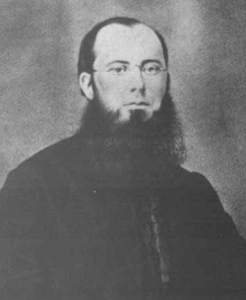
Patrick Francis Healy, Jesuit priest and educator, becomes the 29th President of Georgetown University on July 31, 1874. He is known for expanding the school following the American Civil War. Healy Hall is constructed during his tenure and is named after him. It is designated as a National Historic Landmark in the late 20th century.

Healy is born into slavery in 1834 in Macon, Georgia, the third son of Irish American plantation owner Michael Healy and his African American slave Mary Eliza, who is the multiracial daughter of a black slave and white slaveowner. The law establishes during colonial slavery in the United States that children are to take the legal status of the mother. By the principle of partus sequitur ventrum, Patrick and his siblings are legally considered slaves in Georgia, although their father is free, and they are three-quarters or more European in ancestry.

Discriminatory laws in Georgia prohibit the education of slaves and require legislative approval for each act of manumission, making these essentially impossible to gain. Michael Healy arranges for all his children to leave Georgia and move to the North to obtain their educations and have opportunities in their lives. They are raised as Irish Catholics. Patrick’s brothers and sisters are nearly all educated in Catholic schools and colleges. Many achieve notable firsts for Americans of mixed-race ancestry during the second half of the 19th century, and the Healy family of Georgia is remarkably successful.

Healy sends his older sons first to a Quaker school in Flushing, New York. Despite the Quakers’ emphasis on equality, Patrick encounters some discrimination during his grade school years, chiefly because his father is a slaveholder, which by the late antebellum years the Quakers consider unforgivable. Patrick also meets resistance in the school as an Irish Catholic. When Michael Healy hears of a new Jesuit college, the College of the Holy Cross in Worcester, Massachusetts, he sends his four oldest sons, including Patrick, to study there in 1844. They are joined at Holy Cross by their younger brother Michael in 1849.

Following Patrick’s graduation in 1850, he enters the Jesuit order, the first African American to do so, and continues his studies. The order sends him to Europe to study in 1858. His mixed-race ancestry has become an issue in the United States, where tensions are rising over slavery. He attends the Catholic University of Leuven in Belgium, earning his doctorate, becoming the first American of openly acknowledged part-African descent to do so. During this period, he is also ordained to the priesthood on September 3, 1864.

In 1866 Healy returns to the United States and teaches philosophy at Georgetown University in Washington, D.C. On July 31, 1874, he is selected as the school’s twenty-ninth president. He is the first college president in the United States of African American ancestry. At the time, he identifies as Irish Catholic and is accepted as such.

Patrick Healy’s influence on Georgetown is so far-reaching that he is often referred to as the school’s “second founder,” following Archbishop John Carroll. Healy helps transform the small nineteenth-century college into a major university for the twentieth century, likely influenced by his European education.

He modernizes the curriculum by requiring courses in the sciences, particularly chemistry and physics. He expands and upgrades the schools of law and medicine. The most visible result of Healy’s presidency is the construction of the university’s flagship building designed by Paul J. Pelz, begun in 1877 and first used in 1881. The building is named in his honor as Healy Hall.

Healy leaves the College in 1882 and travels extensively through the United States and Europe, often in the company of his brother James, a bishop in Maine. In 1908 he returns to the campus infirmary, where he dies on January 10, 1910. He is buried on the grounds of the university in the Jesuit cemetery.


Leave a comment

Birth of Cathal Brugha, Revolutionary & Politician

Cathal Brugha, Irish revolutionary and politician, is born in Dublin on July 18, 1874. He is active in the Easter Rising, the Irish War of Independence, and the Irish Civil War and is the first Ceann Comhairle (chairman) of Dáil Éireann as well as the first President of Dáil Éireann, then the title of the chief of government.

Born Charles William St. John Burgess, Brugha is the tenth of fourteen children and is educated at the Jesuit Belvedere College but is forced to leave at the age of sixteen because of the failure of his father’s business.

In 1899 Brugha join the Gaelic League, and he subsequently changes his name from Charles Burgess to Cathal Brugha. He meets his future wife, Kathleen Kingston, at an Irish class in Birr, County Offaly and they marry in 1912. They have six children, five girls and one boy. Brugha becomes actively involved in the Irish Republican Brotherhood (IRB) and in 1913 he becomes a lieutenant in the Irish Volunteers. He leads a group of twenty Volunteers to receive the arms smuggled into Ireland in the Howth gun-running of 1914.

He is second-in-command at the South Dublin Union under Commandant Éamonn Ceannt in the Easter Rising of 1916. On the Thursday of Easter Week, being badly wounded, he is unable to leave when the retreat is ordered. Brugha, weak from loss of blood, continues to fire upon the enemy and is found by Eamonn Ceannt singing “God Save Ireland” with his pistol still in his hands. He is initially not considered likely to survive. He recovers over the next year but is left with a permanent limp.

Brugha is elected speaker of Dáil Éireann at its first meeting on January 21, 1919, and he reads out the Declaration of Independence in Irish, which ratifies “the establishment of the Irish Republic.” On the following day, he is appointed president of the ministry pro tempore. He retains this position until April 1, 1919, when Éamon de Valera takes his place.

In October 1917 Brugha becomes Chief of Staff of the Irish Republican Army and holds that post until March 1919. He is elected as a Sinn Féin MP for the County Waterford constituency at the 1918 general election. In January 1919, Sinn Féin MPs refuse to recognise the Parliament of the United Kingdom and instead assemble at the Mansion House in Dublin as a revolutionary parliament called Dáil Éireann. Due to the absence of Éamon de Valera and Arthur Griffith, Brugha presides over the first meeting of Dáil Éireann on January 21, 1919.

Brugha has differences with Michael Collins, who, although nominally only the IRA’s Director of Intelligence, has far more influence in the organisation as a result of his position as a high-ranking member of the Irish Republican Brotherhood, an organisation that Brugha sees as undermining the power of the Dáil and especially the Ministry for Defence. Brugha opposes the oath of allegiance required for membership of the IRB and, in 1919, his proposition that all Volunteers should swear allegiance to the Irish Republic and the Dáil is adopted.

At a top-level IRA meeting in August 1920, Brugha argues against ambushes of Crown forces unless there is first a call to surrender, but it is dismissed as unrealistic by the brigade commanders present. Brugha also has the idea of moving the front line of the war to England but is opposed by Collins.

On January 7, 1922, Brugha votes against the Anglo-Irish Treaty. During the Treaty debates, he points out that Collins has only a middling rank in the Department of Defence, which supervises the IRA even though Arthur Griffith hails him as “the man who had won the war.” He leaves the Dáil and is replaced as Minister for Defence by Richard Mulcahy.

In the months between the Treaty debates and the outbreak of Civil War, Brugha attempts to dissuade his fellow anti-treaty army leaders including Rory O’Connor, Liam Mellows and Joe McKelvey from taking up arms against the Free State. When the IRA occupies the Four Courts, he and Oscar Traynor call on them to abandon their position. When they refuse, Traynor orders the occupation of the area around O’Connell Street in the hope of easing the pressure on the Four Courts and of forcing the Free State to negotiate.

On June 28, 1922, Brugha is appointed commandant of the forces in O’Connell Street. The outbreak of the Irish Civil War ensues in the first week of July when Free State forces commence shelling of the anti-treaty positions.

Most of the anti-Treaty fighters under Oscar Traynor escape from O’Connell Street when the buildings they are holding catch fire, leaving Brugha in command of a small rearguard. On July 5, he orders his men to surrender but refuses to do so himself. He then approaches the Free State troops, brandishing a revolver. He sustains a bullet wound to the leg which severs a major artery.

Cathal Brugha dies on July 7, 1922, eleven days before his 48th birthday. He has been re-elected as an anti-Treaty Teachta Dála (TD) at the 1922 Irish general election but dies before the Dáil assembles. He is buried in Glasnevin Cemetery.


Leave a comment

Birth of Brian Coffey, Poet & Publisher

Brian Coffey, Irish poet and publisher, is born in Dún LaoghaireCounty Dublin on June 8, 1905. His work is informed by his Catholicism and by his background in science and philosophy, and his connection to surrealism. For these reasons, he is seen as being closer to an intellectual European Catholic tradition than to mainstream Irish Catholic culture.

Coffey attends the Mount St. Benedict boarding school in GoreyCounty Wexford from 1917 to 1919 and then Clongowes Wood College, in ClaneCounty Kildare from 1919 until 1922. In 1923, he goes to France to study for the Bachelor’s degree in Classical Studies at the Institution St. Vincent, SenlisOise. While still at college, Coffey begins writing poetry. He publishes his first poems in University College Dublin‘s The National Student under the pseudonym Coeuvre.

In the early 1930s, Coffey moves to Paris where he studies Physical Chemistry under Jean Baptiste Perrin, who won the Nobel Prize for Physics in 1926. He completes these studies in 1933, and his Three Poems is printed in Paris by Jeanette Monnier that same year. In 1934 he enters the Institut Catholique de Paris to work with the noted French philosopher Jacques Maritain, taking his licentiate examination in 1936. He then moves to London for a time and contributes reviews and a poem to T.S. Eliot‘s The Criterion magazine. He returns to Paris in 1937 as an exchange student to work on his doctoral thesis on the idea of order in the work of Thomas Aquinas. In 1938, Coffey’s second volume of poetry, Third Person, is published by George Reavey‘s Europa Press.

During the war, Coffey teaches in schools in London and Yorkshire, leaving his young family in Dublin. After the war, he returns to Paris and completes his doctoral thesis. The family then moves so that Coffey can take up a teaching post at the Jesuit Saint Louis University.

By the early 1950s, Coffey becomes uncomfortable for a number of reasons, including the nature of his work, his distance from Ireland and the pressures that inevitably come to bear on an academic who has previously associated with well-known left-wing writers in Paris. For these reasons, he resigns in 1952.

In 1952, Coffey returns to live in London and, from 1973, Southampton. He begins again to publish his poetry and translations, mainly of French poetry. The first work in English to appear after this period of silence is Missouri Sequence, apparently begun in St. Louis but first appearing in the University Review, later known as the Irish University Review, in 1962.

Over the next decade or so, he publishes regularly in the University Review. He also sets up his own publishing enterprise, Advent Press, which publishes work by himself and by younger writers he wants to support.

Brian Coffey dies at the age of 89 on April 14, 1995, and is buried in Southampton, England.


Leave a comment

Death of Marie Dolores Eliza Rosanna Gilbert, Dancer & Actress

lola-montez

Marie Dolores Eliza Rosanna Gilbert, Countess of Landsfeld, Irish dancer and actress better known by the stage name Lola Montez, dies in Brooklyn, New York, on January 17, 1861. She becomes famous as a “Spanish dancer,” courtesan, and mistress of King Ludwig I of Bavaria, who makes her Countess of Landsfeld. She uses her influence to institute liberal reforms. At the start of the German revolutions of 1848-1849, she is forced to flee. She proceeds to the United States via Switzerland, France, and London, returning to her work as an entertainer and lecturer.

Gilbert is born in Grange, County Sligo, on February 17, 1821. Her family makes their residence at King House in Boyle, County Roscommon, until early 1823, when they journey to Liverpool, thence departing for India on March 14. Gilbert spends much of her childhood in India but is educated in Scotland and England. At age 19 she elopes with Lieutenant Thomas James. The couple separates five years later, and, in 1843, Gilbert launches a career as a dancer. Her London debut in June 1843 as “Lola Montez, the Spanish dancer” is disrupted when she is recognized as Mrs. James. The fiasco would probably have ended the career of anyone less beautiful and determined, but Gilbert receives additional dancing engagements throughout Europe. During her travels she reputedly forms liaisons with Franz Liszt and Alexandre Dumas, among many others.

Late in 1846, Gilbert dances in Munich and Ludwig I of Bavaria is so struck by her beauty that he offers her a castle. She accepts, becomes Baroness Rosenthal and Countess of Lansfeld, and remains as his mistress. Under Gilbert’s influence, Louis inaugurates liberal and anti-Jesuit governmental policies, but his infatuation with her helps to bring about the collapse of his regime in the revolution of 1848. In March of that year Ludwig abdicates in favour of his son. Gilbert flees to London, where in 1849 she marries Lieutenant George Heald, although she has never been divorced from James. Heald later leaves her.

From 1851 to 1853 Gilbert performs in the United States. Her third marriage, to Patrick P. Hull of San Francisco in 1853, ends in divorce soon after she moves to Grass Valley, California. There, among other amusements, she coaches young Lotta Crabtree in singing and dancing. She settles in New York City after an unsuccessful tour of Australia in 1855–1856 and gathers a following as a lecturer on such topics as fashion, gallantry, and beautiful women. An apparently genuine religious conversion leads her to take up various personal philanthropies.

Gilbert publishes Anecdotes of Love; Being a True Account of the Most Remarkable Events Connected with the History of Love; in All Ages and among All Nations (1858), The Arts of Beauty, or, Secrets of a Lady’s Toilet with Hints to Gentlemen on the Art of Fascination (1858), and Lectures of Lola Montez, Including Her Autobiography (1858). The international notoriety of her heyday persists long after her death and inspires numerous literary and balletic allusions.

Gilbert spends her last days in rescue work among women. By November 1859 she is showing the tertiary effects of syphilis, and her body begins to waste away. She dies at the age of 39 on January 17, 1861. She is buried in Green-Wood Cemetery in Brooklyn, New York.


Leave a comment

Birth of John B. Bannon, Irish Catholic Jesuit Priest

john-bannon

John B. Bannon, Irish Catholic Jesuit priest who serves as a Confederate chaplain during the American Civil War, is born in Roosky, County Roscommon, on December 29, 1829. He is also renowned as an orator.

Bannon is born to James Bannon, a Dublin grain dealer, and Fanny Bannon (née O’Farrell). He goes to the vincentian Castleknock College in Dublin. In 1846 he goes to study for the priesthood at St. Patrick’s Pontifical University, Maynooth, in the minor seminary until 1850 and completing his theology course in 1853. He is ordained on June 16, 1853, by Archbishop Paul Cullen for the Dublin Diocese. He soon applies to move to America.

Shortly after ordination he moves to the Archdiocese of St. Louis, Missouri. He becomes pastor to St. John the Apostle and Evangelist Church which he builds in 1858. He serves in the First Missouri Confederate Brigade, during the American Civil War. He ministers at the battles of Corinth, Fort Gibson, and at Big Black River Bridge, Vicksburg.

He is detained on July 4, 1863, when Vicksburg surrenders. After being released by Union forces, he goes to Richmond, Virginia in August 1863, where Jefferson Davis and Secretary of State Judah Benjamin ask him to go to Ireland to discourage recruitment for the Federal forces and try to get international help for the Confederacy.

In November 1863, Bannon returns to Ireland, writing and pamphleting to discourage people from emigrating and joining the Union side of the civil war. He makes two trips to Rome to try, unsuccessfully, to get the Vatican to side with the Confederacy. Following the American Civil War, he is banned from preaching in St. Louis, and stays in Ireland, becoming a Jesuit in 1865, spending some time in Milltown Park, Tullabeg College, and in Gardiner Street.

Bannon dies on July 14, 1913, in Upper Gardiner Street, and is buried in the Jesuit plot at Glasnevin Cemetery, Dublin.


Leave a comment

Birth of Irish Nationalist Joseph Mary Plunkett

joseph-mary-plunkett

Joseph Mary Plunkett, Irish nationalist, poet, journalist, and a leader of the 1916 Easter Rising, is born at 26 Upper Fitzwilliam Street in Dublin on November 21, 1887.

Both his parents come from wealthy backgrounds, and his father, George Noble Plunkett, has been made a papal count. Despite being born into a life of privilege, young Joe Plunkett does not have an easy childhood.

Plunkett contracts tuberculosis at a young age. This is to be a lifelong burden. His mother is unwilling to believe his health is as bad as it is. He spends part of his youth in the warmer climates of the Mediterranean and North Africa. He spends time in Algiers where he studies Arabic literature and language and composes poetry in Arabic. He is educated at the Catholic University School and by the Jesuits at Belvedere College in Dublin and later at Stonyhurst College, in Lancashire, England, where he acquires some military knowledge from the Officers’ Training Corps. Throughout his life, Plunkett takes an active interest in Irish heritage and the Irish language and also studies Esperanto. He is one of the founders of the Irish Esperanto League. He joins the Gaelic League and begins studying with Thomas MacDonagh, with whom he forms a lifelong friendship. The two are both poets with an interest in theatre, and both are early members of the Irish Volunteers, joining their provisional committee. Plunkett’s interest in Irish nationalism spreads throughout his family, notably to his younger brothers George and John, as well as his father, who allows his property in Kimmage, south Dublin, to be used as a training camp for young men who wish to escape conscription in Britain during the First World War. Men there are instead trained to fight for Ireland.

Sometime in 1915 Plunkett joins the Irish Republican Brotherhood (IRB) and soon after is sent to Germany to meet with Roger Casement, who is negotiating with the German government on behalf of Ireland. Casement’s role as emissary is self-appointed, and, as he is not a member of the IRB, the organisation’s leadership wishes to have one of their own contact Germany to negotiate German aid for an uprising the following year. Plunkett is seeking, but not limiting himself to, a shipment of arms. Casement, on the other hand, spends most of his energies recruiting Irish prisoners of war in Germany to form a brigade to fight instead for Ireland. Some nationalists in Ireland see this as a fruitless endeavour, and prefer to seek weapons. Plunkett successfully gets a promise of a German arms shipment to coincide with the rising.

Plunkett is one of the original members of the IRB Military Committee that is responsible for planning the Easter Rising, and it is largely his plan that is followed. Shortly before the rising is to begin, Plunkett is hospitalised following a turn for the worse in his health. He has an operation on his neck glands days before Easter and has to struggle out of bed to take part in what is to follow. Still bandaged, he takes his place in the General Post Office with several other of the rising’s leaders, including Patrick Pearse and Tom Clarke, though his health prevents him from being terribly active. His energetic aide-de-camp is Michael Collins.

Following the surrender Plunkett is held in Kilmainham Gaol, and faces a court-martial. Seven hours before his execution by firing squad at the age of 28, he is married in the prison chapel to his sweetheart Grace Gifford, a Protestant convert to Catholicism, whose sister, Muriel, had years before also converted and married his best friend Thomas MacDonagh, who is also executed for his role in the Easter Rising. Plunkett is executed by firing squad on May 4, 1916, and is the fourth and youngest signatory of the Proclamation of the Irish Republic to be executed.

Plunkett’s brothers, George Oliver Plunkett and Jack Plunkett, join him in the Easter Rising and later become important Irish Republican Army (IRA) men. His father’s cousin, Horace Plunkett, is a Protestant and unionist who seeks to reconcile unionists and nationalists. Horace Plunkett’s home is burned down by the Anti-Treaty IRA during the Irish Civil War.

The main railway station in Waterford City is named after Plunkett as is Joseph Plunkett Tower in Ballymun. Plunkett barracks in the Curragh Camp, County Kildare is also named after him.


Leave a comment

Founding of the Pontifical Irish College in Rome

pontifical-irish-college

The Pontifical Irish College, a Roman Catholic seminary for the training and education of priests, is founded in Rome, Italy, on November 6, 1628.

Towards the close of the sixteenth century, Pope Gregory XIII sanctions the foundation of an Irish college in Rome and assigns a large sum of money as the nucleus of an endowment. However, the pressing needs of the Irish chieftains make him think that, under the circumstances, the money might as well be used for religion by supplying the Irish Catholics with the sinews of war in Ireland as by founding a college for them at Rome.

The project is revived in 1625 by the Irish bishops, in an address to Pope Urban VIII. Cardinal Ludovico Ludovisi, who is Cardinal Protector of Ireland, resolves to realize at his own expense the desire expressed to the pope by the Irish bishops. A house is rented opposite Sant’Isodoro a Capo le Case, and six students go into residence January 1, 1628. Eugene Callanan, Archdeacon of Cashel, is the first rector, Father Luke Wadding, OFM being a sort of supervisor. Cardinal Ludovisi dies in 1632 and as he is of a princely family with a large patrimony, he makes provision in his will for the college. It is to have an income of one thousand crowns a year, a house is to be purchased for it, and he leaves a vineyard as Castel Gandolfo where the students might pass their villeggiatura. The cardinal’s will directs that the college should be placed under the charge of the Jesuits. Both the heirs and Wadding suspect that provision and disputed it. A protracted lawsuit is finally decided in 1635 in favour of the Jesuits.

On February 8, 1635, the Jesuits take charge of the college and govern it until financial difficulties force them to give up control in September 1772. An Italian priest, Abbate Luigi Cuccagni, is made rector. The rectorate of Cuccagni comes to an end in 1798, when the college is closed by order of Napoleon.

Dr. Michael Blake, Bishop of Dromore, who is the last student to leave the college at its dissolution in 1798, returns a quarter of a century later to arrange for its revival, which is affected by a brief of Pope Leo XII, dated February 18, 1826. He becomes the first rector of the restored college, and among the first students who seek admission is Francis Sylvester Mahony of Cork, known to the literary world as Father Prout. Having set the college well to work, Blake returns to Ireland and is succeeded by Dr. Boylan, of Maynooth, who soon resigns and dies in 1830. He is succeeded by a young priest, later Cardinal Paul Cullen.

Dr. Cullen is succeeded by Dr. Tobias Kirby, known for his holiness of life. He governs the college for more than forty years. His successor is Michael Kelly, later coadjutor to the Archbishop of Sydney.

In 2011, under orders from Pope Benedict XVI, Cardinal Timothy Dolan, Archbishop of New York, leads a root and branch review of all structures and processes at the college. He is assisted in the visitation report by then Archbishop of Baltimore and now Cardinal Edwin O’Brien and Msgr. Francis Kelly of the Northern American College in Rome. The report is highly critical of the college and, as a result of which, three Irish members of the staff are sent home and a fourth resigns.

In 2012, four Irish archbishops, Cardinal Seán Brady, Archbishop of Armagh, Dr. Diarmuid Martin, Archbishop of Dublin, Dr. Michael Neary, Archbishop of Tuam, and Dr. Dermot Clifford, Archbishop of Cashel, are sent a copy of the visitation report by the Vatican. A response prepared for them says “a deep prejudice appears to have coloured the visitation and from the outset and it led to the hostile tone and content of the report.”

Today the Pontifical Irish College serves as a residence for clerical students from all over the world. Every year over 250 Irish couples choose the college chapel as a means to marry in Rome. It organises events for the Irish and wider international community who are currently residing in Rome and has over the years become an unofficial centre for Irish visitors to Rome seeking advice and information.


Leave a comment

Canonisation of Sir Oliver Plunkett

oliver-plunkett

Sir Oliver Plunkett is canonised in Rome by Pope Paul VI on October 12, 1975, the first new Irish saint in almost seven hundred years, and the first of the Irish martyrs to be beatified. For the canonisation, the customary second miracle is waived.

Plunkett is born on November 1, 1625, in Loughcrew, County Meath, to parents with Hiberno-Norman ancestors. Until his sixteenth year, his education is entrusted to his cousin Patrick Plunkett, Abbot of St. Mary’s, Dublin, and brother of Luke Plunkett, the first Earl of Fingall, who later becomes successively Bishop of Ardagh and of Meath. As an aspirant to the priesthood, Plunkett sets out for Rome in 1647.

Plunkett is admitted to the Pontifical Irish College in Rome and proves to be an able pupil. He is ordained a priest in 1654 and deputed by the Irish bishops to act as their representative in Rome. Meanwhile, the Cromwellian conquest of Ireland (1649–1653) has defeated the Roman Catholic cause in Ireland. As a result, it is impossible for Plunkett to return to Ireland for many years, so he petitions to remain in Rome. At the Congregation of Propaganda Fide on July 9, 1669, he is appointed Archbishop of Armagh and is consecrated on November 30 at Ghent. He returns to Ireland on March 7, 1670, as the English Restoration of 1660 has begun on a basis of toleration.

Plunkett sets about reorganising the ravaged Roman Church and builds schools both for the young and for clergy. The Penal Laws have been relaxed in line with the Declaration of Breda in 1660 and he is able to establish a Jesuit College in Drogheda in 1670, which becomes the first Catholic-Protestant integrated school in Ireland.

On the enactment of the Test Act in 1673, to which Plunkett does not agree for doctrinal reasons, the college is closed and demolished. Plunkett goes into hiding, travelling only in disguise, and refuses a government edict to register at a seaport to await passage into exile.

In 1678 the so-called Popish Plot, concocted in England by clergyman Titus Oates, leads to further anti-Roman Catholic action. Archbishop Peter Talbot of Dublin is arrested, and Plunkett again goes into hiding. Despite being on the run and with a price on his head, Plunkett refuses to leave his flock.

Plunkett is arrested in Dublin in December 1679 and imprisoned in Dublin Castle. He is tried at Dundalk for conspiring against the state by allegedly plotting to bring 20,000 French soldiers into the country, and for levying a tax on his clergy to support 70,000 men for rebellion. The trial soon collapses as the prosecution witnesses are themselves wanted men and afraid to appear in court. Plunkett is moved to Newgate Prison in London in order to face trial at Westminster Hall. The first grand jury finds no true bill, but he is not released. The second trial is generally regarded as a serious miscarriage of justice as Plunkett is denied defending counsel.

Archbishop Plunkett is found guilty of high treason in June 1681 “for promoting the Roman faith,” and is condemned to death. Plunkett is hanged, drawn, and quartered at Tyburn on July 1, 1681, the last Roman Catholic martyr to die in England. His body is initially buried in two tin boxes in the courtyard of St. Giles in the Fields church. The remains are exhumed in 1683 and moved to the Benedictine monastery at Lamspringe, near Hildesheim in Germany. His head is brought to Rome, and from there to Armagh, and eventually to Drogheda where it has rested in St. Peter’s Church since June 29, 1921. Most of the body is brought to Downside Abbey, England, where the major part is located today, with some parts remaining at Lamspringe.


Leave a comment

Birth of Actor Richard Harris

richard-harris

Richard St. John Harris, actor, singer, songwriter, producer, director, and writer, is born in Limerick, County Limerick, on October 1, 1930. He is brought up in a middle class and staunchly Roman Catholic family.

Harris is schooled by the Jesuits at Crescent College. He is a talented rugby player; however, his athletic career is cut short when he comes down with tuberculosis in his teens. After recovering from tuberculosis, Harris moves to Britain, wanting to become a director. Unable to find any suitable training courses, he enrolls in the London Academy of Music and Dramatic Art (LAMDA) to learn acting.

Harris makes his film debut in 1958 in the film Alive and Kicking and plays the lead role in The Ginger Man in the West End in 1959. Harris’ first starring role is in the film This Sporting Life (1963), as a bitter young coal miner, Frank Machin, who becomes an acclaimed rugby league football player. For his role, Harris wins Best Actor in 1963 at the Cannes Film Festival and an Academy Award nomination. He also wins notice for his role in Sam Peckinpah‘s Major Dundee (1965), as an Irish immigrant who becomes a Confederate cavalryman during the American Civil War.

Harris performs the role of King Arthur in the film adaptation of the musical play Camelot (1967). He continues to appear on stage in this role for many years, including a successful Broadway run in 1981–1982. In 1970 British exhibitors vote him the 9th most popular star at the UK box office.

Other film performances follow, among them a role as a reluctant police informant in the coal-mining tale The Molly Maguires (1970), also starring Sean Connery. Harris stars in Cromwell (1970), a film based on the life of Oliver Cromwell who leads the Parliamentary forces during the English Civil War and, as Lord Protector, ruled Great Britain and Ireland in the 1650s.

Harris’ film career collapses after the late 1970s and in the next decade he is rarely seen on screen, although he continues to act on stage. During his career Harris appears in two films which win the Academy Award for Best Picture. First, as the gunfighter “English Bob” in the Western Unforgiven (1992); second, as the Roman Emperor Marcus Aurelius in Ridley Scott‘s Gladiator (2000).

Harris is diagnosed with Hodgkin’s disease in August 2002, reportedly after being hospitalised with pneumonia. He dies at University College Hospital in Fitzrovia, London on October 25, 2002, at the age of 72. He was in a coma in his final three days. Harris’ body is cremated, and his ashes are scattered in the Bahamas, where he had owned a home.


Leave a comment

Death of Father Willie Doyle

father-willie-doyle

Father Willie Doyle, an Irish Jesuit priest, is killed in action on August 16, 1917, during the World War I.

Born William Joseph Gabriel Doyle in Dalkey, County Dublin, on March 3, 1873, Doyle is the youngest of seven children of Hugh and Christine Byrne Doyle. He is educated at Ratcliffe College, Leicester. After reading St. Alphonsus’ book Instructions and Consideration on the Religious State he is inspired to enter the priesthood and is ordained a Jesuit priest in 1907. He serves for five years on the mission staff.

Doyle serves in the Royal Army Chaplains’ Department of the British Army during World War I, appointed as a chaplain to 48 Brigade of the 16th Irish Division. During the Battle of Loos Doyle is caught in a German gas attack and for his conduct is mentioned in dispatches. A recommendation for a Military Cross is rejected as “he had not been long enough at the front.” Instead, Doyle is presented with the parchment of merit of the 49th Infantry Brigade (Irish). He is killed in the Battle of Langemarck, on August 16, 1917. Father Doyle’s body is never recovered but he is commemorated at Tyne Cot Memorial in Belgium.

General William Bernard Hickie, the commander-in-chief of the 16th Irish Division, describes Doyle as “one of the bravest men who fought or served out here.” Doyle is awarded the Military Cross for his bravery during the assault on the village of Ginchy. He is recommended for a posthumous Victoria Cross and Distinguished Service Order but is awarded neither. Doyle is proposed for canonisation in 1938, but this is not followed through.

A stained-glass window dedicated to his memory is present in St. Finnian’s Church, Dromin, County Louth.