seamus dubhghaill

Promoting Irish Culture and History from Little Rock, Arkansas, USA


Leave a comment

Birth of William Reeves, Bishop of Down, Connor & Dromore

bishop-william-reeves

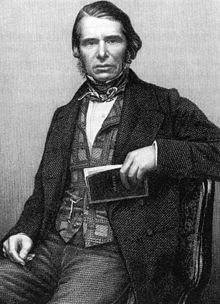
William Reeves, Irish antiquarian and the Church of Ireland Bishop of Down, Connor and Dromore from 1886 until his death, is born on March 16, 1815. He is the last private keeper of the Book of Armagh and at the time of his death is President of the Royal Irish Academy.

Reeves is born at Charleville, County Cork, the eldest child of Boles D’Arcy Reeves, an attorney, whose wife Mary is a daughter of Captain Jonathan Bruce Roberts, land agent to the Edmund Boyle, 8th Earl of Cork. This grandfather had fought at the Battle of Bunker’s Hill, and Reeves is born at his house in Charleville.

From 1823, Reeves is educated at the school of John Browne in Leeson Street, Dublin, and after that at a school kept by the Rev. Edward Geoghegan. In October 1830, he enters Trinity College, Dublin, where he quickly gains a prize for Hebrew. In his third year, he becomes a scholar and goes on to graduate BA in 1835. He proceeds to read medicine, wins the Berkeley Medal, and graduates MB in 1837. His object in taking his second degree is that he intends to become a clergyman and to practice the medical profession among the poor of his parish.

In 1838, Reeves is appointed Master of the diocesan school in Ballymena, County Antrim, and is ordained a deacon of Hillsborough, County Down. The following year, he is ordained a priest of the Church of Ireland at Derry.

In 1844, Reeves rediscovers the lost site of Nendrum Monastery when he visits Mahee Island in Strangford Lough, County Down, searching for churches recorded in 1306, and recognises the remains of a round tower. By 1845, he is corresponding with the Irish scholar John O’Donovan, and an archive of their letters between 1845 and 1860 is preserved at University College, Dublin. In July 1845, Reeves visits London.

Reeves resides in Ballymena from 1841 to 1858, when he is appointed vicar of Lusk following the success of his edition of Adomnán‘s Life of Saint Columba (1857), for which the Royal Irish Academy awards him their Cunningham Medal in 1858. In 1853, he purchases from the Brownlow family the important 9th-century manuscript known as the Book of Armagh, paying three hundred pounds for it. He sells the book for the same sum to Archbishop Beresford, who has agreed to present it to Trinity College, Dublin.

In 1875 Reeves is appointed Dean of Armagh, a position he holds until 1886 when he is appointed as Bishop of Down, Connor and Dromore. In 1891 he is elected as President of the Royal Irish Academy. As bishop, he resides at Conway House, Dunmurry, County Antrim, and signs his name “Wm. Down and Connor.”

William Reeves dies in Dublin on January 12, 1892, while still President of the Academy. At the time of his death, he is working on a diplomatic edition of the Book of Armagh, by then in the Trinity College Library. The work is completed by Dr. John Gwynn and published in 1913.


Leave a comment

First Performance of “She Stoops to Conquer”

she-stoops-to-conquer

She Stoops to Conquer, a comedy by the Anglo-Irish author Oliver Goldsmith, is first performed at Covent Garden Theatre, London on March 15, 1773, and is an immediate success. Lionel Brough is supposed to have played Tony Lumpkin 777 times. Lillie Langtry has her first big success in this play in 1881.

She Stoops to Conquer is a stage play in the form of a comedy of manners, which ridicules the manners of a certain segment of society, in this case the upper class. The play is also sometimes termed a drawing room comedy. The play uses farce, including many mix-ups, and satire to poke fun at the class-consciousness of eighteenth-century Englishmen and to satirize what Goldsmith calls the “weeping sentimental comedy so much in fashion at present.”

Most of the play takes place in the Hardcastle mansion in the English countryside, about sixty miles from London during the eighteenth century. The mansion is an old but comfortable dwelling that resembles an inn. A brief episode takes place at a nearby tavern, The Three Pigeons Alehouse.

She Stoops to Conquer is a favourite for study by English literature and theatre classes in the English-speaking world. It is one of the few plays from the 18th century to have retained its appeal and continues to be performed regularly. The play has been adapted into a film several times, including in 1914 and 1923. Initially the play was titled Mistakes of a Night and the events within the play take place in one long night. In 1778 John O’Keeffe wrote a loose sequel, Tony Lumpkin in Town.

Perhaps one of the most famous modern incarnations of She Stoops to Conquer is Peter Hall‘s version, staged in 1993 and starring Miriam Margolyes as Mrs. Hardcastle. The most famous TV production is the 1971 version featuring Ralph Richardson, Tom Courtenay, Juliet Mills and Brian Cox, with Trevor Peacock as Tony Lumpkin. It is shot on location near Ross-on-Wye, Herefordshire and is part of the BBC archive.

(Pictured: Kyrle Bellew and Eleanor Robson in a scene from She Stoops to Conquer in 1905)


Leave a comment

Initial Publication of “At Swim-Two-Birds”

at-swim-two-birds

At Swim-Two-Birds, a novel by Irish writer Brian O’Nolan writing under the pseudonym Flann O’Brien, is published on March 13, 1939. It is widely considered to be O’Brien’s masterpiece, and one of the most sophisticated examples of metafiction.

At Swim-Two-Birds is accepted for publication by Longman on the recommendation of Graham Greene, who is a reader for them at the time. It is published under the pseudonym of Flann O’Brien, a name O’Nolan had already used to write hoax letters to The Irish Times. O’Nolan suggests using “Flann O’Brien” as a penname during negotiation with Longman. The novel’s title derives from Snámh dá Én, a ford on the River Shannon, between Clonmacnoise and Shannonbridge, reportedly visited by the legendary King Sweeney, a character in the novel.

The book does not sell well after it is published. By the outbreak of World War II, it has sold scarcely more than 240 copies. In 1940, Longman’s London premises are destroyed during a bombing raid by the Luftwaffe and almost all the unsold copies are incinerated. The novel is republished by Pantheon Books in New York City in 1950, on the recommendation of James Johnson Sweeney, but sales remain low. In May 1959 Timothy O’Keeffe, while editorial director of the London publishing house MacGibbon & Kee, persuades O’Nolan to allow him to republish At Swim-Two-Birds. More recently, the novel is republished in the United States by Dalkey Archive Press.

The initial reviews for At Swim-Two-Birds are not enthusiastic. The Times Literary Supplement says that the book’s only notable feature is a “schoolboy brand of mild vulgarity.” The New Statesman complains that “long passages in imitation of the Joycean parody of the early Irish epic are devastatingly dull” and the Irish novelist Seán Ó Faoláin comments in John O’London’s Weekly that although the book had its moments, it “had a general odour of spilt Joyce all over it.”

However, most of the support for At Swim-Two-Birds comes not from newspaper reviewers but from writers. Dylan Thomas, in a remark that would be quoted on dust jackets in later editions of the book, says “This is just the book to give your sister – if she’s a loud, dirty, boozy girl.” Anthony Burgess considers it one of the ninety-nine greatest novels written between 1939 and 1984. Graham Greene’s enthusiastic reader’s report is instrumental in getting the book published in the first place.

Stephen Fry has declared At Swim-Two-Birds one of his favourite books. In 2011, the book is placed on Time‘s top 100 fiction books written in English since 1923.


Leave a comment

Death of John Redmond, Politician & Barrister

john-edward-redmond

John Edward Redmond, Irish nationalist politician, barrister, and Member of Parliament (MP) in the House of Commons of the United Kingdom, dies on March 6, 1918, in London, England. He is best known as leader of the moderate Irish Parliamentary Party (IPP) from 1900 until his death. He is also leader of the paramilitary organisation the National Volunteers.

Redmond is born to an old prominent Catholic family in Kilrane, County Wexford on September 1, 1856. Several relatives are politicians. He takes over control of the minority IPP faction loyal to Charles Stewart Parnell after Parnell dies in 1891. He is a conciliatory politician who achieves the two main objectives of his political life: party unity and, in September 1914, the passing of the Irish Home Rule Act.

The Irish Home Rule Act grants limited self-government to Ireland, within the United Kingdom. However, implementation of Home Rule is suspended by the outbreak of the World War I. Redmond calls on the National Volunteers to join Irish regiments of the New British Army and support the British and Allied war effort to restore the “freedom of small nations” on the European continent, thereby to also ensure the implementation of Home Rule after a war that is expected to be of short duration. However, after the Easter Rising of 1916, Irish public opinion shifts in favour of militant republicanism and full Irish independence, resulting in his party losing its dominance in Irish politics.

In sharp contrast to Parnell, Redmond lacks charisma. He works well in small committees but has little success in arousing large audiences. Parnell had always chosen the nominees to Parliament. Now they are selected by the local party organisations, giving Redmond numerous weak MPs over whom he has little control. He is an excellent representative of the old Ireland but grows increasingly old-fashioned because he pays little attention to the new forces attracting younger Irishmen, such as Sinn Féin in politics, the Gaelic Athletic Association in sports, and the Gaelic League in cultural affairs.

Redmond never tries to understand the unionist forces emerging in Ulster. He is further weakened in 1914 by the formation of the Irish Volunteers by Sinn Féin members. His enthusiastic support for the British war effort alienates many Irish nationalists. His party has been increasingly hollowed out, and a major crisis, notably the Easter Rising, is enough to destroy it.

Redmond is increasingly eclipsed by ill-health after 1916. An operation in March 1918 to remove an intestinal obstruction appears to progress well initially, but he then suffers heart failure. He dies a few hours later at a London nursing home on March 6, 1918.

Condolences and expressions of sympathy are widely expressed. After a funeral service in Westminster Cathedral his remains are interred, as requested in a manner characteristic of the man, in the family vault at the old Knights Templars‘ chapel yard of Saint John’s Cemetery, Wexford, amongst his own people rather than in the traditional burial place for Irish statesmen and heroes in Glasnevin Cemetery. The small, neglected cemetery near the town centre is kept locked to the public. His vault, which has been in a dilapidated state, has been only partially restored by Wexford County Council.


Leave a comment

Birth of Irish Artist Nano Reid

nano-reid-crumphan-achill

Nano Reid, Irish landscape artist, figure painter and portraitist, is born in Drogheda, County Louth on March 1, 1900. An individual, expressionistic artist, Reid is acknowledged to be one of the finest Irish woman painters of twentieth-century visual art in Ireland. Her works are represented in many public collections throughout Ireland.

In 1920, Reid wins a scholarship to study fine art painting and drawing at the Dublin Metropolitan School of Art, now the National College of Art and Design, under Harry Clarke. At the time, she is, in the words of fellow student Hilda van Stockum, “a fierce redhead…uncompromising and looking for truth.” In 1925 she starts showing at the Royal Hibernian Academy (RHA), submitting a total of 42 canvases until the late 1960s.

In 1928, Reid goes to Paris and enrolls briefly at the Académie de la Grande Chaumière, after which she spends a year in London studying fine art at the Central School of Arts and Crafts under Bernard Meninsky. She returns to Ireland in 1931 and once more begins exhibiting her landscape painting at the RHA.

In 1950, with Norah McGuinness, Reid represents Ireland at the Venice Biennale. This is followed by the Exhibition of Contemporary Irish Art in Aberystwyth, Wales (1953), and the Mostra Internazionale di Bianco e Nero in Lugano, Switzerland (1956), the Guggenheim International Award Exhibition in New York City (1960) and the Twelve Irish Painters show in New York City (1963). In 1974, the Arts Council and the Arts Council of Northern Ireland stage a major retrospective of Reid’s artworks.

Nano Reid dies in Drogheda in 1981. Retrospectives are held at Taylor Galleries in Dublin (1984), Droichead Arts Centre in Drogheda (1991), and at Linenhall Arts Centre in Castlebar, County Mayo (1999).

(Pictured: “Crumphan, Achill,” oil on canvas)


3 Comments

Death of General Daniel Florence O’Leary

daniel-florence-oleary

Daniel Florence O’Leary (Irish: Dónall Fínín Ó Laoghaire), a military general and aide-de-camp under Simón Bolívar, dies in Bogotá, Colombia on February 24, 1854.

O’Leary is born around 1800 in Cork, County Cork. His father is Jeremiah O’Leary, a butter merchant. Little is known of his early life.

In 1817, O’Leary travels to London to enlist in a regiment being formed by Henry Wilson. Wilson is recruiting officers and NCOs to go to South America and form a Hussar regiment in service to Simón Bolívar, who goes on to liberate much of South America from Spanish rule.

O’Leary sails for Venezuela with Wilson near the end of 1817, arriving in March 1818. Unlike many of the Irish who fight for Simón Bolívar in his many campaigns to win South American independence, he has not served in the Napoleonic Wars. He first meets Bolívar away from the front shortly his arrival and Bolívar is apparently impressed with the young Irish officer.

In March 1819, O’Leary sees his first action and is promoted to captain. In July, after Bolívar’s famous crossing through the Casanare Swamps and over the Andes, he receives a saber wound in the battle of Pantano de Vargas but he quickly recovers and takes part in the Battle of Boyacá on August 9. Shortly after this, he becomes aide-de-camp to Bolívar. Two years later, after much more fighting, Venezuela is freed.

During the next few years, as the fight continues to free the rest of South American from Spanish domination, O’Leary performs many dangerous missions for “The Liberator,” rising ever higher in his esteem. He continues to serve Bolívar well through the political and military intrigues that follow the freeing of South America from the Spanish.

After Bolívar’s death in December 1830, O’Leary disobeys orders to burn the general’s personal documents and is exiled to Jamaica by the new Venezuelan government. There he writes extensive memoirs that are later edited by his son, Simon Bolivar O’Leary, and published in the 1870s and 1880s. Simon is the eldest of six children O’Leary has with his South American wife. He also writes his own very extensive memoirs, spanning thirty-four volumes, of his time fighting in the revolutionary wars with Bolívar.

In 1833, O’Leary is able to return to Venezuela. He holds a number of diplomatic posts for the Venezuelan government for the next 20 years, and on at least two occasions is able to visit his boyhood home of Cork.

Daniel O’Leary dies in Bogotá on February 24, 1854. The Venezuelans name a plaza after him in Caracas. In 1882, they obtain permission to take O’Leary’s body from Bogotá to Caracas, where it is laid to rest in the National Pantheon of Venezuela to lie forever in death next to the man he had served so faithfully in life, Don Simón Bolívar. A bust and plaque honouring O’Leary are presented by the Venezuelan Government to the people of Cork and unveiled on May 12, 2010 by the Venezuelan Ambassador to Ireland, Dr. Samuel Moncada.


Leave a comment

Birth of Playwright Tom Murphy

thomas-murphy

Tom Murphy, Irish playwright who has worked closely with the Abbey Theatre in Dublin and with Druid Theatre, Galway, is born in Tuam, County Galway on February 23, 1935.

Murphy attends the local Archbishop McHale College and later becomes a metalwork teacher. He begins writing in the late 1950s, saying, “In 1958, my best friend said to me, why don’t we write a play? I didn’t think it was an unusual question, because in 1958 everyone in Ireland was writing a play.” His second play, A Whistle in the Dark, is written in his Tuam kitchen on his free Friday and Saturday nights. It is entered into a competition for amateur plays, which it wins, and is eventually performed at the Theatre Royal Stratford East in London in 1961. It causes considerable controversy both there and in Dublin when it is later given its Irish premiere at the Abbey having initially been rejected by its artistic director.

Though Murphy is religious as a boy, education by the Christian Brothers leaves him largely irreligious. His 1975 play The Sanctuary Lamp is produced in the Abbey Theatre and receives a hostile reception due to its anti-Catholic nature, with theatregoers walking out and much negative criticism in the media.

Considered by many to be Ireland’s greatest living playwright, a title also often given to Brian Friel prior to his death in 2015, Murphy is honoured by the Abbey Theatre in 2001 by a retrospective season of six of his plays. His plays include the historical epic Famine (1968) which deals with the Irish Potato Famine between 1846 and spring 1847, the anti-clerical The Sanctuary Lamp (1975), The Gigli Concert (1983) and for many his masterpiece, the lyrical Bailegangaire and the bar-room comedy Conversations on a Homecoming (both 1985).

Murphy’s work is characterised by a constant experimentation in form and content from the apparently naturalistic A Whistle in the Dark to the surreal The Morning After Optimism and the spectacularly verbal The Gigli Concert. Recurring themes include the search for redemption and hope in a world apparently deserted by God and filled with suffering. Although steeped in the culture and mythology of Ireland, Murphy’s work does not trade on familiar clichés of Irish identity, dealing instead with Dostoyevskian themes of violence, nihilism and despair while never losing sight of the presence of laughter, humour and the possibilities of love and transcendence.


Leave a comment

Death of Activist James Haughton

james-haughton

James Haughton, Irish social reformer and temperance activist, dies in Dublin on February 20, 1873.

Haughton, son of Samuel Pearson Haughton (1748–1828), by Mary, daughter of James Pim of Rushin, Queen’s County (now County Laois), is born in Carlow, County Carlow, and educated at Ballitor, County Kildare, from 1807 to 1810, under James White, a quaker. After filling several situations to learn his business, in 1817 he settles in Dublin, where he becomes a corn and flour factor, in partnership with his brother William. He retires in 1850. Although educated as a Friend, he joins the Unitarians in 1834 and remains throughout his life a strong believer in their tenets.

Haughton supports the anti-slavery movement at an early period and takes an active part in it until 1838, going in that year to London as a delegate to a convention. Shortly after the Temperance campaigner Father Theobald Mathew takes the pledge, on April 10, 1838, Haughton becomes one of his most devoted disciples. For many years he gives most of his time and energies to promoting total abstinence and to advocating legislative restrictions on the sale of intoxicating drinks.

In December 1844 Haughton is the chief promoter of a fund which is raised to pay some of the debts of Father Mathew and release him from prison. About 1835 he commences a series of letters in the public press which make his name widely known. He writes on temperance, slavery, British India, peace, capital punishment, sanitary reform, and education. His first letters are signed “The Son of a Water Drinker,” but he soon commences using his own name and continues to write until 1872.

Haughton takes a leading part in a series of weekly meetings which are held in Dublin in 1840, when so numerous are the social questions discussed that a newspaper editor calls the speakers the “Anti-everythingarians.” In association with Daniel O’Connell, of whose character he has a very high opinion, he advocates various plans for the amelioration of the condition of Ireland and the Repeal of the Union but is always opposed to physical force.

Haughton becomes a vegetarian in 1846, both on moral and sanitary grounds. For two or three years before his death he is president of the Vegetarian Society of the United Kingdom. He is one of the first members of the Statistical Society of Dublin (1847), a founder of the Dublin Mechanics’ Institute (1849), in the same year is on the committee of the Dublin Peace Society, aids in abolishing Donnybrook Fair in 1855, and takes a chief part in 1861 in opening the National Botanic Gardens at Glasnevin on Sundays.

James Haughton dies at 35 Eccles Street, Dublin, on February 20, 1873, and is buried in Mount Jerome Cemetery on February 24 in the presence of an immense crowd of people.

Haughton’s son, Samuel Haughton, publishes a memoir of his father’s life including extracts from his public correspondence in 1877.


Leave a comment

Birth of Singer Delia Murphy Kiernan

delia-murphy

Delia Murphy Kiernan, singer and collector of Irish ballads, is born on February 16, 1902, in Ardroe, Roundfort, County Mayo. She records several 78 rpm records in the 1930s, 1940s and 1950s. In 1962 she records her only LP, The Queen of Connemara, for Irish Prestige Records, New York, on the cover of which her name appears alongside the LP title.

Delia’s father, John Murphy, from nearby Hollymount, makes his fortune in the Klondike Gold Rush. While in America, he marries Ann Fanning from Roscrea, County Tipperary. They return to Ireland in 1901 and purchase the large Mount Jennings Estate in Hollymount. John encouraged Delia’s interest in singing ballads from a young age. He also allows Irish travelers to camp on the estate. According to her own account, she learns her first ballads at their campfires.

Delia is educated at Presentation Convent in Tuam, Dominican College in Dublin and University College Galway (UCG), where she graduates with a Bachelor of Commerce degree. In UCG she meets Dr. Thomas J. Kiernan, and they marry in 1924, on her 22nd birthday. Kiernan then joins the Irish diplomatic service, where his first posting is to London. While there Delia sings at many venues including many gatherings of Irish emigrants and becomes quite well-known. In 1939 she records The Blackbird, The Spinning Wheel and Three Lovely Lassies for HMV.

In 1941 Kiernan is appointed Irish Minister Plenipotentiary to the Holy See in Rome. The Irish legation is the only English-speaking legation to remain open after the United States enters World War II. Delia becomes one of those who assist Hugh O’Flaherty in hiding Jews and escapes allied soldiers from the Nazis. In 1943, when Italy changes sides, many escaped POWs are helped by the legation to leave Italy. In 1946 she is awarded to Dame Commander of the Equestrian Order of the Holy Sepulchre.

Kiernan later serves as Irish High Commissioner and later first Ambassador in Australia, and later to West Germany, Canada, and the United States. In 1961, while she is living in Ottawa, Delia makes the recording of The Queen of Connemara produced by Ken Goldstein. The Kiernans purchase a farmhouse in Jasper, Ontario, near the Rideau Canal where she spends most of her time, even after Kiernan is posted to Washington, D.C. Tom Kiernan dies in December 1967.

By 1969 Delia’s health is in decline. In November of that year, she sells her farmhouse in Canada and returns to Ireland. She lives in a cottage in Strawberry Beds, Chapelizod, County Dublin. She dies of a massive heart attack on February 11, 1971, five days before her 69th birthday. She records upwards of 100 songs during her lifetime.


Leave a comment

Death of War Correspondent William Howard Russell

william-howard-russell

Sir William Howard Russell, an Irish reporter with The Times and considered to be one of the first modern war correspondents, dies in London, England on February 11, 1907.

Russell is born in Tallaght, County Dublin on March 28, 1820. As a young reporter, he reports on the First Schleswig War, a brief military conflict between Prussian and Danish troops in Denmark in 1850.

Initially sent by editor John Delane to Malta to cover British support for the Ottoman Empire against Russia in 1854, Russell despises the term “war correspondent” but his coverage of the conflict brings him international renown, and Florence Nightingale later credits her entry into wartime nursing to his reports. The Crimean medical care, shelter and protection of all ranks by Mary Seacole is also publicised by Russell and by other contemporary journalists, rescuing her from bankruptcy.

His dispatches are hugely significant as for the first time the public can read about the reality of warfare. Shocked and outraged, the public’s backlash from his reports leads the Government to re-evaluate the treatment of troops and leads to Florence Nightingale’s involvement in revolutionising battlefield treatment.

On September 20, 1854, Russell covers the battle above the Alma River, writing his missive the following day in an account book seized from a Russian corpse. The story, written in the form of a letter to Delane, is supportive of the British troops and pays particular attention to the battlefield surgeons’ “humane barbarity” and the lack of ambulance care for wounded troops. He later covers the Siege of Sevastopol where he coins the phrase “thin red line” in referring to British troops at Balaclava.

Following Russell’s reports of the appalling conditions suffered by the Allied troops conducting the siege, including an outbreak of cholera, Samuel Morton Peto and his partners build the Grand Crimean Central Railway, which is a major factor leading to the success of the siege.

Russell spends December 1854 in Constantinople on holiday, returning in early 1855. He leaves Crimea in December 1855 to be replaced by the Constantinople correspondent of The Times.

In 1856 Russell is sent to Moscow to describe the coronation of Tsar Alexander II and in the following year is sent to India where he witnesses the final re-capture of Lucknow.

In 1861 Russell goes to Washington, D.C., returning to England in 1863. In July 1865 he sails on the SS Great Eastern to document the laying of the transatlantic telegraph cable and writes a book about the voyage with color illustrations by Robert Dudley. He publishes diaries of his time in India, the American Civil War and the Franco-Prussian War, where he describes the warm welcome given him by English-speaking Prussian generals such as Leonhard Graf von Blumenthal.

Russell retires as a battlefield correspondent in 1882 and founds the Army and Navy Gazette. He is knighted in May 1895 and is appointed a Commander of the Royal Victorian Order (CVO) by King Edward VII on August 11, 1902.

Sir William Howard Russell dies on February 11, 1907, and is buried in Brompton Cemetery, London.