Reynolds is educated at Summerhill College in Sligo, County Sligo and works for a state transport company before succeeding at a variety of entrepreneurial ventures, including promoting dances and owning ballrooms, a pet-food factory, and newspapers. In 1974 he is elected to the Longford County Council as a member of Fianna Fáil. He enters Dáil Éireann, lower house of the Oireachtas, the Irish parliament, in 1977 as a member representing the Longford-Westmeath parliamentary constituency and becomes Minister for Posts and Telegraphs in Haughey’s Fianna Fáil government (1979–81). He is subsequently Minister of Industry and Commerce (1987–88) and Minister for Finance (1988–91) in Haughey’s third and fourth governments. He breaks with Haughey in December 1991. On January 30, 1992, Haughey retires as leader of Fianna Fáil at a parliamentary party meeting. Reynolds easily defeats his rivals Mary O’Rourke and Michael Woods in the party leadership election and succeeds Haughey as Taoiseach on February 11, 1992.
The Fianna Fáil–Progressive Democratscoalition that Reynolds inherits breaks up in November 1992 but, after the general election later that month, he surprises many observers by forming a new coalition government with the Labour Party in January 1993. He plays a significant part in bringing about a ceasefire between the Irish Republican Army (IRA) and unionist paramilitary groups in Northern Ireland in 1994, but he is less effective in maintaining his governing coalition. When this government founders in November 1994, he resigns as Taoiseach and as leader of Fianna Fáil, though he remains acting prime minister until a new government is formed the following month. He unsuccessfully seeks his party’s nomination as a candidate for the presidency of Ireland in 1997. He retires from public life in 2002.
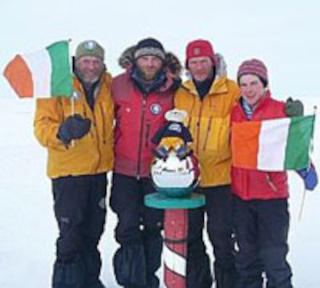
The first Irish expedition arrives at the South Pole on January 8, 2008. Team leader Pat Falvey (50), Dr. Clare O’Leary (35), Jonathan Bradshaw (36) and Shaun Menzies (42) arrive at their destination after covering the final 23 kilometres.
The expedition has been trekking since November through some of the harshest known conditions, battling icy winds, sub-zero temperatures and snowstorms. The squad, who make up the Beyond Endurance expedition, travel approximately 1,100 km (680 miles), with each member hauling a sledge weighing over 150 kg (330 lbs.).
“We’re so happy to be here, we can’t believe it,” says Falvey. “We’re ecstatic but totally exhausted, shattered, and worn away. It’s now -32.5 degrees Celsius (-26.5 F) and I’m chattering from the cold but so excited. All of the meridians and all of the longitudes passed through the point where my hand was. By walking around the South Pole, I could go back in time to yesterday or go a day ahead to tomorrow.”
A spokesman for the team confirms their arrival at their destination at around 7:30 p.m. Irish time.
Menzies and Bradshaw are relatively inexperienced high-altitude trekkers who are invited to join the expedition.
“This a very historic occasion. It is very exciting. It shows that Ireland can play its part in polar exploration,” spokesman Niall Foley says from the team’s base in Killarney, County Kerry. The team is in good spirits and resting at the Amundsen-Scott South Pole Station, he adds. “They’re well and being taken care of by the researchers there. They’re having a cup of cocoa I think.”
The team flies from the South Pole back to Ireland, via Chile, arriving on January 16. The Beyond Endurance Expedition begins in 2006 with an ambitious adventure by a group of “ordinary” people aged from 21 to 61 traveling across South Georgia, landing on Elephant Island, a mountainous ice-covered island off the Antarctic coast.
The purpose of the expedition is to give budding explorers the chance to see Antarctica. From this group, Menzies, a Dublin IT consultant, is selected for rigorous training in Greenland for the South Pole expedition. There they meet up with Bradshaw, a budding adventurer who has explored remote parts of the Himalayas, Africa and New Zealand, who is on a separate trek.
The four adventurers retrace the steps of some of the best-known Irish Antarctic explorers, including Ernest Shackleton and Tom Crean. In 2004, County Kerry native Mike Barry becomes the first Irish man to trek to the South Pole as part of an international expedition. However, Falvey’s squad has now become the first Irish-led team to perform the feat.
PresidentMary McAleese says the achievement, which coincides with the one hundredth anniversary of Ernest Shackleton’s first attempt on the South Pole, is “particularly poignant.” “I congratulate Pat Falvey, Clare O’Leary, Jonathon Bradshaw and Shaun Menzies on their remarkable accomplishment, and send my very best wishes to their many supporters in this mammoth undertaking.”
TaoiseachBertie Ahern says he has been following the team’s expedition since the team set out. “Total admiration is perhaps the best way to sum up my thoughts on what you have achieved,” Ahern says. “You are continuing a proud tradition of Irish adventurers, and you should be very proud of your wonderful achievement.”
(From: “Irish team reaches South Pole” by Paul Anderson, The Irish Times, http://www.irishtimes.com, January 9, 2008)
Michael “Mick” Lally, Irish stage, film and television actor, is born in the Gaeltacht village of Toormakeady, County Mayo, on November 10, 1945. He departs from a teaching career for acting during the 1970s. Though best known in Ireland for his role as Miley Byrne in the television soap Glenroe, his stage career spans several decades, and he is involved in feature films such as Alexander and the Academy Award-nominated The Secret of Kells. Many reports cite him as one of Ireland’s finest and most recognisable actors.
Lally begins his acting career with Taibhdhearc na Gaillimhe, Ireland’s national Irish language theatre, and is a founding member of the Druid Theatre Company. He receives an Irish Times/ESB Theatre Award Nomination for Best Actor for his role in Druid’s production of The Dead School. He also becomes a member of the Field Day Theatre Company, and stars in the company’s 1980 premiere of Brian Friel‘s play Translations. He first plays at the Abbey Theatre in 1977 in a production of Wild Oats and goes on to perform in many other Abbey productions.
In 1982, Lally stars in the TV series The Ballroom of Romance alongside Brenda Fricker. From 1983 he plays the role of Miley Byrne in the RTÉ soap Glenroe, reprising the character that he played earlier in Bracken in 1978. In 1979, he wins a Jacob’s Award for his performance as Miley in Bracken. He also has some musical success when “The By-road to Glenroe” goes to the top of the Irish charts in 1990. He is also involved in voice-over work, including a noted advertisement for Kilmeaden Cheese during the 1990s. Other TV appearances include roles in Tales of Kinvarna, The Year of the French and Ballykissangel.
In 1994, Lally plays the character Hugh in The Secret of Roan Inish, and in 1995 portrays Dan Hogan in the film adaptation of Maeve Binchy‘s Circle of Friends. Other film roles included Poitín, Our Boys, The Outcasts, A Man of No Importance and others. In later years, he provides the voice of Brother Aidan in the Academy Award-nominated The Secret of Kells, an animated film directed by Tomm Moore.
Lally appears in several TV advertisements encouraging elderly people to “release the equity tied up in their homes” during the Celtic Tiger.
Mick Lally dies in Dublin on the morning of August 31, 2010, after a short stay in the hospital. The cause of death is reported as heart failure, arising from an underlying emphysema condition. His funeral takes place in Dublin on September 2, 2010. The Irish Examiner comments that the “nation has lost one of its favourite uncles.” Personalities from TV, film, theatre and politics attend, while President of IrelandMary McAleese sends a letter and Lally receives a standing ovation at the end.
Seóirse Bodley, Irish composer and former associate professor of music at University College Dublin (UCD), is born George Pascal Bodley in Dublin on April 4, 1933. In 2008, he is the first composer to become a Saoi of Aosdána. He is widely regarded as one of the most important composers of twentieth-century art music in Ireland, having been “integral to Irish musical life since the second half of the twentieth century, not just as a composer, but also as a teacher, arranger, accompanist, adjudicator, broadcaster, and conductor.”
Bodley’s father is George James Bodley (1879–1956), an employee in the Dublin office of the London Midland & Scottish Railway Company, and later of the Ports and Docks Board. His mother, Mary (née Gough, 1891–1977), works for the Guinness Brewery. He attends schools in the Dublin suburbs of Phibsborough and Glasnevin before he moves at the age of nine to an Irish-speakingChristian Brothers school at Parnell Square. He later studies at the School of Commerce in Rathmines, where he obtains his Leaving Certificate.
Music is encouraged in his parents’ home, and Bodley receives initial lessons on the mandolin from his father and on the piano from his mother. He studies the piano, harmony and counterpoint at the Royal Irish Academy of Music and obtains a Licentiate in piano from Trinity College London (TCL). From the age of 13, he also enrolls for a time at the Brendan Smith Academy of Acting. While he is still at school, he receives his first lessons in composition privately from the Dublin-based German choral conductor Hans Waldemar Rosen (1904–94), which continues, on and off, until 1956. From his student days he performs as an accompanist to singers and takes part in chamber music performances. An important element in his musical education is the twice-weekly free concerts given by the Radio Éireann Symphony Orchestra in the Phoenix Hall, Dame Court, where he has the opportunity to hear leading Irish and international performers and conductors presenting both classics and modern repertory.
From 1952 Bodley studies for a Bachelor of Music degree from University College Dublin, mainly with Anthony Hughes. He obtains the degree in 1955. From 1957 to 1959 he studies composition (with Johann Nepomuk David) and conducting at the Württembergische Hochschule für Musik in Stuttgart, Germany, and a year later he obtains a Doctorate in Music from UCD. He also takes classes in conducting with Hans Müller-Kray and Karl Maria Zwißler, and in piano with Alfred Kreutz. He returns to Germany several times in the early 1960s to participate in courses at the Darmstädter Ferienkurse, which significantly expands his knowledge of avant-garde techniques.
From 1959 until his retirement in 1998, Bodley lectures at the university’s music department, becoming associate professor in 1984. During the 1960s, he is conductor of the Culwick Choral Society.
Bodley’s development as a composer sees several distinct phases. In the 1970s he merges avant-garde styles with elements from Irish traditional music and becomes a figure of national importance. He receives several prestigious commissions for large-scale works, such as Symphony No. 3 (1981), written for the opening of the National Concert Hall.
In 1982 Bodley becomes a founder-member of Aosdána and PresidentMary McAleese confers the distinction of Saoi on him in November 2008. McAleese says that Bodley “has helped us to recast what it means to be an artist in Ireland.”
Beere joins the Civil Service of the Republic of Ireland in 1924 and works initially in the Statistics Branch. In 1925, she wins a Rockefeller Foundation scholarship and travels extensively in the United States before resuming her Civil Service career. From 1939, she works in the Department of Industry and Commerce where during The Emergency, as World War II is known in Ireland, she works in the area of supply with Minister Seán Lemass. She becomes Assistant Secretary of that Department in 1953. She is the first woman to achieve the rank of Department Secretary, the highest-ranking post in a government department, doing so at the Department of Transport and Power in 1959. PresidentMary McAleese calls her the “ultimate civil servant.”
Trinity College Dublin confers an honorary doctorate of Doctor of Laws upon her in 1960. After her retirement in 1967 she is active in public life, serving as a governor of Alexandra College and as a director of The Irish Times. She is requested by the Government to chair the Commission on the Status of Women in 1970, and the Beere Report is presented to the Minister for Finance in December 1972. The report provides a model for change in equal pay, the Civil Service marriage bar (which requires female civil servants to resign from their position upon marriage) and the widow’s pension. Her name is mentioned as a possible candidate for the Irish presidency in 1976.
Beere has a lifelong interest in the proceedings of the Statistical and Social Inquiry Society of Ireland and serves as its President. She is a Governor of The Irish Times Trust and chairwoman of the International Labour Organization office in Geneva, Switzerland. She is a member of the organising committee, which on May 7, 1931, sets up An Óige (the Irish Youth Hostel Association), of which she is President from 1968 to 1974. She also has an extensive interest in the arts, in particular the paintings of Cecil King.
Beere dies on February 19, 1991, in Killiney, County Dublin. She never marries but has a 40-year companionship with businessman JJ O’Leary.
FitzGerald joins Fine Gael, attaching himself to the liberal wing of the party. and in 1969 is elected to Dáil Éireann, the lower house of the Oireachtas, the Irish parliament. He later gives up his university lectureship to become Minister for Foreign Affairs in the coalition government of Liam Cosgrave (1973–1977). When the coalition government is resoundingly defeated in the 1977 Irish general election, Cosgrave yields leadership of Fine Gael to FitzGerald. In his new role as Leader of the Opposition and party leader, he proceeds to modernize and strengthen the party at the grass roots. He briefly loses power in 1982 when political instability triggers two snap elections.
By the time of the 1981 Irish general election, Fine Gael has a party machine that can easily match Fianna Fáil. The party wins 65 seats and forms a minority coalition government with the Labour Party and the support of a number of Independent TDs. FitzGerald is elected Taoiseach on June 30, 1981. To the surprise of many FitzGerald excludes Richie Ryan, Richard Burke and Tom O’Donnell, former Fine Gael stalwarts, from the cabinet.
On May 5, 2011, it is reported that FitzGerald is seriously ill in a Dublin hospital. Newly elected Fine Gael Taoiseach Enda Kenny sends his regards and calls him an “institution.” On May 6 he is put on a ventilator. On May 19, after suffering from pneumonia, he dies at the Mater Private Hospital in Dublin at the age of 85.
In a statement, Irish PresidentMary McAleese hails FitzGerald as “a man steeped in the history of the State who constantly strove to make Ireland a better place for all its people.” Taoiseach Enda Kenny pays homage to “a truly remarkable man who made a truly remarkable contribution to Ireland.” Henry Kissinger, the former United States Secretary of State, who serves as an opposite number to FitzGerald in the 1970s, recalls “an intelligent and amusing man who was dedicated to his country.”
FitzGerald’s death occurs on the third day of Queen Elizabeth II‘s state visit to the Republic of Ireland, an event designed to mark the completion of the Northern Ireland peace process that had been “built on the foundations” of FitzGerald’s Anglo-Irish Agreement with Margaret Thatcher in 1985. In a personal message, the Queen offers her sympathies and says she is “saddened” to learn of FitzGerald’s death.
On his visit to Dublin, United States PresidentBarack Obama offers condolences on FitzGerald’s death. He speaks of him as “someone who believed in the power of education; someone who believed in the potential of youth; most of all, someone who believed in the potential of peace and who lived to see that peace realised.”
FitzGerald is the author of a number of books, including Planning in Ireland (1968), Towards a New Ireland (1972), Unequal Partners (1979), All in a Life: An Autobiography (1991), and Reflections on the Irish State (2003).
Gorbachev, the man who led Russia through the most difficult days of his country’s shift to democracy, is also conferred with an honorary degree. On his arrival he goes to Trinity College Dublin to receive the honour before launching the new European Russian Trust. He later dines as a guest of the Irish Government in Dublin Castle.
On the following day, Gorbachev is accompanied by Dublin’s Lord Mayor Michael Mulcahy during a visit to see members of the city’s Russian community at the Hugh Lane Gallery. He also chats with local shop owners and residents during an informal tour of The Liberties area. After addressing the Institute of European Affairs and lunching with President McAleese at Áras an Uachtaráin, the president’s official residence and principal workplace, he is granted freedom of the Irish capital at a special ceremony.
Following his visit with President McAleese, Gorbachev jokes with Mulcahy that he fully intends to exercise his right to graze sheep in the city. Mulcahy says, “This visit will help to cement relations between us, as well as doing appropriate honour to a genuinely great man whose place in history is already secure.”
Gorbachev formally announced his resignation as Soviet President and Commander-in-Chief on December 25, 1991. The following day, the Soviet of the Republics, the upper house of the Supreme Soviet of the Soviet Union, formally voted the Soviet Union out of existence. The Soviet Union officially ceased to exist at midnight on December 31, 1991. As of that date, all Soviet institutions that had not been taken over by Russia ceased to function.
(Pictured: Mikhail Gorbachev samples a pint of Guinness watched by Dublin’s Lord Mayor Michael Mulcahy, in Doheny & Nesbitt’s pub in Merrion Row. Picture by Donal Doherty)
O’Riordan joins the Communist Party of Ireland in 1935 while still in the IRA and works on the communist newspaper The Irish Workers’ Voice. In 1937, following the urgings of Peadar O’Donnell, several hundred Irishmen, mostly IRA or ex-IRA men, go to fight for the Spanish Republic in the Spanish Civil War with the XVth International Brigade. They are motivated in part by enmity towards the 800 or so Blueshirts, led by Eoin O’Duffy who go to Spain to fight on the “nationalist” side in the Irish Brigade. He accompanies a party led by Frank Ryan. In the Republic’s final offensive of July 25, 1938, he carries the flag of Catalonia across the River Ebro. On August 1, he is severely injured by shrapnel on the Ebro front. He is repatriated to Ireland the following month, after the International Brigades are disbanded.
In 1938 O’Riordan is offered an Irish Army commission by the Irish Free State but chooses instead to train IRA units in Cork. As a result of his IRA activities during World War II, or the Emergency as it is known in neutral Ireland, he is interned in the Curragh internment camp from 1939 until 1943 where he is Officer Commanding of the Cork Hut and partakes in Máirtín Ó Cadhain’s Gaelic League classes as well as publishing Splannc (Irish for “Spark,” named after Vladimir Lenin‘s newspaper).
In 1944 O’Riordan is founding secretary of the Liam Mellows Branch of the Labour Party and in 1945 is a founding secretary of the Cork Socialist Party, whose other notable members include Derry Kelleher, Kevin Neville and Máire Keohane-Sheehan.
In 1947, O’Riordan is a founding secretary of the Irish Workers’ League and general secretary thereafter, and of its successor organisation the Irish Workers’ Party from 1962–70.
In all O’Riordan runs for election five times, campaigning throughout for the establishment of a socialist republic in Ireland but given Ireland’s Catholic conservatism and fear of communism, he does so without success. He does, however, receive playwright Sean O’Casey‘s endorsement in 1951.
O’Riordan’s participation in the Spanish Civil War is always an important part of his political identity. In 1966 he attends the International Brigades’ Reunion in Berlin and is instrumental in having Frank Ryan’s remains repatriated from Germany to Ireland in 1979.
O’Riordan is a member of the Irish Chile Solidarity Committee and attends the 1st Party Congress of the Communist Party of Cuba in 1984. He also campaigns on behalf of the Birmingham Six and attends their Appeal trial in 1990. He serves as General Secretary of the Communist Party of Ireland (1970–83) and as National Chairman of the party (1983–88). He publishes many articles under the auspices of the CPI.
O’Riordan’s last major public outing comes in 2005 at the re-dedication of the memorial outside Dublin’s Liberty Hall to the Irish veterans of the Spanish Civil War. He and other veterans are received by President of IrelandMary McAleese. He is also presented with Cuba’s Medal of Friendship by the Cuban Consul Teresita Trujillo to Ireland on behalf of Cuban President Fidel Castro.
In 1969, according to Soviet dissident Vasili Mitrokhin, O’Riordan is approached by IRA leaders Cathal Goulding and Seamus Costello with a view to obtaining guns from the Soviet KGB to defend Irish republican areas of Belfast during the communal violence that marks the outbreak of the Troubles. Mitrokhin alleges that O’Riordan then contacts the Kremlin, but the consignment of arms does not reach Ireland until 1972. The operation is known as Operation Splash. The IRA splits in the meantime between the Provisional IRA and the Official IRA and it is the latter faction who receives the Soviet arms. Mitrokhin’s allegations are repeated in Boris Yeltsin‘s autobiography.
O’Riordan’s book, Connolly Column – The Story of the Irishmen who fought for the Spanish Republic 1936–1939, is published in 1979 and deals with the Irish volunteers of the International Brigade who fought in support of the Spanish Republic against Francisco Franco in the Spanish Civil War (1936–1939). An updated version of the book is reprinted in 2005 and is launched by the Lord Mayor of Dublin, Cllr. Michael Conaghan at a book launch at SIPTU headquarters, Liberty Hall. The book is the inspiration for Irish singer-songwriter Christy Moore‘s famous song “Viva la Quinta Brigada.”
In 1991, O’Riordan’s wife dies at the age of 81 at their home. He continues to live in their family home before moving to Glasnevin in 2000 to be close to his son Manus who lives nearby. He lives there until falling ill in November 2005 and is taken to the Mater Hospital. His health rapidly deteriorates, and he quickly develops Alzheimer’s disease. Soon afterwards he is moved to St. Mary’s Hospital in the Phoenix Park where he spends the final few months of his life, before his death at the age of 88 on May 18, 2006.
O’Riordan’s funeral at Glasnevin Crematorium is attended by over a thousand mourners. Following a wake the previous night at Finglas Road, hundreds turn up outside the house of his son Manus and traffic grounds to a halt as family, friends and comrades – many of whom are waving the red flag of the Communist Party of Ireland – escort O’Riordan to Glasnevin Cemetery. A secular ceremony takes place led by Manus O’Riordan, Head of Research at SIPTU, with contributions from O’Riordan’s family, Communist Party general secretary Eugene McCartan and IBMT representative Pauline Frasier.
Scallon is born Rosemary Brown, the fifth of seven children of a King’s Cross railway station porter and trumpet player originally from Derry, Northern Ireland. When she is five, the family moves back to Derry where she grows up in the Creggan housing estate and Bogside. She attends St. Eugene’s Primary School and then enrolls at Thornhill College. A singing talent from childhood, she wins several local contests while also participating in local choirs and taking piano, violin and ballet lessons.
In the early 1960s Scallon forms a trio with two of her sisters, often performing at charity concerts organized by their father. When one sister leaves, the remaining duo lands a summer-long booking at the Palladium and a recording contract with Decca Records. Her other sister, however, leaves to join her new husband, a United States airman, in America. Stricken with stage fright, Scallon the solo singer manages to win a folk competition at the Embassy Ballroom with her eyes shut. The contest’s sponsor, teacher and music promoter Tony Johnston, helps her complete her equivalency degree and records a demo that convinces Decca Records to sign her on as a solo artist. She releases a single in 1967 that brings some attention from local TV and radio.
Performing under her school nickname “Dana,” Scallon becomes a fixture in Dublin‘s cabaret and folk clubs. She is crowned “Queen of Cabaret” and feted with a parade and a reception at Clontarf Castle on the Saturday before Easter 1968.
At the suggestion of Decca Record’s local agent, Phil Mitton, Scallon auditions for the Irish National Song Contest, a preliminary for the 1969 Eurovision competition. She reaches the finals in Dublin but comes in second.
RTÉ Television chief Tom McGrath invites Scallon back to compete the following year. She accepts even though she is preparing to retire from active performing to pursue teaching. The song, “All Kinds of Everything” by Derry Lindsay and Jackie Smith, is picked for her by McGrath and propels her to victory. She goes on to represent Ireland in the 1970 Eurovision contest, held in Amsterdam. She performs perched on a stool on stage and defeats England’s Mary Hopkin and Spain‘s Julio Iglesias to secure Ireland’s victory.
Scallon is given a hero’s welcome upon her return to Ireland, especially in Northern Ireland. “All Kinds of Everything” shoots to #1 on the Irish Singles Chart, as well as the UK Singles Chart. It is also successful in Australia, Austria, Germany, Israel, Malaysia, the Netherlands, New Zealand, Singapore, South Africa, Switzerland and Yugoslavia, on its way to passing 1 million sales. She quickly records an album, with orchestral accompaniment. Her follow-up single, “I Will Follow You,” fails to make much of a splash. Given the choice of giving up, she decides to fight for her recording career, and succeeds with Paul Ryan‘s “Who Put the Lights Out,” which spends eleven weeks on the UK charts.
In 1974 Scallon switches to GTO Records. Her first single on that label, “Please Tell Him That I Said Hello,” returns her to the top 10. Her 1975 holiday single “It’s Gonna be a Cold Cold Christmas” by Roger Greenaway and Geoff Stephens, reaches #4 and remains a classic. Now an established Irish singing star she appears in films and festivals and sells out a week of concerts at the London Palladium. She also maintains her “Queen of the Cabaret” reputation with regular appearances in top London clubs. The BBC gives her two shows of her own: a series called A Day with Dana in 1974 and four-part series of Wake Up Sunday in 1979. BBC Radio follows suit with a series of I Believe in Music in 1977.
Meanwhile, Scallon begins performing stage pantomime in a blockbuster production of Cinderella in Oxford. In September 1976, however, she is hospitalized with a non-malignant growth on her left vocal cord, requiring surgery. The single “Fairytale” is sustained in the charts with the publicity from her dire medical prognosis. The experience strengthens her religious faith. On October 5, 1978, she marries Damien Scallon, a hotel-owner from Newry, at St. Eugene’s Cathedral in Derry.
In 1979, recovered from her surgery, Scallon records a new album entitled The Girl is Back, which has modest success. Pope John Paul II‘s visit to Ireland that year inspires her to write a song based on his personal motto, “Totus Tuus,” which tops the Irish charts. Long associated with Christian causes and Sunday-morning programs, she and her husband look for opportunities to reach a broader market for Christian music and find one in the United States. They attend the National Religious Broadcasters conference in Washington, D.C. in 1980 and secure a contract with Word Records.
Scallon’s first album of Christian songs, Totally Yours, is released on Word Records in 1981. She continues to record pop music, including the 1982 album Magic and the official 1982 FIFA World Cup song for the Northern Ireland team, “Yer Man.” She also continues her stage career, starring in Snow White and the Seven Dwarfs at Hull and later in London’s West End and Wolverhampton. She tours the United States in 1984, including appearances at Billy Graham‘s Boston crusades. She pens an autobiography in 1985. She performs “Totus Tuus” before a packed Superdome crowd during John Paul II’s visit to New Orleans in 1987.
Also in 1987, after one of her husband’s hotels is damaged for the seventh time by a terrorist bomb, he takes a job managing retreats for EWTN and moves the family to Alabama. They rent a house in the Cherokee Bend area of Mountain Brook and enroll their children at Saint Rose Academy. Scallon is welcomed to the network as well, hosting the Say Yes and We Are One Body programs. She leaves Word Records and signs with Heart Beat Records for her later Catholic albums. In 1993 she again performs for the Pope at a World Youth Day event in Denver, Colorado.
Scallon is naturalized as a dual citizen of the United States and Northern Ireland in 1997 and moves back there a year later because she has been drafted as an independent candidate for President of Ireland. She garners 15% of the popular vote, finishing third in the race won by Mary McAleese, ahead of the Labour Party candidate. Most of her votes come from rural districts where conservative values are more strongly held.
In 1999 Scallon wins a seat on the European Parliament, representing Connacht-Ulster on a family values and anti-abortion platform. During her five-year term she opposes the development of a European constitution. She also speaks out against a 2001 proposal to amend the Irish constitution to legalize the “morning-after pill” and intrauterine contraceptive devices. With the support of the mainstream parties, the amendment is put to a popular referendum, which fails in 2002. That same year she is defeated in a campaign to represent Galway West in the Dáil Éireann, the lower house of the Irish parliament. In 2004 she fails to hold her seat in the European Parliament and also does not secure a nomination for President.
Leaving politics behind, Scallon joins a weight-loss challenge on RTÉ’s The Afternoon Show in 2005. In 2006 she competes with Ronan McCormack on Celebrity Jigs ‘n’ Reels, finishing second on the popular dance contest.
That same year, Scallon and her husband launch their own music label, DS Music Productions, and release a compilation of songs deidcated to John Paul II’s memory. That is followed by Good Morning Jesus: Prayers and Songs for Children of All Ages, which is featured in a special series on EWTN. Heart Beat Records files a lawsuit against DS Music Productions for alleged copyright violations.
In 2007 Scallon appears as a guest judge for Young Star Search, a Belfast CityBeat radio contest. In 2009 she is brought on as a judge for The All Ireland Talent Show. That same year she returns to EWTN as host of Dana and Friends.
Susan Jane Denham, SC (née Gageby), Irish judge who is the first woman to hold the position of Chief Justice of Ireland (2011-17), is born in Dublin on August 22, 1945. She serves as a Judge of the Supreme Court of Ireland (1992-2017) and is the longest-serving member of the court on her retirement. She also serves as a Judge of the High Court (1991-92).
Gageby is called to the bar in July 1971 and becomes a Senior Counsel in October 1987. She is the fourth woman to enter the Inner Bar. She becomes a senior counsel on the same day as future Supreme Court colleague Mary Laffoy. She works on the Midland circuit until 1979, following which she is based in Dublin. She is involved in a number of leading cases while a junior barrister and a Senior Counsel particularly in the area of judicial review. She becomes a High Court judge in 1991.
Gageby marries paediatrician Dr. Brian Denham in 1992. Also in 1992, at the age of 47, Denham is the first woman appointed to the Supreme Court. She is considered for appointment to the role of President of the High Court in 1994 but declines to have her name put forward. She makes two dissents early on in her period on the Court. Throughout her tenure as a judge, she is seen by commentators to be a “liberal” judge.
In Kelly v Hennessy in 1996, Denham outlines criteria for a court to consider the evidence of the existence of nervous shock in Ireland. In 2001, she is the sole member of the Supreme Court to dissent in TD v Minister for Education. The court overturns a decision of Peter Kelly in the High Court to direct the government to build secure care units for certain children.
From 1995 to 1998, Denham chairs the Working Group on a Courts Commission, which is responsible for a significant reform of the organisation of the courts since the foundation of the state. It leads to the establishment of the Courts Service. She is on the Interim Board of the Court Service and serves on the Board of the Court Service from its inception and chairs the board from 2001 to 2004. She chairs the Committee on Court Practice and Procedure which recommends in 2002 the establishment of a commercial court within the High Court.
From 2006, Denham chairs the Working Group on a Court of Appeal. The report of the group is published by the government in August 2009 and recommends the establishment of a general Court of Appeal. This is ultimately established in 2014, after a referendum in 2013.
Denham writes the judgment in McD v. L (2009), upholding the parental rights of a sperm donor.
On July 4, 2011, Denham is nominated by TaoiseachEnda Kenny to become Chief Justice of Ireland and is appointed as Chief Justice by PresidentMary McAleese on July 25, 2011. She is the first woman appointed to the office and as a member of the Church of Ireland, she is the first non-Catholic to hold the position. She is also the first graduate of Trinity College Dublin to have been appointed as Chief Justices have largely been graduates of University College Dublin. She succeeds John L. Murray.
During Denham’s tenure as Chief Justice, the Supreme Court issues suspended declarations of unconstitutionality for the first time. The possibility to delay the effect of a court declaration that a piece of legislation is contrary to the Constitution is first explored by Denham in A v Governor of Arbour Hill Prison. The court first adopts this approach in N.V.H. v Minister for Justice & Equality in May 2017.
As Chief Justice, Denham oversees changes in the operations of the Supreme Court and the courts generally. She oversees the removal of the requirement for judges to wear wigs while hearing cases. In 2015, the Supreme Court sits outside Dublin for the first time since 1931, sitting in Cork. She corresponds with the Office of Public Works over the lack of heating in the Four Courts, threatening to cancel sittings if the issue is not resolved. She advocates for the inclusion of a new courtroom for the Supreme Court in plans to develop a new family court complex on Hammond Lane.
In her capacity as Chief Justice, Denham oversees the administration of the Presidential Declaration of Office at the inauguration of President Michael D. Higgins in Dublin Castle in November 2011.
Denham retires from the position in July 2017 and is succeeded by Judge Frank Clarke. She is the third-longest serving Supreme Court judge ever at the time of her retirement. In her remarks on her retirement, she draws attention to the government’s failure to institute a judicial council, having first attempted to persuade the government to establish one in 1997.
In 2019, Denham is made an honorary fellow of Trinity College Dublin, where she was a Pro-Chancellor from 1996-2010.
The Courts Service announces on August 24, 2020, that the Supreme Court has appointed Denham to review the attendance of Supreme Court judge Séamus Woulfe at a dinner organised by the Oireachtas Golf Society. She is appointed on a non-statutory basis as the relevant section in the Judicial Council Act 2019 on judicial conduct has not yet been commenced.