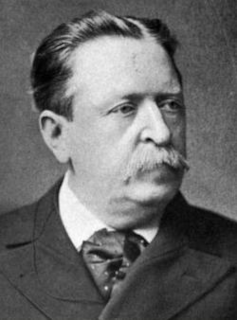
Young is invited to accompany President Ulysses S. Grant on Grant’s famous 1877-79 world tour, chronicled in Young’s book Around the World with General Grant. He impresses Grant, especially in China where he strikes up a friendship with Li Hongzhang. Grant persuades President Chester A. Arthur to appoint Young minister to China in 1882. In this position he distinguishes himself by mediating and settling disputes between the United States and China and France and China. Unlike many other diplomats, he opposes the policy of removing Korea from Chinese suzerainty.
In 1885 Young resumes working for the New York Herald in Europe. In 1890 he returns to Philadelphia. In 1897 President William McKinley appoints him Librarian of Congress, the first librarian confirmed by Congress. During his tenure, the library begins moving from its original home in the United States Capitol building to its own structure, an accomplishment largely the responsibility of his predecessor, Ainsworth Rand Spofford. Spofford serves as Chief Assistant Librarian under Young. Young holds the post of librarian until his death.
Young’s brother is Congressman James Rankin Young. His son is Brigadier General Gordon Russell Young, who is Engineer Commission of the District of Columbia from 1945-51 and a recipient of the Distinguished Service Medal and the Legion of Merit.
Born on April 1, 1743, in St. Bridget’s Parish, Dublin, Butler is the oldest son of Thomas and Eleanor Butler (née Parker). His father is an Irish aristocrat who serves in the British Army. He is the brother of Colonel Thomas Butler and Captain Edward Butler. All three brothers serve in the American Revolution and in the Northwest Indian War against the Northwestern Confederacy of Native American tribes in the Northwest Territories. His two other brothers, William and Percival, serve in the Revolution but do not see later military service.
By 1760, the family moves to the frontier at Carlisle, Pennsylvania, where Thomas and his sons manufacture long rifles and become friends with Daniel Morgan. The Butler gun shop still stands in Carlisle.
By the 1770s, Butler and his brother William are important traders at Fort Pitt in Pennsylvania and in Ohio. Butler Street in Pittsburgh is named for them.
At the outset of the American Revolution, the Continental Congress names Butler a commissioner in 1775 to negotiate with the Indians. He visits representatives of the Delaware, Shawnee, and other tribes to secure their support, or at least neutrality, in the war with Britain.
On July 20, 1776, Butler is commissioned a major in the 8th Pennsylvania Regiment in the Continental Army, serving first as second in command to his friend Daniel Morgan. He is promoted to lieutenant colonel on March 12, 1777, retroactive to September 1776. On June 7, 1777, he is promoted to colonel and placed in command of 9th Pennsylvania Regiment.
At the conclusion of the Battle of Yorktown in October 1781, General George Washington confers on Butler the honor of receiving Cornwallis’ sword of surrender, an honor which he gives to his second in command, Ebenezer Denny. At the last moment, Baron von Steuben demands that he receive the sword. This almost precipitates a duel between Butler and Von Steuben.
At the victory dinner for his officers, George Washington raises his glass and toasts, “The Butlers and their five sons!”
Following Yorktown, Butler remains in the Continental Army and is transferred to the 3rd Pennsylvania Regiment following a consolidation of the Army on January 1, 1783. On September 30 of the same year, he is breveted as a brigadier general. He remains in active service with the Continental Army until it is finally disbanded on November 3, 1783.
In 1783 Butler and his brothers become original members of the Pennsylvania Society of the Cincinnati, a military society of officers who had served in the Continental Army.
Butler returns to Pennsylvania and is a judge in Allegheny County. He also serves in the state legislature. He marries Maria Smith, and they have four children, only one of whom lives to have children and continue the line. He also fathers a son, Captain Butler (or Tamanatha) with Shawnee chief Nonhelema. He and his Shawnee son fight in opposing armies in 1791.
In 1791, Butler is commissioned a major general in the levies (i.e. militiamen conscripted into Federal service) under Major General Arthur St. Clair to fight against the Western Confederacy of Native Americans in the Northwest Territories (modern day Ohio). He is killed in action on November 4, 1791, in St. Clair’s Defeat at what is now Fort Recovery, Ohio.
Reportedly Butler is first buried on the battlefield, which site is then lost until it is accidentally found years later. The remains are laid to rest with the remains of the other fallen at Fort Recovery.
Butler is also honored in the name of General Richard Butler KYSAAR, Butler County, Kentucky recognized August 20, 2016. A chapter of the Sons of the American Revolution is named for him as as is the General Richard Butler Chapter of the Daughters of the American Revolution (DAR), founded in Butler, Pennsylvania.
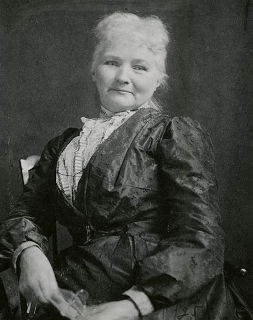
Mary G. Harris Jones, known as Mother Jones, an Irish-born American schoolteacher and dressmaker who becomes a prominent union organiser, community organiser, and activist, is baptised on August 1, 1837, in Cork, County Cork. Her exact date of birth is uncertain. She is once deemed “the most dangerous woman in America” because of her union activities.
Jones is the daughter of Richard Harris, a Roman Catholictenant farmer and railway labourer, and Ellen (née Cotter) Harris. She and her family are victims of the Great Famine, as are many other Irish families of the time. The famine forces more than a million families, including the Harrises, to immigrate to North America when she is ten years old. She lives in the United States and Canada, where she attends and later teaches in a Roman Catholic normal school in Toronto. In the United States she teaches in a convent school in Monroe, Michigan and works as a seamstress. In 1861 she marries George Jones, an iron-moulder and labour union member in Memphis, Tennessee. After the death of her husband and their four children in a yellow fever epidemic in 1867, she relocates to Chicago, Illinois, where she becomes involved with an early industrial union, the Knights of Labor. Her seamstress shop is destroyed in the Great Chicago Fire of 1871.
In the 1890s Jones becomes known as ‘Mother’ Jones and begins a long association with socialist causes and the United Mine Workers of America. She attends the founding convention of Social Democracy of America, later known as the Cooperative Brotherhood, in 1897 and in the same year organises support and publicity for striking bituminous coal miners in West Virginia, including a children’s march and parades of farmers delivering food to the miners’ camp. These types of defiant mass action become her trademark. Notable activities include organising women in support of an 1899 anthracite coal strike in eastern Pennsylvania, directing strikes of young women working in textile mills, a 1903 ‘children’s crusade’ against child labour which includes a ninety-mile march from Philadelphia to New York City, participating in 1905 in the founding convention of the Industrial Workers of the World, a radical labour union committed to the organisation of unskilled workers, campaigning for the release of Mexican revolutionaries imprisoned in American jails, and testifying in 1915 in congressional hearings against the abuse of corporate power by Rockefeller interests.
Jones reportedly meets with James Connolly, Irish socialist and labour organiser, in New York City in 1910. She is arrested for the first time for violating a federal injunction during a miners’ strike in West Virginia in 1902. In 1904, during a Colorado miners’ campaign, she has to avoid the authorities to escape possible deportation. During a 1914 strike in Ludlow, Colorado, she is imprisoned without trial for nine weeks. In 1919 she is arrested in Pennsylvania during a steelworkers’ strike for defending freedom of speech and the right of workers to organise unions. She remains active in the labour movement and radical causes into her nineties.
During her later years, Jones lives with her friends Walter and Lillie May Burgess on their farm in what is now Adelphi, Maryland. She celebrates her self-proclaimed 100th birthday there on May 1, 1930, and is filmed making a statement for a newsreel.
In 1932, about 15,000 Illinois mine workers gather in Mount Olive to protest against the United Mine Workers, which soon becomes the Progressive Mine Workers of America. Convinced that they have acted in the spirit of Mother Jones, the miners decide to place a proper headstone on her grave. By 1936, the miners have saved up more than $16,000 and are able to purchase “eighty tons of Minnesota pink granite, with bronze statues of two miners flanking a twenty-foot shaft featuring a bas-relief of Mother Jones at its center.” On October 11, 1936, also known as Miners’ Day, an estimated 50,000 people arrive at Mother Jones’s grave to see the new gravestone and memorial. Since then, October 11 is not only known as Miners’ Day but is also referred to and celebrated in Mount Olive as “Mother Jones’s Day.”
The farm where she died begins to advertise itself as the “Mother Jones Rest Home” in 1932, before being sold to a Baptist church in 1956. The site is now marked with a Maryland Historical Trust marker, and a nearby elementary school is named in her honor.
Griffin is born in Limerick, County Limerick, on December 12, 1803, the youngest son of thirteen children of a substantial Catholic farming family. Patrick Griffin, his father, also makes a living through brewing, and he participates as one of Henry Grattan‘s Irish Volunteers (18th century). His mother comes from the ancient O’Brien dynasty and first introduces him to English literature. When he is aged seven, the family moves to Fairy Lawn, a house near Loghill, County Clare, which sits on a hill above the bank of the Shannon Estuary, about twenty-seven miles from Limerick. Here he has an idyllic childhood and receives a classical education.
In 1820 the family at Fairy Lawn is broken up. The parents with several of the children emigrate to the United States and settle in Pennsylvania. Griffin, with one brother and two sisters, is left behind under the care of his elder brother William, a practicing physician in Adare, County Limerick. He meets John Banim in Limerick. Inspired by the successful production of Banim’s play Damon and Pythias (1821), Griffin, at nineteen years of age, moves to London in 1823. After an unsuccessful attempt at becoming a playwright, he endures years of poverty in London, managing only to scrape by through writing reviews for periodicals and newspapers. At the end of two years, he obtains steady employment in the publishing house as reader and reviser of manuscripts, and in a short time becomes frequent contributor to some of the leading periodicals and magazines. His early pieces in The Literary Gazette vividly describe the rural setting of his childhood, recount Irish folklore, translate the Celtic Irish language for the English readers, and, as Robert Lee Wolff observes, “waxed richly sardonic about Irishmen who tried to be more English than the English.”
Griffin’s Holland-Tide or Munster Popular Tales is published by Simpkin & Marshall in 1827. Holland-Tide is a collection of seven short stories, all of which are told in the house of a hospitable Munster farmer during All Hallows’ Eve in Munster. Holland-Tide establishes his reputation, and he returns to Ireland, where he writes Tales of the Munster Festivals in Pallaskenry to which his brother William has moved.
Experience leads Griffin to modify his expectations in relation to literary work, and, with a view to the legal profession, he enters the University of London as a law student, but in a short time removes to Dublin for the study of ancient Irish history, preparatory to his work The Invasion, which is published in 1832. This work has a good sale and is highly praised by scholars but never becomes popular.
With the exception of a tour through Scotland and a short trip on the European continent, Griffin lives with his brother, keeping up to some extent his literary labours. By 1833, he is increasingly concerned that he is wasting his time and begins to devote himself to teaching the poor children of the neighborhood. In 1838, hes all of his unpublished manuscripts and joins the Congregation of Christian Brothers, a Catholic religious order which has as its special aim the education of children of the poor. Writing to an old friend he says he feels a great deal happier in the practice of this daily routine than he ever did while roving about the great city, absorbed in the modest project of rivaling Shakespeare and throwing Scott in the shade. In June 1839, he is transferred from Dublin to Cork, where he dies of typhus fever at the age of thirty-six on June 12, 1840.
One of Griffin’s most famous works is The Collegians, a novel based on a trial that he had reported on, involving the murder of a young Irish Catholic girl (Ellen Hanley) by a ProtestantAnglo-Irish man (John Scanlon). The novel is later adapted for the stage as The Colleen Bawn by Dion Boucicault.
Griffin has a street named after him in Limerick and another in Cork. Loughill/Ballyhahill GAA club in west Limerick plays under the name of Gerald Griffins.
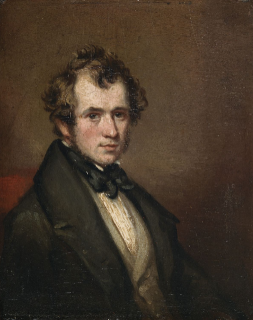
(Pictured: “Portrait of Gerald Griffin (1803-1840), Poet and Novelist,” painting by Richard Rothwell (1800-1868), National Gallery of Ireland)
Smyth is a Freemason. He is raised on March 6, 1865, in Washington Lodge No. 1 in Wilmington, Delaware.
Smyth enlists in 1861 in the Union Army in an Irish American three-months regiment, the 24th Pennsylvania, and quickly makes the rank of captain. He is later commissioned as major of the 1st Delaware Infantry, a three-years regiment. He serves at the battles of Fredericksburg (following which he is promoted to lieutenant colonel and then to colonel) and Chancellorsville. During the Gettysburg campaign, he commands the 2nd Brigade, 3rd Division of the II Corps. During the Battle of Gettysburg, his men help defend Cemetery Ridge and advance to the area of the Bliss farm to oust enemy sharpshooters. He is wounded on the third day of the battle and relinquishes command briefly.
Smyth retains brigade command during the reorganization of II Corps before General Ulysses S. Grant‘s Overland Campaign. He leads the second brigade of the first division from March 25 to May 17, 1864. When Col. Samuel S. Carroll is wounded, Smyth is transferred to his command, the third brigade of second division, the Gibraltar Brigade. In October 1864, he is promoted to brigadier general during the Siege of Petersburg. He retains command of his brigade throughout the siege.
Between July 31, 1864, and August 22, 1864, and between December 23, 1864, and February 25, 1865, Smyth commands the 2nd division of the corps. On April 7, 1865, near Farmville, Virginia, he is shot through the mouth by a Confederatesniper, with the bullet shattering his cervical vertebrae and paralyzing him. He dies two days later at Burke’s Tavern; the same day Confederate General Robert E. Lee and his army surrender at Appomattox Court House.
The son of a docker, Doherty is born into an Irish republican family, his grandfather being a member of the Irish Citizen Army which fought against British rule in the 1916 Easter Rising. Doherty leaves school at the age of 14 and begins work on the docks and as an apprentice plumber, before being arrested in 1972 on his seventeenth birthday under the Special Powers Act. He is interned on the prison ship HMS Maidstone and at Long Kesh Detention Centre, and while interned hears of the events of Bloody Sunday in Derry, where 14 civil rights protesters were shot dead by the British Army. This leads to him joining the IRA after he is released in June 1972. In the mid-1970s he is convicted of possession of explosives and sentenced to six years imprisonment in Long Kesh. He is released in December 1979.
After his release, Doherty becomes part of a four-man active service unit nicknamed the “M60 gang” due to their use of an M60 heavy machine gun, along with Angelo Fusco and Paul Magee. On April 9, 1980, the unit lures the Royal Ulster Constabulary (RUC) into an ambush on Stewartstown Road, killing one constable and wounding two others. On May 2 the unit is planning another attack and has taken over a house on Antrim Road, when an eight-man patrol from the Special Air Service (SAS) arrive in plain clothes, after being alerted by the RUC. A car carrying three SAS members goes to the rear of the house, and another car carrying five SAS members arrives at the front of the house. As the SAS members at the front of the house exit the car, the IRA unit opens fire with the M60 machine gun from an upstairs window, hitting Captain Herbert Westmacott in the head and shoulder. Westmacott, who is killed instantly, is the highest-ranking member of the SAS killed in Northern Ireland. The remaining SAS members at the front, armed with Colt Commando automatic rifles, submachine guns and Browning pistols, return fire but are forced to withdraw. Magee is apprehended by the SAS members at the rear of the house while attempting to prepare the IRA unit’s escape in a transit van, while the other three IRA members remain inside the house. More members of the security forces are deployed to the scene and, after a brief siege, the remaining members of the IRA unit surrender.
The trial of Doherty and the other members of the M60 gang begins in early May 1981, on charges including three counts of murder. On June 10, Doherty and seven other prisoners, including Angelo Fusco and the other members of the IRA unit, take a prison officer hostage at gunpoint in Crumlin Road Gaol. After locking the officer in a cell, the eight take other officers and visiting solicitors hostage, also locking them in cells after taking their clothing. Two of the eight wear officers’ uniforms while a third wears clothing taken from a solicitor, and the group moves towards the first of three gates separating them from the outside world. They take the officer on duty at the gate hostage at gunpoint and force him to open the inner gate. An officer at the second gate recognises one of the prisoners and runs into an office and presses an alarm button, and the prisoners run through the second gate towards the outer gate. An officer at the outer gate tries to prevent the escape but is attacked by the prisoners, who escape onto Crumlin Road. As the prisoners are moving towards the car park where two cars are waiting, an unmarked RUC car pulls up across the street outside Crumlin Road Courthouse. The RUC officers open fire, and the prisoners return fire before escaping in the waiting cars. Two days after the escape, Doherty is convicted in absentia and sentenced to life imprisonment with a minimum recommended term of thirty years.
Doherty escapes across the border into the Republic of Ireland, and then travels to the United States on a false passport. He lives with an American girlfriend in Brooklyn and New Jersey, working on construction sites and as a bartender at Clancy’s Bar in Manhattan, where he is arrested by the Federal Bureau of Investigation (FBI) on June 28, 1983. He is imprisoned in the Metropolitan Correctional Center in Manhattan, and a legal battle ensues with the British government seeking to extradite him back to Northern Ireland. Doherty claims he is immune from extradition as the killing of Westmacott was a political act, and in 1985 federal judge John E. Sprizzo rules Doherty cannot be extradited as the killing was a “political offense.” His legal battle continues as the United States Department of Justice then attempts to deport him for entering the country illegally.
Doherty remains in custody at the Metropolitan Correctional Center and attempts to claim political asylum, and June 15, 1988, the United States Attorney GeneralEdwin Meese overturns an earlier ruling by the Federal Board of Immigration Appeals that Doherty can be deported to the Republic of Ireland and orders his deportation to Northern Ireland. In February 1989 new Attorney General Dick Thornburgh chooses not to support the decision made by his predecessor and asks lawyers for Doherty and the Immigration and Naturalization Service to submit arguments for a review of the decision and Doherty’s claim for asylum. By this time Doherty’s case is a cause célèbre with his sympathisers including over 130 Congressmen and a son of then President of the United StatesGeorge H. W. Bush, and in 1990 a street corner near the Metropolitan Correctional Center is named after him.
Rowan comes to the United States at the age of ten and lives in Piqua, Ohio. He is a graduate of Miami University and is appointed as a midshipman in the U.S. Navy on February 1, 1826, at the age of seventeen. Later, he takes an active role in the Mexican–American War, serving as executive officer of the sloop-of-warUSS Cyane during the capture of Monterey, California on July 7, 1846, and in the occupation of both San Diego and Los Angeles. In January 1847 he leads a provisional battalion, with the nominal rank of major, of seven companies of naval infantry (along with a company of artillery and a company of sappers and miners) for the recapture of Los Angeles.
Commissioned rear admiral on July 25, 1866, Rowan serves as commandant of the Norfolk Naval Shipyard until 1867, when he assumes command of the Asiatic Squadron. Returning in 1870, he is appointed vice admiral, following the death of Admiral David Farragut and the promotion of Vice Admiral David Dixon Porter in August of that year. In December 1870 he reaches the mandatory retirement age of 62 but, like admirals Farragut and Porter before him, he is allowed to remain on active duty.
In 1882 Rowan is elected as a First Class Companion of the District of Columbia Commander of the Military Order of the Loyal Legion of the United States (MOLLUS). He is assigned MOLLUS insignia number 2510. His son, Hamilton Rowan, an officer in the United States Army, is elected as a Second Class Companion of MOLLUS and becomes a First Class Companion upon his father’s death.
Rowan dies at the age of 81 in Washington, D.C. on March 31, 1890.
Kelly’s father, Irish AmericanJohn B. Kelly, Sr., wins three Olympic gold medals for sculling, and owns a successful brickwork contracting company that is well known on the East Coast. As Democratic nominee in the 1935 election for Mayor of Philadelphia, he loses by the closest margin in the city’s history. In later years he serves on the Fairmount Park Commission and, during World War II, is appointed by PresidentFranklin D. Roosevelt as National Director of Physical Fitness. Her mother, Margaret Majer, has German parents. She teaches physical education at the University of Pennsylvania and is the first woman to coach women’s athletics at Penn. She also models for a time in her youth. After marrying John Kelly in 1924, she focuses on being a housewife until her four children are of school age, following which she begins actively participating in various civic organizations.
Kelly receives her elementary education in the parish of Saint Bridget’s in East Falls. While attending Ravenhill Academy, a reputable Catholic girls’ school, she models fashions at local charity events with her mother and sisters. In 1942, at the age of 12, she plays the lead in Don’t Feed the Animals, a play produced by the Old Academy Players also in East Falls. In May 1947, she graduates from Stevens School, a socially prominent private institution in nearby Chestnut Hill, where she participates in drama and dance programs. Owing to her low mathematics scores, she is rejected by Bennington College in July 1947. Despite her parents’ initial disapproval, she decides to pursue her dreams of becoming an actress.
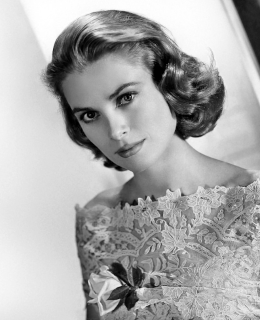
Kelly retires from acting at age 26 to marry Rainier and begins her duties as Princess of Monaco. Hitchcock hopes that she will appear in more of his films which require an “icy blonde” lead actress, but he is unable to coax her out of retirement. The Prince and Princess have three children: Princess Caroline, Prince Albert, and Princess Stéphanie. Princess Grace retains her link to America by her dual U.S. and Monégasque citizenship. Her charity work focuses on young children and the arts, establishing the Princess Grace Foundation-USA to support local artisans in 1964. Her organization for children’s rights, World Association of Children;s Friends (AMADE), gains consultive status within UNICEF and UNESCO. Her final film contribution is in 1977 to documentary The Children of Theatre Street directed by Robert Dornhelm, where she serves as the narrator. The documentary is nominated for an Academy Award for Best Documentary Feature.
On September 13, 1982, Princess Grace suffers a small stroke while driving back to Monaco from her country home in Roc Agel. As a result, she loses control of her 1971 Rover P6 3500 and drives off the steep, winding road and down the 120-foot mountainside. Her teenage daughter Stéphanie, who is in the passenger seat, tries but fails to regain control of the car. The Princess is taken to the Monaco Hospital (later named the Princess Grace Hospital Centre) with injuries to the brain and thorax and a fractured femur. She dies the following night at 10:55 PM after Rainier decides to turn off her life support. Stéphanie suffers a slight concussion and a hairline fracture of a cervical vertebra and is unable to attend her mother’s funeral.
David Whyte, Anglo-Irishpoet, is born in Mirfield, West Yorkshire, England on November 2, 1955. He has said that all of his poetry and philosophy are based on “the conversational nature of reality.” His book The Heart Aroused: Poetry and the Preservation of the Soul in Corporate America (1994) topped the best-seller charts in the United States.
Whyte’s mother is from Waterford, County Waterford, and his father is a Yorkshireman. He attributes his poetic interest to both the songs and the poetry of his mother’s Irish heritage and to the landscape of West Yorkshire. He grows up in West Yorkshire and comments that he had “a Wordsworthian childhood,” in the fields and woods and on the moors. He has a degree in marine zoology from Bangor University, a public university in Bangor, Gwynedd, Wales.
During his twenties, Whyte works as a naturalist and lives in the Galápagos Islands, where he experiences a near drowning on the southern shore of Hood Island. He leads anthropological and natural history expeditions in the Andes, the Amazon and the Himalayas.
Whyte moves to the United States in 1981 and begins a career as a poet and speaker in 1986. From 1987, he begins taking his poetry and philosophy to larger audiences, including consulting and lecturing on organisational leadership models in the United States and UK exploring the role of creativity in business. He has worked with companies such as Boeing, AT&T, NASA, Toyota, the Royal Air Force and the Arthur Andersen accountancy group.
Work and vocation, and “Conversational Leadership” are the subjects of several of Whyte’s prose books, including Crossing the Unknown Sea: Work as Pilgrimage of Identity, The Three Marriages: Reimagining Work, Self and Relationship, and The Heart Aroused: Poetry and the Preservation of The Soul in Corporate America which tops the business best seller lists, selling 155,000 copies.
Whyte has written ten volumes of poetry and four books of prose. Pilgrim, published in May 2012, is based on the human need to travel, “From here to there.” The House of Belonging looks at the same human need for home. He describes his collection Everything Is Waiting For You (2003) as arising from the grief at the loss of his mother. His latest book is Consolations: The Solace, Nourishment and Underlying Meaning of Everyday Words, an attempt to ‘rehabilitate’ many everyday words we often use only in pejorative or unimaginative ways. He has also written for newspapers, including The Huffington Post and The Observer. He leads group poetry and walking journeys regularly in Ireland, England and Italy.
Whyte has spent a portion of every year for the last twenty-five years in County Clare. Over the years and over a number of volumes of poetry he has built a cycle of poems that evoke many of the ancient pilgrimage sites of The Burren mountains of North Clare and of Connemara.
Whyte runs the “Many Rivers” organisation and “Invitas: The Institute for Conversational Leadership,” which he founds in 2014. He has lived in Seattle and on Whidbey Island and currently lives in the U.S. Pacific Northwest. He holds U.S., British and Irish citizenship. He is married to Gayle Karen Young, former Chief Talent and Culture Officer of the Wikimedia Foundation. He has a son, Brendan, from his first marriage to Autumn Preble and a daughter, Charlotte, from his second marriage to Leslie Cotter. He has practised Zen and was a regular rock climber. He is a close friend of the late Irish poet John O’Donohue.
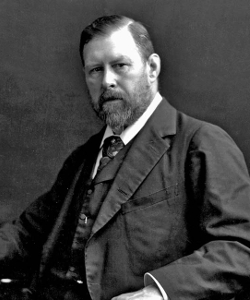
Stoker is born on November 8, 1847, in Clontarf, Dublin. During his lifetime, he is better known as the personal assistant of actor Henry Irving and business manager of the Lyceum Theatre, London, which Irving owns.
Stoker’s father, Abraham Stoker, is a civil servant and his mother, Charlotte Mathilda Blake Thornley, is a charity worker and writer. Stoker is a sickly child and is bedridden with an unknown illness until he starts school at the age of seven, when he makes a complete recovery. Growing up his mother tells him a lot of horror stories which may have influence on his later writings.
In 1864 Stoker enters Trinity College, Dublin. While attending college he begins working as an Irish civil servant. He also works part time as a free lance journalist and drama critic. In 1876 he meets Henry Irving, a famous actor, and they soon become friends. Not long after that, Stoker meets and falls in love with an aspiring actress named Florence Balcombe whom he marries on December 4, 1878 at St. Anne’s Parish Church, Dublin. In 1878 he accepts a job working in London as Irving’s personal secretary.
On December 9, Stoker and his new wife move to England to join Irving. His first book The Duties of Clerks of Petty Sessions in Ireland, though written while he is still in Dublin, is published in 1879. On December 30, 1879 Stoker and his wife have their only child, a son Noel. While in England Stoker also writes several novels and short stories. His first book of fiction, Under the Sunset, is published in 1881.
Stoker visits the English coastal town of Whitby in 1890, a visit that is said to be part of the inspiration for Dracula. Before writing Dracula, he meets Ármin Vámbéry, a Hungarian writer and traveler. Dracula likely emerges from Vámbéry’s dark stories of the Carpathian Mountains. Stoker then spends several years researching European folklore and mythological stories of vampires.
Dracula is an epistolary novel, written as a collection of realistic but completely fictional diary entries, telegrams, letters, ship’s logs, and newspaper clippings, all of which add a level of detailed realism to the story, a skill which Stoker develops as a newspaper writer. At the time of its publication, Dracula is considered a “straightforward horror novel” based on imaginary creations of supernatural life.
The original 541-page typescript of Dracula is believed to have been lost until it is found in a barn in northwestern Pennsylvania in the early 1980s. It consists of typed sheets with many emendations, plus handwritten on the title page is “THE UN-DEAD.” The author’s name is shown at the bottom as Bram Stoker. The typescript is purchased by Microsoft co-founder Paul Allen.
After suffering a number of strokes, Abraham “Bram” Stoker dies at No. 26 St. George’s Square, London on April 20, 1912. Some biographers attribute the cause of death to tertiary syphilis, others to overwork. He is cremated and his ashes are placed in a display urn at Golders Green Crematorium in north London.





 seamus dubhghaill