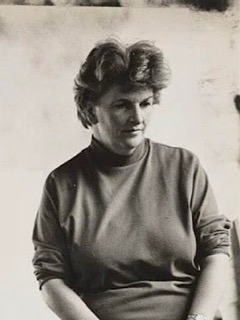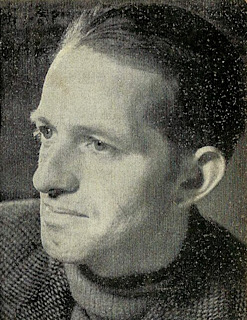
Mary Esperance (“Nancy”) Wynne-Jones is born on December 10, 1922, in Penmaenucha, Wales, to landowner Charles Llewellyn Wynne-Jones and Sybil Mary Gella Scott. The family spends half the year in Wales and half the year in Thornhill, Stalbridge, Dorset. She has two brothers, Andrew and Ronald (“Polly”), both of whom die in Africa during World War II.
Wynne-Jones is educated at home. Her skill in art leads to her getting lessons in Sherborne from a children’s book illustrator. Her music is encouraged by the family doctor and she begins to compose and study the violin, receiving lessons in Bournemouth with the first violinist of the symphony orchestra. After the start of World War II, she continues in Aberystwyth. She goes on to study the violin and composition at the Royal Academy of Music, London (1940–43). While in London she also serves as a Voluntary Aid Detachment nurse until 1943 and later as a draughtswoman at the Ordnance Survey.
After the war, Wynne-Jones purchases and manages a bookshop on the King’s Road in Chelsea, but it is not a financial success. She returns to painting, studying at the Heatherley School of Fine Art, London, from 1951 to 1952 and the Chelsea School of Art from 1952 to 1955. She travels extensively through Portugal and Italy painting landscapes. An interest in completing landscapes in an abstract manner leads her to study with Peter Lanyon in St. Ives, Cornwall.
In 1962, Wynne-Jones purchases Trevaylor House near Penzance and provides accommodation for other artists including renowned Irish painter Tony O’Malley, sculptor Conor Fallon and English poet and writer W. S. ‘Sydney’ Graham. In the 1970s she exhibits in Ireland at the Project Arts Centre, Dublin (1970) and at the Emmet Gallery, Dublin (1975 and 1977). During the 1980s she exhibits at the Lincoln and Hendricks galleries in Dublin before joining the Taylor Gallery, run by John and Patrick Taylor. She is elected an honorary member of the Royal Hibernian Academy (RHA) in 1994 and becomes a member of Aosdána in 1996. Originally an abstract artist, her contact with the Irish countryside slowly transforms her work to that of a landscape artist, albeit with an influence of abstraction attached to it. She becomes well-known in Irish art circles as an eminent Irish landscape artist.
Wynne-Jones is involved with artist Derek Middleton before moving to Cornwall. There she becomes romantically involved with Graham who is in an open marriage, however, it is the death of her mentor Peter Lanyon which devastates her. She meets the sculptor Conor Fallon through their mutual friend, Tony O’Malley. Fallon had arrived in Cornwall ostensibly to meet Lanyon. They marry in 1966. Their honeymoon in Provence is immortalised in expressionist paintings done by her. The couple adopts a boy and a girl, siblings, John and Bridget. In 1972, she moves with her family to Kinsale, County Cork. It is in the area around here that a number of her paintings are created. Later she paints the mountain visible from her Wicklow home after the family moves in the late 1980s. She moves to Ballard House, near Rathdrum, County Wicklow in 1987.
Wynne-Jones dies on November 9, 2006, and is buried in Ballinatone (Church of Ireland), Rathdrum.
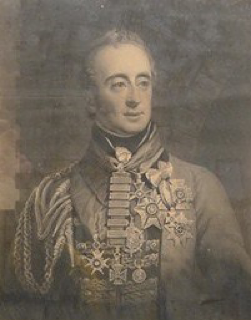
Pack is born on October 7, 1775 in Kilkenny, County Kilkenny, the younger son of Rev. Thomas Pack, Dean of Ossory, and Catherine Pack (née Sullivan), of St. Andrew’s parish, Dublin. In June 1790, he enters Trinity College Dublin (TCD), aged 15, but does not take his degree. His elder brother, Thomas Pack, previously attends TCD, but dies in December 1786.
Promoted to lieutenant colonel in December 1800, Pack commands the 71st (Highland) Regiment of Foot and takes part in the expedition to the Cape of Good Hope in 1806. He then takes part in General John Whitelocke‘s expedition to South America and is captured after an unsuccessful attack on Montevideo. His fellow-prisoner is William Carr Beresford, later 1st Viscount Beresford, and the two men remain friends for the rest of their lives. Refusing to give their parole to General Santiago de Liniers, they escape from La Plata in a boat, meeting a British cruiser at sea. Pack later takes part in the successful attack on Montevideo on February 9, 1807.
Pack is posted to Portugal in 1808 and is present at the Battle of Roliça on August 17 and the Battle of Vimeiro on August 21. In 1809, he takes part in the Walcheren Campaign and, promoted to colonel in July 1810, he is made aide-de-camp to George III. Returning to Portugal in 1810, he serves under Beresford, commanding a Portuguese brigade, and takes part in the Battle of Bussaco on September 27, 1810. Promoted to brigadier general in January 1812, he takes part in the Siege of Ciudad Rodrigo and is present at the Battle of Salamanca on July 22, 1812. In June 1813, he is promoted to major general and later is present at the battles of Vitoria (June 21, 1813), Nivelle (November 10, 1813), Nive (December 10-13, 1813), Orthez (February 27, 1814) and the final French defeat at Toulouse (April 10, 1814). In January 1815, he is made a Knight Commander of the Order of the Bath (KCB) in recognition of his services in the Peninsula.
In July 1816, Pack marries Lady Elizabeth Louisa de la Poer Beresford, daughter of George Beresford, 1st Marquess of Waterford. They have two sons and two daughters. His descendants adopted “Pack-Beresford” as their family name. He dies on July 24, 1823, at Lord Beresford’s house in Upper Wimpole Street, London. A monument to him is later erected in St. Canice’s Cathedral, Kilkenny. A portrait by G. L. Saunders is in family possession; another by Charles Turner, showing Pack wearing his numerous orders and decorations, is in the National Portrait Gallery, London. A collection of his papers is held by the University of Southampton.
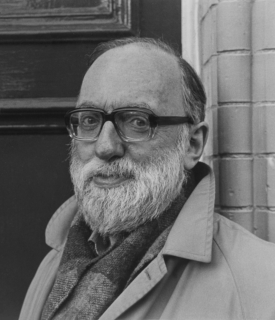
Hutchinson is born in Glasgow, Scotland, on February 16, 1927. His father, Harry Hutchinson, a Scottish printer whose own father had left Dublin to find work in Scotland, is Sinn Féin treasurer in Glasgow and is interned in Frongoch internment camp in 1919–21. His mother, Cathleen Sara, is born in Cowcaddens, Glasgow, of emigrant parents from County Donegal. She is a friend of Constance Markievicz. In response to a letter from Cathleen, Éamon de Valera finds work in Dublin for Harry as a clerk in the Labour Exchange, and later he holds a post in Stationery Office.
Hutchinson is five years old when the family moves to Dublin and is the last to be enrolled in St. Enda’s School before it closes. He then goes to school at Synge Street CBS where he learns Irish and Latin. One of his close friends there is the poet and literary critic John Jordan. In 1948 he attends University College Dublin (UCD) where he spends a year and a half, learning Spanish and Italian.
Having published some poems in The Bell in 1945, Hutchinson’s poetic development is greatly influenced by a 1950 holiday in Spain and Portugal. A short stop en route at Vigo brings him into contact for the first time with the culture of Galicia. Later, in Andalusia, he is entranced by the landscape and by the works of the Spanish poets Federico García Lorca, Emilio Prados and Luis Cernuda.
In 1951 Hutchinson leaves Ireland again, determined to live in Spain. Unable to get work in Madrid, as he had hoped, he travels instead to Geneva, where he gets a job as a translator with the International Labour Organization, which brings him into contact with Catalan exiles, speaking a language then largely suppressed in Spain. An invitation by a Dutch friend leads to a visit to the Netherlands, in preparation for which he teaches himself the Dutch language.
Hutchinson returns to Ireland in 1953 and becomes interested in the Irish language poetry of writers such as Piaras Feiritéar and Aonghus Fionn Ó Dálaigh and publishes a number of poems in Irish in the magazine Comhar in 1954. The same year he travels again to Spain, this time to Barcelona, where he learns the Catalan and Galician languages, and gets to know Catalan poets such as Salvador Espriu and Carles Riba. With the British poet P. J. Kavanagh, he organises a reading of Catalan poetry in the British Institute.
Hutchinson goes home to Ireland in 1957 but returns to Barcelona in 1961 and continues to support Catalan poets. An invitation by the publisher Joan Gili to translate some poems by Josep Carner leads to the publication of his first book, a collection of thirty of Carner’s poems in Catalan and English, in 1962. A project to publish his translation of Espriu’s La Pell de brau (The Bull-skin), falls through some years later. Some of the poems from this project are included in the collection Done into English.
In 1963, Hutchinson’s first collection of original poems in English, Tongue Without Hands, is published by Dolmen Press in Ireland. In 1967, having spent nearly ten years altogether in Spain, he returns to Ireland, making a living as a poet and journalist writing in both Irish and English. In 1968, a collection of poems in Irish, Faoistin Bhacach (A Lame Confession), is published. Expansions, a collection in English, follows in 1969. Friend Songs (1970) is a new collection of translations, this time of medieval poems originally written in Galician-Portuguese. In 1972 Watching the Morning Grow, a new collection of original poems in English, comes out, followed in 1975 by another, The Frost Is All Over.
In October 1971, Hutchinson takes up the Gregory Fellowship in Poetry at the University of Leeds, on the recommendation of Professor A. Norman Jeffares. There is some controversy around the appointment following accusations, later retracted, that Jeffares had been guilty of bias in the selection because of their joint Irish heritage. He holds tenure at the University for three years, and during that time contributes to the University’s influential poetry magazine Poetry & Audience.
From 1977 to 1978 Hutchinsonn compiles and presents Oró Domhnaigh, a weekly radio programme of Irish poetry, music and folklore for Ireland’s national network, RTÉ. He also contributes a weekly column on the Irish language to the station’s magazine RTÉ Guide for over ten years. A collaboration with Melita Cataldi of Old Irish lyrics into Italian is published in 1981. Another collection in English, Climbing the Light (1985), which also includes translations from Irish, Italian and Galician, is followed in 1989 by his last Irish collection, Le Cead na Gréine (By Leave of the Sun). The Soul that Kissed the Body (1990) is a selection of his Irish poems translated into English. His most recent English collection is Barnsley Main Seam (1995). His Collected Poems is published in 2002 to mark his 75th birthday. This is followed in 2003 by Done into English, a selection of many of the translated works he produced over the years.
A co-editor and founder of the literary journal Cyphers, Hutchinson receives the Butler Award for Irish writing in 1969. He is a member of Aosdána, the state-supported association of artists, from which he receives a cnuas (stipend) to allow him to continue writing. He describes this as “a miracle and a godsend” as he is fifty-four when invited to become a member and is at the end of his tether. A two-day symposium of events is held at Trinity College Dublin, to celebrate his 80th birthday in 2007, with readings from his works by writers including Macdara Woods, Eiléan Ní Chuilleanáin, Paul Durcan and Sujata Bhatt. His most recent collection, At Least for a While (2008), is shortlisted for the Poetry Now Award.
Hutchinson lives in Rathgar, Dublin, and dies of pneumonia in Dublin on January 14, 2012. His extensive archive is in the library of Maynooth University. Its opening on May 24, 2015, is accompanied by the inauguration of an annual Pearse Hutchinson seminar and the launch of a collection of unpublished Hutchinson poems, Listening to Bach.
Some critics argue that Hutchinson’s concern with simplicity and Ireland’s place in the comparative history of human oppression too often deteriorates into banality, didacticism, and regurgitation of sentimental revivalist tropes. Even these, however, acknowledge his occasional greatness, while his champions argue that his achievement has not yet been fully recognised and absorbed.
William Corbet, an Anglo-Irish soldier in the service of France, is born in Ballythomas, County Cork, on August 17, 1779. In September 1798, he accompanies James Napper Tandy in an aborted French mission to Ireland in support of the United Irish insurrection. After two years of incarceration, he escapes from Ireland and serves in the campaigns of Napoleon reaching the rank of colonel. In 1831, under the July Monarchy, he is employed in the Morea expedition to Greece. He returns to France in 1837, retiring with the rank of Major-General.
Corbet is born into a branch of the Corbet family, an Anglo-Irish Protestant family. In 1798, as a member of the Society of United Irishmen, he is expelled from Trinity College Dublin with Robert Emmet and others for treasonable activities and goes instead to Paris. In September of the same year, he joins a French military force under James Napper Tandy with the rank of Captain and sails from Dunkirk with arms and ammunition for Ireland. The expedition has to turn back following the defeat of General Jean Joseph Amable Humbert and arriving in Hamburg they are handed over to the British authorities and taken to Ireland, where they are imprisoned in Kilmainham Gaol.
Corbet escapes in 1803 and returns to France. He is appointed professor of English at the military college of Saint-Cyr. Later that year he becomes a captain in the Irish Legion. Following the death of his brother Thomas (who was also in the Legion) in a duel with another officer, he is transferred to the 70th Regiment of the line, where he serves in André Masséna‘s expedition to Portugal, and distinguishes himself in the retreat from Torres Vedras and the Battle of Sabugal. After the Battle of Salamanca, he is appointed chef de bataillon of the 47th regiment and serves until 1813 when he is summoned to Germany to join the staff of MarshalAuguste de Marmont. He serves at the battles of Lützen, Bautzen, Dresden and others and is made a commander of the Legion of Honour. In December 1814, he is naturalised as a French citizen. In 1815, after the abdication of Napoleon, he is promoted to colonel and chief of staff to General Louis-Marie-Celeste d’Aumont at Caen.
In 1837, Corbet returns to France where, with the rank of Major-General, he is commander in the region of Calvados. He dies at Saint-Denis on August 12, 1842.
The Irish novelist Maria Edgeworth bases the main theme of her novel Ormond on Corbet’s 1803 escape from Kilmainham Gaol.
Three Irish regiments in the service of Spain fight in the Battle of Villaviciosa on December 10, 1710, during the War of the Spanish Succession. The regiments are commanded by Colonel Don Demetrio MacAuliffe, Colonel Don John de Comerford, and Colonel Don Reynaldo Mac Donnell. This last becomes known as the Hibernia Regiment.
The Battle of Villaviciosa is a battle between a Franco-Spanish army led by Louis Joseph, Duke of Vendôme, and Philip V of Spain and a Habsburg-allied army commanded by AustrianGuido Starhemberg. The battle takes place one day after a Franco-Spanish victory at Brihuega against a British army under James Stanhope, 1st Earl Stanhope. Both Philip V of Spain and the Archduke Charles of Austria claim victory, but the number of dead and wounded, the number of artillery and other weapons abandoned by the Allied army and the battle’s strategic consequences for the war confirm victory for Philip.
The battle is largely determined by the Spanish dragoons commanded by the Marquis of Valdecañas and the Count of Aguilar, which far exceeds the opposing forces. The Austrian forces retreat, pursued by Spanish cavalry, and the allied army is reduced to 6,000 or 7,000 men when it reaches Barcelona, one of the few places in Spain still recognizing Charles’ authority, on January 6.
After victories in the Battle of Almenar on July 27 and the Battle of Saragossa on August 20, the Habsburg allies supporting Archduke Charles capture Madrid for the second time and Charles enters Madrid on September 21. The 1710 invasion is a repetition of the one in 1706, and the 23,000-strong allied army is reduced at Almenara and Saragossa and in skirmishes with the Spanish-Bourbon militia. The allied troops are unable to maintain an occupation.
The allied position in Madrid is dangerous. On November 9, the city is evacuated and the retreat to Catalonia begins, pursued by Spanish cavalry led by the Marquis of Valdecañas. The archduke leaves the army with 2,000 cavalry and rushes back to Barcelona, while the rest of the army marches in two detachments. Austrian general Starhemberg and the main body of 12,000 men are a day’s march ahead of the 5,000 British troops under Lord Stanhope. The British force, surprised, is defeated at Brihuega on December 9, 1710. The British are taken prisoner, including Stanhope, who finally surrenders.
When General Starhemberg is informed of the attack on the British column, he moves his troops to help Stanhope’s army, unaware that the latter had capitulated. The next morning, December 10, the Franco-Spanish army is waiting on the plain of Villaviciosa. Compared to the Austrian general’s 14,000 troops, the Duke of Vendôme deploys about 20,000 men, including King Philip and other troops who had joined the duke that morning. The armies deploy in two lines on parallel ridges.
The battle begins during the afternoon, lasting until midnight. Each army has 23 pieces of artillery, deployed in three batteries. The artillery fire begins simultaneously, damaging both armies. The Marquis de Valdecañas, commanding the cavalry in the Bourbon right wing, begins the attack. Valdecañas sends his cavalry against the allied left wing, composed of German infantry and Portuguese and Spanish cavalry under Imperial General von Frankenberg. The German infantry and Portuguese cavalry try to stop the Bourbon charge before yielding, and the left wing is destroyed. The Spanish capture the artillery pieces, killing the Anglo-Dutch troops sent to aid the left wing. With the allied left wing defeated, the archduke’s infantry advances toward the Franco-Spanish center and drives back the Bourbon infantry. The Marquis of Toy tries to prevent losses in the center and avoid the division of the army, but most of his men are taken prisoner by the Portuguese.
Although the Bourbons in the center are in difficulty, the Count of Aguilar throws his cavalry against the archduke’s right wing, commanded by General Starhemberg and comprising the best grenadiers and cavalry squadrons of the allied army. The allies are unable to stop the Count of Aguilar’s cavalry. The archduke’s right wing is saved from disaster by support from the center, led by the Spanish general Antoni de Villarroel. Starhemberg regroups his forces, repulses the Count of Aguilar’s cavalry and charges the Bourbon left wing. After capturing the left-wing cannons, Starhemberg launches his army against the center.
The Bourbon center and left wing begin to retreat, and the right-wing cavalry pursues the allied left wing. The Count of Aguilar then attacks against the archduke’s right wing with his dragoons. Although the German and Portuguese cavalry, under Pedro Manuel de Ataíde, 5th Count of Atalaya, resist the first charge, Aguilar’s cavalry breaks the allied right wing. Valdecañas’ cavalry also deals a severe blow to the allied army, and Lt. Gen. Mahony and Field Marshal Amezaga’s troops charge from the right wing. Starhemberg in return launches three cavalry charges against them. During the fighting, Amezaga is wounded in the face. Starhemberg’s forces retreat to a nearby forest to escape the Franco-Spanish cavalry, and the allied forces begin their withdrawal under cover of night. The British regiments suffer heavy losses. Brigadier-General Lepell, the senior British officer, reports two regiments have been cut off while over 107 men are missing from his own and he has only two squadrons still available.
Although Philip V of Spain and the Archduke Charles both claim victory, the number of dead and wounded, the weapons abandoned by the allied army, and the strategic consequences in the war confirm French domination.
Starhemberg continues his retreat, harassed by Spanish cavalry. His army is reduced to 6,000 or 7,000 men by the time he reaches Barcelona. The Spanish throne is finally secured for Philip when Charles leaves Spain in April 1711 to become Holy Roman Emperor after the death of his older brother.
(Pictured: “Battle of Villaviciosa, December 10, 1710,” oil on canvas by Jean Alaux, Museum of the History of France)
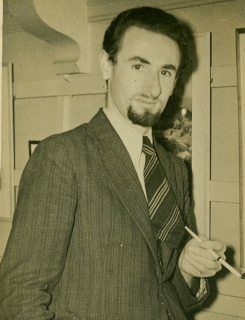
Patrick Anthony HennessyRHA, Irish realist painter known for his highly finished still lifes, landscapes and trompe-l’œil paintings, is born in Cork, County Cork, on August 28, 1915. The hallmark of his style is his carefully observed realism and his highly finished surfaces, the result of a virtuoso painting technique.
Hennessy is the son of John Hennessy an army sergeant major from County Kerry and Bridget Hennessy from Cork. His father is killed in World War I at the Battle of Passchendaele in 1917. In 1921, when he is five years old, his mother remarries in Cork. Her second husband is a Scot named John Duncan and shortly afterwards the whole family moves to Arbroath, Scotland, where Duncan has relatives.
Hennessy is educated in Arbroath at St. Thomas RC Primary School followed by secondary education at Arbroath High School, where he begins to show an aptitude for art, leaving in 1933 with the Dux for Art and an accompanying medal. In the autumn of 1933 he enrolls at the Dundee of Jordanstone College of Art & Design, for a four-year Diploma course in Drawing and Painting under James McIntosh Patrick and Edward Baird. Here he meets Harry Robertson Craig who becomes his lifelong companion. He plays a full part in the social activities of the college, winning a fancy-dress award at the Christmas revels in 1935 and producing a ballet “Paradise Lost” the following year. He gains a First-Class Pass in each year of the course along with winning first prize in 1934 and 1936 for work done during the summer vacation. He graduates with a First-Class Distinction in 1937.
Having gained a scholarship, Hennessy continues his studies at the Dundee of Jordanstone College of Art & Design for a further year by doing a Post-Graduate Diploma course in Drawing and Painting. Within a month of gaining his Post-Graduate Diploma he holds his first joint exhibition at the Art Galleries in Arbroath. In June 1938 he is awarded the Annual Travelling Scholarship for further studies in Paris and Italy. In Paris he meets up with the artists Robert Colquhoun and Robert MacBryde, whom he had met the previous year, the three travelling south together to Marseilles towards the end of that year. On his return to Scotland he is selected for the residential summer school course at Hospitalfield House near Arbroath under James Cowie. Two of his paintings, a still life and a self-portrait, are accepted that year by the Royal Scottish Academy for their Annual Exhibition. However, by the autumn of 1939 with war looming and feeling somewhat disenchanted on his return to Scotland, he decides to return to Ireland.
On arrival in Dublin Hennessy is offered an exhibition in December 1939 at the Country Shop on St. Stephen’s Green which is opened by Mainie Jellett. This attracts favourable attention. During the early 1940s he lives at various addresses in and around Dublin with frequent trips to Cork. In 1940 he is invited to join the Society of Dublin Painters and holds regular annual exhibitions of his work there during the 1940s and early 1950s. These exhibitions are supplemented by an eclectic mix of commissions, mostly portraits which he undertakes during this period. In 1941 he has three of his paintings accepted by the Royal Hibernian Academy (RHA) for their annual exhibition. This is the beginning of a long relationship with the RHA. He exhibits there virtually every year from 1941 until 1979, the year before his death.
From the early 1940s onwards, Hennessey’s work sometimes incorporates a homosexual visual subtext. He re-unites with Harry Robertson Craig in 1946 and soon after they move to Crosshaven, County Cork, and later to Cobh. In 1947, Time magazine selects him as one of Ireland’s outstanding painters, in recognition of the important position he has then attained in the art world. In 1948 he has an exhibition at the Victor Waddington Gallery, Dublin, and that same year is elected an associate of the Royal Hibernian Academy and a full member the following year. In 1950 his painting De Profundis is selected for the Contemporary Irish Painting exhibition that tours North America. As a result of this tour, the American public and critics begin to take notice of his work. In 1951 he visits Italy, taking in Venice and Sicily and returning to Dublin with many of his canvases painted abroad. One of these paintings, Bronze Horses of St. Marks, is exhibited at the Royal Academy of Arts in London in 1954.
In 1956, a friend of Hennessy, David Hendriks, opens the Ritchie Hendriks Gallery on St. Stephen’s Green, Dublin and it is this gallery that is to be the main outlet for his work over the following 22 years. In October 1956 the Thomas Agnew Gallery in London holds an exhibition of his work comprising 38 of his paintings. However, during the winter of 1959 he becomes seriously ill with pneumonia. As a consequence of this, in the autumn of that year he and Craig decide to winter in Morocco. This is the beginning of a new era in both their lives. They would never again spend a full year in Ireland. His exhibitions at the Ritchie Hendriks Gallery had for many years enjoyed favourable reviews from the art critics but in the 1960s this changes with critics claiming his paintings to be dull, repetitive and suggest he needs to explore new areas. Despite the barrage of criticism, in 1965 the Guildhall Gallery in Chicago offers him a major exhibition. Shortly after this exhibition takes place in 1966, he becomes one of the artists on permanent display at the gallery with an annual exhibition. The North American market is extremely lucrative for him and by the end of the decade he is selling more of his work in the United States than in Ireland. In 1968 he finally moves to Tangier, Morocco on a permanent basis and in 1970 sells his studio on Raglan Lane, Dublin.
In Morocco, Hennessy paints prolifically for nine years to keep up with demand from the Hendriks Gallery and Guildhall Gallery along with the RHA. In 1975 the Guildhall Gallery mounts a highly successful Retrospective of his work. In 1978 he has his last exhibition in Dublin at the Hendriks Gallery. By this time he has moved to the Algarve, Portugal and is beginning to have health problems.
In November 1980, with his health deteriorating, Craig brings Hennessy to a hospital in London for treatment. However, on December 30, 1980 he dies from cancer. Following cremation his ashes are buried in nearby Golders Green Crematorium. He leaves his entire estate to Harry Robertson Craig with the proviso that on Craig’s death the Royal Hibernian Academy should be the beneficiary. This legacy has been used to set up the annual Hennessy Craig Scholarship for aspiring artists.
Hennessy falls into the category of painter who develops a distinctive personal style, labelled at various times in his life as a Traditional Realist, Romantic, Photo Realist, Illusionary and Surrealist. However, he always remains intrinsically himself. His subjects range from still life and interiors to landscapes and portraits.
Father and son, both accounted “notorious womanizers,” have a bitter relationship. His father once challenges him to a duel, but he declines, observing that his father is not a gentleman.
With the support of the Grafton ministry and of the Court, in 1769 Luttrell stands in Middlesex against John Wilkes, the radical and popular figure who had already been the constituency’s three-time democratic choice. He loses the poll (1,143 votes to 269) but is seated in Parliament, Wilkes having once again been barred as an adjudged felon. As a result of the affair, for some months, Luttrell dares not appear in the street and is “the most unpopular man in the House of Commons.”
The government rewards Luttrell by appointing him Adjutant General for Ireland in 1770. He continues to sit in the Commons, where he describes the Whigs in their opposition to the conduct of the American War, as “the abetters of treason and rebellion combined purposely for the ruin of their country.”
In 1788, Luttrell is publicly accused in Dublin of the rape of a 12-year-old girl. Having been paid to deliver a message, Mary Neal claims she is bundled into a brothel and there assaulted throughout the night by Luttrell. The keeper of the house, Maria Llewellyn, is charged in a case marked by accusations of witness tampering, the death in prison of Mary’s mother and newborn baby sister and by the insinuation that Mary was already working as a prostitute. The affair becomes a cause célèbre with the public intervention of Archibald Hamilton Rowan, later a founding member of the Dublin Society of United Irishmen. To clear Mary’s name he brings her to Dublin Castle to see the Lord Lieutenant, John Fane, 10th Earl of Westmorland. Westmorland, unmoved, pardons Llewellyn and sets her at liberty. Luttrell is never asked to answer for raping Mary Neal. In 1790 he re-enters the British Parliament as Member for Plympton Erle.
In 1791 and 1792, Luttrell helps vote down bills to abolish the slave trade. Negroes, he proposes, only want “to murder their masters, ravish their women, and drink all their rum.” At the same time, he opposes lifting civil disabilities on Roman Catholics by abolishing the Test Act in Scotland and speaks scathingly of parliamentary reform.
In October 1793, a younger brother, Temple Simon Luttrell, is arrested in Boulogne and, until February 1795, is held in Paris where, on the strength of their sister Anne Luttrell being married to Prince Henry, Duke of Cumberland, he is publicly exhibited as the brother of the king of England.
In 1795, Luttrell is entrusted with the breakup and disarming of Defenders, the agrarian semi-insurgency, in Connacht. His proceedings and impressment of some 1,300 “rebels” into the British navy elicits criticism in otherwise loyal circles.
In 1796, with the leaders of the democratic party, the United Irishmen, preparing for a French-assisted insurrection, Luttrell is given overall command of the Crown forces in Ireland. He demonstrates still greater ruthlessness in attempting to “pacify” the country and suppress the eventual rising in the summer of 1798. His command has the unusual distinction of being upbraided by his successor as Commander in Chief, Sir Ralph Abercromby, for an army “in a state of licentiousness, which must render it formidable to everyone but the enemy.”
Luttrell is seen by his critics as having “fanned the flame of disaffection into open rebellion” by “the picketings, the free quarters, half hangings, flogging and pitch-cappings” he directs.
In July 1799, Luttrell sells his Irish property and by his own later account, he takes no part in the Acts of Union. He claims to be “disgusted at the scene that was passing before me”, and to abandon Ireland because, under a “cowardly” government, he sees “the country likely to become Catholic.” When the Dublin Post of May 2, 1811, erroneously reports his death, he demands a retraction which they print under the headline Public Disappointment.
Luttrell purchases an estate at Painshill Park in Surrey and lives for several years in relative obscurity. From 1813 he harries the government of Robert Jenkinson, 2nd Earl of Liverpool, with the claim that George III had promised him a secure seat in the Commons. In June 1817, five weeks short of his eightieth birthday, he finds his own way back to Parliament as Member for Ludgershall and revenges himself, in the four years remaining to him, by voting with the opposition. This, however, does not extend to joining in the attacks on the domestic spy system in 1818 nor to voting for parliamentary reform in 1819. Moreover, in the wake of the Peterloo Massacre, he supports the government, lauding the use of deadly force against “the Radicals and their system.”
Melesina Trench (née Chenevix), Irish writer, poet and diarist, dies in Malvern, Worcestershire, England, on May 27, 1827. During her lifetime she is known more for her beauty than her writing. It is not until her son, Richard Chenevix Trench, publishes her diaries posthumously in 1861 that her work receives notice.
Chenevix is born in Dublin on March 22, 1768, to Philip Chenevix and Mary Elizabeth Gervais. She is orphaned before her fourth birthday and is brought up by her paternal grandfather, Richard Chenevix (1698–1779), the AnglicanBishop of Waterford and Lismore. The family is of Huguenot extraction.
After the death of Richard Chenevix, Chenevix goes to live with her other grandfather, the Archdeacon Gervais. On October 31, 1786, she marries Colonel Richard St. George, who dies only four years later in Portugal, leaving one son, Charles Manners St. George, who becomes a diplomat.
On March 3, 1803, in Paris she marries her second husband, Richard Trench, who is the sixth son of Frederick Trench and brother of Frederick Trench, 1st Baron Ashtown.
After the breakdown of the Peace of Amiens, Richard Trench is detained in France by Napoleon‘s armies, and in August 1805 Melesina takes it upon herself to petition Napoleon in person and pleads for her husband’s release. Her husband is released in 1807, and the couple settles at Elm Lodge in Bursledon, Hampshire, England.
Their son, Francis Chenevix Trench, is born in 1805. In 1807, when they are on holiday in Dublin, their son Richard Chenevix Trench is born. He goes on to be the Archbishop of Dublin, renowned poet and contemporary of Alfred, Lord Tennyson. Her only daughter dies a few years later at the age of four.
Trench corresponds with, amongst others, Mary Leadbeater, with whom she works to improve the lot of the peasantry at her estate at Ballybarney. She dies at the age of 59 in Malvern, Worcestershire on May 27, 1827.
Melesina Trench’s diaries and letters are compiled posthumously by Richard Chenevix Trench as The remains of the late Mrs. Richard Trench in 1861 with an engraving of her taken from a painting by George Romney. Another oil painting, The Evening Star by Sir Thomas Lawrence, has her as a subject, and she is reproduced in portrait miniatures – one in Paris by Jean-Baptiste Isabey and another by Hamilton that is copied by the engraver Francis Engleheart.
In September 1808 Napier sails with his regiment to Spain, where he serves throughout the Peninsular campaign of Gen. Sir John Moore. He is present at many of the major actions of the later campaigns, including the Combat of the Côa in July 1810, where he is wounded, the Battle of Bussaco on September 27, 1810, and the actions at Pombal and Redinha. At the action at Casal Novo on March 14, 1811, he is severely wounded while leading forward six companies of the 52nd (Oxfordshire) Regiment of Foot in an effort to harass the rearguard of André Masséna‘s army. He later returns to the army, with his wound still open and a bullet lodged near his spine, and is appointed as brigade major to the Portuguese brigade. He takes part in the Battle of Fuentes de Oñoro on May 3-5, 1811, and is promoted to major at the end of the month.
Succumbing to fever, Napier returns to England. During a period of leave, he marries his cousin, Caroline Amelia Fox, daughter of General Henry Edward Fox and niece of Charles James Fox in February 1812. After his leave he returns to Portugal and takes command of the 43rd (Monmouthshire) Regiment of Foot as senior major present. He subsequently serves in the battles of Salamanca on July 22, 1812, Nivelle on November 10, 1813, and Nive on December 10-13, 1813, which is Marshal Jean-de-Diew Soult‘s last attempt to drive the allied army from France. Promoted to lieutenant-colonel in November 1813, he is present at the Battle of Orthez on February 27, 1814, but has to return to England due to wounds and illness. He is subsequently awarded the gold and silver Peninsular medal, with two and three clasps respectively. Arriving too late in France in 1815, he takes no part in the ‘Hundred days’ campaign and retires from the active list in 1819. He is made a Knight Commander of the Order of the Bath (KCB) in the same year.
Napier devotes the rest of his life to historical writing, initially contributing an article to the Edinburgh Review in 1821. In 1823, at the suggestion of Henry Bickersteth, 1st Baron Langdale, he begins writing his History of the War in the Peninsula and the South of France, 1807–1814 (6 vols., 1828–40). This epic work, which runs to several editions, makes use of material supplied by both the Duke of Wellington and the French marshals Soult and Suchet, while papers of Joseph Bonaparte, captured after the Battle of Vittoria, are also made available to him. In July 1830 he is promoted to full colonel. Promoted to major-general in November 1841, he is appointed Lieutenant Governor of Guernsey (1842–47). Appointed colonel of the 27th (Inniskilling) Regiment of Foot in February 1848, he is made a KCB in May 1848.
Napier later publishes several works centred on his brother, Gen. Sir Charles James Napier, after the latter resigns as commander-in-chief in India. These include History of Sir Charles James Napier’s Administration of Scinde (1851) and Life and Opinions of General Sir Charles James Napier (4 vols., 1857). As both of these works seek to vindicate his brother, they are generally seen to be biased in the extreme. Subsequently promoted to lieutenant-general on November 11, 1851, and general on October 17, 1859, he spends his later years troubled by ill health. He dies on February 12, 1860, at his London residence, Scinde House in Clapham, and is buried at West Norwood Cemetery.
Doyle is born close to New Ross, County Wexford in 1786, the posthumous son of a respectable Catholic farmer. His mother, Anne Warren, of Quaker extraction, is living in poverty at the time of his birth. At the age of eleven he witnesses the horrors of the Battle of New Ross between the United Irishmen and British Crown forces supplemented by the militia and yeomanry.
Doyle receives his early education at Clonleigh, at Rathconrogue at the school of a Mr. Grace, and later at the Augustinian College, New Ross under the care of an Augustinian monk, Rev. John Crane.
Doyle joins the Augustinian friars in 1805 at Grantstown, County Wexford, and then studies for his doctorate at Coimbra in Portugal (1806–08). His studies are disturbed by the Peninsular War, during which he serves as a sentry in Coimbra. Later, he accompanies the British Army with Arthur Wellesley‘s forces to Lisbon as an interpreter.
Following Doyle’s return to Ireland, he is ordained to the priesthood on October 1, 1809, at Enniscorthy. He teaches logic at the Augustinian College, New Ross. In 1813, he is appointed to a professorship at St. Patrick’s, Carlow College, holding the Chair of Rhetoric and in 1814, the Professorship of Theology.
Michael Corcoran, Bishop of Kildare and Leighlin, dies on February 22, 1819. Doyle is a popular choice of the clergy and bishops of the Archdiocese of Dublin and is chosen by the Holy See as Corcoran’s successor. He is formally named in August 1819 and is duly consecrated in Carlow Parish Church on November 14. During his fifteen-year tenure as Bishop of Kildare and Leighlin, he earns respect nationwide for his polemics in furtherance of the Catholic position in both Irish and British society, and in supporting the work of the Catholic Association. His books on pastoral, political, educational and inter-denominational matters provide a rich source of material for social and religious historians. He is a close ally of Daniel O’Connell in the political campaign for Catholic emancipation which is finally passed in 1829 by the Wellington government.
In 1830, the new tithe-proctor of Graigue, a parish of 4,779 Catholics and 63 Protestants, decides to break with the tradition of Doyle’s predecessor and to enforce seizure orders for the collection of arrears of Tithes. Tithes provide financial support of the established AnglicanChurch of Ireland. Some of the recalcitrant Catholics habitually transfer ownership of their livestock to Doyle in order to avoid seizure at the town fair. The new proctor requests their priest’s cooperation in handing over the assets. Doyle refuses, and the proctor, aided by the Royal Irish Constabulary, seize some of the livestock. A mass riot breaks out at the fair and there is several casualties. A civil disobedience campaign follows, peppered with sporadic violence mostly at county fairs over the seizure of livestock. A period of instability that becomes known as the Tithe War follows.
Doyle is a leader of nonviolent resistance to the Tithe, devoting himself both to strengthening the nonviolent resistance and to discouraging like paramilitary secret societies who have taken to using violence to drive out tithe-collectors and to intimidate collaborators. He says, “I maintain the right which [Irish Catholics] have of withholding, in a manner consistent with the law and their duty as subjects, the payment of tithe in kind or in money until it is extorted from them by the operation of the law.”
Given Doyle’s prior experience in education, his major contribution is arguably in helping the establishment of National Schools across Ireland from 1831, the initiative of Edward Smith-Stanley, Chief Secretary for Ireland, which are initially started with a UK government grant of £30,000. The proposed system is ahead of state provision for education in England or Scotland at that time. This Model School prototype is, in some respects, experimental. His involvement is a sign of his practicality and foresight.
Doyle makes statements on other issues: the theological status of ‘non-Catholic’ Christians, freedom to convert to Protestantism, mixed marriages and, as already mentioned, on the union of Catholics and Anglicans. On this last issue he is asked to resign by Rome and is eventually allowed to continue after agreeing not to speak on the issue again.
The construction of Carlow Cathedral of the Assumption crowns Doyle’s career, being started in 1828 and finished at the end of November 1833. He falls ill for a number of months before dying on June 15, 1834. He is buried in his new cathedral. A sculpture, by John Hogan, in memorial to Doyle is finished in 1839.
Several biographies are written on Doyle before 1900 and his influence on the later Irish Catholic bishops in the period 1834-1900 is considerable. He had proved that negotiations with government could be beneficial to his church, his congregation, and its finances.