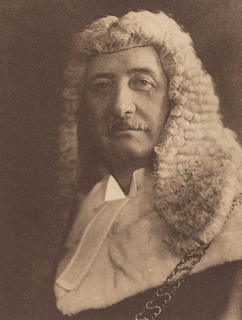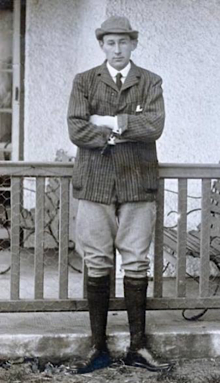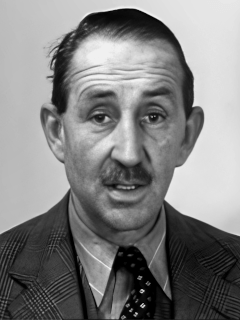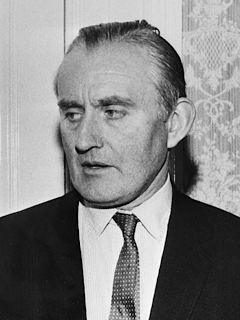
Moore is the eldest son of Queen Victoria‘s honorary physician in Ireland, Dr. William Moore of Rosnashane, Ballymoney, and Sidney Blanche Fuller. His ancestors came to Ulster during the Plantation of Ulster, settling at Ballymoney, at which time they were Quakers. The Moore Lodge estate is inherited from a relative. The family owns several other houses: Moore’s Grove and Moore’s Fort. He goes on to become a Deputy Lieutenant for County Antrim and a Justice of the Peace.
In 1903, Moore is one of the first landowners of Ireland to sell off their estates under the land acts. By the early 1920s he owns a Belfastpied-à-terre called “Glassnabreedon,” in the village of Whitehouse, four miles north of Belfast. This house is once owned by the son of Nicholas Grimshaw, Ireland’s first cotton pioneer.
Moore becomes a member of the General Synod of the Church of Ireland and is a founder member of the Ulster Council. He is a passionate Orangeman: his vehemence in defending Ulster’s right to oppose Irish Home Rule is said to alarm even those who share his views. Speaking in England on March 10, 1913, he makes his feelings clear on the possibility of Irish Home Rule: “I have no doubt, if Home Rule is carried, its baptism in Ireland will be a baptism in blood.” He shows little respect for English politicians, and has nothing but contempt for Southern Unionists. The eventual political settlement in 1921 meets with his approval.
Moore dies at his home, Moore Lodge, in Ballymoney on November 28, 1944, less than a week after his 80th birthday. He is buried in the family burial ground, “Lamb’s Fold,” two days later.
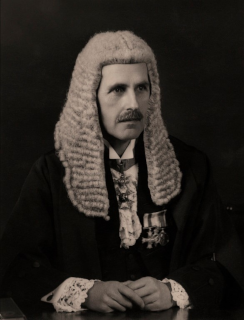
Babington is called to the Irish Bar in 1900. He briefly lectures in Equity at King’s Inns, and it is during this time, in 1910, that he re-arranges and re-writes R.E. Osborne’s Jurisdiction and Practice of County Courts in Ireland in Equity and Probate Matters. He takes silk in 1917.
In 1947, Babington chairs the Babington Agricultural Enquiry Committee, named in his honour, which is established in 1943 to examine agriculture in Northern Ireland. The committee’s first recommendation under Babington’s leadership is that Northern Ireland should direct all its energies to the production of livestock and livestock products and to their efficient processing and marketing.
Babington retires from the judiciary in 1949, taking up the chairmanship of the Northern Ireland Transport Tribunal, which exists until 1967, established under the Ulster Transport Act – promoting a car-centred transport policy – and which is largely responsible for the closure of the Belfast and County Down Railway. He endorses the closure on financial grounds and is at cross purposes with his co-chair, Dr. James Beddy, who advises against the closure, citing the disruption of life in the border region between the north and the south as his primary reason in addition to financial grounds.
Babington also chairs a government inquiry into the licensing of clubs, the proceeds of which results in new regulatory legislation at Stormont. While Attorney General, he is a proponent of renaming Northern Ireland as “Ulster.”
Babington is critical of the newly proposed Irish constitution, in which the name of the Irish state is changed to “Ireland,” laying claim to jurisdiction over Northern Ireland.
Michael McDunphy, Secretary to the President of Ireland, then Douglas Hyde, recalls Ernest Alton‘s correspondence with Babington on the question of Irish unity, in which Alton and Babington are revealed to be at cross purposes. The discussion is used as an example by Brian Murphy, in Forgotten Patriot: Douglas Hyde and the Foundation of the Irish Presidency, as an example of the office of the Irish President becoming embroiled in an initiative involving Trinity College Dublin and a senior Northern Ireland legal figure, namely Babington.
Babington writes to Alton, then Provost of Trinity College, Dublin, expressing his view that, as Murphy summarises, “… Severance between the two parts of Ireland could not continue, that it was the duty of all Irishmen to work for early unification and that in his opinion Trinity College was a very appropriate place in which the first move should be made.” When Alton arrives to meet with Hyde, it emerges, after conversing with Hyde’s secretary McDunphy, that he and Babington are at cross purposes. “It soon became clear that the united Ireland contemplated by Mr. [sic] Justice Babington of the Northern Ireland Judiciary was one within the framework of the British Commonwealth of Nations, involving recognition of the King of England as the Supreme Head, or as Dr. Alton put it, the symbol of unity of the whole system,” writes McDunphy.
Babington is a keen golfer. He is an international golfer from 1903 to 1913, during which he is runner-up in the Irish Amateur Golf Championships in 1909 and one of the Irish representatives at an international match in 1913. The Babington Room in the Royal Portrush Golf Club is named after him, as is the 18th hole on the course as a result of the key role he plays in shaping its history.
Babington dies at the age of 94 on April 10, 1972 at his home, Creevagh, Portrush, County Antrim.
MacDermott is born in Belfast on April 12, 1896, the third surviving son and sixth of seven children of the Reverend John MacDermott DD, a Presbyterian clergyman who is minister of Belmont and moderator of the Presbyterian Church in Ireland, and of his wife Lydia Allen MacDermott (née Wilson), the daughter of a Strabane solicitor. He is educated at Campbell College, Belfast, from where he wins a scholarship to read Law at the Queen’s University Belfast (QUB) in 1914.
Eight years later MacDermott is appointed to determine industrial assurance disputes in Northern Ireland, and in 1931 becomes a lecturer in Jurisprudence at Queen’s University Belfast, teaching for four years.
In 1940, MacDermott is appointed Minister of Public Security in the Government of Northern Ireland, and the following year becomes the Attorney General for Northern Ireland. He is succeeded in this post by William Lowry, whose son, Lord Lowry, would eventually succeed MacDermott as Lord Chief Justice. In 1944, he resigns his parliamentary seat on appointment as a High Court Judge for Northern Ireland, and three years later, on April 23, 1947, is made a Lord of Appeal in Ordinary, becoming a life peer as Baron MacDermott, of Belmont in the city of Belfast.
MacDermott returns from the House of Lords to take up his appointment as Lord Chief Justice of Northern Ireland. His successors to the latter office become Law Lords subsequently. Whilst Lord Chief Justice, he is affectionately known as “the Baron.”
In 1977, aged over eighty, MacDermott offers to redeliver a lecture at the Ulster College, which had been interrupted by a bomb meant for him and which had severely wounded him.
Having been made a Northern Ireland Privy Counsellor seven years earlier, MacDermott is sworn of the British Privy Council in 1947.
Four years later, in 1951, MacDermott is appointed Lord Chief Justice of Northern Ireland, a post he holds for twenty years. He is also Pro-Chancellor of his alma mater from 1951 to 1969. In 1958, he chairs the commission on the Isle of ManConstitution. He dies at his home in Belfast on July 13, 1979.
In 1926, MacDermott weds Louise Palmer Johnston, later Lady MacDermott. Their son, Sir John MacDermott, is also sworn into the British Privy Council in 1987, as a Lord Justice of Appeal in Northern Ireland. He later became a Surveillance Commissioner for Northern Ireland.
Known principally for his contribution to Ulster politics at local level, Armstrong serves as JP and is appointed High Sheriff of Armagh for 1875 and High Sheriff of Longford for 1894. He is a County Councillor for Armagh from 1899 to 1920, and a Member of the Irish Convention in 1917–18. Vice-Lieutenant of County Armagh in 1920, he is a Senator of Queen’s University Belfast from 1920 to 1937.
Armstrong is returned unopposed to the Imperial House of Commons for Mid-Armagh in the 1921 Mid Armagh by-election, at the advanced age of 76, becoming one of the oldest first-time MPs whose birth date is recorded. Certainly, he immediately becomes the oldest member of the current House of Commons. He is a Senator of Northern Ireland from 1921 to 1937, and Lord Lieutenant of Armagh from 1924 to 1939. For twenty-five years he is a member of the Representative Body of the Church of Ireland. He is Chairman of the County Armagh Education Committee from 1925 to 1931, and President of the Association of Education Committees of Northern Ireland. In 1932, he is made a Privy Councillor for Northern Ireland, and in 1938 he serves as a Justice for the Government of Northern Ireland in the absence of the Governor.
In his later years, Armstrong provides financial support for Jewish refugees fleeing Nazi-occupied Europe.
In 1883, Armstrong marries Margaret Leader, daughter of William Leader of Rosnalea, County Cork. They have five sons and three daughters, of whom C. W. Armstrong also becomes a politician.
Armstrong dies at his home in Dean’s Hill, Armagh, on December 4, 1943, at the age of 99 years.
Brooke is born on June 9, 1888, at Colebrooke Park, his family’s neo-Classicalancestral seat on what is then the several-thousand-acre Colebrooke Estate, just outside Brookeborough, a village near Lisnaskea in County Fermanagh. He is the eldest son of Sir Arthur Douglas Brooke, 4th Baronet, whom he succeeds as 5th Baronet when his father dies in 1907. His mother is Gertrude Isabella Batson. He is a nephew of Field MarshalAlan Brooke, 1st Viscount Alanbrooke, Chief of the Imperial General Staff (CIGS) during World War II, who is only five years his senior. His sister Sheelah marries Sir Henry Mulholland, Speaker of the Stormont House of Commons and son of Lord Dunleath. He is educated for five years at St. George’s School in Pau, France, and then at Winchester College (1901–05).
Brooke is a very active Ulster Unionist Party member and ally of Edward Carson. He founds his own paramilitary group, Brooke’s Fermanagh Vigilance, from men returning from the war front in 1918. Although the umbrella Ulster Volunteers had been quiescent during the war, it is not defunct. It re-emerges strongly in 1920, subsuming groups like Brooke’s.
In 1920, having reached the rank of captain, Brooke leaves the British Army to farm the Colebrooke Estate, the family estate in west Ulster, at which point he turns toward a career in politics.
Brooke has a very long political career. When he resigns the Premiership of Northern Ireland in March 1963, he is Northern Ireland’s longest-serving prime minister, having held office for two months short of 20 years. He also establishes a United Kingdom record by holding government office continuously for 33 years.
On May 2, 1943, Brooke succeeds John M. Andrews as Prime Minister of Northern Ireland. In 1952, while Prime Minister, was raised to the peerage as Viscount Brookeborough, the title taken from the village named after the Brookes. Although a peer, he retained his seat in the House of Commons at Stormont and remained Prime Minister for another decade.
As the Northern Ireland economy begins to de-industrialise in the mid-1950s, leading to high unemployment amongst the Protestant working classes, Brooke faces increasing disenchantment amongst UUP backbenchers for what is regarded as his indifferent and ineffectual approach to mounting economic problems. As this disenchantment grows, British civil servants and some members of the UUP combine to exert discreet and ultimately effective pressure on Brooke to resign to make way for Captain Terence O’Neill, who is Minister of Finance.
Brooke is noted for his casual style toward his ministerial duties. Terence O’Neill later writes of him, “he was good company and a good raconteur, and those who met him imagined that he was relaxing away from his desk. However, they did not realise that there was no desk.”
In his retirement Brooke develops commercial interests as chairman of Carreras (Northern Ireland), a director of Devenish Trade, and president of the Northern Ireland Institute of Directors. He is also made an honorary LL.D. of Queen’s University Belfast.
From 1970 to 1973, years in which the Stormont institution comes under its greatest strain and eventually crumbles, Brooke makes only occasional forays into political life. In 1972, he appears next to William Craig MP on the balcony of Parliament Buildings at Stormont, a diminutive figure beside the leader of the Vanguard Unionist Progressive Party (VUPP) who is rallying right-wing Unionists against the Government of Northern Ireland. He opposes the Westminsterwhite paper on the future of Northern Ireland and causes some embarrassment to his son, Captain John Brooke, the UUP Chief Whip and an ally of Brian Faulkner, by speaking against the Faulkner ministry‘s proposals.
Brooke dies at his home, Colebrooke Park, on the Colebrooke Estate, on August 18, 1973. His remains are cremated at Roselawn Cemetery, East Belfast, three days later, and, in accordance with his wishes, his ashes are scattered on the demesne surrounding his beloved Colebrooke Park.
Craig is born at Sydenham, Belfast, on January 8, 1871, the seventh of nine children of James Craig (1828–1900), a wealthy whiskey distiller who had entered the firm of Dunville & Co. as a clerk and by age 40 is a millionaire and a partner in the firm. Craig Snr. owns a large house called Craigavon, overlooking Belfast Lough. His mother, Eleanor Gilmore Browne, is the daughter of Robert Browne, a prosperous man who owned property in Belfast and a farm outside Lisburn. Craig is educated at Merchiston Castle School in Edinburgh, Scotland. After school he begins work as a stockbroker, eventually opening his own firm in Belfast.
Craig enlists in the 3rd (Militia) battalion of the Royal Irish Rifles on January 17, 1900, to serve in the Second Boer War. He is seconded to the Imperial Yeomanry, a cavalry force created for service during the war, as a lieutenant in the 13th battalion on February 24, 1900, and leaves Liverpool for South Africa on the SS Cymric in March 1900. After arrival he is soon sent to the front and is taken prisoner in May 1900, but released by the Boers because of a perforated colon. On his recovery he becomes deputy assistant director of the Imperial Military Railways, showing the qualities of organisation that are to mark his involvement in both British and Ulster politics. In June 1901 he is sent home suffering from dysentery, and by the time he is fit for service again the war is over. He is promoted to captain in the 3rd Royal Irish Rifles on September 20, 1902, while still seconded to South Africa.
On June 7, 1921, Craig is appointed the first Prime Minister of Northern Ireland by the Lord Lieutenant of Ireland. The House of Commons of Northern Ireland assembles for the first time later that day.
Craig had made his career in British as well as Northern Irish politics, but his premiership shows little sign of his earlier close acquaintance with the British political world. He becomes intensely parochial and suffers from his loss of intimacy with British politicians in 1938, when the British government concludes agreements with Dublin to end the Anglo-Irish trade war between the two countries. He never tries to persuade Westminster to protect Northern Ireland‘s industries, especially the linen industry, which is central to its economy. He is anxious not to provoke Westminster, given the precarious state of Northern Ireland’s position. In April 1939, and again in May 1940 during World War II, he calls for conscription to be introduced in Northern Ireland (which the British government, fearing a backlash from nationalists, refuses). He also calls for Winston Churchill to invade Ireland using Scottish and Welsh troops in order to seize the valuable ports and install a Governor-General at Dublin.
While still prime minister, Craig dies peacefully at his home at Glencraig, County Down at the age of 69 on November 24, 1940. He is buried on the Stormont Estate on December 5, 1940, and is succeeded as the Prime Minister of Northern Ireland by the Minister of Finance, J. M. Andrews.
(Pictured: James Craig, 1st Viscount Craigavon, bromide print by Olive Edis, National Portrait Gallery, London)
Parker is born Dehra Kerr-Fisher, the only child of James Kerr-Fisher and his wife Annie. Her father, a native of Kilrea, County Londonderry, is a successful financier. She is educated in the United States, where her father holds extensive property holdings, and in Germany. The surname has been spelled, alternatively, as Ker-Fisher or Ker Fisher.
Parker is married twice. Her first husband is Lieutenant ColonelRobert Peel Dawson Spencer Chichester, MP, with whom she has one son and one daughter, Robert James Spencer Chichester (1902–1920) and Marion Caroline Dehra Chichester (1904–1976). She is predeceased by her son. On June 4, 1928, she marries her second husband, Admiral Henry Wise Parker (CB, CMG).
Parker’s promotion to the Cabinet at the age of 67 under Sir Basil Brooke (later created the 1st Viscount Brookeborough) is part of his so-called “reforming” premiership, his predecessor, J. M. Andrews, having been criticised for appointing elderly members to Cabinet. She is the first woman to serve in the Northern Ireland Cabinet.
Outside of parliamentary activities, Parker is a long-serving local councilor on Magherafelt District Council, president of both the Northern Ireland Physical Training Association and the Girls’ Training Corps, and chairman of the Ancient Monuments Advisory Committee. In 1944, she is appointed senior vice-chairman of the Council for the Encouragement of Music and the Arts (CEMA NI), and in 1949 she succeeds Sir David Lindsay Keir as President for CEMA, a position she holds until 1960. She is made an honorary member of the Ulster Society of Women Artists in 1958.
Parker dies at her home, Shanemullagh House, Castledawson, in the south of County Londonderry, on November 28, 1963, at age 81. She is interred two days later in the grounds of Christ Church, Castledawson.
Armstrong is the second surviving son of William Jones Wright Armstrong of County Armagh and Frances Elizabeth, widow of Sir Michael McCreagh, and daughter of Major Christopher Wilson. He is educated at The Royal School, Armagh and Trinity College, Cambridge, gaining a BA (2nd Class Law Tripos) in 1867 and an MA in 1870. Admitted at the Inner Temple in 1866, he is called to the Bar in 1868.
In 1883, Armstrong marries Margaret Leader, daughter of William Leader of Rosnalea, County Cork. They have five sons and three daughters, of whom C. W. Armstrong also becomes a politician.
Armstrong is returned unopposed to the House of Commons of the United Kingdom for Mid Armagh in a by-election in 1921, at the advanced age of 76, becoming one of the oldest first-time MPs whose birth date is recorded. Certainly, he immediately becomes the oldest member of the current House of Commons. He is a Senator of Northern Ireland from 1921 to 1937, and Lord Lieutenant of Armagh from 1924 to 1939. For 25 years he is a member of the Representative Body of the Church of Ireland. He is Chairman of the County Armagh Education Committee from 1925 to 1931, and President of the Association of Education Committees of Northern Ireland. In 1932 he is made a Privy Councillor for Northern Ireland, and in 1938 he serves as a Justice for the Government of Northern Ireland in the absence of the Governor.
Armstrong dies at the age of 99 on December 4, 1943, at his home in Dean’s Hill, County Armagh.
At the outbreak of war in 1939, Stronge joins the North Irish Horse as a lieutenant but has to relinquish his commission the following year due to ill health. He is then granted the rank of captain. Resuming his political career, he becomes Assistant Parliamentary Secretary at the Ministry of Finance (Assistant Whip) (1941–42) and then Parliamentary Secretary at the Ministry of Finance (Chief Whip) (1942–44). His period as Chief Whip is marked by more robust and “fluid” debate within the party and significant backbench discontent in early 1943. In June 1944 he is elected chairman of Armagh County Council, and in the following year is returned unopposed in the general election. He becomes Speaker of the House of Commons of Northern Ireland in 1945 and in this position he earns the respect of, and makes friends with, politicians of every hue, and is regarded as a moderating influence. It has been said of him that he disproved the myth that politicians at Stormont never spoke to each other. He is unopposed in every postwar election up to 1965, when he sees off the challenge of the Liberal candidate. He does not contest the 1969 general election. He is made Chevalier of the Order of Leopold in 1946 and in the same year is appointed to the Privy Council of Northern Ireland. A member of the Commonwealth Parliamentary Association, he is a delegate to its 1950 conference in New Zealand. Another interest is the Royal Over-Seas League, of which he is president for a time.
Stronge is closely associated with Sir Basil Brooke, Dame Dehra Parker and Sir Henry Mulholland. He is president of the Northern Ireland area council of the Royal British Legion, sovereign grand master of the Royal Black Institution, president of the Federation of Boys’ Clubs, and chairman of the Commercial Insurance Co. and of the Central Advisory Council for the Employment of the Disabled. It is this last position that causes a brief interruption of his speakership, with an act of parliament deemed necessary to remove any doubt about it having been an office of profit. A prominent member of the Orange Order, he is also chairman of the BBC appeals advisory committee and the Northern Ireland scout council. His retirement from public life in 1977 is marked by his investiture as a Knight of Grace by Prince Richard, Duke of Gloucester.
A leading member of the Church of Ireland, Stronge becomes Commander of the Order of Saint John in 1952 and is for many years on the Armagh diocesan synod and council. Until his death, he is a nominator for the position of rector and reads the lessons each Sunday morning in Tynan parish church. In September 1921 he marries Gladys Olive, daughter of Major Henry Thomas Hall of Knockbrack, Athenry, County Galway. They have three daughters and a son, James. In his later life he lives with James, a bachelor, on their 800-acre estate near the border. James is educated at Eton College and Christ Church, Oxford. He succeeds his father in the Mid Armagh constituency in 1969, serving as Ulster Unionist MP in the Stormont parliament until 1972. He is firmly opposed to the Sunningdale Agreement of December 1973, which he describes as a “great act of political appeasement.” Although both are known in the locality, neither seeks public attention and both live relatively quiet lives. Stronge likes to work in the garden but has little interest in the farm, most of which is let out to tenants.
Stronge and his son become prominent victims of the Troubles when a unit of the Provisional Irish Republican Army shoots them dead on January 21, 1981, at Tynan Abbey and sets the mansion alight, destroying it. The Provisional IRA statement describes them as “symbols of hated unionism” and their killings as “direct reprisal for a whole series of loyalist assassinations and murder attacks on nationalist people.” The killings come five days after an attempted assassination of the former MP Bernadette Devlin McAliskey and her husband. Tynan Abbey is long held to have been an easy target, given its relative isolation and its proximity to the border. In 1985 a man is tried for their murders but is acquitted. In 1999 the shell of Tynan Abbey is demolished.
(From: “Stronge, Sir Charles Norman Lockhart” by Tom Feeney, Dictionary of Irish Biography, http://www.dib.ie, October 2009)
Hutton becomes a Queen’s Counsel in 1970. From 1979 to 1989, as Sir Brian Hutton, he is a High Court judge. In 1989, he becomes Lord Chief Justice of Northern Ireland, becoming a member of the Privy Council of Northern Ireland, before moving to England to become a Lord of Appeal in Ordinary on January 6, 1997. He is consequently granted a life peerage as Baron Hutton, of Bresagh in the County of Down.
On March 30, 1994, as Lord Chief Justice of Northern Ireland, Hutton dismisses Private Lee Clegg‘s appeal against his controversial murder conviction. On March 21, 2002 he is one of four Law Lords to reject David Shayler‘s application to use a “public interest” defence as defined in section 1 of the Official Secrets Act 1989 at his trial.
Hutton represents the Ministry of Defence at the inquest into the killing of civil rights marchers on “Bloody Sunday.” Later, he publicly reprimands Major Hubert O’Neil, the coroner presiding over the inquest, when the coroner accuses the British Army of murder, as this contradicts the findings of the Widgery Tribunal.
Hutton also comes to public attention in 1999 during the extradition proceedings of former Chilean dictator General Augusto Pinochet. Pinochet had been arrested in London on torture allegations by request of a Spanish judge. Five Law Lords, the UK’s highest court, decide by a 3-2 majority that Pinochet is to be extradited to Spain. The verdict is then overturned by a panel of seven Law Lords, including Hutton, on the grounds that Lord Lennie Hoffmann, one of the five Law Lords, has links to human rights group Amnesty International which had campaigned for Pinochet’s extradition.
In 1978, Hutton defends the UK at the European Court of Human Rights in the case of Ireland v United Kingdom, when the court decides that the interrogation techniques used were “inhuman and degrading” and breached the European Convention on Human Rights, but do not amount to “torture.” The court also finds that the practice of internment in Northern Ireland had not breached the Convention. He sentences ten men to 1,001 years in prison on the word of “supergrass” informer Robert Quigley, who is granted immunity in 1984.
Hutton is appointed by Tony Blair‘s government to chair the inquiry on the circumstances surrounding the death of scientist David Kelly. The inquiry commences on August 11, 2003. Many observers are surprised when he delivers his report on January 28, 2004 and clears the British Government in large part. His criticism of the BBC is regarded by some as unduly harsh with one critic commenting that Hutton had given the “benefit of judgement to virtually everyone in the government and no-one in the BBC.” In response to the verdict, the front page of The Independent newspaper consists of one word, “Whitewash?”
Peter Oborne writes in The Spectator in January 2004: “Legal opinion in Northern Ireland, where Lord Hutton practised for most of his career, emphasises the caution of his judgments. He is said to have been habitually chary of making precedents. But few people seriously doubt Hutton’s fairness or independence. Though [he is] a dour Presbyterian, there were spectacular acquittals of some very grisly IRA terrorist suspects when he was a judge in the Diplock era.”
Hutton retires as a Law Lord on January 11, 2004. He remains a member of the House of Lords until retiring under the House of Lords Reform Act 2014 on April 23, 2018.