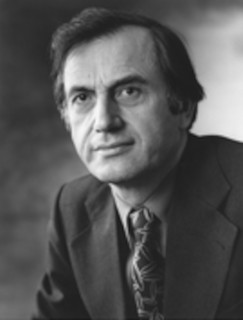
Bleakley runs for the Westminster seat of Belfast East in 1970 (gaining 41% of the vote), February 1974 and October 1974 for the Northern Ireland Labour Party each time, but never enough to win the Westminister seat from the Ulster Unionist Party (UUP). In 1971, Brian Faulkner appoints him as his Minister for Community Relations at Stormont, but as Bleakley is not an MP, he can only hold the post for six months. He resigns five days before his term expires in order to highlight his disagreement with government policy, specifically the failure to widen the government to include non-Unionist parties, and the decision to introduce internment. He writes a respectful biography of Faulkner and his own memoir of the period.
After the Parliament is abolished, Bleakley stands for, and is elected to, the Northern Ireland Assembly and its successor, the Northern Ireland Constitutional Convention. He stands again for Belfast East in the February and October UK general elections, but wins only 14% of the vote each time.
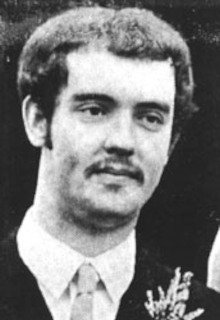
Unlike most Protestants in Northern Ireland, Bunting becomes a militant republican. His father, by contrast, was a committed Ulster loyalist. Despite their political differences, they remain close.
Bunting joins the Official Irish Republican Army (OIRA) around 1970 as he is attracted to their left-wing and secular interpretation of Irish republicanism and believes in the necessity of armed revolution. The other wing of the IRA, the Provisional Irish Republican Army, is seen to be more Catholic and nationalist in its outlook. At this time, the communal conflict known as the Troubles is beginning and the Official IRA is involved in shootings and bombings. He is interned in November 1971 and held in Long Kesh until the following April.
In 1974, Bunting follows Seamus Costello and other militants who disagree with the Official IRA’s ceasefire of 1972, into a new grouping, the Irish National Liberation Army (INLA). Immediately, a violent feud breaks out between the Official IRA and the INLA.
In 1975, Bunting survives an assassination attempt when he is shot in a Belfast street. In 1977, Costello is killed by an Official IRA gunman in Dublin. Bunting and his family hide in Wales until 1978, when he returns to Belfast. For the remaining two years of his life, he is the military leader of the INLA. The grouping regularly attacks the British Army and Royal Ulster Constabulary (RUC) in Belfast. He calls in claims of responsibility to the media by the code name “Captain Green.”
At about 4:30 AM on October 15, 1980, several gunmen wearing balaclavas storm Bunting’s home in the Downfine Gardens area of Andersonstown. They shoot Bunting, his wife Suzanne and another Protestant INLA man and ex-member of the Red Republican Party, Noel Lyttle, who has been staying there after his recent release from detention.
Both Bunting and Lyttle are killed. Suzanne Bunting, who is shot in the face, survives her serious injuries. The attack is claimed by the Ulster Defence Association (UDA), but the INLA claims the Special Air Service are involved.
Upon his death, Bunting’s body is kept in a funeral parlour on the Newtownards Road opposite the headquarters of the UDA. On the day of the funeral, as the coffin is being removed, UDA members jeer from their building. The Irish Republican Socialist Party wants a republican paramilitary-style funeral for Bunting but his father refuses and has his son buried in the family plot of a Church of Ireland cemetery near Donaghadee.
Milligan is brought up as a Methodist, the daughter of the writer Seaton Milligan, antiquarian and member of the Royal Irish Academy (RIA). She is one of eleven children, including music collector Charlotte Milligan Fox, and from 1877 to 1887 attends Methodist College Belfast (MCB), after which she completes a teacher-training course. Together with her father she writes a political travelogue of the north of Ireland in 1888, Glimpses of Erin. She writes her first novel, A Royal Democrat, in 1890.
After the death of Charles Stewart Parnell, Milligan becomes an ardent nationalist. In 1894 with Jenny Armour, she founds branches of the Irish Women’s Association in Belfast and other places and becomes its first president. With Ethna Carbery she founds two nationalist publications in the 1890s, The Northern Patriot, and later The Shan Van Vocht, a monthly literary magazine published in Belfast from 1896 to 1899.
Alice Milligan dies in Omagh in April 1953 and is buried in Blackford Municipal Cemetery, County Tyrone. On her headstone is inscribed “She loved no other place than Ireland.”
During 2010/2011 the Ulster History Circle mounts plaques for famous Ulster figures. Charlotte Milligan Fox and Alice Milligan have a plaque mounted on Omagh Library, 1 Spillar’s Place, Omagh, County Tyrone.
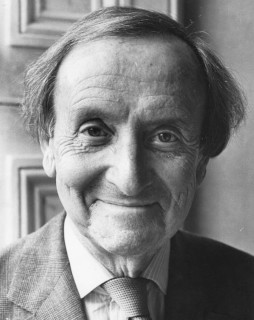
Brian Moore, novelist and screenwriter who is acclaimed for the descriptions in his novels of life in Northern Ireland after World War II, is born in Belfast, Northern Ireland on August 25, 1921. He has been described as “one of the few genuine masters of the contemporary novel.”
In 1948 Moore emigrates to Canada to work as a reporter for the Montreal Gazette and becomes a Canadian citizen. While eventually making his primary residence in California, he continues to live part of each year in Canada up to his death.
Moore lives in Canada from 1948 to 1958, where he meets his first wife, Jacqueline (“Jackie”) Sirois, a French Canadian and fellow journalist. They marry in 1952. He moves to New York City in 1959 to take up a Guggenheim Fellowship and remains there until his divorce in October 1967. He then moves to the west coast of the United States, settling in Malibu, California, with his new wife Jean Denney, a former commentator on Canadian TV. There he teaches creative writing at UCLA.
Moore writes his first novels in Canada. His earliest novels are thrillers, published under his own name or using the pseudonyms Bernard Mara or Michael Bryan. His first novel outside the genre, Judith Hearne, remains among his most highly regarded. The book is rejected by ten American publishers before being accepted by a British publisher. It is made into a film, with British actress Maggie Smith playing the lonely spinster who is the book/film’s title character.
Some of Moore’s novels feature staunchly anti-doctrinaire and anti-clerical themes, and in particular he speaks strongly about the effect of the Church on life in Ireland. A recurring theme in his novels is the concept of the Catholic priesthood. On several occasions he explores the idea of a priest losing his faith. At the same time, several of his novels are deeply sympathetic and affirming portrayals of the struggles of faith and religious commitment, Black Robe most prominently.
Moore dies at his Malibu home, which is celebrated in Seamus Heaney‘s poem Remembering Malibu, on January 11, 1999, from pulmonary fibrosis. His widow, Jean, lives on in the house until it is destroyed in 2018 in the Woolsey Fire.
At the time of his death, Moore is working on a novel about the 19th-century French symbolist poet Arthur Rimbaud. His last published work before his death is an essay entitled “Going Home.” It is a reflection inspired by a visit he made to the grave in Connemara of his family friend, the Irish nationalist Bulmer Hobson. The essay is commissioned by Granta and published in The New York Times on February 7, 1999.
In 1996, the Brian Moore Short Story Awards is launched by the Creative Writers Network in Northern Ireland and is open to all authors of Irish descent. Previous judges have included Glenn Patterson, Lionel Shriver, Carlo Gébler and Maeve Binchy.
In 1975 Moore arranges for his literary materials, letters and documents to be deposited in the Special Collections Division of the University of Calgary Library, an inventory of which is published by the University of Calgary Press in 1987. His archives, which include unfilmed screenplays, drafts of various novels, working notes, a 42-volume journal (1957–1998), and his correspondence, are housed at the Harry Ransom Center at the University of Texas at Austin.
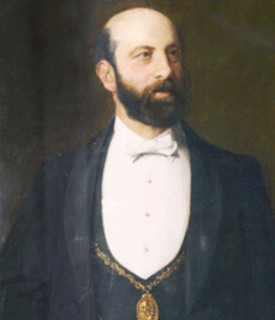
Jaffe is born into a Jewish family, one of four boys and five girls born to Daniel Joseph and Frederiké Jaffe. In 1852, his parents bring their family to Belfast. His father, along with his older brothers, Martin, John and Alfred, set up a business exporting linen. He is educated at Mr. Tate’s school in Holywood, County Down, and later in Hamburg and Switzerland.
Jaffe marries Paula Hertz, daughter of Moritz Hertz from Braunschweig, on March 8, 1879. They have two sons, Arthur Daniel and William Edward Berthold Jaffe. Daniel Joseph Jaffé is his nephew, son of his brother Martin.
From 1867 to 1877 Jaffe lives and works in New York. In 1877, his brothers retire so he returns to Belfast to head the family business, The Jaffe Brothers, at Bedford Street. He builds it up to become the largest linen exporter in Ireland. He is a member of the Belfast Harbour Commission and becomes a naturalised citizen in 1888. In 1894, he successfully agitates for the reporting and destruction of shipwrecks in the North Atlantic Ocean.
Jaffe is a Justice of the Peace, a governor of the Royal Hospital, a member of the Irish Technical Education Board and a member of the Senate of Queen’s College, which later becomes Queen’s University Belfast. He is the German consul in Belfast. He is an active member of the committee which gets the Public Libraries Act extended to Belfast, leading to the first free library being established there. In 1910 he erects the Jaffe Spinning Mill on the Newtownards Road, also known as Strand Spinning. This provides work for 350 people, rising to 650 in 1914 when the company expands to make munitions. He is lavishly charitable and contributes to Queen’s College.
Jaffe takes a keen interest in the Jewish community of Belfast. He is life-president of the Belfast Hebrew Congregation, which worships at the Great Victoria Street, Belfast synagogue. His father established it on July 7, 1871. Between 1871 and 1903 the congregation increases from fifty-five to over a thousand. He pays most of the £4,000 cost of building the synagogue in Annesley Street. He opens it in 1904 wearing his mayoral regalia. Three years later with his wife, they set up the Jaffe Public Elementary School on the Cliftonville Road.
The outbreak of war sees anti-German sentiment and when the RMS Lusitania passenger liner is torpedoed by a German U-boat of the coast of County Cork on May 7, 1915, resulting in the death of 1,000 people, anti-German feeling in Britain and Ireland rise to breaking point. Even though he is loyal to the Crown, and his eldest son Arthur and his nephew are serving in the British Army, Jaffe is accused of being a German spy. Society women refuse support for the Children’s Hospital so long as Jaffe and his wife remain on the board. He is “overwhelmed with pain and sorrow.”
After twenty-five years of service, Jaffe resigns his post as Alderman of Windsor Ward for Belfast City Council in June 1916 when he is almost 70 years of age and takes up residence in London, where he dies on April 29, 1929. Lady Jaffe is too ill to attend his funeral, and she dies a few months later, in August 1929.
Trimble has vowed to quit as head of the Stormont Executive, where his party shares power with Sinn Féin, if the Irish Republican Party (IRA) has not started to get rid of its guns by July 1. Paisley, however, has accused Trimble and British Prime MinisterTony Blair of breaking their promises to the people of Northern Ireland by allowing into government a party linked to a terrorist group, without prior arms decommissioning.
While Clinton is no longer the most powerful man in the world, his charisma and his past efforts to keep the peace process moving are still appreciated by many. He receives Northern Ireland political leaders countless times at the White House and gives support and encouragement by phone during difficult periods of the peace talks.
The leader of the Social Democratic and Labour Party (SDLP), John Hume, who welcomes Clinton to Derry, says the former president has done a great deal of good for all the people of Ireland. But the Democratic Unionist Party (DUP) deputy leader, Peter Robinson, claims that Clinton and Blair could have a negative effect on Trimble’s campaign. “As a unionist, I wouldn’t like to be sitting next to either of them just before an election,” he said. “Blair’s name is associated with the now-broken pledges he wrote on a board here just before the [Good Friday agreement] referendum, so for him to come over and moralise now won’t do much good. And Clinton is so disgraced and powerless that, while he might prop up the nationalist SDLP and Sinn Féin vote, he’ll have no impact on unionists voters.”
(Pictured: Bill Clinton and SDLP leader John Hume at public address at Guildhall Square in Derry. Sinn Féin leader Gerry Adams and Chelsea Clinton are in the second row.)
Lynd is born to Robert John Lynd, a Presbyterian minister, and Sarah Rentoul Lynd, the second of seven children. His paternal great-grandfather emigrated from Scotland to Ireland. He is educated at Royal Belfast Academical Institution and Queen’s University Belfast. His father serves a term as Presbyterian Church Moderator, but he is just one of a long line of Presbyterian clergy in the family.
Lynd marries the writer Sylvia Dryhurst on April 21, 1909. They meet at Gaelic League meetings in London. Their daughters Máire and Sigle become close friends of Isaiah Berlin. Sigle’s son, born in 1941, is artist Tim Wheeler. In March 1924, they move to what is to be their long-term married home, the elegant Regency house of 5 Keats Grove in the leafy suburb of Hampstead in northwest London. The house had been lived in by various members of Sylvia’s family.
The Lynds are literary hosts, in the group including J. B. Priestley. They are on good terms also with Hugh Walpole. Priestley, Walpole and Sylvia Lynd are founding committee members of the Book Society. Irish guests include James Joyce and James Stephens. On one occasion reported by Victor Gollancz in Reminiscences of Affection, Joyce intones Anna Livia Plurabelle to his own piano accompaniment. Joyce and his wife Nora Barnacle hold their wedding lunch at the Lynds’ house after getting married at Hampstead Town Hall on July 4, 1931.
Lynd uses the pseudonym Y.Y. in writing for the New Statesman. According to C. H. Rolph‘s Kingsley, Lynd’s weekly essay, which runs from 1913 to 1945, is “irreplaceable.” In 1941, editor Kingsley Martin decides to alternate it with pieces by James Bridie on Ireland, but the experiment is not at all a success.
Lynd’s political views are at a certain point radicalised by his experience of how Ulster and Home Rule develop in the 1912–1914 period. He is appalled at the threat of the use of violence to deliver Ulster from Home Rule and the later decision to postpone the implementation of the Third Home Rule Bill. He later writes, “Then came August 1914 and England began a war for the freedom of small nations by postponing the freedom of the only small nation in Europe which it was within her power to liberate with the stroke of a pen.”
Lynd becomes fluent in the Irish language and is a Gaelic League member. As a Sinn Féin activist, he uses the name Robiard Ó Flionn/Roibeard Ua Flionn. He dies in Hampstead, London on October 6, 1949. He is buried in Belfast City Cemetery.
Milligan is the eldest of eleven children born to Methodist parents Seaton Milligan (1837–1916) and Charlotte Burns (1842–1916), with nine surviving including Alice Milligan and Edith Wheeler. All nine children enroll at Methodist College Belfast which provides a privileged and exceptional education. She studies classical piano and composition at the Royal College of Music in London and the Conservatoires of Frankfurt and Milan. Following her marriage to Charles Eliot Fox in 1892, she settles in London.
In 1904 Fox co-founds with Alfred Perceval Graves the Irish Folk Song Society, an offshoot of the Folk-Song Society formed in 1898. Its aim is to collect and publish Irish airs and ballads, in addition to holding lectures and concerts on the subject. She acts as the society’s honorary secretary. The rules of the Society are collected in volume 4 of the Journal of the Irish Folk Song Society. The subscription is 5 shillings payable every January and committee meetings are held at the Rooms of the Irish Literary Society in London.
Fox is a musician in her own right and tours Ireland collecting folk songs and airs. She undertakes a series of tours of County Antrim between 1909 and 1910 with her sisters Edith Wheeler and Alice Milligan. The sisters record and transcribe songs by Irish singers, then publish articles and musical scores in The Journal of Irish Folk Song.
In 1910 Fox visits the east coast of the United States where the New York branch of the Irish Folk Song Society is formed. “The Bardic Recital” is produced on March 16 at the National Theatre in Washington, D.C. She collects and arranges the music for the play.
Fox rediscovers Edward Bunting‘s papers, and under the provision of her will they come to Queen’s University Belfast in 1916. From these papers she writes The Annals of the Irish Harpers. The publication of The Annals of the Irish Harpers stimulates a revival of interest in both the Irish harp and Edward Bunting. Alice Milligan nurses her sister prior to Fox’s death in London on March 25, 1916. An obituary of Charlotte Milligan Fox is in The Irish Booklover (1916). The Journal of the Irish Folk Song Society (1917) has a poem in remembrance of Charlotte Milligan Fox. The same issue has a memoir of Fox by Alice Milligan and an appreciation of Fox by Alfred Perceval Graves.
During 2010 and 2011, the Ulster History Circle mounts plaques for famous Ulster figures. Charlotte Milligan Fox and Alice Milligan have a plaque mounted on Omagh Library, 1 Spillar’s Place, Omagh, County Tyrone.
Farrell is born into a middle-class family with no link to militant Irish republicanism other than a grandfather who had been interned during the Irish War for Independence. She is educated at Rathmore Grammar School, Belfast. At the age of 14 she is recruited into the Provisional IRA by Bobby Storey. After leaving school at the age of 18, she is hired as a clerical worker for an insurance broker’s office.
On March 1, 1976, the British government revokes Special Category Status for prisoners convicted from this date under anti-terrorism legislation. In response, the IRA instigates a wave of bombings and shootings across Northern Ireland and younger members such as Farrell are asked to participate. On April 5, 1976, along with Kieran Doherty and Sean McDermott, she attempts to plant a bomb at the Conway Hotel in Dunmurry, as that hotel had often been used by British soldiers on temporary duty in Northern Ireland. She is arrested by Royal Ulster Constabulary (RUC) officers within an hour of planting the bomb. McDermott, her boyfriend, is shot dead by a RUC reservist at a nearby housing estate.
At her trial, Farrell refuses to recognise the court as it is an institution of the British state. She is sentenced to fourteen years in prison for explosives offences, firearms offences, and belonging to an illegal organisation.
When Farrell arrives at Armagh Prison, she refuses to wear a prison uniform in protest at the designation of republican prisoners as criminals and becomes the official Officer Commanding of the female IRA prisoners. After 13 months, she, along with Mary Doyle and Mairead Nugent, begin a hunger strike to coincide with the one already taking place in Long Kesh Prison. It ends on December 19, a day after the men’s strike. In March 1981 the prisoners’ rights campaign is focused on the hunger strike being undertaken by Bobby Sands, leader of IRA prisoners in the H-Blocks. She was one of the H-Block/Armagh prisoners to stand for election in the Republic of Ireland in the 1981 Irish general election, standing in Cork North-Central and polling 2,751 votes (6.05%).[17]
Upon her release from prison in October 1986, Farrell enrolls at Queen’s University, Belfast for a course in Political Science and Economics. However, she drops out to re-engage in IRA activity. The IRA sends her with Seán Savage and Daniel McCann to the British overseas territory of Gibraltar to plant a car bomb in a heavily populated town area. The target is the band and guard of the 1st Battalion of the Royal Anglian Regiment during a weekly ceremonial changing of the guard in front of Governors’ residence, on March 8, 1988. According to interrogated IRA members, Gibraltar is selected as a target because it is a British possession that is in dispute, and that it is an area with lighter security measures than had become endemic at British military installations elsewhere due to the IRA’s campaign.
The British Government’s domestic intelligence service MI5 becomes aware of their plan and a detachment from the British Army is specifically deployed to Gibraltar to intercept the IRA team and prevent the attack. Farrell, Savage and McCann are confronted by plainclothes soldiers from the Special Air Service regiment while they are engaged in a reconnaissance in Gibraltar pending the delivery of the car bomb. Farrell is shot three times in the back and once in the face. Her two accomplices are also killed in an operation code-named Operation Flavius by the British Government. Some witnesses to the shooting state that Farrell and McCann were shot while attempting to surrender, and while lying wounded on the ground. The three IRA members are all found afterwards to be unarmed.
Keys to a hire car found in Farrell’s handbag lead the Spanish Police to the discovery across the border in Spain of five packages totaling 84 kg of Semtex explosive in a car which the IRA team intended to subsequently drive into Gibraltar for the attack. These packages have four separate detonators attached. Around this is packed 200 rounds of ammunition as shrapnel. There are two timers but they were not primed or connected.
Thomson spends much of his youth in Glasgow. His father James is professor of mathematics at the University of Glasgow from 1832 onward. He attends Glasgow University from a young age and graduates in 1839 with high honors in his late teens. After graduation, he serves brief apprenticeships with practical engineers in several domains. He then gives a considerable amount of his time to theoretical and mathematical engineering studies, often in collaboration with his brother, during his twenties in Glasgow. In his late twenties he enters into private practice as a professional engineer with special expertise in water transport. In 1855, he is appointed professor of civil engineering at Queen’s University Belfast. He remains there until 1873, when he accepts the Regius professorship of Civil Engineering and Mechanics at the University of Glasgow in which he is successor to the influential William Rankine. He serves in this position until he resigns with failing eyesight in 1889.
Thomson dies of cholera in Glasgow on May 8, 1892. He is buried on the northern slopes of the Glasgow Necropolis overlooking Glasgow Cathedral. One obituary describes Thomson as “a man of singular purity of mind and simplicity of character,” whose “gentle kindness and unfailing courtesy will be long remembered.”
Thomson is known for his work on the improvement of water wheels, water pumps and turbines. He is also known for his innovations in the analysis of regelation, i.e., the effect of pressure on the freezing point of water, and his studies in glaciology including glacial motion, where he extends the work of James David Forbes. He studies the experimental work of his colleague Thomas Andrews concerning the continuity of the liquid and gaseous states of matter, and strengthens understanding of it by applying his strong knowledge of thermodynamics. He derives a simplified form of the Clapeyron equation for the solid-liquid phase boundary. He proposes the term triple point to describe the conditions for which solid, liquid and vapour states are all in equilibrium.
Thomson also makes contributions in the realm of fluid dynamics of rivers. It is claimed that the term torque is introduced into English scientific literature by Thomson in 1884.