seamus dubhghaill

Promoting Irish Culture and History from Little Rock, Arkansas, USA


Leave a comment

Birth of Angelo Fusco, Provisional Irish Republican Army Volunteer

Angelo Fusco, former volunteer in the Belfast Brigade of the Provisional Irish Republican Army (IRA) who escapes during his 1981 trial for killing a Special Air Service (SAS) officer in 1980, is born in West Belfast, Northern Ireland, on September 2, 1956.

Fusco is born to a family with an Italian background who owns a fish and chip shop. He joins the Belfast Brigade of the IRA and is part of a four-man active service unit (ASU), along with Joe Doherty and Paul Magee, which operates in the late 1970s and early 1980s nicknamed the “M60 gang” due to their use of an M60 heavy machine gun.

On April 9, 1980, the unit lures the Royal Ulster Constabulary (RUC) into an ambush on Stewartstown Road, killing one constable and wounding two others. On May 2 the unit is planning another attack and has taken over a house on Antrim Road, when an eight-man patrol from the SAS arrive in plain clothes, after being alerted by the RUC. A car carrying three SAS members goes to the rear of the house, and another car carrying five SAS members arrives at the front of the house. As the SAS members at the front of the house exit their car the IRA unit opens fire with the M60 machine gun from an upstairs window, hitting Captain Herbert Westmacott in the head and shoulder, killing him instantly. He is the highest-ranking member of the SAS killed in Northern Ireland. The remaining SAS members, armed with Colt Commando automatic rifles, submachine guns and Browning pistols, return fire but are forced to withdraw. Magee is apprehended by the SAS members at the rear of the house while attempting to prepare the IRA unit’s escape in a transit van, while the other three IRA members remain inside the house. More members of the security forces are deployed to the scene, and after a brief siege the remaining members of the IRA unit surrender.

The trial of Fusco and the other members of the M60 gang begins in early May 1981, with them facing charges including three counts of murder. On June 10 Fusco and seven other prisoners, including Joe Doherty and the other members of the IRA unit, take a prison officer hostage at gunpoint in Crumlin Road Jail. After locking the officer in a cell, the eight take other officers and visiting solicitors hostage, also locking them in cells after taking their clothing. Two of the eight are wearing officer’s uniforms while a third wears clothing taken from a solicitor, and the group moves towards the first of three gates separating them from the outside world. They take the officer on duty at the gate hostage at gunpoint and force him to open the inner gate. An officer at the second gate recognises one of the prisoners and runs into an office and presses an alarm button, and the prisoners run through the second gate towards the outer gate. An officer at the outer gate tries to prevent the escape but is attacked by the prisoners, who escape onto Crumlin Road. As the prisoners are moving towards the car park where two cars are waiting, an unmarked RUC car pulls up across the street outside Crumlin Road Courthouse. The RUC officers open fire, and the prisoners returned fire before escaping in the waiting cars. Two days after the escape, Fusco is convicted in absentia and sentenced to life imprisonment with a minimum recommended term of thirty years.

Fusco escapes across the border into the Republic of Ireland before being arrested in January 1982 and is sentenced to ten years imprisonment for the escape and firearms offences under extra-jurisdictional legislation. A further three years are added to his sentence in 1986 after he attempts to escape from Portlaoise Prison, and he is released in January 1992. Upon his release, he is immediately served with extradition papers from the British government for his return to the Maze Prison in Northern Ireland to serve his sentence for the murder conviction. The extradition is granted by a District Court but Fusco appeals, and in 1995 he wins a legal victory when a judge at the High Court in Dublin rules it would be “unjust, oppressive and invidious” to order his extradition due to the time lag involved. Fusco settles in Tralee with his wife and three children until February 1998, when the Supreme Court of Ireland brings an end to the six-year legal battle by ordering his extradition, but he has already fled on bail and a warrant is issued for his arrest.

Fusco is arrested at a Garda checkpoint in Castleisland, County Kerry, on January 3, 2000. The following day he is being escorted back to Northern Ireland to be handed over to the RUC, when his handover is halted by a successful court appeal by Sinn Féin. The arrest and abortive return of Fusco undermines the Northern Ireland peace process, with Unionist politicians including Ken Maginnis criticising the extradition being halted. Republicans are critical of Fusco’s arrest, with leading Sinn Féin member Martin Ferris stating, “The Irish government should immediately move to rescind the warrant against Angelo Fusco. The action will cause great anger and resentment within the nationalist community,” and graffiti in one republican area reads “Extradite Bloody Sunday war criminals, not Fusco.” On January 6 Fusco is refused bail and remanded to prison in Castlerea, County Roscommon, to await a legal review of his extradition, prompting scuffles outside the court between police and Sinn Féin supporters.

Fusco is freed on bail on March 21 pending the outcome of his legal challenge, and in November 2000 the Irish government informs the High Court that it is no longer seeking to return him to Northern Ireland. This follows a statement from Secretary of State for Northern Ireland Peter Mandelson saying that “it is clearly anomalous to pursue the extradition of people who appear to qualify for early release under the Good Friday Agreement scheme, and who would, on making a successful application to the Sentence Review Commissioners, have little if any of their original prison sentence to serve.” After the court hearing Fusco states, “I’m relieved it’s over,” and that he will continue to live in Tralee with his family and work for Sinn Féin.

In December 2000 Fusco and three other IRA members, including two other members of the M60 gang, are granted a royal prerogative of mercy which allows them to return to Northern Ireland without fear of prosecution.


Leave a comment

The Provisional Irish Republican Army Ceasefire Announcement

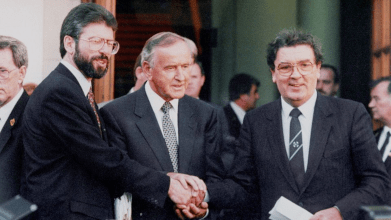
The Provisional Irish Republican Army (IRA) announces a ceasefire on August 31, 1994, after a quarter century of what it calls its “armed struggle” to get the British out of Northern Ireland. The statement comes just after 11:00 a.m. BST and says there will be a “complete cessation of military operations” from midnight and that the organisation is willing to enter into inclusive talks on the political future of the Province.

The statement raises hopes for peace and an end to 25 years of bombing and shooting that led to the deaths of more than 3,000 people. There is scepticism from the loyalist community and celebration in the Catholic areas of Belfast and Derry.

The Irish Minister for Foreign Affairs, Dick Spring, says the statement is historic and meets his government’s demand for an unconditional end to IRA violence. The Irish Taoiseach (Prime Minister), Albert Reynolds, calls on loyalist paramilitaries to follow suit.

But loyalists are suspicious of the declaration and fear it may lead to a sell-out in which Northern Ireland’s position within the United Kingdom is under threat. The Ulster Unionist Party (UUP) MP James Molyneaux says no moves towards talks should begin until the IRA has added the word “permanent” to the ceasefire declaration.

The announcement comes 18 months after secret talks began between the British Government and Irish republicans. It leads to the Anglo-Irish Downing Street Declaration in December 1993 which states that any change in the partition of Ireland can only come with the consent of those living north of the border. It also challenges republicans to renounce violence.

Social Democratic and Labour Party (SDLP) leader John Hume MP, who has been negotiating with Sinn Féin leader Gerry Adams, is “very pleased.” However, British Prime Minister John Major is cautious in his reaction to the IRA announcement. “We are beyond the beginning,” he says, “but we are not yet in sight of the end.”

Ian Paisley, leader of the hardline Democratic Unionist Party (DUP), rejects the wording of the declaration and says it is an “insult to the people [the IRA] has slaughtered because there was no expression of regret.”

Seven weeks later, on October 13, the loyalist terrorist groups announce their own ceasefire. On December 9, British officials meet Sinn Féin representatives for their first formal talks in 22 years.

The IRA ceasefire ends on February 9, 1996, when it plants a huge bomb in the London Docklands. It kills two, injures more than 100 and causes more than £85m of damage.

A new ceasefire is finally announced in July 1997.

(Pictured: (L to R) Sinn Féin President Gerry Adams, Taoiseach Albert Reynolds and Social Democratic and Labour Party leader John Hume)


Leave a comment

Birth of Poet Francis Edward Ledwidge

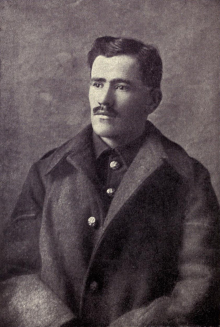
Francis Edward Ledwidge, Irish poet sometimes known as the “poet of the blackbirds,” is born on August 19, 1887, to a poor family in Slane, County Meath. He is later also known as a World War I war poet.

Ledwidge starts writing at an early age and is first published in a local newspaper at the age of fourteen. Finding work as a labourer and miner, he is also a trade union activist and a keen patriot and nationalist, associated with Sinn Féin. He becomes friendly with a local landowner, the writer Lord Dunsany, who gives him a workspace in the library of Dunsany Castle and introduces him to literary figures including William Butler Yeats and Katharine Tynan, with whom he has a long-term correspondence. He is elected to a local authority post and helps organise the local branch of the Irish Volunteers, while Dunsany edits and helps him secure publication for a first volume of his poetry.

Having sided with the faction of the Irish Volunteers which oppose participation in the war, he enlists in the Royal Inniskilling Fusiliers in October 1914, and continues to write poetry on assignment, sending work to Lord Dunsany and to family and other friends. The poems he writes on active service reveal his pride at being a soldier, as he believes, in the service of Ireland. He often wonders whether he would find a soldier’s death.

On July 31, 1917, a group from Ledwidge’s battalion of the Royal Inniskilling Fusiliers are road-laying in preparation for an assault during the Third Battle of Ypres, near the village of Boezinge, Ypres Salient, Belgium.

According to Irish author and lecturer Alice Curtayne, “Ledwidge and his comrades had been toiling since the early morning at roadmaking. The army’s first need was men; their second, guns; their third roads. These latter consisted mainly of heavy beech planks bolted together, which could be rapidly laid down. No advance could be supported in that sodden land without a sufficiency of these communications tracks, six or seven feet wide. Supplies were conveyed by pack mules over the wooden paths. Survivors concur in placing the road work done by B Company that day one mile northeast of Hellfire Corner, so called because it was very exposed to German shelling. There was a violent rainstorm in the afternoon, shrouding the region in a gray monochrome. Sullenly, the enemy’s long-range guns continued to fling their shells far behind the lines. Roadwork could not be suspended, however, as the tracks were in use as fast as they were laid down. Tea was issued to the men and drenched to the skin, they stopped to swallow it. A shell exploded beside Ledwidge, and he was instantly killed.”

A Roman Catholic military chaplain, Father Devas, is the first on the scene. That night, Father Devas writes in his diary, “Crowds at Holy Communion. Arranged for service but washed out by rain and fatigues. Walk in rain with dogs. Ledwidge killed, blown to bits, at Confession yesterday and Mass and Holy Communion this morning. R.I.P.”

Ledwidge is first buried at Carrefour de Rose, and later re-interred in the nearby Artillery Wood Military Cemetery, at Boezinge, where the Welsh poet Hedd Wyn, who was killed in action on the same day, also lies buried.

Dunsany arranges for the publication of more of Ledwidge’s poems, and a collected edition in 1919. Further poems, from the archives at Dunsany Castle and some material held by family, are later published by Ledwdige’s biographer, Alice Curtayne, and by one of the Ledwidge memorial societies. Ledwidge is selected as one of twelve prominent war poets for the exhibition Anthem for Doomed Youth at the Imperial War Museum in London in 2002, and memorialised at an event in Inchicore, Dublin, in 2017, with his work set to music by Anúna. A museum of his life and work is opened in his birthplace cottage in 1982. Some of his manuscripts are held in the National Library of Ireland and more in the archives of Dunsany Castle.


Leave a comment

The Convening of the Second Dáil

The Second Dáil (Irish: An Dara Dáil) is Dáil Éireann as it convenes on August 16, 1921, following the dissolution of the First Dáil. The Second Dáil runs until June 8, 1922.

From 1919 to 1922, Dáil Éireann is the revolutionary parliament of the self-proclaimed Irish Republic. The Second Dáil consists of members elected at the 1921 Irish elections, but with only members of Sinn Féin taking their seats. On January 7, 1922, it ratifies the Anglo-Irish Treaty by 64 votes to 57 which ends the Irish War of Independence and leads to the establishment of the Irish Free State on December 6, 1922.

Since 1919, those elected for Sinn Féin at the 1918 Irish general election had abstained from the House of Commons and established Dáil Éireann as a parliament of a self-declared Irish Republic, with members calling themselves Teachtaí Dála or TDs. In December 1920, in the middle of the Irish War of Independence, the British Government passes the Government of Ireland Act 1920, which enacts partition by establishing two home rule parliaments in separate parts of Ireland. These provisions arise out of discussions held at the Irish Convention held in 1917, from which Sinn Féin abstains. In May 1921 the first elections to the House of Commons of Northern Ireland and the House of Commons of Southern Ireland are held, by means of the single transferable vote. On May 10, 1921, the Dáil passes a resolution that the elections scheduled to take place later in the month in both parts of the country will be “regarded as elections to Dáil Éireann.”

In the elections for Southern Ireland, all seats are uncontested, with Sinn Féin winning 124 of the 128 seats, and Independent Unionists winning the four seats representing the Dublin University. In the 1921 Northern Ireland general election, the Ulster Unionist Party (UUP) wins 40 of the 52 seats, with Sinn Féin and the Nationalist Party winning 6 seats each. Of the six seats won by Sinn Féin in Northern Ireland, five are held by people who had also won seats in Southern Ireland.

The Second Dáil responds favourably to the proposal from King George V on June 22, 1921, for a truce, which becomes effective from noon on July 11, 1921. This is upheld by nearly all of the combatants while the months-long process of arranging a treaty gets under way. The Truce allows the Dáil to meet openly without fear of arrest for the first time since September 1919, when it had been banned and driven underground.

During the Second Dáil the Irish Republic and the British Government of David Lloyd George agree to hold peace negotiations. As President of Dáil Éireann, Éamon de Valera is the highest official in the Republic at this time but is notionally only the head of government. In August 1921, to strengthen his status in the negotiations, the Dáil amends the Dáil Constitution to grant him the title President of the Republic, and he thereby becomes head of state.

On September 14, 1921, the Dáil ratifies the appointment of Arthur Griffith, Michael Collins, Robert Barton, Eamonn Duggan and George Gavan Duffy as envoys plenipotentiary for the peace conference in England. These envoys eventually sign the Anglo-Irish Treaty on December 6. The debate on the Treaty starts on December 14 and continues until January 7, 1922. On that date, the Dáil approves the treaty by 64 in favour to 57 against. As the leader of the anti-Treaty minority, de Valera resigns as President. He allows himself to be nominated again but is defeated on a vote of 60–58. He is succeeded as president by Arthur Griffith. The anti-Treaty deputies continue to attend the Dáil, with de Valera becoming the first Leader of the Opposition in the Dáil.

The ratification specified by the Treaty is by “a meeting summoned for the purpose of the members elected to sit in the House of Commons of Southern Ireland.” The Dáil vote does not fulfil this because four unionists are absent and one Northern Ireland member is present. The requisite approval comes at a separate meeting on January 14, 1922, attended by the unionists and boycotted by anti-Treaty TDs. The meeting also approves a Provisional Government led by Collins, which runs in parallel to Griffith’s Dáil government and with overlapping membership. The Government of Ireland Act 1920 requires the Commons to be summoned by the Lord Lieutenant and its members to take an oath of allegiance to the king, whereas the meeting on January 14 is summoned by Griffith and the members present do not take an oath.

Under the terms of the Treaty, a Constituent Assembly is to be elected to draft a Constitution for the Irish Free State to take effect by December 6, 1922. The assembly is also to serve as a “Provisional Parliament” to hold the Provisional Government responsible. This election is held on June 16, 1922, pursuant to both a resolution by the Second Dáil on May 20 and a proclamation by the Provisional Government on 27 May 27.

The Third Dáil is elected at the general election held on June 16, 1922. This election is required to be held under the Anglo-Irish Treaty signed on December 6, 1921.

(Pictured: Some members of the Second Dáil at the Grosvenor Hotel in London, seated (L to R) Éamon de Valera and Arthur Griffith, National Library of Ireland, NPA-RPH-10)


Leave a comment

Death of Robert Barton, Nationalist & Anglo-Irish Politician

Robert Childers Barton, Anglo-Irish politician, Irish nationalist and farmer who participates in the negotiations leading up to the signature of the Anglo-Irish Treaty, dies in Annamoe, County Wicklow, on August 10, 1975. His father is Charles William Barton, and his mother is Agnes Alexandra Frances Childers. His wife is Rachel Warren of Boston, daughter of Fiske Warren. His double first cousin and close friend is the English-born Irish writer Erskine Childers.

Barton is born in Annamoe on March 14, 1881, into a wealthy Irish Protestant land-owning family, namely of Glendalough House. His two younger brothers, Erskine and Thomas, die while serving in the British Army during World War I. He is educated in England at Rugby School and the University of Oxford and becomes an officer in the Royal Dublin Fusiliers on the outbreak of World War I. He is stationed in Dublin during the 1916 Easter Rising and comes into contact with many of its imprisoned leaders in the aftermath while on duty at Richmond Barracks. He resigns his commission in protest at the heavy-handed British government suppression of the revolt. He then joins the Irish Republican Brotherhood (IRB).

At the 1918 Irish general election to the British House of Commons, Barton is elected as the Sinn Féin member for West Wicklow. In common with all Sinn Féin members, he boycotts the Westminster parliament and sits instead in Dáil Éireann (the First Dáil). Arrested in February 1919 for sedition, he escapes from Mountjoy Prison on Saint Patrick’s Day, leaving a note to the governor explaining that, owing to the discomfort of his cell, he felt compelled to leave, and requests the governor to keep his luggage until he sends for it. He is appointed as Director of Agriculture in the Dáil Ministry in April 1919. He is recaptured in January 1920 and sentenced to three years’ imprisonment but is released under the general amnesty of July 1921.

In May of that year, prior to his release, Barton is elected as a Sinn Féin member for Kildare–Wicklow in the 1921 Irish election to the House of Commons of Southern Ireland. Once again, all Sinn Féin members boycott this parliament, sitting as the Second Dáil. In August 1921, he is appointed to cabinet as Secretary for Economic Affairs.

Barton is one of the Irish plenipotentiaries to travel to London for the Anglo-Irish Treaty negotiations. His cousin is a secretary to the delegation. He reluctantly signs the Treaty on December 6, 1921, defending it “as the lesser of two outrages forced upon me and between which I had to choose.”

Although he had signed the Treaty and voted for it in the Dáil, Barton stands in the 1922 Irish general election for Anti-Treaty Sinn Féin, the only TD who had voted for the Treaty to do so and wins a seat in the Third Dáil. In common with other Anti-Treaty TDs, he does not take his seat. In October 1922 he is appointed Minister for Economic Affairs in Éamon de Valera‘s “Emergency Government,” a shadow government in opposition to the Provisional Government and the later Executive Council of the Irish Free State. His memoir of this period is completed in 1954 and can be seen on the Bureau of Military History website. He is arrested and interned for most of the war at the Curragh Camp.

Barton is defeated at the 1923 Irish general election and retires from politics for the law, practicing as a barrister. He later becomes a judge. He is chairman of the Agricultural Credit Corporation from 1934 to 1954. He dies at home in County Wicklow on August 10, 1975, at the age of 94, the last surviving signatory of the Anglo-Irish Treaty. Éamon de Valera dies only nineteen days later, on August 29, 1975.

Glendalough House, run by Barton for over 70 years right up until his death, is still considered one of Ireland’s most notable properties, alongside nearby Powerscourt Estate. The house is the center of numerous political meetings and gatherings from 1910 to 1922. It has also been featured as a location in many large Hollywood films including Excalibur, Saving Private Ryan and Braveheart.


Leave a comment

Loyalists Protest Sinn Féin Minister’s Refusal to Fly Union Flag

On Friday, August 4, 2000, Loyalists protest after Northern Ireland health minister Bairbre de Brún, a member of Sinn Féin, refuses to fly the Union flag outside her Belfast offices to mark the 100th birthday of Britain’s Queen Mother. First Minister David Trimble had written to the Northern Ireland secretary requesting that the Union Flag should be flown on all government buildings.

About 20 people take part in the picket organised by the loyalist Progressive Unionist Party (PUP) as the minister leaves the Department of Health offices on Friday morning.

In Bangor, County Down, a group of loyalist protesters put up a Union Flag outside the offices of Sinn Féin education minister Martin McGuinness at his department’s Rathgael House headquarters. Another group of PUP protesters demonstrate at government buildings in Adelaide Street in Belfast city centre, where the Union Flag is flying above two of the government buildings in the street.

Protestors hold up posters showing the faces of de Brun and McGuinness printed on a Union Flag. The posters also show the face of the nationalist Social Democratic and Labour Party (SDLP) agriculture minister Bríd Rodgers.

The PUP’s Billy Hutchinson criticises Sinn Féin ministers over their refusal to fly the Union Flag. “These people cannot even recognise that we have a monarch who’s 100 years old and they can’t even fly the flag, just because they think that everything that is British is no good,” he says. “These people forget that they have lived in Britain all their lives, most of them. They weren’t even born at Partition (of Ireland).” He adds that Sinn Féin’s ministers should accept that they are “British ministers in a British state.”

However, Sinn Féin’s Alex Maskey condemns the protests as “intimidating and sectarian.” He says Sinn Féin’s position on the flying of flags is designed not to cause offence. “Where British cultural and political symbols are invoked in public life, equivalent Irish cultural and political symbols should be given equal prominence. Where this cannot be agreed, no such symbols should fly,” he says.

The issue of flags has been emotive and divisive in Northern Ireland. The Sinn Féin ministers anger unionists on May 2 by ordering their civil servants not to fly the flag as part of the Coronation Day celebrations. The row reaches a head when the anti-agreement Democratic Unionist Party (DUP) attempts to guarantee the flying of the Union Flag with an assembly motion in June. However, the party fails to win enough support for their motion to be passed.

There are about 13 days in the year when the Union Flag is flown on designated government offices in the United Kingdom. Government buildings across the UK – from Whitehall ministries to town council offices are expected to raise the Union Flag on these days.

It is the second time in a week that the health minister has run into controversy. On Wednesday, August 2, she is confronted by angry loyalist protesters during an official visit to a County Antrim hospital. Around 20 demonstrators picket the Lagan Valley Hospital in Lisburn, while she is on a visit to see a GP scheme as part of a programme to learn about aspects of the health service. The tyres on the minister’s car are let down and an egg is thrown. De Brun is forced to leave the complex by another door.

(From: “Trimble joins Union Flag row,” BBC News, news.bbc.co.uk, Friday, August 4, 2000 | Pictured: Protesters picket the Department of Health)


Leave a comment

First Assassination by “The Squad”

On July 30, 1919, the first assassination authorised by Michael Collins is carried out by The Squad, also known as the Twelve Apostles, when Detective Sergeant “the Dog” Smith is shot near Drumcondra, Dublin.

The Squad is an Irish Republican Army (IRA) unit founded by Collins to counter British intelligence efforts during the Irish War of Independence, mainly by means of assassination.

On April 10, 1919, the First Dáil announces a policy of ostracism of Royal Irish Constabulary (RIC) men. At the time Sinn Féin official policy is against acts of violence. Boycotting, persuasion and mild intimidation succeed against many officers. However, others escalate their activities against republicans and in March 1920 Collins asks Dick McKee to select a small group to form an assassination unit.

When The Squad is formed, it comes directly under the control of the Director of Intelligence or his deputy and under no other authority. The Squad is commanded by Mick McDonnell.

The original “Twelve Apostles” are Mick McDonnell, Tom Keogh, Jimmy Slattery, Paddy Daly, Joe Leonard, Ben Barrett, Vincent Byrne, Sean Doyle, Paddy Griffin, Eddie Byrne, Mick Reilly and Jimmy Conroy. After some time, The Squad is strengthened with members Ben Byrne, Frank Bolster, Mick Keogh, Mick Kennedy, Bill Stapleton and Sam Robinson. Owen Cullen, a member of 2nd Battalion, is driver for a short time, and Paddy Kelly of County Clare for a short time. They are employed full-time and received a weekly wage.

Sometimes, as occasion demands, The Squad is strengthened by members of the IRA Intelligence Staff, the Active Service Unit, munition workers and members of the Dublin Brigade, Tipperary Flying Column men, Dan Breen, Séumas Robinson, Seán Treacy and Seán Hogan, and also Mick Brennan and Michael Prendergast of County Clare. The IRA Intelligence Staff consists of the Director of Intelligence Michael Collins, the Deputy Director of Intelligence Liam Tobin, the Second Deputy Director of Intelligence Tom Cullen, the Third Director of Intelligence Frank Thornton, and members Joe Dolan, Frank Saurin, Ned Kelleher, Joe Guilfoyle, Paddy Caldwell, Paddy Kennedy, Charlie Dalton, Dan McDonnell and Charlie Byrne. The munitions workers include Mat Furlong, Sean Sullivan, Gay McGrath, Martin O’ Kelly, Tom Younge and Chris Reilly.

Other members include Mick Love, Gearoid O’Sullivan, Patrick Caldwell, Charlie Dalton, Mick O’Reilly, Sean Healy, James Ronan, Paddy Lawson, John Dunne, Johnny Wilson and James Heery. Seán Lemass and Stephen Behan, the father of Irish writers Brendan and Dominic Behan, have also been listed as members of the Apostles. There is no hard evidence to support the inclusion of many of the names, but those who subsequently serve in the Irish Army have their active service recorded in their service records held in the Military Archives Department in Cathal Brugha Barracks, Rathmines. Andrew Cooney is also reported to have been associated with The Squad. Stephen Behan’s involvement is first made public in 1962, when the BBC broadcasts an episode of This Is Your Life dedicated to Behan. During the broadcast, remaining members of the squad joined Behan on the set of the show.

Following “The Dog” Smith’s assassination, The Squad continues to target plainclothes police, members of the G Division of the Dublin Metropolitan Police, and, occasionally, problematic civil servants. Organisationally it operates as a subsection of Collins’ Intelligence Headquarters. Two of the executions by The Squad are the killing on January 21, 1920, of RIC Inspector William Redmond of the DMP “G” Division and on March 2, 1920, a British double agent John Charles Byrnes.

One of the Apostles’ particular targets is the Cairo Gang, a deep-cover British intelligence group, so called since it has either been largely assembled from intelligence officers serving in Cairo or from the Dublin restaurant called The Cairo, which the gang frequents. Sir Henry Wilson brings in the Cairo Gang in the middle of 1920, explicitly to deal with Michael Collins and his organization. Given carte blanche in its operations by Wilson, the Cairo Gang adopts the strategy of assassinating members of Sinn Féin unconnected with the military struggle, assuming that this will cause the IRA to respond and bring its leaders into the open.

The most well-known operation executed by the Apostles occurs on what becomes known as Bloody Sunday, November 21, 1920, when British MI5 officers, linked to the Cairo Gang and significantly involved in spying, are shot at various locations in Dublin with fourteen killed and six wounded. In addition to the The Squad, a larger number of IRA personnel are involved in this operation. The only IRA man captured during the operation is Frank Teeling. In response to the killings, the Black and Tans retaliate by shooting up a Gaelic football match between Dublin and Tipperary at Croke Park, the proceeds from which are for the Irish Republican Prisoners Fund. Fourteen civilians are killed including one of the players, Michael Hogan, and 68 are wounded. The Hogan stand at Croke Park is named after Hogan.

The elimination of the Cairo Gang is seen in Dublin as an intelligence victory, but British Prime Minister David Lloyd George comments dismissively that his men “… got what they deserved, beaten by counterjumpers…”. Winston Churchill adds that they were “.. careless fellows … who ought to have taken precautions.”

Some members of The Squad are hanged in 1921 for the killings on Bloody Sunday, including Thomas Whelan and Patrick Moran. Moran had killed a vet, Patrick MacCormack, who seems to have been an innocent victim.

In May 1921, after the IRA’s Dublin Brigade takes heavy casualties during the burning of the Custom House, The Squad and the Brigade’s Active Service Unit are amalgamated into the Dublin Guard, under Paddy Daly. Under the influence of Daly and Michael Collins, most of the Guard take the Free State side and join the National Army in the Irish Civil War of 1922–23. During this conflict some of them are attached to the Criminal Investigation Department and are accused of multiple assassinations of Anti-Treaty fighters. They are also involved in several atrocities against Republican prisoners, particularly after the death of Collins, due to many of them having personal ties with him.

Bill Stapleton goes on to become a director in Bord na Móna, Charles Dalton and Frank Saurin become directors in the Irish Sweepstakes. In October 1923, Commandant James Conroy is implicated in the murder of two Jewish men, Bernard Goldberg and Emmanuel ‘Ernest’ Kahn. He avoids arrest by fleeing to Mexico, returning later to join the Blueshirts. A later application for an army pension is rejected. The killings are the subject of a 2010 investigative documentary by RTÉ, CSÍ: Murder in Little Jerusalem.


Leave a comment

Éamon de Valera Visits Butte, Montana During His American Tour

President Éamon de Valera visits Butte, Montana, on July 25, 1919, during his American Tour of 1919-20. Montana Lieutenant Governor W. W. McDowell meets his train and rides with de Valera through the streets to where de Valera then addresses over 10,000 people who have come out to hear him. The next day, de Valera addresses a joint session of the Montana State Legislature.

De Valera’s eventful 1919 begins in Lincoln Jail and ends in New York City’s Waldorf Astoria, the largest and most luxurious hotel in the world. Smuggled aboard the SS Lapland in Liverpool in June, he sails for the United States during the closing stages of the Paris Peace Conference. As London’s Sunday Express complains in August 1919, “there is more Irish blood in America than in Ireland,” making the United States the obvious destination for a sustained propaganda and fundraising mission.

After his highly-publicised American debut at New York’s Waldorf Astoria, the self-styled “President of the Irish Republic” embarks on the first leg of what is to be an eighteen-month tour of the United States. The purpose of his mission is twofold: to gain formal recognition of the Irish Republic and to raise funds via a bond issue to support the independence movement and the newly established Dáil Éireann.

Between July and August 1919, de Valera and his entourage travel over 6,000 miles from New York to San Francisco, addressing enormous crowds at dozens of venues. He fills Madison Square Garden to capacity and receives a thirty-minute standing ovation from 25,000 people in Chicago’s Wrigley Field. Twice as many people fill Boston’s Fenway Park on June 29, cheering the arrival of the “Irish Lincoln.” The Sinn Féin envoys also visit less obvious Irish communities of the period, such as Scranton, Savannah, New Orleans and Kansas City. For de Valera’s personal secretary, Seán Nunan, the public meeting in Butte, Montana is like “an election meeting at home – there were so many first-generation Irishmen working on the mines – mainly from around Allihies in West Cork.” In San Francisco de Valera dedicates a statue of Robert Emmet by Irish-born sculptor Jerome Connor in Golden Gate Park, a replica of which stands sentinel in St. Stephen’s Green in Dublin. This is one of many symbolic gestures linking the American and Irish struggles for independence played out before the flashing bulbs of the ubiquitous press photographers. On August 15, The Cork Examiner notes that the enthusiastic American exchanges “indicate that few public missionaries from other lands – possibly only Mr. Parnell – have ever had such receptions as were accorded to the Sinn Féin leader.”

De Valera’s team deserves credit for the incredible logistical triumph that is the U.S. tour. As chief organiser, Liam Mellows travels ahead to each city, ensuring a suitable reception is prepared and a venue secured for a mass meeting. Seán Nunan is de Valera’s fastidious personal secretary and Harry Boland, Sinn Féin TD for South Roscommon and Irish Republican Brotherhood (IRB) envoy, is at his side troubleshooting, speechmaking and shaking hands. As the tour progresses, de Valera’s supporting cast expands to include Kerry-born Kathleen O’Connell who becomes de Valera’s full-time personal secretary from 1919.

The next stage of de Valera’s American odyssey begins on October 1, 1919, in Philadelphia, a city with a rich Irish heritage and rife with symbolism of America’s struggle for independence. Over the next three weeks, de Valera and his team travel from the Atlantic to the Pacific seaboard and back again, delivering seventeen major public speeches and a host of smaller ones to aggregate crowds of over half a million.

The pace is relentless as the Irish team makes its way through middle America. De Valera is received as a visiting dignitary at multiple state legislatures and presented with honorary degrees from six American universities. In line with his secondary objective to foster the interest of “wealthy men of the race in the industrial development of Ireland,” he addresses the Chambers of Commerce in a number of cities and arranges a personal meeting with Henry Ford, the son of an Irish emigrant, during his visit to Detroit in October. In the same month in Wisconsin, he is made a Chief of the Chippewa Nation, an honour he later says meant more to him than all the freedoms of all the cites he was ever given. It is not surprising that by the time they reach Denver on October 30, The Irish World reports that “the President looked tired.” Still, he musters the energy to make high profile visits to Portland, Los Angeles and San Diego before beginning the return journey to New York at the end of November.

After a short break for Christmas, the Irish team prepares for the launch of the Bond Certificate Drive. A week-long frenzy of publicity kicks off on January 17 at New York City Hall where Mayor John F. Hylan presents de Valera with the Freedom of the City. During the spring of 1920, de Valera addresses the Maryland General Assembly at Annapolis before making the swing through the southern states of America.

It is not all plain sailing for the Sinn Féin representatives in America. The tour of the west coast in late 1919 sees increasing tensions with American patriotic bodies who are critical of de Valera’s perceived pro-German stance during World War I. He is heckled during a speech in Seattle and a tricolour is ripped from his car in Portland by members of the American Legion. The trip through the southern states in the spring of 1920 coincides with rising American anti-immigration and anti-Catholic nativism. A small number of counter demonstrations are organised by right-wing Americans. Most notably, members of the Ku Klux Klan make unwelcome appearances at several rallies in the American south, making clear their opposition to de Valera’s presence.

The Irish envoys also contend with antagonism from the leaders of Friends of Irish Freedom (FOIF), the broad-based popular front of Clan na Gael headed by veteran Fenian John Devoy and Judge Daniel Cohalan. The FOIF uses its significant resources to finance de Valera’s tour and facilitate the Bond Certificate Drive, but behind the scenes there are significant personality clashes and tensions over tactics.

The increasingly public dispute comes to a head in a row over strategies at the Republican National Convention in Chicago in June 1920. Drawing on his influential political contacts, Cohalan persuades the Republican Party to include Irish self-determination in their election platform. However, much to Cohalan’s fury, de Valera leads a separate delegation to the Convention and insists on a resolution calling for recognition of the Irish Republic. The result is that two resolutions are submitted to the Platform Committee, which indicates dissension in the Irish ranks and gives the Committee the excuse to include neither in the final platform. After de Valera also fails to secure the endorsement of the Democratic convention in San Francisco in June, it is clear that the Irish question will not be a significant factor in the ensuing presidential election. Relations between the FOIF and de Valera reach a new low. In November 1920, de Valera makes the final break with the FOIF and sets up a new organisation, the American Association for the Recognition of the Irish Republic.

De Valera is in Washington, D.C. on October 25 when Terence MacSwiney dies after 74 days on hunger strike. Six days later, at the last great meeting of the American tour, 40,000 people fill New York’s Polo Grounds to commemorate MacSwiney’s death. By late November, de Valera knows that it is time to return to Ireland. Smuggled aboard SS Celtic in New York harbour on December 10, he prepares for the nine-day journey home. He had failed to obtain the recognition of the United States Government for the Republic, but his cross-continental tour and associated press coverage raised international awareness and over $5 million for the Irish cause.

(From: An article by Helene O’Keeffe that was first published in the Irish Examiner on March 24, 2020 | Photo: Eamon de Valera, center, president of the Provisional Government of the Irish Republic, in Butte, Montana, in 1919 to encourage support for Ireland’s fight for independence. Courtesy of Butte-Silver Bow Public Archives)


Leave a comment

Death of Joe Cahill, Former Chief of Staff of the Provisional IRA

Joe Cahill, a prominent figure in the Irish Republican movement in Northern Ireland and former Chief of Staff of the Provisional Irish Republican Army (IRA), dies in Belfast on July 23, 2004.

Cahill is born in Belfast on May 19, 1920. He is educated at St. Mary’s Christian Brothers’ Grammar School. At age 14 he leaves school to assist in his father’s print shop. Soon after, he joins the Catholic Young Men’s Society, which campaigns on social issues with a focus on eradicating moneylenders from working-class areas of Belfast, as they often charge usurious interest rates. At the age of seventeen, he joins Na Fianna Éireann, a republican-orientated Scouting movement. Na Fianna Eireann is regarded as the “Junior Irish Republican Army.”

Cahill joins the local Clonard-based ‘C’ Company of the Belfast Brigade of the Irish Republican Army in 1938. Four years later, during an anniversary march by the IRA for the Easter Rising, he gets into a shootout with five other IRA men against four Royal Ulster Constabulary (RUC) officers. Several men are wounded, and Constable Patrick Murphy is killed. Cahill and four of the other men spend time in prison in Belfast. The IRA declares a formal ceasefire in 1945. Afterwards, republican prisoners begin to be released. Cahill is released in October 1949.

The IRA launches a new campaign in 1956. The IRA border campaign attacks ten targets in six counties, damaging bridges, courthouses and border roads. By 1957, three RUC officers and seven republicans have been killed during the campaign. Cahill is arrested and interned in January 1957 with several other republicans. He is released from internment in April 1961. Following his release from prison, he is disappointed at the direction of the IRA and resigns from the organisation around 1962.

In 1969, Cahill is a key figure in the founding of the Provisional Irish Republican Army. During his time in the Provisional IRA, he helps import weapons and raise financial support. He serves as the Chief of Staff in 1972 but is arrested the following year when a ship importing weapons is intercepted.

After his release, Cahill continues to serve on the IRA Army Council and leads all financial dealings for Sinn Féin. In the 1990s, the IRA and Sinn Féin begin to work on seeking peace. Cahill serves on the council that calls a cessation on July 21, 1996. He attends several of the talks that finally lead to the Good Friday Agreement on April 10, 1998. Shortly after the agreement is made, he resigns as treasurer of Sinn Féin. To honour his service, he is made honorary Sinn Féin Vice-President for life. He serves the Republican movement in Ireland all his life, as one of the longest-serving political activists in Ireland of any political party.

Cahill dies at age 84 in Belfast on July 23, 2004. He had been diagnosed with asbestosis, which he probably developed while working at the Harland & Wolff shipyards in his twenties. He and several other former shipyard workers later sue the company for their exposure to the dangerous substances but only win minimal compensation.


Leave a comment

Reverend Ian Paisley Elected MP for North Antrim

After having been in prison for unlawful assembly and breach of the peace, the “anti-popery” Reverend Ian Richard Kyle Paisley, loyalist politician and Protestant religious leader from Northern Ireland, is elected to Westminster on July 18, 1970, as an MP for North Antrim.

Paisley is born on April 6, 1926, in Armagh, County Armagh. He becomes a Protestant evangelical minister in 1946 and remains one for the rest of his life. In 1951, he co-founds the fundamentalist Free Presbyterian Church of Ulster and is its leader until 2008. He becomes known for his fiery speeches and regularly preaches and protests against Catholicism, ecumenism and homosexuality. He gains a large group of followers who are referred to as “Paisleyites.”

Paisley becomes involved in Ulster unionist/loyalist politics in the late 1950s. In the mid-late 1960s he leads and instigates loyalist opposition to the Catholic civil rights movement in Northern Ireland. This leads to the outbreak of the Troubles in the late 1960s, a conflict that engulfs Northern Ireland for the next thirty years. In 1970, he becomes Member of Parliament for North Antrim and the following year he founds the Democratic Unionist Party (DUP), which he leads for almost forty years. In 1979, he becomes a Member of the European Parliament.

Throughout the Troubles, Paisley is seen as a firebrand and the face of hard-line unionism. He opposes all attempts to resolve the conflict through power-sharing between unionists and Irish nationalists/republicans, and all attempts to involve the Republic of Ireland in Northern affairs. His efforts help bring down the Sunningdale Agreement of 1974. He also opposes the Anglo-Irish Agreement of 1985, with less success. His attempts to create a paramilitary movement culminate in Ulster Resistance. He and his party also oppose the Northern Ireland peace process and Good Friday Agreement of 1998.

In 2005, Paisley’s DUP becomes the largest unionist party in Northern Ireland, displacing the Ulster Unionist Party (UUP), which has dominated unionist politics since 1905. In 2007, following the St. Andrews Agreement, the DUP finally agrees to share power with republican party Sinn Féin and consent to all-Ireland governance in certain matters. He and Sinn Féin’s Martin McGuinness become First Minister and deputy First Minister respectively in May 2007. He steps down as First Minister and DUP leader in May 2008 and leaves politics in 2011. He is made a life peer in 2010 as Baron Bannside.

In November 2011, Paisley announces to his congregation that he is retiring as a minister. He delivers his final sermon to a packed attendance at the Martyrs’ Memorial Hall on December 18, 2011, and finally retires from his religious ministry on January 27, 2012.

Paisley dies in Belfast on September 12, 2014. He is buried in Ballygowan, County Down on September 15 following a private funeral and a public memorial for 800 invited guests is held in the Ulster Hall on October 19. An obituary in The New York Times reports that late in life Paisley had moderated and softened his stances against Roman Catholics but that “the legacies of fighting and religious hatreds remained.”