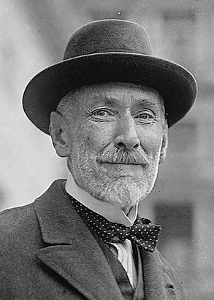
Threatened by lung trouble in 1879, Plunkett goes to the United States and spends ten years as a cattle rancher in the Bighorn Mountains of Wyoming. He returns to Ireland in 1889 and devotes himself to the agricultural cooperative movement, first organizing creameries and then, in 1894, the Irish Agricultural Organisation Society, a forerunner of similar societies in England, Wales, and Scotland. A moderate Unionist member of Parliament for South County Dublin from 1892 to 1900, he becomes vice president (1899–1907) of the new Department of Agriculture and Technical Instruction for Ireland, which he has been instrumental in creating.
Plunkett’s later experience convinces him of the need for the independence of an Ireland without partition inside the Commonwealth, and he fights strongly for this goal, as chairman of the Irish Convention (1917–18) and, in 1919, as founder of the Irish Dominion League and of the Plunkett Foundation for Cooperative Studies, an agricultural research and information centre. He is appointed to the first Senate of the Irish Free State (1922–23). His house in Dublin is bombed and burned during in the Irish Civil War and he lives in England thereafter. In 1924 the Plunkett Foundation also moves to England. In 1924 he presides over a conference in London on agricultural co-operation in the British Commonwealth and in 1925 he visits South Africa to help the movement there.
Hoban is an Irish Catholic raised on an estate belonging to the Earl of Desart in Cuffesgrange, near Callan, County Kilkenny. He works there as a wheelwright and carpenter until his early twenties, when he is given an “advanced student” place in the Dublin Society‘s Drawing School on Lower Grafton Street. He studies under Thomas Ivory. He excels in his studies and receives the prestigious Duke of Leinster‘s medal from the Dublin Society for drawings of “Brackets, Stairs, and Roofs” in 1780. Later, Hoban finds a position as an apprentice to Ivory, from 1779 to 1785.
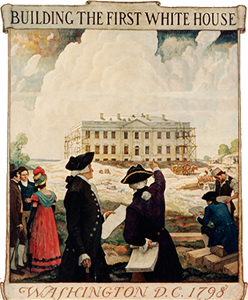
Hoban is in South Carolina by April 1787, where he designs numerous buildings including the Charleston County Courthouse. President George Washington admires Hoban’s work on his Southern Tour and summons the architect to Philadelphia, the temporary national capital, in June 1792.
In July 1792, Hoban is named winner of the design competition for the White House. His initial design seems to have had a 3-story facade, nine bays across, much like the Charleston courthouse. Under Washington’s influence, Hoban amends this to a 2-story facade, eleven bays across, and, at Washington’s insistence, the whole presidential mansion is faced with stone. It is unclear whether any of Hoban’s surviving drawings are actually from the competition.
In 1800, President John Adams becomes the first president to reside in the executive mansion, which soon becomes known as the “White House” because its white-gray Virginiafreestone contrasts strikingly with the red brick of nearby buildings.
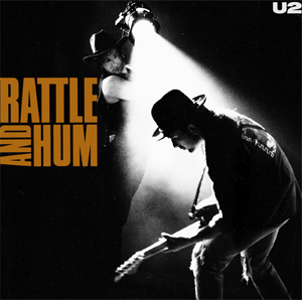
Although Rattle and Hum is intended to represent the band paying tribute to rock legends, some critics accuse U2 of trying to place themselves amongst the ranks of these artists. Critical reception to both the album and the film is mixed. One Rolling Stone editor speaks of the album’s “excitement”, another describes it as “misguided and bombastic.” The film grosses just $8.6 million, but the album is a commercial success, reaching number one in several countries and selling 14 million copies. Lead single “Desire” becomes the band’s first U.K. number-one song while reaching number three in the United States.
At the end of 1988, Rattle and Hum is voted the 21st-best album of the year in the Pazz & Jop, an annual poll of American critics published by The Village Voice. In other critics’ lists of the year’s top albums, it is ranked number one by HUMO, second by the Los Angeles Times and Hot Press, 17th by OOR, 23rd by New Musical Express (NME), and 47th by Sounds.
Lifetime sales for the album have surpassed 14 million copies.
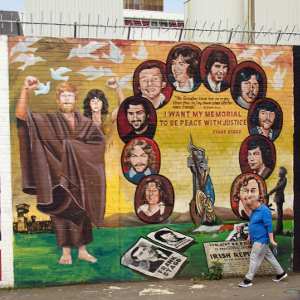
The Irish Republican Army (IRA) hunger strike is called off at Long Kesh prison – later known as HM Prison Maze – on October 3, 1981. While the IRA does not win immediate concessions, in some ways it is a Pyrrhic victory for Margaret Thatcher’s government. It galvanises support and membership for the IRA and generates huge sympathy for the strikers in the United States where fund-raising is a major priority. The death of the first hunger striker, Bobby Sands, creates a martyr and an iconic figure.
In January 1981, prison authorities begin to supply the prisoners with officially issued civilian clothing, whereas the prisoners demand the right to wear their own clothing. On February 4, the prisoners issue a statement saying that the British government has failed to resolve the crisis and declares their intention of a hunger strike. The hunger strike begins on March 1, when Bobby Sands, the IRA’s former officer commanding (OC) in the prison, refuses food. Unlike the first hunger strike the previous year, the prisoners join one at a time and at staggered intervals, which they believe would arouse maximum public support and exert maximum pressure on Prime Minister Margaret Thatcher.
The republican movement initially struggles to generate public support for the second hunger strike. The Sunday before Sands begins his strike, 3,500 people march through west Belfast. During the first hunger strike four months earlier, the marchers had numbered 10,000. Five days into the strike, Independent Republican MP for Fermanagh and South TyroneFrank Maguire dies, resulting in a by-election. There is debate among nationalists and republicans regarding who should contest the election. After negotiations they agree not to split the nationalist vote by contesting the election and Sands stands as an Anti H-Block candidate against Ulster Unionist Party candidate Harry West. Following a high-profile campaign, the election takes place on April 9, and Sands is elected to the British House of Commons with 30,492 votes to West’s 29,046.
Sands’ election victory raises hopes that a settlement can be negotiated, but Thatcher stands firm in refusing to give concessions to the hunger strikers. The world’s media descends on Belfast, and several intermediaries visit Sands in an attempt to negotiate an end to the hunger strike, including Síle de Valera, granddaughter of Éamon de Valera, Pope John Paul II‘s personal envoy John Magee, and European Commission of Human Rights officials. With Sands close to death, the government’s position remains unchanged.
On 5 May, Sands dies in the prison hospital on the 66th day of his hunger strike, prompting rioting in nationalist areas of Northern Ireland. More than 100,000 people line the route of his funeral, which is conducted with full IRA military honours. Margaret Thatcher shows no sympathy for his death.
In the two weeks following Sands’ death, hunger strikers Francis Hughes, Raymond McCreesh and Patsy O’Hara die. Following the deaths of Joe McDonnell and Martin Hurson, the families of some of the hunger strikers attend a meeting on July 28 with Catholic priest Father Denis Faul. The families express concern at the lack of a settlement to the priest, and a decision is made to meet with Gerry Adams later that day. The following day Adams holds a meeting with six of the hunger strikers to outline a proposed settlement on offer from the British government should the strike be brought to an end. The six men reject the settlement, believing that accepting anything less than the “Five Demands” would be a betrayal of the sacrifice made by Bobby Sands and the other hunger strikers who had died.
The hunger strike begins to break on July 31, when the mother of Paddy Quinn insists on medical intervention to save his life. The following day Kevin Lynch dies, followed by Kieran Doherty on August 2, Thomas McElwee on August 8 and Michael Devine on August 20. On September 6, the family of Laurence McKeown becomes the fourth family to intervene and asks for medical treatment to save his life, and Cahal Daly issues a statement calling on republican prisoners to end the hunger strike.
The strike is called off at 3:15 PM on October 3, 1981. Three days later, James Prior, the new Secretary of State for Northern Ireland, announces partial concessions to the prisoners including the right to wear their own clothes at all times. The only one of the “Five Demands” still outstanding is the right not to do prison work. Following sabotage by the prisoners and the Maze Prison escape in 1983, the prison workshops are closed, effectively granting all of the “Five Demands” but without any formal recognition of political status from the government.
(Pictured: A Belfast mural of the Long Kesh hunger strikers)
The statue of Charles Stewart Parnell on Sackville Street, now known as O’Connell Street, is unveiled in Dublin on October 1, 1911. It is one of the last sculptural initiatives in the city before independence.
On January 3, 1882 a resolution is passed by the Dublin City Council to grant the freedom of the city to Parnell. The plan for the Parnell monument is instigated by John Redmond, who succeeded Parnell as leader of the Irish Parliamentary Party, partly as a symbolic gesture to honour the “uncrowned king of Ireland” and to consolidate his aspiration to reunite the constitutionalists under his own leadership. The monument is funded through the efforts of a voluntary body, the Parnell Committee, founded in 1898. It is first proposed to place the monument on the site of the Thomas Moore statue, which would be moved to another location. The City Council refuses to grant this site and directs that the monument be erected on a site near the Rotunda Hospital, where it now stands.
Augustus Saint-Gaudens, an Irish-born sculptor and the most eminent in the art of public monuments in the United States, accepts the commission. It is however to prove a protracted project as the demand for Saint-Gaudens’ work in America is such that completion of the Parnell project is fraught with delays.
For the Parnell monument, Saint-Gaudens makes a scale replica of the buildings and square in Dublin and also a full scale model of the monument in wood in a field near his studio. In 1904 there is a disastrous fire in his studio and only the head of the statue is saved. The original concept is of an 8-foot high bronze figure placed by a bronze table and set against a 30-foot pyramid. However, as this form is already utilised in the Wellington Monumentobelisk in Phoenix Park, Saint-Gaudens and architect Henry Bacon propose a triangular shaft almost double the height of the original.
Saint-Gaudens finally presents Parnell in what he considers a noble and calm manner, depicted in an open frock coat, with one hand resting on a table and the other extended dramatically as if making a point at a parliamentary debate. The shaft of the monument is constructed in undecorated ashlar granite.
On October 1, 1911, the monument is unveiled to a large crowd, many of whom had been absent from the foundation stone ceremony, but there are also strikes and marches indicating the unrest to follow.
In June 1913, John Redmond, as Secretary to the Parnell Monument Committee, writes to the City Council requesting the council to take the Monument into their charge on behalf of the Citizens of Dublin. The Council agrees to this request and ever since then the Parnell Monument has been in the care of the Dublin Corporation.
The inscription on the monument reads:
To Charles Stewart Parnell
No Man has a right to fix the Boundary to the march of a nation No man has a right To say to his country Thus far shat thou Go and no further We have never Attempted to fix The ne-plus-ultra To the progress of Ireland’s nationhood And we never shall
At the base of the statue the Irish inscription reads:
Ashe is born in Lispole, County Kerry, on January 12, 1885. He enters De La Salle Training College, Waterford in 1905 and begins a teaching career as principal of Corduff National School, Lusk, County Dublin, in 1908.
Ashe plays a major part in the 1916 Easter Rising outside the capital city commanding the Fingal battalion of the Irish Volunteers. He is commandant of the 5th battalion of the Dublin brigade, a force of 60–70 men engaging British forces around north County Dublin during the rising. They are armed only with a few rounds, about a dozen service rifles, a dozen Mausers, and a dozen Martini carbines. Some of Ashe’s men are armed only with a shotgun against the well-equipped army regulars.
Ashe’s battalion wins a major victory in Ashbourne, County Meath, where they engage a much larger force. They capture a significant quantity of arms and up to twenty Royal Irish Constabulary (RIC) vehicles. Eleven RIC members, including County Inspector Alexander Gray, and two volunteers are killed during the 5-1/2-hour battle. Twenty-four hours after the rising collapses, Ashe’s battalion surrenders on the orders of Patrick Pearse. On May 8, 1916, Ashe and Éamon de Valera are court-martialled and sentenced to death. The sentences are commuted to penal servitude for life. Ashe is imprisoned in Frongoch internment camp and Lewes Prison in Lewes, East Sussex, England.
De Valera, Ashe, and Thomas Hunter lead a prisoner hunger strike on May 28, 1917. With accounts of prison mistreatment appearing in the Irish press and mounting protests in Ireland, Ashe and the remaining prisoners are freed on June 18, 1917, by David Lloyd George as part of a general amnesty.
Upon his release, Ashe returns to Ireland and begins a series of speaking engagements. In August 1917, he is arrested and charged with sedition for a speech that he makes in Ballinalee, County Longford, where Michael Collins is also speaking. He is detained at the Curragh but is then transferred to Mountjoy Prison in Dublin. He is convicted and sentenced to two years hard labour. Ashe and other prisoners, including Fionán Lynch and Austin Stack, demand prisoner of war status.
On September 20, 1917, Ashe again goes on hunger strike. He dies at Mater Misericordiae Hospital on September 25, 1917, after being force fed by prison authorities. At the inquest into his death, the jury condemns the staff at the prison for the “inhuman and dangerous operation performed on the prisoner, and other acts of unfeeling and barbaric conduct.” His body lies in state at Dublin City Hall and is buried in Glasnevin Cemetery in Dublin.
The Ashe Memorial Hall built in 1928, housing the Kerry County Museum, in Tralee is named after him while Nelson Street, also in Tralee, is renamed Ashe Street. Ashe is a relative of Catherine Ashe, the paternal grandmother of American actor Gregory Peck, who emigrates to the United States in the 19th century.
Raised in Cork, the only child of Minnie (née O’Connor) and Michael O’Donovan, O’Connor attends Saint Patrick’s School on Gardiner’s Hill and North Monastery CBS. His early life is marked by his father’s alcoholism, debt, and ill-treatment of his mother. His childhood is shaped in part by his mother, who supplies much of the family’s income by cleaning houses, because his father is unable to keep steady employment due to his drunkenness. He adores his mother and is bitterly resentful of his father. In his memoirs, he recalls his childhood as “those terrible years,” and admits that he has never been able to forgive his father for his abuse of himself and his mother. When his mother is seventy, O’Connor is horrified to learn from his own doctor that she has suffered for years from chronic appendicitis, which she has endured with great stoicism, as she has never had the time nor the money to see a doctor.
Following his release, O’Connor takes various positions including that of teacher of Irish, theatre director, and librarian. He begins to move in literary circles and is befriended by George William Russell (Æ), through whom he comes to know most of the well-known Irish writers of the day, including William Butler Yeats, Lennox Robinson, F. R. Higgins and Lady Gregory. In his memoirs, he pays tribute to both Yeats and Russell for the help and encouragement they gave him.
In 1935, O’Connor becomes a member of the board of directors of the Abbey Theatre in Dublin, founded by Yeats and other members of the Irish National Theatre Society. In 1937, he becomes managing director of the Abbey. Following Yeats’s death in 1939, O’Connor’s long-standing conflict with other board members comes to a head and he leaves the Abbey later that year. In 1950, he accepts invitations to teach in the United States, where many of his short stories have been published in The New Yorker and have won great acclaim. He spends much of the 1950s in the United States, although it is always his intention to return eventually to Ireland.
From the 1930s to the 1960s O’Connor is a prolific writer of short stories, poems, plays, and novellas. His work as an Irish teacher complements his plethora of translations into English of Irish poetry, including his initially banned translation of Brian Merriman‘s Cúirt an Mheán Oíche (The Midnight Court). Many of O’Connor’s writings are based on his own life experiences – notably his well-known The Man of the House in which he reveals childhood details concerning his early life in County Cork. The Sullivan family in this short story, like his own boyhood family, is lacking a proper father figure.
O’Connor’s early years are recounted in An Only Child, a memoir published in 1961 which has the immediacy of a precocious diary. He continues his autobiography through his time with the Abbey Theatre in Dublin in his book My Father’s Son, which is published posthumously in 1968. It contains valuable character sketches of many of the leading Irish literary figures of the 1930s, in particular Yeats and Æ.
Frank O’Connor has a stroke while teaching at Stanford University in 1961, and he later dies from a heart attack in Dublin on March 10, 1966. He is buried in Deans Grange Cemetery two days later.
McElroy is born on May 14, 1782, in Enniskillen, County Fermanagh, the younger of two sons. In the hopes of providing a better life for John and his brother Anthony, their father, a farmer, finances their travel to the United States. In 1803 the two young men board a ship leaving the port of Londonderry and arrive in Baltimore, Maryland, on August 26. McElroy eventually settles in Georgetown, Washington, D.C., and becomes a merchant.
In 1806, McElroy enters Georgetown College in Washington, D.C., the same year he enters the novitiate of the Society of Jesus as a lay brother. He eventually manages the finances of Georgetown College and in 1808 erects the tower building. He managed the school’s finances so well that through the period of economic hardship following the War of 1812, he is able to send several Jesuits to Rome to study.
McElroy is ordained in May 1817, after less than two years of preparation. As a new priest, he is assigned to Holy Trinity Catholic Church in Georgetown as an assistant pastor. In his short time at Trinity, he contributes to the growth of the congregation and enlarging of the church building. This is achieved by increasing the monthly subscription for congregation members from 12½ cents to $12.50 on July 3, 1819. The following day he travels to most of the congregation members’ homes and collects $2,000 in pledges. He immediately sets to work having the Church modified to include two lateral-wing chapels, which are first used on October 3, 1819.
On January 11, 1819, McElroy is granted United States citizenship. Also in 1819, McElroy starts a Sunday School for black children who are taught prayers and catechism simultaneously with spelling and reading, by volunteer members of the congregation. McElroy spends his remaining years in Georgetown teaching the lower grades.
In 1823, McElroy begins negotiations with the Sisters of Charity in Emmitsburg, Maryland, for the establishment of a school for girls in Frederick. In 1824, the St. John’s Benevolent Female Free School is founded by the Sisters of Charity of Saint Joseph at 200 East Second Street in Frederick. In 1825, McElroy sets to work replacing the pre-American Revolutionlog cabin that houses the school with a modern building large enough to also house an orphanage.
McElroy’s next task is to found an educational institution for boys. On August 7, 1828, the construction of St. John’s Literary Institute begins. The following year the construction is completed, and the school is opened, a school which is currently operating under the name of Saint John’s Catholic Prep.
In 1853, McElroy finds a property in the South End where the city jail once stood. After two years of negotiations the project falls through due to zoning issues. A new site is identified, and city officials endorse the sale. In 1858, Bishop Fitzpatrick and Father McElroy break ground for Boston College, and for the Church of the Immaculate Conception. Classes began in the fall of 1864 and continue at this location until 1913 when the college moves to its current location at Chestnut Hill. Initially Boston College offers a 7-year program including both high school and college. This joint program continues until 1927 when the high school is separately incorporated.
In 1868, McElroy retires to the Jesuit novitiate in Frederick, Maryland. He visits Georgetown for the final time in 1872 to celebrate his golden jubilee. His eyesight is failing and while moving through his home he falls, fracturing his femur, which eventually leads to his death. Father John McElroy dies September 12, 1877, at the Jesuit novitiate in Frederick, Maryland. For some years leading up to his death, he is regarded as the oldest priest in the United States and the oldest Jesuit in the world. He is buried in the Novitiate Cemetery. In 1903, the Jesuits withdraw from Frederick and the graves are moved from the Frederick Jesuit Novitiate Cemetery to St. John’s Cemetery.
Ireland is known for his progressive stance on education, immigration and relations between church and state, as well as his opposition to saloons and political corruption. He promotes the Americanization of Catholicism, especially in the furtherance of progressive social ideals. He is a leader of the modernizing element in the Roman Catholic Church during the Progressive Era. He creates or helps to create many religious and educational institutions in Minnesota. He is also remembered for his acrimonious relations with Eastern Catholics.
Ireland is appointed pastor at Saint Paul’s cathedral in 1867, a position which he holds until 1875. In 1875, he is made coadjutor bishop of St. Paul and in 1884 he becomes bishop ordinary. In 1888 he becomes archbishop with the elevation of his diocese and the erection of the ecclesiastical province of Saint Paul. Ireland retains this title for thirty years until his death in 1918. Before Ireland dies, he burns all of his personal papers.
Ireland is awarded an honorary doctorate (LL.D.) by Yale University in October 1901, during celebrations for the bicentenary of the university.
Ireland is personal friends with Presidents William McKinley and Theodore Roosevelt. At a time when most Irish Catholics are staunch Democrats, Ireland is known for being close to the Republican party. He opposes racial inequality and calls for “equal rights and equal privileges, political, civil, and social.” Ireland’s funeral is attended by eight archbishops, thirty bishops, twelve monsignors, seven hundred priests and two hundred seminarians.
A friend of James J. Hill, Archbishop Ireland has his portrait painted in 1895 by the Swiss-born American portrait painter Adolfo Müller-Ury almost certainly on Hill’s behalf, which is exhibited at M. Knoedler & Co., New York, January 1895 and again in 1897.
Parnell is the eighth child out of eleven and fourth daughter born to John Henry Parnell, a landowner and the grandson of the last Chancellor of the Exchequer of Ireland, and Delia Tudor Stewart Parnell, an Irish American and the daughter of Admiral Charles Stewart (1778–1869) of the United States Navy. Her mother hates British rule in Ireland, a view presented through her children’s works. She is an intelligent girl and before she is through her teen years, she has studied mathematics, chemistry, and astronomy, and she can speak and write fluently in almost all the major European languages. She also has talents in music and painting and drawing in oil and water colours. Her parents separate when she is young. Soon afterwards, in July 1859, her father dies at the age of forty-eight and she and her mother move to Dalkey. A year later they move to Dublin, and in 1865 they move to Paris where Fanny studies art and writes poetry. In 1874 they move to Bordentown, New Jersey in the United States.
Parnell is known as the Patriot Poet. She shows interest in Irish politics and much of her poetry is about Irish nationalism. While she is living in Dublin in 1864, she begins publishing her poetry under the pseudonym “Aleria” in The Irish People, the newspaper of the Fenian Brotherhood. Most of her later work is published in The Pilot in Boston, the best-known Irish newspaper in America during the nineteenth century. Two of her most widely published works are The Hovels of Ireland, a pamphlet, and Land League Songs, a collection of poems. Her best-known poem is “Hold the Harvest,” which Michael Davitt refers to as the “Marseillaise of the Irish peasant.”
Parnell’s brother, Charles, becomes active in the Irish National Land League, an organisation that fights for poor tenant farmers, in 1879 and she strongly supports him. She and her younger sister, Anna Parnell (1852–1911), co-found the Ladies’ Land League in 1880 to raise money in America for the Land League. In 1881 the Ladies’ Land League continues the work of the men in the Land League while they are being imprisoned by the British government. In Ireland Anna becomes the president of the Ladies’ Land League, and the women hold many protests and quickly become more radical than the men, to the resentment of the male leaders. Fanny stays in America and works to raise money for the organisation. Most of the Land League’s financial support comes from America because of the campaigning done by Fanny Parnell.




 seamus dubhghaill