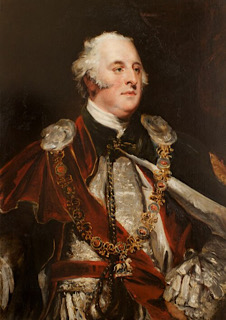
In 1786, Pratt’s father is created Earl Camden, at which point he becomes known by one of his father’s subsidiary titles as Viscount Bayham.
In 1793, Pratt is sworn of the Privy Council. In 1794 he succeeds his father as 2nd Earl Camden, and the following year he is appointed Lord Lieutenant of Ireland by Pitt.
Pratt resigns from office in June 1798, to be replaced with Charles Cornwallis, 1st Marquess Cornwallis, who oversees the military defeat of the rebellion. In 1804, Pratt becomes Secretary of State for War and the Colonies under Pitt, and in 1805 Lord President of the Council, an office he retains until 1806. He is again Lord President from 1807 to 1812, after which date he remains for some time in the cabinet without office. In 1812 he is created Earl of Brecknock and Marquess Camden.
The enforced resignation from the Cabinet of Robert Stewart, Viscount Castlereagh, the stepson of his sister Frances (Lady Londonderry), to whom he has always been personally close, in September 1809, leads to a series of bitter family quarrels, when it becomes clear that Pratt has known for months of the plan to dismiss Stewart, but has given him no warning. Stewart himself regards Pratt as “a weak friend,” not an enemy, and they are eventually reconciled. Other members of the Stewart family, however, never forgive Pratt for what they regard as his disloyalty.
Pratt marries Frances, daughter of William Molesworth, in 1785. She dies at Bayham Abbey, Sussex, in July 1829. He survives her by eleven years and dies at Seal, Kent, on October 8, 1840, aged 81. He is succeeded by his only son, George.
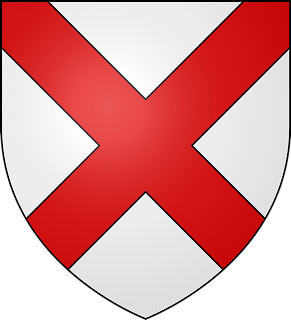
FitzMaurice is born in Wales in about 1150, the second-eldest son of Maurice FitzGerald, Lord of Llanstephan, by his wife, Alice (daughter of Arnulf de Montgomery). He has one sister, Nesta, who is named after their celebrated grandmother, Princess Nest ferch Rhys, and five brothers, including the eldest, William FitzMaurice, 1st Baron of Naas.
FitzMaurice’s father is the leader of the first landing of Normans who arrive in Ireland in 1169 to assist the exiled Irish king of Leinster Diarmait Mac Murchada regain his kingdom. Accompanying his father from Wales to Ireland, he and his brother Alexander show great valour in the battle against Ruaidrí Ua Conchobair outside the walls of Dublin in 1171. Upon the death of their father on September 1, 1176, his elder brother William grants him half the cantred of Ophelan with centres at Maynooth and Rathmore. He is confirmed in them by Prince John in 1185.
William FitzAldelm deprives FitzMaurice and his brothers of their stronghold of Wicklow, though, after a time, is compelled to give them Ferns in exchange. FitzMaurice has already received, from Strongbow, Naas and other districts in what becomes County Kildare, and has erected Maynooth Castle.
In 1199, though receiving King John’s letters of protection, FitzMaurice is ordered to “do right” to Maurice Fitzphilip for the lands of “Gessil and Lega,” that he had taken from Fitzphilip. Between 1185 and 1204, FitzGerald has established a settlement at Geashill. Originally of motte-and-bailey design, it is a timber castle on an earthen mound, nearby are located the church and tenant dwellings. On his death, FitzMaurice is still in possession of those estates. In the 15th century the wooded fortress at Geashill is replaced by a stone tower house. Today, only the west wall of the castle remains.
FitzMaurice is often described as “Baron Offaly,” the middle cantred of which had been among his father’s possessions. He dies on January 15, 1204.
FitzMaurice is described by his cousin, Gerald of Wales, as small in stature, but distinguished for prudence and honesty. He is the patrilineal ancestor of the earls of Kildare.
Sometime around 1193, FitzMaurice marries as her first husband, Eve de Bermingham, daughter of Sir Robert de Bermingham. In marriage, he receives the barony of Offaly, becoming the first FitzGerald Lord of Offaly. Together he and Eve have one son:
Following FitMaurice’s death in 1204, Eve goes on to marry two more times. Her second husband is Geoffrey FitzRobert, and her third, whom she marries sometime after 1211, is Geoffrey de Marisco, Justiciar of Ireland. She dies between June 1223 and December 1226.
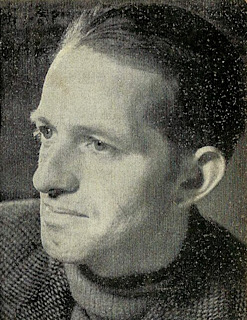
Ó Cuinneagáin Is the third child of Sean Cunningham and his wife Caitlín. He is educated in Belfast, at St. Brigid’s school, Malone Road, and the St. Patrick’s Christian Brothers school on Donegall Street. His political views are permanently influenced by memories of the sectarian violence of 1920–22. In 1927, he enters the Irish civil service as a tax clerk, stationed first at Athlone and then at Castlebar. He is promoted to junior executive officer in the Department of Defence, but resigns in July 1932 after his superiors refuse to allow him six months unpaid leave to study the Irish language in the Donegal Gaeltacht. He turns down a promotion to the Department of Finance, a decision partly motivated by disillusion with Fianna Fáil. He subsequently works as an accountant and lives in the south Dublin suburbs. In 1934, he establishes his own publishing company, Nuachtáin Teoranta, which he boasts is the first company to be registered in the Irish language, and he also contributes to an Irish language socialist paper, An t-Éireannach, under the pen name “Bruinneal gan Smal.”
In 1940–41, Ó Cuinneagáin is active in the Friends of Germany, a pro-Nazi organisation which disintegrates after some of its leading members are interned. On September 26, 1940, he founds Craobh na h-Aiséirighe, a branch of the Gaelic League aimed at attracting dynamic young enthusiasts frustrated by the older activists who dominate established branches. It makes a point of using modern publicity methods to get its message across, a trait which is carried over into Ailtirí na hAiséirghe (Architects of Resurrection), a political movement made up of branch members, which Ó Cuinneagáin founds in 1942. This move leads to the expulsion of Craobh na h-Aiséirighe from the Gaelic League and the establishment of Glún na Buaidhe by branch members who disapprove of his political ambitions and wish to concentrate on the promotion of the Irish language.
Members of Ailtirí wear an informal uniform of a green shirt, tweed suit, and báinín jacket. In private Ó Cuinneagáin reveals that the organisation is modeled on the Hitler Youth. His own title of “ceannaire” (leader) equates with “Führer” and “duce.” Features of the movement copied from Nazism include an emphasis on propaganda based on a few simple concepts and phrases. The claim that party politics allow statesmen to evade individual responsibility, whereas a single leader is necessarily more responsive to public opinion; and the belief that all difficulties can be overcome through willpower.
Ó Cuinneagáin takes to extremes contemporary Catholic advocacy of a corporate state based on vocational principles as the solution to the problems of modernity. While venerating António de Oliveira Salazar‘s Portugal as a role model, he believes that Ireland can surpass it and create a Catholic social model that will redeem the whole world. He takes a quasi-racial view of Irishness and comes close to saying that the only true Irish Catholics are of Gaelic race. When Seán Ó’Faoláin comments acidly in The Bell on the paradox of “Celtophiles” who bear such Celtic names as Blackham and Cunningham, Ó Cuinneagáin protests that he can prove his pure Gaelic descent. The Ailtirí state forces all male citizens to undertake a year’s compulsory military service, which is also used as a means of Gaelicisation, and the resulting citizen army of 250,000 would mount a lightning invasion of Northern Ireland, modeled on the blitzkrieg, with a favourite slogan being “Six Counties, Six Divisions, Sixty Minutes.” In 1943, the Stormont government excludes Ó Cuinneagáin from Northern Ireland.
Ailtirí attracts considerable attention. Its leaders address numerous meetings around the country, attracting large crowds to demonstrations at Dublin and Cork. Ó Cuinneagáin, who is by no means unintelligent, is capable of shrewd observations on the restrictions imposed on most Irish-language bodies by government subsidies, and the impact of the snobbery shown toward the poor by their middle class co-religionists. Several of his lieutenants are academics or engineers. In the 1970s he praises modernist architecture as breaking with the hated Georgian past, and denounces conservationists who oppose plans to build an oil refinery in Dublin Bay. Bilingual pamphlets produced by the group sell thousands of copies. Ó Cuinneagáin is the author of several, including Ireland’s twentieth century destiny (1942), Aiséirí says . . .(1943), Partition: a positive policy (1945), and Aiséirí for the worker (1947). Hus attempts to launch a party paper are stifled until the end of the war. Some of the interest attracted by the group is derived from curiosity or amusement. It also functions to some extent as a front organisation for the banned Irish Republican Army (IRA), with Ó Cuinneagáin declaring that Jews and freemasons should be locked up instead of IRA men. Aiséirí members are involved in the bombing of the Gough memorial in Phoenix Park in July 1957, with the stolen head concealed for a time in the party’s offices.
The party runs four candidates, including Ó Cuinneagáin in Dublin North-West, in the 1943 Irish general election and seven in 1944, but all lose their deposits. Ó Cuinneagáin does not actually vote for himself. Throughout his life he demands Irish language ballot papers. When given English language ones he tears them up, claiming that they disenfranchise him and that this invalidates the election. In 1946, Ailtirí na h-Aiséirí elects eight members to local bodies in counties Louth and Cork. This helps to bring about the decline of the party, as the Cork activists rebell against the rigid Führerprinzip upheld by the electorally unsuccessful ceannaire and his Dublin acolytes. Most of the party’s local support is absorbed by Clann na Poblachta. Ó Cuinneagáin retains a small group of followers centred on his newspaper Aiséirighe.
Ó Cuinneagáin keeps himself in the public gaze by driving around the country in a van painted with slogans, and by regularly appearing in court for refusing to respond to official documents (rates demands, car insurance, court summonses) unless they are supplied in Irish. He enjoys some success in securing the provision of Irish language versions of such documents, and he contrasts the state’s niggardliness on this point with its professed commitment to the revival of Irish. In 1954, he founds an Irish language women’s artistic and social paper, Deirdre, which operates successfully for over a decade without government subsidy.
Ó Cuinneagáin continues to write sympathetically about IRA activities, at one point offering a £1,000 reward for the capture of the Prime Minister of Northern Ireland, Basil Brooke. He maintains surprisingly extensive international neo-fascist contacts. He regularly reprints in Aiséirighe material by the American antisemite and racial segregationistGerald L. K. Smith. He cites praise for Aiséirighe from Der Stahlhelm, a far-right German veterans’ paper, and notes Oswald Mosley‘s support for Irish reunification. He denounces Hugh Trevor-Roper‘s Last days of Hitler as typical British slander of a fallen enemy. He compares the sacrificial ideology of the Hungarian Nazi collaborator Ferenc Szálasi to that of Patrick Pearse. He praises Juan Perón as a model whom Ireland should imitate and he follows the electoral fortunes of Italian neo-fascism with interest. He also maintains contacts with the radical right-wing fringes of Breton, Scottish, and Welsh nationalism. He declares that Ireland’s grievance is against England alone and bemoans the Dublin government’s failure to encourage the break-up of the United Kingdom.
Ó Cuinneagáin denounces the Soviet Union and United States alike as controlled by Zionists and freemasons. He points to illegitimacy and divorce rates in the United States as proof of the folly of those who regard “progressive” American education as superior to the sound Irish teaching methods embodied by the Christian Brothers, and bemoans the increasing flow of “immoral” American comics and paperback books into Ireland. While noting with pride that he has been described as “Ireland’s foremost Jew-baiter,” He claims that his frequent diatribes against Robert Briscoe and the state of Israel are merely anti-Zionist, and that he has nothing against Jews, whom he defines as ultra-Orthodox anti-Zionists. He hopes that a Europe united on national–Christian principles might fend off the influence of the super powers. He echoes Mosleyite calls for European unity and is an early and determined advocate of Irish membership of the European Community. However, he dissents from the Mosleyite view that such a union should be based on African empire. He is generally anti-imperialist, though somewhat more lenient toward Portuguese than British imperialism, and from 1956 the President of Egypt, Gamal Abdel Nasser, becomes one of his heroes. While supporting European unity as a defensive strategy, he also warns that unless Ireland adopts mass conscription the country might be conquered by a regiment of Russian paratroopers landing on Dollymount Strand. Throughout the 1950s and 1960s he regularly calls for the Irish Army to mount a military coup, hinting that it should install him as leader in the same way that the Portuguese army had installed Salazar.
Ó Cuinneagáin gives up contesting elections but regularly cites those who do not vote in elections as indicating the extent of political support for Ailtirí na hAiséirghe. He regularly laments that the safety valve of emigration had taken the steam out of radical politics. In his later years he notes the growth of anti-clericalism and the beginnings of a permissive society in Dublin. He attributes this to the church’s failure to implement its own social teaching and its encouragement of West British snobbery at the expense of the truly Catholic traditions of the Gael.
On April 4, 1945, Ó Cuinneagáin marries Sile Ní Chochláin. They have four sons and two daughters, some of whom become active in left-wing politics. He dies on June 13, 1991. He tends to be remembered as a figure of fun, but this view demands some qualification. He possesses genuine abilities and dedication. His fantasies are an extreme development of the official ideology of the state, and part of his appeal stems from his ability to point out the hypocrisy involved in paying it lip service while failing to push it to its logical conclusion. The blindness and cruelty involved in imposing his world view at a personal level has their counterparts in the institutions of official Ireland. Ailtirí na hAiséirghe may have been a marginal millennial cult, but in Europe during the 1940s such groups were often raised to power by circumstances. Had the World War II taken a different direction after 1940, he might be remembered not as a parody of Pearse but as an Irish Szálasi.
(From: “ÓCuinneagáin, Gearóid Seán Caoimhín” by Patrick Maume, Dictionary of Irish Biography, http://www.dib.e, October 2009)
Traynor is born in Dublin on March 21, 1886, into a strongly nationalist family. He is educated by the Christian Brothers. In 1899, he is apprenticed to John Long, a famous woodcarver. As a young man he is a noted footballer and tours Europe as a goalkeeper with Belfast Celtic F.C. whom he plays with from 1910 to 1912. He rejects claims soccer is a foreign sport calling it “a Celtic game, pure and simple, having its roots in the Highlands of Scotland.”
When the Irish Civil War breaks out in June 1922, Traynor takes the Anti-Treaty IRA side. The Dublin Brigade is split, however, with many of its members following Michael Collins in taking the pro-Treaty side. During the Battle of Dublin, he is in charge of the Barry’s Hotel garrison, before making their escape. He organises guerilla activity in south Dublin and County Wicklow, before being captured by Free State troops in September. He is then imprisoned for the remainder of the war.
In 1936, Traynor is first appointed to the Cabinet as Minister for Posts and Telegraphs. In September 1939, he is appointed Minister for Defence and holds the portfolio to February 1948. In 1948, he becomes President of the Football Association of Ireland, a position he holds until his death. He serves as Minister for Defence in several Fianna Fáil governments and as Minister for Justice, where he is undermined by his junior minister, and later Taoiseach, Charles Haughey, before he retires in 1961.
Traynor dies in Dublin at the age of 77 on December 14, 1963. He has a road named in his memory, running from the Malahide Road through Coolock to Santry in Dublin’s northern suburbs.
Mary Carryl, an Irish-born loyal servant and friend of the celebrated Ladies of Llangollen, dies on November 22, 1809. She serves them up to her death. When the Ladies die, they share the same grave.
Carryl is brought up in a poor family in Ross, County Wexford. Little is known about her until she is employed by Lady Elizabeth “Betty” and Sir William Fownes, 2nd Baronet, at the Woodstock Estate near Inistioge, County Kilkenny. He inherits the baronetcy from his father Sir William Fownes, 1st Baronet, the Lord Mayor of Dublin, and over 21,000 acres from his grandfather. When Fownes marries Elizabeth Ponsonby, he receives £4,000 as a dowry and the couple builds the six-bayed, three-story Woodstock House in County Kilkenny in 1745-47. In 1769, the Fownes have a thirteen-year-old guest to stay for some time named Sarah Ponsonby, who is Elizabeth’s cousin and the orphaned daughter of Chambré Brabazon Ponsonby. She attends school at Kilkenny.
Sarah develops a friendship with Eleanor Butler, which is not approved of by the Fownes nor by Eleanor’s family guardians. When the friendship begins, Sarah is an unhappy thirteen-year-old orphan. She is captivated by the well-educated Eleanor Butler, a 30-year-old spinster no longer considered marriageable. Sarah is also receiving unwanted attention from Sir William, her guardian.
When Eleanor Butler runs away from home, she is hidden in Sarah’s room and Carryl smuggles in food for her stowaway. Eventually Butler and Ponsonby agree that they can leave Ireland together. They go to Llangollen in Wales where they set up home in a cottage called Plas Newydd. Meanwhile Carryl, who is known as Mary the Bruiser, has been fired after throwing a candlestick that wounds another servant. Her prospects are saved when Eleanor and Sarah send for her to come to Llangollen.
In time Eleanor and Sarah become notorious as “The Ladies of Llangollen,” and Carryl becomes both their servant and the head of the household. She is loyal to her employers. She is said to have “masculine qualities” and Lady Eleanor’s diary records how she gives as good as she gets as she bargains loudly with the fishermen, the butchers and the inebriated.
Carryl dies at Plas Newydd on November 22, 1809, and is buried in the churchyard of St. Collen’s Church, Llangollen. She leaves a shilling to her brother and sister, but leaves the field she owns to Sarah. When in time the Ladies of Llangollen die, they are buried beside their faithful servant.
The memorial monument to Mary Carryl, Eleanor Butler and Sarah Ponsonby in the churchyard of St. Collen’s Church is erected in 1810. The inscription on Carryl’s part of the monument reads: “In Memory of / Mrs Mary Carryl / Deceased 22 November 1809 / This monument is erected by Eleanor Butler, / and Sarah Ponsonby, of Plasnewydd in this Parish. / Released from Earth and all its transient woes, / She whose remains beneath this stone repose, / Stedfast in Faith resigned her parting breath, / Looked up with Christian joy, and smiled in Death! / Patient, Industrious, Faithful, Generous, Kind, / Her Conduct left the proudest far behind, / Her Virtues dignified her humble birth, / And raised her mind above this sordid earth, / Attachment (Sacred bond of grateful breasts) / Extinguished but with life, this Tomb attests, / Reared by Two Friends who will her loss bemoan, / ‘Till with Her Ashes…Here shall rest, Their own.”
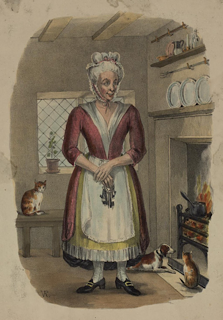
(Pictured: A portrait of Mary Carryl from the Welsh Portrait Collection at the National Library of Wales)
Mary Esperance (“Nancy”) Wynne-Jones is born on December 10, 1922, in Penmaenucha, Wales, to landowner Charles Llewellyn Wynne-Jones and Sybil Mary Gella Scott. The family spends half the year in Wales and half the year in Thornhill, Stalbridge, Dorset. She has two brothers, Andrew and Ronald (“Polly”), both of whom die in Africa during World War II.
Wynne-Jones is educated at home. Her skill in art leads to her getting lessons in Sherborne from a children’s book illustrator. Her music is encouraged by the family doctor and she begins to compose and study the violin, receiving lessons in Bournemouth with the first violinist of the symphony orchestra. After the start of World War II, she continues in Aberystwyth. She goes on to study the violin and composition at the Royal Academy of Music, London (1940–43). While in London she also serves as a Voluntary Aid Detachment nurse until 1943 and later as a draughtswoman at the Ordnance Survey.
After the war, Wynne-Jones purchases and manages a bookshop on the King’s Road in Chelsea, but it is not a financial success. She returns to painting, studying at the Heatherley School of Fine Art, London, from 1951 to 1952 and the Chelsea School of Art from 1952 to 1955. She travels extensively through Portugal and Italy painting landscapes. An interest in completing landscapes in an abstract manner leads her to study with Peter Lanyon in St. Ives, Cornwall.
In 1962, Wynne-Jones purchases Trevaylor House near Penzance and provides accommodation for other artists including renowned Irish painter Tony O’Malley, sculptor Conor Fallon and English poet and writer W. S. ‘Sydney’ Graham. In the 1970s she exhibits in Ireland at the Project Arts Centre, Dublin (1970) and at the Emmet Gallery, Dublin (1975 and 1977). During the 1980s she exhibits at the Lincoln and Hendricks galleries in Dublin before joining the Taylor Gallery, run by John and Patrick Taylor. She is elected an honorary member of the Royal Hibernian Academy (RHA) in 1994 and becomes a member of Aosdána in 1996. Originally an abstract artist, her contact with the Irish countryside slowly transforms her work to that of a landscape artist, albeit with an influence of abstraction attached to it. She becomes well-known in Irish art circles as an eminent Irish landscape artist.
Wynne-Jones is involved with artist Derek Middleton before moving to Cornwall. There she becomes romantically involved with Graham who is in an open marriage, however, it is the death of her mentor Peter Lanyon which devastates her. She meets the sculptor Conor Fallon through their mutual friend, Tony O’Malley. Fallon had arrived in Cornwall ostensibly to meet Lanyon. They marry in 1966. Their honeymoon in Provence is immortalised in expressionist paintings done by her. The couple adopts a boy and a girl, siblings, John and Bridget. In 1972, she moves with her family to Kinsale, County Cork. It is in the area around here that a number of her paintings are created. Later she paints the mountain visible from her Wicklow home after the family moves in the late 1980s. She moves to Ballard House, near Rathdrum, County Wicklow in 1987.
Wynne-Jones dies on November 9, 2006, and is buried in Ballinatone (Church of Ireland), Rathdrum.
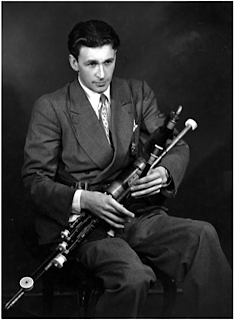
Séamus Ennis (Irish: Séamas Mac Aonghusa), Irish musician, singer and Irish music collector, dies in Naul, County Dublin, on October 5, 1982. He is most noted for his uilleann pipe playing and is partly responsible for the revival of the instrument during the twentieth century, having co-founded Na Píobairí Uilleann, a nonprofit organisation dedicated to the promotion of the uilleann pipes and its music. He is recognised for preserving almost 2,000 Irish songs and dance-tunes as part of the work he does with the Irish Folklore Commission. He is widely regarded as one of the greatest uilleann pipers of all time.
Ennis’s father, James, works for the Irish civil service at Naul, County Dublin. In 1908, James Ennis is in a pawn shop in London and purchases a bag containing the pieces of a set of old uilleann pipes. They were made in the mid nineteenth century by Coyne Pipemakers of Thomas Street in Dublin. In 1912, he comes in first in the Oireachtas competition for warpipes and second in the uilleann pipes. He is also a prize-winning dancer. In 1916, he marries Mary Josephine McCabe, an accomplished fiddle player from County Monaghan. They have six children, Angela, Séamus, Barbara, and twins, Cormac and Ursula (Pixie) and Desmond. Séamus is born on May 5, 1919, in Jamestown in Finglas, Dublin. James Ennis is a member of the Fingal trio, which includes Frank O’Higgins on fiddle and John Cawley on flute, and performs regularly with them on the radio. At the age of thirteen, Séamus starts receiving lessons on the pipes from his father. He attends a Gaelscoil, Cholmcille, and a Gaelcholáiste, Coláiste Mhuire, which gives him a knowledge of the Irish language that serves him well in later life. He sits in an exam to become Employment Exchange clerk but is too far down the list to be offered a job. He is twenty and unemployed.
Colm Ó Lochlainn is editor of Irish Street Ballads and a friend of the Ennis family. In 1938, Ennis confides in Colm that he intends to move to England to join the British Army. Colm immediately offers him a job at The Three Candles Press. There Ennis learns all aspects of the printing trade. This includes writing down slow airs for printed scores – a skill which later proves important. Colm is director of an Irish language choir, An Claisceadal, which Ennis joins. In 1942, during The Emergency, shortages and rationing mean that things become difficult in the printing trade. Professor Seamus Ó Duilearge of the Irish Folklore Commission hires the 23-year-old to collect songs. He is given “pen, paper and pushbike” and a salary of three pounds per week. Off he goes to Connemara.
From 1942 to 1947, working for the Irish Folklore Commission, Ennis collects songs in west Munster; counties Galway, Cavan, Mayo, Donegal, Kerry; the Aran Islands and the Scottish Hebrides. His knowledge of Scottish Gaelic enables him to transcribe much of the John Lorne Campbell collection of songs. Elizabeth Cronin of Ballyvourney, County Cork, is so keen to chat to Ennis on his visits that she writes down her own songs and hands them over as he arrives, and then gets down to conversation. He has a natural empathy with the musicians and singers he meets. In August 1947, he starts work as an outside broadcast officer with Raidió Éireann. He is a presenter and records Willie Clancy, Seán Reid and Micho Russell for the first time. There is an air of authority in his voice. In 1951, Alan Lomax and Jean Ritchie arrived from the United States to record Irish songs and tunes. The tables are turned as Ennis becomes the subject of someone else’s collection. There is a photograph from 1952/53 showing Ritchie huddled over the tape recorder while Ennis plays uilleann pipes.
Late in 1951, Ennis joins the BBC. He moves to London to work with producer Brian George. In 1952, he marries Margaret Glynn. They have two children, the organist Catherine Ennis and Christopher. His job is to record the traditional music of England, Scotland, Wales and Ireland and to present it on the BBC Home Service. The programme is called As I Roved Out and runs until 1958. Meeting up with Alan Lomax again, he is largely responsible for the album Folk and Primitive Music (volume on Ireland) on the Columbia Records label.
In 1958, after his contract with the BBC is not renewed, Ennis starts doing freelance work, first in England then back in Ireland, with the new TV station Teilifis Éireann. Soon he is relying totally on his musical ability to make a living. About this time, his marriage breaks down and he returns to Ireland. He suffers from tuberculosis and is ill for some time. In 1964, he performs at the Newport Folk Festival. His father gives him the pipes he had bought in 1908. Although most pipers can be classed as playing in a tight style or an open style, Ennis is in between. He is a master of the slow air, knowing how to decorate long notes with taste and discreet variation.
Two events will live in legend among pipers. The first is in Bettystown, County Meath, in 1968, when the society of Irish pipers, Na Píobairí Uilleann, is formed. Breandán Breathnach is playing a tape of his own piping. Ennis asks, “What year?” Breandán replies, “1948.” Ennis says, “So I thought.” For a couple of hours the younger players perform while Ennis sits in silence. Eventually he is asked to play. Slowly he takes off his coat and rolls up his sleeves. He spends 20 minutes tuning up his 130-year-old pipes. He then asks the gathering whether all the tape recorders are ready and proceeds to play for over an hour. To everyone’s astonishment he then offers his precious pipes to Willie Clancy to play a set. Clancy demurs but eventually gives in. Next, Liam O’Flynn is asked to play them, and so on, round the room. The second unforgettable session is in Dowlings’ Pub in Prosperous, County Kildare. Christy Moore is there, as well as most of the future members of Planxty.
Ennis never runs any school of piping but his enthusiasm infuses everyone he meets. In the early 1970s, he shares a house with Liam O’Flynn for almost three years. Finally, he purchases a piece of land in Naul and lives in a mobile home there. One of his last performances is at the Willie Clancy Summer School in 1982. He dies on October 5, 1982. His pipes are bequeathed to Liam O’Flynn. Radio producer Peter Browne produces a compilation of his performances, called The Return from Fingal, spanning 40 years.
Séamus Ennis Road in his native Finglas is named in his honour. The Séamus Ennis Arts Centre in Naul is opened in his honour, to commemorate his work and to promote the traditional arts. He is also the subject of Christy Moore’s song “The Easter Snow.” This is the title of a slow air Ennis used to play, and one after which he named his final home in Naul.
Christened as William O’Brien, Ó Briain is born at 10 Church Street, North Wall, Dublin, on September 16, 1888, the seventh child of Arthur O’Brien, clerk, and Mary O’Brien (née Christie), who is from County Meath. He takes an interest in the Irish language from an early age and begins learning Irish by himself from a grammar book, as it is not encouraged by his teachers at the Christian Brothers’ O’Connell School nor spoken by his parents. While still at the O’Connell School, he starts using the Irish version of his name. He also attends meetings of the Gaelic League, then attends University College Dublin (UCD) on a scholarship, where he studies French, English and Irish, receiving a BA (1909) and an MA (1910).
UCD decides to start awarding one annual scholarship for overseas travel in 1911, and Ó Briain wins the first one, using it to visit Germany and study under Kuno Meyer and Rudolf Thurneysen. After three years, he returns home, where he rejoins the Gaelic League and begins teaching French at UCD. He also joins the Irish Volunteers then, the following year, Seán T. O’Kelly convinces him to join the Irish Republican Brotherhood (IRB).
Around this time, Ó Briain joins Sinn Féin, and he stands unsuccessfully for the party in Mid Armagh at the 1918 United Kingdom general election in Ireland, taking 5,689 votes. His campaign leads, indirectly, to his arrest and three months in jail in Belfast. In 1920, following his release, he is appointed a judge in the then-illegal republican court system in Galway, and visits both France and Italy to try to source weapons for the Irish Republican Army (IRA). In November 1920, he is arrested in the UCG dining room by Black and Tans, and is imprisoned for thirteen months, first in Galway and then in the Curragh camp in County Kildare, thereby missing the conclusion of the Irish War of Independence. By the time he is released, the Anglo-Irish Treaty has been signed. He supports the treaty and takes no further part in militant activity.
In the newly independent Ireland, Ó Briain remains a professor at Galway. He also stands in the 1925 Seanad election, although he is not successful. He is the founding secretary of the Taibhdhearc na Gaillimhe theatre, also acting in many of its productions, and spends much time translating works from English and the Romance languages into Irish. He stands to become president of UCG in 1945, but is not elected, and in the 1940s and 1950s is best known for his many appearances on television and radio.
From his retirement in 1959, Ó Briain lives in Dublin. In 1974, the National University of Ireland (NUI) confers an honorary doctorate on him. He dies on August 12, 1974, at St. Gabriel’s Hospital, Cabinteely, County Dublin. His funeral to Glasnevin Cemetery is almost a state occasion, with a huge attendance of public figures, and a military firing party at the graveside, where the oration is given by Micheál Mac Líammóir and a lesson is read by Siobhán McKenna. For days after his death, the newspapers carry tributes to his many-sided career and personality. On the one hundredth anniversary of his birth, Proinsias Mac Aonghusa and Art Ó Beoláin write commemorative articles in Feasta.
On September 1, 1921, Ó Briain marries Helen Lawlor, of Dublin, who dies two years before him. The couple’s only child is Eibhlín Ní Bhriain, who is a journalist for The Irish Times and other periodicals.
Geddes is born on her maternal grandparent’s farm at Drumreilly Cottage in Leitrim, County Leitrim, on May 25, 1887. She is the eldest of four children, three girls and a boy, of William Geddes and his wife Eliza Jane Stafford. The family, who migrates to Ireland from Scotland, has mainly been farmers. Her father, a Methodist, who is born near his father’s farm at Tandragee, County Armagh, emigrates to the United States as a young man, working as a labourer for the railway construction business. This serves a useful purpose as he had worked as a site engineer at the Cavan, Leitrim and Roscommon Railway Company. When she is still an infant her parents move to their native home in Belfast, so her father can set up in business as a building contractor.
Geddes begins drawing subjects from life and nature from the age of four. She learns first how to draw from the school mistress in Ayrshire, where her father occasionally goes shooting. She begins her studies at Methodist College Belfast along with her three younger sisters. She later moves to the Belfast School of Art. She is encouraged by Rosamond Praeger, a sculptor from County Down, to continue with her studies. She is accepted as a student to study at the Belfast School of Art, Ulster University. This is where she adapts and improves her style and is introduced to a professional standard of art work.
While still studying at the Belfast School of Art, Geddes takes part in the Arts and Crafts Society of Ireland‘s fourth exhibition. For this exhibition, she contributes a glowingly coloured illustration of the book Cinderella Dressing the Ugly Sister (Dublin City Gallery), which she had created. It is at this exhibition that her work is spotted by Sarah Purser, a well established painter seeking newly trained students to introduce to stained glass artistry. Purser, who goes on to be her lifelong mentor, invites the young Geddes to join her in Dublin, working under the established stained glass artist William Orpen.
Geddes contributes a watercolour illustration of a Ballad Seller with the Belfast Art Society in 1907. She is elected as an Associate of the Belfast Art Society’s successor, the Ulster Academy of Arts, in 1933 before promotion to Honorary Academician in 1935. She shows five illustrations in the 1911 Oireachtas Exhibition. It is some twenty-one years before she returns to the Oireachtas when she exhibits three cartoons and three sketches for stained glass in 1932.
Geddes joins Purser at the acclaimed stained glass workshop called An Túr Gloine in 1910. The workshop is held in Dublin’s Metropolitan School of Art. It is here that she discovers her passion for the craftsmanship of stained glass artistry and creates her most important works.
During her early years at An Túr Gloine, Geddes’s originality shines, and important commissions come from St. Ann’s Church, Dawson Street, Dublin and the Presbyterian church in Rathgar. Dogged by illness, she returns to Belfast before 1916 and lives between there and Dublin until moving in 1925, as she has long wanted, to work in London at The Glass House, Fulham. While working at The Glass House, she instructs the Irish painter and stained glass artist Evie Hone.
Geddes’s work is considered pioneering and represents a rejection of the Late Victorian approach. She creates a new view of men in stained glass windows, portraying them with close-shaven crew cuts. The muscularity and tension of her portraiture is matched by the radical design of her constructions. Ambitious large-scale projects, as at the cathedral in Ypres, are equalled by the drama of smaller-scale work at Wallasey (Lancashire) and Wallsend (Northumberland), or war memorial windows in obscure country churches.
Despite the hardships of living in London during World War II, poverty, and ill health, Geddes designs seventeen full-scale stained glass masterpieces, sixteen of which she completes.
Geddes dies on August 10, 1955 in London of a pulmonary embolism. She is buried in CarnmoneyCemetery, County Antrim, along with her mother and sister Ethel. Even after moving to London, she claims that her native identity never wavered as she says she was always “a Belfast woman.”
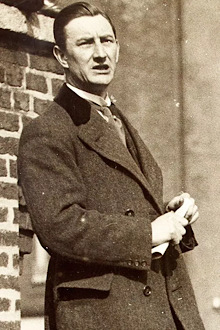
Mulcahy is second-in-command to Thomas Ashe in an encounter with the armed Royal Irish Constabulary (RIC) at Ashbourne, County Meath, during the 1916 Easter Rising, one of the few stand-out victories won by republicans in that week and generally credited to Mulcahy’s grasp of tactics. In his book on the Rising, Charles Townshend principally credits Mulcahy with the defeat of the RIC at Ashbourne, for conceiving and leading a flanking movement on the RIC column that had engaged with the Irish Volunteers. Arrested after the Rising, he is interned at Knutsford and at the Frongoch internment camp in Wales until his release on December 24, 1916.
Mulcahy and Michael Collins are largely responsible for directing the military campaign against the British during the Irish War of Independence. During this period of upheaval in 1919, he marries Mary Josephine (Min) Ryan, sister of Kate and Phyllis Ryan, the successive wives of Seán T. O’Kelly. Her brother is James Ryan. O’Kelly and Ryan both later serve in Fianna Fáil governments.
Mulcahy supports the Anglo-Irish Treaty of December 1921. Archive film shows that Mulcahy, as Minister of Defence, is the Irish officer who raises the Irish tricolour at the first hand-over of a British barracks to the National Army in January 1922. He is defence minister in the Provisional Government on its creation and succeeds Collins, after the latter’s assassination, as Commander-in-Chief of the Provisional Government’s forces during the subsequent Irish Civil War.
Mulcahy earns notoriety through his order that anti-Treaty activists captured carrying arms are liable for execution. A total of 77 anti-Treaty prisoners are executed by the Provisional Government. He serves as Minister for Defence in the new Free State government from January 1924 until March 1924, but resigns in protest because of the sacking of the Army Council after criticism by the Executive Council over the handling of the “Army Mutiny,” when some National Army War of Independence officers almost revolt after he demobilises many of them at the end of the Irish Civil War. He re-enters the cabinet as Minister for Local Government and Public Health in 1927.
After the resignation of W. T. Cosgrave as Leader of Fine Gael in 1944, Mulcahy becomes party leader while still a member of the Seanad. Thomas F. O’Higgins is parliamentary leader of the party in the Dáil at the time and Leader of the Opposition. Facing his first general election as party leader, Mulcahy draws up a list of 13 young candidates to contest seats for Fine Gael. Of the eight who run, four are elected. He is returned again to the 12th Dáil as a TD for Tipperary at the 1944 Irish general election. While Fine Gael’s decline had been slowed, its future is still in doubt.
Following the 1948 Irish general election Mulcahy is elected for Tipperary South, but the dominant Fianna Fáil party finishes six seats short of a majority. However, it is 37 seats ahead of Fine Gael, and conventional wisdom suggests that Fianna Fáil is the only party that can possibly form a government. Just as negotiations get underway, however, Mulcahy realises that if Fine Gael, the Labour Party, the National Labour Party, Clann na Poblachta and Clann na Talmhan band together, they would have only one seat fewer than Fianna Fáil and, if they can get support from seven independents, they will be able to form a government. He plays a leading role in persuading the other parties to put aside their differences and join forces to consign the then Taoiseach and Fianna Fáil leader Éamon de Valera, to the opposition benches.
Mulcahy initially seems set to become Taoiseach in a coalition government. However, he is not acceptable to Clann na Poblachta’s leader, Seán MacBride. Many Irish republicans had never forgiven him for his role in the Irish Civil War executions carried out under the Cosgrave government in the 1920s. Consequently, MacBride lets it be known that he and his party will not serve under Mulcahy. Without Clann na Poblachta, the other parties would have 57 seats between them — 17 seats short of a majority in the 147-seat Dáil. According to Mulcahy, the suggestion that another person serve as Taoiseach comes from Labour leader William Norton. He steps aside and encourages his party colleague John A. Costello, a former Attorney General of Ireland, to become the parliamentary leader of Fine Gael and the coalition’s candidate for Taoiseach. For the next decade, Costello serves as the party’s parliamentary leader while Mulcahy remained the nominal leader of the party.
Mulcahy goes on to serve as Minister for Education under Costello from 1948 until 1951. Another coalition government comes to power at the 1954 Irish general election, with Mulcahy once again stepping aside to become Minister for Education in the Second Inter-Party Government. The government falls in 1957, but he remains as Fine Gael leader until October 1959. In October the following year, he tells his Tipperary constituents that he does not intend to contest the next election.


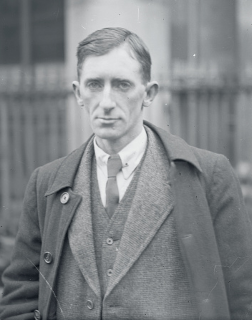
 seamus dubhghaill