seamus dubhghaill

Promoting Irish Culture and History from Little Rock, Arkansas, USA


Leave a comment

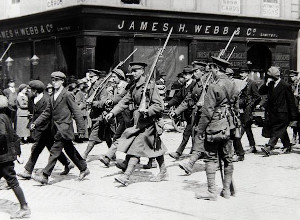
Martial Law Declared in Ireland

martial-law-april-1916

The United Kingdom declares martial law in Ireland for one month on April 25, 1916, the day after the commencement of the Easter Rising. A curfew is imposed from 8:30 PM until 5:00 AM. Anyone spotted on the streets during the hours of darkness are to be shot on sight. The trams stop running at 7:00 PM and the theatres and cinemas close by 8:00 PM. Those rushing for trams leaving the city centre have to pass through a stop-and-search military cordon.

The Easter Rising, also known as the Easter Rebellion, is an armed insurrection in Ireland during Easter Week, 1916. The Rising is mounted by Irish republicans in an attempt to end British rule in Ireland, secede from the United Kingdom of Great Britain and Ireland and establish an independent Irish Republic. This takes place while the United Kingdom is heavily engaged in World War I. It is the most significant uprising in Ireland since the Irish Rebellion of 1798.

Organized by seven members of the Military Council of the Irish Republican Brotherhood (IRB), the Rising begins on Easter Monday, April 24, 1916, and lasts for six days. The following day the British Government immediately declares martial law in Ireland. Members of the Irish Volunteers, led by schoolmaster and Irish language activist Patrick Pearse and joined by the smaller Irish Citizen Army of James Connolly and 200 members of Cumann na mBan, seize key locations in Dublin and proclaim the Irish Republic independent of the United Kingdom. There are actions in other parts of Ireland, however, except for the attack on the Royal Irish Constabulary barracks at Ashbourne in County Meath, they are minor.

With vastly superior numbers and artillery, the British army quickly suppresses the Rising and Pearse agrees to an unconditional surrender on Saturday, April 29, 1916. Most of the leaders are executed following courts-martial, but the Rising succeeds in bringing physical force republicanism back to the forefront of Irish politics. Support for republicanism continues to rise in Ireland in the context of the ongoing war in Europe and the Middle East and revolutions in other countries, and especially as a result of the Conscription Crisis of 1918 and the failure of the British-sponsored Irish Convention.

In the 1918 Irish general election, republicans, by then represented by Sinn Féin, secure an overwhelming victory, winning 73 Irish seats out of 105 to the British Parliament, on a policy of abstentionism and Irish independence. The following year Éamon de Valera escapes from Lincoln Gaol to become party leader. On January 21, 1919, they convene the First Dáil and declare the independence of the Irish Republic. Later that same day the Irish Republican Army, organised by Minister for Finance and IRB president Michael Collins, begins the Irish War of Independence with the Soloheadbeg ambush.

(Pictured: Rebel prisoners are marched out of Dublin by the British Army)


Leave a comment

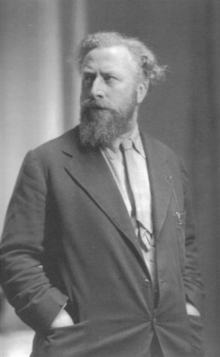
Shaw’s “Too True to Be Good” Premieres in New York City

george-bernard-shaw-2

Too True to Be Good (1932), a comedy written by playwright George Bernard Shaw premieres at the Guild Theatre in New York City on April 4, 1932. Subtitled “A Collection of Stage Sermons by a Fellow of the Royal Society of Literature,” it moves from surreal allegory to the “stage sermons” in which characters discuss political, scientific and other developments of the day. The second act of the play contains a character, Private Napoleon Meek, based on Shaw’s friend T. E. Lawrence.

The play explicitly deals with the existential crisis that hit Europe after the end of World War I, especially the emergence of a “modernist” culture fueled by uncertainties created by Freudian psychology and Albert Einstein‘s new physics. The whole of the second and third acts of the play have often been interpreted as a dream of escape occurring in the mind of the feverish Patient (hence the talking Microbe‘s comment that the “real” action is over), and the Patient repeatedly says that what is happening is a dream.

The play is an early example of the formal experimentation with allegory and the absurd that become a feature of Shaw’s later work, having much in common with the later play The Simpleton of the Unexpected Isles, which is also set in an obscure island at the edge of the British Empire. Its absurdist elements later lead to its being viewed as a precursor to the work of Samuel Beckett and Harold Pinter.

The idea that microbes, specifically bacteria, are somehow made sick by human illnesses is a belief that Shaw repeatedly promotes, claiming that disease produces mutations in bacteria, misleading doctors into the belief that “germs” cause disease. The play dramatises his theory that life-energy itself cures illness.

The play is first staged on Monday, February 29, 1932, at Boston‘s Colonial Theatre, by the Theatre Guild. After the April performance in New York it is followed in the same year by a production in Malvern, Worcestershire starring Beatrice Lillie, Claude Rains, and Leo G. Carroll.

The play receives a Broadway revival in 1963, directed by Albert Marre and starring Robert Preston, Lillian Gish, David Wayne, Cedric Hardwicke, Cyril Ritchard, Glynis Johns, and Eileen Heckart. This production features incidental music by Mitch Leigh, who later works with Marre on Man of La Mancha. It has also been presented at the Shaw Festival four times: in 1974, 1982, 1994, and 2006.


Leave a comment

Easter Rising “Remembrance Wall” Unveiled

glasnevin-memorial-wall

A “Remembrance Wall” showing the names of all those who died during the 1916 Easter Rising is unveiled at Glasnevin Cemetery in Dublin on April 3, 2016. The memorial wall bears the names of all those who died, Irish and British, military and civilian, in the rebellion 100 years earlier.

Almost 500 people are killed in the uprising, with 268 of them being civilians caught up in the violence. The names are displayed chronologically without distinction between the different categories. The inclusion of the names of 119 British soldiers on the wall, some of whom are buried in Glasnevin, causes some controversy and a number of protesters gather outside the cemetery to demonstrate as the interfaith service takes place inside. A significant Garda Síochána presence monitors the protest events.

The Glasnevin Trust insists the memorial is an attempt to present the historical facts, without hierarchy or judgement. Chairman of Glasnevin Trust John Green tells the service the wall reflects modern Ireland. “Behind each and every one of these lost lives is a story of heartbreak, no matter what side the person served on or indeed for those innocently caught up in the conflict,” he says. “One hundred years on we believe this memorial reflects the time we live in, with the overwhelming majority of the Irish people wishing to live in peace and in reconciliation. But it is for each visitor to take from the wall what they wish.”

Senior church figures from a range of faiths and humanist representatives are among those to speak at the ceremony. Inspiration for the project is drawn from an international memorial near Arras in France that lists the names of 580,000 people killed in fighting on the western front in World War I. Taoiseach Enda Kenny lays a wreath during the event, which is part of the official State programme commemorating the uprising.

Conradh na Gaeilge expresses its disappointment about a spelling mistake on the new memorial wall. The wall is titled Éirí Amach na Cásca but the word Éirí (meaning Rising) appears with a fada on the first i, instead of on the E. Julian de Spáinn of Conradh na Gaeilge says the mistake illustrates a laziness toward the Irish language and he cannot understand why those involved did not ensure that the Irish is as accurate and correct as the English spelling on the wall.


Leave a comment

Birth of William Massey, New Zealand Prime Minister

william-ferguson-massey

William Ferguson Massey, New Zealand statesman, Prime Minister from 1912 to 1925, and founder of the Reform Party, is born in Limavady, County Derry in what is now Northern Ireland on March 26, 1856. He is a lifelong spokesman for agrarian interests and opponent of left-wing movements. His Reform Party ministries include leadership of the country during World War I.

The Massey family arrives in New Zealand on October 21, 1862, on board the Indian Empire as Nonconformist settlers, although William remains in Ireland for an additional eight years to complete his education. After arriving on December 10, 1870, on the City of Auckland, he works as a farmhand for some years before acquiring his own farm in Mangere, south Auckland, in 1876.

While managing his own farm, Massey assumes leadership in farmers’ organizations. He enters Parliament in 1894 as a conservative and from 1894 to 1912 is a leader of the conservative opposition to the Liberal ministries. He becomes prime minister in 1912 and promptly signs legislation enabling freeholders to buy their land at its original value. The first years of his ministry see labour strikes by miners in Waihi in 1912 and wharf workers in Wellington in 1913. His harsh repression of them give impetus to the formation of the Labour Party in 1916. He also improves federal administration by putting civil service positions under a nonpolitical commission.

A coalition with the Liberal Party led by Sir Joseph Ward enables Massey to continue his ministry in 1915. He participates in the Imperial War Cabinet (1917–18) and signs the Treaty of Versailles at the Paris Peace Conference of 1919, making New Zealand a founding member of the League of Nations. He opposes separate sovereign status for dominions within the British Commonwealth.

Following the war, farmers are troubled by depressed prices resulting from the sharply reduced British demand for their products, and they also face inflation in land prices, aggravated by increased demand for land by returning servicemen. Massey responds to these problems by establishing the Meat Control Board (1922) and the Dairy Export Control Board (1923), but rural and urban unrest resulting from rising prices continue to mount in the final years of his ministry.

In 1924 cancer forced Massey to relinquish many of his official duties, and he dies on May 10, 1925, at Wellington, New Zealand. The Massey Memorial is erected as his mausoleum in Wellington, paid for mostly by public subscription. Massey University is named after him, the name chosen because the university had a focus on agricultural science, matching Massey’s own farming background.


Leave a comment

Terence O’Neill Becomes Fourth Prime Minister of Northern Ireland

File source: http://en.wikipedia.org/wiki/File:Captain_Terence_O%27Neill.jpg

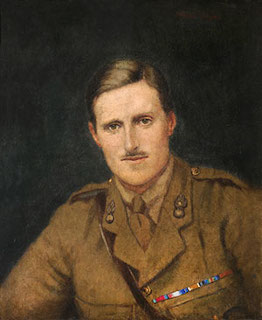
Terence O’Neill becomes the fourth Prime Minister of Northern Ireland on March 25, 1963, following the resignation of Basil Brooke, 1st Viscount Brookeborough. He plays a significant role in the first year of the Troubles, trying unsuccessfully to stem growing sectarian violence.

O’Neill is born on September 10, 1914, at 29 Ennismore Gardens, Hyde Park, London, the son of Captain Arthur O’Neill of Shane’s Castle, Randalstown, the first member of parliament (MP) to be killed in action in World War I five months later. He is educated in the English public school system at West Downs SchoolWinchester and Eton College, spending his summer holidays at the family estate in Ulster. He is later commissioned in the British Army, rising to the rank of captain and serving with the Irish Guards in World War II. He is wounded in 1944 and opts to resettle permanently in Northern Ireland.

In 1946, O’Neill is elected to the Parliament of Northern Ireland, representing the Unionist stronghold of Bannside. He remains in the parliament at Stormont for almost 25 years. He becomes Northern Ireland’s Minister of Home Affairs in April 1956, Minister of Finance in September 1956 and Prime Minister in March 1963.

As Prime Minister, O’Neill introduces economic reforms to stimulate industrial growth and employment, with mixed results. He also tries narrowing the divide between Protestants and Catholics. He does this with important gestures, like visiting Catholic schools and expressing condolences on the death of Pope John XXIII.

O’Neill also seeks better relations with the Republic of Ireland, and in January 1965 invites Taoiseach Seán Lemass to Belfast. Catholics and moderate Unionists welcome this reconciliation but many conservative Loyalists, like Ian Paisley, condemn it as treachery.

When the civil rights movement erupts in the late 1960s, O’Neill offers a package of reforms and concessions, including changes to the allocation of housing. These proposals, however, anger staunch Unionists and fail to satisfy many Republicans.

In December 1969, O’Neill appears on Northern Ireland television and makes an impassioned plea for unity, warning that “Ulster stands at the crossroads.” His government is reelected in February 1969, though O’Neill himself is almost voted out of his own seat.

With the situation worsening, O’Neill is further embarrassed by Loyalist attempts to sabotage Belfast’s water supply. Fast losing the confidence of his own party, he resigns the prime ministership in April 1969. He remains in the parliament until January 1970.

O’Neill is made Baron O’Neill of the Maine and spends the last decade of his life in Britain’s House of Lords. He dies of cancer on June 12, 1990.


Leave a comment

Birth of Robert Gibbings, Wood Engraver & Sculptor

LEAD Technologies Inc. V1.01

Robert John Gibbings, Irish artist and author most noted for his work as a wood engraver and sculptor, and for his books on travel and natural history, is born into a middle-class family in Cork, County Cork on March 23, 1889. Along with Noel Rooke he is one of the founder members of the Society of Wood Engravers in 1920 and is a major influence in the revival of wood engraving in the twentieth century.

Gibbings’ father, the Reverend Edward Gibbings, is a Church of Ireland minister. His mother, Caroline, is the daughter of Robert Day, Fellow of the Royal Society of Antiquaries of Ireland and president of The Cork Historical and Archaeological Society. He grows up in the town of Kinsale where his father is the rector of St. Multose Church.

Gibbings studies medicine for three years at University College Cork before deciding to persuade his parents to allow him to take up art. He studies under the painter Harry Scully in Cork and later at the Slade School of Fine Art and the Central School of Art and Design.

During World War I Gibbings serves in the Royal Munster Fusiliers and is wounded at Gallipoli before eventually being invalided out of the army in 1918. He then resumes his studies in London.

Gibbings is very much at the centre of developments in wood engraving. He is a founder member and leading light of the Society of Wood Engravers, which he sets up with Noel Rooke in 1920. In 1922 he contributes two wood engravings, “Clear Waters” and “Hamrun,” to Contemporary English Woodcuts, an anthology of wood engravings produced by Thomas Balston, a director at Gerald Duckworth & Company and an enthusiast for the new style of wood engravings. In 1923 he receives a commission for a set of wood engravings for The Lives of Gallant Ladies for the Golden Cockerel Press, his most important commission to date at 100 guineas.

Gibbings is working on the wood engravings The Lives of Gallant Ladies when Hal Taylor, the owner of the press, becomes very ill with tuberculosis and has to put it up for sale. He seeks a loan from a friend, Hubert Pike, a director of Bentley Motors, to buy the press. He takes over in February 1924 and owns and runs the press until 1933.

Gibbings illustrates numerous books on travel and natural history, including Charles Darwin’s The Voyage of the Beagle, and writes a series of bestselling river books, notably Sweet Thames Run Softly. He does a huge amount to popularise the subject of natural history, travelling extensively through Polynesia, Bermuda and the Red Sea to gather inspiration for his work.

Gibbings is the first man to draw underwater, the illustrations filling his Penguin classic Blue Angels and Whales. He is one of the first natural history presenters on the BBC.

In September 1955 Gibbings and his wife, Patience, purchase Footbridge Cottage, a tiny beehive of a cottage in Gibbings’s words, in Long Wittenham on the banks of the River Thames. Life there suits him, and he has a period of tranquility that he had not known previously. They live there until he dies of cancer in an Oxford hospital on January 19, 1958. He is buried in the churchyard at Long Wittenham. The grave is marked by a simple headstone featuring his device of a crossed quill and graver, carved by Michael Black, a young sculptor who is a friend of Gibbings.


Leave a comment

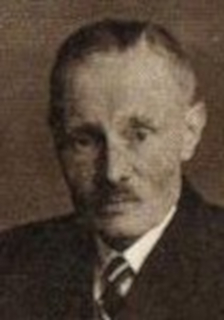
Birth of Cyril Falls, Military Historian & Journalist

cyril-bentham-falls

Cyril Bentham Falls, British military historian, journalist and academic, noted for his works on World War I, is born in Dublin on March 2, 1888.

Falls is the eldest son of Sir Charles Falls, an Ulster landowner in County Tyrone. He receives his formal education at the Portora Royal School, Enniskillen, and the University of London. At the age of 27 he publishes his first book, Rudyard Kipling: A Critical Study (1915).

During World War I Falls receives a commission into the British Army as a subaltern in the Royal Inniskilling Fusiliers. He serves as a Staff Officer in the Head Quarters of the 36th (Ulster) Division and the 62nd (2nd West Riding) Division during the conflict. He receives the French Croix de guerre and is discharged from the British Armed Forces with the rank of Captain.

Immediately after leaving the British Army Falls writes a history of one of the Divisions that he had served with during the war, entitled The History of the 36th (Ulster) Division, which is published in 1922.

From 1923 to 1939 Falls is employed by the Historical Section of the United Kingdom Government‘s Committee of Imperial Defence, researching and writing the text of several volumes of the British Government’s official History of the Great War. He serves as the military correspondent for The Times during World War II from 1939 to 1945.

Falls holds the post of Chichele Professor of Military History at All Souls College, Oxford from 1946 to 1953. From the late 1940s through to the end of his life in the early 1970s he is a productive writer of military histories, publishing in-depth detailed studies as well as general works for the commercial market, his final two titles being published posthumously.

The historian Sir Michael Howard later describes Falls’ work The History of the 36th (Ulster) Division (1922) as “containing some of the finest descriptions of conditions on the Western Front to be found anywhere in the literature of the war.”

Cyril Falls dies at the age of 84 in Walton-on-Thames, Surrey, on April 23, 1971.


Leave a comment

Birth of Frank Harris, Journalist & Novelist

frank-harris

Frank Harris, Irish American editor, novelist, short story writer, journalist and publisher, is born James Thomas Harris to Welsh parents in Galway, County Galway on February 14, 1855. He is friendly with many well-known figures of his day.

Harris’s father, Thomas Vernon Harris, is a naval officer from Fishguard, Pembrokeshire, Wales. While living with his older brother he is, for a year or more, a pupil at The Royal School, Armagh. At the age of twelve he is sent to Wales to continue his education as a boarder at the Ruabon Grammar School in Denbighshire, a time he is to remember later in My Life and Loves. He is unhappy at the school and runs away within a year.

Harris runs away to the United States in late 1869, arriving in New York City virtually penniless. The 13-year-old takes a series of odd jobs to support himself, working first as a shoeshiner, a porter, a general laborer, and a construction worker on the erection of the Brooklyn Bridge. He later turns these early occupational experiences into art, incorporating tales from them into his book The Bomb (1908).

From New York Harris moves to Chicago, where he takes a job as a hotel clerk and eventually a manager. Owing to Chicago’s central place in the meat packing industry, he makes the acquaintance of various cattlemen, who inspire him to leave the big city to take up work as a cowboy. He eventually grows tired of life in the cattle industry and enrolls at the University of Kansas, where he studies law and earns a degree, gaining admission to the Kansas Bar Association.

Harris is not cut out to be a lawyer and soon decides to turn his attention to literature. He returns to England in 1882, later traveling to various cities in Germany, Austria, France, and Greece on his literary quest. He works briefly as an American newspaper correspondent before settling down in England to seriously pursue the vocation of journalism.

Harris first comes to general notice as the editor of a series of London papers including The Evening News, The Fortnightly Review and the Saturday Review, the latter being the high point of his journalistic career, with H. G. Wells and George Bernard Shaw as regular contributors.

From 1908 to 1914 Harris concentrates on working as a novelist, authoring a series of popular books such as The Bomb, The Man Shakespeare, and The Yellow Ticket and Other Stories. With the advent of World War I in the summer of 1914, he decides to return to the United States.

From 1916 to 1922 Harris edits the U.S. edition of Pearson’s Magazine, a popular monthly which combines short story fiction with socialist-tinted features on contemporary news topics. One issue of the publication is banned from the mails by United States Postmaster General Albert S. Burleson during the period of American participation in World War I. Despite this Harris manages to navigate the delicate situation which faces the left-wing press and keeps Pearson’s Magazine functioning and solvent during the war years.

Harris becomes an American citizen in April 1921. In 1922 he travels to Berlin to publish his best-known work, his four-volume autobiography My Life and Loves (1922–1927). It is notorious for its graphic descriptions of his purported sexual encounters and for its exaggeration of the scope of his adventures and his role in history. A fifth volume, supposedly taken from his notes but of doubtful provenance, is published in 1954, long after his death.

Harris also writes short stories and novels, two books on William Shakespeare, a series of biographical sketches in five volumes under the title Contemporary Portraits and biographies of his friends Oscar Wilde and George Bernard Shaw. His attempts as a playwright are less successful. Only Mr. and Mrs. Daventry (1900), which is based on an idea by Oscar Wilde, is produced on the stage.

Married three times, Harris dies of a heart attack in Nice, France on August 26, 1931. He is buried at Cimetière Sainte-Marguerite, adjacent to the Cimetière Caucade, in Nice. Just after his death a biography written by Hugh Kingsmill (pseudonym of Hugh Kingsmill Lunn) is published.


Leave a comment

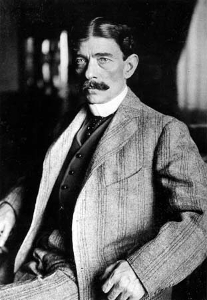
Birth of Henry Harrison, Politician & Writer

henry-harrison

Captain Henry Harrison, nationalist politician and writer, is born in Holywood, County Down on December 17, 1867.

A Protestant nationalist, Harrison is the son of Henry Harrison and Letitia Tennent, the daughter of Robert James Tennent, who had been Liberal Party MP for Belfast from 1847 to 1852. Later, when widowed, she marries the author Hartley Withers.

Harrison goes to Westminster School and then to Balliol College, Oxford. While there he develops an admiration for Charles Stewart Parnell and becomes secretary of the Oxford University Home Rule League. At this time, the Land War is in progress and in 1889 he goes to Ireland to visit the scene of the evictions in Gweedore, County Donegal. He becomes involved in physical confrontations with the Royal Irish Constabulary and as a result becomes a Nationalist celebrity overnight. The following May, Parnell offers the vacant parliamentary seat of Mid Tipperary to Harrison, who leaves Oxford at age 22, to take it up, unopposed.

Only six months later, following the divorce case involving Katharine O’Shea, the Irish Parliamentary Party splits over Parnell’s leadership. Harrison strongly supports Parnell, acts as his bodyguard and aide-de-camp, and after Parnell’s death devotes himself to the service of his widow Katharine. From her he hears a completely different version of the events surrounding the divorce case from that which had appeared in the press, and this is to form the seed of his later books.

At the 1892 United Kingdom general election in Ireland, Harrison does not defend Mid-Tipperary. He stands at West Limerick as a Parnellite instead but comes nowhere near winning the seat. In the 1895 United Kingdom general election in Ireland, he stands at North Sligo, polling better but again far short of winning. In 1895 he marries Maie Byrne, an American, with whom he has a son. He comes to prominence briefly again in 1903 when, in spite of his lack of legal training, he successfully conducts his own case in a court action all the way to the House of Lords.

Otherwise, however, Harrison disappears from public view until his war service with the Royal Irish Regiment when he serves on the Western Front with distinction in the New British Army formed for World War I, reaching the rank of Captain and being awarded the Military Cross (MC). He organises patrols in “No Man’s Land” so successfully that he is appointed special patrol officer to the 16th (Irish) Division. He is invalided out and becomes a recruiting officer in Ireland. He is appointed an Officer of the Order of the British Empire in the 1919 New Year Honours.

Harrison then makes a return to Irish politics, working with Sir Horace Plunkett as Secretary of the Irish Dominion League, an organisation campaigning for dominion status for Ireland within the British Empire. He is a lifelong opponent of Irish partition. He is Irish correspondent of The Economist from 1922 to 1927 and owner-editor of Irish Truth from 1924 to 1927.

Harrison’s two books defending Parnell are published in 1931 and 1938. They have had a major impact on Irish historiography, leading to a more favourable view of Parnell’s role in the O’Shea affair. F. S. L. Lyons comments that he “did more than anyone else to uncover what seems to have been the true facts” about the Parnell-O’Shea liaison. The second book, Parnell, Joseph Chamberlain and Mr Garvin, is written in response to J. L. Garvin‘s biography of Joseph Chamberlain, which had ignored his first book, Parnell Vindicated: The Lifting of the Veil. Later, he successfully repulses an attempt in the official history of The Times to rehabilitate that newspaper’s role in using forged letters to attack Parnell in the late 1880s. In 1952 he forces The Times to publish a four-page correction written by him as an appendix to the fourth volume of the history.

During the difficult years of the Anglo-Irish Trade War over the land purchase annuities, declaration of the Republic, Irish neutrality during World War II, and departure from the Commonwealth, Harrison works to promote good relations between Britain and Ireland. He publishes various books and pamphlets on the issues in dispute and writes numerous letters to The Times. He also founds, with General Sir Hubert Gough, the Commonwealth Irish Association in 1942.

At the time of his death on February 20, 1954, Harrison is the last survivor of the Irish Parliamentary Party led by Parnell, and as a member of the pre-1918 Irish Parliamentary Party, he seems to have been outlived only by John Patrick Hayden, who dies a few months after him in 1954 and by Patrick Whitty and John Lymbrick Esmonde who are only MPs for a very short time during World War I. He is buried in Holywood, County Down.


Leave a comment

1918 Irish General Election

irish-general-election-1918

Sinn Féin, pledged to an Irish Republic, wins 73 of 105 Irish Member of Parliament (MP) seats in the 1918 United Kingdom general election in Ireland held on December 14, 1918. Winners include Constance Markievicz who becomes the first woman elected to the Parliament of the United Kingdom. In 1919 she is appointed Minister for Labour, the first female minister in a democratic government cabinet.

The Irish general election is that part of the 1918 United Kingdom general election which takes place in Ireland. The election is now seen as a key moment in modern Irish history because it sees the overwhelming defeat of the moderate nationalist Irish Parliamentary Party (IPP), which had dominated the Irish political landscape since the 1880s, and a landslide victory for the radical Sinn Féin party. The party had never stood in a general election but had won six seats in by-elections in 1917–1918. Sinn Féin vows in its manifesto to establish an independent Irish Republic. In Ulster, however, the Unionist Party is the most successful party.

The election is held in the aftermath of World War I, the Easter Rising and the Conscription Crisis. It is the first general election to be held after the Representation of the People Act 1918. It is thus the first election in which women over the age of 30, and all men over the age of 21, can vote. Previously, all women and most working-class men had been excluded from voting.

In the aftermath of the elections, Sinn Féin’s elected members refuse to attend the British Parliament in Westminster. Instead, they form a parliament in Dublin, the First Dáil Éireann, which declares Irish independence as a republic. The Irish War of Independence is conducted under this revolutionary government which seeks international recognition and sets about the process of state-building.