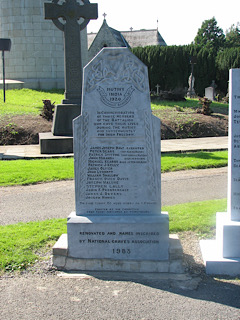
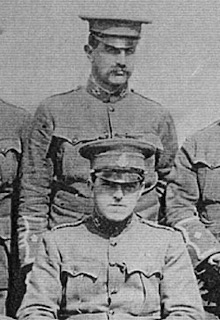
On June 28, 1920, four men from C Company of the 1st Battalion, Connaught Rangers, based at Wellington Barracks, Jalandhar in the Punjab Province, India, protest against martial law in Ireland by refusing to obey orders. One of them, Joe Hawes, had been on leave in County Clare in October 1919 and had seen a hurling match prevented from happening by British forces with bayonets drawn. Poor accommodation conditions in the Wellington Barracks likely provide an additional cause of the dispute.
The protestors are soon joined by other Rangers, including several English soldiers, such as John Miranda from Liverpool and Sergeant Woods. By the following morning, when a rebel muster takes place, 350 Irish members of the Rangers are involved in the mutiny.
On June 30, 1920, two mutineers from the Jalandhar barracks (Frank Geraghty and Patrick Kelly) travel to Solon barracks where C Company are stationed and, despite arrest, help spark a mutiny there, led by PrivateJames Daly, whose brother William also takes part in the protest.
Initially, the protests are peaceful with the men involved donning green, white and orange rosettes and singing Irish nationalist songs. At Solon, however, on the evening of July 1, a party of about thirty men led by James Daly, carrying bayonets, attempt to seize their company’s rifles, stored in the armoury. The troops guarding the magazine open fire and two men are killed: Private Smythe who is with Daly’s party, and Private Peter Sears, who had not been involved in the attack on the magazine but is returning to his billet when hit by a stray bullet. Within days, both garrisons are occupied by other British troops. Daly and his followers surrender and are arrested. Eighty-eight mutineers are court-martialed: seventy-seven are sentenced to imprisonment and ten are acquitted. James Daly is shot by a firing squad at Dagshai Prison on November 2, 1920. He is the last member of the British Armed Forces to be executed for mutiny. The bodies of Privates Sears and Smythe are buried at Solan, while Daly and Miranda (who later dies in prison) are buried at a cemetery in Dagshai. Among those who receive a sentence of life in prison is Martin Conlon, a half brother to the eight brothers from Sligo town who fight in World War I, in which four are killed in action.
In 1923, following Irish Independence, the imprisoned mutineers are released and returned to Ireland. In 1936, the Irish Free State‘s Fianna Fáil government awards pensions to those whose British Army pensions were forfeited by conviction for their part in the mutiny. The bodies of Privates Sears, Smythe, and Daly are repatriated from India to Ireland for reburial in 1970.
O’Toole is the second son among five children of John O’Toole and Bridie O’Toole (née Doran). Of farming stock on both sides, he is educated at the local national school at Ballycumber and at a Dublinsecondary school. When in the mid-1890s he moves to Dublin, he joins the Benburb Gaelic Football Club at Donnybrook, where his teammates include the future nationalist parliamentarian Thomas M. Kettle, who is killed in 1916 near Ginchy, France, during World War I. The proprietor of two newsagents’ shops near his home in Mount Pleasant Square, he soon becomes his club’s delegate to the Dublin county committee of the Gaelic Athletic Association about 1899. Founded in 1884 by Michael Cusack, the GAA by the late 1890s is insolvent and almost moribund, having been riven by rival nationalist factions. However, a group of younger officials which includes O’Toole is determined not to allow the Association to die, and at its annual congress in Thurles on September 22, 1901, stages what is in effect a palace coup. Alderman James Nowlan of Kilkenny, County Kilkenny, a labour activist and Gaelic League enthusiast, is elected president, and in a contest for the post of secretary, O’Toole defeats Cusack.
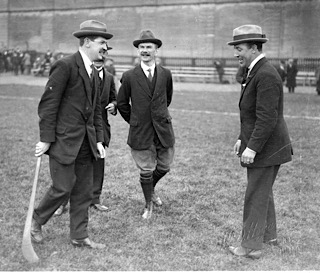
O’Toole holds the post of chief officer of the GAA until his death almost thirty years later. During this period, despite major political and military turmoil, including the world war, the Irish War of Independence, and the Irish Civil War, he is instrumental in turning the Association into the biggest Irish sports body, and some leading members, such as Michael Collins and Harry Boland, play major political roles between 1913 and 1923. Essentially a backroom administrator, O’Toole rarely appears in public apart from GAA events, one notable exception being on November 25, 1913, at the foundation meeting of the Irish Volunteers at the Rotunda Rink, Dublin, where he is one of the platform party. After the suppression of the 1916 Easter Rising, he goes into hiding temporarily in his native Wicklow. From then until the cessation of hostilities in mid-1921 he manages to evade the notice of the authorities though he is always a close associate of Sinn Féin leaders. He plays a big part in reviving the fortunes of the GAA after the Irish Civil War and is a principal organiser of the Tailteann Games in 1924 and 1928. His career, however, is cut short at the age of 56 by his sudden death at his desk on July 17, 1929.
For most of his life O’Toole resides in a house provided by the GAA beside Croke Park, the Association’s headquarters and principal stadium. He marries Bridget Doyle, a shopkeeper of Dublin. They have four sons and four daughters.
(From: “O’Toole, Luke” by Marcus de Búrca, Dictionary of Irish Biography, http://www.dib.ie, October 2009 | Pictured: Michael Collins, Luke O’Toole and Harry Boland in 1921, Image credit: GAA)
On July 1-2, 1915, in Gallipoli, Turkey, when, owing to hostile bombing, some of his troops had retired from a sap, Sergeant Somers remains alone there until a party brings up bombs. He then climbs over into the Turkish trench and bombs the Turks with great effect. Later on, he advances into the open under heavy fire and holds back the enemy by throwing bombs into their flank until a barricade has been established. During this period, he frequently runs to and from his trenches to obtain fresh supplies of bombs.
In a letter to his father, Somers writes:
“I beat the Turks out of our trench single-handed and had four awful hours at night. The Turks swarmed in from all roads, but I gave them a rough time of it, still holding the trench. It is certain sure we are beating the Turks all right. In the trench I came out of, it was shocking to see the dead. They lay, about three thousand Turks, in front of our trenches, and the smell was absolutely chronic. You know when the sun has been shining on those bodies for three or four days it makes a horrible smell; a person would not mind if it was possible to bury them. But no, you dare not put your nose outside the trench, and if you did, you would be a dead man.”
Somers had previously been severely wounded during the Retreat from Mons in August 1914.
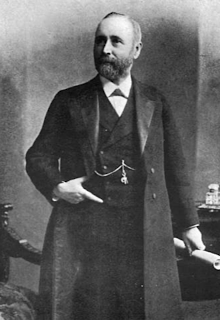
Pirrie is educated at the Royal Belfast Academical Institution before entering Harland & Wolff shipyard as a gentleman apprentice in 1862. Twelve years later he is made a partner in the firm, and on the death of Sir Edward Harland in 1895, he becomes its chairman, a position he holds until his death. As well as overseeing the world’s largest shipyard, he is elected Lord Mayor of Belfast in 1896, and is re-elected to the office as well as made an Irish Privy Counsellor the following year. He becomes Belfast’s first honorary freeman in 1898, and serves in the same year as High Sheriff of Antrim and subsequently of County Down. In February 1900, he is elected President of the UK Chamber of Shipping, where he had been vice-president the previous year. He helps finance the Liberals in Ulster in the 1906 United Kingdom general election, and that same year, at the height of Harland & Wolff’s success, he is raised to the peerage as Baron Pirrie, of the City of Belfast.
In February 1912, after chairing a famous meeting of the Ulster Liberal Association at which Winston Churchill defends the government’s policy of Home Rule for Ireland, Pirrie is jeered on the streets of Belfast, and assaulted as he boards a steamer in Larne: pelted with rotten eggs, herrings, and bags of flour. In 1910, the Ulster Liberal Association, an overwhelmingly Protestant body, with a weekly newspaper, and branch network throughout Ulster, adopts (in opposition to the Ulster Liberal Unionist Association) an explicitly pro-home rule position.
In the months leading up to the 1912 sinking of the RMS Titanic, Pirrie is questioned about the number of life boats aboard the Olympic-classocean liners. He responds that the great ships are unsinkable and the rafts are to save others. This haunts him for the rest of his life. In April 1912, Pirrie is to travel aboard RMS Titanic, but illness prevents him.
During the war Pirrie is a member of the War Office Supply Board, and in 1918 becomes Comptroller-General of Merchant Shipbuilding, organising British production of merchant ships.
In 1921, Pirrie is elected to the Senate of Northern Ireland, and that same year is created ViscountPirrie of the City of Belfast, in the honours for the opening of the Parliament of Northern Ireland in July 1921, for his war work and charity work. In Belfast he is, on other grounds, already a controversial figure: a Protestant employer associated as a leading Liberal with a policy of Home Rule for Ireland.
Pirrie dies at sea off Cuba on June 7, 1924. His body is embalmed. On June 13, Ebro reaches Pier 42 on the North River in New York City, where Pirrie’s friend Andrew Weir, 1st Baron Inverforth and his wife meet Viscountess Pirrie and her sister. UK ships in the port of New York lower their flags to half-mast, and Pirrie’s body is transferred to Pier 59, where it is embarked on White Star Line‘s RMS Olympic, one of the largest ships Pirrie ever built, to be repatriated to the UK. He is buried in Belfast City Cemetery. The barony and viscountcy die with him. Lady Pirrie dies on June 19, 1935. A memorial to Pirrie in the grounds of Belfast City Hall is unveiled in 2006.
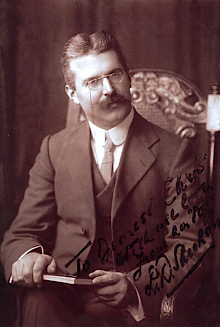
The eldest of the three sons and one daughter of Daniel Sheehan, tenant farmer, and his wife, Ellen (née Fitzgerald). He is educated at the local primary school. In his book Ireland since Parnell (1921) he states that witnessing the ragged poverty of labourers’ and smallholders’ children who attended the school made him determined to do something for the poor. The family’s Fenian tradition and his parents’ eviction from their holding in 1880 form his early years. At the age of sixteen he becomes a schoolteacher.
In 1890, Sheehan takes up journalism, serving as correspondent of the Kerry Sentinel and special correspondent of the Cork Daily Herald in Killarney. He also becomes correspondence secretary to the Kanturk trade and labour council, which campaigns on behalf of agricultural labourers. He manages to get reports of meetings into the Cork papers, and this helps the rapid spread of the association, which in 1890 becomes the Irish Democratic Trade and Labour Federation, under the leadership of Michael Davitt. It is, however, fatally disrupted by the Parnell split. While Sheehan continues to admire Davitt, and despite the pre-split Irish party leadership having opposed the federation as a threat to Charles Stewart Parnell‘s leadership, he becomes a Parnellite, and always remembers his only meeting with Parnell at Tralee, when the chief is presented with a loyal address (drafted by Sheehan) from his Killarney supporters. After Parnell’s death and the defeat of the Second Home Rule Bill, he temporarily drops out of Irish politics.
Following his marriage on February 6, 1894, to Mary Pauline O’Connor of Tralee, Sheehan joins the staff of the Glasgow Observer in pursuit of journalistic experience, then becomes editor of the Catholic News in Preston, Lancashire. In 1898, he returns to Ireland and works on various papers, including the Cork Constitution, before serving as editor of the Skibbereen-based Cork County Southern Star (1899–1901), where his Parnellism brings him into conflict with the Bishop of Ross, Denis Kelly. He expresses sympathy for the newly founded United Irish League (UIL), established by William O’Brien in Connacht with the dual aim of representing western smallholders and using a new land agitation as a vehicle for Irish Party reunion. He does not, however, join the UIL himself.
In August 1894, the Clonmel solicitor J. J. O’Shee, anti-Parnellite MP for West Waterford from 1895, forms the Irish Land and Labour Association (ILLA) to agitate on behalf of agricultural labourers and small tenant farmers. Its appearance reflects the breakdown of the centralised party discipline which had existed before the Parnell split, and recognition that the land war’s prime beneficiaries had been large and middle-sized tenant farmers rather than the nation as a whole. On returning from Britain in 1898, Sheehan throws himself into organising the ILLA and becomes its president. In 1900 there are 100 branches, mostly in Cork, Tipperary, and Limerick. The Irish Party leadership look on this organisation with some suspicion.
At the 1900 United Kingdom general election in Ireland Sheehan seeks the Irish Parliamentary Party (IPP) nomination for South Cork but was defeated by Edward Barry. After the death of Dr Charles Tanner, however, he succeeds in obtaining the IPP nomination for the constituency of Mid Cork, despite the party leadership’s attempts to deny recognition to ILLA branches in order to hand the nomination to its favoured candidate. Sheehan is elected unopposed on May 17, 1901. At the age of 28, he is the youngest Irish member of parliament. Although he has been admitted to the party, his position as a labour representative and his perceived independent base make him something of an outsider.
From October 1904 Sheehan allies himself with O’Brien, writing regularly for the latter’s weekly a TheIrish People. Redmondites accuse him of opportunism, but he always maintains that his personal inclination as an old Parnellite has been towards John Redmond and that his support for O’Brien derives from the older man’s willingness from 1904 to identify himself with the labourers’ campaign. Although their alliance originally likely contains elements of expediency, Sheehan and O’Brien develop a deep personal friendship.
Sheehan’s support for O’Brien leads to a split in the ILLA in 1906, with Tipperary and Waterford branches following O’Shee and Redmond, and Sheehan retaining the support of his Cork base and of some branches in Limerick and Kerry. He serves on the Cork advisory committee which represents tenant interests in land purchase negotiations under the Wyndham Land Act. It’s policy of “conference plus business” combines an offer to negotiate with willing landlords and a threat of agitation against those unwilling to give satisfactory terms. His faction of the ILLA becomes the basis for the grassroots organisation of O’Brien’s followers, and sporadic attempts, financed by O’Brien, are made to spread it outside its Munster base. Both factions of the ILLA claim credit for the passage of the 1906 and 1911 Labourers’ (Ireland) Acts which provide for the allocation of cottages and smallholdings to labourers. In Cork and some other parts of Munster these buildings become popularly known as “Sheehan’s cottages,” a term which long outlives Sheehan’s political career. He also helps to bring about the creation of a “model village” at Tower, near Blarney, the result of cooperation between the local ILLA branch and the rural district council.
At the 1906 general election the Redmond leadership attempts to avoid an open split by allowing O’Brien’s supporters to return unopposed. However, the continuing conflict between the two factions rapidly leads to a formal break. Shortly after the election Sheehan is excluded from the IPP, and thereby deprived of the parliamentary stipend paid to MPs with insufficient resources to maintain themselves. With the support of O’Brien and the small group of O’Brienite MPs, he maintains that the party has no right to exclude an elected MP willing to take the party pledge. After resigning his seat to which he was re-elected without opposition on December 31, 1906, he demands readmission to the party and mounts an unsuccessful lawsuit demanding payment of the stipend. He is subsequently supported from the proceeds of collections outside church gates on Sundays.
Sheehan and the other O’Brienite MPs are readmitted to the party in 1908 as part of an attempt at general reconciliation after the disruptions following the rejection of the Irish Council Bill. Dissensions rapidly reappear over Augustine Birrell‘s 1909 land act, which the O’Brienites see as wriggling out of the financial responsibilities accepted by the British government in the Wyndham land act and as sabotaging land purchase, since landlords will not accept the terms offered. Sheehan’s section of the ILLA is denied official recognition and thereby prevented from sending delegates to a party convention called to consider the bill. At the convention, groups of “heavies”recruited from Joseph Devlin‘s Ancient Order of Hibernians (AOH) exclude delegates with Cork accents, while O’Brienite speakers are howled down. This leads to the formation in March 1909 of the All-for-Ireland League (AFIL), a body based on the existing O’Brienite organisation and advocating O’Brien’s policy of gradually implementing home rule through step-by-step cooperation with moderate unionist supporters of devolution. Although O’Brien’s temporary retirement for health reasons in April 1909 leads to the suspension of the AFIL, it is revived in response to an attempted purge of the O’Brienite MPs by the leadership and by O’Brien’s reappearance in response to the January 1910 general election. Sheehan writes regularly for its paper, the Cork Free Press.
In the general election the O’Brienites hold their seats while two Cork Redmondites are displaced. Sheehan is re-elected for Mid Cork, defeating the Redmondite W. G. Fallon in a campaign marked by widespread rioting and impassioned clerical denunciations of Sheehan. Fallon subsequently attempts to get up a “red scare” against the ILLA. The Cork ILLA later splits over Sheehan’s slightly erratic leadership. While the split is initially personality-driven, the breakaway faction, led by Patrick Bradley and centred in east Cork, moves back toward alignment with Redmond. At the December 1910 election the AFIL consolidates its position in Cork, but is defeated everywhere else. Sheehan retains his Mid Cork seat against a local candidate but is defeated in a simultaneous contest in East Limerick. He is also defeated when he stands for Cork County Council in June 1911, though the AFIL wins control of that body.
Sheehan studies law at University College Cork (UCC) (1908–09), where he is an exhibitioner and prizeman, and at King’s Inns, where he graduated with honours. He is called to the bar in 1911 and practised on the Munster circuit. In 1913–14 he is active in the AFIL’s attempts to avert partition by trying to recruit sections of British political opinion in favour of a conference between the parties. He becomes vice-chairman of the Imperial Federation League. This receives considerable attention among the British political classes but contributes to the decline of the AFIL’s electoral base. The policy of conciliation has been driven to a considerable extent by the belief that it is the only way of achieving home rule. The abolition of the House of Lords’ veto and the introduction of the third home rule bill by the Asquith government undercuts this argument and increases Redmond’s prestige, while AFIL denunciations of Redmondism are seen as driven by personal resentment and playing into the hands of unionists. The decision of the AFIL MPs to abstain from supporting the bill on its final passage through the House of Commons in 1914 as a protest against the prospect of a partition-based compromise is represented by Redmondites as a vote against home rule itself and contributed to AFIL loss of Cork County Council in June 1914.
On the outbreak of World War I, Sheehan supports O’Brien in calling for Irish enlistment for foreign service. In November 1914, at the age of forty-two, he enlists himself and is gazetted as a lieutenant in the Royal Munster Fusiliers. It is claimed that he is almost single-handedly responsible for raising the 9th (service) battalion of this regiment. Three of his sons also enlist. Two of his sons are killed in action with the Royal Flying Corps, and a daughter is disabled by injuries received in an air raid while serving as a nurse. In the spring and summer of 1915 he organises and leads recruiting campaigns in Cork, Limerick, and Clare. This is part of a nationwide drive for recruits, aimed in particular at the farming community, which reflects the realisation that the war is going to last much longer than expected.
In 1915, Sheehan is promoted to the rank of captain and serves with his battalion on the Loos-en-Gohellesalient and at the Battle of the Somme, contributing a series of articles from the trenches to the London Daily Express. Various ailments, including deafness caused by shellfire, and hospitalisation necessitate his transfer to the 3rd Royal Munster Fusiliers (Reserve) Battalion, and he resigns his commission on January 13, 1918, due to ill health. In April 1918 he speaks at Westminster against the bill extending conscription to Ireland, threatening to resist it by force. One of his last parliamentary speeches (in October 1918) is in support of a bill providing land grants for Irish ex-servicemen. With the growth of Sinn Féin and the virtual demise of the AFIL, his position in Cork grows increasingly untenable. The Sheehan family faces intimidation and are obliged to leave their home on the Victoria Road for London, where he has secured the Labour Party nomination for the Limehouse–Stepney division of the East End, later represented by Clement Attlee.
Sheehan is unsuccessful in the 1918 United Kingdom general election, and is obliged to leave politics after a financially disastrous involvement in an Achill Island mining company leads to his bankruptcy. Unable to practise at the bar because of the hearing loss caused by his war service, he returns to journalism and becomes editor and publisher of TheStadium, a daily newspaper for sportsmen. In 1921, shortly before the Anglo-Irish truce, he publishes Ireland since Parnell, a history of recent events heavily dependent on the writings of O’Brien but incorporating some personal reminiscences. It concludes by blaming the outbreak of the IRA guerrilla campaign on provocation by Crown forces, denouncing reprisals, and pleading for British recognition of Dáil Éireann and dominion home rule for an undivided Ireland.
Sheehan moves to Dublin in 1926 after hearing that the threats against him have been lifted. His wife, who has never fully recovered from the stresses and bereavements she has experienced since 1914, dies soon afterward. Sheehan himself becomes managing editor of Irish Press and Publicity Services and, in 1928, publisher and editor of the South Dublin Chronicle. The paper gives critical support to the Irish Labour Party, publishes campaigning articles on slum conditions, and advocates housing reform. In September 1930, he is an unsuccessful Labour candidate for Dublin County Council. In the 1930s, as his health deteriorates further, he works as coordinator for the ex-servicemen’s group the Old Comrades’ Association, editing both northern and southern editions of its annual journal. In 1942, he offers himself to Richard Mulcahy as a Fine Gael candidate for Cork South-East, but is turned down. He dies on November 28, 1948, while visiting his daughter at Queen Anne Street, London. Both he and his wife are buried in Glasnevin Cemetery.
(From: “Sheehan, Daniel Desmond (‘D. D.’)” by Patrick Maume, Dictionary of Irish Biography, http://www.dib.ie, October 2009)
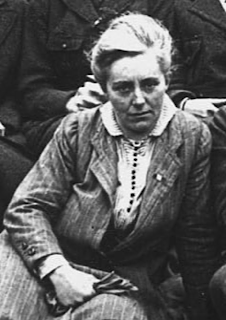
Ffrench-Mullen is born on December 30, 1880, in Malta, where her father, St. Lawrence ffrench-Mullen, a Royal Navy surgeon, is stationed. She has two brothers, St. Lawrence Patrick Joseph (1890–1891) and Douglas (1893–1943).
Ffrench-Mullen’s interest in politics starts young. Her father is a committed Parnellite and their Dundrum home is a campaign headquarters. She is a radical feminist and republican during her life. Like many others of the time, she regards it as a woman’s right to vote. She joins the suffrage movement, and meets women with a similar worldview and values. The women’s suffrage movement is included in the Movements of Extremists reports of the Dublin Metropolitan Police. Ffrench-Mullen goes on to join Inghinidhe na hÉireann, a radical nationalist women’s group founded by Maud Gonne in 1900. The organisation develops into Cumann na mBan in 1913. Suffragist values are central to Cumann na mBan’s goal of standing side-by-side with men in the fight for the Irish Republic. Some members see this as women regaining the rights that had belonged to them in pre-invasion Gaelic civilisation. She is on the socialist wing of the moment, holding to the ideals of universal social equality of the syndicalist James Connolly and the Irish Citizen Army (ICA).
During the 1916 Easter Rising, ffrench-Mullen serves as a lieutenant in the Irish Citizen Army. She sees action with the St. Stephen’s Green and Royal College of Surgeons garrison. In St. Stephen’s Green she is in command of the 15 Citizen Army women who set up a medical station and field kitchen. While occupying St. Stephen’s Green, she and her comrades come under sustained heavy fire from the Shelbourne Hotel and buildings on the north side of the Green. After the surrender of the College of Surgeons garrison, ffrench-Mullen is one of the 77 women who had fought in the Rising who are imprisoned, among them her life partner Kathleen Lynn. While in captivity ffrench Mullen is moved three times, spending time in Richmond Barracks, Kilmainham Gaol and Mountjoy Prison. She is released on June 5, 1916.
Ffrench-Mullen meets Kathleen Lynn through Inghinidhe na h-Éireann. In 1915, she moves into Lynn’s home in Belgrave Road, Rathmines, where they live together for thirty years, until ffrench-Mullen’s death in 1944.
Ffrench-Mullen records in her prison diary in 1916 that she can face prison without fear once Lynn (whom she refers to as “the Doctor”) and she are together. Katherine Lynch of the Women’s Studies Centre at University College Dublin (UCD) describes them as partners, calling them part of a network of lesbians living in Dublin—which includes Helena Molony, Louie Bennett and Elizabeth O’Farrell—who meet through the suffrage movement and later become involved with the national and trade union movement. These women are featured, along with Eva Gore-Booth and others, in a 2023 TG4 documentary about “the radical queer women at the very heart of the Irish Revolution”: Croíthe Radacacha (Radical Hearts).
In 1919, Madeleine ffrench-Mullen and Kathleen Lynn establish Saint Ultan’s Children’s Hospital, also known as Teach Ultan, which is a female-run hospital for infants at 37 Charlemont Street, Dublin. The hospital focuses on children’s health and wellbeing, an area that is perceived at the time as women’s concern. In the aftermath of World War I many health problems have arisen including a rise in venereal diseases such as syphilis, carried from soldiers returning home from war. Many of Ireland’s infants of the time suffer from congenital syphilis (inherited disease from mother at birth), and this is a driving factor in the opening of St Ultan’s hospital. Tuberculosis is endemic in Ireland during its time as a British colony. Against steadfast opposition by the State and the Catholic Church, Lynn and ffrench-Mullen establish a vaccination project, vaccinating thousands of impoverished children who would have died of tuberculosis without their vaccines. Their success leads to the foundation of Ireland’s BCG vaccine programme, which has vaccinated all babies since the 1950s.
Ffrench-Mullen dies at the age of 63 in a Dublin nursing home on May 26, 1944. She is interred with her parents as well as her younger brothers (whom she outlives) in the ffrench-Mullen family plot in Glasnevin Cemetery. Her funeral takes place on the same day as the 1944 Irish general election.
Perceval-Maxwell is born in 1870, the only son of John Perceval-Maxwell, eldest son of Robert Perceval-Maxwell DL (1813–1905), of Finnebrogue House, Downpatrick, County Down.
Perceval-Maxwell is educated at Eton College. He plays a significant part in the raising of the 36th (Ulster) Division on the outbreak of World War I. He is commissioned Major in the 13th (County Down) Battalion, Royal Irish Rifles, which he had raised, in September 1914, and is appointed second-in-command in December 1914. He is promoted to the temporary rank of Lieutenant-Colonel and commands a battalion from November 1916 and commands a battalion of the Royal Munster Fusiliers from May 1918. He is seriously wounded during the war. He resigns his commission in January 1919.
He is appointed to the Privy Council of Ireland in the honours for the opening of the Parliament of Northern Ireland in July 1921, entitling him to the style “The Right Honourable.” He serves in the Northern Ireland Senate from 1921 to 1925.
In 1895, Perceval-Maxwell marries Edith Grace Head. They have five sons: John Robert Perceval-Maxwell (born 1896), Richard Henry (born 1897, killed in action in 1916), Patrick Edward (born 1900), Brian Stephen (born 1908), and David (born 1911).
Perceval-Maxwell dies at the age of 62 on May 24, 1932, in a Belfast nursing home. He is buried in Inch Parish Churchyard, Downpatrick.
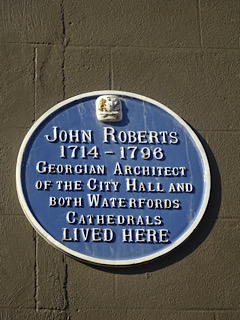
Roberts is born in Waterford in 1712 or 1714, the son of Thomas Roberts, an architect and builder. Little is known of his early life, although he possibly trains in London for a time. At 17, he elopes with Mary Susannah Sautelle, a Huguenot heiress who also lives in Waterford.
In 1785, Roberts builds a house in Waterford for William Morris, now the Harbour Commissioners’ headquarters and the Chamber of Commerce. In 1786, he designs Newtown House, later Newtown School, a Quaker school. In 1787, he designs The Leper Hospital and Church of St. Stephen. He also builds the Assembly Rooms on Waterford’s Mall in 1788, which is now the Theatre Royal and City Hall.
Roberts has between 21 and 24 children with his wife Susannah, of whom eight live to adulthood, including the painters Thomas Roberts and Thomas Sautelle Roberts. They live for many years in the old bishop’s palace, opposite the cathedral, with a country residence at Roberts Mount. He is nicknamed “Honest John” because he pays his workers so reliably, sometimes giving half their pay directly to their wives so that it would not be wasted on alcohol.
Roberts dies on May 23, 1796, after falling asleep on the floor of the Cathedral of the Most Holy Trinity, Waterford, and contracting pneumonia. The main square in Waterford is named John Roberts Square in his honour.
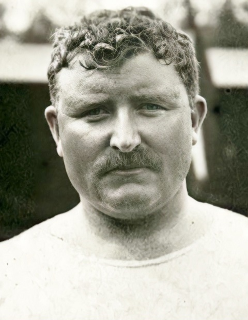
McDonald was born Patrick Joseph McDonnell in Killard, County Clare, on July 29, 1878. When his sister lands at Ellis Island after her sea voyage from Ireland, immigration officials pin a name tag on her with her name spelled “McDonald.” Taking no chances of being deported, she and all the McDonnells who come after her, accept the name McDonald.
McDonald competes for the United States in the 1912 Summer Olympics held in Stockholm, Sweden, in the shot put where he once again defeats Rose and wins the gold medal. He also takes part in the shot put competition where the distance thrown with each hand is added together. This is the only time this event is held in the Olympic program, and he finishes second behind Rose.
McDonald continues to be a nationally competitive athlete well into his 50s. At the age of 54, he beats his old rival Matt McGrath to win the weight throw for distance at the 1933 USA Outdoor Track and Field Championships. It is his 26th senior national championship meet, and the Omaha World-Herald notes that he has gray hair at the time of his last victory.
The U-20, a GermanU-boat under the command of KapitänleutnantWalther Schwieger, sinks the British steamship Centurion off the southeast coast of Ireland on May 6, 1915. This tragic event has far-reaching consequences and shapes the course of World War I.
The Centurion is traveling through the waters southeast of Ireland when a torpedo fired from the U-20 hits the vessel, causing it to rapidly sink. This act of aggression results in the loss of many innocent lives and sends shockwaves throughout the world.
At the time of the incident, World War I is in full swing. Germany, engaged in submarine warfare, seeks to disrupt British supply lines and cut off its access to vital resources. The sinking of merchant ships, regardless of their civilian nature, is part of Germany’s strategy to weaken the enemy. The attack on the Centurion is just one of many instances in which German submarines target and sink British vessels.
A difference in this particular incident as opposed to other similar incidents is the widespread outrage it triggers. The Centurion is an unarmed cargo ship carrying civilian goods, and its destruction is seen as a ruthless and unjustifiable act. The loss of civilian lives and the callousness with which the submarine attack is executed causes public opinion to turn against Germany.
The sinking highlights the growing concern over unrestricted submarine warfare and its impact on civilian populations. It pushes the United States, which at the time is neutral, closer to entering the war on the side of the Allies. The incident also plays a significant role in shaping public opinion in other neutral countries, putting pressure on Germany to reconsider its aggressive tactics.
In response to international outrage, Germany initially defends its actions, arguing that the Centurion was carrying contraband cargo. However, under mounting pressure, the German government eventually backs down and pledges to modify its submarine warfare policies to reduce the risk to civilian lives. This move is meant to appease neutral countries and prevent the United States from entering the war.
The sinking of the Centurion has a lasting impact on maritime warfare. The incident leads to the introduction of new rules of engagement, such as the requirement for submarines to surface and warn civilian vessels before attacking. These rules aim to minimize civilian casualties and reduce the risk of similar tragedies occurring in the future.
Moreover, the sinking serves as a catalyst for technological advancements in submarine warfare. Navies worldwide realize the need for more sophisticated anti-submarine measures and began developing detection systems and tactics to counter the stealth of submarines. This incident marks a turning point in the evolution of naval warfare, as nations seek to adapt and respond to the new challenges posed by underwater vessels.
The following day, May 7, 1915, the U-20 sinks the British ocean linerRMS Lusitania off the southern coast of Ireland. The liner sinks in eighteen minutes with 1,197 casualties. The wreck lies in 300 feet of water.
On November 4, 1916, U-20 becomes grounded on the Danish coast south of Vrist, after suffering damage to its engines. Her crew attempts to destroy her with explosives the following day, succeeding only in damaging the boat’s bow but making it effectively inoperative as a warship.
The U-20 remains on the beach until 1925 when the Danish government blows it up in a “spectacular explosion.” The Danish navy removes the deck gun and makes it unserviceable by cutting holes in vital parts. The gun is kept in the naval stores at Holmen, Copenhagen for almost 80 years. The conning tower is removed and placed on the front lawn of the local museum Strandingsmuseum St. George Thorsminde, where it remains today.
(Pictured: The U-20, second from left, at Kiel, Schleswig-Holstein, on February 17, 1914)



 seamus dubhghaill