The Most Reverend William MacNeely, the Bishop of Raphoe from 1923 until 1963, is born in County Donegal on December 28, 1889. He has the distinction of being Raphoe’s first completely Roman-educated bishop.
MacNeely is the son of a butcher in Donegal Town. He is educated at the High School in Letterkenny, and in Rome from 1906–12. He is ordained to the priesthood on February 4, 1912, and upon his return to Ireland is appointed to the staff of St. Eunan’s College.
On July 27, 1923, at the comparatively young age of 35, MacNeely is ordained as Bishop of Raphoe in succession to Bishop Patrick O’Donnell who had been appointed coadjutorArchbishop of Armagh the previous year. In this role he is responsible for the completion of the Cathedral of St. Eunan and St. Columba in Letterkenny and negotiating with Harry Clarke to finish the work of glazing the cathedral.
Keen to develop religious life in his diocese, MacNeely invites the Capuchin Franciscans to the Creeslough area in 1930 to a site that becomes known as Ards Priory.
In a diocese where farming is the main industry, MacNeely maintains a strong interest in farming, being himself a successful breeder of Shorthorn cattle.
In 2008, it is reported that MacNeely was one of the two Irish episcopal coordinators who worked alongside “an intelligence-gathering secret service” set up in 1948 to monitor any sign of a “Communist takeover” of Ireland.
In 1953, MacNeely is a member of the inaugural Episcopal Commission for Emigrants reflecting the high levels of migration that afflict his diocese and wider Donegal for much of the twentieth century.
MacNeely serves as Bishop for over forty years, attending the early sessions of the Second Vatican Council. Shortly before his death, he is appointed Assistant to the Papal Throne. He dies on December 11, 1963, and is interred beside the Cathedral of St. Eunan and St. Columba.
Orpen is the fourth and youngest son of Arthur Herbert Orpen (1830–1926), a solicitor, and his wife, Anne Caulfield (1834–1912), the eldest daughter of the Right Rev. Charles Caulfield (1804–1862), the Bishop of Nassau. Both his parents are amateur painters, and his eldest brother, Richard Caulfield Orpen, becomes a notable architect. His nieces are Bea Orpen and Kathleen Delap. The historian Goddard Henry Orpen is his second cousin. The family lives at “Oriel,” a large house with extensive grounds containing stables and a tennis court. He appears to have a happy childhood there.
Orpen is a naturally talented painter, and six weeks before his thirteenth birthday is enrolled at the Dublin Metropolitan School of Art. During his six years at the college, he wins every major prize there, plus the British Isles gold medal for life drawing, before leaving to study at the Slade School of Fine Art in London between 1897 and 1899. At the Slade he masters oil painting and begins to experiment with different painting techniques and effects.
While at the Slade, Orpen becomes engaged to Emily Scobel, a model and the subject of his painting The Mirror (1900). She ends their relationship in 1901, and he marries Grace Knewstub, the sister-in-law of Sir William Rothenstein. He and Knewstub have three daughters together, but the marriage is not a happy one. By 1908, he has begun a long-running affair with Evelyn Saint-George, a well-connected American millionairess based in London, with whom he also has a child.
Orpen first exhibits at the New English Art Club (NEAC) in 1899, becoming a member in 1900. In 1901, he holds a solo exhibition at the Carfax Gallery in central London. His portraits, which establish his reputation, show the influence of the Realist artist Édouard Manet. He also becomes known as a painter of group portraits such as Homage to Manet (1909), in which he portrays members of the contemporary English art world sitting in conversation beneath a famous portrait by that artist.
At the start of World War I, a number of Irish people living in England return to Ireland to avoid conscription. Among them is Orpen’s studio assistant and former pupil, Seán Keating. Keating encourages him to do likewise, but he refuses and commits himself to supporting the British war effort. In December 1915, he is commissioned into the Royal Army Service Corps and reports for clerical duty at London’s Kensington Barracks in March 1916. Throughout 1916 he continues painting portraits, most notably one of a despondent Winston Churchill, but soon starts using both his own contacts and those of Evelyn Saint-George, to secure a war artist posting.
He is the official painter of the Paris Peace Conference after World War I. Throughout 1919 he paints individual portraits of the delegates to the Conference and these form the basis of his two large paintings, A Peace Conference at the Quai d’Orsay and The Signing of Peace in the Hall of Mirrors. In both pictures, the architecture overwhelms the gathered politicians and statesmen who’s political wranglings and vainglory diminish them in Orpen’s eyes.
Orpen becomes seriously ill in May 1931, and, after suffering periods of memory loss, dies at the age of 52 on September 29, 1931, in South Kensington, London, of liver and heart failure. He is buried at Putney Vale Cemetery in southwest London. A stone tablet in the Island of Ireland Peace Park Memorial at Mesen, Belgium, commemorates him. He is posthumously regarded as a facile and prolific, but somewhat superficial, artist who nevertheless achieves great popularity in his day.
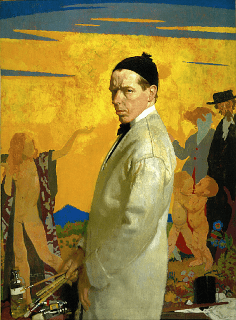
(Pictured: “Self-portrait” (1913), oil on canvas by William Orpen, Saint Louis Art Museum)
O’Kelly is born on August 25, 1882, on Capel Street in the north inner-city of Dublin. He joins the National Library of Ireland in 1898 as a junior assistant. That same year, he joins the Gaelic League, becoming a member of the governing body in 1910 and General Secretary in 1915.
In 1905 O’Kelly joins Sinn Féin who, at the time, supports a dual monarchy. He is an honorary secretary of the party from 1908 until 1925. In 1906 he is elected to Dublin Corporation, which is Dublin’s city council. He retains the seat for the Inns Quay Ward until 1924.
O’Kelly is elected Sinn Féin MP for Dublin College Green in the 1918 Irish general election. Along with other Sinn Féin MPs he refuses to take his seat in the British House of Commons. Instead, they set up an Irish parliament, called Dáil Éireann, in Dublin. O’Kelly is Ceann Comhairle (Chairman) of the First Dáil. He is the Irish Republic’s envoy to the post-World War I peace treaty negotiations at the Palace of Versailles, but the other countries refuse to allow him to speak as they do not recognise the Irish Republic.
O’Kelly is a close friend of Éamon de Valera, and both he and de Valera oppose the Anglo-Irish Treaty of December 1921. When de Valera resigns as President of the Irish Republic on January 6, 1922, O’Kelly returns from Paris to try to persuade de Valera to return to the presidency but de Valera orders him to return to Paris.
During the Irish Civil War, O’Kelly is jailed until December 1923. Afterwards he spends the next two years as a Sinn Féin envoy to the United States.
In 1926 when de Valera leaves Sinn Féin to found his own republican party, Fianna Fáil, O’Kelly follows him, becoming one of the party’s founding members. In 1932, when de Valera is appointed President of the Executive Council of the Irish Free State, he makes O’Kelly the Minister for Local Government and Public Health. He often tries to publicly humiliate the Governor-General of the Irish Free State, James McNeill, which damages O’Kelly’s reputation and image, particularly when the campaign backfires.
In 1938, many believe that de Valera wants to make O’Kelly the Fianna Fáil choice to become President of Ireland, under the new Irish constitution, Bunreacht na hÉireann. When Lord Mayor of Dublin, Alfie Byrne, says he wants to be president there is an all-party agreement to nominate Douglas Hyde, a Protestant Irish Senator, Irish language enthusiast and founder of the Gaelic League. They believe Hyde to be the only person who might win an election against Alfie Byrne. O’Kelly is instead appointed Minister of Finance and helps create Central Bank in 1942.
O’Kelly leaves the cabinet when he is elected President of Ireland on June 18, 1945, in a popular vote of the people, defeating two other candidates. He is re-elected unopposed in 1952. During his second term he visits many nations in Europe and speaks before the United States Congress in 1959. He retires at the end of his second term in 1959, to be replaced by his old friend, Éamon de Valera. Following his retirement, he is described as a model president by the normally hostile newspaper, The Irish Times. Though controversial, he is widely seen as genuine and honest, but tactless.
O’Kelly’s strong Roman Catholic beliefs sometimes cause problems. Éamon de Valera often thinks that O’Kelly either deliberately or accidentally leaks information to the Knights of Saint Columbanus and the Church leaders. He ensures that his first state visit, following the creation of the Republic of Ireland in 1949, is to the Vatican City to meet Pope Pius XII. He accidentally reveals the Pope’s private views on communism. This angers the Pope and Joseph Stalin and is why he is not given the papal Supreme Order of Christ which is given to many Catholic heads of state.
On his retirement O’Kelly gives a series of radio talks about his early life and the independence movement. These form the basis of an account serialised in TheIrish Press (July 3 to August 9, 1961) and subsequently translated into Irish and published as Seán T. (1963), echoing the nickname by which he is commonly known. The book relies heavily on memory and its accuracy on points of detail has been questioned by scholars such as F. X. Martin. In retirement he lived at his home, Roundwood Park in County Wicklow.
O’Kelly dies at the Mater Private Nursing Home in Dublin on November 23, 1966, at the age of 84, fifty years after the Easter Rising that first brought him to prominence. He is buried in Glasnevin Cemetery, Glasnevin, Dublin. His perceived unctuousness and his opportunistic tendencies in his later career should not efface his significance as a separatist organiser and an effective populist politician, who played a major role in the establishment of Fianna Fáil political hegemony.
At dawn on the morning of November 20, 1917, the 16th (Irish) Division of the British Army assaults an area of the German lines known as “Tunnel Trench,” named for an elaborate tunnel system that runs along it. The attack is meant as a diversion for the main attack, about eight miles to the southeast at Cambrai, France, where six infantry and two cavalry divisions of the British Expeditionary Force, with additional support from fourteen squadrons of the Royal Flying Corps, join the British Tank Corps in a surprise attack on the German lines.
By autumn 1917, three years into World War I, continuous shelling and lack of drainage has transformed the Ypres Salient, on the Western Front, into a waterlogged quagmire. In Ireland, meanwhile, a month earlier, Eamon de Valera becomes president of Sinn Féin and decides to push for an independent Irish republic. Despite the growing political turmoil at home, in France, on firm ground near the town of Cambrai, the British Army’s 16th (Irish) Division again proves to be formidable adversaries for the Germans.
According to the divisional historian, at Cambrai, the “swift and successful operation by 16th Division was a model of attack with a limited objective.” In addition to securing 3,000 yards of trench, 635 prisoners are captured from the German army’s 470th and 471st Regiments and 330 German bodies are counted in the trenches. More importantly, though, the mayhem caused by the diversionary assault contributes greatly to the initial success of the Cambrai offensive, though the offensive eventually sputters, dragging the war into 1918.
Cambrai becomes the field of operations when the British Commander-in-Chief, Field MarshalDouglas Haig, recognising that it is impossible to launch further military operations in the Ypres sector, seeks a new battlefield where he hopes success can be achieved before year’s end. Lieutenant ColonelJohn Fuller of the Tank Corps and GeneralJulian Byng, commander of the Third Army, recommend that a massed assault by 400 tanks should be mounted across the firm, chalky ground to the southwest of Cambrai. Haig adopts this proposal, confident that the tanks can punch a hole through the mighty Hindenburg Line and allow his underused Cavalry Divisions to break through to the enemy rear.
In order to create maximum confusion among the Germans, Sir Aylmer Haldane, commander of VI Corps, is ordered to stage a diversionary attack. The area selected for the assault is about eight miles to the northwest of Cambrai, where the British line passes through the villages of Bullecourt and Fontaine-lès-Croisilles. The units select to make this subsidiary attack are 3rd Army and 16th (Irish) Division.
The defences of the Hindenburg Line opposite VI Corps positions consists of Tunnel Trench, a heavily defended front-line trench, with a second, or support trench, some 300 yards behind. The whole area is scattered with concrete machine gun forts, or Mebus, similar to those that had decimated the 16th (Irish) Division at the Battle of Langemarck three months earlier.
Tunnel Trench is so called because it has a tunnel 30 or 40 feet below ground along its entire length, with staircase access from the upper level every 25 yards. The entire tunnel has electric lighting, and side chambers provide storage space for bunks, food, and ammunition. Demolition charges are set that can be triggered from the German rear in order to prevent the defences from falling into British hands.
The 16th (Irish) Division, attacking on a three-brigade front, is assigned the task of capturing a 2,000-yard section of the trench network. On the right flank of the Irishmen, 3rd Division’s 9th Brigade is detailed to capture an additional 800 yards. One unusual feature of the attack is that there is to be no preliminary bombardment as surprise is the key to the success of the operation. Once the assault begins, however, 16th (Irish) Division’s artillery, reinforced with guns from the 34th Division, is to open a creeping barrage upon the German positions.
The morning of the advance, November 20, is overcast, with low visibility. At 6:20 a.m., the Divisional 18 pounder-field guns open fire, and the leading assault companies spring from their jump-off positions. At the same time, Stokes mortars begin to lay a smoke barrage upon the German trenches in imitation of a gas attack. This deception proves successful, as many German troops don cumbersome gas masks and retreat to the underground safety of the tunnel, thus leaving the exposed portion of the trench undefended.
On the left flank, the attack of the 49th Brigade is launched by 2nd Royal Irish Regiment and 7/8th Royal Irish Fusiliers. They quickly cross the 200 yards of no-man’s-land and reach the enemy frontline just as the barrage lifts. Resistance above ground is minimal, and storming parties began the task of flushing the Germans from the tunnel with Mills bombs and bayonets.
Once the tunnel is secure, sappers, acting on information obtained by 7th Leinster Regiment’s intelligence officer, cut the leads connecting the demolition charges. Supporting companies then press on to capture Tunnel Support Trench, while Divisional support units rapidly wire and made secure the new defensive front in anticipation of German counterattacks.
Only on the extreme left flank does 49th Brigade encounter any serious opposition. In this sector, Company “B” of the 7/8th Royal Irish Fusiliers suffers heavy losses inflicted by concentrated machine gun fire from Mebus Flora. Nearly one-hour elapses before resistance from this strong point can be overcome.
In the centre, 10th and 2nd Royal Dublin Fusiliers head the attack of the 48th Brigade. The advance here is so rapid that the Irish find many Germans still wearing gas masks and unable to fight. Two more Mebus, Juno and Minerva, are stormed and many more prisoners taken, particularly by 10th Royal Dublin Fusiliers which captures 170 Germans.
After capturing their assigned section of Tunnel Trench, two companies of Rangers press forward to assault the strong points known as Mars and Jove. The Division had learned from the disastrous frontal attack made at Langemarck, and so the Rangers work around to the rear before pressing home with the bayonet.
Unfortunately, 3rd Division fails in its attempt to capture the trench network immediately to the right of 16th (Irish) Division, and the flank of the Connaught Rangers is thus exposed to a savage counterattack. The Rangers ferociously engage the Germans and use captured “potato masher” grenades brought up from the tunnel to great effect. Eventually, overwhelming numbers begin to tell, and “A” Company is forced to yield Jove and fall back upon “B” Company, which is holding Mars.
These two isolated companies doggedly hold their ground for several hours. The situation only improves when the Divisional pioneer battalion, the 11th Hampshire Regiment, digs a communication trench across the fire-swept no-man’s-land, thereby allowing the support companies of the Rangers to come to the aid of their comrades. The front is finally stabilised three days later when 7th Leinster Regiment recaptures and consolidates Jove and successfully assaults the untaken section of Tunnel Trench.
On the first day of the Battle of Cambrai, General Byng’s eight attacking Divisions achieve complete surprise and pierce the Hindenburg Line, driving the Germans back four miles toward Cambrai itself. Having captured 8,000 prisoners and 100 guns for the loss of only 5,000 British casualties, it is small wonder that church bells are sounded in celebration in Britain for the first time during the war.
Unfortunately, Byng lacks sufficient reserves to exploit, or consolidate his success, and German counterattacks, launched by some 20 Divisions, recover most of the lost ground. Although the battle ultimately ends in failure for the British, the willingness to employ new weaponry and tactics at Cambrai and during the diversionary assault upon Tunnel Trench, points the way to the final victory in 1918.
Although the capture of Tunnel Trench contributes greatly to the early success at Cambrai, it proves costly as VI Corps suffers 805 casualties. Most of these occur close to Jove Mebus, where the Connaught Rangers had engaged the enemy in hand-to-hand combat.
Perhaps an idea of the ferocious nature of this form of trench warfare can be gleaned from Father William Doyle, chaplain of the 8th Royal Irish Fusiliers, who once remarks, “We should have had more prisoners, only a hot-blooded Irishman is a dangerous customer when he gets behind a bayonet and wants to let daylight through everybody.”
(From: “Tunnel Trench: 16th (Irish) Division Clears the Way at Cambrai,” by Kieron Punch, posted by The Wild Geese, http://www.thewildgeese.irish, January 18, 2013 | Pictured: Troops from the Royal Irish Regiment about to go into action at Cambrai)
The Battle of the Somme ends on November 18, 1916. This dreadful battle claims more Irish lives in combat than any other battle in history.
On the first day of battle alone, July 1, 1916, twenty thousand soldiers of the British Army are killed and forty thousand are wounded. The 36th (Ulster) Division suffers an estimated 5,500 casualties, almost all of whom are drawn from what is now Northern Ireland. Nearly 2,000 Irish soldiers are killed in the first few hours of fighting following a morning mist that poet Siegfried Sassoon references as “of the kind commonly called heavenly.”
The Battle of the Somme, also known as the Somme Offensive, is a battle in World War I fought by the armies of the British Empire and the French Third Republic against the German Empire. It takes place between July 1 and November 18, 1916, on both sides of the upper reaches of the river Somme in France. The battle is intended to hasten a victory for the Allies and is the largest battle of World War I on the Western Front. More than 3 million men fight in this battle and one million men are wounded or killed, making it one of the bloodiest battles in human history.
The French and British commit themselves to an offensive on the Somme during Allied discussions at Chantilly, Oise, in December 1915. The Allies agree upon a strategy of combined offensives against the Central Powers in 1916, by the French, Russian, British and Italian armies, with the Somme offensive as the Franco-British contribution. Initial plans call for the French army to undertake the main part of the Somme offensive, supported on the northern flank by the Fourth Army of the British Expeditionary Force (BEF). When the Imperial German Army begins the Battle of Verdun on the Meuse on February 21, 1916, French commanders divert many of the divisions intended for the Somme and the “supporting” attack by the British becomes the principal effort.
The first day on the Somme, July 1, sees a serious defeat for the German Second Army, which is forced out of its first position by the French Sixth Army, from Foucaucourt-en-Santerre south of the Somme to Maricourt on the north bank and by the Fourth Army from Maricourt to the vicinity of the Albert–Bapaume Road. The first day on the Somme is, in terms of casualties, also the worst day in the history of the British Army, which suffers 57,470 casualties. These occur mainly on the front between the Albert–Bapaume road and Gommecourt, where the attack is defeated, and few British troops reach the German front line. The British troops on the Somme comprise a mixture of the remains of the pre-war standing army, the Territorial Force, and Kitchener’s Army, a force of volunteer recruits including many Pals Battalions, recruited from the same places and occupations.
The battle is notable for the importance of air power and the first use of the tank. At the end of the battle, British and French forces have penetrated 6 miles into German-occupied territory, taking more ground than in any of their offensives since the First Battle of the Marne in 1914. The Anglo-French armies fail to capture Péronne and halt three miles from Bapaume, where the German armies maintain their positions over the winter. British attacks in the Ancre valley resume in January 1917 and force the Germans into local withdrawals to reserve lines in February, before the scheduled retirement to the Siegfriedstellung (Hindenburg Line) begins in March.
Debate continues over the necessity, significance and effect of the battle. David Frum opines that a century later, “‘the Somme’ remains the most harrowing placename” in the history of the British Commonwealth.
(Pictured: Men of the Royal Irish Rifles rest during the opening hours of the Battle of the Somme. July 1, 1916)
Cosgrave is born at 174 James’s Street, Dublin, on June 5, 1880, to Thomas Cosgrave, grocer, and Bridget Cosgrave (née Nixon). He is educated at the Christian Brothers School at Malahide Road, Marino, Dublin, before entering his father’s publican business. He first becomes politically active when he attends the first Sinn Féin convention in 1905.
At an early age, Cosgrave is attracted to the Irish nationalist party Sinn Féin. He becomes a member of the Dublin Corporation in 1909 and is subsequently reelected to represent Sinn Féin interests. He joins the Irish Volunteers in 1913, although he never joins the Irish Republican Brotherhood (IRB) because he does not believe in secret societies. When the group splits in 1914 upon the outbreak of World War I, he sides with a radical Sinn Féin minority against the constitutional nationalists led by John Redmond, who supports the British war effort.
Cosgrave takes part in the 1916 Easter Rising and is afterward interned by the British for a short time. In 1917, he is elected to Parliament for the city of Kilkenny. In the sweeping election victory of Sinn Féin in the 1918 United Kingdom general election, he becomes a member of the First Dáil. He is made Minister for Local Government in the first republican ministry, and during the Irish War of Independence (1919–21) his task is to organize the refusal of local bodies to cooperate with the British in Dublin.
Cosgrave is a supporter of the 1921 Anglo-Irish Treaty settlement with Great Britain, and he becomes Minister of Local Government in Ireland’s provisional government of 1922. He replaces Michael Collins as Chairman of the Provisional Government when the latter becomes commander-in-chief of the National Army in July 1922. He also replaces Arthur Griffith as president of the Dáil after Griffith’s sudden death on August 12, 1922. As the first president of the Executive Council of the Irish Free State, he, who had helped found the political party Cumann na nGaedheal in April 1923 and became its leader, represents Ireland at the Imperial Conference in October 1923. A month earlier he is welcomed as Ireland’s first spokesman at the assembly of the League of Nations.
Cosgrave’s greatest achievement is to establish stable democratic government in Ireland after the Irish Civil War (1922–23). In the Dáil there is no serious opposition, since the party headed by Éamon de Valera, which refuses to take the oath prescribed in the treaty, abstains from attendance. But neither Cosgrave nor his ministry enjoy much popularity. Order requires drastic measures, and taxation is heavy and sharply collected. He seems sure of a long tenure only because there is no alternative in sight.
In July 1927, shortly after a general election, the assassination of Kevin O’Higgins, the vice president, produces a crisis. The Executive Council introduces a Public Safety Act, which legislates severely against political associations of an unconstitutional character and introduces a bill declaring that no candidature for the Dáil should be accepted unless the candidate declares willingness to take a seat in the Dáil and to take the oath of allegiance. The result of this measure is that de Valera and his party decide to attend sessions in the Dáil, and, since this greatly alters the parliamentary situation, Cosgrave obtains leave to dissolve the assembly and hold a general election. The September 1927 Irish general election leaves his party numerically the largest in the Dáil but without an overall majority. He continues in office until de Valera’s victory at the 1932 Irish general election. Cumann na nGaedheal joins with two smaller opposition parties in September 1933 to form a new party headed by Cosgrave, Fine Gael (“Irish Race”), which becomes Ireland’s main opposition party. In 1944 he resigns from the leadership of Fine Gael.
Cosgrave dies on November 16, 1965, at the age of 85. The Fianna Fáil government under Seán Lemass awards him the honour of a state funeral, which is attended by the Cabinet, the leaders of all the main Irish political parties, and Éamon de Valera, then President of Ireland. He is buried in Goldenbridge Cemetery in Inchicore, Dublin. Richard Mulcahy says, “It is in terms of the Nation and its needs and its potential that I praise God who gave us in our dangerous days the gentle but steel-like spirit of rectitude, courage and humble self-sacrifice, that was William T. Cosgrave.”
While Cosgrave never officially holds the office of Taoiseach (prime minister), Ireland considers him to be its first Taoiseach due to having been the Free State’s first head of government.
Cosgrave’s son, Liam, serves as a TD (1943-81), as leader of Fine Gael (1965-77) and Taoiseach (1973-77). His grandson, also named Liam, also serves as a TD and as Senator. His granddaughter, Louise Cosgrave, serves on the Dún Laoghaire–Rathdown County Council (1999-2009).
In October 2014, Cosgrave’s grave is vandalised, the top of a Celtic cross on the headstone being broken off. It is again vandalised in March 2016.
On November 6, 1929, Conradh na Gaeilge (English: Gaelic League) announces expulsion for anyone who attends “foreign jazz dances.”
Conradh na Gaeilge, a cultural organisation which promotes the Irish language, implements a ban against all forms of jazz music. Taken by the executive of the Conradh na Gaeilge, it is an issue, which has festered for many months prior to the ban and will for some time afterward.
It is claimed that jazz music has taken hold in Ireland in the wake of World War I and has spread from Dublin to the music halls which have sprung up in towns and villages across the country. Detractors claim that jazz music and dancing is just a “passing phase” and that it is the “natural reaction” to the post-war phase that Ireland finds itself in.
All branches of Conradh na Gaeilge are sent a warning as to their conduct going forward with particular regard to attending or promoting jazz. The idea is to follow the Gaelic Athletic Association’s bans on the playing of foreign games, something which has proved popular across the country. While the debate had begun earlier in 1929 in Wexford and other centres, it is in Leitrim that the most vocal opponents of jazz are to be found. Here the parish priest of Cloone, Fr. Conferey, openly criticises jazz from the pulpit and tells the people that they should sing Irish songs only. In nearby Mohill it is reported that 3,000 people demand that jazz be banned and they carry banners with slogans such as “Down with Jazz” and “Out with paganism.”
Ultimately, the ban sparks outrage across the country but it speaks volumes about post-independent Ireland and attitudes towards culture and pastimes, which are not Irish.
(From: Gaelic League Bans ‘Jazz’ – 6 November 1929, Sunday Independent, Irish Newspaper Archives, http://www.irishnewsarchives.com, November 10, 1929)
Plunkett’s only grown sibling, a younger brother, from whom he is estranged from about 1916, for reasons not fully clear but connected to his mother’s will, is the noted British naval officer Sir Reginald Drax. Another younger brother dies in infancy.
The title passes to Plunkett at his father’s death in 1899 at a fairly young age. The young Lord Dunsany returns to Dunsany Castle in 1901 after war duty. In that year he is also confirmed as an elector for the Representative Peers for Ireland in the House of Lords.
In 1903, Plunkett meets Lady Beatrice Child Villiers (1880–1970), youngest daughter of Victor Child Villiers, 7th Earl of Jersey, who is then living at Osterley Park. They marry in 1904. Their one child, Randal, is born in 1906. Lady Beatrice is supportive of her husband’s interests and helps him by typing his manuscripts, selecting work for his collections, including the 1954 retrospective short story collection, and overseeing his literary heritage after his death.
The Plunketts are socially active in Dublin and London and travel between homes in Meath, London and Kent, other than during the First and Second World Wars and the Irish War of Independence. He circulates with many literary figures of the time. To many of these in Ireland he is first introduced by his uncle, the co-operative pioneer Sir Horace Plunkett, who also helps to manage his estate and investments for a time. He is friendly, for example, with George William Russell, Oliver St. John Gogarty, and for a time, W. B. Yeats. He also socialises at times with George Bernard Shaw and H. G. Wells and is a friend of Rudyard Kipling.
In 1910 Plunkett commissions a two-story extension to Dunsany Castle, with a billiard room, bedrooms and other facilities. The billiard room includes the crests of all the Lords Dunsany up to the 18th.
Plunkett serves as a second lieutenant in the Coldstream Guards in the Second Boer War. Volunteering in World War I and appointed Captain in the Royal Inniskilling Fusiliers, he is stationed for a time at Ebrington Barracks in Derry, Northern Ireland. Hearing while on leave of disturbances in Dublin during the Easter Rising of 1916, he drives in to offer help and is wounded by a bullet lodged in his skull. After recovery at Jervis Street Hospital and what is then the King George V Hospital (now St. Bricin’s Military Hospital), he returns to duty. His military belt is lost in the episode and later used at the burial of Michael Collins. Having been refused forward positioning in 1916 and listed as valuable as a trainer, he serves in the later war stages in the trenches and in the final period writing propaganda material for the War Office with MI7b. There is a book at Dunsany Castle with wartime photographs, on which lost members of his command are marked.
During the Irish War of Independence, Plunkett is charged with violating the Restoration of Order in Ireland Act 1920, tried by court-martial on February 4, 1921, convicted, and sentenced to pay a fine of 25 pounds or serve three months in prison without labour. The Crown Forces had searched Dunsany Castle and had found two double-barreled shotguns, two rook rifles, four Very pistols, an automatic pistol and a large quantity of pistol ammunition, along with shotgun and rifle ammunition.
During World War II, Plunkett signs up for the Irish Army Reserve and the British Home Guard, the two countries’ local defence forces, and is especially active in Shoreham, Kent, the English village bombed most during the Battle of Britain.
Plunkett’s fame arises chiefly from his prolific writings. He is involved in the Irish Literary Revival. Supporting the Revival, he is a major donor to the Abbey Theatre, and he moves in Irish literary circles. He is well acquainted with W. B. Yeats, Lady Gregory, Percy French, George “AE” Russell, Oliver St. John Gogarty, Padraic Colum and others. He befriends and supports Francis Ledwidge, to whom he gives the use of his library, and Mary Lavin.
Plunkett makes his first literary tour to the United States in 1919 and further such visits up to the 1950s, in the early years mostly to the eastern seaboard and later, notably, to California. His own work and contribution to the Irish literary heritage are recognised with an honorary degree from Trinity College Dublin.
In 1940, Plunkett is appointed Byron Professor of English in the University of Athens in Greece. Having reached Athens by a circuitous route, he is so successful that he is offered a post as Professor of English in Istanbul. However, he has to be evacuated due to the German invasion of Greece in April 1941, returning home by an even more complex route, his travels forming a basis for a long poem published in book form (A Journey, in 5 cantos: The Battle of Britain, The Battle of Greece, The Battle of the Mediterranean, Battles Long Ago, The Battle of the Atlantic, special edition January 1944). Olivia Manning‘s character Lord Pinkrose in her novel sequence the Fortunes of War is a mocking portrait of Dunsany in that period.
In 1947, Plunkett transfers his Meath estate in trust to his son and heir and settles in Kent at his Shoreham house, Dunstall Priory, not far from the home of Rudyard Kipling. He visits Ireland only occasionally thereafter and engages actively in life in Shoreham and London. He also begins a new series of visits to the United States, notably California, as recounted in Hazel Littlefield-Smith’s biographical Dunsany, King of Dreams.
In 1957, Plunkett becomes ill while dining with the Earl and Countess of Fingall at Dunsany, in what proves to be an attack of appendicitis. He dies in hospital in Dublin, at the age of 79, on October 25, 1957. He is buried in the churchyard of the ancient church of St. Peter and St. Paul, Shoreham, Kent. His funeral is attended by many family members, representatives of his old regiment and various bodies in which he had taken an interest, and figures from Shoreham. A memorial service is held at Kilmessan in County Meath, with a reading of “Crossing the Bar,” which coincides with the passing of a flock of geese.
Beatrice survives Plunkett, living mainly at Shoreham and overseeing his literary legacy until her death in 1970. Their son Randal succeeds to the barony and is in turn succeeded by his grandson, the artist Edward Plunkett. Plunkett’s literary rights pass from Beatrice to Edward.
Stoney is born in Dublin on February 4, 1870, to George and Margaret Sophia Stoney. Her father is a mathematical physicist who later serves as Secretary of Queen’s University of Ireland and is an advocate for women’s right to higher education in Ireland. His efforts are considered to be among the principal reasons that women can qualify for a medical license. Of weak health as a child, she is at first privately educated in the home but then attends the Royal College for Science of Ireland with her sister Edith. In 1883, the Stoney family moves to London in order to provide higher education for the daughters since this is unavailable for women in Ireland at the time. She attends the London School of Medicine for Women where she is a distinguished student with great academic achievements in subjects such as anatomy and physiology. She obtains her MBBS with honours in 1895 and a Doctor of Medicine in 1898, going on to specialise in radiology.
Stoney works as an ENT clinical assistant at the Royal Free Hospital as well as spending six years as a demonstrator in anatomy at the London School of Medicine for Women.
After this she spends a short amount of time in the Victoria Hospital for Sick Children in Kingston upon Hull and then goes on to establish an X-ray department in the Elizabeth Garret Anderson Hospital for Women in London in 1902. At the hospital she carries out a variety of work but mainly deals with X-rays, often developing the radiographic plates at her own house. She is the first female radiologist to work in the United Kingdom at a time when knowledge on radiology and the equipment involved is still in its developmental stages. She is forced to work in poor conditions with badly ventilated rooms and a lack of space for X-ray work. She is given no assistance and has to do the majority of the work on her own. Furthermore, she is excluded as a member of the medical staff and from the X-ray department committee. In 1906 she sets up a practice in Harley Street.
Stoney leaves the hospital at the start of the war. She has 13 years of experience in her field when World War I breaks out in August 1914. She and her sister Edith, a medical physicist, volunteer to assist the British Red Cross, but both are refused by surgeon Frederick Treves since they were women. Despite the refusal, Stoney prepares an X-ray installation and helps to organise a unit of women volunteers alongside Mrs. St. Clair Stobart, Women’s Imperial Service League and the Belgian Red Cross to aid the Belgian soldiers in Antwerp. The team converts an abandoned music hall into a makeshift hospital where she manages the surgical unit as head of the medical staff and radiologist. The hospital comes under fire and after enduring ongoing shellfire for 18 hours, the hospital is evacuated. The team walks to Holland, where they manage to cross the Scheldt River on buses carrying ammunition, twenty minutes before the bridge is blown up. She and her unit earn the 1914 Star for bravery.
Stoney continues working in a hospital near Cherbourg in France, mainly dealing with cases relating to compound fractures and locating bullet fragments in wounds. During this time, she becomes experienced in recognizing dead bone and discovers that removing it will speed up recovery.
In March 1915, the Cherbourg hospital is no longer needed, and Stoney moves back London. She begins full-time work at the 1,000-bed Fulham Military Hospital. She is one of the first female physicians granted to serve as a full-time worker under the British War Office and goes on to receive the Order of the British Empire in June 1919. She works as the Head of the X-ray and Electrical Department and remains there until 1918.
In her later years, Stoney suffers from ill health, largely attributed to her over-exposure to radiation in her work. It is reported that she has X-ray dermatitis of her left hand, a painful skin condition associated in modern times with radiation therapy as a treatment for cancer. She moves to the south coastal town of Bournemouth in England where she is on the staff of two hospitals, practicing radiology part-time. She occupies the position of Honorary Medical Officer to the Electrical Department of the Royal Victoria and West Hants Hospital in Bournemouth. She is the founder and president of the Wessex branch of the British Institute of Radiology. She serves as the consulting actinotherapist at the Victoria Cripples Home. During retirement she pens a number of articles in contribution to the medical literature of the time. She publishes research on topics such as fibroids, goitre, Graves’ disease, soldier’s heart, rickets and osteomalacia.
Stoney retires from all of her hospital positions in 1928 at the age of 58. She, along with her older sister Edith, travel in retirement. One trip is to India, where she writes her final scientific paper, the subject of which is osteomalacia (bone softening), in particular in relation to pelvic deformities in childbirth. She studies and investigates this topic overseas, and specifically the association between UV exposure, vitamin D and skeletal development. In India, she also uses her expertise to advise on the use of UV light in hospitals.
Stoney dies at the age of 62, on October 7, 1932. She is suffering from a long and painful illness, vertebral cancer, again largely attributed to her work in the presence of high levels of radiation. Her funeral takes place on October 11 at Golders Green Crematorium, London. The British Journal of Radiology publishes her official obituary which spans five pages, containing many warm personal testimonials. After her sister’s death, Edith Stoney continues to travel and research.
Leventhal is born Abraham Jacob Leventhal in Lower Clanbrassil Street, Dublin, on May 9, 1896. His parents are Moses (Maurice) Leventhal and Rosa (née Levenberg). His father is a draper, and his mother is a poet. She is a Zionist, who is a founding member of the Women’s Zionist Society. He lives in the “Little Jerusalem” area of Dublin, the area around the South Circular Road, in his youth. He attends Wesley College, Dublin, and then Trinity College Dublin (TCD) to study modern languages. He edits the TCD student magazine in 1918. It is in TCD that he acquires the nickname “Con,” an allusion to his father’s job as a “Continental” agent. He joins the first Zionist commission and travels to Palestine after World War I and helps to found the newspaper Palestine Weekly. He is then invited to join the Jewish National Fund‘s London office and begins working on the Zionist Review. He returns to Dublin to complete his degree in 1920, and in 1921 travels to Paris where he meets James Joyce.
Leventhal marries Gertrude Zlotover in October 1922. He works with his father-in-law, Joseph Zlotover, at the family furniture business on Mary Street for a time. After, he starts a number of unsuccessful businesses of his own, including the Irish Book Shop on Dawson Street from 1924 to 1925. It is possibly his business failures that inspire the idea of the TCD Students Appointment Association, which would give students pragmatic business skills. TCD accepts this proposal and employes him as the first administrator.
Leventhal completes a PhD in contemporary French literature, and in 1932 is appointed to the staff of the French department at TCD. He replaces his friend Samuel Beckett. During his time in TCD, he is an assistant editor to Hermathena, to which he also contributes his translations of French poetry. He is associated with a number of progressive cultural movements in Dublin of the 1920s and 1930s. He is a regular attendee at meetings held to promote Jewish culture and nationalism and lectures this group on Joyce. Through his interest in Joyce, he becomes an associate of Seumas O’Sullivan, and The Dublin Magazine. When the printers refuse to set his review of Ulysses in 1923 for The Dublin Magazine, he is moved to found his own magazine, The Klaxon, in response to the censorship. The only issue of the magazine publishes a shortened version of the review under the pseudonym “Lawrence K. Emery.” He is also associated with Francis Stuart‘s Tomorrow magazine. He is also interested in drama and is a member of the avant-garde Dublin Drama League, occasionally performing with them. Among his close friends are Daisy Bannard Cogley, Micheál Mac Liammóir, and Lennox Robinson. From 1943 to 1958 his column, “Dramatic commentary”, is published in The Dublin Magazine. He is also published in The Irish Times, The Irish Press, The Listener, Westminster Weekly, Financial Times, and International Herald Tribune. He is a regular contributor to Radio Éireann and BBC broadcasts.
Leventhal begins a long-term relationship with Ethna MacCarthy, marrying her after the death of his first wife in 1956. She dies in 1959. He retires from TCD in 1963 and moves to Paris, where he becomes Beckett’s literary assistant. He lives on Boulevard du Montparnasse with his partner Marion Leigh.
Leventhal dies of cancer in Paris on October 3, 1979. There are two known portraits of Leventhal, one by John Russell (1920) and a second by Avigdor Arikha. The Leventhal Scholarship at TCD is founded in his memory. TCD and the Harry Ransom Center hold papers relating to Leventhal.





 seamus dubhghaill