In a final week of farewell flights around the United Kingdom, a British Airways Concorde visits Birmingham on October 20, Belfast on October 21, Manchester on October 22, Cardiff on October 23, and Edinburgh on October 24. Each day the aircraft makes a return flight out and back into Heathrow Airport to the cities concerned, often overflying those cities at low altitude. Over 650 competition winners and 350 special guests are carried.
On the evening of October 23, 2003, Queen Elizabeth II consents to the illumination of Windsor Castle as Concorde’s final west-bound commercial flight departs London and flies overhead. This is an honour normally reserved for major state events and visiting dignitaries.
British Airways retires its aircraft the next day, October 24. G-BOAG leaves New York City to a fanfare similar to her Air France predecessor’s, while two more made roundtrips, G-BOAF over the Bay of Biscay, carrying VIP guests including many former Concorde pilots, and G-BOAE to Edinburgh. The three aircraft then circle over London, having received special permission to fly at low altitude, before landing in sequence at Heathrow.
The two round-trip Concordes land at 4:01 and 4:03 PM BST, followed at 4:05 by the one from New York. All three aircraft then spend 45 minutes taxiing around the airport before finally disembarking the last supersonic fare-paying passengers. The pilot of the New York to London flight is Mike Bannister.
All of British Airway’s Concordes have been grounded, have lost their airworthiness certificates and have been drained of hydraulic fluid. Ex-chief Concorde pilot and manager of the fleet, Jock Lowe, estimates it would cost £10-15 million to make G-BOAF airworthy again. British Airways maintains ownership of the Concordes and has stated that their Concordes will not be flown again.
O’Duffy does an apprenticeship as an engineer in Wexford before working as an engineer and architect in Monaghan. In 1919 he becomes an auctioneer. He is a leading member of the Gaelic Athletic Association in Ulster in the 1910s. In 1912 he is appointed secretary of the Ulster provincial council. He is also a member of Harps’ Gaelic Football Club.
Professionally, O’Duffy becomes the second Commissioner of the Garda Síochána, the police force of the new Irish Free State, after the Civic Guard Mutiny and the subsequent resignation of Michael Staines. He holds this post until 1933, when he is dismissed by Éamon de Valera. In his political life O’Duffy is an early member of Sinn Féin, founded by Arthur Griffith. He is elected as a Teachta Dála (TD) for his home county of Monaghan during the 1921 election.
After a split in 1923 he becomes associated with Cumann na nGaedheal and becomes head of a veteran’s group then known as the Army Comrades Association. O’Duffy changes its name to “National Guard” and begins to stage fascist-style rallies and adopts a fascist salute. Its members begin to wear blue uniform shirts and become known as the Blueshirts. When government opposition groups form Fine Gael in September 1933, he becomes its first president, reaching the apex of his political power.
Subsequently, the government bans O’Duffy’s National Guard, as well as the group he creates to replace it, the Young Ireland Association, which he in turn replaces with the League of Youth, but their blue shirts indicate its continued fascist ideology. Fine Gael’s other leaders soon tire of his inflammatory rhetoric and the frequent violent behavior of the Blueshirts but are still surprised when their opposition causes him to resign his party leadership in September 1934. He is then ousted as leader of the Blueshirts as well but does retain a small loyal following.
Eoin O’Duffy takes no further part in Irish politics and dies in Dublin on November 30, 1944. In spite of his later politics, he is given a state funeral for his earlier contributions to the Irish government. He is buried in Dublin’s Glasnevin Cemetery.
Lawless is born at Lyons Demesne below Lyons Hill, Ardclough, County Kildare. Her grandfather is Valentine Lawless, 2nd Baron Cloncurry, a member of the Society of United Irishmen and son of a convert from Catholicism to the Church of Ireland. Her father is Edward Lawless, 3rd Baron Cloncurry, thus giving her the title of “The Honourable.” In contrast, her brother Edward Lawless is a landowner with strong Unionist opinions, a policy of not employing Roman Catholics in any position in his household, and chairman of the Property Defence Association set up in 1880 to oppose the Irish National Land League and “uphold the rights of property against organised combination to defraud.” The prominent Anglo-Irish unionist and later nationalist, Home Rule politician Horace Plunkett is a cousin. Lord Castletown, Bernard FitzPatrick, 2nd Baron Castletown is also a cousin. It is widely believed that she is a lesbian and that Lady Sarah Spencer, dedicatee of A Garden Diary (1901) is her lover.
Lawless spends part of her childhood with the Kirwans of Castle Hackett, County Galway, her mother’s family, and draws on West of Ireland themes for many of her works. She occasionally writes under the pen name “Edith Lytton.”
Lawless writes nineteen works of fiction, biography, history, nature studies and poetry, many of which are widely read at the time. She is most famous today for her Wild Geese poems (1902).
Some critics identify a theme of noble landlord and noble peasant in her fourth book, Hurrish, a Land War story set in The Burren of County Clare which is read by William Ewart Gladstone and said to have influenced his policy. It deals with the theme of Irish hostility to English law. In the course of the book a landlord is assassinated, and Hurrish’s mother, Bridget, refuses to identify the murderer, a dull-witted brutal neighbour. The book is criticised by Irish-Ireland journals for its “grossly exaggerated violence,” it’s embarrassing dialect, staid characters.
Her reputation is damaged by William Butler Yeats who accuses her in a critique of having “an imperfect sympathy with the Celtic nature” and for adopting “theory invented by political journalists and forensic historians.” Despite this, Yeats includes her novels With Essex in Ireland (1890) and Maelcho (1894) in his list of the best Irish novels.
Emily Lawless dies at Gomshall, Surrey, on October 19, 1913. Her papers are preserved in Marsh’s Library in Dublin.
Máirtín Ó Cadhain, one of the most prominent Irish language writers of the twentieth century, dies on October 18, 1970. Perhaps best known for his 1949 work Cré na Cille, Ó Cadhain plays a key role in bringing literary modernism to contemporary Irish language literature.
Born in Connemara, County Galway, Ó Cadhain becomes a schoolteacher but is dismissed due to his membership in the Irish Republican Army (IRA). In the 1930s he serves as an IRA recruiting officer, enlisting fellow writer Brendan Behan, and participates in the land campaign of the native speakers, which leads to the establishment of the Ráth Cairn neo-Gaeltacht in County Meath. Subsequently, he is arrested and interned in the Curragh Camp in County Kildare during the Emergency years due to his continued involvement in the violent activities of the IRA.
Ó Cadhain’s politics are a nationalist mix of Marxism and social radicalism tempered with a rhetorical anti-clericalism. In his writings concerning the future of the Irish language he is, however, practical about the position of the Catholic Church as a social and societal institution, craving rather for a wholehearted commitment to the language cause even among Catholic churchmen. It is his view that, as the Church is there anyway, it would be better if it were more willing to address the Faithful in the national idiom.
As a writer, Ó Cadhain is acknowledged to be a pioneer of Irish language modernism. His Irish is the dialect of Connemara, but he is happy to cannibalise other dialects, classical literature and even Scottish Gaelic for the sake of linguistic and stylistic enrichment of his own writings. Consequently, much of what he writes is reputedly hard to read for a non-native speaker.
Ó Cadhain is a prolific writer of short stories. His collections of short stories include Cois Caoláire, An Braon Broghach, Idir Shúgradh agus Dháiríre, An tSraith Dhá Tógáil, An tSraith Tógtha and An tSraith ar Lár. He also writes three novels, of which only Cré na Cille is published during his lifetime. The other two, Athnuachan and Barbed Wire, appear in print only recently. He translates Charles Kickham‘s novel Sally Kavanagh into Irish as Saile Chaomhánach, nó na hUaigheanna Folmha. He also writes several political or linguo-political pamphlets. His political views can most easily be discerned in a small book about the development of Irish nationalism and extremism since Theobald Wolfe Tone, Tone Inné agus Inniu. In the early 1960s he writes, partly in Irish, partly in English, a comprehensive survey of the social status and actual use of the language in the west of Ireland, published as An Ghaeilge Bheo – Destined to Pass. In August 1969 he delivers a speech, published as Gluaiseacht na Gaeilge: Gluaiseacht ar Strae, in which he speaks of the role Irish speakers should take in ‘Athghabháil na hÉireann’, or the Re-Conquest of Ireland as James Connolly first coins the term.
He and Diarmaid Ó Súilleabháin are considered the two most innovative Gaelic authors to emerge in the 1960s. He has frequent difficulties to get his work edited, but unpublished writings have appeared at least every two years since the publication of Athnuachan in the mid-nineties.
The League is the main base of support for the Irish Parliamentary Party (IPP), and under Parnell’s leadership, it grows quickly to over 1,000 branches throughout the island. In 1884, the League secures the support of the Roman Catholic Church in Ireland. Its secretary is Timothy Harrington who organises the Plan of Campaign in 1886. The Irish League is effectively controlled by the Parliamentary Party, which in turn is controlled by Parnell, who chairs a small group of MPs who vet and impose candidates on constituencies.
In December 1890 both the INL and the IPP split on the issues of Parnell’s long standing family relationship with Katharine O’Shea, the earlier separated wife of a fellow MP, Captain William O’Shea, and their subsequent divorce proceedings. The majority of the League, which opposes Parnell, breaks away to form the “Anti-Parnellite” Irish National Federation (INF) under John Dillon. John Redmond assumes the leadership of the minority Pro-Parnellite (INL) group who remains faithful to Parnell. Despite the split, in the 1892 general election the combined factions still retain the Irish nationalist pro-Home Rule vote and their 81 seats.
Early in 1900 the Irish National League (INL) finally merges with the United Irish League and the Irish National Federation (INF) to form a reunited Irish Parliamentary Party under Redmond’s leadership returning 77 seats in the September 1900 general election, together with 5 Independent Nationalists, or Healyites, in all 82 pro-Home Rule seats.
(Pictured: A hostile Punch cartoon, from 1885, depicting the Irish National League as the “Irish Vampire”, with Parnell’s head)
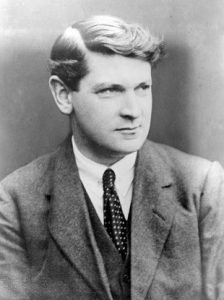
Michael Collins, soldier and politician who was a leading figure in the struggle for, and achievement of Irish independence in the early 20th century, is born near Clonakilty, County Cork, on October 16, 1890.
Michael Collins is born to a successful farmer, Michael John Collins, and Mary Anne O’Brien. When the couple marries, she is twenty-three years old, and he is sixty. The couple have eight children, with Michael being the youngest.
Raised in a beautiful but remote part of southwest Ireland, Collins is educated at local primary schools. At the Lisavair National School, Collins is inspired by his teacher, Denis Lyons, a member of a secret organization, the Irish Republican Brotherhood (IRB), whose aim is to gain Ireland’s independence from Great Britain. Collins is also influenced by the stories of local men who had taken part in the Irish Rebellion of 1798, a conflict that sparks a feud between the Irish Protestants and Catholics. From these stories Collins learns of Irish pride, rebellion, executions, and the general harsh treatment imposed on his country by the British.
In 1906 Collins goes to London to enter the civil service as a postal clerk. For ten years Collins lives in London, where he becomes active in various Irish organizations, including the Gaelic League, a society that promotes the use of the Irish language. Also, during this time, Collins is influenced by the writings of Arthur Griffith, an Irish nationalist who founded the Irish political party Sinn Féin. In 1909 Collins himself becomes a member of the IRB, and later becomes the IRB treasurer for the South of England.
Collins returns to Ireland in 1916 to take part in the Easter Rising, a rebellion against British rule. After the rebellion is crushed, Collins is interned in North Wales along with most of the other rebels from the IRB. When the internees are released in December 1916, he goes to Dublin, where his sharp intelligence and dynamic energy soon secure him a leadership position in the reviving revolutionary movement.
Collins plays the most important role in this struggle. As director of intelligence of the IRA, he cripples the British intelligence system in Ireland and replaces it with an effective Irish network. At the same time, he performs other important military functions, heads the IRB, and, as minister of finance in the Republican government, successfully raises and hands out large sums of money on behalf of the rebel cause. Despite constant efforts, the British are unable to capture Collins or stop his work. The “Big Fellow” becomes an idolized and near-legendary figure in Ireland, and he wins a reputation in Britain and abroad for ruthlessness, resourcefulness, and daring.
After the truce of July 1921, Collins reluctantly agrees to Irish president Éamon de Valera‘s request to serve on the peace-making talks headed by Arthur Griffith. During the autumn negotiations in London, the British government firmly rejects any settlement that involves recognition of the republic. Instead, its representatives offer Dominion status for Ireland with the right of exclusion for loyalistNorthern Ireland. Collins decides to accept these terms, in the belief that rejection would mean renewal of the war and quick defeat for Ireland, and that the proposed treaty will soon lead to unity and complete freedom for his country. Using these arguments, he and Griffith persuade their side to sign the treaty on December 6, 1921, and Dáil Éireann to approve it on January 7, 1922.
De Valera and many Republicans refuse to accept the agreement, however, believing that it means a betrayal of the republic and a continued domination by Britain. As the British evacuate southern Ireland, Collins and Griffith do their best to maintain order and enforce the treaty signed with the British. They find their efforts frustrated by the opposition of an armed Republican minority. Collins seeks desperately to satisfy the forces that oppose the treaty without abandoning the treaty altogether, but he finds it impossible to make a workable compromise.
In late June 1922, after the population had supported the settlement in an election, Collins agrees to use force against the opposition. This action sparks a civil war, a bitter conflict in which the forces of the infant Irish Free State eventually overcome the extreme Republicans in May 1923. However, Collins does not live to see the end of the war. He is killed in an ambush in West Cork on August 22, 1922, just ten days after the death of Arthur Griffith.
Much of Collins’s success as a revolutionary leader is due mainly to his realism and extraordinary efficiency. He also possesses an amazing vision and humanity in his character, however, which appeals to friend and foe alike. The treaty that costs him his life does not end the argument, as he had hoped, but it does make possible the peaceful gaining of full political freedom for most of Ireland.
Sheridan has her early vocal training while at school at the Dominican Convent in Eccles Street, Dublin, with additional lessons from Vincent O’Brien. In 1908, she wins a gold medal at the Feis Ceoil. From 1909 to 1911 she studies at the Royal Academy of Music in London, during which time she is introduced to the Italian inventor Guglielmo Marconi, who is instrumental in arranging further studies for her in opera in Rome.
Sheridan returns to Italy, where her career continues to grow, with performances at the Teatro Dal Verme in Milan and at the Teatro di San Carlo in Naples, primarily in Puccini roles. In 1922 she first sings at La Scala, Milan, in La Wally by Alfredo Catalani under the direction of Arturo Toscanini. For the next few years, she sings at La Scala with great success. Perhaps her greatest role is Madama Butterfly, which she sings extensively in Italy and at Covent Garden. When she plays the part of Madama Butterfly, Puccini is said to be spellbound.
Despite her successes, Sheridan’s career is short. Suffering vocal difficulties, she goes into retirement around 1930 except for a few concerts. Bríd Mahon, in her 1998 book While Green Grass Grows, states that “It was rumoured that an Italian whose overtures she had rejected had blown his brains out in a box in La Scala, Milan, while she was on stage and that after the tragedy, she never sang in public again.”
Margaret Sheridan dies in relative obscurity on April 16, 1958, having lived in Dublin for many years, and her remains are buried in Glasnevin Cemetery, Dublin.
Davis is the son of a Welsh father, a surgeon in the Royal Artillery, and an Irish mother. Through his mother he is descended from the Gaelic noble family of O’Sullivan Beare. His father dies one month after his birth and his mother moves to Warrington Place near Mount Street bridge in Dublin. In 1830, they move to 67 Lower Baggot Street. He attends school in Lower Mount Street before studying at Trinity College, Dublin. He graduates in Law and receives an arts degree in 1836, before being called to the Irish Bar in 1838.
Davis gives a voice to the 19th-century foundational culture of modern Irish nationalism. Formerly it is based on the republicans of the 1790s and on the Catholic emancipation movement of Daniel O’Connell in the 1820s-30s, which has little in common with each other except for independence from Britain. Davis aims to create a common and more inclusive base for the future. He establishes The Nation newspaper with Charles Gavan Duffy and John Blake Dillon.
He writes some stirring nationalistic ballads, originally contributed to The Nation and afterwards republished as Spirit of the Nation, as well as a memoir of Curran, the Irish lawyer and orator, prefixed to an edition of his speeches, and a history of King James II‘s parliament of 1689. He has formed many literary plans which are unfinished at the time of his early death.
Davis supports O’Connell’s Repeal Association from 1840, hoping to recreate the old Parliament of Ireland. They split during a debate on the proposed new Queen’s University of Ireland, when Davis is reduced to tears by O’Connell’s superior debating skill. Davis is in favour of a university that would inclusively educate all Irish students. O’Connell and the Catholic hierarchy prefer a separate system for Catholic students within Ireland that would remain under church control.
O’Connell generally refers to his inexperienced allies as “Young Ireland,” initially as a dismissive term, that from the 1870s becomes the accepted term for nationalists inspired by Davis. He also prefers a federal arrangement with Britain in the 1840s while Davis seeks a greater degree of autonomy. Both agree that a gradual and non-violent process is the best way forward. Despite their differences, O’Connell is distraught at Davis’s early death.
Davis is a Protestant but preaches unity between Catholics and Protestants. To him, it is not blood that makes a person Irish, but the willingness to be part of the Irish nation. He is to the fore of Irish nationalist thinking and it has been noted by later nationalist notables, such as Patrick Pearse, that while Theobald Wolfe Tone laid out the basic premise that Ireland as a nation must be free, Davis is the one who built this idea up promoting the Irish identity.
Hoban is an Irish Catholic raised on an estate belonging to the Earl of Desart in Cuffesgrange, near Callan, County Kilkenny. He works there as a wheelwright and carpenter until his early twenties, when he is given an “advanced student” place in the Dublin Society‘s Drawing School on Lower Grafton Street. He studies under Thomas Ivory. He excels in his studies and receives the prestigious Duke of Leinster‘s medal from the Dublin Society for drawings of “Brackets, Stairs, and Roofs” in 1780. Later, Hoban finds a position as an apprentice to Ivory, from 1779 to 1785.
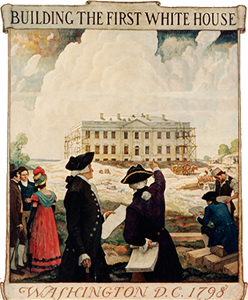
Hoban is in South Carolina by April 1787, where he designs numerous buildings including the Charleston County Courthouse. President George Washington admires Hoban’s work on his Southern Tour and summons the architect to Philadelphia, the temporary national capital, in June 1792.
In July 1792, Hoban is named winner of the design competition for the White House. His initial design seems to have had a 3-story facade, nine bays across, much like the Charleston courthouse. Under Washington’s influence, Hoban amends this to a 2-story facade, eleven bays across, and, at Washington’s insistence, the whole presidential mansion is faced with stone. It is unclear whether any of Hoban’s surviving drawings are actually from the competition.
In 1800, President John Adams becomes the first president to reside in the executive mansion, which soon becomes known as the “White House” because its white-gray Virginiafreestone contrasts strikingly with the red brick of nearby buildings.
Patrick Magee stays in the hotel under the pseudonym Roy Walsh during the weekend of September 14-17, 1984. During his stay, he plants the bomb under the bath in his room, number 629. The device, described as a “small bomb by IRA standards,” is fitted with a long-delay timer made from videocassette recorder components and a Memo Park Timer safety device. The device may have avoided detection by sniffer dogs due to it being wrapped in cling film to mask the smell of the explosive.
The bomb detonates at approximately 2:54 AM (BST) on October 12. The midsection of the building collapses into the basement, leaving a gaping hole in the hotel’s facade. Firemen say that many lives are likely saved because the well-built Victorian hotel remained standing. Margaret Thatcher is still awake at the time, working on her conference speech for the next day in her suite. The blast badly damages her bathroom but leaves her sitting room and bedroom unscathed. Both she and her husband escape injury. She changes her clothes and is led out through the wreckage along with her husband and her friend and aide Cynthia Crawford and driven to Brighton police station.
At about 4:00 AM, as Thatcher leaves the police station, she gives an impromptu interview to the BBC‘s John Cole, saying that the conference would go on as scheduled. Alistair McAlpine persuades Marks & Spencer to open early at 8:00 AM so those who have lost their clothes in the bombing can purchase replacements. Thatcher goes from the conference to visit the injured at the Royal Sussex County Hospital.
Five people are killed, none of whom are government ministers. But a Conservative MP, Sir Anthony Berry, is killed, along with Eric Taylor, North-West Area Chairman of the Conservative Party, Lady Jeanne Shattock, wife of Sir Gordon Shattock, Western Area Chairman of the Conservative Party, Lady Muriel Maclean, wife of Sir Donald Maclean, President of the Scottish Conservatives, and Roberta Wakeham, wife of Parliamentary Treasury Secretary John Wakeham. Donald and Muriel Maclean are in the room in which the bomb explodes, but Mr. Maclean survives.
Several more, including Walter Clegg, whose bedroom is directly above the blast, and Margaret Tebbit, the wife of Norman Tebbit, who is then President of the Board of Trade, are left permanently disabled. Thirty-four people are taken to the hospital and recover from their injuries. When hospital staff asks Norman Tebbit, who is less seriously injured than his wife, whether he is allergic to anything, he is said to answer “bombs.”





 seamus dubhghaill